Introduction
Cold exposure can be fatal for an injured person, who is often immobile, and whose body is thus not able to sufficiently produce metabolic heat.Reference Gentilello 1 Circulatory and respiratory demands may increase, and as body core temperature declines, the casualty's condition may deteriorate.Reference Tisherman 2
Previous studies of casualty coverings, thermal responses, and experiences in cold environments have been conducted for prehospital aeromedical,Reference Schmelz, Bridges and Wallace 3 ground,Reference Alex, Karlsson and Saverman 4 , Reference Watts, Roche and Tricarico 5 and mountain rescue.Reference Grant, Dowsett and Hutchison 6 , Reference Light, Dingwall and Norman 7 Maritime conditions, which are often cold, wet, and windy, demand a sustained prehospital effort to prevent body cooling and hypothermia. They also set requirements for the protective properties and functionality of prehospital coverings during boat transportation. Therefore, protective clothing, weather conditions, the level of injury, and the time used for transportation should be taken into account in maritime conditions.Reference Færevik 8 A protective covering is required to provide sufficient thermal insulation, as well as protection against wind, humidity, and water splashes, and to ensure functionality in prehospital boat transportation. Information based on research into prehospital coverings in cold maritime conditions is lacking in the literature.
Thermal insulation defines resistance to dry heat loss by radiation, conduction, and convection and is mostly related to the ensembles’ ability to retain air. It has been shown previously that the thermal insulation of casualty coverings, such as blankets and rescue bags, correlates with the thickness of the ensemble under low wind conditions.Reference Henriksson, Lundgren and Kuklane 9 A 2-layer construction of a casualty covering is thought to provide higher thermal insulation and to better restrict air movements in the bag than a 1-layer covering.Reference Grant, Dowsett and Hutchison 6 Correspondingly, it is suggested that the combination of a vapor-tight layer and dry, insulating layer is the most effective covering system for preventing hypothermia in a moderate wind and with wet clothing. This combination was shown to increase skin temperatures the most, to lower metabolic rate, and to provide good thermal comfort after covering a precooled person wearing wet clothing.Reference Thomassen, Færevik and Østerås 10
In maritime conditions, convective heat loss due to high wind speed has a great influence on the thermal insulation of coverings during boat transportation. Wind can multiply heat loss by convection from the bodyReference Holmér, Nilsson and Anttonen 11 and increase the risk of frostbite and hypothermia. According to Henriksson et al, the insulation capacity of blankets and rescue bags at high wind speeds is best preserved by ensembles that are windproof and resistant to the compressive effect of the wind.Reference Henriksson, Lundgren and Kuklane 9
During maritime prehospital transportation, casualties may be exposed to splashes and rain. Clothing may also be wet from water or body fluids. It has been shown that moisture reduces clothing insulation and that a dramatic increase in cooling efficiency occurs when moisture is absorbed from the skin before it evaporates.Reference Chen, Fan and Zhang 12 – Reference Meinander and Hellsten 14 Moisture in textile materials decreases their ability to retain air, and a considerable increase in evaporative heat loss from the body occurs.Reference Meinander and Hellsten 14 Moreover, it has been shown that effective water-vapor resistance increases greatly as outside temperature decreases.Reference Meinander and Hellsten 14 , Reference Rossi, Gross and May 15
Practical prehospital guidance for cold conditions often recommends that wet clothing should be removed, if possible,Reference Silfvast, Castrén and Kurola 16 or some recommendations advise adding a waterproof material layer in order to reduce evaporative heat loss. 17 It is proposed that both the removal of wet clothing and adding a vapour barrier substantially decreases evaporative heat loss from a casualty.Reference Henriksson, Lundgren and Kuklane 18 Other previous studies have focused in more detail on the effects of evaporative resistance and heat loss in, for example, sleeping bags. It is claimed that using an impermeable, nondetachable cover around a sleeping bag at subzero temperatures can lead to excessive moisture accumulation.Reference Havenith 19 , Reference Havenith, den Hartog and Heus 20 The use of a semi-permeable membrane in sleeping bags is beneficial in terms of reduced moisture accumulation.
The aim of this study was to determine the thermal protective properties of different types of casualty coverings and to evaluate which would be adequate for use under difficult maritime conditions. The study also aimed to evaluate the need of thermal protection of a casualty and to verify the optimum covering system for prehospital maritime transportation.
Methods and Materials
Study Design
The study consisted of two parts: (1) the evaluation and comparison of different protective covering systems in different ambient conditions; and (2) the verification of the protective system for maritime casualty transportation. The first part was carried out using a thermal manikin in the climatic chamber, whereas the second part was performed during authentic maritime evacuation and transportation training at the Gulf of Finland.
Evaluation and Comparison of Protective Coverings
Covering Systems
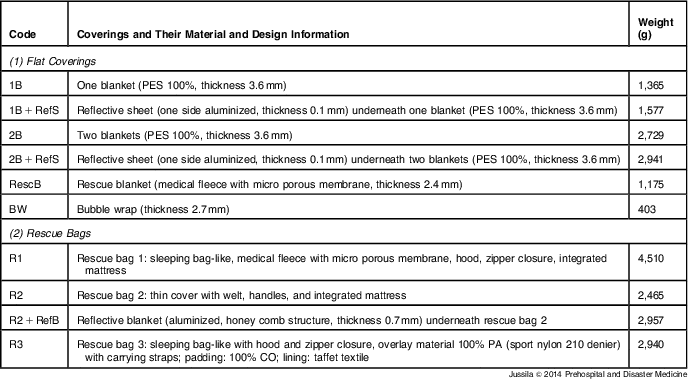
Ten different covering systems were divided into two categories: (1) flat coverings, such as blankets, reflective sheets, and bubble wrap; and (2) rescue bags, such as coverings similar to sleeping bags. The covering systems and their weights are shown in Table 1. The thermal manikin was dressed in a long-sleeved shirt and long-legged underpants (polyester (PES) 50%, cotton (CO) 33%, modacrylic (MAC) 17%), and calf-length socks.
Measured Casualty Covering Systems and Their Weight

Abbreviations: PES, polyester; PA, polyamide; CO, cotton.
Measuring Thermal Insulation
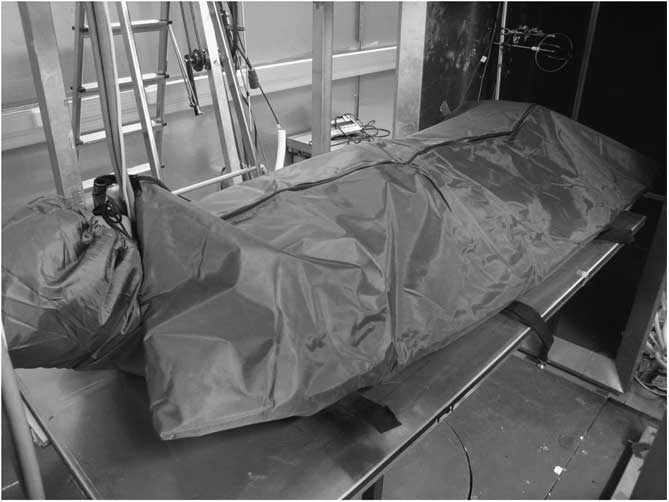
The thermal insulation of the different coverings was measured in a climate chamber (length 10.3 m×width 4.4 m×height 3.3 m) using an aluminum thermal manikin (Finnish Institute of Occupational Health, Helsinki, Finland) consisting of twenty segments (Figure 1). The thermal manikin was the size of an average male with a height of 176 cm and 1.89 m2 body surface area. Surface temperature was set to 34.0°C (SD = 0.1°C).
Measuring Thermal Insulation of Protective Coverings Using Supine Thermal Manikin on Metal Sheet

The measurement setup was based on the European standard for sleeping bags. 21 The thermal manikin was in a supine position on a profiled steel plate (170 cm × 95 cm × 0.2 cm) simulating cold ground. The steel plate was on a plywood board (200 cm ×80 cm × 1.2 cm) supported 73 cm above the ground to allow air circulation.
The air temperature in the climatic chamber (SattGraph 5000, ABB, Sweden) was adjusted to -5°C, and two different wind speeds were selected, 0.3 m/s and 4.0 m/s. The higher wind speed was used only for measurements with dry ensembles. The wind conditions were provided by two fans (VN100-10-4-1850, DLK Ventilatoren, Schöntal-Berlichingen, Germany) with 100 cm wing diameter and independently adjustable frequency converters (SAMI GS, ABB, Sweden) placed one on the other. The thermal manikin's legs were facing towards a wind tunnel (6.7 m × 1.0 m ×2.0 m). To the front of the wind tunnel, three ambient air temperature sensors (YSI-405,±0.1°C, Yellow Springs Instrument Co, Inc, Ohio USA) and three wind speed sensors (TSI-8465-300,±0.5%, TSI Incorporated, Minnesota USA) were positioned at different heights from the ground: 0.2 m, 1.1 m, and 1.7 m. The ambient temperature and wind speed were measured and recorded (VEEPro, version 6.1, Agilent Technologies, California USA).
The effect of moisture, such as wet clothing, inside the covering was simulated by spraying 300 g of water evenly on the long-sleeved shirt and long-legged underpants before measurement started. In the other measurement, external moisture, such as rain and splashes, was simulated by sprinkling 2,300 g of water on the upper surface of the covered thermal manikin. This corresponded with rainfall of 2 mm. The ambient temperature was set to -5 °C and wind speed to 0.3 m/s. The effect of the moisture on thermal insulation was monitored for four hours and measured using the ensembles presented in Table 1, excluding rescue bag 2.
The standard thermal insulation of the coverings was calculated using Formulas 1, 2, and 3, 21
 $$\hskip-4pc(1)\ \ \ \ \ \ \ \ \ \ \ \ \ \it {{R}_c} = \mathop{\sum}\limits_{i = \rm 1}^n {{{f}\!\!__i}} \times {{R}_{ci}}\eqno\rm$$
 $$\hskip-7.5pc(2)\ \ \ \ \ \ \ \ \ \ \ \ \ \it {{f}\!\!__i} = \frac{{{{a}_i}}}{A}\eqno\rm$$
 $$\hskip-4.6pc(3)\ \ \ \ \ \ \ \ \ \ \ \ \ \it{{R}_{ci}} = \frac{{{{T}_{\!\!ski}} - {{T}_{\!\!a}}}}{{{{H}_{\!ci}}}}\eqno\rm$$
where Rc is the standard thermal insulation (m2K/W), fi is the surface area factor of each segment, n is the number of independent segments, Rci is the local thermal insulation of the segment (m2K/W), ai is the surface area of the segment (m2), A is the total surface area of the manikin (m2), Tski is the temperature of the segment ( °C), Ta is the air temperature ( °C), and Hci is the dry heat loss of the segment (W).
Verification of Protective Covering for Maritime Transportation
Protective Coverings
One of the measured coverings was selected as an optimum covering for casualty transportation in authentic maritime conditions, on the basis of its thermal insulation, protection against wind, moisture handling properties, and functionality based on laboratory measurements. Layered winter clothing (LWC) with rain clothing (0.53 m2K/W) was used as control clothing (CC). Protective covering was evaluated together with LWC and compared with CC. Layered winter clothing consisted of a T-shirt, long-legged underpants, a turtleneck shirt, a woollen sweater, middle pants, a combat jacket and trousers, and a cold-weather padded jacket and trousers. Feet were covered with liner socks, felt linings, and winter rubber boots. Hands were protected with leather gloves, the head with a woollen hat, and the face in two measurements with a balaclava (PES 100%) and the rest without. All subjects had to wear a life vest on top of LWC or CC.
Experimental Procedure Test Subjects
Four healthy males volunteered to participate in the field measurements. The subjects were informed of the experimental protocol, and they gave their written consent to participate in the study. The experimental protocol of the study was conducted in accordance with the provisions of the Declaration of Helsinki, which describes international standards for human subject research, and the measurements were supervised by Kai Parkkola, MD, Surgeon General of the Finnish Navy.
The test subjects were between 18 and 20 years of age, and their average weight was 74.1 kg (SD = 4.8 kg). Each subject tested both ensembles in random order during the maritime transportation.
Experimental Procedure Measurements
The core temperatures of the test subjects were measured using a telemetric thermo capsule (Jonah Temperature Capsule, Respironics Inc, Murrysville, Pennsylvania USA). The data were saved at 1-minute intervals by data loggers (VitalSense Monitor IP52, Mini Mitter Company Inc, A Respironics Inc. Company, Bend, Oregon USA). Skin temperatures were measured at ten sites (cheek, chest, upper back, upper arm, hand, finger, thigh, calf, foot, and toe) by thermistors (NTC DC95 Type 2252 OHM, Digi-Key, Thief River Falls, Minnesota USA). The thermistors were fixed onto the skin by flexible tape (Fixomull Stretch, BSN Medical GmbH & Co, Hamburg, Germany). These data were also saved at 1-minute intervals by data loggers (SmartReader Plus 8, ACR Systems, Surrey, British Columbia, Canada). Weighted mean skin temperature was calculated according to the ISO 9886 standard. 22 Relative humidity and the temperature between the lower and middle layers were measured using a sensor (OM-CP-Microtemp, Omega, Laval, Quebec, Canada). Thermal sensations were elicited according to the ISO 10551 standard. 23
Air temperature was measured throughout the test by placing portable weather data loggers (iButton, DS 1921G-F50, ±1 °C, Thermochron iButton Device, Maxim Integrated Products, Inc, California USA) outside the boat cabin; these data loggers took readings every ten minutes. The wind speed was measured by a rotating vane anemometer (4.3405.20, ±2%, Thies Clima, Göttingen, Germany) and the speed of the boat was also recorded.
Protocol of Prehospital Transportation Measurements
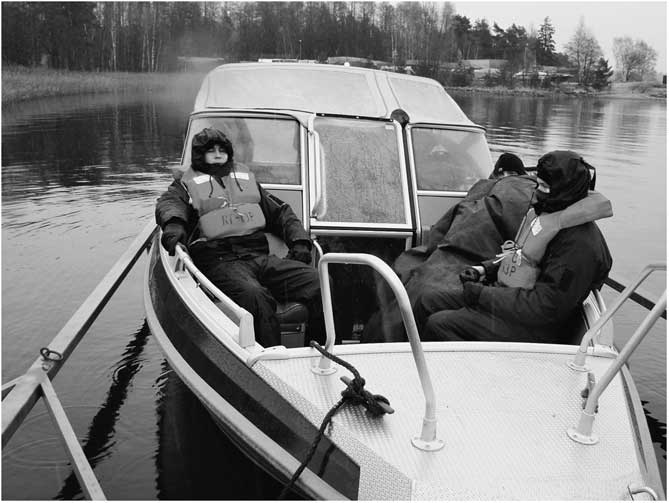
The prehospital transportation exercise was carried out in November at sea in the Gulf of Finland. Those acting as walking casualties were transported by a partially covered motor boat for eight persons (Buster Magnum, Inhan Tehtaat Oy Ab, Ähtäri, Finland). The boat had been specially modified for maritime casualty evacuation in the offshore archipelago. The boat was 6.7 m×2.4 m and the recommended engine size was 225 hp. The boat had three places outside the cabin for seated casualties as presented in Figure 2.
Placement of Sitting Casualties Outside the Boat Cabin

Before the boat transportation, the subjects were precooled for approximately 20 minutes on a pier wearing LWC or CC. The boat transportation started from the pier when the casualties were on the boat and dressed in the protective covering. Duration of transportation was 30 minutes, which is typical boat transportation time in the archipelago. Measurements ended after transportation when the boat arrived back at the pier.
Results
Evaluation and Comparison of Protective Coverings: Thermal Insulation
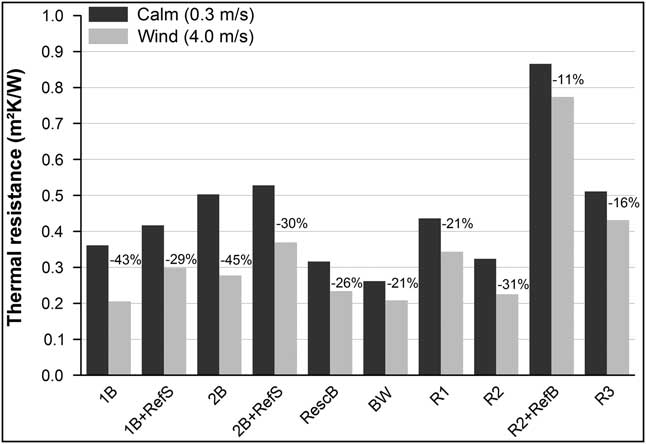
The standard thermal insulation of the measured ensembles varied from 0.26 to 0.87 m2K/W (1.7-5.6 clo) in calm (0.3 m/s) conditions (Figure 3). A wind speed of 4 m/s increased heat convection from the coverings and thus decreased standard thermal insulation on average by 27% (SD = 11%). The thin, windproof, reflective sheet inside one or two blankets (1B + RefS and 2B + RefS) provided 33%-45% higher thermal insulation in the wind than the blankets alone (1B and 2B). The thick windproof reflective blanket with a honeycomb structure over rescue bag 2 (R2 + RefB) raised total thermal insulation in the wind by approximately 243% compared to that of the thin rescue bag 2 (R2) alone.
Thermal Insulation of Different Coverings in Wind Speeds of 0.3 m/s and 4 m/s and Percent Decrease of Thermal Insulation Due to Wind

The local thermal insulation of the chest and back differed in calm conditions. Conductive cooling was stronger on the back due to the simulated cold ground (metal sheet) and compressed insulating covering fabrics. The rescue bags with the integrated mattress (R1 and R2) had exceptionally higher thermal insulation on the back than on the chest. However, only minor differences were found between the thermal insulation of the torso and legs in the studied ensembles.
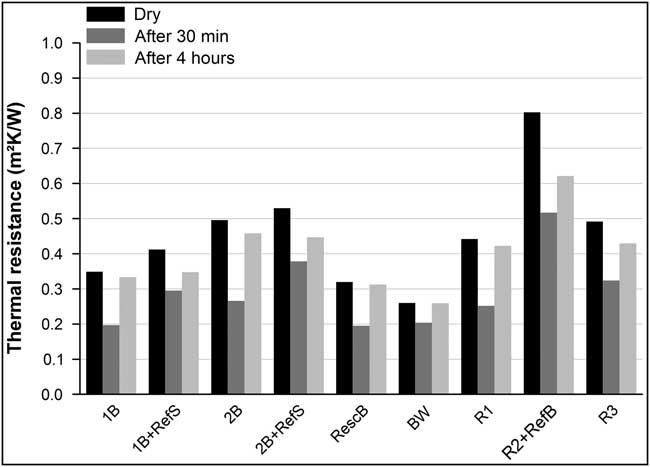
The effect of wet clothing (300 g sprayed water) inside the coverings was seen in reduced standard thermal insulation, due to moisture transfer from clothing to the coverings 30 minutes after the water was sprayed (Figure 4). After this, drying occurred due to moisture evaporation. The added moisture resulted in a smaller decrease in standard thermal insulation when the reflective sheet was used underneath one or two blankets (1B + RefS and 2B + RefS). The standard thermal insulation of one and two blankets (1B and 2B) declined by 45% on average after 30 minutes. However, the decrease of standard thermal insulation was, on average, 29% with the reflective sheet inside the blankets (1B + RefS and 2B + RefS), and approximately 22% with the vapor-tight bubble wrap. The effect of moisture inside the rescue bags (R1, R2 + RefB and R3) decreased by 34%-43%, 30 minutes after the test had begun.
Thermal Insulation of Coverings When Dry, 30 Minutes After, and 4 Hours After Spraying 300 g Water on Clothing Inside the Ensembles (Air Temperature = -5°C)

Four hours after the test began, over 90% of the sprayed water from the clothing had evaporated through one open-structured blanket (1B) and medical fleece with micro porous membrane (RescB), approximately 82%-85% through two blankets (2B) and medical fleece rescue bag with micro porous membrane (R1), and approximately 69% when a reflective sheet was used underneath the blankets (1B + RefS, 2B + RefS). In contrast, 31%-39% of the moisture had evaporated through the thin rescue bag inside the honeycomb structured reflective blanket (R2 + RefB) and the rescue bag with padding (R3) after measurements, and 51% through the vapor-tight bubble wrap.
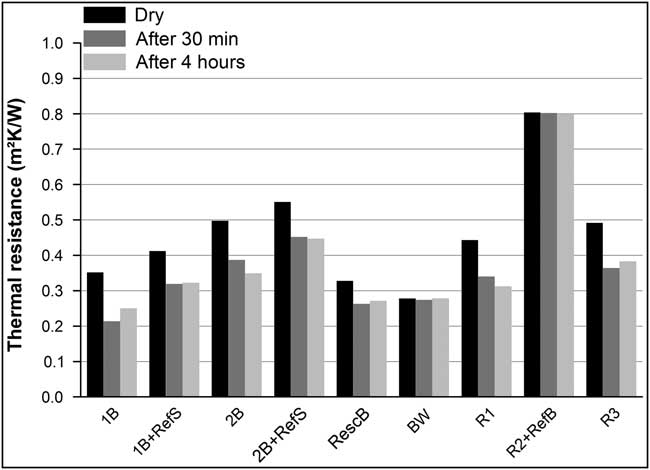
The effect of external moisture was simulated by sprinkling water (2,300 g) on the surface of the coverings. The amount of unabsorbed water drippage just after sprinkling varied from 606 g to 1,901 g, depending on the moisture absorbency of the covering materials. Figure 5 shows that the effect of external water on the standard thermal insulation of the coverings was not as strong 30 minutes after sprinkling as that of the moisture inside the coverings (Figure 4). The thin rescue bag 2 inside the thick reflective blanket (R2 + RefB) and the water-tight bubble wrap absorbed the least water and thermal insulation remained at the same level during the 4-hour measurement. The standard thermal insulation of the other coverings decreased by 18%-39%, 30 minutes after sprinkling the water. After this, standard thermal insulation remained almost the same until the end of the measurement (four hours) and drying of the coverings did not occur.
Thermal Insulation of Coverings When Dry, 30 Minutes After, and 4 Hours After Sprinkling 2,300 g of Water on Surface of Ensembles (Air Temperature = -5°C)

Verification of Protective Covering for Maritime Transportation
Rescue bag 3 was the most optimum for casualty protection during prehospital transportation measurements in authentic maritime conditions on the basis of the comparative measurements performed in the laboratory. Its thermal insulation, protection against the wind, and functionality for prehospital boat transportation were the most suitable for these specific maritime conditions. The water-resistant rescue bag 3 consisting of padding was used on top of the LWC (LWC + R3).
Ambient Conditions
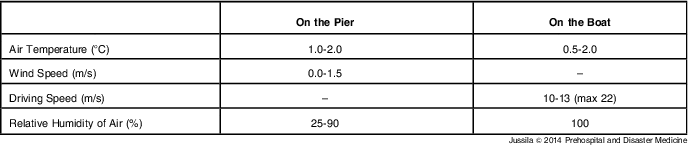
The ambient conditions were cloudy and occasionally rainy during the measurements. The measured ambient conditions are presented in Table 2.
Ambient Conditions During Boat Transportation Measurements

Temperature and Humidity Inside Protective Coverings
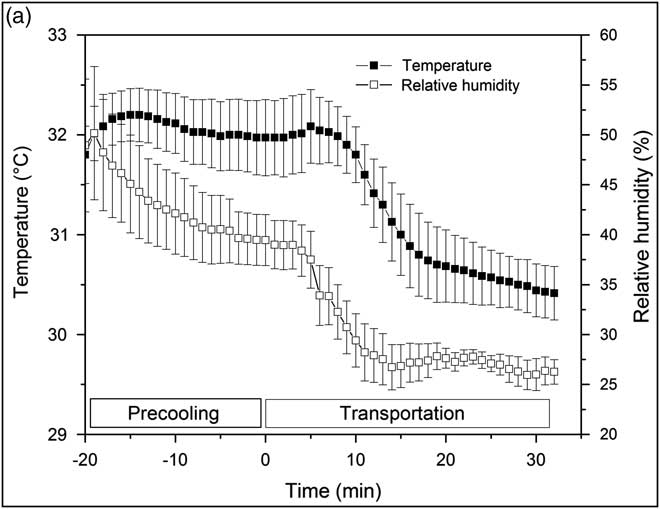
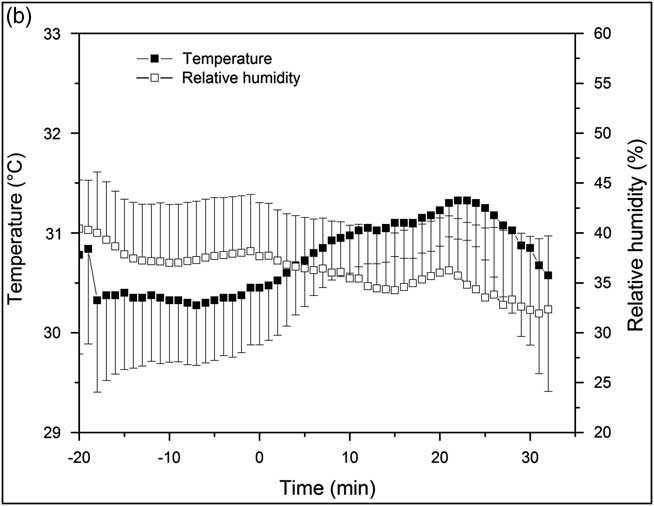
The subjects (n = 4) wore CC or LWC during the precooling period on the pier (20 minutes). Control clothing included the rain clothing, whereas R3 was layered over LWC just before transportation began. The relative humidity between the lower and middle clothing layers remained dry (<50%) in both tested ensembles (Figures 6A and 6B). The temperature and relative humidity between the clothing layers declined during transportation when CC alone was used (Figure 6A), whereas relative humidity remained relatively constant during the measurement when LWC + R3 was used (Figure 6B). The temperature between the clothing layers increased slightly after R3 was added on top of LWC, and declined to the same level at the end of the transportation. At the end of the measurement, the temperature between the clothing layers was the same in both ensembles (30.5 °C).
Mean Temperature and Relative Humidity Between Lower and Middle Layers with CC During Precooling and With LWC + R3 During Transportation Abbreviations: CC, control clothing; LWC, layered winter clothing; R3, rescue bag 3.

Mean Temperature and Relative Humidity Between Lower and Middle Layers With LWC During Precooling and With LWC + R3 During Transportation Abbreviations: CC, control clothing; LWC, layered winter clothing; R3, rescue bag 3.

Physiological Measurements
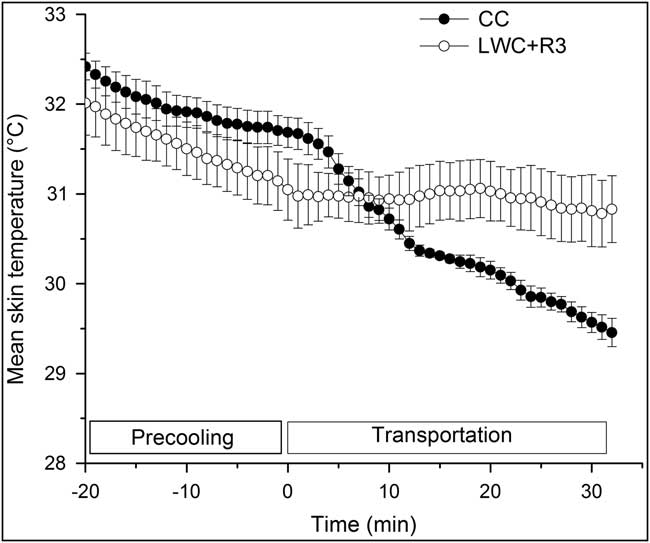
Skin temperature decreased during approximately 30 minutes of maritime transportation by an average of 3 °C with CC, and 0.5 °C with LWC + R3 (Figure 7). General thermal sensation, before and after boat transportation, was “slightly cool.” Core temperature increased during the precooling period on the pier, but at the end of the transportation, returned to the initial level with LWC + R3, and to slightly below the initial level with CC. Core temperature was 37.2 °C and 37.3 °C for LWC and CC, respectively, after the precooling period. After transportation, core temperature declined by 0.1 °C with LWC + R3 and CC.
Mean Skin Temperature During Precooling With CC and LWC, and During Transportation With CC and LWC + R3 Abbreviations: CC, control clothing; LWC, layered winter clothing; R3, rescue bag 3.

At the end of transportation with CC, finger temperatures averaged 15 °C, the coldest temperature being 10 °C. Layered winter clothing +R3 maintained 6 °C higher finger temperatures at the end of the boat transportation than CC. Thermal sensations of the hands were “cold” with CC and “slightly cool” with LWC + R3 during transportation. Toe skin temperatures averaged 25 °C after the boat transportation, with both CC and LWC + R3. Similarly, thermal sensation on toes varied from “neutral” to “cold.”
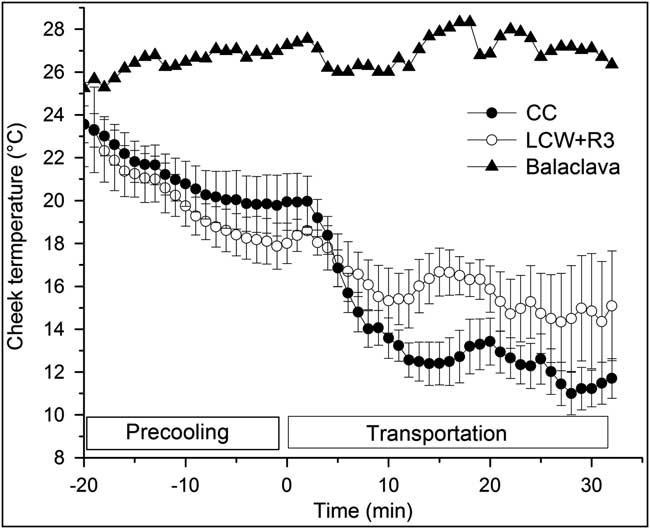
Cheek skin temperatures decreased below 15 °C and 12 °C with LWC + R3 and CC, respectively, when uncovered (Figure 8) because of the high air movement due to driving speed. Therefore, face protection by a balaclava was tested (n = 2): cheek skin temperatures remained constant, around 26 °C, during the measurement (Figure 8). Thermal sensations on the unprotected face were “cool” or “cold” during transportation, whereas sensations were “neutral” or “slightly cool” with the balaclava.
Mean Cheek Temperature During Precooling With CC and LWC, and During Transportation With CC (n = 2), LWC + R3 (n = 4), and CC + Balaclava (n = 2) Abbreviations: CC, control clothing; LWC, layered winter clothing; R3, rescue bag 3.

Discussion
During maritime prehospital transportation, it is essential to provide injured persons with thermal, wind, and moisture protection. When sitting, the subject is located outside the motor boat cabin, and is exposed to cold temperatures, high wind speeds, and water splashes. This study concentrated on the evaluation of different types of casualty coverings and on finding an optimum protective solution for injured persons exposed to maritime conditions while being transported by boat.
Evaluation and Comparison of Protective Coverings
Persons seated on an uncovered boat are exposed to high wind speeds. It has been shown that a moderate wind speed (3 m/s) decreases the thermal insulation of low insulation covers by 20% to 40%, and that of high insulation covers by 15% to 25%.Reference Henriksson, Lundgren and Kuklane 9 It has been shown that high wind speeds (12 m/s to 18 m/s) will decrease the thermal insulation of highly impermeable clothing ensembles by 30% to 40%. The decrease of the thermal insulation in wind is caused mostly because of boundary layer breakdown and compression effects.Reference Holmér, Nilsson and Anttonen 11 The results of the present study show that in windy conditions (4 m/s), thermal insulation of the windproof rescue bags decreased on average by approximately 20%. The thermal insulation of traditional blankets with lightweight and open fabric structures was reduced on average by 44%. Whereas when an additional reflective sheet was under the blankets, the decrease was on average 29%.
A recent study evaluated the thermal protection of bubble wrap and showed that it provided thermal insulation of 0.27 m2K/W.Reference Vangberg, Brennested and Krüger 24 The result obtained in this study was similar to previous results. On the basis of the standard for sleeping bags, 21 the bubble wrap measured in this study provided only an adequate period of protection in ambient temperatures above 18 °C. The results of this study also show that bubble wrap maintains its thermal protective properties well in the wind and prevents evaporative heat loss. Both wind and internal moisture decreased the thermal insulation of bubble wrap by approximately 22%, and decreased that of the insulation of both one and two blankets by 45%, on average. These results correspond with the literature.Reference Henriksson, Lundgren and Kuklane 9
Wet garments inside the coverings increased evaporative heat transfer from the skin. Therefore, the dry thermal resistance of the coverings declined. The ability of wet coverings to retain air is less and thus, thermal resistance decreased. Moisture may occur from an external source, such as rain, snow, and splashes, or from wet garments or bleeding. It has been shown that an evaporative barrier in prehospital covering prevents moisture from transferring to the outer layers of the coverings and thus reduces insulation capacity.Reference Thomassen, Færevik and Østerås 10 In this study, the effect of moisture inside the covering was examined by spraying the inner layer with 300 g of water. The blankets (1B and 2B) had an open fabric structure and therefore water vapor permeability was expected to be high. Thirty minutes after spraying, more water was absorbed from the clothing to the blankets, and further to the ambient air, than to coverings with vapor-tight material, such as reflective sheets or bubble wrap. Similarly, the decrease in thermal insulation was higher when blankets were used than when vapour-tight materials were added.
The influence of external moisture was evaluated by sprinkling 2,300 g water on the surface of the coverings. The water drippage from the coverings varied depending on the material construction and the properties, such as water resistance, of the different coverings. The blankets, being the outermost covering, absorbed more water than the bubble wrap, the water-resistant rescue bag with padding (R3), and the rescue blanket with micro porous membrane (RescB). This implies that bubble wrap, rescue bag 3, and a rescue blanket provide higher protection against splashes and moisture in maritime conditions. However, only minor moisture evaporation from the coverings was seen, even during a 4-hour measurement in cold ambient temperature (-5 °C). Thus, total thermal insulation remained at approximately the same level after four hours as after 30 minutes.
If a covering provides sufficient protection against cold, wind, and moisture, it is able to maintain the thermal balance of casualties in cold conditions during prehospital transportation from the accident site to a warm place. When these results were compared with the duration limited exposure (DLE) index based on standard EN ISO 11079, 25 it was seen that covering with an insulation value higher than 0.46 m2K/W (2.94 clo) can provide sufficient protection for an immobile healthy person (58 W/m2) for half an hour in -5 °C with high wind speed (10 m/s). In these ambient conditions, and for this exposure time, the thin rescue bag inside the honeycomb structured reflective blanket (R2 + RefB) and the water-resistant rescue bag 3 consisting of padding (R3) fulfilled the required protection due to their cold- and wind-protective properties.
Verification of Protective Covering for Maritime Transportation
Ambient conditions, such as cold, high wind speed, and water splashes, were simultaneously present in the authentic field measurements. Due to practical and financial reasons, it was only possible to test one covering ensemble and CC in these field conditions. Results from earlier studies have shown that the thermal insulation values of dry and moist clothing, defined using a thermal manikin, correspond well with wear trial values at moderate temperatures of 0 °C and -10 °C, and that the reproducibility of the test is good.Reference Meinander and Hellsten 14 , Reference Anttonen 26 - Reference Meinander, Anttonen and Bartels 28 The results of the laboratory measurements were used to estimate the DLE in the expected ambient conditions during prehospital transportation. Based on the obtained results and functional properties, such as zipper closure and protective hood, rescue bag 3 (R3) was selected as the optimum covering for sitting casualties on an uncovered part of a boat.
During prehospital transportation in the uncovered part of the boat, wind speed was approximately 20 knots to 25 knots (10 m/s to13 m/s). In this situation, heat loss from the body to the ambient air increases.Reference Havenith and Nilsson 29 In the present study, the temperature and relative humidity between the under and middle layers of the CC decreased rapidly after transportation began, due to the speed of the boat. This indicates that cold air got under CC through sleeve cuffs, legs, and the jacket hem, and thus conveyed warm air and moisture from the clothing. The rescue bag prevented air movement under the clothing through the jacket hem, cuffs, and legs. Thus, the temperature between the lower and middle layers in the rescue bag was 1 °C warmer for about 25 minutes of the transportation than without it. However, at the end of the transportation, the temperature between the clothing layers was approximately the same in both ensembles.
Thomassen et alReference Thomassen, Færevik and Østerås 10 have studied the warming effect of three different prehospital wrapping systems on humans. There were significant differences between the systems in skin temperature, metabolic heat production, and thermal sensations, but not in rectal temperature.Reference Thomassen, Færevik and Østerås 10 This study showed that rescue bag 3 on top of LWC provided sufficient protection in the studied conditions (air temperature approximately 1 °C). Core temperature remained on average between 37.1 °C and 37.4 °C in both tested ensembles, which is within Lotens’ “comfort” limits.Reference Lotens 30 Skin temperature decreased by only 0.5 °C, which was approximately 31 °C during maritime transportation, whereas skin temperature while wearing CC declined by 3 °C, making it approximately 29 °C at the end of the measurement. It has been determined that the discomfort limit for the skin temperature of a healthy person is 31 °C and the tolerance limit is 25 °C.Reference Lotens 30
Wind and water caused strong cooling of unprotected skin. The rescue bag protected fingers and toes from cooling while the face was uncovered. Previous studies have found that cold wind on the face decrease the heart rateReference Hayward, Holmes and Gooden 31 and systolic and diastolic blood pressure.Reference Gavhed, Mäkinen and Holmér 32 In addition, it was found that cold wind on the face decreased blood circulation in the forearm by up to 22%.Reference Hayward, Holmes and Gooden 31 Due to vasoconstriction in the present study, cheek temperature averaged below 15 °C and the thermal sensation was “cold.” The use of an additional balaclava prevented cheek cooling, resulting in a 10 °C to 15 °C warmer temperature than without any cover. Hence, uncomfortable cold sensations and the possible occurrence of cold pain were avoided.
In this study, the subjects were healthy males. The tested protective solution provided sufficient protection against harmful cooling during transportation. It can be expected that cooling is more serious for an injured person than a healthy person. For example, hypovolemia accelerates the cooling of the body, especially of the extremities, due to impaired coagulation enzyme activity.Reference Patt, McCroskey and Moore 33
Limitations and Future Research
The detailed laboratory tests were performed with 10 different prehospital coverings using the thermal manikin. It was not possible to cut the coverings for samples on the hot-plate tests, and therefore, water-vapor resistance was not able to be measured. Due to practical and financial reasons, it was only possible to validate the results of the one selected covering during authentic maritime boat transportation with four test subjects. The number of test subjects was set due to practical limitations of the training.
The tested rescue bag (R3) protected subjects against wind and water splashes by air- and water-tight material, and prevented air movement through sleeve cuffs, legs, and hems. However, putting the rescue bag on in the boat can be difficult due to injury and boat movement. Therefore, product development of cold protective coverings for casualties who are able to walk themselves should take into account the results of this study.
Conclusions
This study focused on prehospital protection of casualties during authentic maritime evacuation. Protection against cold, high wind speeds, and water splashes is required to prevent the cooling of casualties during prehospital boat transportation lasting approximately 30 minutes. The selected optimum rescue bag consisted of insulating and water-resistant layers providing sufficient protection against ambient conditions in the uncovered part of a motor boat. For casualties with wet clothing, it is also important to use a covering with vapor-tight material to avoid excessive evaporative heat loss. A rescue bag with thermal insulation of at least 0.46 m2K/W (2.94 clo) is required to maintain the thermal balance of human casualties for half-an-hour of maritime transportation on an uncovered boat.
Acknowledgements
This research was carried out as part of the “Casualty Protection and Evacuation at Sea” project, financially supported by the Scientific Advisory Board for Defence, and the “Cooperation for Safety in Sparsely Populated Areas” project, financially supported by the European Union, the Northern Periphery Programme, and the Ministry of Employment and the Economy of Finland, to which the authors wish to express their thanks.