Staphylococcus aureus is a commensal bacteria of the skin and mucous membranes, colonizing 30% to 50% of healthy individuals.Reference Kluytmans, Belkum and Van Verbrugh 1 , Reference Riewerts Eriksen, Espersen, Thamdrup Rosdahl and Jensen 2 Colonization provides a reservoir for later infectionsReference Wertheim, Melles and Vos 3 —for example, in individuals whose skin-mucosal barrier is impaired after wounds or invasive medical procedures. This issue is particularly important in healthcare settings where S. aureus accounts for about 15% of all bacteria isolated in hospital-acquired infections (bacteremia, surgical site infections) in France. 4 It is of even greater concern as S. aureus strains with ever increasing resistance profiles are isolated.Reference Stryjewski and Corey 5
In hospitals, both patients and healthcare workers (HCWs) can be colonized by S. aureus. Reviews of methicillin-resistant S. aureus (MRSA) colonization among HCWs showed that it was highly variable, with an observed prevalence ranging from 0 to 59%.Reference Albrich and Harbarth 6 , Reference Hawkins, Stewart, Blatchford and Reilly 7 In addition to geographical variations, risk factors for MRSA colonization included type of hospital department, MRSA prevalence among patients, having close contact with patients, and imperfect compliance with infection control measures. However, most of these studies were cross-sectional and focused on colonization prevalence, rather than on incidence estimation based on longitudinal investigations. Hence, risk factors for MRSA acquisition by HCWs have seldom been studied.
Here, we present an investigation of the dynamics of both prevalence and incidence of HCW colonization with MRSA, based on a 6-month longitudinal study performed in a rehabilitation center. We explore the risk factors for HCW acquisition of MRSA, including prevalence of patient colonization. As MRSA and methicillin-susceptible S. aureus (MSSA) dynamics may be related, we also describe MSSA colonization epidemiology.
METHODS
Population
This study was nested within the Individual-Based Investigation of Resistance Dissemination (iBird) program, a prospective, observational cohort study conducted from May 1 through October 31, 2009 in a French rehabilitation center hospital including beds for obesity care, post-surgery disability, neurologic rehabilitation, geriatric rehabilitation, and persistent vegetative state (see Appendix). HCWs of the rehabilitation center include auxiliary nurses, nurse interns, nurses, reeducation therapists, ancillary hospital staff, nurse managers, physicians, and administrative staff. Auxiliary nurses and nurses are in charge of daily care of patients, nurse interns are students involved in the care of patients, reeducation therapists are involved in the reeducation of patients and have frequent physical contact with patients, and nurse managers are in charge of supervising and planning the work of nurses and have only occasional physical contact with patients.
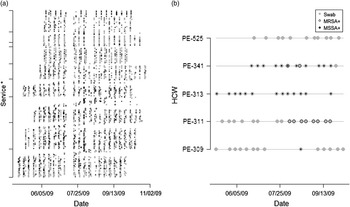
Every week, HCWs and patients were screened for S. aureus nasal carriage, providing the weekly status of individuals regarding MSSA and MRSA colonization (Figure 1). During the study period, no measure to reduce colonization was adopted in addition to standard hygiene measures. Each participant was followed for an average of 12.5 weeks (7.6 for patients, 15.2 for HCWs), with some participants followed up as long as 22 weeks. We observed an overall participation of 90.1% (795 participants) among all patients and HCWs present in the hospital during the study period.
Data collected on healthcare worker (HCW) methicillin-susceptible Staphylococcus aureus (MSSA) and methicillin-resistant S. aureus (MRSA) carriage from May 1 through October 31, 2009. Dates are represented on the x-axis and each individual HCW is represented on the y-axis. Gray dots indicate the dates at which swabs were taken for each HCW. Black dots indicate MSSA-positive tests, black circles indicate MRSA-positive tests. Figure 1a shows all the HCWs included in the study, Figure 1b zooms in on 5 sampled HCWs. In Figure 1a, HCWs are grouped together according to the department they work in. Department*: W1-W5: Ward 1-Ward 5, Night: night staff, E: Occupational therapists, P: Physiotherapists, Other: Other departments.

The present article describes the analysis performed on the data collected among HCWs. Data collected among patients are used for the purpose of comparison only and will be detailed elsewhere.
Microbiological Methods
To assess S. aureus colonization, swab specimens were obtained as previously described.Reference Couderc, Jolivet and Thiébaut 8 Briefly, swabs were placed in Stuart’s transport medium (500 μL; Transwab, Medical Wire and Equipment). A 100-μL aliquot was plated on selective and nonselective media for MSSA/MRSA isolation as described previously.Reference Alvarez, Remy and Allix-Béguec 9 The rest of the heavy dispersed suspension was then stored at −80°C for further use. Screening for MRSA and antimicrobial susceptibility testing were performed as described previously.Reference Alvarez, Remy and Allix-Béguec 9
Data Analyses and Statistical Methods
S. aureus, MRSA, and MSSA carriage weekly prevalence and incidence among HCWs in the hospital were computed. We also computed prevalence and incidence in the hospital during the whole period and among hospital departments or among various groups of HCWs classified according to their profession or the type of contact they have with patients. In our analyses, we considered the physiotherapist and the occupational therapist departments as one single department. Finally, we analyzed the risk for acquisition of MRSA by HCWs using multiple regression. All analyses were performed with R (http://www.r-project.org/).
Prevalence and Incidence of S. aureus, MRSA, and MSSA Colonization
The weekly carriage prevalence among HCWs was computed by dividing the ratio of the number of positive tests in a given week by the total number of tests performed in the same week. When more than one microbiological test was performed during the same week in the same individual, we retained only the result of the latest test. Exact binomial confidence intervals were computed. To estimate the average prevalence over the study period for the whole population or for specific groups, we used an inverse variance weighted estimator (http://cran.r-project.org/web/packages/meta/index.html).
For estimating incidence, we first preprocessed the raw individual longitudinal data for elimination of false-negative results due to imperfect sensitivity of sampling. More precisely, when a sequence of positive/negative/positive tests or positive/missing/positive was found, the negative or missing intermediary test was assumed to be indeed positive. The preprocessing was applied for S. aureus, then separately for MRSA and MSSA. All remaining analyses were performed on these preprocessed data that we refer to as “smoothed” data. A case was counted as incident in a given week if the carriage status changed from negative in the preceding week to positive in this week. Incidence rate was defined as the ratio of the number of incident cases to those who were negative for carriage the week before.
Risk Factors for Acquisition of MRSA
To study the individual risk for acquisition of MRSA among noncolonized HCWs, we extracted from the smoothed data all swab results obtained for HCWs who were tested negative for MRSA the preceding week. Both HCWs who were attached to a ward and HCWs working in several different hospital wards (eg, physiotherapists) or in support departments (eg, administrative staff) were included in analyses. The risk of MRSA acquisition was modeled as a function of occupation, type of contact with patients, MSSA colonization status in the preceding week, and HCW sex. We also included the hospital department and MRSA prevalence among patients in the department in the preceding week. When staff members were not attached to a specific ward (eg, physiotherapists), we used the hospital-level patient MRSA prevalence because this type of HCW is likely to be in contact with patients from any ward. All reeducation therapist professions were grouped together, ancillary hospital staff and stretcher bearers were grouped together as well, and all professions having few contacts with patients (health executive, administrative staff, logistic staff, and hairdressers) were included in the category “other.” Since our aim was to determine whether a high prevalence among patients could increase the risk of acquisition of MRSA among HCWs, we transformed this prevalence into a discrete variable with 2 or 3 classes (low/average/high or average/high). To account for variations of the average patient prevalence from one ward to another, the thresholds used to build the classes varied from one ward to another and were computed as the mean of the weekly MRSA patient prevalence in the ward plus or minus 1 standard deviation. When fewer than 10 swabs were available per week and per ward, we considered the prevalence as missing.
We conducted simple and multiple regression analyses. Logistic regression was adjusted using generalized estimating equation methods to account for repeated measurements in the same individuals. Independent or exchangeable within-individuals correlation structures were used.
All effects and levels were tested using Wald tests. Model selection was performed using the quasi-likelihood information criteria.Reference Pan 10 The goodness-of-fit of the final models was tested.Reference Horton, Bebchuk and Jones 11 The model parameters inference and the statistics were computed with R packages (cran.r-project.org/web/packages/geepack/index.html, cran.r-project.org/web/packages/doBy/index.html).
RESULTS
Participant Characteristics
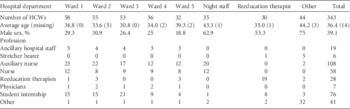
A total of 3,286 nasal swab samples taken from 343 HCWs were included in the analysis. Among the 343 HCWs, 108 (31.5%) were auxiliary nurses, 76 (22.2%) were nurse student interns, 58 (16.9%) were nurses, 19 (5.5%) were ancillary hospital staff, and 28 (8.2%) were part of the reeducation staff. The age, sex, and job type distributions of the HCWs according to hospital departments are summarized in Table 1. On average, 9.6 swab samples were taken per HCW (range, 1–20) during the study period.
Average Age, Sex and Profession Distribution of Healthcare Workers (HCWs) Among Hospital Departments

S. aureus, MRSA, and MSSA Colonization Prevalence
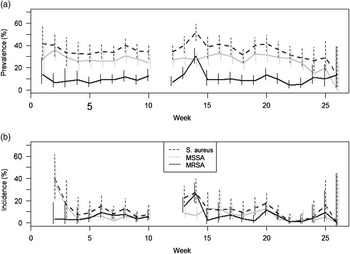
The average prevalence of S. aureus colonization among HCWs during the whole period was 36% (95% CI, 34%–38%). This average prevalence was 10% (95% CI, 8%–11%) for MRSA and 27% (24%–29%) for MSSA. Overall, prevalence of multiple colonization was limited with 4.6% co-colonization by at least 1 resistant and 1 susceptible strain.
There was substantial change in prevalence during the study period, ranging between 4% (95% CI, 1.5%–8.6%) and 30.5% (23.7%–37.9%) for MRSA prevalence (Figure 2A) and between 14.7% (7.0%–26.2%) and 36.4% (25.7%–48.1%) for MSSA prevalence (Figure 2B).
Staphylococcus aureus, methicillin-susceptible S. aureus (MSSA), and methicillin-resistant S. aureus (MRSA) weekly carriage prevalence and incidence among all healthcare workers (HCWs). Figure 2a depicts the weekly prevalence, defined as the number of positive tests on a given week divided by the total number of tests performed on this week using the raw data, of S. aureus (black dashed line), MSSA (gray line) and MRSA carriage (black line) among HCWs. Figure 2b depicts the weekly incidence, defined as the number of new cases in a given week divided by the total number of negative tests on the preceding week using the smoothed data, of S. aureus (black dashed line), MSSA (gray line), and MRSA carriage (black line) among HCWs.

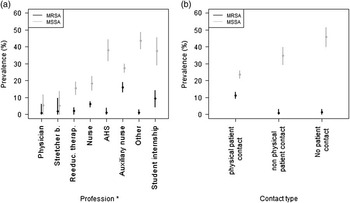
The average prevalence also varied according to occupation (Figure 3) with auxiliary nurses having the highest MRSA prevalence (16.1% [95% CI, 13.3%–18.9%]) and ancillary hospital staff and interns having the highest MSSA prevalence (38.0% [31.6%–44.4%] and 37.4% [29.1%–45.7%], respectively). HCWs having more physical contact with patients had the highest MRSA prevalence and the lowest MSSA prevalence (Figure 3B).
Average prevalence of methicillin-susceptible Staphylococcus aureus (MSSA) (gray) and methicillin-resistant S. aureus (MRSA) (black) depending on the profession (a) or the type of contacts with patients (b). *Reeduc. therap. includes physiotherapists, occupational therapists, and other reeducation therapists, AHS: ancillary hospital staff, Stretcher b.: stretcher bearer, Other: hairdresser/animation, logistic, health executive, administrative.

Variations were also observed among wards, with the average MSSA prevalence ranging from 11.7% (95% CI, 7.3%–16.1%) in Ward 5 to 34.4% (30.2%–38.5%) and 34.4% (29.5%–39.3%) in Ward 3 and Ward 4, respectively, and MRSA prevalence ranging from 6.7% (4.5%–8.9%) in Ward 1 to 15.9% (11.3%–20.5%) in Ward 2.
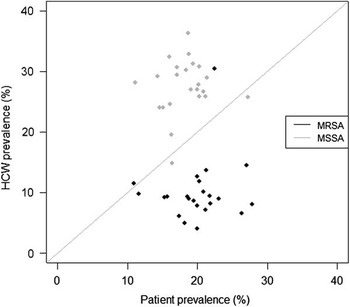
S. aureus prevalence among the 452 patients swabbed during the same period (3,331 swabs) was quite similar to the prevalence among HCWs (38% [95% CI, 36%–40%] vs 36% [34%–38%]). However, when splitting MRSA and MSSA, the MRSA average prevalence among patients was higher than among HCWs (20% [95% CI, 19%–22%] vs 10% [8%–11%]). On the contrary, MSSA average prevalence among patients was smaller than among HCWs (18% [95% CI, 17%–19%] vs 27% [24%–29%]). When examining weekly prevalence, we observed that during the study period, MRSA prevalence was higher among HCWs than among patients for one week only (Figure 4), which corresponds to the peak observed on Figure 2 (P=.0015). MRSA (respectively MSSA) prevalence among HCWs was not significantly correlated with MRSA (respectively MSSA) prevalence among patients.
Carriage prevalence among healthcare workers (HCWs) versus carriage prevalence among patients for methicillin-susceptible Staphylococcus aureus (MSSA) (gray) and methicillin-resistant S. aureus (MRSA) (black).

Risk Factors for MRSA Acquisition
Among the 1,827 patient-weeks of observations contributed by 308 HCWs, 129 MRSA colonization events were observed in 103 HCWs. However, the multivariable analysis includes only 128 colonization events (1 observed prevalence taken out owing to sample size). The weekly incidence varied between 0% and 26.3% (95% CI, 18.5%–36%) for MRSA and between 0% and 36% (20.2%–55.6%) for MSSA (Figure 2).
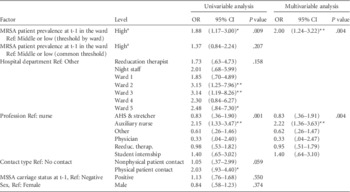
In the univariable analysis (Table 2), HCW occupation and the prevalence level among patients the preceding week (compared to its usual level in the ward) stood out as being the most discriminant characteristic. Contact type showed borderline association, with increased risk of acquisition in HCWs having physical contact with patients.
Association Between Methicillin-Resistant Staphylococcus aureus (MRSA) Acquisition and Healthcare Worker (HCW) Characteristics

NOTE. Estimates from univariable and multivariable generalized estimating equation analyses using an independent correlation structure. Observed level of the Wald test for each parameter: *: 10%, **: 5%. OR, odds ratio.
a A high level of prevalence within a ward was defined as a weekly prevalence higher than the average of the weekly prevalence within the ward (threshold by ward) or in the whole hospital (common threshold)+1 standard deviation.
In the multivariable analysis, the factors found associated with MRSA acquisition were the HCW occupation and the level of MRSA prevalence among patients in the preceding week (Table 2). The model including those 2 factors had the best quasi-likelihood information criteria and overall good fit (P=.13). HCW occupation had a significant effect on the risk of acquisition, auxiliary nurses having a significant relative risk of 2.2 (95% CI, 1.4–3.6) compared with nurses. A high MRSA patient prevalence in the hospital department increased the risk of HCW colonization by 2 (95% CI, 1.2–3.2). However, when estimating this model ward by ward and adjusting for multiple testing, we found that the level of prevalence had a significant effect in only 1 ward (Ward 2; P<.001).
When reassessing the number of MRSA acquisitions using non-smoothed data, we found 144 MRSA acquisitions (instead of 129 with smoothed data), but the risk factors analysis did not differ. The best model for explaining MRSA acquisition remained the one including MRSA prevalence among patients, and HCW profession and odds ratio estimates were only slightly affected by the additional 15 cases included in the analysis.
A similar analysis was undertaken to identify risk factors for MSSA acquisition (results not shown). The selected model included only the HCW hospital department as a significant factor. Other factors were not significant and the model did not fit the data correctly (P=.002), suggesting that MSSA acquisition can’t be fully explained by hospital environmental factors.
For all analyses, we checked that the results were not strongly affected by the assumptions on the correlation structure (results not shown).
DISCUSSION
We report the analysis of a comprehensive longitudinal follow-up of S. aureus carriage among HCWs in a rehabilitation center. Our results show that within the same hospital, colonization prevalence of S. aureus among HCWs fluctuates widely with time, according to ward, and with HCW occupation, but that the risk factors for carriage may be different for MSSA and MRSA. The observed variations in prevalence may reflect either differences in the carriage duration and probability of decolonization or differences in the risk of acquisition of MRSA, as suggested by the variations in incidence.
For MRSA, it was found that colonization pressure arising from high MRSA prevalence among patients of the ward was a risk factor for incidence in HCWs. Furthermore, HCW occupation modulated the risk of acquisition with an increased risk in those having more physical contact with patients. In this respect, auxiliary nurses were more at-risk than nurses, ancillary hospital staff, and stretcher bearers. Because the occupation is related to the nature and duration of HCW-patient contacts, our results support the existence of transmission between patients and HCWs through certain contacts. Interestingly, the MRSA prevalence level among patients was not identified as a risk factor when using the same threshold for all wards but only when the threshold was computed ward by ward. This suggests that other factors, depending on the ward, were involved in MRSA colonization dynamics, including the type of patients and environmental and organizational factors. Indeed, organization of care in the ward, patient pathologic features, clinical interventions performed in the ward, and compliance with hygiene measures may vary from one ward to another and may have an impact on pathogen transmission. Owing to the size of our sample, we were not able to appropriately estimate interaction terms between hospital department and prevalence level. Using a threshold specific to each ward to categorize the prevalence partially accounted for this interaction.
The picture was different with MSSA acquisition where none of the potential predictors were found to be associated with incidence in HCWs beside differences between wards. Importantly, there was no obvious association with MSSA carriage in patients or with type of occupation. This suggests that the mechanisms of transmission may be quite different, with hospital factors less relevant for MSSA transmission.
The MSSA carriage status among HCWs in the preceding week was not significantly associated with the risk of MRSA acquisition. This result may indicate that the probability of MRSA acquisition is unchanged by MSSA carriage but it could also be due to a lack of power to detect any significant effect of MSSA carriage status.
Comparison With Previously Published Studies
Reviews on HCW S. aureus or MRSA carriage were published in 2008Reference Albrich and Harbarth 6 and 2011.Reference Hawkins, Stewart, Blatchford and Reilly 7 The MSSA carriage prevalence we found over the 6-month study period (27% [95% CI, 24%–29%]) is consistent with the 23.7% (10.7%–36.7%) average reported in the latter review based on 41 studies. The reported range of MRSA carriage prevalence among HCWs varied between 0% and 59% depending on several factors, including the type of healthcare setting, the country, and infection control practices. Several risk factors for MRSA carriage were identified: ward type, MRSA prevalence among patients, close contact with patients, and infection control compliance. The MRSA colonization prevalence we found (10% [95% CI, 8%–11%]) falls in this large range but is higher than reported in the 2008 review based on 127 studies (4.6% [1%–8.2%]). This is notably high compared with the 3.1% (95% CI, 1%–8%) prevalence found in a rehabilitation hospital in ItalyReference Rossini, Balice and Ciotoli 12 but consistent with another study that suggested that MRSA prevalence is higher in long-term care facilities.Reference Eveillard, Martin and Hidri 13
A study performed in a Portuguese hospital identified “nurses” and “nurse aids” as the professions having the highest risks for MRSA acquisition.Reference Amorim, Vasconcelos and Oliveira 14 This study was based on 3 point prevalence surveys per year conducted over a 2-year period. Our study, performed on a shorter period but with much more frequent swab samples, partly confirms this result because we identified auxiliary nurses as having the highest risk of MRSA acquisition. However, in our study, we did not identify that nurses were more at risk than other professions; this could be due to differences in the type of nurse/patient contact or compliance with hygiene measures in different hospital settings, as suggested by the Italian study cited above where auxiliary nurses alone were found to be at increased risk of MRSA colonization.Reference Rossini, Balice and Ciotoli 12 Our findings are also consistent with other studies that have identified close contact with patients (eg, dressing changes, wound contact) as a risk factor for MRSA carriage in HCWs.Reference Albrich and Harbarth 6
Other studies have also demonstrated that employment in areas of high patient MRSA prevalence is a risk factor for MRSA carriage.Reference Albrich and Harbarth 6 We further show that high MRSA carriage prevalence among patients in the preceding week may be a risk factor for HCW MRSA acquisition.
Discussion of Methods and Limits
To control the impact of possible false-negative swab sample results on our estimated incidences, we smoothed the data using a simple rule (changing +/−/+ sequences into +/+/+ sequences). We did not account for false-positive samples because the culture approach is highly specific.Reference Yam, Siu and Ho 15 We are aware that the smoothing rule we used was arbitrary, but given the sensitivity of the phenotypic assays we used,Reference Yam, Siu and Ho 15 , Reference Kluytmans-van den Bergh, Vos and Diederen 16 we chose to keep it as simple as possible. We did not use smoothed data to estimate prevalences because they were highly overestimated for the week where no samples were collected. Hence, prevalences presented in this study may be at least slightly underestimated.
A recent review shows that nasal colonization with MRSA underestimates whole body colonization by about one-third (range, 8%–45%)Reference McKinnell, Huang, Eells, Cui and Miller 17 but remains the most informative of all sites.Reference Eveillard, de Lassence and Lancien 18 We further limited the effect of imperfect sensitivity of nasal swabbing by ignoring isolated negative results in the definition of incident colonization (see smoothing procedure). Information on HCWs’ nasal colonization is valuable to understand the transmission dynamics of MRSA in the hospital because it might be a reservoir for patient colonization. Yet, while it seems logical that HCWs carrying MRSA in the nares may be more at risk of transmitting MRSA, detailed data on these relationships are still unclear and should be investigated further in the future.
In this article, we did not account for spa-typing data which have been analyzed elsewhere to study diversity of S. aureus Reference Alvarez, Remy and Allix-Béguec 19 and to investigate MRSA transmission dynamics via the contact network within the hospital.Reference Obadia, Silhol and Opatowski 20 However, on the basis of a preliminary analysis, accounting for spa-typing data would not drastically increase the number of incident cases.
The use of anti-staphylococcal antibiotics by HCWs during the study period may have modified the pattern of MRSA acquisition. Unfortunately, data regarding HCW antibiotics consumption were not available in this study. However, in this hospital, decolonization regimens of HCW are not a common practice, hence antibiotic use by HCWs during the study period was probably marginal. In addition, because the results of nasal swab tests were not provided to the HCWs during the study period, it should not have affected their antibiotic use consumption.
This study was undertaken in 2009 and we do not have data on the evolution of MRSA colonization among HCWs in the rehabilitation center where our study took place, nor in France, since this date. Regarding hospital patients’ colonization, a study (http://www.cclinparisnord.org/BMR/BMR2012.pdf) has estimated that in rehabilitation centers and long-term care facilities in northern France the MRSA incidence was 0.35 per 1,000 hospitalization-days (1,000 HD) in 2009 and 0.28/1,000 HD in 2012.
In France, the spread of community-associated MRSA has until now been limited compared with other European countries and the United States.Reference Baud, Giron and Aumeran 21 Were the spread of community-associated MRSA to increase in France, it could modify the risk factors for HCW MRSA acquisition.
CONCLUSIONS
Because transmission between patients and HCWs is thought to be a major driver of MRSA circulation dynamics within hospitals, it is important to understand the determinants of MRSA carriage among HCWs, as well as among patients. However, most studies have focused on patients or were point-prevalence studies. Here, we have presented results from a longitudinal study that may help further our understanding of MRSA acquisition in HCWs, identifying several risk factors, in particular related to the HCW profession and patient carriage. However, the exact role of patient-HCW contact remains unclear, because a simple classification of contacts as physical vs nonphysical did not explain acquisition as well as HCW profession did. In the future, the risk factors we identified would require reassessment with a more complete analysis, including notably data on strain genotypes, HCW antibiotic consumption, and infection control measures undertaken during the study period. This study should also be complemented by a more in-depth analysis of patient-HCW contacts, allowing for an exploration of the role of the contact duration and frequency in the risk of MRSA acquisition. This would be allowed by an ongoing analysis of the contact network recorded during the same study thanks to electronic devices carried by all HCWs and patients.
Members of the iBird Study Group
Members of the iBird Study Group are Mariano Beiró (Universidad de Buenos Aires, Buenos Aires, Argentina), Inga Bertucci (APHP, Paris, France), Pierre-Yves Boelle (Univ. Pierre et Marie Curie, Paris, France), Eric Fleury (ENS Lyon, Lyon, France), Matthieu Domenech (Univ. Pierre et Marie Curie, Paris, France), Antoine Fraboulet (Insa, Lyon, France), Didier Guillemot (Univ. Versailles Saint Quentin, Versailles, France), Jean-Louis Herrmann (Univ. Versailles Saint Quentin, Versailles, France), Boris Labrador (APHP, Paris, France), Jennifer Lasley (Inserm, Paris, France), Christine Lawrence (APHP, Paris, France), Judith Legrand (Univ. Paris Sud, Orsay, France), Lucie Martinet (Inria, Lyon, France), Lulla Opatowski (Univ. Versailles Saint Quentin, Versailles, France), Jérôme Salomon (Cnam, Paris, France), Laura Temime (Cnam, Paris, France), Thomas Obadia (Univ. Pierre et Marie Curie, Paris, France), Anne Thiebaut (Inserm, Paris, France), and Philippe Tronchet (APHP, Paris, France).
Acknowledgments
We thank the iBird study group for fruitful discussions as well as Marie-Laure Delaby, Laetitia Remy, Anne-Sophie Alvarez, and Anais Petit for their involvement in microbiological analyses.
Financial support. European Commission under the Life Science Health Priority of the 6th Framework Program (MOSAR network contract LSHP-CT-2007-037941).
Potential conflicts of interest. All authors report no conflicts of interest relevant to this article.
APPENDIX
The iBird (Individual Based Investigation of Resistant Bacteria Dissemination) program was a prospective, observational, cohort study conducted in a 200-bed long-term care hospital over a 6-month period (June-November) in 2009. This center, located in Berck-sur-Mer, France, is organized in five wards corresponding to five different clinical specialties (geriatrics, neurology, nutrition, orthopedics, and postoperative care). This facility was chosen for several reasons. First, these acute-care centers are viewed as a potential reservoir of antibiotic-resistant bacteria, with the potential for amplification and dissemination into the community. Second, the average stay of 3 months provided a long follow-up for the patients, which improved the feasibility of the study by facilitating the recording of interactions among participants.
Several meetings were held in April and May 2009 to encourage the participation of patients and HCWs. The overall participation rate was 90.1% (795 participants in total) of all patients and HCWs present in the hospital over the 6-month study period. This figure comprised 452 patients, 108 auxiliary nurses, 76 nurse interns, 58 nurses, 28 reeducation therapists (including physiotherapists and occupational therapists), 19 ancillary hospital staff, 7 nurse managers, 7 physicians, and 40 administrative staff. Overall, 8,599 weeks of participant follow-up were recorded. Each participant was followed for an average of 12.5 weeks (7.6 for patients, 15.2 for HCWs) and up to a maximum of 22 weeks.
Bacterial Follow-up and Characterization
Microbiological monitoring of participating patients included weekly nasal and rectal swabs, as well as swabs of entry wounds or invasive devices (tracheotomy, gastrostomy, etc.) to test for Staphylococcus aureus and enterobacteria resistant to third-generation cephalosporins. The screening of participating HCWs included only weekly nasal swabs. All collected swabs (nasal, rectal, and entry wounds) were frozen at −80°C and stored in the microbiological laboratory of Raymond Poincaré University Hospital (Garches, France). The targeted microorganisms were isolated, subjected to antibiotic-resistance phenotyping, and genotyped (to date only S. aureus).
Microbiological Methods for the Identification and Characterization of Staphylococcus aureus
Nasal swabs were collected as described previously with sterile cotton-wool swabs.Reference Alvarez, Remy and Allix-Béguec 9 They were immediately placed in transport medium and sent to the microbiology laboratory where they were used to inoculate 500 μL of brain-heart infusion medium. Then, 100 μL of this broth was plated onto Chapman agar (bioMérieux) and MRSA ID screening agar (bioMérieux) and incubated for 48 h at 36°C. S. aureus was identified by mass spectrometry with the MALDI-TOF-MS spectrometer and flex control software (Autoflex; Bruker Daltonics).
Antimicrobial susceptibility of all isolated S. aureus strains was determined on Mueller-Hinton agar plates (bioMérieux) by the disk diffusion method.Reference Leclercq, Cantón and Brown 22 Antibiotic susceptibility used the agar disk diffusion method, interpreted as recommended by the French Antibiogram Committee (http://www.sfm.asso.fr). S. aureus was categorized as susceptible to methicillin if the inhibition zone diameter around the cefoxitin disk (30 microg) was 27 mm or larger and as resistant to methicillin if the diameter was smaller than 25 mm. If the diameter was 25 or 26 mm, additional tests were performed to detect the penicillin binding protein 2a production. Twenty antibiotics were tested, including methicillin, which was subsequently used to classify strains as methicillin-resistant (MRSA) or methicillin-susceptible (MSSA). Antibiotic resistance was described as susceptible, intermediate, or resistant.
Other Recorded Data
Data collected by the study team included a condensed clinical recording form and data from electronic databases of drug prescription, complementary clinical data, and HCW management. HCW management data were retrieved from the automated database of hospital staff management.
Ethical Considerations
The iBird investigation received official approval of all institutional review board–equivalent agencies in France (Ref CPP 08061; Ref Afssaps 2008-A01284-51; Ref CCTIRS 08.533; Ref CNIL AT/YPA/SV/SN/GDP/AR091118 N°909036). No signed consent was required by the French ethical review board where the project was submitted.