You go on board sane, logical, level-headed and serious; you become comparatively insane, unlevel-headed, and trivial. You lose your balance, and why you lose it, is something that I have never been able to explain. . . . When I find myself opera-glassing the passing ship, raving over a shoal of porpoises, in fevered quest of passengers' autographs, and playing bridge in the smoke-room, I am convinced that I have left my other self on shore. I am somebody else whom I scarcely recognise, and certainly do not admire. My real self would cut my ship self dead on Fifth Avenue or Broadway.
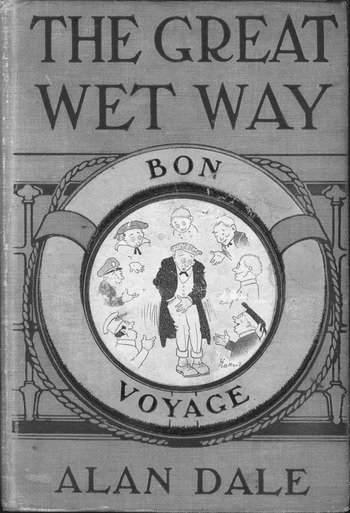
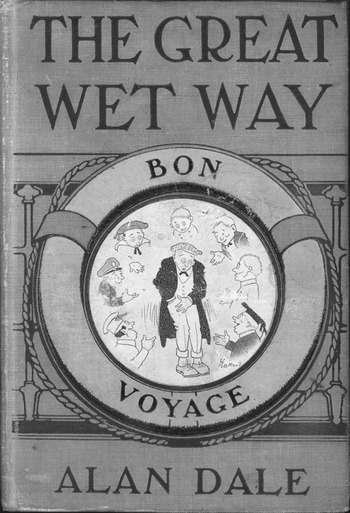
—Alan Dale, The Great Wet Way Footnote 1In The Great Wet Way, a humorous account of transatlantic travel, American theatre critic Alan Dale represents ocean liners as sites of transformation, frivolity, and performance. In the passage above, he ponders the peculiar metamorphosis that overtakes him whenever he crosses the Atlantic. Cut off from the hustling world of Broadway and Fifth Avenue, he loses his “real self,” becoming instead an autograph-hunting, bridge-playing, opera-glassing “ship self.” It is as though the ship has remade Dale and the social world around him (Fig. 1). Within this altered world, new sights become old sights, and eccentric clothing or mannerisms come to seem commonplace. Dale recalls seeing a young woman wearing a Panama hat covered with autographs from her fellow passengers. If the woman dared to “walk down Broadway or Fifth Avenue wearing that hideous autograph hat,” he writes, “[s]he would probably be followed by a howling and derisive mob. . . . Yet on board she was unmolested. After the first few days nobody noticed the autograph hat.”Footnote 2
Cover of theatre critic Alan Dale's 1909 comical travelogue, The Great Wet Way. A longtime critic for newspaper magnate William Randolph Hearst, Dale's acerbic yet amusing writing style marked a general shift in theatre criticism away from the traditional, gentlemanly style of critics such as William Winter. Photo by author. Courtesy of the Library of Congress.
Margaret Werry has urged theatre scholars to think “about theatre globally—not as an instrument of representational stabilization, but as a machine of circulation that produces the social imaginaries that characterize global modernity.”Footnote 3 If, as Werry contends, theatre is a “machine of circulation” that produces global imaginaries, then an examination of the actual machines that made this circulation possible promises to yield new insights into the role of technology in the lives of theatre artists and the workings of capital. Alan Dale's description of his transatlantic adventures calls attention to the power of the ocean liner as both a modern machine and an engine of modernity that profoundly affected the physical, emotional, and psychological well-being of its human cargo. The ship transforms Dale, almost against his will, from a “logical, level-headed and serious” critic into an “insane, unlevel-headed, and trivial” traveler.Footnote 4
This essay takes up the subject of the theatrical life of the transatlantic ocean liner during the period frequently described as the “golden age of travel” (1880–1920), joining recent efforts in theatre and performance studies to develop a more coherent understanding of how human subjectivity is forged with and through an engagement with the material world.Footnote 5 Actor-network theory (ANT)—one of a wide array of “new materialist” methodologies to emerge from the social sciences—offers a helpful model for thinking about how transatlantic ocean liners both facilitated the expanding transnational trade in theatrical commodities at the turn of the twentieth century and functioned as actors themselves in the multiple actor-networks that extended across the Atlantic Ocean. Originating in the sociology of science, ANT “describes the enactment of materially and discursively heterogeneous relations that produce and reshuffle all kinds of actors including objects, subjects, human beings, machines, animals, ‘nature’, ideas, organizations, inequalities, scale and sizes, and geographical arrangements.”Footnote 6 Early ANT studies troubled assumptions about the production of scientific knowledge by analyzing the complex environment of the scientific laboratory, where human actions are informed, and in some cases directed by, nonhuman materials such as test tubes, microscopes, and other instruments.Footnote 7 Where ANT theorists depart most directly (and controversially) from other sociologists is in their insistence on treating human and nonhuman actors as equal partners in the production of actor-networks and their willingness to grant machines, animals, and inanimate objects the ability to act. ANT theorists Bruno Latour and John Law posit that the “social” comes into being only through the varied interactions and group-making activities of actors continuously involved in the process of making, breaking, and remaking network connections.Footnote 8 Humans and nonhumans define one another through their participation in actor-networks; for example, when I sit down to write, I join a network that involves my computer, the table it's on, the room we're in, and the lights that shine down upon us. If the lights burn out or the ceiling collapses or the table gives way or I leave to go watch television, the network dissolves. All elements need to be in play for the actor-network to remain; put another way, actor-networks exist only in and through performance.Footnote 9
Although ANT scholars have been criticized for ascribing agency to objects, “focusing on privileged actors and for its blindness to other possible ways in which networks might develop,”Footnote 10 ANT (as both a theory and a methodology) has a great deal to offer theatre and performance historians looking to investigate interactions between humans and nonhumans. ANT's deliberate invocation of theatrical terminology highlights the multiple staging elements that influence and encode an actor's performance, irrespective of whether the actor is human. “To use the word ‘actor,’” writes Latour, “means that it's never clear who and what is acting when we act since an actor on stage is never alone in acting.” Actors (e.g., cars, computers, roads, cats, children) act, but they are also acted upon in much the same way that an actor onstage is acted upon by a costume designer, playwright, or director. “[T]he very word actor directs our attention to a complete dislocation of the action, warning us that it is not a coherent, controlled, well-rounded, and clean-edged affair,” Latour argues.Footnote 11 Indeed, as Alan Dale's account makes clear, ocean liners acted upon the human and nonhuman cargo they carried (the stereotypical image of the seasick traveler offers the most vivid example of this), while the passengers, the crew, the ocean, and (perhaps most notoriously) enemy vessels and icebergs acted upon them.Footnote 12
Recognizing that some actors inevitably assume larger roles than others in any given network, Latour distinguishes between intermediaries, actors that play a passive role in a network, and mediators, “actors endowed with the capacity to translate [i.e., change or transform] what they transport, to redefine it, redeploy it, and also to betray it.”Footnote 13 In the example from Alan Dale, the autographed hat of the young woman slipped from being a mediator to being an intermediary as it was naturalized by other actors in the network (i.e., the ocean, the other passengers, the ship decks). By contrast, the liner maintained its status as a mediator, at least for Dale.
In defining transatlantic ocean liners and the people, goods, machines, organizations, and ideas that traveled upon them as actors in a continually forming, always shifting network, this essay offers a different perspective on theatre makers, the objects they used, the ideas they encountered, and the technological advances that made the rapid circulation of all three possible. Of course, theatre scholarship has long acknowledged the importance of transportation networks in establishing and transforming theatre culture, particularly in the mid-nineteenth century, when the construction of extensive railway lines across North America and Europe made theatrical touring a much more viable and profitable endeavor.Footnote 14 In the United States, the popularity of touring “‘combination’ companies” eventually displaced the local stock company as audiences made known their preferences for star actors and productions originating in New York.Footnote 15 Yet while most historical narratives emphasize the role of railroads in the gradual nationalization of theatre in the United States and elsewhere, few consider the extent to which transatlantic ocean liners encouraged the transnationalization of theatre practices and cultures.Footnote 16 This tendency is understandable given the twentieth-century project of writing national theatre histories, but it also misses (and in some cases misrepresents) the relationships, structures, and networks that gave rise to theatrical innovation and cultural exchange. Looking at the role of ocean liners in the development of early twentieth-century commercial theatre extends the traditional geographic focus of American theatre history, particularly the history of Broadway theatre.Footnote 17
In keeping with ANT's emphasis on close description, I follow a mode of “technological storytelling” that emphasizes how “humans and nonhumans perform together to produce effects.”Footnote 18 Rather than trace a single network (e.g., the various actors present on a single liner, such as the passengers, the crew, the decks, the engine room, and the cargo), I examine different scales of networks to develop a more thorough understanding of how, where, and with whom/what ocean liners acted.Footnote 19 In so doing, I stress the accuracy of Alan Dale's playful pun on the Great White Way, for while Broadway was paved in New York City, it was also built upon the Atlantic, the “highway that made empire possible.”Footnote 20
I begin by describing some of the more impressive ocean liner performances that transformed transatlantic travel in the early twentieth century, highlighting the liners' interactions with international media, spectators, and one another. I then discuss how competition among liner companies encouraged the formation of new theatrical actor-networks that redefined traditional touring circuits and challenged the continental limits of Broadway. From there I move to analyzing the actor-networks that formed both on and around the liners, paying particular attention to the way that ship decks, dining halls, and piers shaped and extended managerial enterprises. I conclude with the literal destruction of an actor-network—the sinking of the Lusitania and the loss of more than a thousand lives, including the life of one of the most influential actors in Broadway's actor-network, theatre manager Charles Frohman.
The Great Atlantic “Sister Act”
More supple than the notion of system, more historical than the notion of structure, more empirical than the notion of complexity, the idea of network is the Ariadne's thread of these interwoven stories.
—Bruno Latour, We Have Never Been Modern Footnote 21In 1907, the British-owned Cunard Steamship Company sent its two sister ships, the Mauretania and the Lusitania, on their maiden voyages across the Atlantic. These massive, elegantly appointed vessels offered a wide range of services to first- and second-class passengers, including special writing rooms, luxurious parlors, wood-paneled dining halls, Turkish and Russian baths, and elevator service between decks.Footnote 22 Perhaps more important, they were fast, achieving speeds of over 25 knots an hour with the help of huge turbine engines that had an estimated horsepower of seventy thousand. An article in Scientific American congratulated Cunard for “being the first to place in service a ship of this maximum speed, particularly when it is borne in mind that to the distinction of being the fastest, the new flyer adds also those of being the largest, the most commodious, and the steadiest ship afloat.”Footnote 23 Articles in mass-circulation newspapers likewise published details about the Lusitania's technological inner workings, photographs of its stately rooms, and imaginative comparisons to other large structures including the U.S. Capitol, New York skyscrapers, and the pyramids.Footnote 24 Such accounts framed the liner as a technological wonder caught up in an actor-network of whirring machinery and polished wood, while deemphasizing its participation in other, much larger actor-networks, most notably those characterized by capital investment, imperial struggle, and mass immigration.
Alert to the liner's potential as spectacle, the Cunard Company transformed the Lusitania, the first of its sister ships, into a vast public stage before it left Liverpool. On 2 September 1907, ten thousand onlookers paid 2 shillings, 6 pence each for the privilege of exploring the great ship and its luxurious accommodations.Footnote 25 The excitement this preview generated was merely a prelude to the noise and festivities that surrounded the ship five days later, when a cheering, singing crowd of a hundred thousand from across the country gathered at the Mersey Docks to watch the Lusitania depart.Footnote 26 “It was not an event merely for Liverpoolians [sic] but for the entire nation,” a special cable to the Chicago Daily Tribune wrote.Footnote 27 Arriving by special trains, motors, and “wagonettes,” thousands of well-wishers “covered every vantage point from the Princess landing stage to Seaport,” singing “Rule Britannia” as the great ocean liner made its way out to sea.Footnote 28
The Tribune account situates the Lusitania within a much larger actor-network than the one described in the Scientific American, one that includes trains, motors, wagonettes, wire cables, and more than a hundred thousand flag-waving people. Within this network, the Lusitania gains visibility as a single unit rather than an assemblage of parts, while the networks of labor and machinery that produced the liner disappear. Latour likens this transition to closing a black boxFootnote 29 (also sometimes referred to as punctualization),Footnote 30 a process whereby a heterogeneous network is reduced to a “good machine” or “black box” that behaves in predictable ways and “shields complexity and controversy from view.”Footnote 31 Like the (theoretical) neutrality of a “black box” theatre, a “black-boxed” actor-network appears neutral until it dissolves or breaks or is interrupted, as for example, when the lights go up on a stagehand placing a prop or shifting a set piece. In such moments, the “black-boxed” production (distinct from but nevertheless embedded within the actual black box theatre space) is disrupted, exposed by what Bert States calls “the upsurge of the real.”Footnote 32 As they watch the embarrassed stagehand scurry off the stage, audiences are reminded of the physical labor that literally “props up” the actors and their onstage environment; the existence and complexity of the network is exposed.Footnote 33 To return to the Lusitania, then, in the moment of its triumphant departure, the liner acted as a single, “black-boxed” unit, inspiring spontaneous and collective outbursts of “Rule Britannia.” The crowd in turn acted upon the great ship, transforming it from a functional vessel into a symbol of imperial glory.
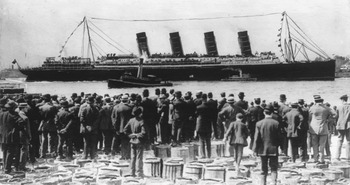
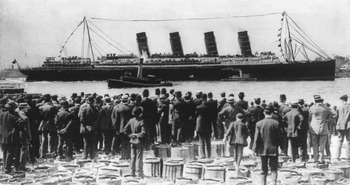
For five days, newspapers on both sides of the Atlantic published breathless accounts of the Lusitania's progress as it attempted to overtake the older Cunard ship Lucania and surpass the speed record set by the Norddeutscher Lloyd ship Deutschland in 1906.Footnote 34 On 9 September, a special wireless sent to the New York Times from “on Board the Lusitania” reported that the ship had passed the Lucania and was “plowing along at nearly 26 knots with scarcely a tremor.”Footnote 35 Early indicators suggested that the Lusitania would easily break the Deutschland's record of an average 23.15 knots, but the onset of heavy fog on 11 September forced the crew to slow the ship down, disrupting the highly functioning actor-network of engine, steam, and ocean. The Lusitania picked up speed on the last leg of the journey, and it passed the Sandy Hook, New Jersey lighthouse at 8:05 a.m. on 13 September, 5 days and 54 minutes after it had departed from Queenstown. Although it easily surpassed the previous Cunard record the Lucania had set for the same journey (5 days, 7 hours, and 23 minutes), the Lusitania failed to take the Blue Riband, the honorary title bestowed upon the fastest ship crossing westward on the Atlantic.Footnote 36 Nevertheless, a large and boisterous crowd greeted the ship's arrival, including many who took to rowboats, motorboats, sailboats, and other small craft to escort her into harbor (Fig. 2).Footnote 37 Thousands of miles away, British newspapers celebrated the ship's arrival, though some expressed disappointment that she had failed to “beat everything.”Footnote 38
A crowd gathers to watch the Lusitania arrive in New York City at the end of her maiden voyage, September 1907. Photographer unknown. Courtesy of the Library of Congress Prints & Photographs Collection.
Any doubts about the liner's abilities were soon put to rest on the Lusitania's second attempt, when she easily broke the speed record and captured the Blue Riband from the Deutschland. But her hold on the prize was short-lived. In December 1907, the Mauretania challenged the Lusitania's claim, setting a new speed record eastward on her maiden voyage. The Lusitania responded by posting an even faster time on her next crossing. For over a year, the two Cunard vessels performed a transatlantic “sister act,” as they passed the Blue Riband back and forth, executing a sequence of daring feats to the delight and wonderment of an international audience. Finally in June 1909, the Mauretania achieved a record time of 4 days, 17 hours, and 21 minutes, which it would hold for twenty years.Footnote 39
The playful “machinic dramaturgy”Footnote 40 of the Cunard sister act, which transformed the Atlantic into a stage for a seemingly endless series of engineering feats, obscured the liners' starring roles in a very different actor-network. Far from benign, the Cunard Company's sister act was a none-too-subtle declaration of British naval superiority, a reminder to the German steamship companies Norddeutscher Lloyd and Hamburg-Amerika, each of which possessed its own fleet of palatial ocean liners, that the Atlantic was not their private playing field. In 1903 the British government had agreed to subsidize the Cunard Company to prevent American financier J. P. Morgan from absorbing it into his massive International Mercantile Marine Company, recognizing the need to secure Britain's share of the lucrative passenger travel market and maintain its centuries-old dominance of the Atlantic. Cunard's German rivals responded to the Lusitania and Mauretania with plans for even faster vessels and larger fleets; with the financial backing of the kaiser, they prepared to launch trios of ships that would challenge the Cunard sisters for supremacy.Footnote 41 Transatlantic ocean liners thus became star performers in the escalating geopolitical contest between Great Britain and Germany, “symbols of their nations' culture, might, and prowess” and the culmination of centuries of colonial expansion and empire building.Footnote 42
But these liners served much more than a symbolic function. As central actors (i.e., mediators) in an imperialist and militaristic network that stretched from the Houses of Parliament in London to the docks of Liverpool to the harbors of New York, the Lusitania and Mauretania simultaneously inspired and embodied the cry “Rule Britannia!” Just as the early nineteenth-century steamship Rob Roy helped to define the geographic boundaries of the United Kingdom on its regular journey between Belfast and Greenock, near Glasgow,Footnote 43 the Cunard sister ships performed and made manifest Britain's dominance of the Atlantic. Historian Douglas R. Burgess describes how “the Cunard sisters fostered the illusion of being in two places at once: while one was at sea, the other was loading coal and passengers. They always seemed to be in their docks, waiting for passengers with the same comfortable regularity of a seaside ferry.”Footnote 44 Burgess's description of the highly functioning Cunard network calls attention to the performativity of spatial relations—that is, the way objects constitute space and vice versa. As physical extensions and embodiments of empire, the magical Cunard ships marked the Atlantic Ocean as British with every crossing.Footnote 45 The message was clear: Britannia still ruled the waves.
A very different narrative emerges when we shift scales and analyze the ocean liner's participation in actor-networks shaped by luxury travel and mass immigration. In a 1908 article titled “The Romance of the World Afloat,” the New York Times observed that “an average of about 50,000 [people were] afloat in every week of the year” on the thirty to forty ships that were “hurrying over the transatlantic lanes” in each direction.Footnote 46 By 1895, 80 percent of all first- and second-class passengers were either traveling from or returning to the United States, and from 1900 to 1914, one million European immigrants traveled to the United States in steerage.Footnote 47 British, German, and American ocean liners thus occupied multiple and sometimes competing roles in a wide range of actor-networks, not just as performers in an escalating imperial struggle but also as the very means through which the building blocks of British, German, and (increasingly) American empire circulated.
Competition among British, German, and American liner companies encouraged the rapid acceleration of immigration and luxury travel from 1907 onward. In August 1907, weeks before the launch of the Lusitania, the Hamburg-Amerika line reduced the price of a first-class ticket from Hamburg to New York from $130 to $107.50, and the Norddeutscher Lloyd line reduced its ticket price from $130 to $117.50. Although the New York Times speculated that rivalry with the Cunard Company had motivated the rate reduction, both German liner companies denied a price war, explaining that all companies had agreed to maintain standard rates.Footnote 48 However, in September, the International Mercantile Marine Company introduced major rate reductions on the New York, Cherbourg, and Southampton routes for its White Star and American Lines.Footnote 49
Although the 1907 price wars affected mostly first-class travelers, the liner companies also competed for steerage passengers. Despite the considerable difference in ticket price—a steerage ticket cost (on average) $35 whereas a first-class ticket was often over $100—ships such as the Hamburg-Amerika's Imperator, which “carried 2,800 of its 4,100 (68 percent) capacity passenger load in steerage,” relied heavily on immigrant traffic. Indeed, as maritime historians Ray W. Coye and Patrick J. Murphy observe, “despite public attention to the luxuries of first class travel, immigrant-based profit built and sustained many of the transatlantic steamship companies.”Footnote 50 In 1913, the Cunard Lines carried 85,291 passengers in steerage (68.3 percent of its total of 124,840 passengers), generating $2,985,185 in revenue.Footnote 51
The apparent democratization of transatlantic travel is comparable to the democratization of desire associated with early twentieth-century department stores and theatres, which appealed to a broad spectrum of customers but ensured that class and racial lines were maintained by designating certain areas for different classes of customer.Footnote 52 Described by one contemporary as “vast and veritable palaces of comfort, each a little city in itself,” ocean liners mirrored the modern city in their heterogeneity and in their reproduction and reinscription of existing social hierarchies.Footnote 53 Each passenger received the same “core service,” namely transportation from one location to another, but their experiences on board varied considerably.Footnote 54 The privileged mobility of first-class passengers, who savored three-course meals in marble-pillared dining halls modeled on the Ritz Carlton, was hardly comparable to the cramped, noisy, smelly mobility of those in steerage.Footnote 55
Second-class passengers, the majority of whom were either middle-class tourists or business travelers (who were often buyers for department stores and other retailers), enjoyed many of the same amenities as first-class travelers, including smoking rooms, lounges, and writing rooms, but were generally expected to share sleeping and toilet facilities. Liner companies recognized the importance of providing superb service to this increasingly reliable market, especially those who crossed the Atlantic multiple times each year.Footnote 56 From January to August 1907, an estimated 77,000 Americans booked “second-cabin” passages to Europe, prompting J. P. Meyer, general passenger agent for the Hamburg-Amerika line, to observe that the prevailing prejudice against traveling second class was “being rapidly overcome.”Footnote 57 The ripple effects of this transformation would be felt up and down Broadway.
The Rise of New Theatrical Networks
Speech, bodies and their gestures, subjectivities, and materials such as architectures, ships, aircraft or firearms, all are treated as enactments of strategic logics. All participate in holding everything together. All are made in, and help to produce, those relations.
—John Law, “Objects and Spaces”Footnote 58The comfort and accessibility of transatlantic ocean liners revolutionized the American theatre industry by allowing performers and managers and their many representatives to make multiple trips between North America and Europe each year. These innovations rapidly accelerated the pace at which theatrical sounds, looks, and ideas moved from one continent to another. By 1910, many of the plays, performers, songs, and costumes that filled commercial theatres in New York were similar to if not identical to the plays, performers, songs, and costumes that filled commercial theatres in London, Paris, Berlin, Budapest, Vienna, Leipzig, Sydney, Melbourne, Cape Town, and Calcutta.Footnote 59
Of course, performing artists and managers had traveled throughout the world for centuries, first on clipper ships, then on the earliest steam-powered vessels. Yet while international touring was a well-established practice for performing artists by the middle of the nineteenth century, it was a costly and sometimes times dangerous venture that required months of planning and preparation.Footnote 60 The introduction of steamship travel in the 1840s reduced travel time between Europe and North America from a minimum of five to six weeks to twelve days, an innovation that led companies such as the Cunard Company and the White Star Line to appeal more directly to wealthy customers by offering larger cabins, dining halls, and other amenities.Footnote 61 Nevertheless, the cost of transporting an entire theatre company, complete with costumes, props, and set pieces, was prohibitive for many, and those who made the voyage across the Atlantic tended to remain abroad for several months, if not years.Footnote 62
The speed and accessibility of ocean liners such as the Lusitania reoriented theatrical practices on both sides of the Atlantic.Footnote 63 As noted above, theatre critics such as Alan Dale traveled frequently to Europe to take in the latest plays in London, Paris, and Berlin and expand their knowledge of dramatic experimentation; in 1909, Dale claimed that he had made “some fifty trips across the Atlantic, on all kinds of steamers, and with all sorts of people.”Footnote 64 American theatre impresarios likewise gave little thought to the costs involved in sending agents abroad to search for talent or attend the opening of new plays in London and Paris. With the support of traveling agents, these impresarios began to entertain thrilling dreams of establishing a global booking system that would transform national theatre industries in North America and Europe into coordinated transnational enterprises.Footnote 65 During the vaudeville wars of the early 1900s, Variety and the New York Dramatic Mirror published detailed accounts of theatrical agents who were traveling to and throughout Europe in a race for talent that took place at the same time as the Lusitania and Mauretania's race for the Blue Riband.Footnote 66 Cunard's sister act and its rivalry with German and American liner companies supported the extension and proliferation of theatrical actor-networks across the Atlantic.
Advances in transatlantic travel also had a major effect on theatrical touring. Although most American companies continued to tour North America, a few adventurous impresarios began to look east. As early as June 1897, four years after the official “closing” of the West,Footnote 67 Charles Frohman outlined plans to extend his operations to Paris, speaking enthusiastically to journalists about sending road versions of his New York productions to Berlin, Vienna, and Johannesburg.Footnote 68 That fall he outraged the people of San Francisco when he announced that he would no longer be sending his acting companies west. “[H]enceforth very little ‘Westward ho!’ for me, thank you,” he told a reporter for the Mail & Express. “London is quite good enough, and I am sure the actors will enjoy the trips on the Atlantic fully as well as ever [on] the Union Pacific Railroad.”Footnote 69 When asked what had motivated this abrupt change, Frohman explained that economics and regional preferences were the greatest factors in his decision. In an interview with the San Francisco Chronicle, he stated matter-of-factly that he could “get a run of three months in the British capital instead of one of three weeks in the Golden Gate City,” where audiences tended to view local stock companies as artistically superior to the New York companies. “[W]hy fatigue the Eastern leading men and women and take the curl out of our ingenues' hair by sending them westward to endeavor to rival those San Francisco stock companies?” he asked.Footnote 70 By December 1897, Frohman was boasting that the next summer he would send “about a hundred actors” to London and was in the process of “augmenting my interests in England so that I may be said to be opening up large avenues across the Atlantic for American theatrical employment.”Footnote 71 While Frohman maintained his theatrical holdings in the United States, he clearly viewed himself as a trailblazer who was redrawing the geographic boundaries of “American” theatre.
Indeed, Frohman's decision to send his actors east via transatlantic ocean liners rather than west via transcontinental railways signaled an important geographic shift in the day-to-day operations of the American commercial theatre industry.Footnote 72 Although the railroad would remain a central actor in most commercial Broadway networks until the mid-twentieth century, the ocean liner emerged as an important new player. In addition to establishing London bases for their expanding operations, managers such as Frohman and the Shubert brothers (Lee and J. J.) kept close contact with European playwrights and literary agents, and they often traveled among London, Paris, and Berlin to view the latest theatrical offerings, or arranged for one of their representatives to do so.Footnote 73
By May 1905, Frohman's interests in London and New York were so extensive that he decided that it would make matters simpler to transport “not only his stars, but stage managers, musical directors and chief electricians to London” for part of the year to assist with his transatlantic plans.Footnote 74 The convenience of the ocean liner thus supported a dramatic realignment of the actor-network that defined Frohman's empire. By rehearsing dance numbers and testing design ideas in London first before moving the productions to New York, he sought to streamline his production processes and perhaps ease the burdens of general stage director William Seymour. A key figure in Frohman's transnational enterprise, Seymour not only hired actors and communicated Frohman's plans for the coming season to production staff in New York, he also transported scripts, designs, and other theatrical commodities from one side of the Atlantic to the other. In May 1908, for example, he boarded the westbound Kaiser Wilhelm II with “a list of 500 actors whom Mr. Frohman [had] instructed him to engage for the coming season” and a “trunk of new manuscripts and designs for new scenery and costumes.” He told a reporter for the New York Times that Frohman had given him enough work for “six more general stage managers” to accomplish. “It seems to me that there are two Charles Frohmans,” he mused, “one in London and one in New York—and both of them are giving me orders to do things all the time.”Footnote 75 Seymour's comments echo historian Douglas R. Burgess's description of the Cunard sister ships, which like Frohman managed to appear in two places at once. Of course, there was really only one Charles Frohman. Yet through his orchestration of and enmeshment within a continuously expanding actor-network of theatre buildings, offices, typewriters, telegraph systems, newspapers, journalists, actors, designers, and highly capable men such as William Seymour, he appeared to be magically doubled—a mediator extraordinaire.
Seymour's comments also make clear that the frequency with which theatre managers and their personnel traveled across the Atlantic profoundly influenced where, when, and how these men (and, to a lesser extent, women) conducted business. Innovations in wireless communication, which by 1903 made it possible for a ship to maintain contact with Europe and North America simultaneously, allowed managers and their agents to remain well informed of the latest news at home while extending their business networks on board and throughout Europe.Footnote 76 Managers also used their time on board to read scripts, prepare lengthy correspondence, and make new contacts. According to theatre historian Veronica Kelly, the Australian impresario J. C. Williamson “grew into his role as [an] international magnate” while “hobnob[ing] with Frohman on transatlantic liners.”Footnote 77 Constant travel also affected impresarios communication methods and styles. According to actress Billie Burke, Frohman spoke in “unpunctuated telegrams” whenever he communicated with actors and stage personnel and developed an effective, if unconventional “abbreviated communications system” that mimicked and enacted his dependency on the telegraph.Footnote 78 In effect, Frohman's frequent interactions with machines mediated his interactions with humans such that he too appeared machinelike.
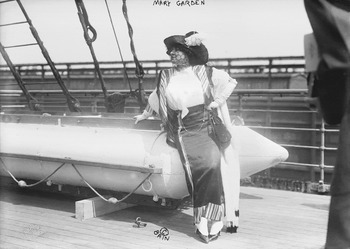
In addition to the telegraph, theatre managers made strategic use of ship decks and piers to call attention to their participation in transatlantic actor-networks (Fig. 3). From 1900 to 1914, photographs chronicling the arrivals and departures of foreign dignitaries, royalty, and celebrities aboard transatlantic liners were a regular feature in newspapers and magazines. Staged against a backdrop of life jackets, lifeboats, rigging, ropes, rails, and other ship paraphernalia, these photographs testified to the desirability, status, and mobility of their subjects and of their circulation within an entertainment industry that was increasingly transnational in scope. For their part, theatre managers made a point of presenting themselves to reporters as skilled hunters of foreign game, the theatrical equivalents of Teddy Roosevelt on safari. For example, when real estate agent–turned–theatre manager Henry W. Savage returned to New York in January 1907 after obtaining the rights to Franz Lehár's operetta The Merry Widow, “a chartered tug carrying several of the members of his staff and a brass band” greeted the Kaiser Wilhelm der Grosse and proceeded to serenade the impresario as the liner made its way to the Hoboken pier.Footnote 79 After another trip several months later, Savage was surrounded by a group of reporters who “showered” him with a “storm of questions” when he alighted onto the pier. A consummate publicity artist, Savage “simply asked for a chance to recover from the shock of seeing a whole parade of his friends wearing blue badges with the inscription ‘Welcome’ in gold letters, and led by a brass band.” After the band had finished playing, Savage turned to the crowd, “recovered his breath,” and then outlined his plans to the patient reporters. Impressed by Savage's carefully paced, well-executed performance, the New York Dramatic Mirror published a full account of the event.Footnote 80
American opera singer Mary Garden poses coyly with a lifeboat upon her arrival in New York. Celebrities such as Garden were frequently swarmed by photographers and reporters and made the most of the free publicity. Photographer unknown, Bain News Service. Courtesy of the Library of Congress Prints & Photographs Collection.

Charles Frohman did not need a brass band to herald his arrivals or departures. “No sooner has it leaked out in New York that Mr. Frohman is going abroad than the press, with one accord and a single purpose, sets its journalistic bloodhounds on his trail,”Footnote 81 the Dramatic Mirror's “Usher” reported. When he was “intercepted before sailing,” Frohman would gamely outline his plans to reporters, who would publish the news in local papers and cable it abroad. On the other side of the Atlantic, Frohman would once again be beset by the British press hungry for more news. “Such is fame,” “The Usher” concluded, “and such are some of fame's penalties.”Footnote 82 Yet while Frohman may have tired of the media circus that surrounded him, he knew how to exploit the attention for maximum effect. Speaking to a London-based correspondent for the New York Times before returning on the Lusitania in 1908, he revealed just enough information to ensure that his journey would be closely followed. “‘You can tell New York,’ said he . . ., ‘that I have bid for a lot of novelties for them from Greek dancing to tragedy.’” Given little to report, the Times correspondent suggested that “[o]n the voyage across,” Frohman would “probably elaborate the details of his permanent stock company of English and American actors.”Footnote 83 Despite his personal preference for remaining out of the public eye, Frohman recognized the value of publicity; more acting than acted upon, he knew how to keep his name, actors, and business in the public eye as they moved across the Atlantic.
Transmitting Culture across the Waves: The Ship's Concert and Other Ship-Bound Performances
The argument is that thinking, acting, writing, loving, earning—all the attributes that we normally ascribe to human beings, are generated in networks that pass through and ramify both within and beyond the body. Hence the term, actor-network—an actor is also, always, a network.
—John Law, “Notes on the Theory of the Actor Network”Footnote 84Transforming ocean liners into functional theatres was a logical extension of Frohman's empire-building efforts in London and New York. With so many stars, plays, costumes, set pieces, and other properties traveling across the Atlantic, mounting a full-scale production at sea was a potentially cost-effective prospect, especially since most contracts required managers to pay for their performers' passage.Footnote 85 In October 1907, shortly after the launch of the Lusitania, Frohman approached the Cunard Company in London with a proposal. His business manager Alf Hayman told the New York Times that while details were undetermined, a light comedy would likely be “tried first on board the Lusitania.” If Cunard agreed to the proposal, Frohman would oversee the production, the first by a professional theatre company at sea.Footnote 86
When asked for their opinion of the scheme, actors and other theatre managers expressed reservations about the feasibility of performing on the open ocean. “The actors and actresses engaged for the ocean theatre must carry certificates stating that they are proof against seasickness,” joked one manager. “They must also be steady on their feet, for it would never do to find two quarreling lovers thrown into each other's arms at the very moment when they were vehemently declaring that they never want to meet again.” The actress Madge Carr Cook disapproved of the plan because it took away from the leisure time of actors. “The actor and actress want a rest as much as other people want it,” she said. “Why, then should they be made to work while they are at sea?”Footnote 87
Despite these challenges, Cunard eventually agreed to the scheme, and Frohman, the consummate mediator, set about transforming the liner into a floating theatre. In February 1910, newspapers on both sides of the Atlantic announced that Marie Doro and the members of Charles Frohman's Floating Theatre Company would perform Edward Locke's play The Climax on board the Mauretania on its upcoming voyage from New York to Liverpool. Since the production had just completed a successful run in New York and was to open in London later that month, mounting it on the Mauretania must have seemed a practical, plausible venture. Plans were made to erect a special stage extending across the entire width of the main dining saloon with seating for five hundred passengers, many of whom had written to Frohman's business manager (presumably Seymour) inquiring about the possibility of “walking on” roles.Footnote 88 The business manager also oversaw the movement of all properties and costumes on board the Mauretania, while the stage carpenter and the ship's carpenter agreed to share responsibilities for assembling the stage.Footnote 89 Frohman himself was scheduled to direct.Footnote 90 In an announcement to the New York press, Frohman shared his belief “that with the advent of giant Cunarders and even bigger vessels, such as the White Star liners now building [i.e., the Titanic], the day for an ocean-going theatre has undoubtedly arrived.”Footnote 91
But Frohman's optimism did not account for the unpredictability of the ocean as an actor in his scheme, and the joking comments about the challenges of performing on the rough seas proved prophetic. According to an almost-buried report in the Observer (London), the Atlantic “proved so unfavourable to theatrical enterprise on board the Mauretania that the project had to be abandoned for the reason indicated in the confiding statement that the principal actress, Miss Marie Doro, threw up her part.”Footnote 92 While acting on the Mauretania was an exciting proposition, the Atlantic Ocean, the real star of Frohman's Floating Theatre Company, refused to play its part accordingly. The failure of The Climax offers a particularly vivid example of the “depunctualization,” or disruption, of an actor-network through the obtrusive actions of a previously “black-boxed” actor. The ocean as calm intermediary posed no threat to the stability of the network; the ocean as raging mediator did.
Despite the failure of Frohman's initial venture, ocean liners remained important actors within the evolving networks that defined theatre culture, often as stages for the performance of songs, sketches, and dance numbers from Broadway and West End shows. Alan Dale recalls a raucous group of twenty young travelers who monopolized a row of steam chairs and subjected their fellow passengers to an impromptu concert. United in their youth and boredom, they sang “through all the musical comedies, operettas, burlesques, extravaganzas, and rag-time excrescences of the New York season” along with “the classic numbers of Vesta Victoria, Alice Lloyd, Vesta Tilley, Harry Lauder, and all the rest of the ‘vaudeville’ nightingales of both sexes.”Footnote 93 Reproducing the Broadway soundscape for the delight (or horror) of their fellow passengers on the ocean liner deck, they presented themselves as avid consumers and disseminators of popular culture.
The ship's concert, a much-anticipated event on most transatlantic crossings, likewise functioned as a space for performing and reproducing commercial theatre culture. Typically held the night before the first sight of land, the concert was a reward for those who had endured days of relative emptiness and boredom, a celebration of the temporary bonds forged between passengers, and an opportunity to give back to the ship's crew by raising money for one of their charities. In The Travelers' Handbook: A Manual for Transatlantic Tourists (1907), Josephine Tozier advised prospective middle-class travelers about how to dress and behave at such an event:
If the duty of giving the concert devolves upon amateurs, every one [sic] who can do anything to interest or entertain offers a service. In this case the audience should be as lenient and admiring as possible. Wear the best garments the restricted stateroom luggage permits, and be attentive and courteous throughout the performance. It is particularly rude to talk or criticize the performers, when they are endeavoring in every way to make the occasion successful.Footnote 94
Finding “talent” for the concert was generally left to an enterprising passenger, who first sought permission from the ship's captain before recruiting acts. In a chapter devoted to the “Atlantic Ocean's sublime relaxation—the ship's concert,”Footnote 95 Alan Dale describes the actions of a “hustler” (221) tasked with arranging the concert. “He pretends that it is most distasteful to him, and that he is actuated by purest motives of charity. My opinion is that he has elected himself to this job, a week before sailing, and that it is his great chance for becoming temporarily ‘prominent’” (221). In Dale's account, the hustler (a traveling salesman from Michigan) succeeded in recruiting a “New England spinster” (225) and an “English matron” (229) to sing ballads, a college professor to deliver a “serious” reading of Omar Khayyám's Rubáiyát (228–9), a banjo soloist to play popular ditties, a sales clerk to read Dickens, and “an anaemic-looking curate” to deliver “The Charge of the Light Brigade” (235). On the evening of the concert, the well-dressed audience was “invariably delighted” (239) with the results, and the performers basked in their newfound celebrity as they were temporarily transformed from clerks and spinsters into Broadway headliners, all for charity.
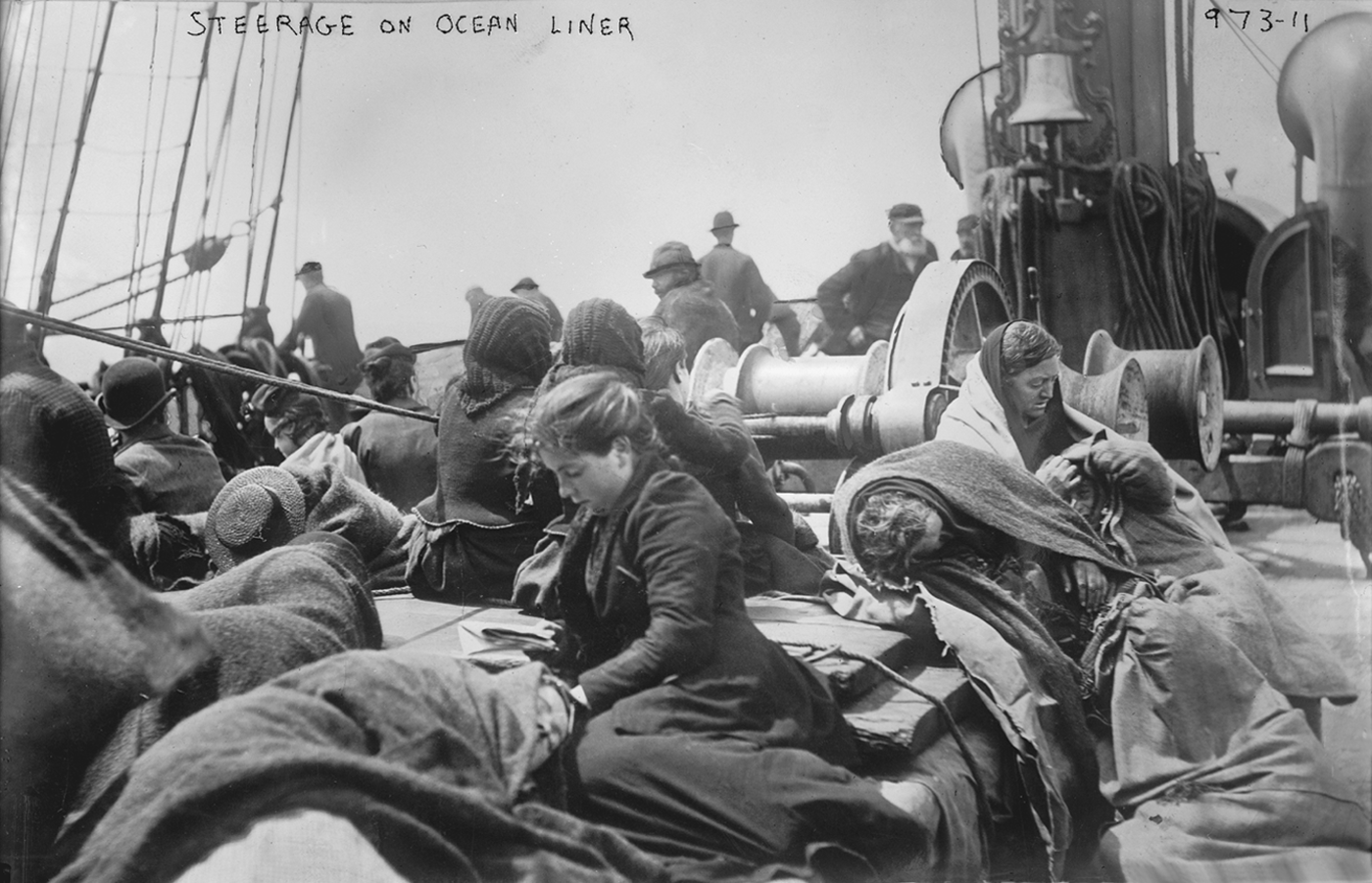
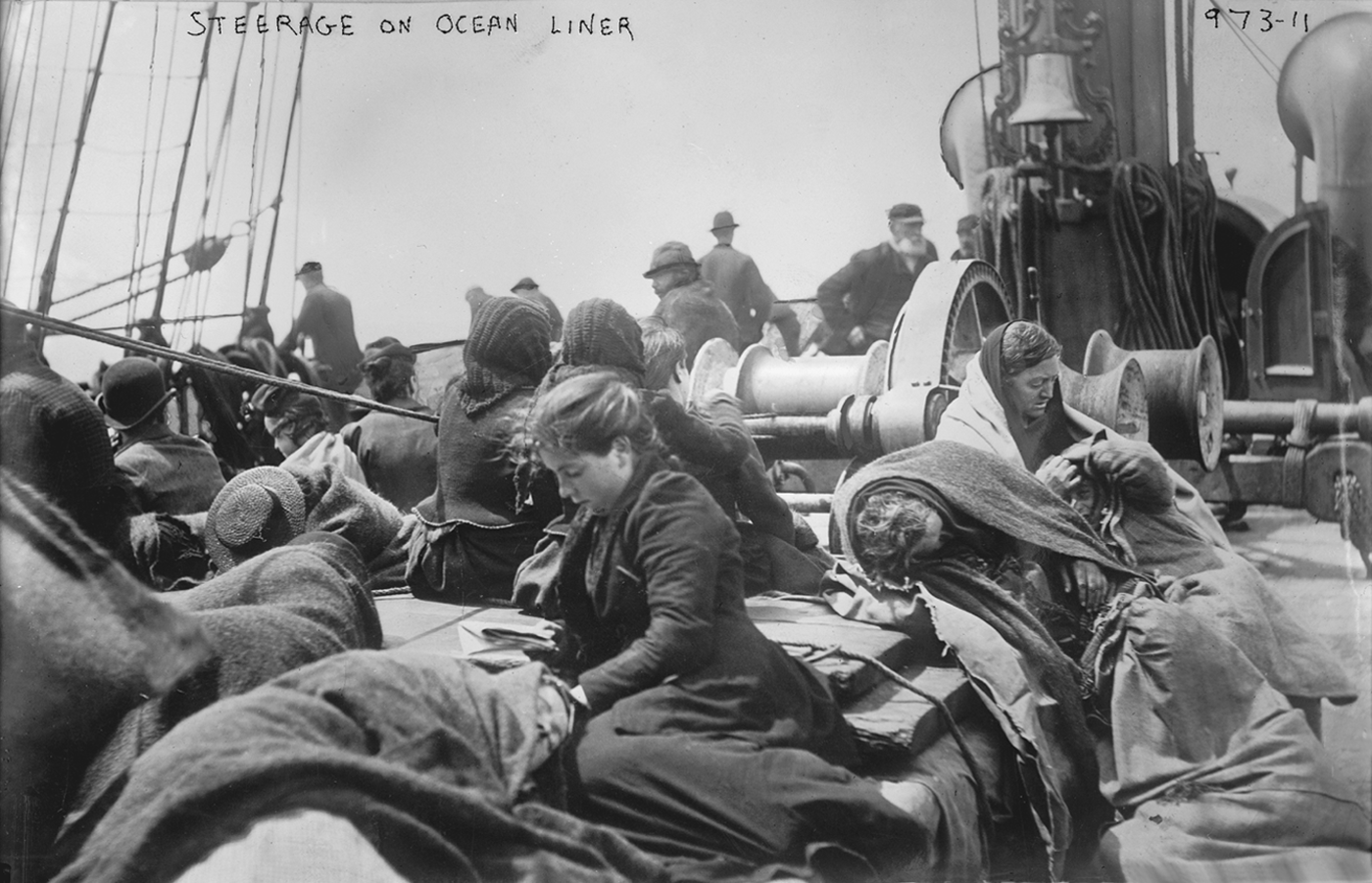
As Dale's wry comments suggest, the charity aspect of the ship's concert provided the necessary justification for average middle-class passengers to abandon their reserve and indulge in dreams of theatrical stardom. Although the specific charity organization varied, the recipients were almost always the widows and orphans of sailors. “There would be no concert if there were no orphans,” was Dale's sardonic conclusion. “Nobody would dare to offer such an entertainment for mere pleasure! It is like the charity bazaar, in which you see more bazaar than charity” (222). More important, the charity aspect of the concert allowed middle-class passengers to assert their status by distinguishing themselves from both the sailors who ensured their safe passage and the passengers traveling in steerage, who were conspicuously absent at the concert (Fig. 4). Rather than identify the actor-networks that bound first-class passengers to those in steerage, the concert focused on the networks that tied first-class passengers to unseen and unidentified widows and orphans on a distant shore. In effect, the concert encouraged its participants to perform a safe, clean kind of charity, a “black-boxed” charity that did not require any reflection upon or confrontation with the examples of poverty that lay beneath them on the ship.
Steerage passengers at rest on board the Red Star Line's first Pennland (formerly Cunard's Algeria). Photographers such as Alfred Steiglitz documented immigrant arrival experiences as part of a larger effort to raise awareness about social and economic disparities in the United States. Photographer unknown. Courtesy of the Library of Congress Prints & Photographs Collection.
The concert's function as a mechanism for performing and asserting class status became glaringly evident in 1907 when actor-comedian Bransby Williams, who had presented a series of Dickens characters during the ship's concert, reappeared later in the dining hall dressed as “Garry” the Irish stoker. Failing to recognize him outside the context of the concert, the ship's pursuer “promptly ordered him below,” only to learn that he was in fact one of the first-class passengers. The “joke,” which fooled most of the ship's officers, also exposed the underlying class prejudices that the ship's concert worked so carefully to obscure. It was one thing for passengers to raise $115 for the benefit of the ship's fireman and stokers and quite another to be required to sit beside them at dinner.Footnote 96 Such a mixing of class lines would have the effect of exploding the black box of ocean liner travel.
Ship's concerts became highly charged political events when participants disagreed over the material being presented or objected to appearing with certain performers on the bill. In 1897, a young American woman named Sophia Schuyler refused to play a piano accompaniment to “God Save the Queen,” much to the shock of other American passengers, who promptly sang the song a cappella.Footnote 97 Lingering middle-class anxieties about the morality of being “on the stage” also influenced the programming of the ship's concert. In 1900, three ministers successfully managed to oust two chorus girls from the concert program on the Minnehaha, declaring that if the girls were allowed to perform, they would not appear. The ministers' aggressive stand divided the passengers, some of whom preferred dancing chorus girls to intoning ministers, but the appeal to morality proved too difficult to challenge. Following the concert, which the dejected chorus girls did not attend, “a social war was declared aboard the vessel.” According to a report in the New York Times, “As the girls walked on deck some of the other women passengers drew their skirts aside as they passed, and otherwise humiliated them.” When the ship arrived in New York, the chorus girls spoke to reporters about the treatment they had received, stating “Just because we are on the stage these people tried to ostracize us.”Footnote 98
Perhaps wary of such a reception, many performing artists refused to play or sing at the ship's concert. Some abstained from performing during the transatlantic voyage, seeing the time on board ship as an important opportunity to rest (and presumably to play), while others cited concerns that appearing at the concert would invalidate contracts to play elsewhere.Footnote 99 Major stars such as opera singers Enrico Caruso and Luisa Tetrazzini opted to give a donation directly to the Seamen's Fund in lieu of a performance or offered a trinket or signed program that could be sold in an auction or given as a raffle prize.Footnote 100 Some performers declined altogether because they felt that the money raised should go to causes that supported actors and their dependents as well as the dependents of seamen. They argued that while such events served as free advertising for managers and their enterprises, performers themselves received little compensation. In 1907, vaudeville comedian R. G. Knowles refused to appear at the concert unless half of the money collected was donated “to Comedy Club and the White Rats organization [a vaudeville union], in trust for the benefit of actors' widows and orphans.” When he reached New York, Knowles enlisted the help of Ernest Lawshe of the United States Amusement Company to convince American actors and vaudeville performers “to refuse to appear at any transatlantic ship's concert unless half the amount collected is given to the Actors' Fund.”Footnote 101 Knowles and Lawshe seem to have had some success in recruiting their peers to this cause. In 1914, Al Jolson, Frank Tinney, Melville Ellis, and five other professional performers on board the Hamburg-Amerika's Vaterland performed on condition that half the proceeds would go to the Actors' Fund, “and the remainder to the German Seaman's Home in Hamburg.”Footnote 102 By insisting that impoverished Americans should also benefit from their labor, these actors disrupted traditional charity networks, which tended to “black-box” poverty by keeping it at a distance, and instead focused attention on matters closer to home. Of course, it's also possible that as war clouds gathered in the summer of 1914, Tinney, Ellis, and Jolson were simply uncomfortable performing for the benefit of German citizens.
Despite their disagreements, performers and managers agreed on one thing: the ship's concert was ripe for commercial exploitation. In May 1914, Frank Allen, managing director of the London Hippodrome, revealed plans to establish an “Ocean Circuit for Vaudeville.” In preparation for the launch of the Cunard ship Aquitania, a brand-new liner that promised to outperform even the Lusitania and the Mauretania, Allen oversaw the construction of a theatre in the Georgian saloon on Deck A, complete with a stage appropriate for vaudeville, ten dressing rooms, an orchestra that would seat sixteen performers, and even a darkroom for newspaper photographers. Designed to “accommodate 1,500, the seating arranged on the same plan as that of the London Hippodrome,” the theatre was scheduled to open on 29 May, the night before the ship embarked on its maiden voyage, with vaudeville stars Cyril Maude, Vesta Tilley, George Robey, and Barclay Gammon on the bill.Footnote 103
In mid-May, Allen boasted to a reporter for the New York Times that performances on the Aquitania would occur nightly “with the proviso that everybody is not seasick—that is[,] the audience—the actors do not matter. Better a sick professional than a well amateur.” Allen's joking yet callous attitude toward performers suggests that he was more concerned with his own financial well-being than with the health and safety of his company. Although he reassured the reporter that a percentage of tickets (which were $5 to $20 per person) would go sailors' widows and orphans, he remained fixated on the “possibility of a world-wide ocean circuit.” “I have had this project in view for the last four years,” he said. “If the Aquitania's theatrical experiment is successful, other lines are almost certain to follow. There is so much rivalry between them that if one moves, they will all go.”Footnote 104 What Allen failed to anticipate was that the growing political tensions that effectively fueled the competition between the liner companies would culminate in war, not theatre.
Though the official launch of the Aquitania was delayed by several days, Allen's vaudeville theatre opened on 29 May, as promised, with lively performances by Vesta Tilley and others. A writer for the Manchester Guardian mused while “[s]itting at ease in deep wicker chairs watching Miss Vesta Tilley repeat her kindly satirical impersonations” that “it required a definite exertion of the memory to realise that we and the theatre, the stage and all, were part of an immense floating structure that will move across the Atlantic comfortably in six days.”Footnote 105 For this writer, the actual experience of being in the theatre obscured (or “black-boxed”) the theatre's physical location; seated in the wicker chairs, laughing at Vesta Tilley, he temporarily forgot about the “immense floating structure” that was propping up the theatre, not to mention British corporate and imperial ambitions. By early August, however, war clouds were hanging heavily over the Atlantic, and Broadway managers and actors began to panic when their bookings on the Aquitania and other liners were cancelled.Footnote 106 Although these stranded individuals eventually secured a passage home, Frank Allen's hopes for a pan-Oceanic vaudeville actor-network had disappeared, along with his key actors: the ships. By late August, the British Admiralty had taken over the Aquitania, installed guns on its decks, and completely stripped it of its cabins, woodwork, and theatre, leaving only the steel shell and its powerful engines intact.Footnote 107
“Why fear death?” The Ocean Liner as Graveyard
It's the power exerted through entities that don't sleep and associations that don't break down that allow power to last longer and expand further.
—Latour, Reassembling the Social Footnote 108On 1 May 1915, Charles Frohman boarded the Lusitania in New York, against the wishes of his friends and business associates. The previous week, the Germany embassy in Washington, D.C., had issued a warning to all travelers, reminding them “that, in accordance with formal notice given by the Imperial German Government, vessels flying the flag of Great Britain, or of any of her allies, are liable to destruction in those waters and that travelers sailing in the war zone on ships of Great Britain or her allies do so at their own risk.”Footnote 109 Days before, while overseeing a production in Philadelphia, Frohman had received an anonymous telegram advising him that the Cunard line would be targeted by German U-boats. Despite these warnings, Frohman refused to change his travel plans. A legal matter required his presence in London, and he was eager to see the new Gaby Delys production that his friend, playwright J. M. Barrie, had written to him about.Footnote 110
In preparing for his departure, Frohman joked with friends about the dangerous situation. “[I]f you want to write to me just address the letter care of the German Submarine U4,” he told his business partner Al Hayman as he bade him goodbye. When playwright Paul Potter, who accompanied Frohman to the pier, asked “Aren't you afraid of the U boats, C. F.?” the manager responded, “No, I am only afraid of the I O U's.” And in a steamer letter Frohman wrote to producer Charles Dillingham, his companion of many years, he included a sketch of an ocean liner under attack by a U-boat. Frohman's biographers suggest that the manager may have had a premonition about his fate and was willing to accept death should it come. “For one thing,” they write, “he dictated his whole program for the next season before he started. It was something that he had never done before.”Footnote 111
Whether out of prescience, bravado, or fear, Frohman's jokes suggest that he was very aware that maintaining his transatlantic enterprise meant participating in an actor-network that was implicitly if not explicitly militaristic. Where once theatrical and military actor-networks had existed alongside each other but rarely converged, by 1915 the two had collapsed into one. Boarding the Lusitania was tantamount to stepping onto a battleship.
On 7 May, when the Lusitania was within sight of the Irish coast, a torpedo launched by a German U-boat ripped into its hull, killing 1,198 of the 1,959 people on board, Frohman among them. Survivor Rita Jolivet, an actress in one of Frohman's companies, recalls that when the liner was hit, the manager calmly continued to smoke his cigar and chat with his companions on the upper promenade deck. When the ship began to lurch, he turned to those around him and asked, “Why fear death? It is the most beautiful adventure of life.” Echoing a line from Barrie's Peter Pan—“To die would be an awfully big adventure”—he refused to allow the German torpedo to dictate his response to the end.Footnote 112
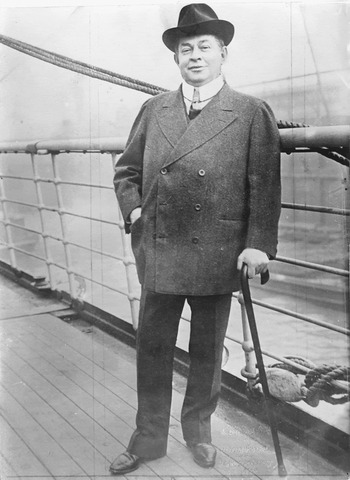
It is perhaps fitting that the most famous photograph of Frohman was taken on board a Cunard liner a year before his death (Fig. 5). In a pose that recalls Jacques-Louis David's famous portrait of Napoleon, he stands on the promenade deck of the Mauretania and looks directly at the camera, a cane in his left hand, his right hand resting casually inside the pocket of his suit jacket.Footnote 113 Although Frohman was one of the world's leading impresarios, he was rarely photographed. But his demeanor in this photograph suggests that he was comfortable in his surroundings. Unlike critic Alan Dale, who despised his unmoored “ship self,” Frohman clearly embraced his. Indeed, if Frohman was one of Broadway's major builders at the turn of the twentieth century, then it was the ocean liner that made him who and what he was.
American impresario Charles Frohman on board an ocean liner (possibly a Cunard ship), ca. 1914. With theatres on both sides of the Atlantic, Frohman spent several months in London each year and was therefore the equivalent of a contemporary “frequent flyer.” This photograph is frequently misidentified as the “Last Photograph of Charles Frohman, taken on the Lusitania, 1915,” but the caption beneath the photograph in the Marcosson and Frohman biography (following p. 384) clearly identifies the date as 1914, which suggests that it was taken several months to a year prior to Frohman's death. Photographer: Underwood and Underwood. Photography Collection, Miriam and Ira D. Wallach Division of Art, Prints and Photographs, The New York Public Library, Astor, Lenox and Tilden Foundations.