1. Introduction
Inverse marking is a type of argument indexation first discovered in Algonquian languages (Plains Cree, for example; see Wolfart Reference Wolfart1973). Although there are some exceptions (Jacques and Antonov Reference Jacques and Antonov2014: 311), it occurs generally in transitive constructions of head-marking languages, to mark the inverse relation between the A and the P, where the A ranks lower than the P in the empathy hierarchy (DeLancey Reference DeLancey1981). For instance, in Plains Cree, the morpheme -iko in (1b) marks the inverse direction, as the A (third person plural) ranks lower than the P (first person plural) in the empathy hierarchy.
(1)

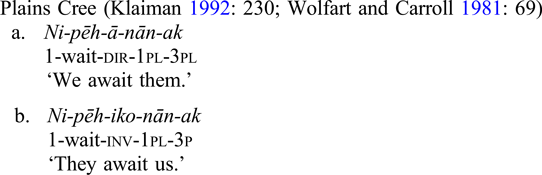
This paper describes the inverse marking system in Khroskyabs, with special focus on the Siyuewu and Wobzi varieties, and carries out a hypothesis on the development of inverse marking in Khroskyabs by comparing the nuances in usage between the two varieties.
The paper is structured as follows: in the remainder of this section, I present some background information on Khroskyabs, focusing on its argument indexation. Section 2 provides a brief presentation of the inverse marking systems in Rgyalrongic languages in general; and Sections 3 and 4 offer detailed descriptions of the inverse marking systems of the two Khroskyabs varieties under study, Siyuewu and Wobzi. In Section 5, I postulate a hypothesis on the evolution of inverse marking in Khroskyabs, in order to reconstruct its proto-system. Finally, Section 6 summarizes and concludes the paper.
1.1. The Khroskyabs language
Khroskyabs is classified under the Rgyalrongic branch in the Trans-Himalayan language family. With the Stau varieties, and possibly Tangut, it forms the West-Rgyalrongic subgroup (Sagart et al. Reference Sagart, Jacques, Lai, Ryder, Thouzeau, Greenhill and List2019; Lai et al. Reference Lai, Gong, Gates and Jacquesforthcoming), as opposed to the other subgroup, the Rgyalrong languages, which consists of Situ, Japhug, Tshobdun, and Zbu (Sun Reference Sun2000a; Reference Sun2000b; Lai Reference Lai2017; Gong Reference Gong2018).
1.2. Dialects under investigation
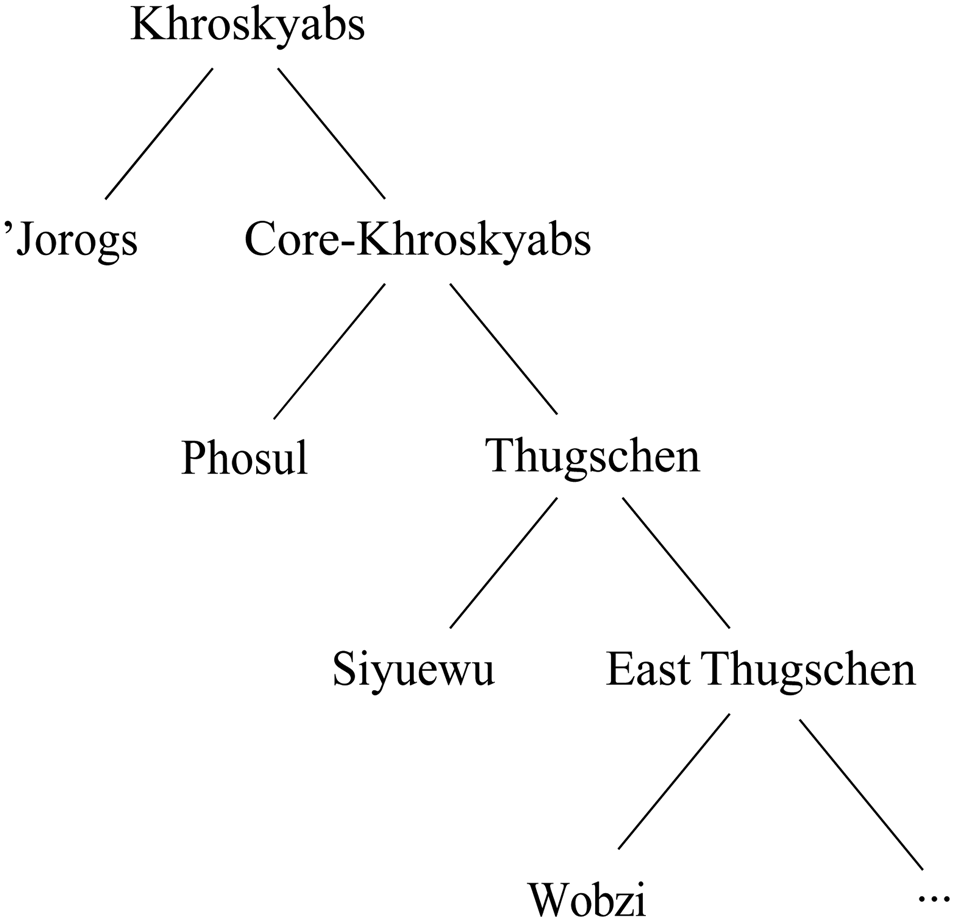
The two varieties discussed in this paper, Siyuewu (斯躍武 Sīyuèwǔ) and Wobzi (俄熱 Érè), are spoken in two different townships, Dzamthang (壤塘縣 Rǎngtáng Xiàn) and Chuchen (金川縣 Jīnchuān Xiàn) respectively; the two are 46 kilometres driving distance apart. Based on common phonological and lexical innovations, the Stammbaum of Khroskyabs is illustrated in Figure 1 (Lai Reference Lai2017: 15). Siyuewu and Wobzi are both classified under the Thugschen subgroup.
Stammbaum of Khroskyabs according to Lai (Reference Lai2017: 15)
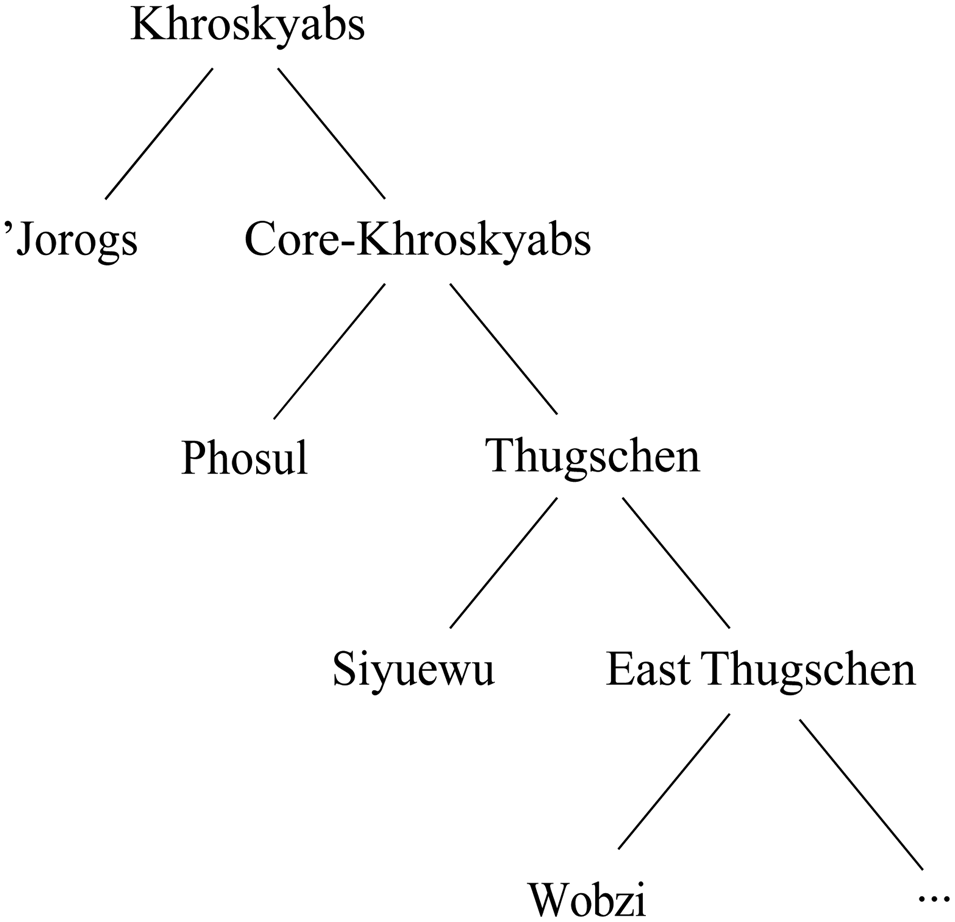
The two varieties are mostly mutually intelligible to native speakers, but they present subtle yet important differences linguistically.
1.3. Argument indexation
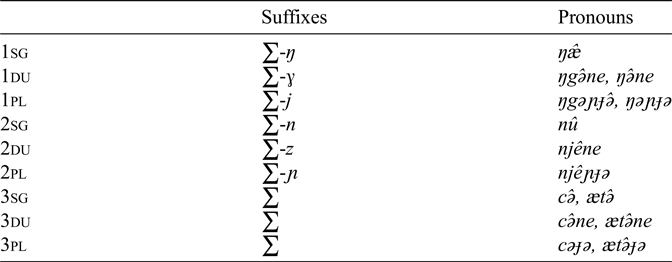
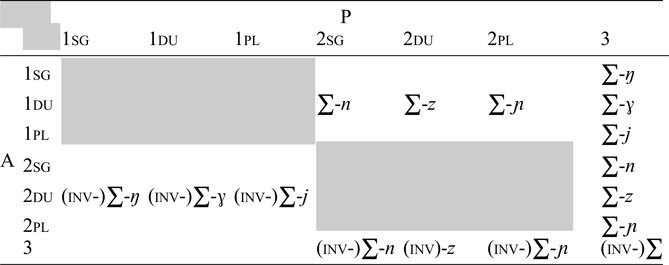
Since inverse marking is a sub-domain of argument indexation, it is necessary to give an outline of the argument indexation system in Khroskyabs. Like other Rgyalrongic languages (Jacques Reference Jacques2004; Gong Reference Gong2018; Zhang Reference Zhang2019), the argument indexation system in Khroskyabs is based on morphological transitivity (Jacques Reference Jacques, Haude and Gilles2012b). Thanks to their different paradigms, two types of verb can be unambiguously distinguished in a morphological way. The first type, intransitive verbs, indexes only one argument; and the second type, transitive verbs, indexes information of two arguments with personal suffixes as well as inverse marking. Tables 1 and 2 show the intransitive and the transitive paradigms of Siyuewu Khroskyabs.
Intransitive indexation in Siyuewu
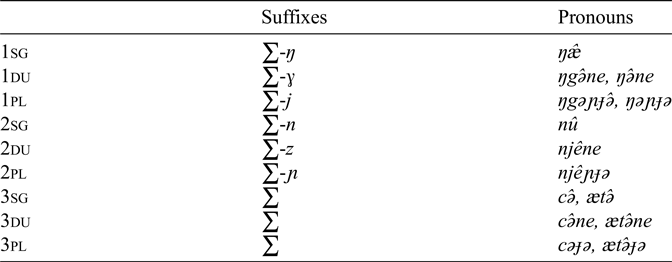
Siyuewu transitive indexation
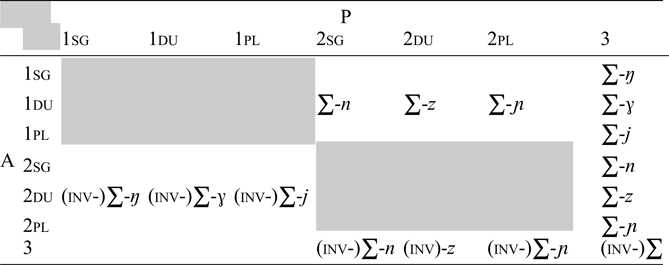
From the perspective of personal suffixes, Siyuewu distinguishes three numbers: singular, dual, and plural, for SAP pronouns,Footnote 3 and has no number distinction for third person. In the transitive paradigm, Siyuewu exhibits globally a hierarchical alignment, where the suffix is indexed for SAP arguments, see (2a). Within SAP arguments, the P is indexed, see (2b) and (2c).
(2)
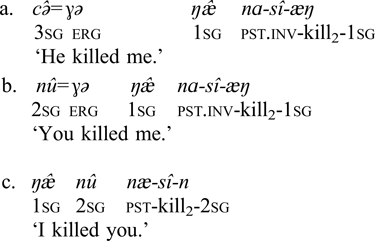
Apart from the suffixes, an additional preverbal element occurs in some specific cases, see the prefix difference between Example (2c) (næ-) and the other two examples in (2) (nɑ-). The element ɑ- is exactly the inverse marker that I am mainly dealing with in this paper.
Lai (Reference Lai2015; Reference Lai2017) accounts for the argument indexation system in the Wobzi variety of Khroskyabs, which is similar to the Siyuewu system. However, Wobzi is simplified suffixwise: there is no 1du, only -ŋ ‘1sg’ and -j ‘1pl’ are preserved, and the only suffix preserved for second person is -n ‘2’. The use of the inverse marker in Wobzi presents some differences from that of Siyuewu.
2. Inverse marking in Rgyalrongic languages
In this section, I present inverse marking systems in Rgyalrongic languages in general. In Section 2.1, I provide some theoretical background information; in 2.2, I focus on inverse marking in Rgyalrong languages; and in 2.3, I discuss inverse marking in West-Rgyalrongic.
2.1. Scenarios
In my analysis I follow the method proposed by Zúñiga (Reference Zúñiga2006), in which three transitive scenarios are distinguished: local (SAP↔SAP), mixed (SAP↔3), and non-local (3↔3). Each scenario can be further divided into direct and inverse sub-scenarios, according to the language-specific empathy hierarchy.
2.2. Inverse marking in Rgyalrong languages
There are at least four recent publications dedicated to inverse marking or argument indexation in Rgyalrong languages: Jacques (Reference Jacques2010) for Japhug; Gong (Reference Gong2014) for Zbu; Sun (Reference Sun2015) for Sastod Situ; and Zhang (Reference Zhang2019) for Bragbar Situ.
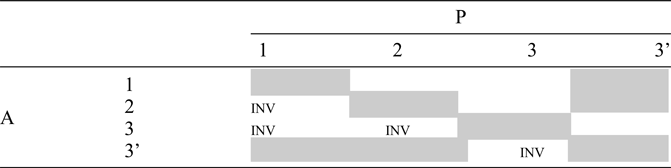
Generally, Rgyalrong languages exhibit this empathy hierarchy: 1 > 2 > 3 > 3’. In the local configuration, first person outranks second person; in the mixed configuration, SAP arguments outrank the non-SAP ones; and in the non-local configuration, the treatment between 3 and 3’ varies from language to language. Table 3 illustrates the generic inverse system in Rgyalrongic languages.
Generic inverse system in Rgyalrong languages
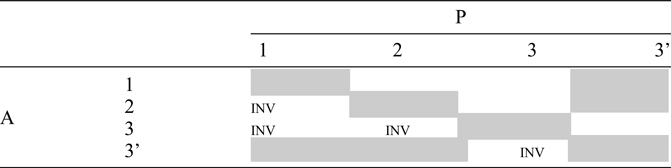
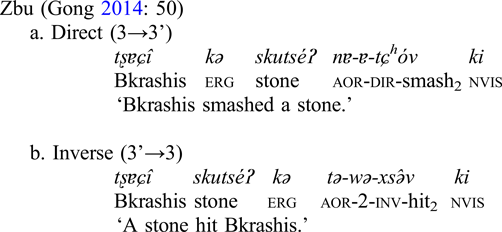
In Zbu, the directions in non-local scenarios are determined by animacy, as illustrated in (3). In (3a), the A of the predicate, tʂɐɕi ‘Bkrashis (personal name)’, is animate, and the P, skutséʔ ‘stone’, is inanimate, therefore the inverse marker does not occur. Example (3b) is the reverse scenario of Example (3a), where the A is inanimate and the P is animate, in this case, the inverse marker wə- must appear.
(3)
Other Rgyalrong languages may have different distributions for 3 and 3’, and some even individually grammaticalized the non-local direct-inverse distinction in various ways.
The Sastod variety of Situ distinguishes third person singular, which ranks higher, from third person non-singular (Sun Reference Sun2015: 733). Therefore, the non-local direct scenario is 3sg→ 3ns, and the non-local inverse scenario is 3ns→ 3sg. Bragbar Situ generalized the non-local inverse use to the past tense (Zhang Reference Zhang2019).
2.3. Inverse marking in West-Rgyalrongic
Three recent publications specifically focus on the inverse marking or argument indexation in West-Rgyalrongic: Sun and Tian (Reference Sun and Tian2014) for Gexi (Stau); Jacques et al. (Reference Jacques, Antonov, Lai and Lobsang2014) for Khang.gsar (Stau); and Lai (Reference Lai2015) for Wobzi Khroskyabs. The system in Tangut, an extinct language that was probably also a West-Rgyalrongic language (Lai et al. Reference Lai, Gong, Gates and Jacquesforthcoming), is mentioned in Gong (Reference Gong2017).
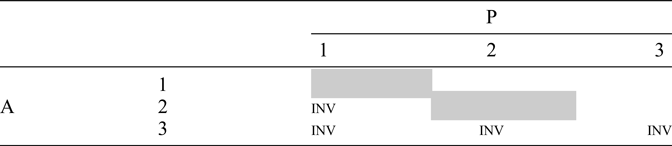
Although there are superficial exceptions due to phonotactics and morphology (as will be discussed below), it is believed that West-Rgyalrongic neutralized the contrast between 3 and 3’, and generalized the inverse use to all non-local scenarios (Jacques et al. Reference Jacques, Antonov, Lai and Lobsang2014: 89; Lai Reference Lai2015: 283–4). This neutralization is also considered one of the shared innovations that characterizes the West-Rgyalrongic subgroup. The generic inverse system in West-Rgyalrongic is shown in Table 4.
Generic inverse system in West-Rgyalrongic languages
3. Inverse marking in Siyuewu Khroskyabs
In this section, I describe the inverse marking in Siyuewu Khroskyabs in detail. I start with the morphophonology in Section 3.1 in order to deal with the conditions of the occurrence of the inverse marker, and give examples for each condition in Sections 3.2 and 3.3.
3.1. Morphophonology
In Siyuewu Khroskyabs, the inverse marker does not have an independent form and thus cannot appear alone. It has to depend on the orientational prefixes or the negative prefix.
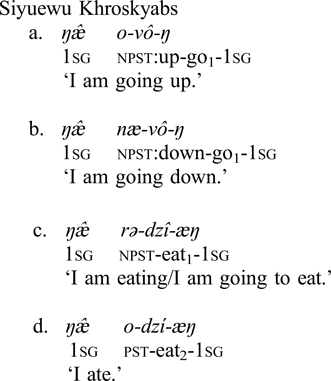
Orientational prefixes have two major functions. First, they indicate the direction of the action denoted by a verb, as shown in (4a) (up) and (4b) (down); and second, they are lexically assigned to verbs to mark TAMEFootnote 4 properties, as shown in (4c) (non-past) and (4d) (past). Most verbs are obligatorily prefixed by an orientational marker in the past tense, but there are a handful of verbs that are not compatible with orientational prefixes in such a situation (for example, vdê ‘to see’, as will be illustrated further below).
(4)
The inverse marker colours the vowel of orientational prefixes with [+back], [+round] or [-high] features, as shown in (5).
(5)
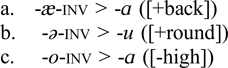
The vowel-colouring results in two series of orientational prefixes, a default series and an inverse series,Footnote 5 are shown in Table 5.
Orientational prefixes in Siyuewu

When there is no orientational prefix, the inverse marker in Siyuewu depends on the negative marker mə- by colouring the vowel into -u, as shown in Example (6).
(6)

3.2. With orientational prefixes
In this part, I analyse the use of inverse with orientational prefixes in each scenario. I first provide canonical non-natural examples, then examples from natural narratives.Footnote 6
3.2.1. Local scenarios
The canonical examples for local scenarios are illustrated with the verb dzîd ‘to eat’, of which the past tense goes with the orientational prefix o- ‘up’. The local direct scenario is shown in (7a), and the local inverse scenario in (7b).
(7)
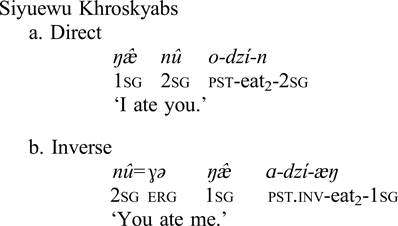
Natural examples are shown in (8). Example (8a) shows a local direct scenario with the verb ɲcô ‘to throw’, and Example (8b) shows a local inverse scenario, with the verb nvlú ‘to fool’.
In narratives, it is usual that personal pronouns are omitted, as in (8a), where the A, ŋæ̂ ‘1sg’, is not pronounced but can be inferred from the context. The inflected verb form næ-ɲcó-n (pst-throw2-2sg), with the uncoloured orientational prefix næ-, and the suffix -n ‘2sg’, can only imply a local direct scenario.
In (8b), the inflected verb form nɑ-nvlû-ŋ (pst.inv-fool2-1sg), with the inverse-coloured orientational prefix nɑ- and the suffix -ŋ ‘1sg’, implies a local or mixed inverse scenario, however the context shows that it can only be a local one.
(8)

3.2.2. Mixed scenarios
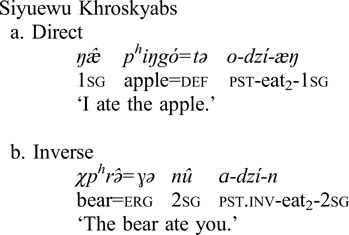
I use again the verb dzîd ‘to eat’ to illustrate canonical examples of the mixed configuration, see the examples in (9). In (9a), the scenario is 1→3 (mixed direct); and in (9b), the scenario is 3→2 (mixed inverse).
(9)
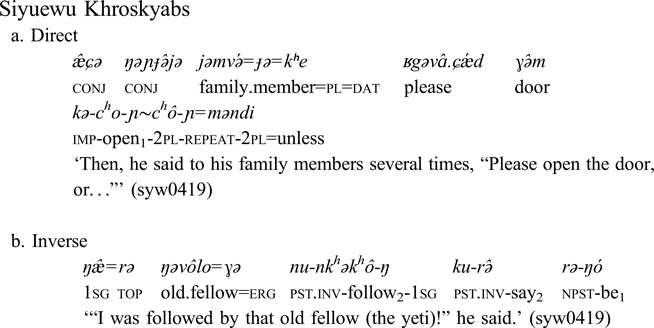
Natural examples of the mixed configuration are shown in (10). The direct scenario (3→2) is illustrated with the verb cʰô ‘to open’ in (10a), and the inverse scenario (3→1) with the verb nkʰəkʰə́ ‘to follow’ in (10b).
(10)
3.2.3. Non-local scenarios
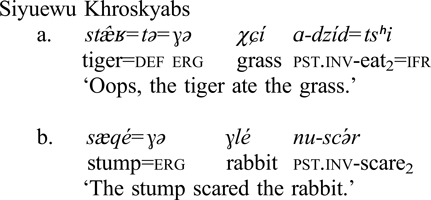
In non-local scenarios, the inverse marker always appears, as shown in (11). In (11a), the A is animate and the P is inanimate; in (11b), the A is inanimate and the P is animate.
(11)
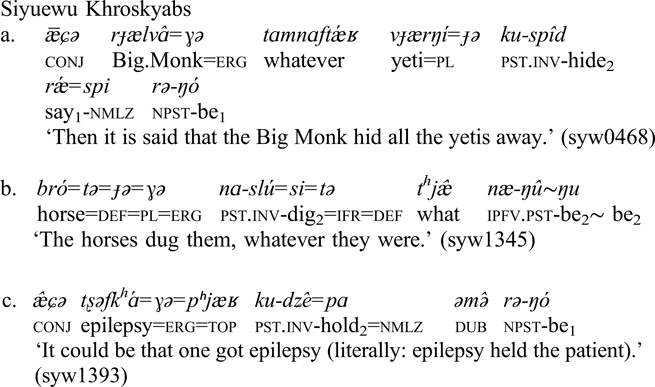
Natural examples are shown in (12). In (12a), a 3sg→ 3pl scenario is shown, the inverse marker appears on the verb form ku-spîd (pst.inv-hide2), the same scenario will render a direct configuration in Sastod Situ. The examples (12b) and (12c) show that animacy is irrelevant to the use of inverse.
(12)
3.3. Without orientational prefixes
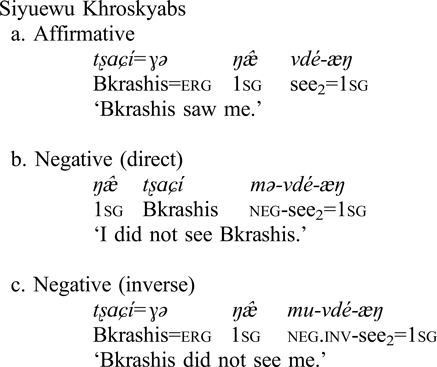
In the absence of an orientational prefix, the inverse marker does not occur unless there is a negative prefix mə-, see (13). In (13a), the verb vdê ‘to see’ is morphologically incompatible with orientational prefixes in the past tense, even though the scenario is inverse (3→1), the inverse marker cannot occur without a host; Example (13b) shows a direct scenario (1→3) with the negative prefix mə-, and in (13c), which exhibits an inverse scenario, the negative prefix mə- serves as the host of the inverse marker, with which it merges into mu-.
(13)
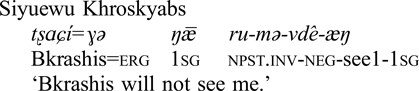
In the case where both an orientational prefix and the negative prefix are present, the inverse marker is hosted by the orientational prefix, as shown in (14).
(14)
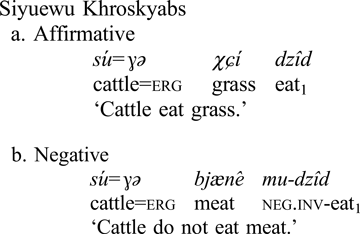
In 3→3 scenarios, verbs without orientational prefixes do not exhibit inverse marking in the affirmative case. In the negative case, the inverse marker has fused with the negating prefix, as shown in (15).
(15)
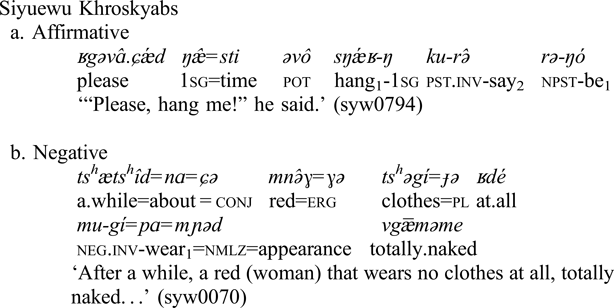
Natural examples are given in (16). In (16a), the inflected verb form sŋǽʁ-ŋ (hang1=1sg) is used in a 2→1 scenario, according to the context. However, it allows for multiple interpretations when taken out of context, due to the non-occurrence of the inverse: 1→2/3, 2/3→1. In (16b), the inflected form mu-gí (neg.inv- wear1) indicates unambiguously a 3→3 scenario.
(16)
4. Inverse marking in Wobzi Khroskyabs
In this section, I present the inverse marking system in Wobzi Khroskyabs, which is slightly different from the Siyuewu one. However, the difference between the two varieties may contain important information about the history of inverse marking in Khroskyabs, as will be discussed in Section 5.
4.1. Morphophonology
Unlike Siyuewu Khroskyabs, the Wobzi inverse marker seems to have an independent form, u-. Synchronically, it does not necessarily need a host to occur. In the presence of an orientational prefix, the inverse marker u- undergoes crasis by replacing the vowel of the orientational prefix, no matter what the vowel is, see Table 6 for a full list of inverse-coloured orientational prefixes. I use a hyphen between the orientational prefix and the inverse marker to account for the fact that the inverse u- is synchronically independent.
Orientational prefixes in Wobzi

The negative prefix in Wobzi cannot serve as the host of the inverse marker, unlike the case of Siyuewu.
4.2. Distribution
In this subsection I present the distribution of the inverse marker in Wobzi, focusing on its differences from that in Siyuewu.
4.2.1. With orientational prefixes
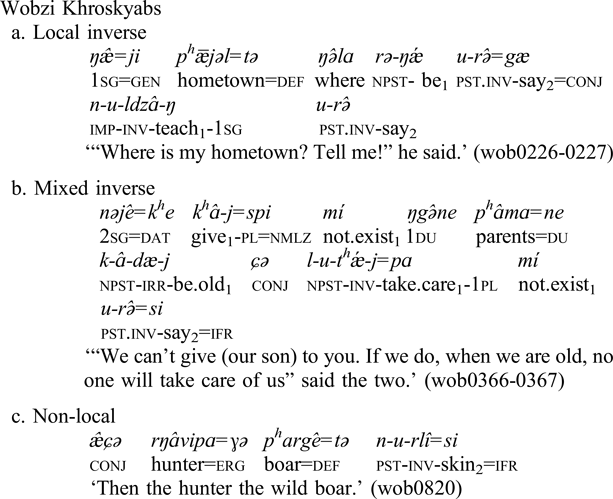
Like Siyuewu, the inverse marker in Wobzi is always present with an orientational prefix in inverse scenarios, see the natural examples in (17). In (17a), the inflected verb form n-u-ldzɑ-ŋ (imp-inv-teach1-1sg) is used in a 2→1; in (17b), the inflected form l-u-tʰǽ-j (npst-inv-take.care1-1pl) is used in a 3→1 scenario; in (17c), the inflected form n-u-rlî (pst-inv-skin2) is used in a non-local scenario, which is always inverse.
(17)
4.2.2. Without orientational prefixes
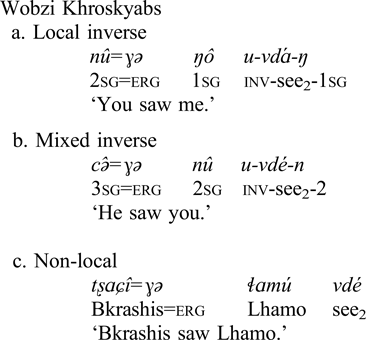
While the behaviour of the inverse marker is the same as in Siyuewu in the presence of an orientational prefix, the case without orientational prefixes is different in Wobzi. The inverse marker u- must appear in local and mixed inverse scenarios, and must be absent from non-local scenarios. Canonical examples are shown in (18) with the verb vdê ‘to see’, which is incompatible with orientational prefixes in the past tense. The inverse marker u- appears without a host in both (18a) (local inverse) and (18b) (mixed inverse), while it is prohibited in (18c) (non-local). The Siyuewu equivalents invariably prohibit the occurrence of the inverse marker.
(18)
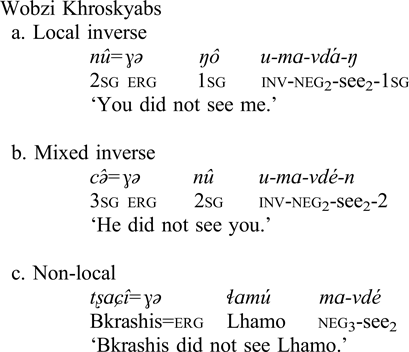
The negative versions are presented in (19). In local and mixed inverse scenarios, the inverse marker appears alone, preceding the negative marker, as in (19a) and (19b); in non-local scenarios, the inverse marker does not occur, as in (19c). The Siyuewu equivalents have the inverse marker merge with the negative marker in all three cases.
(19)
Natural examples without orientational prefixes in Wobzi are shown in (20). In (20a), the verb forms u-sɑ̂-j (inv-kill1-1pl) and u-dzî-j (inv-eat1-1pl) are employed in a 3→1 scenario; in (20b), the inflected verb form mə-ndæ̂ (neg1-love1) is used in a non-local scenario, without inverse.
(20)
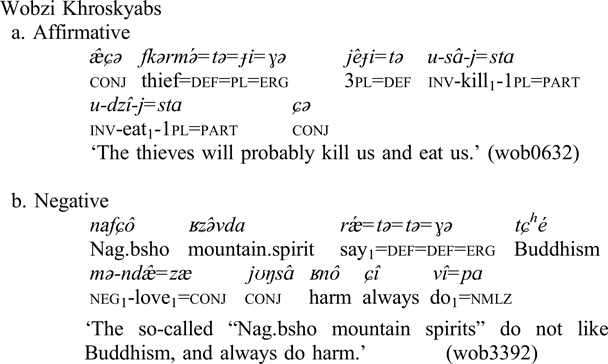
In Wobzi, non-local scenarios without an orientational prefix do not have inverse morphology, unlike Siyuewu which employs the inverse marker in negative forms.
5. Reconstruction of the Proto-Khroskyabs inverse system
In this section, I discuss the reason behind the differences of inverse use between the two Khroskyabs varieties, and come up with a hypothesis about the evolution of the inverse marking system in Khroskyabs.
5.1. Distributions of inverse marking in Siyuewu and Wobzi
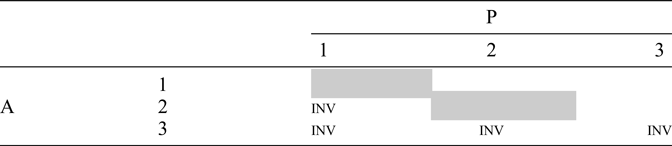
The distributions of inverse marking in the two varieties of Khroskyabs are summarized in Table 7. Scenarios that require inverse marking are shaded. In the cases without an orientational prefix, both affirmative (upper cell) and negative (lower cell) models are given.
Inverse distribution in Wobzi and Siyuewu

While the pattern in the presence of an orientational prefix is the same in the two varieties, Wobzi differs from Siyuewu in the non-local configuration in the absence of an orientational prefix. There is no way to say that the Wobzi case is actually inverse. Therefore, Wobzi presents a split in the non-local configuration: inverse in the presence of an orientational prefix, and direct in its absence.
To account for the non-local split in Wobzi Khroskyabs, there are two main hypotheses that could be proposed:
i. Khroskyabs varieties had the double treatment of the non-local configuration attested in Rgyalrong languages, and generalized the inverse treatment to all the cases where an orientational prefix exists, and the direct treatment to all the cases without an orientational prefix; while Siyuewu generalized the inverse treatment to all non-local scenarios regardless of the morphology.
ii. Neither Wobzi nor Siyuewu had the double treatment of the non-local configuration attested in Rgyalrong languages, and the difference between the two varieties is due to other factors.
The first hypothesis is problematic in two ways. First, there is no evidence that the double treatment of the non-local configuration is old – it is unclear whether it can be reconstructed in Proto-West-Rgyalrongic, not to mention Proto-Rgyalrongic; second, even if the double treatment is old and can be reconstructed in Proto-Rgyalrongic, it is problematic from a West-Rgyalrongic point of view. I mentioned in Section 2.3 that the other modern West-Rgyalrongic subgroup, the Stau varieties, also exhibited inverse-generalization to all non-local scenarios. Following the present hypothesis, the inverse-generalization in Siyuewu would be a parallel innovation alongside the one in the Stau varieties, but not inherited from Proto-West-Rgyalrongic, because Wobzi preserves the direct non-local scenario. Such an evolutionary pathway is surely not the simplest one, and the probability of the parallel innovation is rather low: the odds are that the language generalizes the direct forms that are simpler than the inverse forms which require an additional marker. The generalization of the inverse forms can be considered a typologically uncommon (in the words of Jacques et al. (Reference Jacques, Lai, Antonov, Lobsang, Thurgood and LaPolla2017: 609) “puzzling”) innovation. Given that overwhelming phonological, morphological and lexical evidence points to the close genetic relation between Khroskyabs and Stau (Jacques et al. Reference Jacques, Lai, Antonov, Lobsang, Thurgood and LaPolla2017: 609–11), it is hard not to believe that the inverse-generalization is a shared innovation of West-Rgyalrongic, rather than an independent development in different sub-branches.
The second hypothesis presumes that the inverse-generalization is a West-Rgyalrongic innovation, which implies that the direct forms in the non-local configuration in Wobzi is secondary and unrelated to the double treatment in Rgyalrong languages. In the next section, I present this hypothesis in detail.
5.2. Local inverse and non-local: the hypothetical prefix * Cə-
In this section I focus provisionally on the local inverse scenario and the non-local scenario, and leave discussion of the mixed inverse configuration for Section 5.4. The present hypothesis is built upon the following presupposition: the non-local inverse-generalization is inherited from Proto-West-Rgyalrongic, and all that contradicts this generalization is secondary.
Comparing the distribution of inverse marking in Wobzi and Siyuewu (Table 7), it seems that one can postulate two inverse markers in Proto-Khroskyabs in the case without an orientational prefix, noted *U1- and *U2-. The first marker, *U1-, dropped in both Wobzi and Siyuewu, while the second, *U2-, is preserved only in Wobzi as u-, and dropped in Siyuewu; the reflexes of *U1- and *U2- with an orientational prefix are the same in the modern language, as shown in (21).
(21)
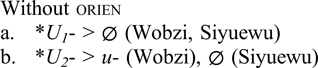
Following this reconstruction, the distribution of *U1- and *U2- in Proto-Khroskyabs is shown in Table 8.
Inverse in Proto-Khroskyabs (provisional reconstruction)

The two inverse markers postulated, *U1- and *U2-, are without doubt related to each other. In West Rgyalrongic languages, the inverse marker is in most cases dependent on another prefix or a stem. In the case of Khroskyabs varieties, it is usually dependent on the orientational prefixes or the negative prefix, and in Stau varieties, it is totally integrated into the verb stem (Jacques et al. Reference Jacques, Antonov, Lai and Lobsang2014; Gates and ’ja’ dpal Reference Gates and ’ja’ dpal2017). There is a tendency in which West Rgyalrongic inverse marking requires a host.
However, it is not necessary to state with absolute certainty that the inverse marking in Proto-Khroskyabs was already dependent on a host. It could have been phonologically independent at the beginning, and gradually lost its segmental feature, before finally becoming dependent. After it became dependent, if it is not preceded by any prefix, it cannot occur. If this assumption is valid, the Wobzi inverse u-, which can be independent in some cases, must be secondary. I will show in the remainder of the paper that this assumption can tell the story satisfactorily.
I hypothesize that *U2-, which left a substantial reflex in Wobzi (u-), was in fact *U1- preceded by a now-dropped presyllable, *Cə-, as shown in (22). The presyllable *Cə- left almost no trace in modern Khroskyabs varieties, but it provided protection against the dropping of the inverse marker and thus helped preserve this latter in Wobzi. After *Cə- dropped, the inverse marker was again exposed to the air, which leads to its disappearance in Siyuewu. Now, it is possible to unify *U1- and *U2- into one *U-, as shown in (22).
(22)
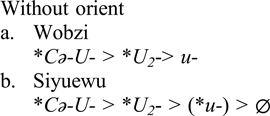
The local inverse case with an orientational prefix is reconstructed as *orien-Cə-U-∑, symmetrically to the case without an orientational prefix. The non-local case with an orientational prefix is reconstructed as *orien-U-∑, without the presyllable *Cə-, symmetrically to its unprefixed counterpart. Both *orien-Cə-U-∑ and *orien-U-∑ will render the same outcome, orien-u-∑ in Wobzi, and orien.inv-∑ in Siyuewu, see (23).
(23)
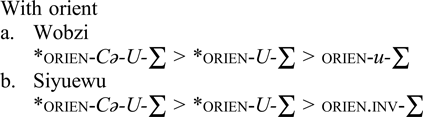
The revised distribution of inverse marking in Proto-Khroskyabs is illustrated in Table 9.
Inverse in Proto-Khroskyabs

5.3. Possible origins of *Cə-
The *Cə- hypothesis is plausible from the point of view of pure historical linguistics, but comparative evidence is necessary for its solidity, i.e. one needs to find out the origin of this *Cə-.
According to Table 9, the presyllable occurs in local scenarios (involving first and second persons), but not in the non-local ones (involving third person). It can therefore be postulated that the occurrence of *Cə- has to do with SAP arguments: first and/or second persons.
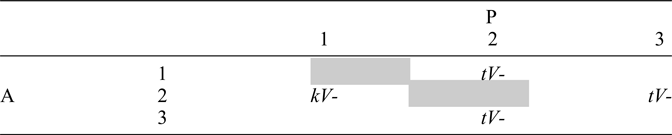
In Rgyalrong languages, the only set of prefixes that can occur in the position of *Cə- are those involving second person: tV- “second person prefix” and kV- “2→1 prefix”. The prefix tV- is attested in many other “Tibeto-Burman” languages and is probably reconstructable into an even earlier Ursprache (DeLancey Reference DeLancey2014).Footnote 7 The generic distribution of these two prefixes in Rgyalrong languages is illustrated in Table 10.
Prefixes involving second person in Rgyalrong languages
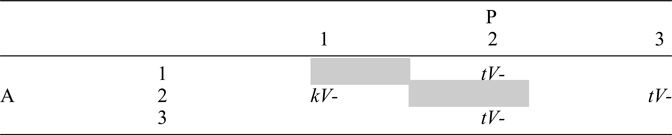
It can be seen that tV- and kV- appear in local scenarios, and are absent in non-local scenarios (mixed scenarios are discussed in Section 5.4), which corresponds to the distribution of *Cə- reconstructed for Khroskyabs. I therefore propose that the origin of *Cə- is related to tV- “second person prefix” or kV- “2→1 prefix”, or both in Rgyalrong. That Khroskyabs once marked second person prefixally was first proposed by DeLancey (Reference DeLanceyunpublished), in which he states “since we have to reconstruct # t- for the nearest ancestor of Rgyalrong and South Central Kiranti, other descendants of that ancestor which lack # t-, such as Khroskyabs and Western Kiranti, must have lost it”. Although Zeisler (Reference Zeisler2015: 40–41) points out a logical inconsistency with DeLancey's statement, the inconsistency is irrelevant to the present paper, since, first, I have no intention of discussing the common ancestor of Rgyalrong and Kiranti; and second, this paper finds a possible trace of second person marking in Khroskyabs – therefore Khroskyabs has probably not completely lost it.
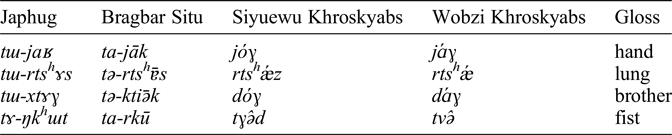
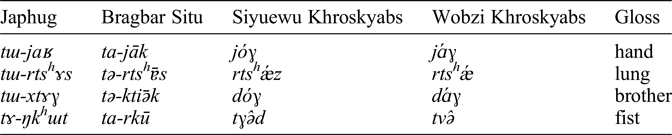
West-Rgyalrongic languages systematically lost prefixes in t- and k- attested in Rgyalrong languages, but a few fossilized traces remain. For instance, the indefinite possessive prefix in Rgyalrong, tV-, is generally absent in Khroskyabs (see the examples in Table 11). In the first three examples, the Khroskyabs varieties do not present any trace of the indefinite possessive prefix; probably only the final example does, in which the initial t- is fossilized as a part of the noun stem.Footnote 8
The indefinite possessive prefix in Rgyalrong
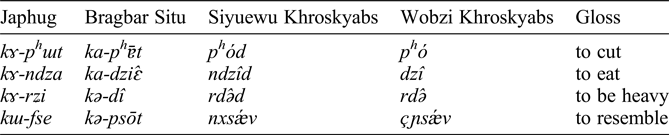
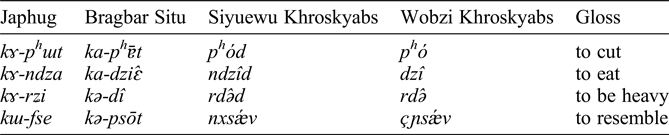
None of the West-Rgyalrongic languages have the infinitive prefix kV- attested in Rgyalrong languages (Lai Reference Lai2017: 256), as shown in Table 12. In the last example, the trace of the infinitive prefix, x- in Siyuewu and ç- in Wobzi, is preserved as a fossilized part of the verb stem.
The infinitive prefix in Rgyalrong
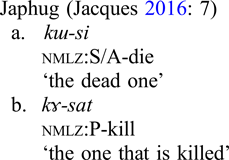
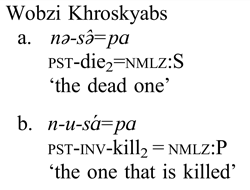
West-Rgyalrongic languages systematically lost the participial prefixes in kV- for the relativization of S, A, and P, and replaced them with nominalizing enclitics (Lai Reference Lai2018); compare Examples (24) (Japhug) and (25) (Wobzi Khroskyabs). The only trace found in Khroskyabs is in the noun ɣrêɣ (Siyuewu)/jræ̂i (Wobzi) ‘superfluous thing’, related to réd (Siyuewu)/ré (Wobzi) ‘to be left’.
(24)
(25)
Summarizing the evidence presented in this section, we can see that with the exception of a few fossilized traces, the forms *tV- and *kV- once existed in Khroskyabs, but are generally lost in the modern language. Since the prefixes involving second person in Rgyalrong have exactly the same forms, *tV- and *kV-, I assume that they could also have existed in Khroskyabs, and were probably the origins of the *Cə- reconstructed in the present paper. That is to say, *Cə- might have two origins, *kə- in the 2→1 scenario, and *tə- in other scenarios involving second person (see Table 13).
Local scenarios in Proto-Khroskyabs

5.4. Mixed inverse: intra-scenario levelling
I have discussed the local and non-local cases in the previous sections, and left the mixed configuration untreated. In this section, I focus on the mixed configuration.
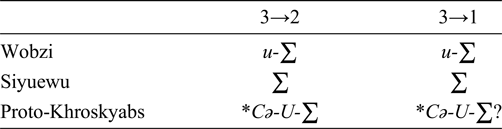
The second person origin(s) proposed for *Cə- is valid for local and non-local scenarios, as *Cə- does not occur in non-local scenarios involving exclusively third persons. However, when it comes to the mixed configuration, a problem occurs. As shown in Table 14, both 3→2 and 3→1 scenarios require the inverse marker to occur in Wobzi, which indicates the presence of *Cə- in both scenarios in Proto-Khroskyabs. Following the current hypothesis, the occurrence of *Cə- is correctly predicted in 3→2, but not in 3→1, because the latter scenario does not involve second person.
Mixed inverse (without orien)
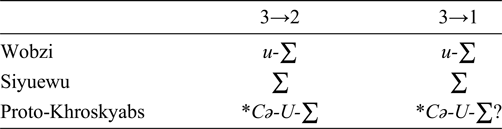
Typologically, it is not impossible for the scenarios 3→2 and 3→1 to be unified with the same form in Trans-Himalayan. Jacques (Reference Jacques2012a: 94) notices that two of the Kiranti languages, Khaling and Dumi, have the same prefix for the two scenarios in question, i- and a- respectively, and that the prefixes seem to be related to the second person pronouns, in in Khaling and an in Dumi. It can be assumed that in these two languages, the form for 3→1 is based on that for 3→2. Other Kiranti languages, such as Camling, Bambara, and Limbu, distinguish morphologically 3→2 from 3→1, which shows that the cases of Khaling and Dumi are innovations.
It is possible that Khroskyabs has undergone a similar process to those attested in Khaling and Dumi: *Cə- was reanalysed as a marker for SAP arguments, and spread from 3→2 to 3→1, if this process happened in the Proto-Khroskyabs stage. Alternatively, it could be a Wobzi innovation that the prefix u- in the 3→1 scenario is based on 3→2 due to analogy. Both pathways imply an intra-scenario levelling of the mixed configuration, see (26) for the illustration of the pathways.
(26)

6. Conclusion
In this paper I have described the functions of inverse marking in two Khroskyabs varieties, Siyuewu and Wobzi, and proposed a hypothesis on the evolution of the inverse marking system in Khroskyabs. A prefix *Cə-, probably originally a second person prefix (or maybe two prefixes), is reconstructed to account for the Wobzi u- that appears in the absence of an orientational prefix. It preceded the original inverse marker *U-, and dropped in the modern varieties. The modern Wobzi inverse u- is, therefore, not the original inverse *U-, but the trace of the combination of *Cə- and *U-; it therefore contains an indirect trace of the second person marker(s). The implication of this hypothesis is that the argument-indexation system in Proto-Khroskyabs is more similar to the Rgyalrong ones than many researchers imagined (i.e. Jacques Reference Jacques2012a: 93; DeLancey Reference DeLanceyunpublished), with a whole set of person prefixes (second person markers, inverse) and suffixes.
Tables 15–18 list the development of the system (changes from the previous table are shaded grey). While *Cə- is lost everywhere after Proto-Khroskyabs, the proto-inverse-marker *U- dropped step-by-step when it is hosted by nothing.
Stage I: Proto-Khroskyabs

Stage II: Proto-Khroskyabs

Stage III: Proto-Wobzi

Stage IV: Proto-Siyuewu