Introduction
The family constitutes a central institution in the social network of most individuals, and plays an important role in the distribution system. There is a strong reciprocal element to intergenerational exchange, with an increased probability to receive support in the form of time or money if support is given (Grundy Reference Grundy2005). Intergenerational family support has been found in a number of countries with varying welfare systems (Kohli Reference Kohli1999; Arber and Attias-Donfout Reference Arber and Attias-Donfut2000; Daatland and Lowenstein Reference Daatland and Lowenstein2005; Fritzell and Lennartsson Reference Fritzell and Lennartsson2005). However, the structure of family life is associated with welfare policies, socio-demographic variations and societal characteristics (Arber and Attias-Donfut Reference Arber and Attias-Donfut2000; Kohli Reference Kohli1999, Reference Kohli and Silverstein2004; Künemund and Rein Reference Künemund and Rein1999). For instance, many studies have found differences in family relations according to gender (Rossi and Rossi Reference Rossi and Rossi1990; Lawton, Silverstein and Bengtson Reference Lawton, Silverstein and Bengtson1994; Silverstein et al. Reference Silverstein, Parrott and Bengtson1995; Attias-Donfut and Wolff Reference Attias-Donfut, Wolff, Arber and Attias-Donfut2000; Szebehely Reference Szebehely, Dahl and Eriksen2005) and socio-economic status (Broese van Groenou and van Tilburg Reference Broese van Groenou and van Tilburg2003; Antonucci et al. Reference Antonucci, Ajrouch, Janevic, Adler, Marmot, McEwen and Stewart1999; Krause and Borawski-Clark Reference Krause and Borawski-Clark1995).
Intergenerational relations cover a number of types of support and these are often found to be socially structured, for instance by social class. The class structure varies both between families and within families. The class structure in Sweden, as in many countries, underwent radical changes during the 20th century, leading to an increase in upward intergenerational social mobility and urbanisation. Hence, the focus of this study is the association between social mobility or stability, geographical proximity and intergenerational family contact in Sweden.
Intergenerational contacts
Geographical distance between family members of different generations is related to the form and the frequency of contacts between them (e.g. Lin and Rogerson Reference Lin and Rogerson1995; Warnes Reference Warnes1986). Compared with other affluent countries, Sweden has during the last 50 years had relatively high levels of geographical mobility, predominately characterised by urbanisation (Kupiszevski et al. Reference Kupiszewski, Borgegård, Fransson, Håkansson, Durham and Rees2001). Although only a small percentage of elderly parents in Sweden cohabit with their children, most live relatively close to at least one child. Over half of those aged 65 or more years live within 10 kilometres of at least one of their children, and 75 per cent have children within 50 kilometres (Larsson and Thorslund Reference Larsson and Thorslund2006). Distance to children has not changed significantly over the past half-century.
Intergenerational family contact in Sweden has also been fairly frequent and stable over a relatively long period (Larsson and Thorslund Reference Larsson and Thorslund2006). Three-in-ten elderly parents have daily face-to-face contact with their children, and nearly 70 per cent meet their children at least once a week. This makes the average rate of contact between parents and children comparable to that of other EU countries. According to Andersson (Reference Andersson1994), 78.2 per cent of elderly parents in the EU have weekly contact with at least one child. There are, however, great international differences in the rate of daily contact. In some southern European countries, over 60 per cent of elderly parents have daily contact with their children (Hank Reference Hank2007). This is probably a result of the high proportion of older adults who live with their children in these countries. In Sweden, as in most northern European countries, the typical household has two generations and a very low percentage of elderly parents live with their adult children (Larsson and Thorslund Reference Larsson and Thorslund2006).
Social mobility, geographical proximity and intergenerational contacts
Because the family is an important institution in the distribution of material, instrumental and social support, intergenerational transfers within the family are essential to the reproduction of social positions. The cultural and material resources possessed by a family affect the opportunities and life chances available to its members through both education and assistance with entry to various occupations. Family support improves the long-term economic circumstances of the recipients, and thereby the chances of attaining a privileged social position. Even though social policies are sometimes used to create opportunities and restrictions in status attainment and family capital transfers, the advantage of intergenerational family exchange is significant and plays an important part in the stratification system (for a discussion see Knijn Reference Knijn, Knijn and Komter2004; Myles Reference Myles, Esping-Andersen, Gallie, Hemerijck and Myles2002; Spilerman Reference Spilerman2000). Thus, social inheritance and private financial transfers contribute to personal security and the reinforcement of class inequalities over generations (Fritzell and Lennartsson Reference Fritzell and Lennartsson2005).
Not only are social positions reproduced within the family, but the very structure of family life also seems to be directly affected by social position. People with a lower socio-economic status tend generally to have smaller, family-centred social networks and more frequent contact with the family than do non-manual families (Broese van Groenou and van Tilburg Reference Broese van Groenou and van Tilburg2003; Antonucci et al. Reference Antonucci, Ajrouch, Janevic, Adler, Marmot, McEwen and Stewart1999; Krause and Borawski-Clark Reference Krause and Borawski-Clark1995). There are several explanations for this association.
Differences in access to resources explain some of the differences in intergenerational family contact. Whereas non-manual families often have the necessary resources to set the level of why and how often they should meet, working-class families often lack such resources (see Arber and Ginn Reference Arber, Ginn, Arber and Evadron1993). Connidis and McMullin (Reference Connidis and McMullin2002) suggested that most family ties are to some extent characterised by ambivalence. This can derive from numerous sources including social arrangements, such as those of the family and work that have differential effects based on one's place in various sets of structured social relations, not least one's social class. The ambivalence is negotiated throughout the relationship, with varying possible outcomes over time, including solidarity. They suggest that the higher social classes are privileged because their resources give them options in these negotiations; that is, they can purchase the help needed for their frail parents. Working-class families, on the other hand, are often forced to turn to family members for help, even when family ties are characterised by ambivalence or conflict. As studies have shown that a substantial amount of all care and support for older adults in Sweden, as in many other countries, is provided by family members (Szebehely Reference Szebehely and Lewis1998, Reference Szebehely, Dahl and Eriksen2005), it is reasonable to expect that at least some of the intergenerational contact is for instrumental purposes.
Social position is also associated with geographical mobility. Middle-class children are more likely than their working-class counterparts to seek educational and labour opportunities away from home. It has been found that Swedish families with a low level of education and socioeconomic positions, such as manual workers, tend to live closer to each other than families with a higher level of education and a non-manual position (Lennartsson Reference Lennartsson2001; Winqvist Reference Winqvist1999). As geographical distance can act as a hindrance to social contact, the association between social position and geographical mobility may constitute a mechanism that explains why children from the middle classes have less contact with their parents than working-class children.
On the other hand, the concept of intergenerational solidarity suggests that geographical distance will be adjusted over time because of the changing needs and resources of both parents and children (Bengtson and Roberts Reference Bengtson and Roberts1991; Silverstein and Litwak Reference Silverstein and Litwak1993; Silverstein and Bengtson Reference Silverstein and Bengtson1997). The assumption is supported by a study which showed that although adult children's economic needs have a strong influence on proximity to their parents early in the lifecourse, parents’ economic and health needs become a stronger influence on geographical proximity later in life (Silverstein Reference Silverstein1995).
Social mobility between parents and their children is likely to have implications for family relations. Over the last 50 years there has been great social mobility, at least in an absolute sense, both in Sweden and in other industrial countries (Erikson Reference Erikson1983; Erikson and Goldthorpe Reference Erikson and Goldthorpe1992). This is mainly because of rapid changes in the Swedish occupational structure. The agricultural sector has declined and many farmers and agricultural workers have become manual workers. More generally, the number of manual jobs has declined while both upper and middle non-manual workers has increased. At the end of the 20th century, an estimated 40 per cent of the gainfully-employed population belonged to the working class, around 50 per cent held traditional non-manual jobs, nearly 10 per cent were self-employed and less than one per cent were farmers (Jonsson Reference Jonsson and Breen2004). In international terms, the rates of social mobility in Sweden have been relatively high, possibly because of egalitarian social policies (Erikson and Goldthorpe Reference Erikson and Goldthorpe1992; Breen Reference Breen2004). Given all this, the question of how such changes affect intergenerational relations is of great interest.
The foundational theoretical analyses of kinship in industrial society often claimed that social mobility had a detrimental effect on the maintenance of social contacts with family and kin. In the 1920s, Sorokin declared that social isolation was an effect of social mobility and that the devastating consequences of losing close relationships from one's own original social class and childhood neighbourhood would eventually lead to disintegration and increasing suicide rates (Sorokin Reference Sorokin1927/Reference Sorokin1959). A more recent study found that people with low lifetime socio-economic status and the downwardly social mobile had small networks and low instrumental and emotional support from non-kin but high instrumental support from kin, when compared with the upwardly mobile or those with high lifetime socio-economic status (Broese van Groenou and van Tilburg Reference Broese van Groenou and van Tilburg2003). In contrast, an early study from Great Britain showed that social mobility had little impact on continuing kinship contacts. In other words, socially-mobile men were not isolated from relatives, except when the isolation was a consequence of geographical distance (Goldthorpe Reference Goldthorpe1980).
Kulis (Reference Kulis1991) found that stable manual working families were more likely to provide household help, take part in social activities and demonstrate positive emotional engagement than stable non-manual families. However, when geographical distance was adjusted for, differences remained only in emotional engagement. He found, further, that children who moved into non-manual positions were more likely than stable manual working-class children to view helping their elderly parents as a sacrifice, and it was mainly daughters who said that they were expected to make the sacrifice.
Findings from a Swedish study have shown that the upwardly mobile (from working-class to non-manual) children see their parents less frequently than stable manual workers. Moreover, upwardly-mobile children in turn meet their parents more than non-manual children whose parents belong to the same class. Downwardly-mobile children meet their parents as much as do stable manual workers. Class differences in accessibility to parents do exist, but people nevertheless visit when able to do so. Thus, among those who live near their parents, the degree of contact is fairly similar, regardless of differences in class position and social mobility (Sundström Reference Sundström1986).
The reviewed literature suggests that social class has an effect on intergenerational contacts. In general, people with lower socio-economic status have more frequent family contact than people with higher socio-economic status. However, some aspects of the relationship between parents and children also seem to be affected by intergenerational social mobility. Geographical mobility, rather than social mobility itself, is often seen as the main reason for spending less time with the family, but the universality of these findings needs further investigation.
Research questions
In the following analyses we have focused on the actual frequency of intergenerational face-to-face contacts, because frequency of social contact is an inclusive measure of family relation, encompassing instrumental contact for care and support. Of special interest is the impact that parents' and children's social class has on intergenerational contact. First we examined the likelihood of parent and child having face-to-face contact several times a week depending on the class of both parent and child. We expected non-manual parents and children to meet less frequently than parents and children classified as manual workers.
Secondly, we examined whether class differences in family contacts can to some extent be explained by differences in geographical proximity between parent and child. The changing class patterns in Sweden have prompted studies on how social mobility has influenced intergenerational geographical proximity and, in turn, contacts within the family. Earlier research suggested that non-manuals are more likely to migrate, usually in association with education and/or employment. Taking the class position of both parent and child into consideration, the second question was whether there were any differences in the spatial distance between parents and children who did not belong to the same social class and those who did. We predicted that there would be a greater separation distance for stable non-manual families than for stable manual families, and that children who had achieved a non-manual position would live further away from their parents than children who were manual workers. Thirdly, we investigated the relationship between intergenerational inequalities and intergenerational family contacts.
Data and variables
The study was based on the 2002 Swedish Longitudinal Study of Living Conditions of the Oldest Old (SWEOLD), which is a continuation of the Swedish Level of Living Survey (LNU), a longitudinal study founded in 1968. The sample was drawn from participants in the LNU sample who had, by the time of the latest LNU survey, reached an age of 75 or more years. The sample was nationally-representative and included people living in their own homes as well as those living in institutions. Proxy interviews were employed when direct interviews were impracticable for reasons of failing health or cognitive impairment. The SWEOLD study was conducted using face-to-face interviews. For a description of the sample and data collection procedures, see Lundberg and Thorslund (Reference Lundberg and Thorslund1996) and Fritzell and Lundberg (Reference Fritzell and Lundberg2006). At the time of the 2002 survey, 736 individuals were eligible for participation. Interviews were conducted with 621 respondents, giving a response rate of 84.4 per cent. Given the nature of the investigation, only those who had children and did not co-reside with a child were included – all-in-all 493 respondents. Since most of the respondents had more than one child, the dataset was restructured, making each child a specific case, creating material with 1,146 individual cases. It is, however, important to bear in mind that, even though the children were treated as individual cases, the actual informants were the parents.
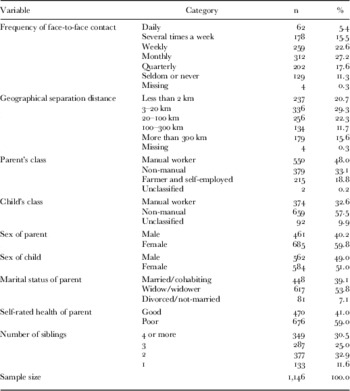
Intergenerational contacts were assessed by a single item asked about each of the respondent's children: How often do you usually meet and spend time with him/her? The variable was collapsed into two categories, separating those who reported having contact daily or several times a week from those who met less often. The rationale behind the dichotomy was to distinguish those with an intensive contact-frequency from those who interacted less often, in order to capture a relationship that might indicate a degree of obligation. In the sample, approximately 21 per cent of the children met their parents several times a week. The variable measuring geographical distance between generations was based on a single question that was asked about each of the respondent's children: How far away from you does he/she live? This variable was used both as continuous and dichotomised (differentiating those living within 20 km from those separated by a greater distance). One-half of the children lived within 20 km of their parents. The attributes of the sample are displayed in Table 1.
Characteristics of the sample

The measure of socio-economic class followed the official Swedish ‘SEI classification’ (Andersson, Erikson and Wärneryd Reference Andersson, Erikson and Wärneryd1981), which is based on several dimensions of the internationally well known EGP classification, with which it has many similarities (Erikson and Goldthorpe Reference Erikson and Goldthorpe1992). As the occupation of both the respondent and his or her spouse was known, the parents were assigned a single class position for the whole household. This was based on the assumption that some positions have a greater impact on the values, attitudes and behavioural patterns of a household than others, in other words, they are dominant (Erikson Reference Erikson1984). For the children, only the individual occupation was known, and class position was consequently assigned individually.
Parents were assigned to one of three social classes and the children to one of two. Given the changes in the Swedish class structure through the 20th century, only a very small minority of the children were farmers. Furthermore, the self-employed children were highly diverse, in having occupations traditionally associated with manual work (e.g. carpenters and taxi drivers) as well as those traditionally associated with non-manual work (e.g., psychologists and architects). Based on their occupation, the self-employed children (with no employees) were classed either as manual or non-manual workers. This classification under-estimates the number of self-employed children. For similar reasons parents classified as farmers with a very small acreage and with no employees were classified as manual workers. Eight per cent of the children were unclassified because of lack of information. They, together with the few children classified as farmers, were excluded from the forthcoming analyses, corresponding to 10 per cent of the sample.
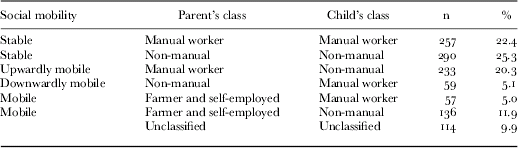
The variable used to assess intergenerational social mobility included six combinations of parent-child class position (Table 2). The first category included two class-stable groups. The first group included parents classified as manual workers and children classified as manual workers (22%). The second group included parents classified as non-manuals and children classified as non-manuals (25%). Thus, the proportion of parents classed as non-manuals is fairly large for these cohorts, possibly due to selective survival. The class-stable families represent nearly one-half of the sample.
The sample by social mobility categories
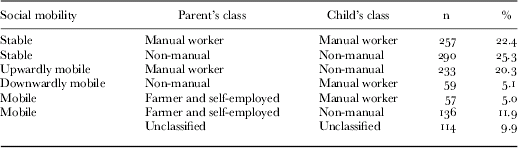
Categories two and three included the groups we have defined as mobile. The first group represents upward mobility – parents classified as manual workers with children ending up as non-manuals, comprising 20 per cent of the sample. The second group represents the downwardly socially mobile, in other words the children who were brought up by non-manuals, but who, are themselves now manual workers (5%). The next group comprised parents classified as farmers (60%) or self-employed (40%) whose children were manual workers. This group constituted five per cent of the sample and is referred to as mobile. Finally, the last mobile group included parents classified as farmers or self-employed whose children were non-manuals. A total of 136 children (12%) were classified as non-manuals with a class origin as farmers or self-employed. The two last groups of socially-mobile children are somewhat over-estimated as a result of the reclassification of self-employed children.
We controlled for gender of the parent and gender of the child, for marital status and self-rated health. In interviews during which the latter question was excluded because of the use of a proxy, the respondent was classified as having poor health. Since parents with several children could be expected to have more contact with children, it is possible that the single-parent, single-child dyads have more contact as individuals. Hence, a variable measuring size of sibling group was included in the analyses, ranging from only child to four or more siblings. For a description of the included variables see Table 1.
Analysis
Logistic regression was applied in the analyses of intergenerational family contact and geographical distance and the results are presented as odds ratios. The estimates express the odds of having intergenerational family contact several times a week or living within 20 km, for each category as compared to a reference category. The odds ratio of the reference category is set at one. Since we used the constructed child population in the regressions, the unit of analyses are not independent (a parent can have more than one child). To correct for this, statistical analyses were carried out using Stata's (7.0) cluster command through which robust standard errors are obtained. The analyses began by examining the association between social class position and the two outcomes, taking the class positions of both parents and children into account. In the following analytic models confounding and mediating factors were taken into account.
Results
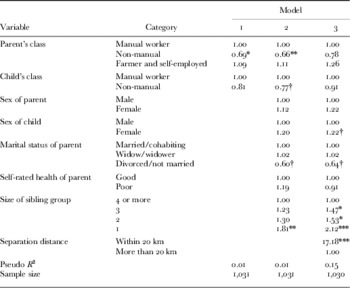
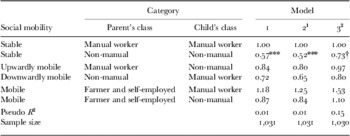
In Table 3 the odds ratios for extensive intergenerational family contacts by parent's and child's social class position are presented (Model 1). The results show that those with non-manuals backgrounds had less intergenerational family contact than parents and children in other classes. The likelihood of having contact several times a week was only about half as high among those with a parent classified as non-manual as it was among those with parents classified as manual workers, when adjusted for the class position of the child. These results suggest that parental social class seems to be of greater importance for intergenerational social contacts than the child's own class.
Odds ratios of parent and adult children having face-to-face contact several times a week by characteristics of the participants

Note: Standard errors adjusted for clustering within families.
Significance levels: *** p⩽0.001, ** p⩽0.01, * p⩽0.05
† ⩽0.10.
In Model 2, the lower likelihood of being in contact several times a week among children and parents classified as non-manuals remained, even when the gender of parent and child, self-rated health, the marital status of the parent and the size of sibling group were controlled (Table 3). It should be noted that none of the control variables were strongly associated with intergenerational family contact. The frequency of contact was, however, somewhat higher among mothers than fathers, among daughters than sons, among parents with poor self-rated health than among parents in good health, and among children with no siblings than among children with siblings, although the differences did not reach statistical significance.
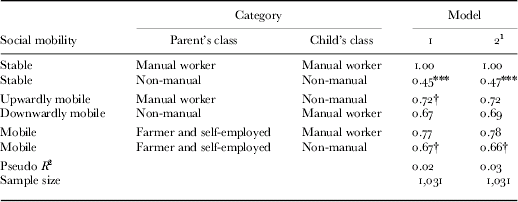
In the third model geographical distance between parent and child was added to the analysis. The results clearly show that geographical proximity was a prerequisite for intense contact. As both the previous analysis and earlier studies have shown an association between class and geographical distance between parent and child, it was reasonable to expect some of the class differences in intergenerational contact to be explained by differences in geographical proximity. Our data show that as many as 50 per cent of all parent/child pairs lived within 20 kilometres of each other. Table 4 (Model 1) shows that stable non-manual families had a significantly higher likelihood of living more than 20 km apart than stable working-class families. In Model 2, adjustments were made for the gender of both parent and child, marital status and self-rated health of parent, and size of sibling group. These factors did not greatly change the results found in Model 1, so the results show significantly less intergenerational accessibility, measured as geographical distance, between stable non-manual families and stable working-class families.
Odds ratios of parents and adult children living within 20 km of each other by intergenerational social mobility
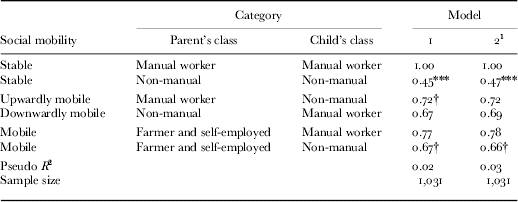
Notes: Standard errors adjusted for clustering within families. 1. Model II control for gender of both parent and child, marital status and self-rated health of parent, and size of sibling group.
Significance levels: *** p⩽0.001
† ⩽0.10.
The final step was to analyse whether extensive intergenerational family contact is affected by children's social mobility. In Table 5 intergenerational family contacts by intergenerational social mobility are presented. Model 1, taking only social class into consideration, shows that the most obvious differences in intergenerational contacts exist between the two stable class groups. Stable non-manual families were only about one-third as likely to have contact several times a week as working-class families. When the potential confounders, gender, self-rated health, and parental marital status and size of sibling group were introduced in Model 2, the estimates for the various social classes hardly changed.
Odds ratios of parents and their adult children having face-to-face contact several times a week by intergenerational social mobility

Notes: Standard errors adjusted for clustering within families. 1. Model 2 controls for gender of both parent and child, marital status and self-rated health of parent, and size of sibling group. Model 3 controls for gender of both parent and child, marital status and self-rated health of parent, size of sibling group, and geographic distance.
Significance levels: *** p⩽0.001
† ⩽0.10.
The second model showed that even when geographical distance was controlled, class-stable non-manuals were less likely (OR=0.47) to maintain frequent contact than stable working-class families (Table 5). Furthermore, the data show no convincing evidence that social mobility had any effect on extensive social contacts between generations. Upward and downward mobility (as defined here) had little impact on extensive family contacts. When geographical proximity was controlled for, however, socially-mobile children with farmer/self-employed parents seemed to be more likely to have extensive family contact than did stable working-class families, although the estimate did not reach statistical significance.
Geographical distance was by far the most influential factor on intergenerational contact, although some class differences remained even when controlled. Given the importance of geographical distance, an additional analysis including only those living within a distance of 20 km was carried out (analysis not presented). As in the previous analyses, class-stable non-manual families were considerably less likely to have frequent contact than stable working-class families. Thus, even if class-stable non-manual families were able to have frequent contact because they lived propinquitously, they still socialised less frequently than other families.
Discussion
This study has focused on the influences of social class and the distance of separation on the level of intergenerational family contact. Changing class patterns and increasing geographical mobility in Sweden raise questions of whether social mobility influences the frequency of contacts beyond once a week. Using nationally representative Swedish data, the analyses showed that social class, parent's class and child's class were all associated with geographical distance between parents and children. Stable non-manual families (both the adult child and the parent classified as non-manuals), were significantly less likely to live within 20 km of each other than stable working-class families. Furthermore, social mobility seemed to have an impact, admittedly weak, on geographical distance, with children who became non-manuals tending to live further away from their parents than stable manual workers. These basic findings are very much in line with earlier studies (e.g. Lawton et al. Reference Lawton, Silverstein and Bengtson1994; Greenwell and Bengtson Reference Greenwell and Bengtson1997; Warnes Reference Warnes1986).
Furthermore, our data (not shown) indicated that elderly parents living in institutions and reporting poor self-rated health tended to live closer to their children than those with good health and those living in ordinary housing. However, there was no evidence to suggest that the geographical proximity between the elderly parents and their children had been systematically adjusted, as suggested by demographic evidence in the US and elsewhere (Silverstein Reference Silverstein1995).
Our findings provide little support for the proposition that social mobility has any effect on intergenerational family contact. Our findings showed, rather, that class-stable non-manual families were least likely to maintain a contact frequency that extended beyond once a week. These patterns remained, albeit somewhat weakened, when geographical distance was taken into consideration. Thus, stable non-manual families tended to have less intergenerational contact even when geographical proximity was controlled for. In analyses including only parents and children living close to each other, these class differences were more distinct. Class-stable non-manual families met less often than stable working-class families even when they had the same geographical proximity and thereby opportunity to do so. These findings are in line with previous research (Arber and Ginn Reference Arber, Ginn, Arber and Evadron1993; Szebehely Reference Szebehely and Szebehely2000, Reference Szebehely, Dahl and Eriksen2005), suggesting that non-manual families have the necessary resources to set the level of why and how often they should meet their children, while manual working-class families might lack such resources. However, the non-manuals were very heterogeneous and included sub-groups with large differences in education and income. The results do not therefore exclude the possibility of variations within the group of non-manuals. Unfortunately, the small number of respondents made it impossible to analyse whether any differences did indeed exist.
We found no evidence that a change in class position, either upward (children originating from manual working families) or downward (children originating from non-manual families) had any effect on family contacts. Instead, the findings suggest that social mobility had little impact on continuing family contacts, and that socially-mobile children did not have less contact with their parents than class-stable children. The small group of downwardly mobile children did not significantly differ from the group of class-stable manual workers. This result might have been different if this group had been larger and more stable. This was not the case, however, since downwardly-mobile children often are unstable in their class position, especially when the downward mobility is experienced early in working life. In contrast, upwardly-mobile children are more likely to be stable, and a return to the class of origin is rare in this group (Goldthorpe Reference Goldthorpe1980).
The results indicate further that parents who were farmers or self-employed tended to have frequent contact with their children even when those children had been socially mobile. So compared with other families, stable or mobile, children from farming families had no more or less contact than others. When living close, they even tended to have a more intensive contact frequency than class-stable families. It should be noted that our choice to treat the small number of self-employed children (with no employees) either as manual workers or non-manuals depending on their occupations and to exclude the small number of children classified as farmers could have influenced the results. However, as this was a small group, mainly of individuals working in conventional manual and non-manual sectors (although self-employed), it is unlikely that this would have significantly biased the results.
As parents grow older, child-parent contacts are increasingly characterised by care-giving and aid. Older adults' dependency on adult children for informal aid may thus result in an increase in intergenerational contact, and the lesser contact among non-manuals could reflect a lower degree of mutual dependency. For instance, non-manual families tend to have greater financial resources with which to buy instrumental support from other sources, as well as having an advantage in negotiations with the welfare authorities (Szebehely Reference Szebehely and Szebehely2000, Reference Szebehely, Dahl and Eriksen2005). People's options and material resources may then, to some extent, influence how often and under what circumstances the family meets. While working-class families possess fewer resources and have a stronger tradition of frequent family contact, they may also shoulder a heavier care burden, as welfare authorities have started to take the availability of family care into account when deciding the allocation of formal care to elderly people (Szebehely Reference Szebehely and Szebehely2000).
According to our results, familial class coherence (i.e. parent and child belonging to the same social class) appeared to have a stronger impact on frequent intergenerational contacts than social mobility. This could indicate that class differences in family contact are at least in part generated by class-bound differences in values, patterns of behaviour and the needs of the family as supplier of social, cultural and material support.
The findings of the present study are consistent with previous research on the association between social class and intergenerational contact. Our results indicate further, however, that geographical distance between parents and children could not, by itself, explain why non-manual families met less often than other families: members of class-stable non-manual families were less likely to meet even when geographical distance was taken into consideration. The findings reported here show that social mobility has some impact on geographical distance between generations and little impact on intergenerational family contacts. Overall the results suggest that familial class coherence is a stronger determinant of intergenerational family contacts than social mobility. Future research should address the complex connection between social mobility and other forms of relations and transfers between generations.
Acknowledgements
Stefan Fors was funded by the Swedish Council for Working Life and Social Research (Grant 2005-0624 and 2002-0919). Carin Lennartsson acknowledges financial support from the Swedish Research Council (Grant 421-2005-1936). The 2002 Swedish Panel Study of Living Conditions of the Oldest Old (SWEOLD) was funded by the Swedish Research Council, Founding for Longitudinal Studies. The authors have shared equal responsibility for the manuscript and they would especially like to thank Vern Bengtson for rewarding discussions and valuable comments on earlier drafts of this article.