Implications
Inclusion of high-quality protein sources (i.e. fishmeal (FM)) is important in weaned pig diets to manage digestive disturbances in the early post-weaning period, but there is concern over the long-term sustainability of FM supply. When included in nursery pig diets, both microbially enhanced soybean meal (MEPRO) and FM reduced post-weaning diarrhea. MEPRO may be used as an alternative to FM in nursery pig diets reducing the global demand for FM and aid in ensuring sustainable FM production.
Introduction
The weaning period presents new stressors to young pigs that typically results in low feed intake and a decrease in BW for several days immediately following weaning (Hötzel et al., Reference Jones, DeRouchey, Nelssen, Tokach, Dritz and Goodband2011). Along with a loss of BW, an altered gut environment is favorable for the colonization of enterotoxigenic Escherichia coli strains resulting in post-weaning diarrhea syndrome (PWDS; Tsiloyiannis et al., Reference Tsiloyiannis, Kyriakis, Vlemmas and Sarris2001). It is important for diets in the immediate post-weaning period to include high-quality ingredients such as FM (DeRouchey et al., Reference DeRouchey, Goodband, Tokach, Nelssen and Dritz2010), which are believed to increase feed intake and growth performance (Berrocoso et al., Reference Berrocoso, Serrano, Cámara, Rebollar and Mateos2012). Dietary acidifiers have also been shown to benefit pig’s gut health and performance and may lower the severity or incidence of PWDS (de Lange et al., Reference de Lange, Pluske, Gong and Nyachoti2010).
There is heightened concern about overfishing of wild capture fisheries, and as of 2011, 28.8% of the world’s recognized fish stocks were overfished (FAO, 2012). This over-harvest has included species used for FM production and when coupled with increasing global demand for FM has led to an unsustainable situation (Olsen and Hasan, Reference Hötzel, de Souza, Costa and Machado Filho2012). Soybean meal (SBM) is the most commonly used protein source in pig diets, but its use is limited in young pig diets due to anti-nutritional factors, which influences PWDS (Friesen et al., Reference Friesen, Goodband, Nelssen, Blecha, Reddy, Reddy and Kats1993). Thus, it is important to find alternative high-quality protein sources that are cost-effective and contain minimal anti-nutritional factors.
Fermented soybean products have been evaluated as alternative protein sources (Jones et al., Reference Jørgensen, Sauer and Thacker2010) and an experimental MEPRO (Prairie AquaTech, Brookings, SD, USA) has shown lower levels of anti-nutritional factors and higher digestibility of amino acids (AAs) than conventional SBM when fed to fish (Sindelar, Reference Sindelar2014). MEPRO may be an alternative to FM in weaned pig diets but the digestible nutrient content when fed to pigs is unknown. Apparent (AID) or standardized ileal digestibility (SID) using cannulated growing pigs is recommended as the standard method for measuring the digestible AA content of feedstuffs fed to swine (Stein et al., Reference Stein, Seve, Fuller, Moughan and de Lange2007). However, digestibility values determined from growing pigs do not necessarily apply to nursery pigs (Viljoen et al., Reference Viljoen, Coetzeel, Fick, Siebrits and Hayes2000); therefore, two digestibility trials were conducted using 30 and 10 kg pigs because the goal was to evaluate MEPRO as a potential replacement for FM in nursery pigs.
Furthermore, assessment of alternative feedstuffs should also include evaluation of pig performance and in combination with common dietary feed additives. The objectives of this study was to determine the digestible AA content of MEPRO and evaluate the use of MEPRO in nursery pig diets containing dietary acidifiers.
Material and methods
All experimental protocols were reviewed and approved by the Institutional Animal Care and Use Committee at South Dakota State University (SDSU; IACUC #13-044A, 13-052A) and experiments were completed at the large animal research unit at SDSU in Brookings, SD, USA. Barrows used for the digestibility trials were the offspring of Landrace×Large White sows mated with Hampshire×German Large White boars obtained from the SDSU swine research facility. Pigs used in the performance trial were obtained from a commercial piggery (Claremont Hutterite Colony, Castlewood, SD, USA) and were of the same genetics as the SDSU swine research facility.
The experimental MEPRO evaluated in this study was provided by Prairie AquaTech. The MEPRO production process involved incubating a pasteurized slurry of SBM and water with the fungus Aureobasidium pullulans for 4 to 5 days to convert sugars and oligosaccharides into fungal cell mass, whereas simultaneously degrading anti-nutritional factors such as trypsin inhibitors. Following incubation, the solids are recovered by centrifugation and dried (Gibbons and Brown, Reference Gibbons and Brown2012). A commercial production facility is in the design phase and MEPRO will be priced competitively with FM.
Experiment 1
Animals, diets and experimental design
For the 30 kg digestibility trial, AID and SID of CP and AA in MEPRO and FM were determined using six barrows (initial BW=30.0±1.6 kg) that were fitted with a simple T-cannula at the distal ileum adapted from Wubben et al. (Reference Wubben, Smiricky, Albin and Gabert2001). Barrows were adapted to individual metabolism pens equipped with two nipple drinkers and individual feeders housed in an environmentally controlled room (23±1°C) for 7 days before surgery.
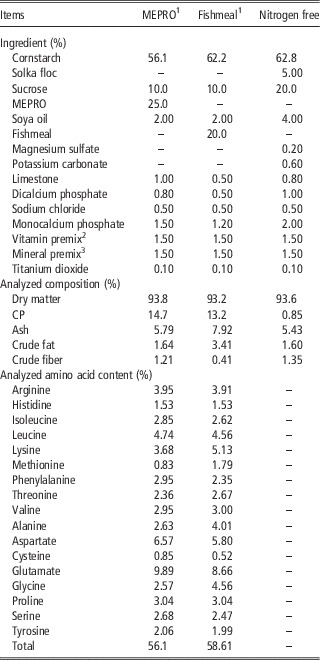
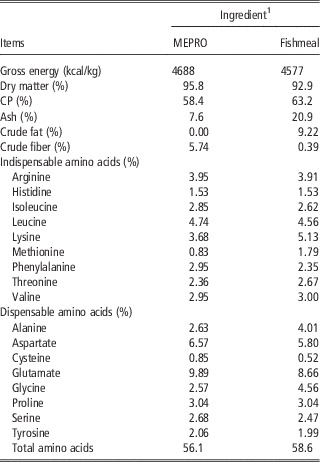
Following a minimum of 10-day post-surgery recovery period, barrows were randomly allotted to one of the three experimental diets: MEPRO, FM or nitrogen free (Table 1) in a duplicated 3×3 Latin square design consisting of three 7-day collection periods (5-day diet adaptation and 2 days of 8 h digesta collection from 0830 to 1630 h). The MEPRO and FM were included as the sole protein source in their respective diets, and the N-free diet was used to estimate basal endogenous losses of CP and AA (Stein et al., Reference Stein, Seve, Fuller, Moughan and de Lange2007). Nutrient contents of the MEPRO and FM are listed in Table 2. Vitamins and minerals were included in all diets to meet or exceed current requirements for growing pigs (National Research Council (NRC), Reference Olsen and Hasan2012), and titanium dioxide (titanium [IV] oxide, 98+%, anatase powder; Fisher Scientific, Pittsburgh, PA, USA) was included at 0.1% in all diets as the indigestible marker (Zhu et al., Reference Zhu, Rademacher and de Lange2005).
Composition and analyzed nutrient content of experimental diets (Experiment 1, as-fed basis)

MEPRO, microbially enhanced soybean meal.
1 MEPRO and Menhaden fishmeal provided by Prairie AquaTech (Brookings, SD, USA).
2 Provided per kg of the complete diet: 329 736 IU vitamin A supplement, 49 467 IU vitamin D3 supplement, 1650 IU vitamin E supplement, 1.32 mg vitamin B12 supplement, 132 mg menadione as menadione dimethylpyrimidinol bisulfite, 297 mg riboflavin supplement, 1815 mg d-pantothenic acid as d-calcium pantothenate, 1650 mg niacin supplement, 33 mg folic acid, 99 mg pyridoxine as pyridoxine hydrochloride, 99 mg thiamine as thiamine mononitrate and 5.12 mg biotin.
3 Provided per kg of the complete diet: 1.65 g Zn as zinc sulfate, 1.65 g Fe as ferrous sulfate, 440 mg Mn as manganese sulfate, 160 mg Cu as basic copper chloride, 3.6 mg I as ethylenediamine dihydriodide and 3 mg of Se as sodium selenite.
Analyzed nutrient content of the microbially enhanced soybean meal (MEPRO) and Menhaden fishmeal used in Experiments 1 and 2 (as-fed basis)

1 Ingredients provided by Prairie AquaTech (Brookings, SD, USA).
Barrows were fed 2.5× their daily maintenance energy requirement (106 kcal/kg of BW0.75; NRC, Reference Olsen and Hasan2012), based on individual BW measured at the beginning of each collection period split into two equal allotments fed at 0800 and 1600 h. Digesta was collected according to the method of Cervantes-Pahm and Stein (Reference Cervantes-Pahm and Stein2010), where 10 ml of 10% formic acid was added to each collection bag to prevent bacterial degradation (Fan et al., Reference Fan, Sauer, Hardin and Lien1994), and bags were changed every 30 to 60 min or near full capacity.
In the 10 kg BW digestibility trial, AID and SID of CP and AA in MEPRO and FM were determined using 37 barrows (9.8±1.2 kg BW) and the serial slaughter method. A total of six pigs were removed (two from MEPRO, four from FM) from the data set due to insufficient digesta available for collection resulting in n=10, 8 and 13 for the MEPRO, FM and N-free diets, respectively. Barrows were weaned at 28 days of age and housed in individual metabolism pens equipped with individual feeders and nipple drinkers in a 14-day feeding trial. Pigs were housed in an environmentally controlled room (28±1°C) and where necessary, supplemental heat was provided using heat lamps placed over individual pens.
Barrows were randomly assigned to one of the three experimental diets used in the 30 kg digestibility trial. Pigs were acclimated to weaning, metabolism pens and experimental diets for 7 days, where experimental diets were included at an increasing ratio to a commercial starter pig diet until pigs were completely transitioned to experimental diets by the afternoon of day 7. Pigs were allowed ad libitum access to feed but to ensure maximal intake, fresh feed was provided daily at 0800, 1200 and 1600 h. Before each feeding, any remaining orts were removed, weighed and recorded. Water was available at all times throughout both digestibility trials.
Barrows were weighed on day 1 and on the morning of slaughter. On day 13 all feed was removed at 1600 h, and on day 14, beginning at 0600 h in 15-min intervals (i.e. 0600, 0615, 0630 h, etc.), pigs were given ad libitum access to their respective diets and were euthanized 4 h later (i.e. 1000, 1015, 1030 h, etc.) by captive bolt and exsanguination. The entire gastrointestinal tract was excised, and ileal digesta was meticulously excised from a 30-cm section immediately proximal to the ileo–cecal junction and stored at −20°C, pending analysis. In both of the digestibility trials, a daily subsample of the experimental diets were taken and pooled at the end of the trial for nutrient analysis.
Sample analyses and calculations
In the 30 kg digestibility trial, digesta was thawed, mixed with a Hobart mixer (Model A-200T; Troy, Hobart Manufacturing Co., OH, USA), and subsampled within animal, diet and period, then lyophilized. In the 10 kg digestibility trial, the entire digesta sample for each pig was lyophilized. All lyophilized digesta was finely ground before further analysis. Subsamples of test ingredients, experimental diets and digesta were analyzed for AA by an institutional analytical lab (Agriculture Experiment Station Chemical Laboratories, University of Missouri-Columbia, Columbia, MO, USA; method 982.30 E(a,b), Association of Official Analytical Chemists (AOAC), 2006). Test ingredients and experimental diets were additionally analyzed for ash content, crude fat, crude fiber and moisture by the Agriculture Experiment Station Chemical Laboratories, University of Missouri-Columbia (method 942.05, 920.39 (A), 978.10 and 934.01, respectively; AOAC, 2006). Test ingredients, experimental diets and digesta were analyzed for nitrogen (Rapid N III; Elementar, Hanau, Germany) and CP was calculated as nitrogen (%)×6.25. Dry matter was measured using a Thelco laboratory oven (130DM, Precision Scientific Inc., Chicago, IL, USA). Experimental diets and digesta were analyzed for titanium according to Short et al. (Reference Short, Gorton, Wiseman and Boorman1996) with modifications. In brief, samples were gently digested on a block heater (H2025-5A; Baxter Scientific Products, Soddy-Daisy, TN, USA) for 20 h at 120°C and were vortex mixed every 30 min for 3 h, every 60 min for an additional 3 h and again following the completion of digestion. Sample absorbance was measured with a spectrophotometer (SPECTRAMAX190; Molecular Devices, Sunnyvale, CA, USA) at 408 nm.
Experiment 2
Animals, diets and experimental design
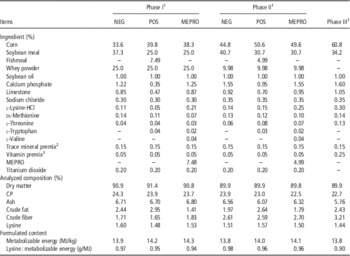
A total of 336 pigs (184 barrows and 152 gilts) in two equal blocks were weaned at 21±1 days of age (initial BW=6.1±0.8 kg) into 48 pens (n=7 pigs/pen). Each pen (1.8×1.2 m) contained one nipple drinker and three-hole self-feeder to provide ad libitum access to feed and water. Pens of pigs were randomly assigned to one of the six experimental diets in a 35-day growth trial. The six experimental diets included (1) a negative control (NEG; corn, SBM and whey); (2) NEG+acidifier (NEG A+; Kemin Industries, Des Moines, IA, USA); (3) NEG plus FM (POS); (4) POS+acidifier (POS A+); (5) NEG+MEPRO (MEPRO); and (6) MEPRO+acidifier (MEPRO A+; Table 3). Dietary acidifier was included at 0.2% in Phase I and Phase II. Pharmacological levels (2000 to 3000 ppm) of zinc oxide are commonly added to nursery diets to reduce the occurrence of pathogens and is an effective means to minimize diarrhea (Lampromsuk et al., Reference Li, Nelssen, Reddy, Blecha, Hancock, Allee, Goodband and Klemm2012). Because the impact of experimental diets on the incidence of diarrhea was evaluated, antibiotics and zinc oxide were not included in the diets. Diets were formulated to meet or exceed NRC (Reference Olsen and Hasan2012) requirements for weaned pigs on an SID AA and available phosphorus basis. The SID AA content in MEPRO and FM determined in the 30 kg digestibility trial was used to formulate respective experimental diets. Metabolizable energy : ileal digestible Lys was maintained similarly across all diets for all phases. A three-phase feeding program was used where experimental diets were fed from day 0 to day 21 in two phases (Phase I, 7 days; Phase II, 14 days) and a common nursery diet was fed from day 22 to day 35 (Phase III) post-weaning. Subsamples of all diets were collected routinely throughout the trial and stored at −20°C, pending analysis.
Composition and nutrient content of experimental diets (Experiment 2, as-fed basis)

NEG=negative control diet; POS=Menhaden fishmeal; MEPRO=microbially enhanced soybean meal.
1 Experimental diets were fed from day 0 to day 7 (Phase I) and from day 8 to day 21 (Phase II) post-weaning. All pigs received a common Phase III diet from day 22 to day 35. A mixture of acids were used for dietary acidifier (Kemin Industries, Des Moines, IA, USA), which was included at 0.2% in NEG, POS and MEPRO diets to create NEG A, POS A and MEPRO A diets in Phases I and II. The MEPRO and POS used in Phase I and II were provided by Prairie AquaTech (Brookings, SD, USA).
2 Provided per kg of the complete diet: 165 mg Zn as zinc sulfate, 165 mg Fe as ferrous sulfate, 43.5 mg Mn as manganese sulfate, 16.5 mg Cu as basic copper chloride, 0.36 mg I as ethylenediamine dihydriodide and 0.3 mg of Se as sodium selenite.
3 Provided per kg of the complete diet: 11 002 IU vitamin A supplement, 1651 IU vitamin D3 supplement, 55.1 IU vitamin E supplement, 0.044 mg vitamin B12 supplement, 4.4 mg menadione as menadione dimethylpyrimidinol bisulfite, 9.91 mg riboflavin supplement, 60.6 mg d-pantothenic acid as d-calcium pantothenate, 55.1 mg niacin supplement, 1.1 mg folic acid, 3.3 mg pyridoxine as pyridoxine hydrochloride, 3.3 mg thiamine as thiamine mononitrate and 0.171 mg biotin.
Pigs were housed in an environmentally controlled room where the initial room temperature was 28±1°C and reduced by 1°C each week until day 21, and behavioral indices of cold stress (i.e. huddling) were monitored daily. Gender and BW were balanced across treatments and within pens as best as possible where the CV of the pen initial BW was ⩽20%. A total of 32, 33, 33, 29, 29 and 28 barrows and 24, 23, 23, 27, 27 and 28 gilts were assigned to NEG, NEG A+, POS, POS A+, MEPRO and MEPRO A+, respectively. To determine the impact of treatment on gut health and microbiota, one pig per pen nearest the mean BW was removed on days 7 and 21 for collection of ileal and cecal digesta and intestinal tissue. Within each collection day and treatment, equal number of barrows and gilts were used. Details on digesta and tissue collection will not be reported in this paper.
Growth performance and diarrhea assessment
Pigs were weighed individually each week and pen feed disappearance was measured simultaneously. Due to errors associated with measuring feed disappearance, one pen fed the POS diet was removed from the data set before analysis. Incidence of diarrhea was recorded daily for each pen from day 1 to day 14 by three trained technicians according to the procedures and scoring system of Shu et al. (Reference Shu, Qu and Gill2001) based on a six-point scale for fecal consistency: (1) hard and formed pellets, (2) non-formed pellets, (3) soft feces, (4) very soft, containing a small amount of water-like feces, (5) semisolid, containing more than 50% water-like feces and (6) water-like feces. A mean daily score for each pen was calculated, and if a mean pen score was 5 or 6, or at least one observer gave a pen a score of a 6, it was considered PWDS requiring treatment. Diarrhea treatment followed SDSU swine research facility protocol; in brief, all pigs in pens identified as requiring treatment for PWDS were treated orally with spectinomycin (Animal Medical Care, Brookings, SD, USA) 2×/day for 3 days (2 ml/dose).
Statistical analysis
Digestibility data were analyzed using the PROC TTEST procedure of SAS (v9.3; SAS Institute Inc., Cary, NC, USA), where each pig was an experimental unit and ingredients were the fixed effects. Digestibility values from 30 to 10 kg pigs were compared using the PROC MIXED procedure of SAS (v9.3), where pig was the experimental unit and ingredient, age and their interactions were fixed effects. Performance data and daily pen fecal scores were analyzed using the PROC MIXED procedure of SAS (v9.3) with pen as the experimental unit in a randomized block design. Fixed effects were diet, dietary acidifier and their interaction. For the performance data, pen nested within block and treatment was the random variable, and initial BW was used as a covariate. Treatment for PWDS was initiated on days 10 and 6 for blocks 1 and 2, respectively; therefore, for the fecal score assessment blocks were analyzed separately. The frequency of a pen receiving a PWDS treatment on day 1, or treated at all, was analyzed using the CATMOD procedure of SAS (v9.3). Statistical significance was established at P<0.05. For all ANOVA analyses, the Tukey–Kramer adjustment was used to test means separation where main effects were significant. All data were tested a priori for normality and homogeneity of variances using SAS (v9.3) and data are presented as least squares means±SEM.
Results
Experiment 1
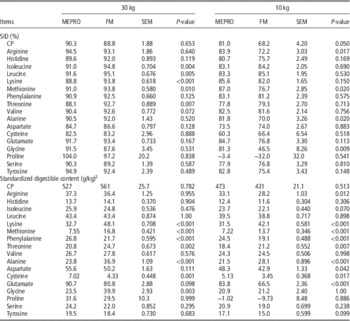
The SID of isoleucine, leucine, lysine, methionine and threonine were lower (P<0.01) in MEPRO than FM fed to 30 kg pigs (Table 4). The SID of CP, arginine, methionine, alanine and glycine was greater (P<0.05) in MEPRO than FM fed to 10 kg pigs, and there was no differences in the SID of other AAs tested (Table 4). There was an age×ingredient interaction (P<0.05) where the SID of CP (88.8% v. 68.2%±5.67%), arginine (93.1% v. 72.2%±4.22%), lysine (93.8% v. 82.0%±2.16%), methionine (93.8% v. 76.7%±3.60%), phenylalanine (92.5% v. 81.2%±3.02%), alanine (92.0% v. 70.0%±4.28%), glutamate (93.4% v. 76.8%±4.28%), glycine (87.6% v. 46.5%±11.0%), proline (97.2% v. −32.01%±45.0%) and tyrosine (92.4% v. 75.4%±4.76%) in FM was greater (P<0.05) when fed to 30 kg pigs than to 10 kg pigs; alternatively, the SID of CP and respective AA were equivalent in MEPRO when fed to 30 and 10 kg pigs (Table 4).
Standard ileal digestibility (SID) and standardized digestible CP and amino acid content in microbially enhanced soybean meal (MEPRO) and Menhaden fishmeal fed to 30 and 10 kg pigs (Experiment 1, as-fed basis)Footnote 1

1 Digesta was collected using T-cannulas in the distal ileum with 30 kg pigs (n=6/diet) and by the serial slaughter method with 10 kg pigs (n=10 and 8 for MEPRO and fishmeal (FM), respectively). The MEPRO and FM were provided by Prairie AquaTech (Brookings, SD, USA).
2 The SID of CP and each amino acid was multiplied by the concentration of CP and corresponding amino acid for each ingredient to calculate the SID CP of amino acid of each ingredient (as-fed basis).
The SID content (g/kg) of CP and all tested AA are listed in Table 4. The SID content (g/kg) of phenylalanine and cysteine were greater (P<0.05) in MEPRO than FM fed to 30 kg pigs. The SID content (g/kg) of lysine, methionine, threonine, alanine and glycine were greater (P<0.05) in FM than MEPRO fed to 30 kg pigs. The SID content (g/kg) of arginine, phenylalanine, aspartate, cysteine and glutamate were greater (P<0.05) in MEPRO than FM fed to 10 kg pigs (Table 4). The SID content (g/kg) of lysine, methionine, threonine and alanine were greater (P<0.05) in FM than MEPRO fed to 10 kg pigs. There was an age×ingredient interaction where the SID content of cysteine (7.02 v. 5.13±0.57 g/kg) and serine (24.2 v. 20.9±1.08 g/kg) were greater (P<0.05) in MEPRO when fed to 30 kg pigs than to 10 kg pigs; alternatively, the SID content (g/kg) of those respective AA in FM were equivalent when fed to 30 and 10 kg pigs. In addition, SID content (g/kg) of CP, arginine (36.4 v. 28.2±1.26 g/kg), lysine (48.1 v. 42.1±0.94 g/kg), methionine (16.8 v. 13.7±0.56 g/kg), alanine (36.9 v. 28.1±1.44 g/kg), glutamate (80.8 v. 66.5±3.81 g/kg), glycine (39.9 v. 21.2±3.88 g/kg), proline (29.5 v. −9.73±13.7 g/kg) and tyrosine (18.4 v. 15.0±0.97 g/kg) were greater (P<0.05) in FM when fed to 30 kg pigs than to 10 kg pigs; alternatively, SID content (g/kg) of those respective AA in MEPRO were equivalent when fed to 30 and 10 kg pigs.
Experiment 2
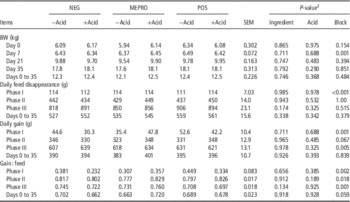
There was no effect of ingredient, dietary acidifier or their interaction on pig performance in Phase I, II or III (Table 5). There was no block×dietary treatment effect on pig performance. However, pigs in block 1 were heavier (P=0.001), had a greater daily feed disappearance (P<0.001), daily gain (P=0.001) and gain : feed (P=0.002) in Phase I than pigs in block 2. During Phase II, block 1 pigs had a greater gain : feed (P<0.02). Pigs in block 2 had a greater daily gain (P=0.005) and gain : feed (P=0.001) during Phase III than pigs in block 1.
Effect of dietary inclusion of microbially enhanced soybean meal (MEPRO) and Menhaden fishmeal (POS) with or without dietary acidifier on growth performance of weaned pigs (Experiment 2)Footnote 1

NEG=negative control diet.
1 Experimental diets were fed in Phase I (days 0 to 7 post-weaning) and Phase II (days 8 to 21) in a three-phase feeding study. All pigs received a common Phase III diet from day 22 to day 35. The NEG was based on corn, soybean meal and whey with decreasing inclusion of whey from Phase I to Phase II. MEPRO and fishmeal were added to the NEG diet at 7.5% at the expense of conventional soybean meal in Phase I and 5% in Phase II to create the MEPRO and POS diets, respectively. The MEPRO and POS were provided by Prairie AquaTech (Brookings, SD, USA). Dietary acidifier was included in experimental diets at 0.2%.
2 Ingredient main effect refers to NEG, MEPRO or POS. There was no block×main effects interaction and no ingredient×acid interaction.
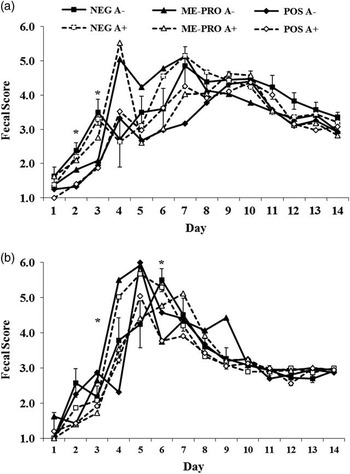
In block 1, pigs fed the NEG diets had higher (P=0.02) fecal scores than pigs fed the POS diets on day 2 and on day 3 (Figure 1a). In block 2, pigs fed diets without dietary acidifier had higher (P=0.047) fecal scores than pigs fed diets with dietary acidifier on day 3 (Figure 1b). In block 2, pigs fed the NEG diets had higher (P=0.01) fecal scores than pigs fed either MEPRO or POS diets on day 6. There was no interaction between ingredient and dietary acidifier on fecal score. A total of 13%, 25%, 25%, 25%, 13% and 25% of pens fed NEG, NEG A+, POS, POS A+, MEPRO and MEPRO A+, respectively, were treated on day 1 of PWDS intervention, and 63%, 63%, 50%, 75%, 38% and 63% of pens fed NEG, NEG A+, POS, POS A+, MEPRO and MEPRO A+, respectively, were treated at least once for PWDS.
Daily pen fecal scores of weaned pigs fed diets containing microbially enhanced soybean meal (MEPRO) or Menhaden fishmeal (POS) compared with a negative control diet (NEG) with or without dietary acidifier (MEPRO A+, POS A+, NEG A+). Treatment for diarrhea began on day 10 in block 1 (a) and on day 6 in block 2 (b); therefore, blocks were analyzed separately. Values represent means±SEM. *Significant difference (P<0.05).

In the present study, we observed reduced fecal scores in pigs fed diets containing MEPRO or FM compared with the control pigs, which is in agreement with Song et al. (Reference Song, Pérez, Pettigrew, Martinez-Villaluenga and de Mejia2010), who noted that replacement of conventional SBM with fermented SBM reduced diarrhea in weaned pigs.
Discussion
Digestibility
This study investigated the digestibility of MEPRO in comparison with FM because MEPRO was proposed as a more sustainable, lower cost alternative to FM and determined that SID of AA was similar between MEPRO and FM. Although we did detect a lower SID of five essential AAs in MEPRO, the difference was between 3% and 5% lower and thus of limited significance on a practical diet formulation basis. However, it should be noted that due to differences in total AA content, the SID content of lysine and methionine were 33% and 50% lower in MEPRO than FM. As a result, use of crystalline lysine and methionine may be required when MEPRO is used in practical diet formulation.
A secondary objective was to compare the digestibility of MEPRO and FM fed to 10 and 30 kg pigs. Age appeared to have a greater influence on SID and SID content for FM than MEPRO. The SID and SID content of AA in FM ranged from 12% to 20% lower when fed to 10 kg pigs but only 3% to 9% lower in MEPRO when fed to 10 kg pigs. While it is unclear why digestibility of FM was more influenced by age than MEPRO, the digestibility of CP and AA in FM fed to 30 kg pigs is above or within the range of previously reported digestibility values for FM (Jørgensen et al., Reference Lampromsuk, Bunchasak, Kaewtapee, Sawanon and Poeikhampha1984; NRC, Reference Olsen and Hasan2012). Similarly, as the closest previously reported comparison for MEPRO, the SID of CP and most AAs in MEPRO fed to 30 kg pigs were above the SID range reported for fermented SBM (Cervantes-Pahm and Stein, Reference Cervantes-Pahm and Stein2010; NRC, Reference Olsen and Hasan2012).
Different methods of digesta collection were used for the 30 and 10 kg pigs; thus the effect of age must be compared with attention. Viljoen et al. (Reference Viljoen, Coetzeel, Fick, Siebrits and Hayes2000) reported higher digestibility values in cannulated pigs in comparison with the serial slaughter method using pigs of the same BW. At death, mucosal cells are shed into the intestinal lumen and influence the digestibility values of nitrogenous compounds (Badaway et al., Reference Badaway, Campbell, Cuthbertson and Fell1957; Fell, Reference Fell1961). Physically manipulating the intestine may also result in further sloughing of mucosal cells, contributing to the endogenous fraction of digesta (Viljoen et al., Reference Viljoen, Coetzeel, Fick, Siebrits and Hayes2000). Great care was taken at the time of digesta collections in the 10-kg trial to limit physical manipulation of the intestine and minimize the impact of extraneous endogenous AA losses. Therefore, the differences between the two methods were expected to be minimal and the comparison between ages acceptable. Proline digestibility and the associated Sy.x may be used as an indirect evaluation of errors associated with digesta extraction, particularly for the protein-free diet. Proline makes up a large component of the AA content of endogenous losses and thus proline digestibility is heavily influenced by variables that increase endogenous loss estimates (i.e. low dietary protein, dietary fiber; Dilger et al., Reference Dilger, Sands, Ragland and Adeola2004). In the current study, the SEM of SID and SID content was 4 to 20 times greater than the other AA, regardless of ingredient. The negative proline digestibility in the 10 kg pigs further indicates a high proportion of proline, compared with other AA, in the digesta from pigs fed the protein-free diet.
Performance
Dietary inclusion of FM or MEPRO reduced the severity and inclusion of MEPRO reduced the incidence of PWDS in weaned pigs but neither FM nor MEPRO influenced growth performance compared with pigs fed NEG. It was expected that pigs fed diets containing MEPRO and FM would have improved performance compared with pigs fed the NEG diets due to the reduced anti-nutritional factors. Anti-nutritional factors such as trypsin inhibitors, raffinose and stachyose in conventional SBM have been shown to reduce nursery pig performance and nutrient digestibility at high inclusion rates in the diet; thus, processed soy proteins were developed to reduce the levels of anti-nutritional factors (Min et al., 2004). On average, levels of anti-nutritional factors in conventional SBM range from 2596 to 6090 trypsin inhibitor units (TIU)/g trypsin inhibitor, 0.98% raffinose and 3.07% stachyose (Choct et al., Reference Choct, Dersjant-Li, McLeish and Peisker2010). The analyzed content of MEPRO included 68.88 TIU/g trypsin inhibitor, 0.00% raffinose and 0.02% stachyose. The levels of trypsin inhibitor, raffinose and stachyose supplied by each experimental diet was calculated based on analyzed values for MEPRO and a mean value for the basal SBM used in producing the MEPRO and corn diets (NRC, Reference Olsen and Hasan2012). Trypsin inhibitor, raffinose and stachyose levels were found to be 66.8%, 50.0% and 50.0%, respectively, lower in the MEPRO and POS diets compared with the NEG diets. All experimental diets were formulated to contain similar metabolizable energy and metabolizable energy : SID lysine ratio; therefore, the similar performance can be explained by similar diet formulation, which may overcome the anti-nutritional factor. Other fermented soy protein (i.e. HP 300 and PepSoyGen; Hamlet Protein A/S, Horsens, Denmark and Nutraferma Inc., North Sioux City, SD, USA, respectively) have been evaluated as alternative protein ingredients for nursery pig diets with varying results (Min et al., 2004; Jones et al., Reference Jørgensen, Sauer and Thacker2010). Min et al. (2004) reported an increase in pig performance (overall daily gain and weekly feed intake) when diets included fermented soy protein. The improved response was explained by greater digestibility in complete diets containing processed soy protein. In our study, digestibility of MEPRO and FM were determined a priori and used to formulate performance study diets containing equivalent SID AA. Jones et al. (Reference Jørgensen, Sauer and Thacker2010) reported no performance advantage when fermented soy protein was included in the diet alone or in combination with FM but reported improved performance (daily gain and gain : feed) when included in diets containing plasma products. Experimental diets reported by Jones et al. (Reference Jørgensen, Sauer and Thacker2010) are similar in ingredient content as those used in the current study, particularly the control (equivalent to the NEG diet), which was formulated with an expectation of reduced pig performance. In the current study, weekly and overall growth performance in pigs fed the NEG diet was above that reported by Jones et al. (Reference Jørgensen, Sauer and Thacker2010) and Min et al. (2004) for all treatments indicating excellent growth performance of all pigs in our study. As discussed previously, the lack of response observed with MEPRO in the current study may be related to an equivalent supply of digestible nutrients among all treatments, as well as the high growth performance observed in all pigs.
The reduced severity and incidence of diarrhea in pigs fed MEPRO may be because of degradation of β-conglycinin and glycinin in MEPRO as a result of further processing. Glycinin and β-conglycinin have been shown to stimulate hypersensitivity in young pigs (Li et al., Reference Min, Hong, Kwon, Lee, Kim, Kim, Cho and Kim1990). The lower fecal scores observed in pigs fed diets with dietary acidifier may also be because of lower pH in the upper intestinal tract. Inclusion of acidifier in the diet is suggested to inhibit proliferation of pathogenic micro-organisms by lowering gastric pH (Tsiloyiannis et al., Reference Tsiloyiannis, Kyriakis, Vlemmas and Sarris2001). Tsiloyiannis et al. (Reference Tsiloyiannis, Kyriakis, Vlemmas and Sarris2001) reported a benefit in PWDS in weaned pigs by feeding diets with organic acidifiers. The lack of a growth response to inclusion of dietary acidifier may be related to diet ingredient composition. According to Bergstrom et al. (Reference Bergstrom, Nelssen, Tokach, Goodband, Loughmiller, Musser and Nessmith1996), the inclusion of organic acids in starter diets may not provide additional growth benefits when the diets contain high levels of milk products. Experimental diets used in the present study contained high levels of whey, which may have minimized the effects of the dietary organic acids.
The results of the current study support our hypothesis that MEPRO is a suitable alternative to FM in nursery pig diets because of the similar ileal digestible CP and AA content in MEPRO compared with FM and the positive impact on PWDS, the lesser reduction in digestibility estimates for MEPRO when fed to the 10 kg pigs further supports our conclusion that MEPRO is a suitable alternative to FM as well. Although there was no interaction between MEPRO and dietary acidifier, possible interactions with other key ingredients should be explored. The maximum level of MEPRO to achieve optimal gain/cost of feed should also be assessed.
Acknowledgments
This project was funded by the National Pork Board, South Dakota Soybean Research and Promotion Council and South Dakota Pork Producers Council. The authors gratefully acknowledge Prairie AquaTech (Brookings, SD, USA) for providing MEPRO and FM and Kemin Industries (Des Moines, IA, USA) for providing dietary acidifier. M. L. B. and W. R. G. serve as Chief Science Officers of Prairie AquaTech, which developed the MEPRO described in this article.