


Introduction
Subclinical mood problems as well as clinical depression are at the top of the list in the most common psychological problems among clients seeking psychological services (Kessler, Chiu, Demler, Merikangas and Walters, Reference Kessler, Chiu, Demler, Merikangas and Walters2005; Kessler, Olfson and Berglund, Reference Kessler, Olfson and Berglund1998), and psychological treatments, especially cognitive therapies (CT) and cognitive-behavioural therapies (CBT) have been found to be effective in the treatment of depression and depressive symptoms (e.g. Hollon and Ponniah, Reference Hollon and Ponniah2010; Westen and Morrison, Reference Westen and Morrison2001). However, therapeutic interventions have been examined using well-trained and clinically experienced psychotherapists, the training of which is time-consuming and expensive. In recent years, research has extended to the field of shorter treatments delivered by novice therapists, and the results have been promising (Forand, Evans, Haglin and Fishman, Reference Forand, Evans, Haglin and Fishman2011; Öst, Karlstedt and Widén, Reference Öst, Karlstedt and Widén2012).
In this preliminary study, a four-session Acceptance and Commitment Therapy (ACT) based intervention for depressive symptoms was administered by Masters level psychology students to adults reporting subjective feelings of depressive mood. ACT is based on functional contextualism and a profound theory of language and cognition called relational frame theory (Hayes, Masuda, Bissett, Luoma and Guerrero, Reference Hayes, Masuda, Bissett, Luoma and Guerrero2004; Hayes, Barnes-Holmes and Roche, Reference Hayes, Barnes-Holmes and Roche2001; Hayes, Strosahl and Wilson, Reference Hayes, Strosahl and Wilson2011). A key combining concept in ACT is psychological flexibility, the ability to be fully present and accepting while constantly changing or persisting in behaviour in the service of values (Hayes, Luoma, Bond, Masuda and Lillis, Reference Hayes, Luoma, Bond, Masuda and Lillis2006). There are various studies supporting the model and its effectiveness in therapy work with respect to several mental health problems compared to treatment-as-usual, waiting-list controls and treatments designed to impact the problem (see meta-analysis by Hayes et al., Reference Hayes, Luoma, Bond, Masuda and Lillis2006; also review by Ruiz, Reference Ruiz2010). The efficacy research on ACT and its processes of change concerning diagnosed depression is still limited and supportive results are seen as preliminary (Bohlmeijer, Fledderus, Rokx and Pieterse, Reference Bohlmeijer, Fledderus, Rokx and Pieterse2011; Hayes, Boyd and Sewell, Reference Hayes, Boyd and Sewell2011; Zettle and Hayes, Reference Zettle and Hayes1986; Zettle and Rains, Reference Zettle and Rains1989).
Psychological treatments by novice therapists have been supported by research, but relatively few studies have been conducted with respect to applying ACT. In a study by Forman, Herbert, Moitra, Yeomans and Geller (Reference Forman, Herbert, Moitra, Yeomans and Geller2007), doctoral students received training in both CT (12 hours) and ACT (18 hours) and conducted both treatments (approximately 18 sessions) with similar improvements in client well-being. Lappalainen et al. (Reference Lappalainen, Lehtonen, Skarp, Taubert, Ojanen and Hayes2007) examined the impact of CBT and ACT interventions for depression when therapists were Masters level psychology students whose training was part of the clinical teaching program consisting of 20 hours of lectures and 30 hours of supervision. The clients treated with ACT showed better improvement of symptoms compared to CBT clients, although well-being in both groups improved. The present study continues the research line of student-administered treatments presented in Lappalainen et al. (Reference Lappalainen, Lehtonen, Skarp, Taubert, Ojanen and Hayes2007) by replicating parts of its design. The current study differentiates from that study by using a waiting-list control and more than a 50% shorter intervention model without a CBT group. A similar target population with subjective distress, but who may not fulfill the diagnostic criteria for depression, was used as we argue that this is a population often in need of psychological treatment. Also, compared to other psychology trainee studies (Forand et al., Reference Forand, Evans, Haglin and Fishman2011; Öst et al., Reference Öst, Karlstedt and Widén2012), the present study uses a considerably shorter intervention and therapist training, a control group and a 6-month follow-up to assess treatment outcome stability. The aim of the current study was to examine whether a brief ACT-based intervention delivered by psychology students would have positive psychological effects on self-referred clients who reported depressive mood, compared to not administering any treatment (i.e. compared to a waiting-list group). This study also permitted the evaluation of longer term outcomes.
Method
Procedure
The analysed data consists of two successive collections (2008 and 2009) investigating the efficacy of a four-session ACT-based intervention in the treatment of depressive symptoms, using an experiment (ACT) group and a waiting-list control (WLC) group design with a 6-month follow-up combining all treated participants. For ethical reasons no control condition was left to follow-up since the WLC group also received the same treatment approximately after a 5-week waiting period. The measurement after the waiting period was used as pre-measurement for the WLC group. The treatment was administered by student therapists conducting the project as a voluntary part of their Masters degree in psychology studies at the University of Jyväskylä, Finland.
Participants were recruited via a newspaper advertisement stating that a university research project studying the efficacy of a brief psychotherapeutic treatment provided by psychology students was seeking individuals with depressed mood. Participants were asked to contact via telephone or e-mail. The criteria of participants sought for inclusion were the following: 1) subjective depressive symptoms or depressed mood (diagnosis not necessary); 2) no other concurrent psychological treatment; 3) no reported diagnosis of schizophrenia; 4) no reported alcoholism; 5) no reported severe sensory or brain injury; 6) no reported neurological disorder. Criteria 3–6 were used for the neuropsychological research component of the same project. The participants were interviewed on the phone about their subjective mood and other inclusion criteria.
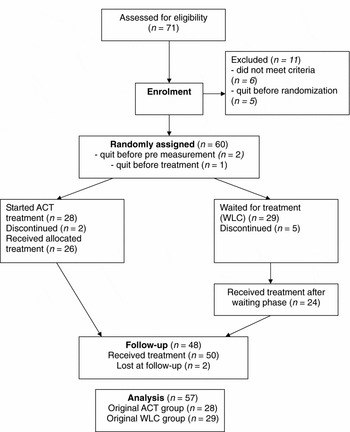
A total of 71 participants contacted the project of whom 60 met baseline inclusion criteria and decided to continue (see Figure 1 for the flow of the participants). After the sample of 60 was collected, a randomization into two groups by gender was conducted. After randomization, three participants decided to quit and the groups starting treatment were as follows: 1) the experiment group (n = 28) and 2) the WLC (n = 29) (i.e. the waiting-list group, of which 5 discontinued and 24 received treatment later). Altogether, 50 participants received the ACT treatment, and 9 discontinued treatment and did not attend the follow-up. Reasons for dropping out are not available.
Participant flow through the study

A set of seven self-report measures (presented later) were completed on three occasions: before and after the treatment or the waiting phase, and 6 months after the treatment had ended; however, the WLC group completed the measures for the fourth time after their treatment had been completed due to the nature of the design. The AAQ-2 (the Acceptance and Action Questionnaire–2, earlier version; Bond et al., Reference Bond, Hayes, Baer, Carpenter, Guenole and Orcutt2011) and the visual rating scale of 0–100 for mood (Ojanen and Seppälä Reference Ojanen and Seppälä1997; Ojanen Reference Ojanen, Jobin, Maltais, LeBlanc and Simard2000, Reference Ojanen and Talo2001) were also completed after every session to be used as additional clinical feedback to guide treatment decisions. Before the follow-up, participants received a letter with information concerning the upcoming measurement, and they were asked to contact the clinic. Those who did not contact were phoned by the research team one week later.
Participants
The sample consisted of 57 Caucasian participants (45 females and 12 males; one participant did not provide background information). Their mean age was 46.2 years (SD = 11.9, range = 17–71). They had an average of 1.6 children, and 16 (29%) of the participants were unmarried, 18 (32%) were married, 9 (16%) were living with their partner, and 13 (23%) were divorced. Twenty-two (39%) of the participants were working, 10 (18%) were unemployed, and 10 (18%) were retired; three (5%) were on sick leave, 6 (11%) were students, 3 (5%) were homemakers and 2 (4%) were entrepreneurs. Five (9%) of the participants had only basic education (comprehensive school), 25 (45%) had a secondary level education, 24 (43%) had higher education (university or college), and 2 (3%) reported other. Thirty-five (63%) of the participants had previously received therapy or conversational support, 37 (66%) had previously used medication for depression or anxiety, and 16 (29%) were on medication when treatment started. Medication at pre-measurement was used by 9 (32%) of the participants in the ACT group and 7 (25%) in the WLC group. An independent samples t-test (for age and the number of children) and a χ2-test (for categorical variables) revealed no significant differences between the ACT and WLC groups or between the two data collection groups with regard to their background information and medication use at pre-measurement.
Client measures
The Beck Depression Inventory (BDI; Beck, Ward, Mendelson, Mock and Erbaugh, Reference Beck, Ward, Mendelson, Mock and Erbaugh1961) is a widely used self-report questionnaire with 21 items measuring the severity of depression. The reliability of the instrument and the internal consistency has been found to be high (Beck et al., Reference Beck, Ward, Mendelson, Mock and Erbaugh1961). The Symptom Checklist-90 (SCL-90) is a broad self-report check list of psychopathological symptoms and has been validated with regard to the Finnish population (Holi, Sammallahti and Aalberg, Reference Holi, Sammallahti and Aalberg1998). The internal consistency ranged between .77 and .90 in a patient sample and between .79 and .97 in a community sample. In our study, the scores from the SCL-90 are reported as General Severity Index (GSI) scores, which are calculated by dividing the original score by the number of questions (90). The Social Adaptation Self-Evaluation Scale (SASS; Bosc, Dupini and Polin, Reference Bosc, Dubini and Polin1997) measures social functioning and coping with daily life, and has the Cronbach's alpha coefficient of .74, indicating good internal consistency.
Three descriptive visual rating scales of 0–100, measuring self-confidence, mood and life satisfaction were also used to present quick visual feedback (Ojanen and Seppälä Reference Ojanen and Seppälä1997; Ojanen Reference Ojanen, Jobin, Maltais, LeBlanc and Simard2000, Reference Ojanen and Talo2001). The Acceptance and Action Questionnaire-2 (AAQ-2, earlier version), a 10-item self-report instrument utilizing a 7-point Likert-type scale, was used to evaluate psychological flexibility and experiential avoidance. The AAQ-2 started out as a 10-item scale that had been translated into Finnish and was used in this study, but it has been reduced to a 7-item scale after final psychometric analysis (Bond et al., Reference Bond, Hayes, Baer, Carpenter, Guenole and Orcutt2011). The 7-item AAQ-2 has the mean alpha coefficient of .84 (Bond et al., Reference Bond, Hayes, Baer, Carpenter, Guenole and Orcutt2011). The 7- and 10-item versions correlate at r = .96 and thus the earlier version of the AAQ-2 should be valid for research purposes (Bond et al., Reference Bond, Hayes, Baer, Carpenter, Guenole and Orcutt2011). We have used it in the sense of evaluating the amount of psychological flexibility, with higher scores indicating more flexibility, thus items 2 to 5 and 7 to 9 were reverse-keyed.
Therapists
All therapists (n = 20) were female Masters level psychology students at the University of Jyväskylä, with mean age of 25.8 years (SD = 5.4; range = 22–47 years). One student had completed an internship period of 6 months, but none of the students had experience of practising psychotherapy.
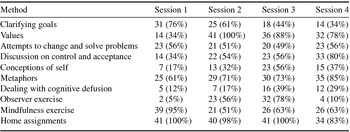
The students had received approximately 10 hours of training on ACT as part of their clinical methods course and, in addition to this, they received extra training (4 hours) in the brief ACT protocol. The training included a lecture on the general principles of ACT core processes as well as the presentation of a “functional analytic clinical case model” (FACCM; Haynes and O'Brien, Reference Haynes and O'Brien2000) and the practice of constructing one. FACCM is a vector-graphic approach for analysing problematic behaviours, the relations between behavioural problems and the importance, strength and direction of those causal and non-causal relations (Haynes and O'Brien, Reference Haynes and O'Brien2000). Therapists used an ACT manual (Lappalainen et al., Reference Lappalainen, Lehtonen, Hayes, Batten, Gifford and Wilson2004) throughout the therapy and they attended weekly group supervisions (2–3 hours) during the treatment. All student therapists took part in the supervision sessions in which ongoing interventions were discussed, methods and exercises used were reviewed, and treatment considerations in line with ACT model were outlined for the following session. The supervisor/trainer (RL) had been trained in both CBT and ACT, and had approximately 10 years of clinical experience in ACT. The supervision was an important component in controlling adherence and assuring the use of ACT-based methods. The therapists were to report what they had actually done during sessions and the use of a checklist was required (Table 1).
The total number and percentage per session of methods used by all therapists, showing all clients attending all four sessions (n = 41); the number in each cell states for how many clients the method was used during each session

Treatment
Treatment was conducted in an individual format and the language used was Finnish, except in the case of one native English speaker with moderate Finnish language skills to whom the treatment was offered in English. Student therapists followed a semi-structured treatment model and they were able to adapt certain aspects such as metaphors and exercises to benefit the client in question. Each session lasted approximately 60 minutes and took place at the Department of Psychology. Two leading guidelines were given to the therapists. First, they were instructed to find out in cooperation with their clients how they could most effectively influence their lives by value-based actions; that is, to “activate” clients between the sessions. The second guideline focused on working with emotional and verbal barriers that may rise when taking actions toward a “good life”.
Session 1 consisted mostly of gathering additional background information and constructing a problem list based on the client's issues. An ACT-based value description (writing down everything the client affiliates with a “good life”) was used as a home assignment. Based on the problem list, the therapist constructed the FACCM showing, in graphical form, how the problems were related to each other. Between sessions 1 and 2 the FACCM was presented to the supervisor, and during session 2 it was viewed with the client. After presenting the FACCM, a value analysis was constructed in session based on the client's value description. The FACCM and values analyses were used to guide decisions concerning treatment targets and aims for each client. Sessions 3 and 4 were more individually planned during supervision, and during session 4 a summary of the treatment and future directions were covered with the client to support future work towards valued life.
ACT metaphors and exercises were used throughout the whole treatment process and therapists were instructed to use at least one during each session. Home assignments were either related to the methods and exercises used during sessions or they emerged from the client's life situation. ACT processes were worked with the client using discussions on values, control and acceptance, different metaphors and exercises.
A more elaborate treatment description is available from the corresponding author. We were not able to collect video or audio recordings of the sessions: instead, after each session, therapists marked on a checklist which methods were used (according to pre-formulated categories, see Table 1). Previous studies in our research group have shown good correspondence (Cohen's kappa = .82) between the checklist and independent observers’ ratings regarding the frequency of the usage of the methods (Haapala, Reference Haapala2008). Our clinical experience is that the adherence to the treatment protocol among students is very high, and observations made during supervision support that.
Statistical analysis
Statistical analyses were conducted with the SPSS for Windows software (version 18.0). The effects of the treatment were compared between groups (Group x Time) using a repeated measures analysis of variance with Group (ACT treatment vs. waiting-list control) as a “between-group” factor and with Time (pre- and post-measurements) as a “within-group” factor. All dependent variables were entered one at a time. If the interaction was significant, the Time effect was further tested for both groups separately. The stability of the treatment outcome was examined using an ANOVA for repeated measures. Pre, post and follow-up scores were entered one at the time, used as dependent variables and compared with each other in order to identify possible changes during and after the treatment. Analyses were conducted for treatment completers and intent-to-treat (ITT) analyses were calculated using the last-observation-carried-forward (LOCF) method on the conservative assumption that participants who discontinued prematurely experienced no change. A similar pattern of results was obtained with both analyses; therefore, only the ITT results are reported. All participants who began treatment (n = 57) were included in the ITT sample. The effect sizes (ES; Cohen's d) were calculated as follows. The between-group ES was calculated posttreatment by dividing the difference between the treatment group mean and the control group mean by the pooled standard deviation (SD) of the conditions. The within-group ES was calculated for both post- and follow-up measurement by dividing the mean change from pre to post by the pre-measurement SD and by dividing the mean change from the pre to follow-up with the pre-measurement SD (Feske and Chambless, Reference Feske and Chambless1995; Morris and DeShon, Reference Morris and DeShon2002). A between-group effect size of 0.2 was considered small, 0.5 medium, and 0.8 large. A within-group ES of 0.5 was considered small, 0.8 medium, and 1.1 large (Roth and Fonagy, Reference Roth and Fonagy1996; Öst, Reference Öst and Öst2006). Clinical significance for depressive symptoms was computed based on the Jacobson and Truax (Reference Jacobson and Truax1991) model in which both a reliable change index (RCI, a minimum decrease from pre to post and pre to follow-up) and the crossing of a cut-off point approximating a shift from clinical to nonclinical status, are required. Calculating the individual RCI and the cut-off C for whole sample, the results of validation study were used: the mean and SD of BDI for non-patient were 7.21 and 6.83 respectively, and internal consistence was .86 (Elovainio et al., Reference Elovainio, Aalto, Kivimäki, Pirkola, Sundvall and Lönnqvist2009). The mean and SD of BDI for patient from this study were 22.44 and 9.95, respectively. Cutoff C level was 13.41 (BDI).
Results
Baseline equivalence
At pre-measurement, there were no statistically significant differences in any of the measures between the data samples (2008/2009) or the two groups (ACT and WLC) except in experienced symptoms (SCL-90-GSI), the higher amount of symptoms being reported in the ACT group.
Comparison of ACT treatment group vs. waiting-list control (WLC) group
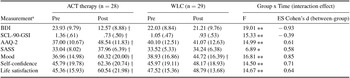
The results yielded a main effect for all the dependent variables (F(1, 55) = 12.45 – 46.29, p = .000 – .001). As can be seen from Table 2, there was a significant Group x Time interaction effect on all variables, indicating that the groups changed differently during the treatment in favour of the ACT group. Between-group effect sizes indicate large differences in depressive symptoms (BDI, d = .93) and mood (Mood, d = .85); medium-sized differences in psychological flexibility (AAQ-2, d = .61), social functioning (SASS, d = .58), self-confidence (Self-confidence, d = .71) and life satisfaction (Life satisfaction, d = .64); and a small difference in experienced symptoms (SCL-90-GSI, d = .39) (see Öst, Reference Öst and Öst2006). Mean scores, standard deviations, interaction effects and between-group effect sizes (Cohen's d) at pre- and posttreatment for both groups are presented in Table 2.
Mean scores (standard deviations), interaction effect and between group effect sizes (Cohen's d) of the intent-to-treat sample

† statistically significant difference between pre- and post-measurements using within-group repeated measures * p < .05, ** p < .01
aBDI = Beck Depression Inventory; SCL-90-GSI = Symptom Checklist-90 General Severity Index; AAQ-2 = Acceptance and Action Questionnaire – 2; SASS = Social Adaptation Self-evaluation Scale; Mood = visual rating scale of 0–100 for mood; Self-confidence = visual rating scale of 0–100 for self-confidence; Life satisfaction = visual rating scale of 0–100 for life satisfaction
Treatment outcome and 6-month follow-up
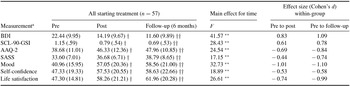
The treatment effects lasted for the 6-month follow-up period and there was a significant within-group treatment main effect over time on all variables (Table 3). Paired t-tests were done on all dependent variables. Psychological flexibility (AAQ-2) had significantly increased during pre to post (t(56) = −4.91, p = .000), and pre to follow-up (t(56) = −6.56, p = .000), but there was no further reductions from post to follow-up (t(56) = −1.17, p = .246). A similar pattern was found in terms of Mood, Self-confidence and Life satisfaction (pre to post t(56) = −4.64 – −6.04, p = .000; pre to follow-up t(56) = −4.61 – −6.13, p = .000; and post to follow-up t(56) = −.64 – −1.95, p = .056 – .524). There were significant changes from post to follow-up in terms of depressive symptoms, experienced symptoms and social functioning (pre to post t(56) = −3.71 – 6.73, p = .000; pre to follow-up t(56) = −4.85 – 6.99, p = .000; and post to follow-up t(56) = −2.56 – 2.45, p = .013 – .039). Within-group effect sizes indicated that the overall effectiveness of the treatment (from pre to follow-up) was large in terms of BDI (d = 1.09) and Mood (d = 1.10). Medium-sized effects were detected in terms of SCL-90-GSI (d = .78), AAQ-2 (d = .84), and Life satisfaction (d = .99). Means, standard deviations, main effects of time, and within-group effect sizes (Cohen's d) are presented in Table 3.
Pre-, post- and follow-up measurement mean scores and standard deviations of the intent-to-treat sample

† significant difference between pre- and post-measurements measured with paired samples t-test; †† significant difference between pre- and follow-up measurements measured with paired samples t-test * p < .05, ** p < .01
aBDI = Beck Depression Inventory; SCL-90-GSI = Symptom Checklist-90 General Severity Index; AAQ-2 = Acceptance and Action Questionnaire – 2; SASS = Social Adaptation Self-evaluation Scale; Mood = visual rating scale of 0–100 for mood; Self-confidence = visual rating scale of 0–100 for self-confidence; Life satisfaction = visual rating scale of 0–100 for life satisfaction
Approximately half of the participants had originally belonged to the WLC group, and they had waited an average of 37.2 days (SD = 5.9) for their treatment. The waiting period had not significantly influenced the WLC group except with regard to mood (Mood t(28) = −2.19, p = .037) which had elevated statistically significantly indicating some positive changes in mood among the waiting clients. The original ACT and WLC groups were also examined as separate groups at follow-up. The assumption of sphericity had been violated in terms of BDI, SCL-90-GSI, SASS and Mood, therefore degrees of freedom were corrected using Huynh-Feldt estimates of sphericity. A repeated measures analysis of variance yielded significant Group x Time interaction effects on all dependent variables: BDI F(1.79, 98.65) = 5.21, p = .009), SCL-90-GSI F(1.81, 99.28) = 10.55, p = .000), AAQ-2 F(2, 110) = 3.67, p = .029), SASS F(1.87, 102.82) = 3.19, p = .049), Mood F(1.85, 101.97) = 6.45, p = .003), Life satisfaction F(2, 110) = 4.89, p = .009) and Self-confidence F(2, 110) = 6.47, p = .002). The additional analysis indicated better treatment outcomes in the case of participants belonging to the first treated ACT group. All clients were also divided in terms of medication use at pre-measurement (yes/no) and no significant differences at pre, post or follow-up between the groups were found.
Clinical significance (Jacobson and Truax, Reference Jacobson and Truax1991) was examined at post and follow-up in terms of self-reported depressive mood based on the BDI (Beck et al., Reference Beck, Ward, Mendelson, Mock and Erbaugh1961) using four categories: (1) recovered; (2) improved; (3) unchanged; (4) deteriorated. When examining all clients who began treatment (n = 57), at post 17 (30%) were recovered, 8 (14%) were improved, 19 (33%) remained unchanged and 1 (2%) deteriorated. At follow-up, the results were 22 (38%), 5 (9%), 17 (30%) and 1 (2%) respectively. Twelve (21%) of the clients had a pre-measurement BDI below the cut-off point (BDI = 13.41), and were not classified according to the model. There were no statistically significant differences between the first treated ACT group and the later treated WLC group at post or follow-up.
Discussion
Main findings
The results indicated that the clients with sub-clinical depressive symptoms who underwent the four-session intervention showed significantly greater decreases in depressive mood and symptoms, and improvements in psychological flexibility and overall mental well-being compared to those not receiving treatment. Stability of the treatment effect was confirmed by a 6-month follow-up. Both between- and within-group effect sizes were comparable to other studies (e.g. Forand et al., Reference Forand, Evans, Haglin and Fishman2011; Hayes et al., Reference Hayes, Luoma, Bond, Masuda and Lillis2006; Ruiz, Reference Ruiz2010; Öst, Reference Öst and Öst2006; Öst et al., Reference Öst, Karlstedt and Widén2012) with regard to self-reported depressive symptoms and psychological flexibility. This study suggests that adults reporting mild to moderate depressive symptoms can be effectively treated with a very brief intervention, even when clinically inexperienced psychology students are applying the treatment, which is consistent with earlier research (Forman et al., Reference Forman, Herbert, Moitra, Yeomans and Geller2007; Lappalainen et al., Reference Lappalainen, Lehtonen, Skarp, Taubert, Ojanen and Hayes2007).
Limitations
When drawing conclusions from this study, the following limitations must be observed. Because of the brief training and complexity of the model, the methods may have been used in a more mechanical way compared to them being used by experienced ACT therapists; however, we argue that this is an issue common to all novice therapists regardless of the orientation. Also, the student therapists were highly motivated to use new approaches. Thus, the results can be generalized with regard to motivated young university students having extensive training in general psychology.
Since self-report measures of depressive symptoms and psychological distress were used instead of formal diagnosis, nonself-report or behavioural measures, the results do not necessarily apply to clients with more severe and complex presentation of symptoms. In those cases, more extensive and intensive treatments applied by experienced clinicians may be required. Nevertheless, we argue that the client group in this study represents a clinically relevant population in mental health settings.
Also, the small sample size limits the generalizability of the results and prevents further reliable analysis concerning subgroups. It could also be argued that the assessment meetings and the waiting period of the WLC group may have affected the results. In fact, there were some indications that waiting for treatment had a positive effect on mood, yet the treatment effect of the WLC group was slightly weaker. The observation of the smaller intervention effect of the WLC group is interesting, and may need further attention. Thus, the conclusions drawn from the pre, post and follow-up data may be conservative. Additionally, another approach instead of the last-observation-carried-forward (LOCF) could have been used. However, based on our earlier experiences (Lappalainen et al., Reference Lappalainen, Lehtonen, Skarp, Taubert, Ojanen and Hayes2007), we estimated that LOCF would produce approximately the same results as using observed cases.
Clinical implications and future research
Although the results supporting the effectiveness of the brief intervention can be seen as preliminary, they illustrate that the combination of extremely brief treatments and therapists with no previous formal psychotherapeutic training or experience can generate positive therapeutic changes in the treatment of subjective distress and depressive symptoms. One must be cautious regarding the results as the current study did not involve a population with clinical depression and the results cannot be readily generalized to such a population.
Future research should investigate to whom these shorter treatments are best suited. Generalizing the results of efficacy research to real-world or other clinical settings can pose a problem (Roth and Fonagy, Reference Roth and Fonagy1996), and we argue that if these findings can be replicated in more naturalistic settings, the cost and clinical implications would be considerable.



Comments
No Comments have been published for this article.