Introduction
The world is witnessing what Sikkink (Reference Sikkink2011) calls the ‘justice cascade’ – the movement to use judicial and quasi-judicial mechanisms to reveal the truth behind human rights atrocities, and to prosecute those who are suspected of such crimes. International judicial institutions, such as the International Criminal Tribunal for the Former Yugoslavia (ICTY), the International Criminal Tribunal for Rwanda, the Special Court for Sierra Leone, and specifically, the permanent International Criminal Court (ICC), herald a potentially significant transformation of international politics, particularly involving security and sovereignty issues. These courts are there to provide justice for the affected populations and the international community while seeking to avoid the perception that they are a variant of ‘victor’s justice’, providing criminal accountability only to those who lose wars or run afoul of the major powers of the world. They have the authority to intrude upon matters that were once considered a sacrosanct right and a responsibility of the state – to administer justice to those who violated international law and to address internal security matters, however they saw fit. As Freeman (Reference Freeman2006: 10) writes, ‘… the importance of criminal trials remains unrivaled. No other mechanism is perceived to have a greater impact on deterrence, public confidence in the state’s ability and willingness to enforce the law, and a victim’s sense of justice’. Yet, despite the fact that these international courts, and other mechanisms of ‘transitional justice’ (processes utilized by states emerging from periods of severe repression or armed conflict; see Olson et al., Reference Olson, Payne and Reiter2010), have proven extremely popular in the last 20 years, systematic and empirical inquiry to determine whether they are beginning to realize these ambitions is a fairly recent phenomenon (Dancy et al., Reference Dancy, Kim and Wiebelhaus-Brahm2010; Kim and Sikkink, Reference Kim and Sikkink2010; Meernik et al., Reference Meernik, Nichols and King2010; Olson et al., Reference Olson, Payne and Reiter2010; Appel and Loyle, Reference Appel and Loyle2012; Taylor and Dukalskis, Reference Taylor and Dukalskis2012). Thoms et al. (Reference Thoms, Ron and Paris2010: 3) write, ‘Our principal finding is that reliable empirical knowledge on the state-level impacts of TJ [transitional justice] is still limited. Systematic research is nascent’.
The problems of evaluating the impact of ICCs, like transitional justice more generally, are magnified when we seek to understand public attitudes regarding these courts. Arguably, support among the publics in the affected countries is one of the most critical types of success necessary for these institutions to gain legitimacy and facilitate the realization of their more far-reaching objectives, such as promoting deterrence, peace, and reconciliation (Drumbl, Reference Drumbl2007; Kelsall, Reference Kelsall2009). As deGuzman (Reference deGuzman2012: 268) writes, ‘… the globalization of communications increasingly means that an institution’s legitimacy depends on the opinions of ordinary citizens around the world’. However, scholars have pointed to many potential deficiencies in international courts in particular, and transitional justice more generally, such as their ‘democracy deficit’ (Drumbl, Reference Drumbl2007); legalistic method of dispute resolution that privileges justice over peace (Snyder and Vinjamuri, 2003–Reference Snyder and Vinjamuri04; Mendelhoff, Reference Mendeloff2004), and other political problems (Grodsky, Reference Grodsky2007; Lebaw, 2008) that may cause affected publics to distrust international justice and thus sow the seeds of local failure. If public perceptions of international courts are tainted by accusations of victor’s justice, western domination, or disregard for local interests, the legitimacy of international justice will be undermined.
I argue that it is critical that the transitional justice, international criminal justice, and human rights scholarly communities develop a theoretically informed model of public opinion regarding international justice. I develop such a theory of public attitudes regarding international criminal justice and test it on support for the ICTY, among the peoples of the former Yugoslavia. I contend that support for the ICTY is filtered through one’s perception of the present and future. As one’s beliefs about whether conditions are good or improving grow more positive, such positive perceptions are generalized to extend to international institutions that play a major role in shaping those conditions. I also argue that support for the ICTY is strongly influenced by an individual’s views on the legitimacy and morality of the law. Finally, ethnicity also plays an important role in support. Individuals are more predisposed to question the legitimacy of the ICTY when its actions, principally the targets of its indictments and the severity of its punishments, conflict with the dominant narrative put forward by their group regarding the conflict.
I first review the extant literature on the impacts of transitional justice, then outline my theory of public attitudes toward the ICTY and finally derive several hypotheses. Although the hypotheses I derive from the literature concern the ICTY, the theory is generalizable to other international and domestic trials that involve the prosecution of individuals for human rights abuses in the transitional justice context. I then describe the data and the manner in which I will test my hypotheses, after which I assess the model estimates. I conclude by commenting on the theoretical and practical significance of the results and outlining an ambitious research agenda for the study of public opinion regarding international justice.
Researching support for international criminal justice
International tribunals are a very recent phenomenon in international relations, and most individuals who live in nations that have become objects of their investigation and prosecution will have few relevant cues or tools with which to evaluate their work. Furthermore, most people will have little understanding of international law and the workings of these courts that might provide a basis on which to evaluate their efforts. Nonetheless, as research is showing, a lack of information does not deter individuals in the affected states from forming and offering opinions about international justice (Cibelli and Guberek, Reference Cibelli and Guberek2000; Orentlicher, Reference Orentlicher2008; Clark, Reference Clark2009; Ford, Reference Ford2012).
Some explanations of individual support for the prosecution of violations of international law emphasize individual- and community-level effects (Elcheroth, Reference Elcheroth2006; Spini et al., Reference Spini, Elcheroth and Fasel2008; Elcheroth and Spini, Reference Elcheroth and Spini2009). Elcheroth and Spini (Reference Elcheroth and Spini2009: 190) argue that when communities experience violence that systematically violates ‘basic principles’, they ‘… become more critical toward local authorities and more supportive of international institutions that prosecute human rights violations’. They find, too, that support for prosecution increases with the scale of the violence – individuals develop a common perception of danger and threat, which then contributes to greater community support for human rights and humanitarian norms (Spini et al., Reference Spini, Elcheroth and Fasel2008). Elcheroth (Reference Elcheroth2006), however, finds that individuals who have experienced trauma in the course of major human rights violations are less likely to desire legal prosecution of the perpetrator. Using the International Committee of the Red Cross People on War survey, Meernik (Reference Meernik2014) finds that support across several states for international justice depends on individual views of the morality and legitimacy of the law, and victim experience.
How would we expect the challenges of acquiring and making sense of information about international courts affect the peoples of the former Yugoslavia? The citizens of the constituent states of what was Yugoslavia have been living in the shadow of the ICTY since 1993; have been inundated with local media coverage, which while not always fair and accurate, still provides them with far more data upon which to form opinions than would someone who resides in, for example, the Congo or Central African Republic (two nations currently subject to ICC investigations), and a long-running outreach program by the ICTY. Surely individuals in the former Yugoslavia have a deeper foundation on which to formulate opinions. In fact, one still finds that there is a great deal of missing, incomplete, and biased information on the part of the populations (Cibelli and Guberek, Reference Cibelli and Guberek2000; Orentlicher, Reference Orentlicher2008; Clark, Reference Clark2009). For example, in one study it was reported that while 93% of the population surveyed were unaware of what exactly former Bosnian Serb leader Biljana Plavsic had confessed guilt to at the ICTY, most were aware that there was a sauna in her Swedish prison (Mladjenovic, Reference Mladjenovic2004: 63). At the same time, however, one also finds strong opinions on the ICTY and the justice it metes out (Saxon, Reference Saxon2005; Hagan and Ivkovic, Reference Hagan and Ivkovic2006; Clark, Reference Clark2009; Subotic, Reference Subotic2009; Ford, Reference Ford2012). After years of state-controlled media and war-fueled propaganda, there is a great deal of information about the ICTY, but it often generates more heat than light.
Those who have studied public opinion and international justice (Hagan and Ivkovic, Reference Hagan and Ivkovic2006; Clark, Reference Clark2009; Klarin, Reference Klarin2009; Orentlicher, 2008; Subotic, Reference Subotic2009) have found that positive evaluations of the ICTY vary considerably across ethnic groups. Kosovar Albanians typically register the highest levels of support for the ICTY, followed by Bosniaks, Croatians, and Serbians (Peskin, Reference Peskin2005, Reference Peskin2008; UN Development Program Early Warning System Special Report, 2005; Arzt, Reference Arzt2006; Hatay, Reference Hatay2005; Nettelfield, Reference Nettelfield2010). A survey by Biro et al. (Reference Biro, Adjukovic, Corkalo, Djipa, Milin and Weinstein2004) finds that support for the ICTY falls primarily along ethnic lines with Bosniaks registering the highest levels of support and Serbs the lowest levels. Essentially, public support is strongly and inversely related to the number of those from one’s ethnic group in detention at the Tribunal (Klarin, Reference Klarin2009: 92). Interestingly, however, Nettelfield (Reference Nettelfield2010) finds that members of the military in post-war Bosnia were quite supportive of holding accountable those who violated international law during wartime.
Thus, while many of the key elements of a theory of public support for international tribunals in general and the ICTY in particular have been identified, a full theory of such support is still lacking. How does one reconcile the development of opinion formation in the absence of an understanding regarding the institution one is evaluating? How do individuals evaluate an institution in the context of their post-conflict society? How does ethnicity factor into these assessments? I argue that individuals use what they believe are the most relevant cues that provide a basis upon which to form an opinion, that makes sense within their socio-demographic and economic milieu. Two such factors are particularly critical in opinion formation. They are the individual’s outlook regarding the present and the future, and one’s views of the law. Ethnicity plays a key role in filtering this information.
A model of individual support for the ICTY
The present and the future
I contend that in post-conflict environments where individuals either lack information or choose not to avail themselves of extant knowledge regarding international tribunals, they use simple, decision-making heuristics to form opinions. The ICTY has been very salient in the lives of the peoples of the former Yugoslavia and so we should expect that its citizens will have developed accessible decision-making cues. I argue that the first of these cues pertains to their own individual circumstances. Are the individual’s present circumstances or prospects for the future favorable? Essentially, I argue that individuals base their judgments, in part, about international courts on their assessment of their own conditions. Second, and subsequently, I explain why individuals also evaluate international justice based on the morality and legitimacy of law.
Why would judgments about international courts be determined by one’s general level of satisfaction and hope for the future? Before proceeding I must acknowledge that the power of this variable to explain attitudes is not unique to the ICTY or any other international organization. Indeed, positive attitudes are predictive of many behaviors and beliefs that have nothing to do with politics. Below, I explain why I believe such attitudes are important in the context of survey respondents’ attitudes toward the ICTY.
International courts are part and parcel of a much broader international intervention into conflict and post-conflict situations. In response to the violence and destruction of war and other human rights atrocities, a veritable industry of international governmental organizations and non-governmental organizations intervenes. Peacekeeping forces may become involved to stop or monitor the violence. Aid organizations descend to help individuals rebuild their lives and communities. To individuals who have lived their entire lives blissfully unaware of the capacity of the international community to remake whole societies, such massive intrusion into their lives must create a tremendous culture shock, and to the extent that the international community makes these peoples’ lives their concern and takes responsibility for them, we might expect that these individuals, who have suffered through unimaginable horrors, would hold these organizations accountable to some degree for their societal and individual political and economic conditions. Such attitudes may be especially likely when the international community has become politically involved in their conflicts through diplomacy, peace negotiations, and other efforts at conflict resolution. The greater the degree of outside intervention, the more likely it is that the affected individuals hold these actors responsible for their present plight. Indeed, this is precisely what Lamont (Reference Lamont2010: 111–137) shows in his analysis of Bosnia–Herzegovina during its years of compromised sovereignty under various international actors (IFOR, SFOR, UN, EU). While the sovereignty of Bosnia–Herzegovina was essentially shared among international and local actors, the powers of the international community generally trumped local interests when conflicts arose (see also King and Meernik, Reference King and Meernik2011). At the extreme these societies may become, in effect, wards of the international community, just as their justice systems may become wards of the international judicial system. I neither suggest that individuals cheerfully accept such outside intervention nor that they are always supportive of such efforts. I argue only that there is reason to believe individuals will expect these organizations to improve their societies because of this massive intrusion into their lives.
Therefore, I argue that to the extent an individual sees her present circumstances as favorable in the post-conflict environment, and as individuals believe the future looks promising, they will be more likely to positively evaluate the external institutions that have intervened to rebuild their societies. This argument finds strong support in psychological research that shows strong associations between positive moods and other behaviors, such as cognitive flexibility (Isen, Reference Isen1990), creativity (Nadler et al., 2010), and other types of success (Lyubomirsky et al., Reference Lyubomirksy, King and Diener2005). Individuals who have a positive affect tend to enjoy and project a range of other positive attitudes and behaviors. As Lyubomirsky et al. (Reference Lyubomirksy, King and Diener2005: 804) write:
The characteristics related to positive affect include confidence, optimism, and self-efficacy; likability and positive construals of others; sociability, activity, and energy; prosocial behavior; immunity and physical well-being; effective coping with challenge and stress; and originality and flexibility. What these attributes share is that they all encourage active involvement with goal pursuits and with the environment.
Further research has also found that positive affect plays an important role in ‘managerial decision making, conflict resolution, team behavior, job task perception, and a host of other processes relevant to the life of organizations’ (Isen, Reference Isen2001: 76). When conditions are good and one’s outlook is optimistic, I argue that one will tend to generalize such a positive outlook and be favorably disposed toward international justice as part of the international community that has improved conditions. When the present and the future look bleak, we would expect individuals would hold these institutions accountable in some measure for their conditions and thus support for international organizations should decline.
It would not seem implausible to suggest, then, that individuals would evaluate the international community on the basis of the post-conflict improvements they have seen in their lives. More specifically, I would argue that as a powerful and visible manifestation of this international intervention, international criminal tribunals are also held, at least partially, responsible for the current and prospective conditions with which these affected individuals must contend. Individuals will assess international tribunals as they would the other prominent, international organizations that have assumed responsibility for their nation’s and their own welfare. I contend that tribunals are identified with this entity we term ‘the international community’. Because individuals are likely to perceive the ICTY as part of the international community that has assumed responsibility for the condition of their society, to the extent individuals believe these conditions have improved in general, they are more likely to support the ICTY as a key actor in this international community. Those individuals who do not believe conditions are improving should be less likely to support the work of the ICTY, and hold it responsible in part (whether rightly or wrongly) for the lack of improvement.
Individuals may hold the ICTY accountable in part for their personal and societal circumstances for several reasons. The ICTY’s verdicts are quite visible and generate tremendous interest and passion in the region, which we might expect would cue individuals to praise or blame those institutions for their present circumstances. If political, economic, and social development is not improving, individuals may blame the ICTY for not doing more to confront the guilty, and find fault with it, perhaps because of the continuing presence and influence of these suspected perpetrators in their midst. They may believe that international justice is too expensive and that the resources devoted to trials would be better spent on helping the victims (regardless of whether such courts can even be involved in such activities). The Tribunal may be faulted for keeping alive the conflicts of the past that seems to distract from the problems of the present. Conversely, if conditions are improving, individuals may believe the ICTY’s arrests, prosecutions, and punishments have rid their communities of human rights abusers and improved their lives. The ICTY may be applauded for refusing to forget the crimes committed in one’s community. More generally, when an individual’s circumstances in life are good and the future looks promising, the international criminal justice system, as part of the larger international reconstruction enterprise, may be viewed more favorably. In short, there are a variety of rationales one may subscribe to that result in hostility toward international criminal justice, when conditions are not favorable, or support for the ICTY when conditions have improved.
Thus, one’s outlook on life can be a decision heuristic that can aid in the formation of opinions about international justice in these types of situations of compromised sovereignty. The development of informed opinions about international tribunals is likely to be well beyond the skills and inclination of most individuals (Orentlicher, Reference Orentlicher2008; Clark, Reference Clark2009). Therefore, it is all the more likely that readily accessible decision cues, that can enable the development of a useful assessment of an institution that is fairly remote and complex, will be utilized. One’s views of life in the present and for the future thus become a stand-in for the larger assessment of how well the international community has improved life. I suggest the following hypotheses:
Hypothesis 1: Individuals who are generally satisfied with their lives will be more likely to support the ICTY.
Hypothesis 2: Individuals who believe that things will get better in the coming years will be more likely to support the ICTY.
Morality and legitimacy of the law
Theories of psychological jurisprudence (Tyler, Reference Tyler1990; Tyler and Darley, Reference Tyler and Darley2000; Tyler et al., 2002) assert that individuals’ support for justice depends on three principal factors: cost/risk assessment, the morality of the law, and the legitimacy of the law (Cassel, Reference Cassel2001). The first, cost/risk assessment, is not relevant here as we are interested in individual support for an institution, the ICTY, that only a very, tiny minority of residents in the former Yugoslavia have ever faced. Hence, the ‘risk’ entailed in breaking the law is largely irrelevant. The two core social values – the morality and legitimacy of the law – are key with the former ‘… linked to people’s assessment that the behaviors prohibited by law are contrary to their moral values’, while legitimacy is tied to perceptions of authority and fairness (Tyler and Darley, Reference Tyler and Darley2000: 716). I acknowledge that these arguments regarding the impact of morality and legitimacy on support for the ICTY are not unique to that institution. Indeed, these concepts are often thought to be generally determinative of support for the law and judicial systems in general (Tyler, Reference Tyler1990).
Morality and the law
First, individuals are apt to obey the law because they perceive such behavior as the morally correct course. If the law proscribes an ethically appropriate and feasible set of actions which individuals should refrain from committing, the law may be said to be ‘moral’. As Tyler and Darley (2000: 714) describe, an individual’s perception of the law are grounded in part in morality – ‘the set of internal values that shape people’s feelings about what is ethical or appropriate to do’ (see also Fuller, Reference Fuller1969). Individual views regarding the morality of the law are formed initially in childhood, and gain strength later in life as individuals come to be a part of their larger community (Tyler, Reference Tyler1990; Tyler et al., 2002). Ideally, these values are internalized and the individual self-regulates without the need for continual external coercion – individuals obey the law because it is the morally right and socially most beneficial course of action. In the context of war and international justice they must decide whether they believe that actions taken during military conflict or periods of systematic human rights abuses are deserving of punishment. Individuals, who view these actions through the lens of the conflict their society has undergone, form judgments regarding whether particular actions that the international community has declared to be illegal are morally wrong. For many individuals the violence and abuses they experienced may be condemned and those who perpetrated such crimes found blameworthy, just as individuals believe that those who commit domestic crimes deserve punishment (Tyler, Reference Tyler1990; Tyler and Darley, Reference Tyler and Darley2000). Such individuals may further believe that these actions are so heinous that they violate the law, and hence, their perpetrators are not only morally culpable, but legally liable. In contrast to those individuals who support prosecution, there may be others who think that such offenses, however objectionable, may be an inevitable consequence of war. If individuals are persuaded that such abuses are unfortunate elements of the waging of war, during which ‘normal’ laws of morality and legitimacy are suspended, they may not believe that those who commit such crimes are blameworthy. They may be excused from culpability because they are not responsible for their actions, and because circumstances beyond their control are determinative.
I contend that those who believe that the actions for which individuals have been indicted by the ICTY are morally wrong and deserving of punishment would be more likely to support their prosecution. Conversely, individuals who believe that these actions were not morally wrong, but defensible in the context of war, and perhaps, even necessary given perceived threats to their communities, would be less likely to support their prosecution. The link between one’s belief in the morality of the law and the need for prosecution is relatively straightforward. The link between support for prosecution and support for the ICTY is more complex. First, I argue that those who believe that the morality of international law is questionable during times of conflict and the fight for survival should oppose prosecution. Hence, they should also oppose the institution designed to carry out these prosecutions – the ICTY. On the other hand, individuals who do believe international humanitarian and human rights laws are moral and should be enforced, may support the ICTY in general as an appropriate method by which to confront law breakers. However, some individuals may believe in the morality of the law, but also believe that the ICTY is not well suited to this task; that it is ineffective; or that local courts might better handle such cases. The relationship between their views and support for the ICTY is not nearly so straightforward. Nonetheless, I contend that, in general, those who exhibit more flexible attitudes on the morality of the law should be less supportive of the ICTY. Those individuals who believe in the moral value of the law should be more likely, than the former group, to support the ICTY. This latter element of the relationship, however, is decidedly weaker.
Hypothesis 3: An individual’s belief in the morality of the law is positively, but weakly related to support for the ICTY.
Legitimacy of law
An individual’s belief in the legitimacy of the law, and the institutions charged with enforcing it, arise from the individual’s sense of duty to ‘accept legal rules and obey the directives of legal authorities… they obey laws because they regard deferring to social authorities as part of the obligations associated with citizenship’ (Darley et al., Reference Darley, Fulero, Haney and Tyler2002: 43). This conception of legitimacy is embedded within the domestic context where laws and authorities are salient and visible on a daily basis. However, the international laws and tribunals, I analyze here, are far removed from the everyday experiences of most individuals living in post-war societies. Thus, ‘obeying’ international laws is not something these individuals consciously do, and thus they likely do not consider the legitimacy of international laws and tribunals as frequently, or as deeply, as they do in the domestic context. Individuals can, however, accord legitimacy to an international court if they believe that it has the authority or the right to adjudicate the crimes committed in their nation. To the extent individuals believe that international tribunals have the appropriate authority to hear such cases and to provide punishment to the guilty, they may be said to grant them a preliminary degree of legitimacy. Other individuals may believe that such tribunals are not the proper or best venue for adjudicating international crimes and would prefer that domestic courts handle such matters. Even though individual opinions regarding the legitimacy of international tribunals may not be as fully developed as those pertaining to domestic judicial systems, many individuals will hold views regarding the legitimacy of international tribunals that will influence their opinions on their right to adjudicate relevant cases. Hence, those who accord legitimacy to the law should be more likely to support the work of the ICTY.
Hypothesis 4: An individual’s belief in the legitimacy of the law is positively related to support for the ICTY.
Identity and group narratives
International courts weigh into complex and often long-running conflicts that may fracture nations along a variety of ethnic, religious, political, and economic fault lines. The wars in the former Yugoslavia pitted Serbs against Croatians; Croatians against Bosniaks; and Christians against Muslims. The genocide in Rwanda was master-minded by the Hutu majority against the Tutsi minority. The conflicts in the Congo, Uganda, Kenya, and other nations, all feature prominent ethnic divisions that were both the source of the conflict and the basis upon which people formed opinions regarding who did what to whom, and why. The divisions in society that give rise to or facilitate these conflicts, develop and sustain competing narrative accounts of who is the victim and who is the villain. As Ford (Reference Ford2012) argues, these narratives form the basis upon which individuals perceive the post-conflict world, and specifically, those external actors who weigh into these socially and politically fraught situations. International courts that seek to assign responsibility and punishment for violations of international law are not likely to be perceived as neutral triers of fact. Rather, local populations will look to them to legitimize what they perceive to be the right and true version of the causes of the atrocities. Hence, individuals who evaluate international justice often come to their opinions on the basis of powerful and emotional bases of understanding. For them, this is not a matter of figuring out who threw the first punch in a fight. Rather, their very identity as an individual and member of a group is intimately bound up in a particular narrative that communicates their deeply felt version of events. Those who seek to treat these narratives as just matters that can be legally and factually adjudicated, do so at their peril.
These strongly held biases and narratives become the basis upon which individuals, despite a paucity of ‘accurate’ information, are able to reach strong opinions about international justice. Thus, accounts of the wars that conflict with these narratives are to be distrusted and opposed. Given the magnitude of the events that individuals live through in situations that become subject to international justice, and the power of these, often centuries-old narratives of one’s very identity, it should come as no surprise that individuals perceive international justice through a very powerful and biased lens. If international courts select the ‘proper’ individuals from the opposition for investigation and prosecution, and these individuals are given the appropriate punishment, we should expect a general level of support among members of the group in question. However, if international courts do not act according to the logic of the group narrative, and instead, through prosecution and punishment undermine this narrative, we should expect a general lack of support. Ford (Reference Ford2012: 433) argues, ‘Perceptions of the ICTY in the former Yugoslavia are driven to a large degree by whom the court indicts and whether these indictments contradict the dominant internal narratives within the various affected populations’.
I expect that Bosniaks and Kosovar Albanians will mostly support the work of the ICTY. The Tribunal has generally upheld their group narratives regarding how the Balkan wars were initiated and who was responsible for the majority of atrocities committed (by mostly ethno-nationalist Serb leaders like Slobodan Milosevic, Radovan Karadzic, and Ratko Mladic). While not all such individuals have agreed with all the Tribunal’s decisions (many have criticized some of the sentences as too lenient), there is generally widespread support for the ICTY. Not so among the Serbs and Croats (Peskin, Reference Peskin2005, Reference Peskin2008; UN Development Program Early Warning System Special Report, 2005; Arzt, Reference Arzt2006; Hatay, Reference Hatay2005; Lamont, Reference Lamont2010). The Serbs, in particular, have found time and again that the Court has judged that their ethnic brethren were responsible for some of the worst crimes committed in Europe since the Holocaust, and have accordingly criticized the ICTY for what they perceive to be a one-sided attribution of blame. Similarly, although not to the same degree as the Serbs, the Croats in Bosnia and Croatia have often found fault with the Tribunal’s prosecution of their leaders. The ICTY’s focus on those most responsible for committing the majority of the worst crimes – principally the Serbs – has lessened the level of distrust we might have expected given the prosecution of many prominent Croats (e.g. General Ante Gotovina, who led the battle to reclaim Croatian territory from Bosnian Serbs). Nonetheless, we should still expect support for the ICTY among all Croatians to be weak since the conflicts of the 1990s were portrayed as heroic defenses of the ‘homeland’.Footnote 1 Therefore, I suggest the following hypotheses:
Hypothesis 5: Bosniaks will be more likely to support the ICTY.
Hypothesis 6: Kosovar Albanians will be more likely to support the ICTY.
Hypothesis 7: Croatians will be less likely to support the ICTY.
Hypothesis 8: Serbs will be less likely to support the ICTY.
Bosniaks refer to those individuals who self-identify as both Bosnian and belonging to the Muslim faith. Kosovar Albanians refer to those who self-identify as Albanian and are from Kosovo. Croat refers to all Croats, who self-identify as such, in Bosnia and Croatia, and Serbs refer to all Serbs from Bosnia and Serbia proper.
The data
In order to test these hypotheses, and, in particular, my measure of support for the ICTY, I utilize the Southeast Europe Social Survey Project (SEESSP) data.Footnote 2 These data come from an extensive survey project carried out by Professor Albert Simkus from 2003 to 2004. The data were only available for use in the last several years owing to the amount of work involved in compiling and organizing the responses of 21,940 people, involving almost 1000 survey questions across 23 different independent samples in the former Yugoslavia. The dependent variable in my study comes from the question, ‘I support the efforts of the International Court to try war criminals from the war in this country, regardless of what side they were on’. Individuals were given the option to ‘strongly agree’; ‘agree’; ‘neither agree nor disagree’; disagree’; and ‘strongly disagree’. I chose to combine ‘strongly agree’ and ‘agree’ into one binary variable to measure ICTY support. In all, we find that 57.2% of the population either agrees or strongly agrees with supporting the ICTY and 42.7% of the population does not agree, strongly disagrees, or expresses no opinion/does not know.
Independent variables
For Hypothesis 1 regarding one’s outlook on life, I measure respondents’ overall level of satisfaction using the responses from the SEESSP question, ‘Taking all things together, how happy would you say you are?’. I create a binary variable from this measure that is coded ‘1’ for all individuals who ranked their happiness as ‘5’ or greater (through ‘10’), and coded ‘0’ for all respondents who ranked their happiness from 0 to 4. For Hypothesis 2 regarding respondents’ views about the future, I used the SEESSP question, ‘I am optimistic that the quality of social life and relations among nationalities in this city/community will improve in the next few years’. The responses range from ‘strongly agree’ to ‘strongly disagree’ on a five-point scale. I reversed the scale so that ‘5’ becomes the most optimistic value and ‘1’ becomes the least optimistic value.
For Hypotheses 3 and 4 regarding the morality and the legitimacy of the law, I use several survey questions. I measure morality somewhat crudely as there are few good measures in the survey to tap into this concept. I first use a measure regarding respondents’ beliefs that the survival of the nation is the most important goal for all individuals. I expect that those who place national survival ahead of all other goals, such as respect for the law, will be less likely to support the ICTY. Such individuals presumably would rather not support the ICTY as international justice would not be a goal prioritized over national survival. The survey question I use is, ‘Survival of your nation is the main goal of every individual’. The values range from ‘strongly agree’ to ‘strongly disagree’ on a five-point scale where ‘3’ is ‘neither agree nor disagree’.
I also measure respondents’ views on the morality of the law with a battery of questions asking individuals whether certain actions are wrong, such as bribing an official to obtain a service. The greater the individual willingness to countenance illegal activities, the less respect the individual has for the morality behind the law. These questions allow individuals to express views that suggest that respect for the law is situationally and instrumentally determined, which is analogously, if loosely, related to the notion that respect for international laws is contextually based. I would not expect such individuals to support the ICTY. The three questions are: (1) ‘To bribe a public official to receive a service that cannot be obtained otherwise is…’; (2) ‘To purchase stolen goods is…’; and (3) ‘To receive social benefits to which one has no right is…’. The possible responses are: ‘1’ ‘always wrong’; ‘2’ ‘almost always wrong’; ‘3’ ‘almost always right’; and ‘4’ ‘always right’. I summed the responses to all three questions to create a scale variable.
I include a measure of ‘legitimacy’ to tap into respondents’ views regarding the propriety of obeying the law. There are no specific measures in the SEESSP survey that explicitly ask individuals if they believe the ICTY, or their own courts, are ‘legitimate’ or ‘fair’. Instead, I rely on a second-order measure that tells us whether the individual believes that it is important to obey the law. Presumably, individuals who believe it is important to obey the law have granted the law some measure of legitimacy. I use answers to the question, ‘Whatever the circumstances, the law should be obeyed’. The values range from ‘strongly agree’ to ‘strongly disagree’ on a five-point scale where ‘3’ is ‘neither agree nor disagree’.
For Hypotheses 5–8, I use data on ethnicity derived from the SEESSP survey. I use the question in the SEESSP survey, ‘To which ethnic group or nationality do you mainly belong?’ I also needed to use the question about religious identity – ‘To which religious denomination – if any – do you belong?’ to distinguish Bosnian Muslims from other ethnic groups in Bosnia, and Kosovar Albanian Muslims from other ethnic groups in Serbia. The reference category consists of all other residents of the former Yugoslavia.
Control variables
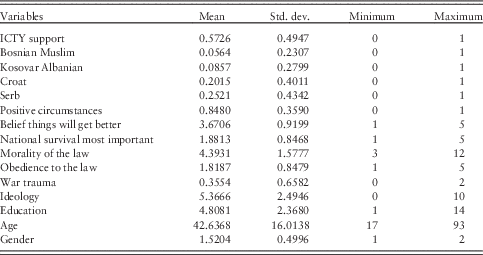
I control for several socio-demographic and experiential factors. I include a measure of the type of experiences one has had during the war to determine if those who were harmed personally, or whose family or friends were harmed, would be more likely to support the ICTY in order to achieve some measure of justice or retribution.Footnote 3 I also include measures of political ideology, age, education, and gender.Footnote 4Table 1 provides descriptive statistics on all the variables.
Descriptive statistics
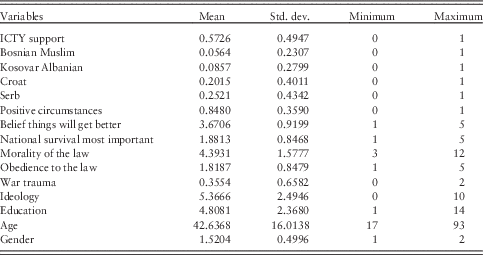
ICTY=International Criminal Tribunal for the former Yugoslavia.
Analysis
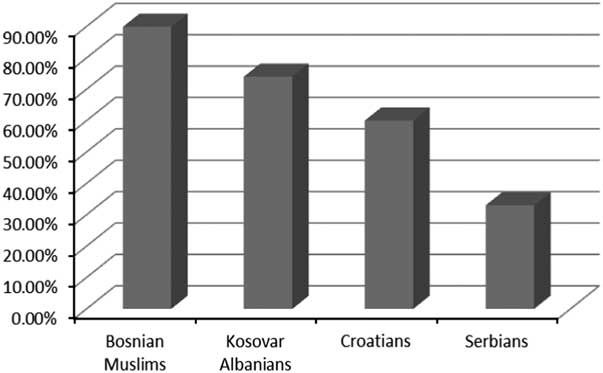
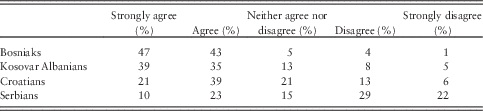
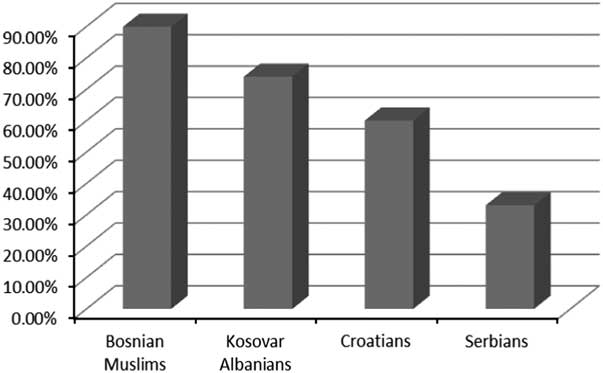
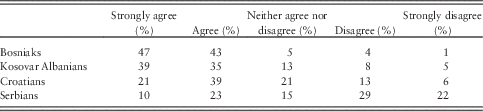
I utilize several estimations of individual support for the ICTY. First, I use a probit model with robust standard errors to test the impact of all of the variables outlined above. Subsequently, I run the model for each of the key ethnic groups separately to assess the impact of the non-group identification variables on support for the ICTY. The full model provides a reasonably good predictive fit. The percentage of correctly predicted cases is 68%, which represents a 24% improvement over predicting the null category (the most common occurrence, which is support for the ICTY at 58%). Table 2 shows the distribution of support for the ICTY across the five-value scale where responses to the question regarding whether one agrees that it is important to support the Tribunal range from ‘strongly agree’ to ‘strongly disagree’. Figure 1 shows how such support varies across the four ethnic groups, but groups together the ‘strongly agree’ and ‘agree’ categories to determine the percentage of individuals who indicate some level of support for the ICTY. As expected, we see that Bosniaks are most supportive, and are followed by Kosovar Albanians. Serbs are the least supportive, and Croats are somewhat more supportive than the Serbs, but are generally inclined to hold unfavorable attitudes toward the ICTY.
Support for the International Criminal Tribunal for the former Yugoslavia across key ethnic populations.
Support for the International Criminal Tribunal for the former Yugoslavia by key ethnic groups across all response types
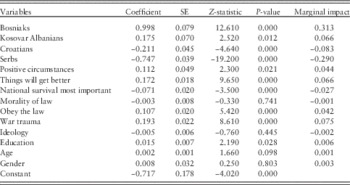
First, we see that respondents’ views of their present and future circumstances play a modest role in shaping their views of international justice (Table 3). I use the marginal impact coefficients to assess the substantive effects of the variables, which tells us the percentage increase in probability of observing support for the ICTY, while holding all other variables constant at their mean value. Individuals who are generally satisfied with their present situation in life are 4.3% more likely to support the ICTY according to the marginal impact coefficient, while those who believe things will get better in the coming years are 6.6% more likely to support the ICTY for every unit increase in this variable. Thus, someone who is the most optimistic on the 1–5 scale is more than 30% more likely to support the ICTY. The coefficients for these variables are positive and statistically significant. I argued that individuals would, in effect, extend some measure of credit to those institutions that have assumed a prominent role in the transformation of the former Yugoslavia. In one sense there is nothing particularly revolutionary about such findings, for a positive outlook on life may generalize to incorporate an affirmative viewpoint on prominent actors in one’s environment.
Individual support for the International Criminal Tribunal for the former Yugoslavia for all respondents

N=7222.
Percent correctly predicted=68%.
Yet, this relationship does highlight the fact that support for international criminal justice occurs in the context of people’s lives that have been disrupted if not destroyed and are in the process of being rebuilt. Post-war reconstruction is both political and personal. The political reconstruction of institutions, the economy, and societal infrastructure are critical in moving beyond the violence of the past. If such transformation successfully takes place, there is greater reason for optimism about the present and the future. Those who are satisfied with their conditions and looking forward in life perceive grounds for optimism in the transformation that is taking place. Undoubtedly, there are some individuals who are optimistic and supportive, regardless of their circumstances. Most individuals, we would suspect, require evidence or reasons for optimism and to the extent that reconstruction provides such a basis, it contributes to peace, prosperity, and ultimately to support for institutions, like the ICTY, associated with post-war rebuilding. Support for the ICTY occurs both in the shadow of the past and in the context of the post-war environment. I would be remiss, however, if I did not point out that the marginal impact of the happiness variable is not substantial. The effects are significant, albeit not powerful. Hence, one’s general level of satisfaction – happiness – exercises a slight effect, but one’s outlook on the future does exercise a more substantial effect. The more one views the future favorably, the more one is likely to support the ICTY. Below I assess how ethnicity may be a filter that reduces the impact of these attitudes on support for the ICTY.
I also find that individual views on the morality and legitimacy of the law exercise an effect on ICTY support. For every one-unit increase in the strength of one’s opinion on the importance of the survival of the nation (a 1–5 point scale) individuals become 2.7% less likely to support the ICTY. The coefficient for this variable is negative and statistically significant. On the other hand, one’s views regarding the propriety of certain behaviors as a measure of one’s belief in the morality of the law (domestic law in this case) is not a statistically significant predictor of support for the ICTY. Admittedly, this is a rather crude measure of the morality of law in the context of evaluations of an international tribunal as it measures one’s views on ‘ordinary’ temptations, especially in societies still rebuilding. Nonetheless, it is suggestive of societies in which perhaps it is either necessary or acceptable for individuals to bend if not break the law. This, in turn, intimates that views of the law in general are sometimes contextually driven rather than fixed. If such attitudes carry over into wartime where normal laws and behavioral norms may be suspended, one can see how other, more violent actions, may not be dealt with through the criminal justice system. Such generalizations must be approached with a healthy dose of caution, but it is a subject worth deeper investigation.
I also find, however, that those individuals who do believe it is important to obey the law are more likely to support the ICTY. The coefficient for this variable is positive and statistically significant. The marginal impact coefficient indicates that for every one-unit increase in an individual’s belief in the importance of obeying the law (on a 1–5 scale), they become 4.1% more likely to support the ICTY, holding all other factors constant. In the abstract, individuals who believe in the value of obeying the law are more supportive of the ICTY. But when individuals are asked to apply such values in the context of difficult situations, where temptations to break the law exist (in the case of the morality and law measure described above), we see there is no relationship between one’s views of the propriety of the law and support for the ICTY.
I turn next to examine the impact of the ethnicity variables, all of which are statistically significant and in the predicted direction. The coefficient for the Bosniak respondent variable is positive and statistically significant. In this case we find the marginal impact coefficient for the Bosniak variable is 0.31, which tells us that Bosniak respondents are 31% more likely to support the ICTY. Similarly, we find the impact of the Kosovar Albanian variable is positive and statistically significant with a marginal impact coefficient of 0.06, which indicates such individuals are 6% more likely to support the ICTY, ceteris paribus. As we would expect, given the congruence between the Bosniak and Kosovar Albanian perspectives of the Balkan wars and the prosecutions and punishments at the ICTY, these individuals are supportive of the Tribunal’s work. Interestingly, there is a fairly large difference between these two groups, each of whom has generally found their narratives supported at the Tribunal. Kosovar Albanians are distinctly less likely than Bosniaks to support the ICTY.
Conversely, Croats and Serbs tend to have a fairly negative view of the ICTY given that their ethnic brethren have been the focus of the Tribunal’s prosecutorial efforts. In addition, the Tribunal has not taken seriously their claims of the nature and severity of threats they were allegedly facing that would justify their actions or foist blame for such actions onto their opponents. Thus, we would expect there to be mostly opposition, especially on the part of the Serbs whose leaders have waged the most vociferous and aggressive campaign against the ICTY. The coefficients for both variables are negative and statistically significant. The Croat marginal impact coefficient is −0.08, while the Serb marginal impact coefficient is −0.28, which indicate an 8 and 28% decline, respectively, in the likelihood of their support for the ICTY. We see here, in stark contrast, the dueling perceptions and narratives about the ICTY. Those whose narratives are confirmed in the prosecutorial strategy and the judgments handed down, find it relatively easy to support the Tribunal, while those whose narratives are rejected find little reason to defend the ICTY. Indeed, perceptions of the present are very much rooted in the problems of the past, and there seems to be little reason to believe that such opinions will change anytime soon.
One critical background determinant of ICTY support is the individual’s experience during wartime. Interestingly, those respondents who experienced traumatic events are more likely to support the Yugoslav Tribunal. The probability of support increases by 7.4%, according to the marginal impact coefficient, for such individuals. Those victimized by war, because they saw first-hand violence done to their person or family, may demand punishment as the appropriate response to restore a sense of balance in the community and retribution for the wrongs done to them. I would argue that victimization leads individuals to develop the belief that justice, peace, or their own personal or societal equilibrium has been violated. Support for those who prosecute the wrongdoers is thus more likely. I also find that education is positively related to support for the ICTY. For each year of education an individual completes, she becomes 0.5% more likely to support the ICTY. Thus, an individual with 10 years of formal schooling is 5% more likely to support the Yugoslav Tribunal than someone with no such education. While the effect is not substantial, it does demonstrate that the broad knowledge that comes with formal education tends to increase support for the institutions of international law. While some scholars (Ford, Reference Ford2012) have noted that, in many contexts, additional information provided to individuals regarding the nature and causes of violence only serves to reinforce deeply held beliefs about such events, perhaps the international community can aid conflict societies and increase support for international tribunals by supporting educational institutions. The other control variables measuring ideology, age, and gender are not statistically significant.Footnote 5
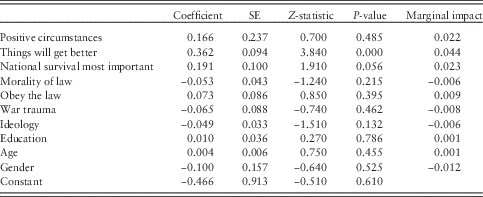
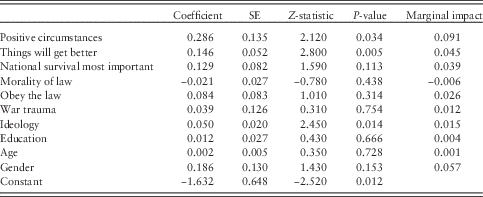
I next examine how well the model applies to each of the four ethnic groups. I re-estimated the model for each of the four groups without the ethnicity variables, but comment on just those variables of interest as well as other unique or unexpected trends. In the case of the Bosniaks in Table 4 we see that the coefficients of only a few of the variables attain statistical significance. With every positive unit increase in the variable measuring one’s outlook on the future, Bosniaks become 4% more likely to support the ICTY, according to the marginal impact coefficient. Interestingly, those Bosniaks who believe in the primacy of national survival are more likely to support the ICTY. Bosniaks may believe that the ICTY has helped ensure their national survival, especially by finding the Serbs guilty of genocide at Srebrenica. The ICTY may, in fact, be in the process of shaping the Bosnian Muslim narrative of national survival. In Table 5 we see that the results are somewhat similar when we examine the model for Kosovar Albanians. Those respondents who believe the future looks brighter are also 4% more likely to support the Tribunal for every unit increase in this variable, while individuals who considered themselves satisfied were 9% more likely to support the ICTY. The reader will also notice that those who are more politically conservative are more likely to support the ICTY.
International Criminal Tribunal for the former Yugoslavia support among Bosniaks
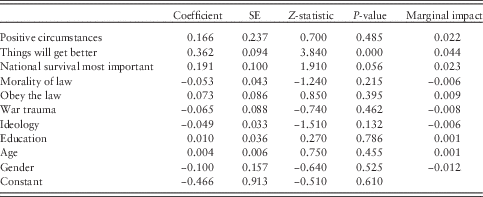
N=631.
Percent correctly predicted=92%.
International Criminal Tribunal for the former Yugoslavia support among Kosovar Albanians
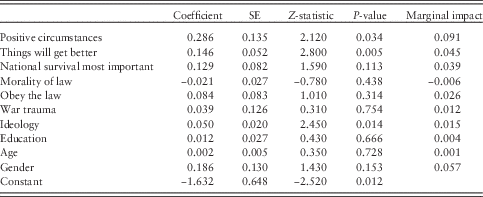
N=557.
Percent correctly predicted=75%.
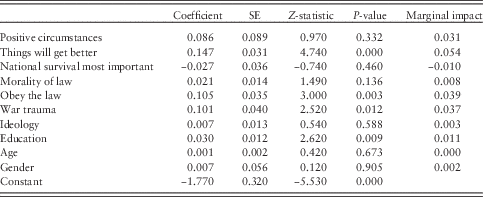
Table 6 contains the results for the Serb respondents. As we have seen thus far, there is a strong relationship between individuals’ beliefs that the future will be better and their willingness to support the ICTY. Serbs who view the future positively are 5.4% more likely to support the Yugoslav Tribunal for every one-unit increase in this variable. In addition, those who subscribe strongly to the importance of obeying the law are also much more likely to support the ICTY. Interestingly, those Serbs who experienced wartime trauma are more likely to support the Tribunal. The marginal impact of this variable shows that such individuals are 3.7% more likely to support the ICTY. While the impact is not substantial it does suggest that among those Serbs who may be most predisposed to harbor negative feelings toward the ICTY because of their experiences during the war, there is a possibility they see promise or potential in international justice.
Support for the International Criminal Tribunal for the former Yugoslavia among Serbs
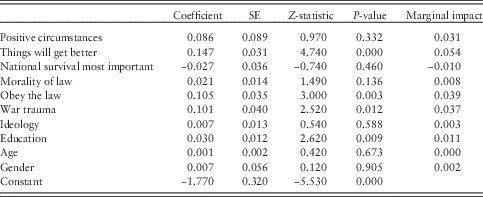
N=2205.
Percent correctly predicted=66%.
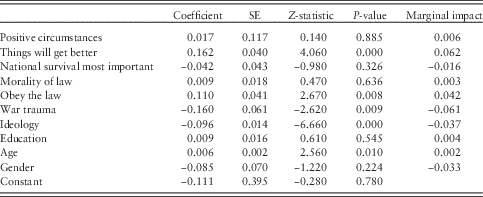
Finally, Table 7 displays the results for the Croatian respondents. Once again, those with a more positive outlook on the future are more likely to support the Tribunal – by 6.2% according to the marginal impact coefficient for every unit increase. This is the largest impact for this variable among any of the ethnic groups. We also find that those who believe in the importance of the law are more likely to support the ICTY. In contrast to the Serbian respondents, however, we see that those Croats who experienced wartime trauma are less likely to support the Tribunal. The marginal impact coefficient is −6%, holding all other variables constant at their mean value. Clearly, wartime experiences have had very different effects across these populations. Bosniaks and Kosovar Albanians did not vary in their support for the ICTY based on such experiences; Serbs who experienced trauma are more likely to support the ICTY; and Croats are less likely to support the Tribunal the more they were affected by the war. I cannot offer any theoretically informed understanding regarding this finding, but it certainly suggests that victims of international crimes and human rights abuses, as well as the general population of affected countries, cannot be assumed to have ethnically similar reactions to their experiences. Those Croatians who consider themselves ideologically to the left are also more likely to support the ICTY. Perhaps because conservatives were strongly identified with the nationalist Tudjman regime that was involved in the Balkan wars of the 1990s, they see the work of the ICTY as undermining the narrative they have constructed about ‘homeland’ wars. For each movement of one unit on this 1–10 scale, there is a 3% increase in the probability of supporting the ICTY, ceteris paribus. Thus, someone who is classified at the far left end is 30% more likely to support the Tribunal than someone at the far right end of the ideological spectrum on this scale. Lastly, we also see that older Croatians are more likely to support the ICTY.
Support for the International Criminal Tribunal for the former Yugoslavia among Croatians
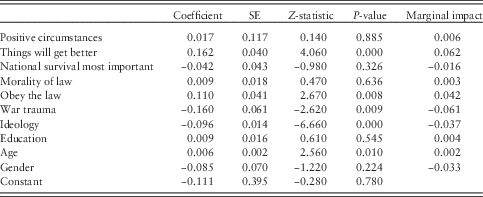
N=1425.
Percent correctly predicted=63%.
Conclusion
In this paper I have sought to develop a more comprehensive and ultimately generalizable theory of public opinion regarding international criminal justice. I developed a theory regarding why individuals, who are generally satisfied with their life circumstances and believe that the future is bright, are inclined to support international institutions, like the ICTY. When individuals find reason to believe that conditions are good or improving, they are likely to generalize from their positive evaluation of their present conditions to support those institutions that are a part of this post-war reconstruction and recovery. I also argued, like other scholars have recently (Clark, Reference Clark2009; Klarin, Reference Klarin2009; Subotic, Reference Subotic2009) and most prominently (Ford, Reference Ford2012), that many individuals tend to perceive the international criminal justice system through a filtered lens that absorbs information in such a manner that conforms to deeply held narratives of conflict origins and responsibility, while diminishing the power of evidence to the contrary. The statistical model of public opinion in the former Yugoslavia provides important, although modest to be sure, support for these hypotheses and demonstrates that support for the ICTY is influenced by the past, in the form of ethnic identity, and in individual’s present circumstances, and perceptions of the future.
I believe this theory of the influence of the past, present, and future can facilitate the development of a broader and even more holistic understanding of public opinion in states that have become the subject of international criminal justice processes. What varies across people is the degree to which these forces, good and bad, hold sway over their interpretation of international justice. The strength of ethnic identities and the impact of present conditions and future prospects will vary across cultures and individuals. Hence, it is also critical to understand what forces, such as the educational system, may dampen the role of less-progressive forces, and enhance the impact of more positive forces. In addition, it is critical to understand individuals’ resilience to the horrors of war and the daunting work of post-conflict reconstruction, to better appreciate how some are able to continue and even prosper in the face of such adversity, and how others are not so capable. Thus, there is ample justification and need for better theories of individual opinion regarding international justice that incorporates insights from studies of psychological health, post-traumatic stress disorder, and psychological resilience or grit (Duckworth et al., Reference Duckworth, Peterson, Matthews and Kelly2007).
The international justice system is expanding its reach, via the ICC, to encompass more of the world’s conflict states that have experienced violations of international law, and as it does, more individuals will find their narratives of victims and villains; causes and consequences; and heroic victories and tragic defeats judged and evaluated. Inevitably, these processes will generate vindication for some and anger among others. This much seems to be as inevitable as the outcome of any contest in which neutral umpires judge opposing sides. The key for those working in international criminal justice is to understand the reasons why these attitudes form, how they interact with the present judicial efforts, which individuals can be persuaded of the evidence of the truth, and which tools are most effective in this process.
Acknowledgments
None.