Implications
Whey is the main co-product of the cheese industry, although it is usually disposed as a waste product. It is therefore essential to give whey an alternative use and minimize environmental pollution. Its high lactose content and high-protein quality make whey a potentially interesting ingredient in poultry nutrition. Our results indicate that dry whey powder and whey protein concentrate can be successfully used to feed broilers, as they enhance their growth. Dry whey powder also improves feed conversion. Both ingredients increase calcium and phosphorus digestibility, and result in a favorable modulation of the cecal microbial composition.
Introduction
The main purpose of modern intensive broiler production is to promote a high growth rate, feed efficiency and optimal health status of animals. Such desirable conditions can be achieved through different dietary interventions that, during the last decades, have focused on the addition of low levels of antibiotics, as growth promoters, for an extended period of time (Huyghebaert et al., Reference Huyghebaert, Ducatelle and Van Immerseel2011). One of the advantages of the use of antibiotics as growth promoters is the improvement of weight gain and feed efficiency through their impact on gut microbiota (Danzeisen et al., Reference Danzeisen, Kim, Isaacson, Tu and Johnson2011). However, the ban on their use in the European Union (European Commision Regulation, 2003) and the potential restriction in other countries (Huyghebaert et al., Reference Huyghebaert, Ducatelle and Van Immerseel2011), have resulted in a concomitant reduction of animal performance and in an increase of the incidence of enteric pathologies. This situation has led to an increasing interest in non-resistant, non-residual feeding alternatives that benefit productivity and health status through a favorable modulation of the gut microbiota (Gaggìa et al., Reference Gaggìa, Mattarelli and Biavati2010).
Animal performance might be associated with changes in gut microbiota. Promotion of a balanced gut microbiota population is basic to protect the host against pathogenic bacteria, enhancing the intestinal integrity and morphology, as well as the absorption of nutrients (Rinttilä and Apajalahti, Reference Rinttilä and Apajalahti2013). One way to benefit gut balance is the use of specific dietary components that serve as substrate to a selective group of bacteria, such as the case of prebiotics (Gaggìa et al., Reference Gaggìa, Mattarelli and Biavati2010). Prebiotics are defined as a non-digestible, dietary compounds that modulate the composition and/or activity of the gut microbiota, conferring a beneficial physiological effect on the host (Bindels et al., Reference Bindels, Delzenne, Cani and Walter2015). Dry whey powder (DWP) is a co-product of cheese industry with high lactose content (~70% of dry matter). Given that birds have a negligible lactase activity in the gut (Denbow, Reference De Vos, Garrity, Jones, Krieg, Ludwig, Rainey, Schleifer and Whitman2000), lactose can be used as a prebiotic. Lactose is not digested, being thus fermented by the cecal microflora, which can lead to a decrease on cecum pH and to a reduction of potential pathogenic bacteria such as Salmonella enteritidis (Tellez et al., Reference Tellez, Dean, Corrier, Deloach, Jaeger and Hargis1993). The benefits of feeding broilers and laying hens with DWP, as lactose source, on their performance and cecal bacteria counts has been reported (Radfar and Farhoomand, Reference Radfar and Farhoomand2008; Pineda-Quiroga et al., Reference Pineda-Quiroga, Atxaerandio, Zubiria, Gonzalez-Pozuelo, Hurtado, Ruiz and García-Rodríguez2017). However, to our knowledge, results on the effects of DWP on broilers concerning nutrient ileal digestibility and cecal microbiota community are lacking so far.
The protein source used in feed formulation influences the productive performance and the gut microbiota composition of broilers. The benefits of the selected protein on animal growth are related to their inclusion level, digestibility and amino acid profile (Beski et al., Reference Beski, Swick and Iji2015). Gut microbiota could also be affected, as diet non-digested proteins might reach the hind gut, promote a proteolytic fermentation and stimulate an increase in the microbiota that use amino acids as energy source (Qaisrani et al., Reference Qaisrani, Van Krimpen, Kwakkel, Verstegen and Hendriks2015). Whey protein concentrate (WPC) is a co-product of cheese or rennet casein industries with relevant protein (30% CP of dry matter) and lactose (52.5% of dry matter) contents. The WPC is considered as an excellent amino acid source in bird nutrition and is composed of biologically active proteins such as β-lactoglobulin, α-lactalbumin and immunoglobulins (Szczurek et al., Reference Szczurek, Szymczyk, Arczewska-Włosek, Józefiak and Alloui2013). These proteins have a higher biological value compared with soybean meal (Smithers, Reference Smithers2015), the main protein source in poultry feed. The lactose of WPC might promote broiler performance by stimulating the growth of beneficial cecal bacteria. The benefits of the inclusion of WPC on the performance and protein ileal digestibility of broiler diets have been reported (Szczurek et al., Reference Szczurek, Szymczyk, Arczewska-Włosek, Józefiak and Alloui2013), but little is known about its effects on digestibility of other nutrients and on cecal microbiota community.
We hypothesize that lactose from supplemented DWP and WPC could modulate the cecal microbiota composition toward beneficial bacteria, in detriment of pathogens, therefore enhancing the sanitary status and the productive performance of broilers. In the case of WPC supplementation, we additionally hypothesize that the benefits of lactose on performance could be further potentiated by simultaneously providing a high nutritional value protein in the diet. Thus, the aim of this study was to evaluate the effect of supplementing broiler diets with DWP as lactose source, and WPC as protein and lactose source, on the productive performance, nutrient ileal digestibility and cecal microbial community of broiler chickens.
Material and methods
This experiment followed the European Union (2010/63/EU) and Spanish regulations (RD 53/2013) for the care and use of animals for experimental and other scientific purposes.
Animals, housing and experimental diets
The study was carried out at the experimental farm of Neiker-Tecnalia in Arkaute (Vitoria-Gasteiz, Spain). One-day-old male broiler chicks (Ross 308 strain), with an average body weight of 42±0.99 g, were obtained from a local commercial hatchery (AN Avícola Melida, S.A, Zumaia, Spain). At arrival, birds were randomly allocated to their floor pens, with stocking density being 30 kg/m2. Pens were equipped with a manual feeder, nipple drinkers, and wood shavings as litter material. Room temperature and lighting program were adjusted following the guidelines for Ross 308.
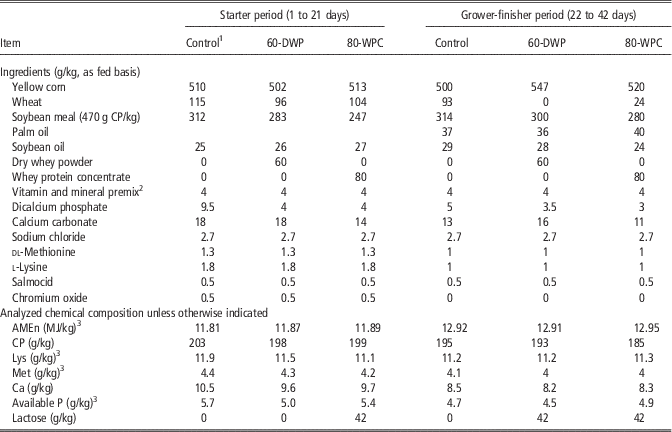
Diets were corn-soybean based, and were formulated to meet broilers’ requirements during the starter and grower-finisher stages (FEDNA, 2008). Starter diets were offered from day one to 21, and grower-finisher diets were offered from day 22 to 42. Chromium oxide (Cr2O3, 5 g/kg of diet) was added to starter diets as an external indigestible marker. Birds had ad libitum access to one of the following experimental diets: control (no supplementation of DWP or WPC), 60-DWP (60 g/kg of inclusion of DWP) and 80-WPC (80 g/kg of inclusion of WPC). Diets with DWP and WPC were formulated to provide 42 g/kg of lactose. The ingredient composition and the analyzed nutritional value of experimental diets are shown in Table 1. The used DWP was a commercial sweet powder (Sueromancha S.L, Toledo, Spain; 703 g/kg of lactose, 126 g/kg of CP). Renylat 3300 (Industrias Lácteas Asturianas, Spain; 520 g/kg lactose content, 350 g/kg of CP) was used as WPC.
Ingredients and chemical composition of the experimental diets (trials 1 and 2)

1 Control: no supplementation of dry whey powder or whey protein concentrate; 60-DWP: 60 g/kg of dry whey powder; 80-WPC: 80 g/kg of whey protein concentrate.
2 Providing the following per kg of diet: of diet: 8000 IU vitamin A (trans-retinyl acetate), 1600 IU vitamin D3 (cholecalciferol), 16 mg vitamin E (dl-α-tocopherol), 1 mg thiamine (thiamine-mononitrate), 3 mg riboflavin, 1 mg pyridoxine (pyridoxine HCL), 0.01 mg vitamin B12 (cyanocobalamin), 1 mg vitamin K3 (menadione nicotinamide bisulphite), 16 mg niacin (nicotinic acid), 7 mg pantotenic acid (d-Ca pantothenate), 70 mg Mn (manganese oxide), 50 mg Zn (zinc sulfate), 30 mg Fe (iron sulfate monohydrate), 4 mg Cu (copper sulfate), 1 mg I (calcium iodate), 0.2 mg Co (cobalt sulfate), 0.1 mg Se (sodium selenite), 240 mg choline (choline choride), 300 units phytase, 110 mg ethoxyquin.
3 Calculated value.
Experimental design, measurements and sampling
Trial 1: Determination of the nutrient coefficient of apparent ileal digestibility
In this trial, 91 one-day-old chicks were randomly allocated to 1.0×0.83 m floor pens, which were assigned to one of the three experimental diets formulated for the starter period (Table 1). Each treatment comprised three pens with 10 chickens each. At 21 days of feeding, five chickens per pen were euthanized by CO2 inhalation, and their ileal digesta was collected. Ileum was considered as the portion of the small intestine from the Meckel’s diverticulum to the ileocecal junction, and digesta of the last two-thirds of this section was gently collected. Ileal samples from birds within the same pen were pooled, frozen at −20°C and lyophilized. Dried ileal digesta samples were ground to pass through a 0.5 mm screen, and stored in airtight containers at room temperature until chemical analyses. The CAID of dry matter (DM), CP, calcium (Ca) and phosphorus (P) was estimated using Cr2O3 as external indigestible marker.
Trial 2: Determination of productive performance and cecal microbial community
In this trial 810 one-day-old chicks were randomly allocated to 1.0×2.5 m floor pens, which were assigned to one of the three experimental diets (Table 1) for a period of 42 days. Each treatment comprised nine replicates of 30 chickens each. To determine productive performance, all chickens and feeders from each pen were weighted weekly. Body weight, average daily gain (ADG), feed intake (FI) and FCR were recorded on a pen basis. Mortality was recorded daily.
Cecal sample collection and DNA extraction
At 42 days, five chickens from each experimental treatment were randomly selected from different pens and euthanized by CO2 inhalation. The gastrointestinal tract was dissected, the two caeca were opened longitudinally, and digesta samples were collected with a sterile spoon. Samples were immediately stored at −80°C until further analysis. Total nucleic acid was extracted from samples using the PowerSoil DNA extraction Kit (MOBIO Laboratories Inc., Carlsbad, CA, USA) according to the manufacturer recommendations. DNA was quantified in Nanodrop (ND-1000 Spectrophotometer; Nanodrop Technologies, Wilmington, DE, USA) and DNA integrity was checked through agarose gel electrophoresis.
16S rRNA amplification, Illumina sequencing and bioinformatics sequence analysis
The V4 hypervariable region of the 16S rRNA gene was used to prepare Illumina amplicon libraries (Caporaso et al., Reference Caporaso, Lauber, Walters, Berg-Lyons, Lozupone, Turnbaugh, Fierer and Knight2011). Two PCR were performed to incorporate Illumina adapters and barcodes for sample identification. The PCR products were purified using Agencourt AMPure®XP kit (Agencourt Bioscience Corporation, Beverly, Massachusetts, USA) according to the manufacturer instructions, and eluted in 20 µl of water. Amplicons were quantified using Qubit fluorometric quantitation (Qubit® 3.0; Thermo Fisher Scientific Inc., USA), and the Agilent 2100 Bioanalyzer (Agilent Technologies, Santa Clara, CA, USA) in order to pool the samples and sequence them on an Illumina MiSeq platform.
Illumina reads were analyzed using Mothur Miseq SOP (Kozich et al., Reference Kozich, Westcott, Baxter, Highlander and Schloss2013). Primers and barcodes were trimmed before analysis. All samples comprised 3 912 932 sequence reads, with a mean number of reads per sample of 261 202±62 590. Sequences were aligned using SILVA-based bacterial reference alignment obtained from Mothur. Chimera sequences were checked and removed using UCHIME. A final data set was then clustered into operational taxonomic units (OTUs) at ⩾97% similarity. Operational taxonomic units with <10 reads in one sample were removed from the analysis (<0.0013% of the total). A total of 855 OTUs were taxonomically assigned using the Seqmatch function in Ribosomal Database Project. Sequences are available at the European Nucleotide Archive under the accession number PRJEB17510 in http://www.ebi.ac.uk/ena.
Chemical analyses and calculations
Experimental diets and ileum samples were analyzed in triplicate for DM (method 934.01), total ash (method 942.05), CP (method 990.03), ether extract (method 920.39), according to the Association of Official Analytical Chemists (2007). Measurements of Ca, P and Cr2O3 oxide were determined by spectroscopy plasma atomic emission.
Calculation of nutrients CAID was made using the following formula:
 $$\eqalignno{ &{\rm CAID}\,{\rm of}\,{\rm diet}\,{\rm component=}\cr &{{{\left( {{\rm Diet}\,{\rm component}\,{\rm /}\,{\rm Cr}_{2} {\rm O}_{3} } \right){\rm d{\minus}}\left( {{\rm Diet}\,{\rm component}\,{\rm /Cr}_{2} {\rm O}_{3} } \right){\rm i}} \over {\left( {{\rm Diet}\,{\rm component}\,{\rm /}\,{\rm Cr}_{2} {\rm O}_{3} } \right){\rm d}}}$$
where (Diet component/Cr2O3)d is the ratio of the diet component to the Cr2O3 content in the diet, and (Diet component/Cr2O3)i is the ratio of the component to Cr2O3 in the ileal digesta.
Statistical analysis
For analysis of productive performance and nutrient CAID, pen was considered the experimental unit. Performance data were evaluated during the starter (day 1 to 21) and grower-finisher periods (day 22 to 42), as well as for the entire feeding period (day 1 to 42). One-way ANOVA was performed considering the experimental diet as the fixed effect, and the pen as the random effect. Performance and CAID were analyzed using a Gaussian distribution, whereas survival data were analyzed considering a binomial distribution. Initial BW was used as a covariate in performance analysis. Data were analyzed using the GLIMMIX procedure of SAS V 9.3 (SAS Institute Inc., Cary, NC, USA). In case of a significant effect (P<0.05) multiple comparisons were carried out to detect differences between treatments using the Tukey’s range test.
For sequencing analysis, relative abundances of the OTUs were analyzed by means of multivariate statistical routines using PRIMER (version 7.0.9, PRIMER-E; Plymouth Marine Laboratory, Plymouth, UK). Data were standardized in relation to their total amount, and a sample similarity matrix was created using Bray-Curtis coefficient. Community structures ordination was explored by hierarchical clustering, and similarity profile permutation test was used to seek for statistically significant clusters. Statistical comparisons of microbial communities between treatments were determined using one-way analysis of similarity (ANOSIM, 999 permutations), and significant differences were considered if P<0.05. Subsets of OTUs summarizing the overall differences in microbial community composition were identified using BEST routine. Individual OTUs contributing to dissimilarity between treatments were identified by similarity percentage analysis, as well as the average of similarity in cecal microbial community composition among birds fed with the same diet.
Results
Trial 1: Nutrient coefficient of apparent ileal digestibility
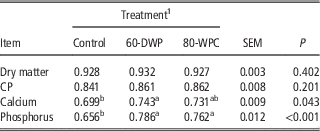
Results relative to nutrient CAID are shown in Table 2. An increase on the CAID of Ca was promoted by 60-DWP diet compared to control diet (P=0.041) while no differences were found between 60-DWP and 80-WPC (P=0.695) or 80-WPC and control diet (P=0.119). Chickens fed with 60-DWP and 80-WPC showed an increase in the CAID of P when compared with control diet (P<0.001 and 0.002, respectively), while no differences were found between 60-DWP and 80-WPC (P=0.406). Feeding birds with experimental diets did not influence the CAID of DM and CP (P=0.402 and 0.201, respectively).
Influence of diet supplementation with dry whey powder and whey protein concentrate on nutrient coefficient of apparent ileal digestibility in broilers at 21 day of age

a,bMeans followed by different superscript in a column indicate differences between treatments (P<0.05).
1 Control: no supplementation of dry whey powder or whey protein concentrate; 60-DWP: 60 g/kg of dry whey powder; 80-WPC: 80 g/kg of whey protein concentrate.
Trial 2: Performance parameters
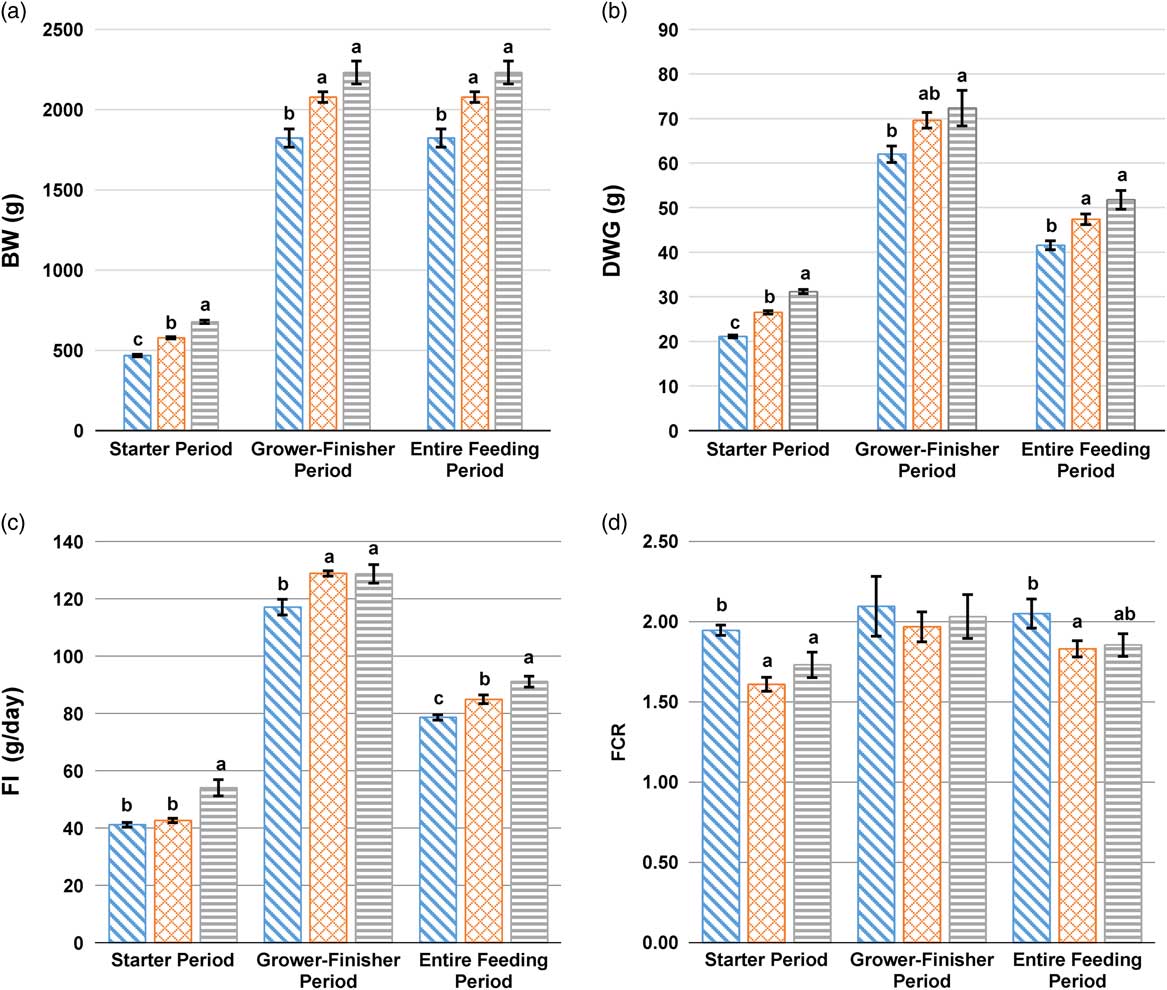
Broilers fed with 60-DWP and 80-WPC diets showed the highest values for growth parameters in the analyzed periods (Figure 1). At the end of the starter period, birds fed with 80-WPC showed higher BW, ADG and FI values when compared with the control diet (P<0.001) and 60-DWP (P<0.001). The FCR of 80-WPC diet was lower than that of control diet (P=0.003) and did not differ from that of 60-DWP (P=0.078). Feeding with 60-DWP promoted an increase in BW and ADG, as well as a reduction in FCR (P<0.001) when compared with control diet. However, no differences were observed for FI (P=0.494). Mean mortality values were 1.75%, remaining unaffected by treatments.
Effect of experimental diets on broiler performance at different feeding periods. Experimental diets:
 $$\raster="rg1"$$
Control: no supplementation of dry whey powder (DWP) or whey protein concentrate
 $$\raster="rg2"$$
60-DWP: 60 g/kg of dry whey powder
 $$\raster="rg3"$$
80-WPC: 80 g/kg of whey protein concentrate. Error bars indicate the square error of the mean. Bars not sharing a common letter are significantly different (P<0.05).

At the end of the grower-finisher period, animals fed with 80-WPC and 60-DWP increased their BW (P<0.001), ADG (P=0.048) and FI (P<0.001) as compared with those fed the control diet, whereas no significant differences were found on FCR (P=0.793). There were no statistical differences in BW, ADG, FI and FCR between birds fed with 60-DWP and 80-WPC (P>0.05). Mean mortality values were 1.22% and remained unaffected by treatments.
For the entire feeding period, birds fed with 60-DWP and 80-WPC showed higher ADG (P=0.006 and <0.001, respectively) and FI (P<0.001 and 0.001, respectively) than those fed control diets. A decrease in FCR was observed by feeding with 60-DWP compared with control diet (P=0.048), while no difference were found between 80-WPC and control diet (P=0.096). When comparing 60-DWP and 80-WPC, no differences were detected for ADG (P=0.061) and FCR (P=0.974), although FI was lower in 60-DWP (P=0.005). Mean mortality values were 2.25%, remaining unaffected by treatments.
Microbial community analysis
Bacteroidetes, Firmicutes and Proteobacteria were the most representative phyla in all diets (Supplementary Material Figure S1). Control samples showed 45% of the sequences associated to Bacteroidetes, 40% to Firmicutes and 14% to Proteobacteria. Bacteroidetes and Proteobacteria decreased their abundance in birds fed 60-DWP diets (31% and 6%, respectively) and 80-WPC diets (39% and 5%, respectively), while Firmicutes increased their abundance (63% in 60-DWP and 55% in 80-WPC). A change in the Firmicutes/Bacteroidetes (F/B) ratio was also observed between treatments, being the ratio 0.89 in samples from control diet, 2.03 in 60-DWP and 1.43 in 80-WPC.
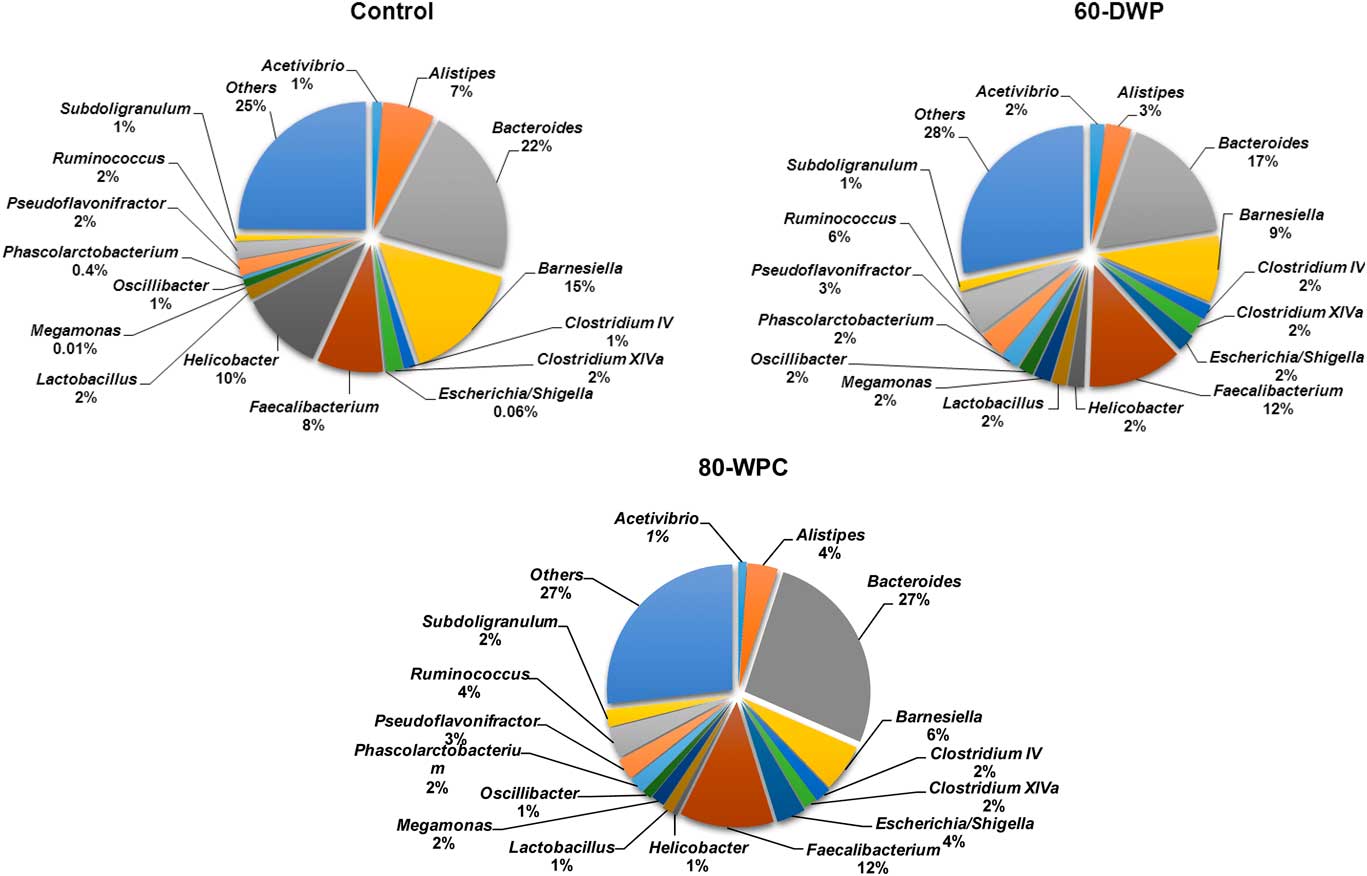
The most abundant families harboring the ceca are shown in Supplementary Material Figure S2. Cecal samples from control diet were mainly colonized by Ruminococcaceae, Bacteroidaceae, Porphyromonadaceae and Helicobacteraceae (24%, 22%, 17% and 10%, respectively), while samples from 60-DWP and 80-WPC diets were represented by Ruminococcaceae (38% and 34%, respectively), Bacteroidaceae (17% and 27%, respectively), Lachnospiraceae (15% and 11%, respectively) and Porphyromonadaceae (10% and 8%, respectively). Bacteroides was the most representative genus in all samples, accounting for 22% of total community in samples from control diet, 17% in 60-DWP, and 27% in 80-WPC (Figure 2), followed by Barnesiella and Helicobacter (15% and 10%) in control diet. In 60-DWP and 80-WPC diets Faecalibacterium accounts for 12% of total bacteria, Barnesiella for 9% and 6%, respectively, and Ruminococcus for 6% and 4%, respectively.
Composition of bacteria in cecal samples of broilers at genus level. Relative abundance (>1% on average) of genus in response to experimental diets. Control: no supplementation of dry whey powder or whey protein concentrate, 60-DWP: 60 g/kg of dry whey powder, 80-WPC: 80 g/kg of whey protein concentrate.

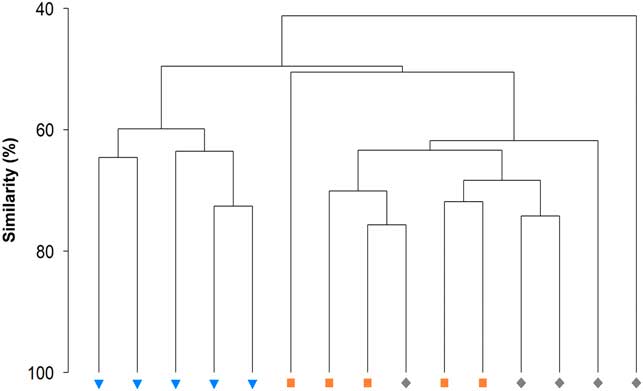
Exploratory analysis of the microbial community revealed two main clusters that separate the cecal samples of chickens fed with control diet from those fed with 60-DWP and 80-WPC (Figure 3). Within each cluster microbial community similarities between 55% and 60% were observed. The average similarity within replicates of cecal samples was 62% in control diet, 61% in 60-DWP and 56% in 80-WPC.
Hierarchical cluster representing relationships among microbial communities of cecal samples from chickens fed with the experimental diets. On y-axis: similarity percentage based on Bray-Curtis matrix, on x-axis: individual samples of cecal digesta. Experimental diets:
 $$\raster="rg4"$$
Control: no supplementation of dry powder whey or whey protein concentrate
 $$\raster="rg5"$$
60-DWP: 60 g/kg of dry whey powder
 $$\raster="rg6"$$
80-WPC: 80 g/kg of whey protein concentrate.

Significant differences in the composition of the bacterial community were observed between experimental diets (R=0.476, P=0.001; Supplementary Material Table S1). A subset of six OTUs summarizes the overall differences (Supplementary Material Table S2), which are associated to Faecalibacterium spp. (OTU 1), Bacteroides spp. (OTU 2), unclassified Porphyromonadaceae (OTU 3), Bacteroides fragilis (OTU 5), Helicobacter pullorum (OTU 7), and Escherichia coli/Shigella flexneri (OTU 9).
Microbial communities from cecal samples of chickens fed with control diet were different from those of 60-DWP (R=0.776, P=0.008). The percentage of dissimilarity was 51%, mainly due to the decrease in the abundance of OTUs associated to Bacteroides spp. (OTU 2), unclassified Porphyromonadaceae (OTU 3), H. pullorum (OTU 7), Barnesiella intestinihominis (OTU 17) and unclassified Rikenellaceae (OTU 13) in 60-DWP treatment. An increase in the abundance of phylotypes associated to Faecalibacterium spp. (OTU 1), B. fragilis (OTU 5), Bacteroides spp. (OTU 6), E. coli/S. flexneri (OTU 9), Megamonas funiformis (OTU 12), Lactobacillus salivarius (OTU 33), Ruminococcus spp. (OTU 4), unclassified Lachnospiraceae (OTU 10), and Phascolarctobacterium spp. (OTU 11) in 60-DWP treatment also contributed to the dissimilarity between both groups.
Microbial communities of samples from control diet were significantly different from those from 80-WPC (R=0.740, P=0.008). The percentage of dissimilarity was 52%, being this attributed to the decrease in the abundance of OTUs associated to Bacteroides spp. (OTU 2), unclassified Porphyromonadaceae (OTU 3) H. pullorum (OTU 7), unclassified Rikenellaceae (OTU 13) and B. intestinihominis (OTU 17) in 80-WPC samples. In contrast, Faecalibacterium spp. (OTU 1), B. fragilis (OTU 5), Bacteroides spp. (OTU 6), E. coli/S. flexneri (OTU 9), unclassified Lachnospiraceae (OTU 10), Phascolarctobacterium spp. (OTU 11), M. funiformis (OTU 12) and Subdoligranulum variabile (OTU 22) were more abundant in 80-WPC samples compared with control samples.
60-DWP and 80-WPC microbial communities did not differ (R=−0.024, P=0.508). The most common OTUs in both diets were associated to Bacteroides spp. (OTU 6), E. coli/S. flexneri (OTU 9), M. funiformis (OTU 12), Faecalibacterium spp. (OTU 1), unclassified Rikenellaceae (OTU 13), and Phascolarctobacterium spp. (OTU 11).
Discussion
The current study shows that including 60 g/kg of DWP or 80 g/kg of WPC in diets improves broiler growth and feed efficiency, from early growth stages to later ages. These dietary supplementations improve ileal digestibility of calcium and phosphorus, and promote a higher ratio of Firmicutes/Bacteroidetes in ceca. Similarly, Gulsen et al. (Reference Gulsen, Coskun, Umucalilar, Inal and Boydak2002) showed that adding 38.5 g/kg of DWP as lactose source at starter and grower-finisher diets improved BW, whereas Kermanshahi and Rostami (Reference Kermanshahi and Rostami2006) reported that supplying 40 g/kg of DWP did not affect BW during the starter period, but BW and FCR were improved both during the grower-finisher and the entire feeding periods. Authors attributed the weight increase to a higher absorption of protein and some minerals such as calcium and phosphorous, although they did not present such results. Regarding the use of proteins from whey in broiler diets, Szczurek et al. (Reference Szczurek, Szymczyk, Arczewska-Włosek, Józefiak and Alloui2013) reported an increase in BW, and a reduction of FCR when adding 8 or 32 g/kg of WPC during both the starter and grower-finisher periods. These authors attributed the improved performance to the observed increase in ileal digestibility of protein measured on broilers at 26 days of age. Digestibility results differ from ours, possibly due to age differences, number of animals sampled, and ingredient and nutrient composition of diets. According to our findings, we consider the improvement of CAID of Ca and P, and the increase in FI as one of the reasons explaining the improved performance of broilers fed with DWP or WPC. Both feed ingredients contain a considerable amount of Ca and P, which led to a reduction in dicalcium phosphate during diet formulation, and to lesser extent in calcium carbonate, with respect to control diet. It is known that mineral organic sources have higher intestinal absorption than inorganic sources (Nollet et al., Reference Nollet, van der Klis, Lensing and Spring2007), and that lactose greatly stimulates the absorption of Ca and P (Matin et al., Reference Matin, Dashtbin and Salari2013), which would explain the observed results. The higher Ca and P digestion influences the growth of animals because these minerals promote bone development and mineralization (Proszkowiec-Weglarz and Angel, Reference Proszkowiec-Weglarz and Angel2013). Similarly, we consider that higher Ca and P digestion, together with the observed increase in FI, promotes a higher digestible mineral intake, and in consequence an improvement in growth.
We also consider that the observed changes in ceca microbiota would enhance broiler performance. Therefore, birds with a higher weight showed a greater F/B ratio. These results are in agreement with Singh et al. (Reference Singh, Karimi, Devendra, Waldroup, Cho and Kwon2013), who found that broilers with greater weight exhibited higher F/B ratio in ceca. Representatives of the Firmicutes phylum are known for harvesting energy from diets and transfering calories to the host, with the subsequent weight gain (Turnbaugh et al., Reference Turnbaugh, Hamady, Yatsunenko, Cantarel, Duncan, Ley, Sogin, Jones, Roe, Affourtit, Egholm, Henrissat, Heath, Knight and Gordon2009). Some of the microorganisms belong to the Ruminococcaceae and Lachnospiraceae families, which were more abundant in broilers with higher weight. Both families break down complex, plant-derived carbohydrates and resistant starch, which are found in diet grains, into saccharides and make them available for microbial fermentation to high-energy metabolites (Biddle et al., Reference Biddle, Stewart, Blanchard and Leschine2013). It was therefore expected that the microorganisms that play an important role in this process were more abundant in birds with higher weight, indicating improved efficiency in extracting energy from the diet.
Our results also revealed that ceca from those chickens with a higher weight was colonized to a larger extent with bacteria able to ferment lactose, among other carbohydrates, and produce short chain fatty acids (SCFAs) as fermentation products. The abundance of Faecalibacterium, Clostridium XIVa and IV, which are linked to butyric acid production, and Ruminococcus associated to acetic acid production (De Vos et al., Reference Denbow2009) increased in supplemented diets. Stanley et al. (Reference Stanley, Hughes, Geier and Moore2016) showed greater abundance of Faecalibacterium and Ruminococcus in broilers with higher growth, together with a major abundance of B. fragilis in those birds with a better energy metabolism. In our study, B. fragilis (OTU 5), Bacteroides spp. (OTU 6) and M. funiformis (OTU 12), known to produce acetic acid and propionic acid as fermentation product (De Vos et al., Reference Denbow2009), were also detected in the ceca of chickens fed with supplemented diets. An increase on E. coli/S. flexneri (OTU 9) was noted as well. Torok et al. (Reference Torok, Hughes, Mikkelsen, Perez-Maldonado, Balding, MacAlpine, Percy and Ophel-Keller2011) showed an increase of E. coli in broilers with improved feed effciency. However, to the best of our knowledge no studies have so far reported an association between OTU 6 and OTU 12 and any performance parameter in poultry. Operational taxonomic unit 6 is a common inhabitant of layer hens’ ceca (Prasai et al., Reference Prasai, Walsh, Bhattarai, Midmore, Van, Moore and Stanley2016), and a previous study has reported that Megamonas acts as hydrogen sink in the ceca of broilers, thereby increasing the SCFAs production (Sergeant et al., Reference Sergeant, Constantinidou, Cogan, Bedford, Penn and Pallen2014). Ceca colonization by efficient SCFA’s-producing microbiota provides extra energy for host metabolism (Rinttilä and Apajalahti, Reference Rinttilä and Apajalahti2013), promoting growth.
In the present study higher abundance of L. salivarius (OTU 33) was identified in broilers with better FCR results, which were those fed with 60-DWP. The same findings were also reported by Stanley et al. (Reference Stanley, Geier, Denman, Haring, Crowley, Hughes and Moore2013). Lactobacillus salivarius is a lactic-acid-producing bacteria able to ferment lactose (De Vos et al., Reference Denbow2009), and it has been used as probiotic in poultry nutrition (Saint-Cyr et al., Reference Saint-Cyr, Haddad, Taminiau, Poezevara, Quesne, Amelot, Daube, Chemaly, Dousset and Guyard-Nicodème2017). We hypothesize that these bacteria improved feed efficiency, possibly through the improvement of the sanitary status and gut microbiota balance of broilers. Lactobacillus salivarius produces effective bacteriocins against some potentially pathogenic bacteria, and has the ability to stimulate butyrate producing bacteria, together with the establishment of good microflora balance (Messaoudi et al., Reference Messaoudi, Manai, Kergourlay, Prévost, Connil, Chobert and Dousset2013).
Broilers with higher weight showed lower cecal abundance of H. pullorum (OTU 7), being this a positive finding because H. pullorum is considered a potential zoonotic pathogen, constituting an important health problem both for poultry and humans. Low abundance of this bacteria reduces the chickens’ risk of enteric disease and vibrionic hepatitis (Borges et al., Reference Borges, Santos, Correia, Saraiva, Ménard, Vieira, Sampaio, Pinheiro, Gomes and Oleastro2015). Therefore, productivity is not threatened by disease and birds are able to gain weight more efficiently. This bacterial reduction also minimizes the risk of contamination of chicken products for human consumption, thereby reducing the risk of several human digestive pathologies (Borges et al., Reference Borges, Santos, Correia, Saraiva, Ménard, Vieira, Sampaio, Pinheiro, Gomes and Oleastro2015). We hypothesize that the reduction in the abundance of H. pullorum could be related to the observed parallel increase of SCFAs-producing bacteria, and to the effectiveness of SCFAs as an inhibitor of some harmful bacteria due to their ability to damage pathogen cell walls.
The current study also showed that inclusion of WPC in diets did not result in improved performance compared with diets supplemented with DWP, despite being both formulated with a similar amino acid profile. The reason could lay on the fact that lactose, provided in equal quantities by both diets, promoted a similar mineral digestibility. The microbial community composition is therefore modulated similarly, leading to chickens reaching comparable productive performance results.
Future work should also include the characterization of different sections of the upper gastrointestinal tract to determine the microbial community modulations that might occur due to the dietary interventions. Also, it would be relevant to investigate the gut bacterial function through metagenomics studies to elucidate the biochemical properties of microbiota, and potential metagenomics modulation by feeding chickens with different dietary treatments.
Conclusion
Data presented here indicate that both DWP and WPC are viable ingredients in poultry feeding because they improve chicken growth, ileal digestibility of Ca and P, and modulate the cecal microbiota. Of special interest is the association of a greater abundance of B. fragilis, Bacteroides spp., E. coli/S. flexneri and Megamonas furniformis with improved weight, as well as a greater abundance of L. salivarius with better FCR. The reduction of the pathogenic phylotype H. pullorum, linked to higher chicken weight, is especially important since DWP and WPC could improve broiler sanitary status and reduce foodborne pathogen contamination risk.
Acknowledgments
The authors would like to thank LIFE program of the European Union (LIFE11/ENV/ES/000639, European Commission, Brussels, Belgium) and the Department of Economic Development and Competitiveness (Basque Government, Vitoria-Gasteiz, Spain) for funding this study. The authors also thank the Department of Education, Language Policy and Culture (PRE/2013/1/1077, Basque Government, Vitoria-Gasteiz, Spain) by the scholarship awarded to C. Pineda-Quiroga.
Supplementary material
To view supplementary material for this article, please visit https://doi.org/10.1017/S1751731117002208