Introduction
Lentil (Lens culinaris ssp. culinaris) is an important pulse crop that was domesticated in the Middle East and is now grown in more than 70 countries and imported by more than 100 countries (FAOSTAT, 2009). The major producers are Canada, India and Turkey and the major exporters are Canada, Turkey, USA and Australia. Lentil is adapted to cool, temperate climates with relatively low rainfall. The three major production environments are the subtropical savannahs of the Gangetic plain of South Asia, the Mediterranean regions of south-eastern Anatolia/south-eastern Australia and the northern temperate prairies of North America. Each region has yield limiting agronomic constraints, abiotic stresses (temperature, drought) and biotic stresses, particularly fungal diseases. The major limiting fungal diseases are rust caused by Ustilago vicia-fabae (Pers.) Schroet, vascular wilt caused by Fusarium oxysporum, ascochyta blight caused by Ascochyta lentis (Vassil.), stemphylium blight caused by Stemphylim botryosum Wallr. and anthracnose caused by Colletotrichum truncatum (Schw.) Andrus and Moore as well as agronomic problems like lodging are limiting factors to productivity (Erskine and Sarker, Reference Erskine and Sarker2004). Variability for these traits exists in the wild species of the genus Lens and development of germplasm with improved tolerance to these abiotic stresses is of great interest in lentil genetic improvement (Tullu et al., Reference Tullu, Buchwaldt, Lulsdorf, Banniza, Barlow, Sarker, Tar'an, Warkentin and Vandenberg2006, Reference Tullu, Banniza, Tar'an, Warkentin and Vandenberg2010; Davies et al., Reference Davies, Lulsdorf, Ahmad and Yadav2007. Resistance to parasitic broomrape (Orobanche spp.) has recently been reported in wild lentil species (Fernandez-Aparicio et al., Reference Fernandez-Aparicio, Sillero and Rubiales2009). Wild species of Lens are considered to be one of the most valuable sources of genetic diversity in lentil breeding (Tullu et al., Reference Tullu, Diederichsen, Suvorova and Vandenberg2011).
Cubero et al. (Reference Cubero, Perez de la Vega, Fratini, Erskine, Muehlbauer, Sarker and Sharma2009) recently reviewed the status of lentil and its wild relatives in terms of their potential for hybridization. The hybridization of cultivated lentil with its wild relatives is normally hampered by post-fertilization barriers which need embryo rescue techniques to develop mature hybrid plants (Cohen et al., Reference Cohen, Ladizinsky, Ziv and Muehlbauer1984). One of the critical steps for obtaining whole plants after embryo rescue is the induction of in vitro root growth, which has proven to be more difficult in lentil than many other plant species (Williams and McHughen, Reference Williams and McHughen1986; Polanco and Ruiz, Reference Polanco and Ruiz1997; Fratini and Ruiz, Reference Fratini and Ruiz2002). Gulati et al. (Reference Gulati, Schryer and McHughen2001) reported that micrografting of in vitro regenerated shoots from cotyledonary nodes in lentil had a success rate of 84–96%, much higher than the low efficiency obtained with in vitro rooting. Khatib et al. (Reference Khatib, Koudsieh, Ghazal, Barton, Tsujimoto and Baum2007) also used in vitro grafting techniques to overcome the rooting difficulty of the regenerated shoots during regeneration of transformed lentil plants. Fiala et al. (Reference Fiala, Tullu, Banniza, Seguin-Swartz and Vandenberg2009) used embryo rescue to successfully develop hybrids between L. culinaris and Lens ervoides.
Compared with in vitro grafting techniques, in vivo grafting does not require aseptic conditions and has been adapted for a variety of applications such as commercial production of vegetables (Lee, Reference Lee1994), physiological studies of root effects on shoot characters (Ramsay and Griffiths, Reference Ramsay and Griffiths1996) and gene function studies (Novák, Reference Novák2010). In vivo grafting was shown to be an efficient technique in the production of inter-specific hybrids in common bean (Gurusamy et al., Reference Gurusamy, Bett and Vandenberg2010). Subsequently, Gurusamy et al. (Reference Gurusamy, Warkentin and Vandenberg2011) showed that it was possible to successfully produce inter-generic in vivo grafts of scions of L. culinaris onto faba bean (Vicia faba L.) rootstocks.
The objective of this study was to evaluate the possibility of using faba bean as the rootstock for grafted scions of all the wild Lens species to assess the potential of the technique for assisting in the development of inter-specific hybrids and more efficient seed multiplication of wild species accessions. We show that all wild Lens species can be successfully grafted onto faba bean rootstocks and that the rootstock has little effect on phenology and seed development of most of the grafted wild Lens scions. This simple, promising approach opens the possibility of using in vivo grafting techniques to increase the success and efficiency of rescue of inter-specific hybrids of lentil.
Materials and methods
Plant materials and growth conditions
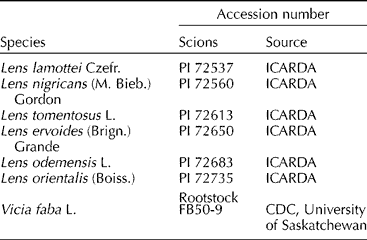
Accessions of six wild Lens species were used as the scions for the grafting experiments. All accessions were originally received from the United States Department of Agriculture (USDA) Plant Introduction Station at Pullman, WA (Table 1). Faba bean breeding line FB50-9 from the Crop Development Centre, University of Saskatchewan was used as rootstock. Prior to planting, the seeds of scions were placed at − 20 °C and then scarified using a sharp blade to improve imbibition and germination. Lentil seeds were planted in 8 L plastic pots containing Sunshine Mix #3 (Sun Gro Horticulture Canada Ltd., Seba Beach, AB, Canada). Scions were cut from lentil seedlings approximately 24 d after planting in pots. For rootstock, faba bean seeds were soaked in water for 24 h, then scarified and placed on wet filter paper in petri dishes at room temperature for about 2 d. When radicles emerged, the faba bean seeds were planted in separate 10 cm2 plastic pots for replicates 1 and 2 and in 28 × 56 cm plastic horticultural nursery trays with 35 cells for replicate 3 containing Sunshine Mix #3. The faba bean seeds were planted 2 weeks later than the lentil seed scions and grown for 8–10 d before preparation for grafting. All plants were grown and maintained in a greenhouse set at 22 °C, 18 h/20 °C, 6 h (day/night) for replicates 1 and 2, and in a controlled growth cabinet set at 21 °C, 18 h/15 °C, 6 h (day/night) for replicate 3.
List of scions and rootstock used for inter-generic in vivo grafting

Grafting procedure
Apical wedge grafting was used in this study (Garner, Reference Garner1958). A V-shaped cut was made in the stem of the scion. The scion was then inserted into a vertical slice cut down the centre of the faba bean rootstock, which was prepared for grafting by severing the shoot approximately 3 cm from the soil surface. The grafted unions were wrapped with Parafilm® (American National Can, Chicago, IL, USA) and covered with Sun bags® (Sigma, Product No. B7026) in separate 10 cm2 pots in replicates 1 and 2 (Fig. 1(A)), or covered with a 28 × 56 × 15 cm clear plastic dome (Early's Farm & Garden Centre, Saskatoon, SK, Canada) in replicate 3 (Fig. 2). The covers were partially opened when the grafted scions had developed new internodes and were removed after 2 weeks when the graft unions were established. The parafilm wrap was left at the graft union until harvest. In replicates 1 and 2, plants were transferred to 8 L pots 1 month after grafting (Fig. 1(B)), while plants were kept in the same tray until plants were mature for replicate 3. For replicates 1 and 2, 10 scions of each of the six wild Lens species were grafted, and six control plants were grown. For replicate 3, 25–30 grafts per species were attempted. Control plants were grown beside the grafted scions.
Example of single-pot system used in replicates 1 and 2. (A): Just after apical wedge grafting; (B): 2 weeks after transferring the grafted plant to an 8-L plastic pot. Lens nigricans PI 72560 scion grafted to Vicia faba FB50-9 rootstock. A colour version of this figure can be found online at journals.cambridge.org/pgr.

Example of tray system used in replicate 3. (A): 1 d after apical wedge grafting; (B): 2 weeks after grafting at time of dome removal. Lens odemensis PI72683 scion grafted to faba bean FB50-9 as the rootstock. A colour version of this figure can be found online at journals.cambridge.org/pgr.

Data collection and analysis
Survival rate of grafted scions was recorded at seed maturity for all three replicates. Days-to-flower was recorded for grafted scions as the date when seeds of scion donor plants were planted until the date when lentil plants began to flower. Length of pods for each species was measured by measuring 10 randomly selected pods that had turned from green to yellow, just prior to dehiscence. Diameter of 10 randomly chosen seeds (in mm) per species was recorded after harvest. Seed colour and pattern of grafted and control plants were observed after the seeds were dried naturally at room temperature.
The General Linear Model Procedure (PROC GLM) in SAS (SAS Institute, Inc., Cary, NC, USA) program was used to determine the effects of replication, species, grafted and non-grafted treatments and their interaction on observed traits. General observations were recorded for seed yield because the wild species of Lens are indeterminate and have strongly dehiscent pods, making it difficult to accurately measure individual plant productivity.
Results
Survival rate of grafted scions
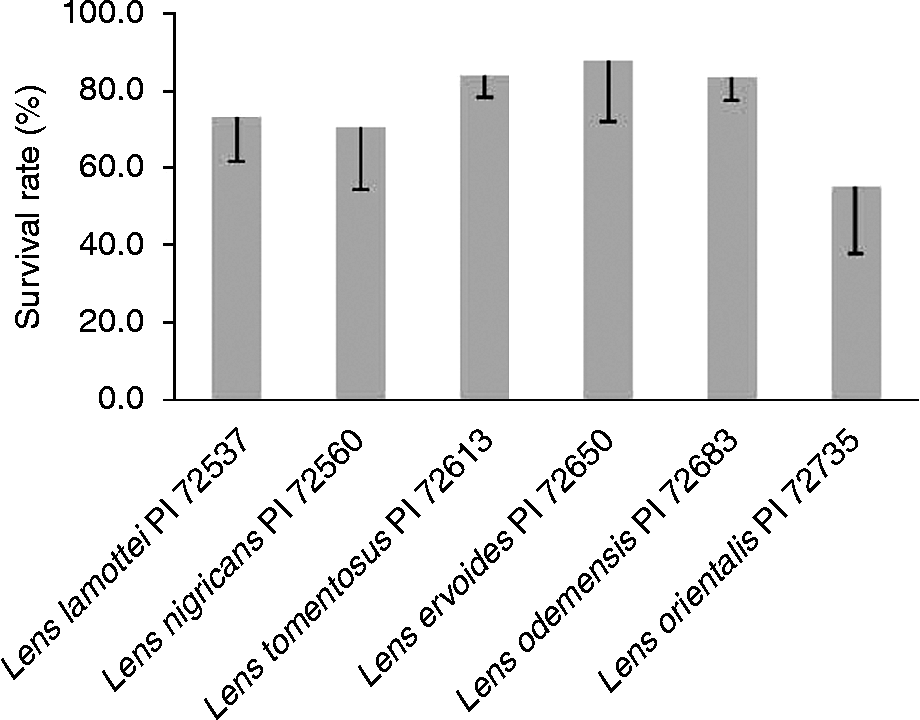
All inter-generic in vivo graft combinations were successful (Figs 3 and 4). The effect of different replicates (single-pot system compared to the tray system) had no influence on the percentage survival of in vivo grafts. The rate of scion survival until seed maturity of the six wild Lens species grafted onto faba bean FB50-9 rootstock is shown in Fig. 3. The lowest survival rate was observed for L. orientalis PI 72735 and the highest in L. ervoides PI 72650. Except for L. orientalis PI 72735, the other five species had relatively high survival rates ranging from 70.7 to 87.7%.
Survival rate of scions of six wild Lens species grafted onto Vicia faba FB50-9 rootstock using apical wedge grafting method.

Appearance of scions of six wild Lens species 1 month after grafting to Vicia faba FB50-9 rootstock in trays. Scions from A to F: (A) Lens lamottei, (B) Lens nigricans, (C) Lens tomentosus, (D) Lens ervoides, (E) Lens odemensis and (F) Lens orientalis. A colour version of this figure can be found online at journals.cambridge.org/pgr.

Phenological and morphological effects of grafting
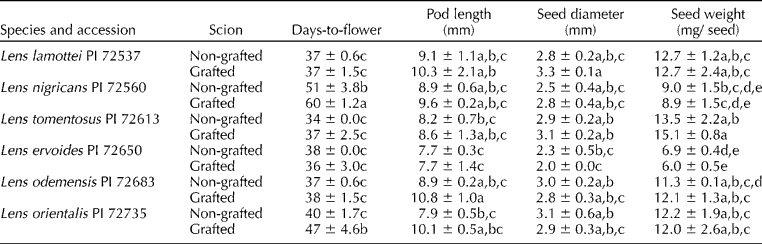
No differences in days-to-flower were observed between control plants and scions grafted onto faba bean rootstocks for four of six species (Table 2). A significant flowering delay of 9 and 7 d, respectively, was observed for the grafted scions of L. nigricans PI 72560 and L. orientalis PI 72735 (Table 2). The scions of the other four wild Lens species maintained growth without a lag phase for flowering date. No differences in pod length of grafted scions compared to ungrafted controls were observed for any of the Lens species (Table 2). Seed diameter and weight were similar for control plants and grafted scions for all six wild Lens species (Table 2). Therefore, faba bean rootstocks had no effect on physical seed characteristics of the six wild Lens species. Visual appearance of the seeds harvested from the grafted scions and control plants was similar.
Comparison of means of days-to-flower, pod length, seed diameter and seed weight of non-grafted controls and scions of six wild Lens speciesa, b grafted onto faba bean rootstocks

a Values are means ± standard deviations.
b Values in a column followed by the same letter are not significantly different at P = 0.05 according to Tukey's Honestly Significant Difference (HSD) test.
Discussion
Potential use of faba bean rootstocks in lentil genetic improvement
Grafting provides a simple and powerful approach to generate chimeric plants from different genotypes. This technique has been widely used in plant research as a means of understanding physiological processes such as salt tolerance and suboptimal temperature tolerance (Santa-Cruz et al., Reference Santa-Cruz, Martinez-Rodriguez, Perez-Alfocea, Romero-Aranda and Bolarin2002; Venema et al., Reference Venema, Dijk, Bax, van Hasselt and Elzenga2008). In legumes, grafting has been used extensively to study the effects of shoots and roots on nodulation control and plant growth within species such as soybean (Glycine max) (Sheng and Harper, Reference Sheng and Harper1997), Lotus japonicus (Nishimura et al., Reference Nishimura, Hayashi, Wu, Kouchi, Imaizumi-Anraku, Murakami, Kawasaki, Akao, Ohmori and Nagasawa2002) and Medicago truncatula (Penmetsa et al., Reference Penmetsa, Frugoli, Smith, Long and Cook2003). Gurusamy et al. (Reference Gurusamy, Bett and Vandenberg2010) reported that grafting intra- and inter-specific scions onto compatible Phaseolus vulgaris rootstock had the potential to improve early generation seed increase ratio, multiplication of clones for screening and perpetuation of sterile or recalcitrant inter-specific hybrids for various common bean breeding strategies.
Our results show that faba bean FB50-9 is a compatible rootstock for all six wild Lens species demonstrated by the relatively high survival rate. The flowering date of both L. nigricans PI 72560 and L. orientalis PI 72735 was delayed by grafting, but pod and seed developments were not affected. Grafting to faba bean had no effect on seed diameter and seed weight of all six wild Lens species. It should be possible to reliably use in vivo grafting techniques for maintaining and propagating lentil inter-specific hybrid embryos from tissue culture once shoots develop, avoiding the need to produce roots in vitro.
A useful application of this technique will be maintenance and multiplication of working seed stocks of wild lentil accessions. Germplasm banks usually supply limited quantities of seeds of wild species (10–20 seeds), which makes it necessary to first multiply the seeds in order to produce sufficient quantities of seeds for experimental purposes. Wild lentil seeds are small (5–20 mg), seeds often have dormancy and irregular germination and emergence, many accessions have prostrate growth habits and the ripening pods are dehiscent. This makes seeding and harvesting operations for seed multiplication difficult. In this set of experiments, the dehiscence of the seeds was not strictly controlled, but grafted plants produced similar amounts of seeds compared to control plants. The technique of in vivo grafting to faba bean could greatly reduce the labour costs of maintenance of collections of wild lentil germplasm, especially if grown in a manner that would allow the capture of dehiscent seeds.
Our experience with indoor seed production of wild lentil species is that seed production can be erratic because the plants are highly sensitive to over-watering which can cause sudden onset of root rots. Faba bean plants are highly tolerant of over-watering. A single seedling of most wild lentil accessions could supply a sufficient number of scions to produce 5–10 plants when grafted onto faba bean rootstocks. If catchment methods for dehiscent seeds are employed, it would be possible to produce sufficient quantities of wild lentil seeds to allow consistent biochemical characterization, for example, seed carbohydrate analysis.
Inter-specific hybridization between wild Lens species and cultivated lentil (L. culinaris Medik.) is used in lentil breeding to improve resistance to fungal diseases. Embryo rescue techniques are required in most cases to develop mature hybrid plants. Induction of root growth is a critical but difficult step in the embryo rescue process. Based on the fact that all wild species could be grafted in vivo to faba bean rootstocks, it should also be useful for grafting shoots produced by inter-specific hybrid embryos grown in tissue culture after embryo rescue.
Management before and after grafting
The usual recommendations for successful intra-specific grafting include matching the stem diameters of scion and rootstock to improve the success rate. Therefore, the sowing dates of the scion and the rootstock become the first important factor considering the potential for different germination periods and growth rates. Matching the stem diameters between lentil and faba bean was not important, but grafting lentil scions during the vegetative growth phase and before the stems of the faba bean plants become hollow will improve success (data not shown). The sowing interval of 2 weeks between scion (wild Lens) and rootstock (faba bean) met these requirements.
Removing branches and adventitious shoots that develop from faba bean rootstocks during the first 2 weeks after grafting is an important factor to ensure that the lentil scions obtain sufficient nutrients from the faba bean rootstock, allowing the graft union to establish. Removing shoots from rootstocks grown in Sun bags (replicates 1 and 2) was more labour-intensive compared to removing them from rootstocks grown in horticultural trays (replicate 3). Thus, the tray with dome in replicate 3 has more advantages.
Acknowledgements
Support for this research was provided by Natural Sciences and Engineering Research Council of Canada (NSERC) and Saskatchewan Pulse Growers. We wish to thank Shermy Badana Mudiyanselage and Tamasyn Ament for helping with the maintenance of plants and experiments. We are also thankful to the Pulse Crop Research Crew for their assistance.