INTRODUCTION
The onset of language skills is a developmental process characterized by a highly uniform course across children, despite striking variability in factors such as language, culture, individual differences in intelligence or sociability, and parental engagement. However, not all individuals follow this well-established timetable, despite exposure to typical conversations and interactions. The study of such failures of acquisition, and language impairments, can help to elucidate the role of specific components of the developmental process by throwing into sharper relief the acquisition of (or failure to acquire) typical language skills, and associating success or failure with other aspects of development. The primary goal of the current study was to explore potentially subtle grammatical differences in older children and adolescents with autism spectrum disorders, and thereby to shed light on typical grammatical development. The well-studied finding that age of acquisition has a significant impact on eventual language attainment (e.g. Johnson & Newport, Reference Johnson and Newport1989) raises the possibility that the early delay in acquisition that defines autism may impact on the timecourse and eventual attainment of grammatical abilities in later childhood and early adolescence.
Autism Spectrum Disorders (ASD) are distinguished by delays and deficits in language and communication, impairments in social interaction, and the presence of repetitive and stereotyped interests and behaviors. Advances in neuroimaging suggest an important role for early neurodevelopmental changes that may underlie these core symptoms (e.g. Eigsti & Shapiro, Reference Eigsti and Shapiro2003). Although communication impairments are a primary characteristic of the disorder, there is remarkable variability across individuals in the nature and extent of these difficulties. Previous work on morphological and syntactic development in ASD has yielded conflicting results, depending in part on the age at which children are assessed, and on whether data were collected using a highly structured instrument (which typically biases the autism group towards improved performance) or a more qualitative instrument (e.g. Eigsti, Bennetto & Dadlani, Reference Eigsti, Bennetto and Dadlani2007). Thus, several authors have concluded that grammatical development in ASD is an area of relative strength, with no impairments (Tager-Flusberg, Reference Tager-Flusberg1985); that impairments are related to cognitive delay but not autism status (in a study of males with Fragile X syndrome; Roberts, Mirrett & Burchinal, Reference Roberts, Mirrett and Burchinal2001); or that impairments are limited to a subgroup of individuals with specific language impairment (SLI; Kjelgaard & Tager-Flusberg, Reference Kjelgaard and Tager-Flusberg2001). Other authors, in contrast, have documented grammatical deficits in ASD (Bartolucci, Pierce & Streiner, Reference Bartolucci, Pierce and Streiner1980; Eigsti et al., Reference Eigsti, Bennetto and Dadlani2007; Hermelin & O'Connor, Reference Hermelin and O'Connor1970). In the current study, we asked whether older children and adolescents with ASD exhibit specific grammatical impairments and, if so, whether these impairments fit a pattern of simple delay or of deviation from the typical developmental pathway (insofar as it is possible to say that any case of ‘delay’ can be non-deviant).
This study can help address the question of whether syntax and morphology might present as ‘islands’ of specific impairment in autism – a ‘delay within a delay’ (Roberts, Rice & Tager-Flusberg, Reference Roberts, Rice and Tager-Flusberg2004) – within the more generally impaired domain of language, analogous to what is seen in SLI. The question of whether impairments are ‘universal’ within a disorder has been central in discussions of other domains in ASD (e.g. impairments of Theory of Mind, joint attention, and executive dysfunction), because only universal deficits are thought to be candidates for a ‘core’ deficit within a disorder; this in turn is significant for questions of etiology and treatment.
More generally, if older children with ASD do exhibit impairments in grammatical development, theories of typical language acquisition will have to account for this specific presentation of children with a set of impairments in contextualized aspects of language such as morphology, syntax, pragmatics, prosody and discourse processes, but not in phonological and lexical domains. The disorder of autism, like SLI, has often been harnessed as a ‘laboratory’ in which to explore the role of many social and cognitive processes (e.g. Theory of Mind, working memory, joint attention, mutual exclusivity principles) in typical language acquisition. As such, claims about the intact or impaired status of grammatical skills in ASD should be based on extensive empirical data, data which to date has been relatively scarce.
The grammatical skills that characterize older children and adolescents are potentially relevant to a distinct, non-clinical population: specifically, individuals learning a new language at a later-than-typical developmental period. Adults are generally less able than children to acquire a novel language (though there is considerable discussion about the mechanism underlying this developmental difference). In a seminal study by Johnson & Newport (Reference Johnson and Newport1989), late learners of English were less able to distinguish grammatical from ungrammatical sentences, to a degree that was closely associated with their age of exposure. Because their diagnosis specifies a delay in early language acquisition, children with autism are categorically ‘late learners’ of their native language. The developmental period of interest differs for verbal children with ASD, who generally begin to produce words and phrases by roughly age five, relative to the late learners in Johnson & Newport (Reference Johnson and Newport1989), where the age of exposure showed an inflection point at puberty. Nonetheless, the notion that acquiring a language with a cognitive and socially ‘older’ brain will impact the language acquisition process is potentially informative in ASD, just as it was for Johnson and Newport's immigrants. The question posed for the present study is whether children with autism proceed to acquire the structure of their native language in the same fluent, native-like fashion as children who are not affected by autism, despite the significant developmental delay in the acquisition process. More broadly, the present study addresses two issues: (1) the presence (or absence) of grammatical impairments in ASD; and (2) the implications of the present findings for theories of typical language acquisition, examining potential links between late (but otherwise typical) language acquisition, and the acquisition process in ASD.
Language impairments in ASD
One way to elucidate the nature of language deficits in ASD is to examine the unfolding of these deficits over time. As early language delays are part of the diagnostic criteria for autism, this population universally exhibits such delays, even among high-functioning individuals with autism (i.e. those with IQs in the normal range). In contrast, the diagnosis of Asperger's syndrome, also included on the spectrum, is characterized by the absence of early language delays; however, practically, children frequently carry this diagnosis despite exhibiting such delays. (it is also possible that children with Asperger's diagnoses exhibit subtle grammatical deficits that go unnoticed in typical standardized assessments.) Individuals with ASD may present with cognitive abilities ranging from severe mental retardation to giftedness. Language delays, while obviously correlated with verbal IQ assessments, appear to be only weakly correlated with non-verbal IQ. In one study of toddlers aged 3 ; 6 with ASD, language was more strongly associated with joint attention and imitation than non-verbal IQ (Charman, Baron-Cohen, Swettenham, Baird, Drew & Cox, Reference Charman, Baron-Cohen, Swettenham, Baird, Drew and Cox2003).
Somewhat unsurprisingly, longitudinal findings indicate that poorer phrase comprehension at age 1 ; 0 for children with autism is related to decreased single word and phrase comprehension, and decreased speech production, at 1 ; 6 (Mitchell et al., Reference Mitchell, Brian, Zwaigenbaum, Roberts, Szatmari, Smith and Bryson2006). Many other reports have focused on a specific milestone of developing productive spontaneous verbal skills by age five (Szatmari, Bryson, Boyle, Streiner & Duku, Reference Szatmari, Bryson, Boyle, Streiner and Duku2003). This milestone, while not salient in studies of typical language acquisition, has been found to be highly predictive of functional adaptive skills, academic skills and autism-specific behaviors in children with autism later in life. Some longitudinal research has indicated a similar relationship between language at age seven to eight and adaptive skills at age twenty-one (Mawhood, Howlin & Rutter, Reference Mawhood, Howlin and Rutter2000), although in contrast, Eisenmajer et al. (Reference Eisenmajer, Prior, Leekam, Wing, Ong, Gould and Welham1998) reported that early language delay was related to the severity of autistic symptomatology, as well as motor skill delays, early in childhood, but not later in life.
In general, children's language is a reliable predictor of other outcomes and appears to be tied to the severity of autistic symptomatology, though these findings have drawn on fairly coarse measures of language acquisition, and findings often rely upon verbal expressiveness.
Morphological and syntactic impairments in ASD
Evidence regarding language impairments in other domains (lexicon, phonology, pragmatics and discourse) is reviewed elsewhere (e.g. Rapin & Dunn, Reference Rapin and Dunn2003); here, we focus on studies of grammatical development. A number of researchers have concluded that syntactic deficits are not central to the communicative impairments in ASD. For example, a study of the order of acquisition of grammatical morphemes suggested that while acquisition may be delayed, the developmental progression itself is similar to that in typical development (Howlin, Reference Howlin1984). An important longitudinal study found few differences between ten children with autism compared to mental age (MA)-matched children with Down syndrome or with typical development in the grammatical complexity of their expressive spontaneous language (Tager-Flusberg, Calkins, Nolin, Baumberger, Anderson & Chadwick-Dias, Reference Tager-Flusberg, Calkins, Nolin, Baumberger, Anderson and Chadwick-Dias1990).
In contrast, several studies of grammatical development have found that syntactic deficits are typical of ASD. In a large, well-characterized sample of 300 children with ASD and 262 children with developmental language disorders between the ages of two and five years, all of the children with ASD had significant comprehension impairments, and 63% were judged to have syntactic impairments (Rapin & Dunn, Reference Rapin and Dunn2003). These investigators concluded that the ASD participants fell into two subtypes: (1) a mixed receptive/expressive subtype (impaired phonology and syntax, with impoverished vocabulary); or (2) a fluent semantic–pragmatic subtype (poor pragmatic and discourse skills, with possible but not necessary phonological and syntactic impairments). They concluded that, contrary to many comparable studies of school-age children with ASD, impairments in phonology and syntax are important contributors to communication deficits in ASD. In other experimental work, Prior & Hall (Reference Prior and Hall1979) found that children with autism differed from both verbal MA-matched children with typical development and Down syndrome in their comprehension of transitive (the man drew a picture on the chalkboard), but not intransitive (the man painted), sentences. Botting & Conti-Ramsden (Reference Botting and Conti-Ramsden2003) demonstrated that a sample of ten-year-old children with autism was as impaired as an age-matched group of children with SLI on an past tense marking task.
Syntactic delays have been documented in younger children with autism as well. Both receptive and expressive language deficits were observed in a sample of preschoolers with autism compared to less severely affected children with pervasive developmental disorder (PDD; Charman, Drew, Baird & Baird, Reference Charman, Drew, Baird and Baird2003). In a study of grammatical abilities in young children with autism (mean age five years) compared to non-verbal IQ and receptive vocabulary matched children with typical development and developmental delays, the autism group exhibited specific delays in grammatical complexity as assessed by the Index of Productive Syntax (Eigsti et al., Reference Eigsti, Bennetto and Dadlani2007). In this study, response patterns for the autism group indicated significant developmental scatter, which was inconsistent with simple developmental delay.
A number of studies have found that the spontaneous speech of children with ASD is marked by a much more limited range of morphological and syntactic forms in their spontaneous speech (prepositions, conjunctions, articles, verb tenses and auxiliaries) and less complex syntax (including embedded sentences, sentence complements and relative clauses) than their MA-matched peers (Bartolucci et al., Reference Bartolucci, Pierce and Streiner1980; Scarborough, Rescorla, Tager-Flusberg, Fowler & Sudhalter, Reference Scarborough, Rescorla, Tager-Flusberg, Fowler and Sudhalter1991). Furthermore, scores generated by structured standardized assessments may be artificially inflated in ASD, though one study suggests otherwise (Condouris, Meyer & Tager-Flusberg, Reference Condouris, Meyer and Tager-Flusberg2003).
Overlap of SLI and ASD
It has been suggested that there is a particular subgroup of children with ASD that exhibits language deficits similar to those seen in children with SLI, with the remaining children exhibiting no grammatical impairments (Jarrold, Boucher & Russell, Reference Jarrold, Boucher and Russell1997; Kjelgaard & Tager-Flusberg, Reference Kjelgaard and Tager-Flusberg2001), consistent with the 2003 Rapin & Dunn study. Roberts et al. (Reference Roberts, Rice and Tager-Flusberg2004) assessed a group of 62 children with autism between the ages of five and fifteen from a wide range of mental ages (FSIQ ranging from 42 to 141) using standardized tasks as well as experimental assessments of third person singular and past tense marking. Children were grouped according to receptive vocabulary (PPVT scores) into normal, borderline and impaired groups. Compared to children with SLI, the autism group frequently omitted tense markers, with the impaired-PPVT group performing at the same level as a younger (mean age five) SLI group. The impaired group had difficulties with task demands, producing many echolalic, semantically inappropriate and perseverative responses. The authors suggested that the data supported a specific morphology deficit within a more general language impairment, for at least the most language-impaired group of children with autism.
Grammaticality judgments as structured assessment
The task of judging the grammaticality of heard sentences has been used widely as a measure of language impairment or language change, in a variety of populations. For example, grammatically judgment tasks have been used in studies of developmental changes in language skill (Wulfeck, Reference Wulfeck1993) and developmental effects in the acquisition of a second language (Johnson & Newport, Reference Johnson and Newport1989), as well as studies of language disorders including SLI (Rice, Wexler & Redmond, Reference Rice, Wexler and Redmond1999) and brain damage and aphasia (Wilson & Saygin, Reference Wilson and Saygin2004). While the task requires metalinguistic judgment, and thus meta-cognitive skills, only a minimal verbal response (yes or no) is required. Scores thus do not penalize individuals who are less talkative or expressive.
The current study examines grammaticality judgments in a sample of high-functioning, carefully diagnosed older children and adolescents with autism, relative to IQ- and age-matched controls, to address the question of whether participants will exhibit any grammatical impairments, and if so whether there is evidence of an effect of age and, by implication, of improvement over the course of development. Grammaticality judgment, which relies entirely on a simple yes/no response, may provide a uniquely sensitive tool with which to assess structural language abilities in ASD.
MATERIALS AND METHODS
Participants
Autism group
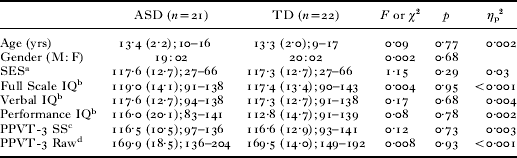
Participants were twenty-one children and adolescents with autism between the ages of ten and seventeen years (see Table 1). Participants were recruited via flyers sent to local clinicians and support groups, as well as from families who had participated in previous research studies. Diagnoses were confirmed with a combination of the Autism Diagnostic Interview-Revised with the parent (ADI-R, Rutter, LeCouteur & Lord, Reference Rutter, Le Couteur and Lord2003) and the Autism Diagnostic Observation Schedule with the participant (ADOS, Lord, Rutter, DiLavore & Risi, 1999). An experienced clinician used data from the ADOS and ADI-R to determine that all participants met criteria for Autistic Disorder using the Diagnostic and Statistical Manual of Mental Disorders (4th edn, American Psychiatric Association, 2000). Cognitive functioning was evaluated with the Wechsler Intelligence Scale for Children (3rd edn, Wechsler, Reference Wechsler1991) or Wechsler Adult Intelligence Scale (3rd edn, Wechsler, Reference Wechsler1997). Language functioning was evaluated with the Wechsler Verbal IQ (VIQ) and the Peabody Picture Vocabulary Test (PPVT-III, 3rd edn, Dunn & Dunn, Reference Dunn and Dunn1997). To decrease the possibility that group differences would be secondary to low IQ or verbal ability in the autism group, we only included participants with high functioning autism, which we defined by Full Scale IQ (FSIQ), VIQ, and PPVT-III Standard Scores within or above the average range (i.e. ⩾85).
Demographic data for Autism Spectrum Disorder (ASD) and Typically Developing control (TD) groups

Note: Scores represent means, standard deviation and range.
a SES=socioeconomic status, assessed with the Hollingshead Four-Factor index.
b IQ assessed with Wechsler Scales (WISC-III or WAIS-III).
c PPVT-3 (Peabody Picture Vocabulary Test, 3rd edn), Scaled Score.
d PPVT-3 Raw score.
Typically developing control group. Participants were twenty-two typically developing children, who were recruited from flyers posted in the community (e.g. pediatrician's offices, restaurants), as well as from families who had previously participated in research and given permission to be contacted. Participants were evaluated as described above. All control participants did not meet criteria for any pervasive developmental disorder on the ADOS and on the ADI-R or the Autism Symptom Questionnaire (Berument, Rutter, Lord, Pickles & Bailey, Reference Berument, Rutter, Lord, Pickles and Bailey1999). There were also no concerns about autism spectrum disorders, learning disabilities, language delays or other psychiatric conditions in the control participants, and no concerns about autism spectrum disorders in their first or second degree relatives. Participants were matched by group to the participants with autism on age, FSIQ, VIQ, PPVT-III Standard Score, gender and socioeconomic status (Hollingshead, Reference Hollingshead1975).
Participants completed additional tasks as part of a larger study of autism conducted at the University of Rochester. Written consent and assent were obtained prior to testing, and procedures followed all applicable ethical guidelines.
Procedures
Subjects were tested on their ability to judge the grammaticality of English syntax and morphology. Stimuli for the grammaticality judgment task were based on sentences from Johnson & Newport's (Reference Johnson and Newport1989) second language acquisition studies. The broad range of grammatical structures tested was based on previous studies that identified deficits in the production of grammatical morphemes (Bartolucci et al., Reference Bartolucci, Pierce and Streiner1980; Howlin, Reference Howlin1984; Tager-Flusberg, Reference Tager-Flusberg and Dawson1989). Because of the potential for analogues between later language acquisition in autism (due to developmental processes) and the later acquisition in typical adult learners (due to exposure), stimuli tested grammatical structures that were found to be sensitive to language deficits in late learners of English (Johnson & Newport, Reference Johnson and Newport1989).
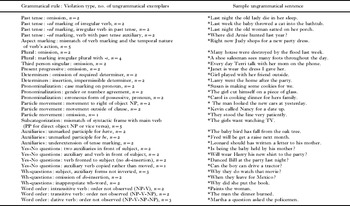
The stimuli comprised 140 sentences that assessed the application of morphological or syntactic rules, as described below. Half of the sentences were grammatical and half violated a rule; these sentence pairs were matched in grammatical structure (aside from the rule violation) and used different lexical items. Lexical items were primarily one- to two-syllable high-frequency words, with a small number of high-frequency three-syllable words. The grammatical violation, or error, could occur at the beginning, middle or end of the sentence. Although an error type often constrained error locations, these were balanced to the degree possible across sentences testing each rule. Sentences varied in length from five to eleven words per sentence, with length balanced for grammatical rule. Grammatical–ungrammatical sentence pairs were presented in opposite halves of the test, and sentence order was randomized within each test half. Sample stimuli are given in Table 2.
Structures tested and sample stimuli – grammaticality judgment task

Note: Note that the number of stimuli refers only to ungrammatical items. Participants responded to an equal number of grammatical items, for a total of 140 trials.
The grammatical structures tested included: past tense, verb aspect marking, plurals, third person singular, present progressive, determiners, pronominalization, particle movement, subcategorization, auxiliaries, yes/no questions, wh-questions and word order. Grammatical rules could be violated in three ways: by substitution (replacing the target word with an item that disagreed in number or tense, or an over-regularization), by omission (removing the relevant morpheme or word from the sentence) and by movement (displacement of the relevant word within the sentence).
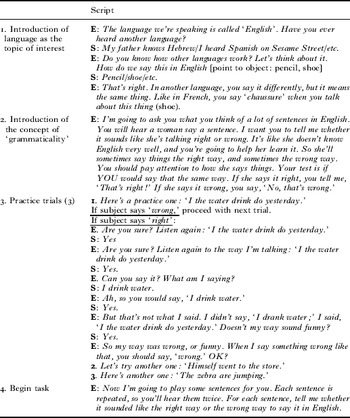
Grammaticality judgments necessarily require meta-cognitive skills in addition to knowledge of the language. Children aged six to seven were able to perform a comparable task in other studies (Wulfeck, Reference Wulfeck1993). However, to minimize the difficulty that children and adolescents with ASD might have with meta-cognitive judgment tasks, the task was introduced with a carefully prepared script, shown in Table 3. First, language was introduced as the topic of interest; second, the concept of ungrammaticality was introduced, and the participant rehearsed giving a ‘wrongness’ judgment; third, the participant was given sample grammatical and ungrammatical sentence trials, on which feedback was permitted.
Preparation for grammaticality judgment task (E=experimenter, S=participant)

Sentences were recorded by a female native English speaker in a sound-controlled booth onto an audiocassette, which was then used to replay the sentences. Sentences were produced with standard (declarative or question) intonation, at a slow to moderate speed. Ungrammatical sentences were recorded with the intonation pattern of the grammatical counterpart. All stimuli were repeated once, to reduce errors due to brief attentional lapses or subject-generated noise; each sentence was followed by a 2-second pause. Participants were tested in a quiet room, and their verbal responses (yes/grammatical vs. no/ungrammatical) were recorded by the experimenter. The procedure lasted twenty minutes.
RESULTS
Data were checked to remove any ‘no response’ trials. As in similar studies (Wulfeck, Reference Wulfeck1993), participants were easily able to complete this task, with a total of only two missing responses across all participants. To assess grammaticality judgments, we calculated a non-parametric index of response sensitivity, the A′ (A-prime) statistic, which provides a ‘pure’ measure of sensitivity, uncontaminated by response bias (see Linebarger, Schwartz & Saffran (Reference Linebarger, Schwartz and Saffran1983) for further discussion). Values of A′ range from 0 to 1 and can be translated into an expected score for a two-alternative, forced-choice procedure. We computed A′ as follows: A′=0·5+[(H – FA)(1+H – FA)]/[4×H x (l – FA)], where H=hit rate (correct response of ‘correct’ to a grammatical sentence) and FA=false alarm rate (incorrect response of ‘correct’ to an ungrammatical sentence). Effect sizes were calculated with partial eta squared (ηp2), which refers to the proportion of variance attributable to a given effect, after partialling out other non-error sources of variance (Cohen, Reference Cohen1988).
Initial analyses were performed to assess response sensitivity over the course of the procedure. As all participants completed the task with the same order of items, response sensitivity in the first half was compared to sensitivity in the second half, using a repeated-measures ANOVA. Data indicated no effects of response set (F(1, 41)=1·51, p=0·23, ηp2=0·04) and no interaction with group (F(1, 41)=0·387, p=0·54, ηp2=0·009).
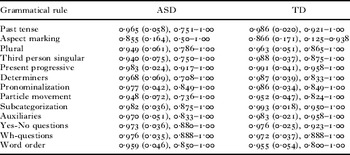
A univariate analysis of covariance (ANCOVA) was conducted on A′ scores across all stimuli with group (ASD vs. TD) as a between-subjects factor and age in years and FSIQ entered as covariates (as both of these variables spanned a relatively large range). Findings indicated a significant group effect on response sensitivity as a whole (F(1, 39)=6·12, p=0·02, ηp2=0·14), which reflected the poor performance of the ASD group (M (SD)=0·963 (0·031)), relative to the TD group (M (SD)=0·972 (0·015)). Results are presented for each grammatical structure, by group, in Table 4.
Results of the grammaticality judgment task

Note: Data are presented as M (SD), range, for A′ (response sensitivity).
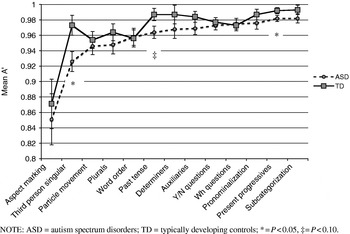
Judgments across the thirteen grammatical distinctions were further examined as a function of group, in an ANCOVA with age and IQ as covariates. Results indicated significant main effects of group for third person singular marking (F(1, 39)=7·92, p=0·008, ηp2=0·17) and present progressive marking (F(1, 39)=4·21, p=0·047, ηp2=0·10). Past tense marking approached significance (F(1, 39)=3·62, p=0·07, ηp2=0·09). There were no differences between groups for other violations; results are presented in Figure 1. Both groups performed with greatest response sensitivity on present progressives, and subcategorization violations; performance on these structures was close to ceiling for both groups (all M's>0·97). The group difference in present progressive marking was present despite the generally accurate performance of both groups. In contrast, performance for aspect marking was relatively poor for both groups, with group mean scores of 0·85 and 0·87 for the ASD and TD groups respectively.
Performance (assessed via the A′ (measure of response sensitivity) on the grammaticality judgment task by group, presented as estimated means (controlling for age and FSIQ).

Given that third person singular, present progressive and past tense violations were most indicative of group differences, further analyses were conducted to ascertain the structures that were contributing most to the difficulties of the ASD group. The third person singular items violated grammaticality by omission (*Every day Terri talk with her mom on the phone); similarly, the present progressive items violated grammaticality by omitting the required morpheme (*The little boy is speak to a policeman). The past tense items violated grammaticality in four possible ways: (1) omission of the required morpheme (*Yesterday the man make chocolate cake); (2) over-regularization of an unmarked irregular verb (*Last week the baby throwed a cat into the bathtub); (3) inappropriate insertion of a past tense (*Where did Arnie hunted last year?); or (4) marking with the regular past tense an already past tense irregular verb (*Last night the old woman satted on her porch). Individually, none of these specific violations reached significance between groups (all F's<2·3, all p's>0·13).
While older participants in both groups had high response sensitivity across all sentences, there was significant variability by age, particularly within the ASD group. The ASD group was split at the mean into younger and older participants; these groups were matched on VIQ, PIQ, FSIQ, PPVT and SES (all p's>0·20). There were with four specific grammatical distinctions that were particularly sensitive to age differences within the ASD group, such that the younger ASD participants were significantly less sensitive to violations of grammaticality: aspect marking (F(1, 18)=8·92, p=0·008, ηp2=0·33); particle movement (F(1, 18)=9·87, p=0·006, ηp2=0·35); past tense (F(1, 18)=9·15, p=0·007, ηp2=0·34); and auxiliaries (F(1, 18)=7·78, p=0·01, ηp2=0·29). When comparing the younger and older TD participants, there were no significant changes with age across any of the grammatical distinctions (all p's>0·15). The age-based autism group differences in particle movement appeared to reflect differences in each of three forms of particle movement (movement to right of object NP, movement outside of clause and omissions), each of which differed between groups (all p's<0·05); differences in past tense were driven primarily by group differences for -ed marking of a verb with past tense auxiliary (p=0·006); and differences in auxiliaries appeared to be reflect differences in the extension of tense marking throughout elements in a clause (p=0·04). No other comparisons reached significance (all p's>0·05). It is important to note that within any of these specific forms of violation, data were based on a small number of stimuli (typically, four sentences total).
Error type
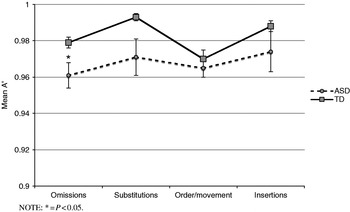
The ungrammatical sentences were grouped by the ways in which they violated grammaticality: through omission (lack of required marking), substitution (replacement of the appropriate morpheme with a related (e.g. also a plural or tense marker) ungrammatical morpheme), movement/ordering (shifting words within an utterance) or insertion (of a morpheme onto what should be an unmarked item). Analysis of response sensitivity as a function of error type indicated a significant main effect of group for two of these patterns (see Figure 2): omissions (F(1, 40)=7·02, p=0·01, ηp2=0·15) and substitutions (F(1, 40)=4·95, p=0·03, ηp2=0·11). Movement/order and insertion error rates did not differ between groups (all p's>0·20).
Mean response sensitivity (A′) by group as a function of grammaticality violation type.

Characteristics of sentences
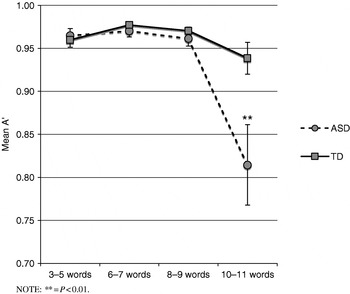
Because the stimuli were constructed to control for sentence length and placement of error, it was possible to examine variability along these dimensions. First, stimuli were grouped by sentence length in words into short (3–5 words), medium-1 (6–7 words), medium-2 (8–9 words) and long (10–11) items. Data were analyzed within a repeated-measures ANOVA for length (×4) by group (×2) with age and IQ as covariates. Results indicated no main effect of length (F(1, 39)=0·09, p=0·97), a significant main effect of group (F(1, 39)=6·79, p=0·01, ηp2=0·15) and a significant length by group interaction (F(1, 39)=5·37, p=0·002, ηp2=0·12). The groups were roughly equivalent across the short and medium sentence lengths, with sensitivity levels at 0·96–0·98. In contrast, the ASD group had significantly more false alarms and misses for the longest sentences (M (SD)=0·814 (0·214)) relative to the TD group (M (SD)=0·938 (0·086)); see Figure 3.
Mean response sensitivity (A′) by group as a function of sentence length.

Given this differential effect of length on response sensitivity, a second analysis was performed, this time examining the interaction between sentence length and location of the grammaticality violation (first, second or third portions of the sentences). Only sentences with an error were included, and data were analyzed as percent correct. For the long sentences (10–11 words), errors were located only in the final third of the sentence. Again, examining relative performance across error locations as an effect of group, the ASD group was significantly less sensitive (M=0·778) than the TD group (M=0·939) to errors located at the end of long sentences (F(1, 39)=7·39, p=0·01, ηp2=0·16).
Correlational analyses
The pattern of performance on the grammaticality task is more likely to be a meaningful index of linguistic skills if it is related to other language assessments. Across the entire sample, A′ was reliably correlated with receptive vocabulary (PPVT-III standard score) (r(41)=0·35, p=0·02) and with VIQ (r(41)=0·37, p=0·02), (but was not as strongly associated with PIQ (r(41)=0·28, p=0·08)). While these relationships support the relevance of grammaticality judgments as an index of linguistic abilities, they could possibly reflect the presence of a non-linguistic moderator variable, such as IQ.
In contrast, if measures assessing linguistic ability at earlier points in development are related to current language functioning, this finding would be consistent with the notion that grammatical skills assessed as late as ages nine to sixteen reflect the timing or developmental course of earlier language skills. As part of a developmental interview in the current study, parents of participants were asked to report the age in months at which their child began to use multiword phrases (where one word was a verb). Previous research indicates that this type of retrospective parent report is consistent with direct observations (Goldberg, Thorsen, Osann & Spence, Reference Goldberg, Thorsen, Osann and Spence2008; Luyster, Kadlec, Carter & Tager-Flusberg, Reference Luyster, Kadlec, Carter and Tager-Flusberg2008; Sivberg, Reference Sivberg2003). Twenty-seven (of forty-three) parents were able to report this information. For these participants, sensitivity of grammaticality judgments was related to first production of phrases (r(25)=−0·44, p=0·02). The individuals who were later talkers were relatively less sensitive in the grammaticality judgment task. The correlations remained when controlling for FSIQ (r(24)=−0·51, p=0·008), indicating that the relationship was not affected by the moderating influence of IQ. Finally, these relationships appeared to have specificity to language; among those children with valid reports of motor milestones, there was no association of grammaticality judgments with age of first walking (r(28)=−0·12, p=0·53). These data suggest that the emergence of language ontogenetically is related to current language abilities as indexed by a metalinguistic task.
Finally, as reviewed earlier, the severity of an individual's symptoms of autism (difficulty with making eye contact, prominence of prosodic or fluency anomalies, etc.) have been more closely associated with language achievements than with intelligence, in previous studies (Charman et al., Reference Charman, Baron-Cohen, Swettenham, Baird, Drew and Cox2003). The present data are consistent with these earlier findings, in that grammaticality task performance was significantly associated with communication (r(41)=−0·33, p=0·03) and social (r(41)=−0·40, p=0·07) scores on the ADOS diagnostic measure (note that ADOS scores increase with symptom severity), though not with repetitive behaviors (r(41)=−0·02, p=0·92). There was no such correlation for ASQ score and response sensitivity in the TD group (r(20)=−0·03, p=0·90).
DISCUSSION
In recent years, there has been extensive discussion about the extent of grammatical deficits in autism. In the present study, participants with autism aged nine to sixteen and matched controls completed a grammaticality judgment task. The ASD group had lower response sensitivity for third person singular and present progressive marking; group differences for past tense marking missed significance. The largest difference between ASD and TD groups was for the third person singular (e.g. she runs to school). These results are especially striking, given that in the analysis IQ was controlled (similar to findings from Roberts et al. (Reference Roberts, Rice and Tager-Flusberg2004), who found that IQ did not account for all the variability within their autism group). The structures which appeared to be most difficult for participants with autism were those grammatical structures involving some forms of verb marking; interestingly, this phenomenon was not an across-the-board one, as groups were essentially identical in performance on verb aspect marking (which was also the structure with worst performance for both groups). While it is possible that this difficulty reflects the relative phonological ‘salience’ of the verb markers, the group similarity on plural morphology argues against this possibility.
As reviewed above, one recent hypothesis (Kjelgaard & Tager-Flusberg, Reference Kjelgaard and Tager-Flusberg2001) suggests that autism comprises two subgroups, with and without language impairments. The language-intact subgroup is thought to include individuals who have overcome the history of early language impairment necessary for a diagnosis of autism, and who now exhibit no syntactic, lexical or phonological deficits, though who may continue to show discourse or pragmatic impairments. The language-impaired subgroup is thought to include individuals who might also meet criteria for SLI; that is, they exhibit language deficits despite having an overall IQ in the unimpaired range. The existence and magnitude of such ongoing language deficits is important both for better understanding of the disorder itself, but also because of the implications for typical language acquisition. Is it possible for a language learner to have significant early language delays, impacting the course of language acquisition, but to finally end up with largely unaffected, intact, grammatical language skills? The data on later language skills in individuals with autism speaks directly to this important question. Contrary to the notion that the autism diagnosis includes a distinct subgroup of children who display grammatical deficits similar to those seen in SLI, our data suggest that grammatical impairments are found in most children with autism, though the difficulties can be detected only with highly sensitive assessments. Thus, the younger ASD group scores on the grammaticality judgment task were low overall, with eight out of ten participants performing below the mean score for the younger TD participants.
Although the present findings are inconsistent with the hypothesis that there is a specific subgroup of ASD children that may meet criteria for SLI, it is worth further comparing the present findings and those from a grammatical judgment study in SLI (Rice et al., Reference Rice, Wexler and Redmond1999). The Extended Optional Infinitive hypothesis states that affected children will accept ungrammatical sentences because they are delayed in discovering the obligatory nature of finiteness marking in English. For the present stimulus set, this would predict impairments in third person singular marking, in past tense marking and in use of auxiliary be and do and copula be. The ASD group as a whole did show impairments in their knowledge of third person singular marking, and possibly in past tense marking, consistent with this hypothesis. Furthermore, the younger ASD participants had impairments in past tense and aspect marking, particle movement and auxiliaries, relative to the older ASD participants. Because deficits included structures that should require finiteness marking, but included additional grammatical structures as well, the current data are not entirely consistent with an Extended Optional Infinitive account.
There are several other results that may aid in interpreting this pattern. First, as has been shown previously in studies of healthy children (Wulfeck, Reference Wulfeck1993), and healthy adults in a cognitive load paradigm (Blackwell & Bates, Reference Blackwell and Bates1995), the ASD group differed from controls in detecting omissions and substitutions; no such differences were found for movement/ordering or insertion errors. This finding is also consistent with the suggestion by Newport and colleagues and others (Newport, Gleitman & Gleitman, Reference Newport, Gleitman, Gleitman, Snow and Ferguson1979; Goldin-Meadow, Reference Goldin-Meadow1978) that word order is a ‘highly resilient’ property of language, and that the characteristic of ‘learnability’ may account for these findings. Contrary to this suggestion was the finding of group differences in present progressive marking, which is typically also found to be a highly resilient structure for late and other atypical learners; however, this group difference reflected performance essentially at ceiling for controls (M=0·991) and performance close to the ceiling (M=0·983) for the ASD group. In general, these results seem to be consistent with the possibility that it is general learnability properties, rather than particular grammatical structures, that are driving group differences. Furthermore, the relationship between the present findings, and findings from studies of late language learners, may merit further investigation. A fundamental implication is that, given a delay in early acquisition, individuals will continue to show subtle differences in grammatical abilities, though these differences may not be apparent on most standardized assessments; this in turn suggests that a delayed developmental course of acquisition may have long-term impacts on grammatical skills not just for individuals with autism but for any learner, consistent with proposals by Karmiloff-Smith and others (e.g. Karmiloff-Smith, Grant, Berthoud, Davies, Howlin & Udwinet, Reference Karmiloff-Smith, Grant, Berthoud, Davies, Howlin and Udwin1997).
Sentence length also influenced the pattern of results. The autism group showed a differentially greater impact of sentence length. Consistent with data indicating that individuals with autism have difficulty with aspects of executive functions, including working memory (e.g. Bennetto, Pennington & Rogers, Reference Bennetto, Pennington and Rogers1996), this length effect may reflect the increased demands on working memory for the longest (10–11 word) sentences.
Our results, though they rely on cross-sectional data, are consistent with the notion that in autism, language skills develop over a greatly protracted developmental period. We divided our participants at age thirteen years, and the older participants, even those with autism, showed intact performance in the grammaticality judgment task. These findings are consistent with a hypothesis of a general delay, as the older autism group was unimpaired relative to controls. Findings are also consistent with longitudinal data from children characterized as toddlers as late talkers, who continue to show delays on a variety of language assessments, including syntactic skills, when assessed at age nine (Rescorla, Reference Rescorla2002).
While correlational analyses cannot determine causation, they were helpful in indicating that, because grammatical judgments were correlated with receptive vocabulary and verbal IQ (but not performance IQ), these judgments may be tapping into specifically linguistic, rather than general cognitive, abilities. Interestingly, grammaticality judgments appeared to be related to autism symptomatology, suggesting that these language abilities may be part and parcel of the autism profile – that is, they may reflect a core deficit. Furthermore, analyses indicated that task performance was associated with early language (first phrases) but not motor (emergence of walking) milestones, suggesting that metalinguistic judgments later in development are relevant to early individual differences in linguistic development. While this finding is tempered by the small sample size, and possible limitations on the reliability of parent report, data suggested that individuals who were later in learning to speak were less sensitive to the grammaticality of sentences, even holding constant their non-verbal and verbal IQ. These correlational analyses are consistent with the notion that language abilities may ‘track’ separately (in autism) from other cognitive domains, and are consistent with previous work finding stronger associations between language and social skills, than language and non-verbal IQ (Charman, Baron-Cohen et al., Reference Charman, Baron-Cohen, Swettenham, Baird, Drew and Cox2003). These results, while tentative, may speak to the lesser role of non-verbal IQ in the process of typical language acquisition.
There are several limitations to this work. First, we report parent descriptions of the timing of early language milestones, which may be subject to reporting error. To reduce retrospective error, data were included only for those parents who were able to recall a specific time at which their child began to use words and phrases. A second limitation is that the grammaticality judgment task is a meta-cognitive, off-line task. An on-line measure, such as eye-tracking as a subject performed an active task that required him or her to correctly interpret a spoken sentence, would likely provide a much more sensitive and rich assessment of spoken language processing skills in children with language delays. Another related limitation to this methodology, which requires subjects only to generate a yes/no response, is the presence of ceiling effects for a number of grammatical structures, for which performance was highly accurate. A task requiring judgments of greater subtlety would have elicited more variable performance. It should be noted, however, that it is precisely this lack of subtlety in task demands that renders the findings interesting; if the task that participants face is highly straightforward and seemingly simple enough that most individuals perform at ceiling, the fact that some participants do not perform at ceiling is all the more notable. A final limitation, of sample size, is one shared by many studies of language in autism. If a larger sample had been included, across a wider variety of ages and functional abilities, the results would be more generalizable. Future work will need to address both production results (as in the elicitation tasks described in Roberts et al. (Reference Roberts, Rice and Tager-Flusberg2004)) and comprehension skills in a larger sample of participants, and ideally would draw on on-line measures such as eye-tracking.
These data present an important new addition to our understanding of grammatical abilities in autism, a condition that is much studied because of central and relevant impairments in other socio-cognitive processes that have been described as the building blocks of typical language acquisition, including theory of mind, joint attention, executive functioning and others. Our findings suggest that despite normal scores on standardized language assessments, older children and young adolescents continue to struggle with the subtle grammatical distinctions, particularly in detecting omissions and substitutions of verbal morphology; these difficulties were particularly pronounced when errors occurred within the final third of the longest sentence stimuli. Importantly, these grammatical difficulties were displayed by participants with intact skills on a measure of receptive vocabulary. These results are consistent with the proposal that, along with pragmatic and discourse skills, grammatical structure is a potentially specific ‘island’ of impairment in autism. While the autism group displayed difficulties with structures that have also been found to be impaired in participants with SLI, the structures impacted included a broader set of items. To us, these data are most consistent with the more general ‘learnability’ explanations that have been raised in work with late language learners. While future data are needed to flesh out this possibility, the present work clearly documents that grammatical language abilities in autism are marked by significant developmental delay.