Introduction
Dementia is an umbrella term encompassing a variety of symptoms related to a decline in memory, orientation, language, judgment, or reasoning which reduces the ability to accomplish activities of daily living. Alzheimer's Disease (AD) is the most common cause of dementia accounting for approximately 70% of patients (Reitz et al., Reference Reitz, Brayne and Mayeux2011). Vascular dementia, Lewy Body dementia, and frontotemporal dementia cause the majority of additional dementia cases. While generally not a common cause for dementia, Parkinson's Dementia (PD) was a common cause of dementia among the Chamorros, an indigenous population with Polynesian descent, of Guam prior to World War II (Galasko et al., Reference Galasko2007).
There is no official definition of “indigenous” as the definition varies from country to country. In general, indigenous people self-identify as indigenous and are accepted as indigenous by their community (World Health Organization, 2007; Australian Bureau of Statistics, 2011; Office of Minority Health and Health Equity, 2015). There are approximately 370 million indigenous people worldwide, representing 5% of the world's population (World Health Organization, 2007). There is a large degree of variability in cultural practices, spiritual beliefs, languages, and historical experiences between indigenous populations. More than 70 countries have indigenous populations, with many countries having numerous distinct indigenous groups. Indigenous populations in a number of countries, including Canada, Australia Guam, and the USA, suffer from intergenerational trauma as a result of colonization, the associated loss of culture and traditions, and racial discrimination. While not all indigenous populations have experienced the same historical trauma, it is generally accepted that indigenous populations worldwide have a lower socio-economic status, lower levels of education, and poorer overall health (including higher rates of cardiovascular disease, diabetes, and alcohol abuse), increasing their risk for the development of dementia (Chen et al., Reference Chen, Lin and Chen2009; Smith et al., Reference Smith2010).
In Canada, there are three distinct indigenous groups (First Nations, Métis, and Inuit). First Nations people represent approximately 60% of Canada's indigenous population (Statistics Canada, 2011). First Nations people include those who are registered under the Indian Act (also known as Registered Indians or Status Indians) and those who are not registered (also known as non-Status Indians).
In the 2013 USA Census, 5.2 million people self-identified as American Indian or Alaska Native accounting for approximately 2% of the total population (Office of Minority Health and Health Equity, 2015). There are 566 federally recognized (a tribe that has a government-to-government relationship and a special trust relationship with the USA) tribes (US Department of the Interior, 2015). Less than half (approximately 1.9 million people) of the American Indians or Alaska Natives living in the USA are members of these tribes (US Department of the Interior, 2015).
The indigenous population in Australia primarily consists of Aboriginal and Torres Strait Islander people (Australian Bureau of Statistics, 2011). The self-identified indigenous Australian population accounts for roughly 3% (669,900) of the general population (Australian Bureau of Statistics, 2011). Among the indigenous population, 90% identified as Aboriginal, 6% identified as Torres Strait Islander, and 4% identified as both.
In 1960, the Chamorro population was approximately 50% (34,762) of the population in Guam (Plato et al., Reference Plato, Garruto, Galasko and Craig2003). By 2000, the Chamorro population had increased to 57,297 and accounted for 37% of the Guam population (Plato et al., Reference Plato, Garruto, Galasko and Craig2003).
In Brazil, 817,000 people self-identified as indigenous accounting for 0.42% of the total population in 2010 (International Work Group for Indigenous Affairs, 2014). There are 305 indigenous ethnic groups and 274 indigenous languages spoken (International Work Group for Indigenous Affairs, 2014). Regionally, the largest number (approximately 168,000) of indigenous Brazilians live in the Amazonas (International Work Group for Indigenous Affairs, 2014).
Information on the age structure of indigenous populations is limited. While the percentage of indigenous seniors in Canada is relatively small in comparison to non-indigenous seniors, the number of indigenous seniors is increasing at a much faster rate in comparison to non-indigenous seniors (50% vs. 24% from 1996 to 2006) (Statistics Canada, 2006). A similar trend is expected for indigenous seniors in the USA. The non-indigenous senior population is expected to double from 2007 to 2047, while the number of indigenous seniors is expected to more than triple for the same period (Department of Health & Human Services, 2007).
Despite the higher incidence of risk factors indicating that the prevalence for dementia among indigenous populations may be higher than the prevalence among non-indigenous populations and may also be on the rise, dementia among indigenous populations has received minimal research attention. The objective of this systematic literature review was to determine the prevalence and incidence rates for dementia among indigenous populations worldwide.
Methods
This systematic review was conducted in accordance with PRISMA guidelines.
Search sources and searches
Two reviewers (LW and QS) conducted a literature search including grey literature (e.g. conference proceedings and dissertations) of MEDLINE & MEDLINE In-Process & Other Non-Indexed Citations (1946 to April 3, 2015); Embase (1980 to 2015, Week 14); PsycINFO (1806 to April 2015, week 1); and grey literature in April 2015. Government (e.g. Statistics Canada, National Institute of Health, Australian Bureau of Statistics) and non-government (e.g. World Health Organization) websites were searched for relevant publications. There were no restrictions by year of publication or language. Searches based on keywords were conducted. Keywords included dementia, cognition disorders, Alzheimer, neurodegenerative diseases, Aboriginal, Aborigine, Native, First Nation, Indigenous, North American Indians, Oceanic Ancestry Group, odds ratio, prevalence, incidence, risk, and relative odds. References from key papers were also searched. Appendix 1 contains details about the search strategy.
Study selection
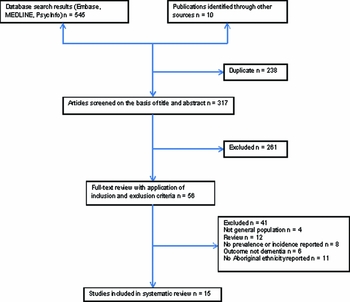
Papers investigating dementia among indigenous populations were included for review, if they met the following inclusion criteria: (1) the study included an indigenous population, (2) prevalence or incidence was reported, (3) the study was conducted in the general population, (4) the disease typically occurred after the age of 45. A flow chart of the search is shown in Figure 1.
Study search and selection.

Data extraction and quality assessment
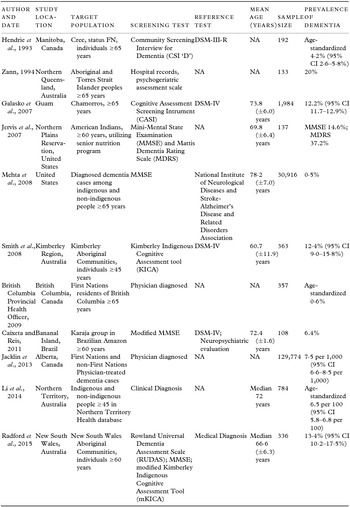
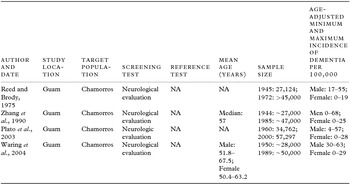
Data were extracted to a table which included: Authors and date, study location, target population, screening test used, reference test used, mean age, sample size, and the prevalence (Table 1), or incidence (Table 2) of dementia including confidence limits (if available). An assessment of publication bias was not conducted due to the small number and heterogeneity (e.g. prevalence/incidence, AD/dementia/MCI/PD, region, primary/secondary data) of studies. Crude prevalence rates cannot be compared unless we compare them using the same standard population. Prevalence rates for individuals ≥ 65 were age-standardized to the 2014 Canadian population using the direct standardization method, where data permitted (Government of Canada, 2014). Two studies presented data in age increments that began at age 60 (Smith et al., Reference Smith2008; Jacklin et al., Reference Jacklin, Walker and Shawande2013). We applied the prevalence rate of the 60–69 year age group to estimate the prevalence rate of individuals aged 65–69 (Kelly et al., Reference Kelly, Yang, Chen and Reynolds2008).
Study characteristics of included prevalence publications

Study characteristics of included incidence publications

Quality assessment was conducted using the Risk of Bias Tool developed for the critical assessment of prevalence studies by Hoy and colleagues (Hoy, Reference Hoy2012). The risk of bias tool includes eleven questions; four questions related to external validity, six questions related to internal validity, and an overall summary score based on the risk of bias assessment for internal and external validity. The overall summary score is based on the methods used in Grades of Recommendation, Assessment, Development, and Evaluation (GRADE) and Cochrane (Terracciano et al., Reference Terracciano, Brozek, Compalati and Schünemann2010; Higgins and Green, Reference Higgins and Green2011). A “low” or “high” risk of bias was assigned to each of the ten questions according to the criteria provided in the tool. Data extraction and quality assessment were conducted by two reviewers (LW and QS). Any discrepancies between the two reviewers’ assessments were resolved with a third author.
Results
Search and selection findings
Fifteen publications were included in this systematic review. Four of these studies were conducted in Australia, (Zann, Reference Zann1994; Smith et al., Reference Smith2008; Li et al., Reference Li2014; Radford et al., Reference Radford2015) two in the USA, (Jervis et al., Reference Jervis, Beals, Fickenscher and Arciniegas2007; Mehta et al., Reference Mehta2008) five in Guam, (Reed and Brody, Reference Reed and Brody1975; Zhang et al., Reference Zhang, Anderson, Lavine and Mantel1990; Plato et al., Reference Plato, Garruto, Galasko and Craig2003; Waring et al., Reference Waring2004; Galasko et al., Reference Galasko2007) one in Brazil, (Caixeta and Reis, Reference Caixeta and Reis2011) while the other three (Hendrie et al., Reference Hendrie1993; British Columbia Provincial Health Officer, 2009; Jacklin et al., Reference Jacklin, Walker and Shawande2013) presented Canadian data.
Study quality
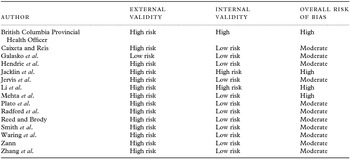
Table 3 displays the risk of bias for the external validity, internal validity, and overall. There were no disagreements in overall study quality assessment between the two reviewers. All included publications except one received high risk of bias scores for external validity as a result of their small, region/province-specific samples (Reed and Brody, Reference Reed and Brody1975; Zhang et al., Reference Zhang, Anderson, Lavine and Mantel1990; Hendrie et al., Reference Hendrie1993; Zann, Reference Zann1994; Plato et al., Reference Plato, Garruto, Galasko and Craig2003; Waring et al., Reference Waring2004; Jervis et al., Reference Jervis, Beals, Fickenscher and Arciniegas2007; Mehta et al., Reference Mehta2008; Smith et al., Reference Smith2008; British Columbia Provincial Health Officer, 2009; Caixeta and Reis, Reference Caixeta and Reis2011; Jacklin et al., Reference Jacklin, Walker and Shawande2013; Li et al., Reference Li2014; Radford et al., Reference Radford2015). A census was used to give a complete enumeration of permanent residents on Guam in the study conducted by Galasko and colleagues, which was the only study to receive a low risk of bias for external validity (Galasko et al., Reference Galasko2007). Three studies (British Columbia Provincial Health Officer, 2009; Jacklin et al., Reference Jacklin, Walker and Shawande2013; Li et al., Reference Li2014) received a high risk of bias for internal validity because diagnostic criteria were not standardized and the sample represented the treated prevalence, which is likely different than the true prevalence.
Quality assessment of included publications

Characteristics of studies
Seven of the studies reported only the prevalence of dementia, (Zann, Reference Zann1994; Galasko et al., Reference Galasko2007; British Columbia Provincial Health Officer, 2009; Caixeta and Reis, Reference Caixeta and Reis2011; Jacklin et al., Reference Jacklin, Walker and Shawande2013; Li et al., Reference Li2014; Radford et al., Reference Radford2015) four of the studies conducted in Guam presented incidence data on PD, (Reed and Brody, Reference Reed and Brody1975; Zhang et al., Reference Zhang, Anderson, Lavine and Mantel1990; Plato et al., Reference Plato, Garruto, Galasko and Craig2003; Waring et al., Reference Waring2004) one study presented the prevalence of AD, (Mehta et al., Reference Mehta2008) one study defined patients with cognitive impairment, (Jervis et al., Reference Jervis, Beals, Fickenscher and Arciniegas2007) one study presented the prevalence of both AD and dementia, (Hendrie et al., Reference Hendrie1993) and in one study participants were classified as having dementia, cognitive impairment but not dementia or no cognitive impairment (Smith et al., Reference Smith2008).
The study conducted among Cree residents of Manitoba provided a breakdown of participants by age category (Hendrie et al., Reference Hendrie1993). While Zann acknowledged the much younger age distribution in the indigenous population compared to the non-indigenous population individuals who were aged ≥ 65 years and individuals who were identified as being at high risk for dementia or showing signs of dementia by health workers were surveyed to be consistent with sampling methodology used in dementia studies in the non-indigenous Australian population (Zann, Reference Zann1994).
The prevalence of dementia among indigenous people ranged from 0.5% (Mehta et al., Reference Mehta2008) to 20% (Zann, Reference Zann1994) (Table 1). Four studies also included data from the non-indigenous population (Mehta et al., Reference Mehta2008; British Columbia Provincial Health Officer, 2009; Jacklin et al., Reference Jacklin, Walker and Shawande2013; Li et al., Reference Li2014). The age-standardized prevalence rate was the same (0.6%) for Status First Nations and other residents in the British Columbia study, (British Columbia Provincial Health Officer, 2009) whereas the age-standardized prevalence of dementia was 34% higher for First Nations (0.75%, 95% CI 0.66–0.85) in comparison to non-First Nations (0.56%, CI 0.55–0.56) in the study led by Jacklin (Jacklin et al., Reference Jacklin, Walker and Shawande2013). Consistent with the study by Jacklin and colleagues, Li and colleagues found the age-adjusted prevalence in the indigenous population aged 45 years or older (6.5 per 100 population, 95% CI 5.8–6.8) was much higher than the age-adjusted prevalence found in the non-indigenous population ≥ 45 (2.6 per 100 population, 95% CI 2.3–2.8) (Li et al., Reference Li2014). Indigenous people represented 0.5% of the 30,916 patients with possible or probable AD seen at an AD Center in the USA between 1984 and 2005 (Mehta et al., Reference Mehta2008). The vast majority (81%) of the patients with possible or probable AD were Caucasian (Mehta et al., Reference Mehta2008).
We age-standardized the prevalence rates of five studies (Hendrie et al., Reference Hendrie1993; Galasko et al., Reference Galasko2007; Smith et al., Reference Smith2008; Jacklin et al., Reference Jacklin, Walker and Shawande2013; Li et al., Reference Li2014) to the 2014 Canadian population. Two of the studies were conducted in Canada, (Hendrie et al., Reference Hendrie1993; Jacklin et al., Reference Jacklin, Walker and Shawande2013) two were conducted in Australia, (Smith et al., Reference Smith2008; Li et al., Reference Li2014) and one was conducted in Guam (Galasko et al., Reference Galasko2007). The age-standardized dementia prevalence rates for individuals 65 years of age or older were the same (Hendrie: 3.5% ± 2.5%, Jacklin: 3.5% ± 0.2%) for the two Canadian studies (Hendrie et al., Reference Hendrie1993; Jacklin et al., Reference Jacklin, Walker and Shawande2013). The age-standardized prevalence rate for those ≥65 was higher (27.2% ± 6.6% compared to 14.6% ± 2.5%) for the prevalence study by Smith and colleagues than it was for the study by Li and colleagues, which was based on treated dementia patients (Smith et al., Reference Smith2008; Li et al., Reference Li2014). The age-standardized prevalence rate in Guam was 15.6% ± 1.8% (Galasko et al., Reference Galasko2007).
All incidence studies were based on the same population for different time periods. Despite using the same data sources, the average annual age-adjusted incidence rates varied slightly between studies for the same time periods (Table 2). The incidence of PD was consistently higher (approximately 3:1) for men in comparison to women across all studies (Reed and Brody, Reference Reed and Brody1975; Zhang et al., Reference Zhang, Anderson, Lavine and Mantel1990; Plato et al., Reference Plato, Garruto, Galasko and Craig2003; Waring et al., Reference Waring2004). Peak incidence, ~63 per 100,000, occurred between 1960 and 1964 for men and from 1970 to 1974 for women (~28 per 100,000) (Reed and Brody, Reference Reed and Brody1975; Zhang et al., Reference Zhang, Anderson, Lavine and Mantel1990; Plato et al., Reference Plato, Garruto, Galasko and Craig2003; Waring et al., Reference Waring2004).
Seven of the prevalence studies were based on primary data collection and developed or modified cognitive assessment tools to be more culturally appropriate for indigenous populations, (Hendrie et al., Reference Hendrie1993; Zann, Reference Zann1994; Galasko et al., Reference Galasko2007; Jervis et al., Reference Jervis, Beals, Fickenscher and Arciniegas2007; Smith et al., Reference Smith2008; Caixeta and Reis, Reference Caixeta and Reis2011; Radford et al., Reference Radford2015) while the other four were based on pre-existing data (Mehta et al., Reference Mehta2008; British Columbia Provincial Health Officer, 2009; Jacklin et al., Reference Jacklin, Walker and Shawande2013; Li et al., Reference Li2014). In three studies, dementia diagnoses were confirmed by neurologists, psychiatrists, or geriatricians using DSM-III (Hendrie et al., Reference Hendrie1993) or DSM-IV (Galasko et al., Reference Galasko2007; Smith et al., Reference Smith2008) criteria. The data from the British Columbia study were based on existing provincial-level hospitalization data and physician billings (Kim Reimer, personal communication, May 7 2014). Patients with dementia were diagnosed by physicians in the study led by Jacklin (Jacklin et al., Reference Jacklin, Walker and Shawande2013). The sample size for indigenous populations ranged from 108 (Caixeta and Reis, Reference Caixeta and Reis2011) to 129,774 (Jacklin et al., Reference Jacklin, Walker and Shawande2013).
Discussion
Globally, indigenous populations have a much lower life expectancy than non-indigenous populations, up to 20 years lower in some countries, which may account for the paucity of research on dementia among indigenous populations. The majority of researchers studying dementia in indigenous populations investigated genetic factors, health, social and cultural factors, and environmental risk factors (Borenstein et al., Reference Borenstein2007; Butler et al., Reference Butler2010; Dingwall et al., Reference Dingwall, Pinkerton and Lindeman2013). However, to date, there are only 15 studies published on the prevalence or incidence of dementia among indigenous populations worldwide.
Due to the small number of studies in combination with the high degree of heterogeneity between study sample sizes, locations, screening and diagnostic methods, outcome definitions, and data sources, (medical records compared to population sampling), the large range in the prevalence rates of dementia are not surprising. Galasko and colleagues conducted an island-wide prevalence survey among all permanent residents of Guam aged ≥65 years. All registered First Nations people in Alberta were counted in the denominator for the study led by Jacklin which accounts for the much larger sample size (n = 129,774) and the low prevalence rates (Jacklin et al., Reference Jacklin, Walker and Shawande2013). Cases were obtained from previous dementia diagnoses (ICD-9 or ICD-10 diagnostic code recorded by hospital or physician visit) in the study conducted in British Columbia (British Columbia Provincial Health Officer, 2009). All of the studies, except for the study led by Galasko, were conducted in relatively small populations which are likely not representative of the national populations they were drawn from. All of the Canadian studies did not include information from non-status First Nations, Métis, and Inuit populations (Hendrie et al., Reference Hendrie1993; British Columbia Provincial Health Officer, 2009; Jacklin et al., Reference Jacklin, Walker and Shawande2013). The three provinces represented were all from Western or Central Canada; there were no studies from Eastern Canada or the territories. Three of the Australian studies were conducted in rural regions in Northern Australia, (Zann, Reference Zann1994; Smith et al., Reference Smith2008; Li et al., Reference Li2014) while the fourth study was conducted in indigenous communities in New South Wales with a significant urban indigenous population (Radford et al., Reference Radford2015). The study by Jervis and colleagues recruited cases from a senior nutrition program in a Northern Plains Reserve in Colorado, USA (Jervis et al., Reference Jervis, Beals, Fickenscher and Arciniegas2007). Data for the study conducted by Mehta and colleagues was obtained from more than 30 AD Centers nation-wide (Mehta et al., Reference Mehta2008).
The diagnostic methods for all 15 studies were different; however, all of the studies completed exclusively in indigenous communities attempted to use culturally appropriate cognitive assessment tools. Seven of the studies identified patients through physician diagnoses (Reed and Brody, Reference Reed and Brody1975; Waring et al., Reference Waring2004; British Columbia Provincial Health Officer, 2009; Caixeta and Reis, Reference Caixeta and Reis2011; Jacklin et al., Reference Jacklin, Walker and Shawande2013; Li et al., Reference Li2014; Radford et al., Reference Radford2015).
In 1966, PD among the Chamorro population of Guam was identified as a clinically and pathologically distinct disease from Parkinson's disease (Steele, Reference Steele2005). PD is typically familial, may have a long latent period and has only occurred in three Pacific regions. Due to the large number of studies relative to the number of cases, its limited geographic region, familial nature, and short exposure window studies on PD are more comprehensive than studies on the other dementias covered in this review. The study led by Galasko was the only study to receive a low risk of bias for external validity due to the complete enumeration of the permanent residents of Guam (Galasko et al., Reference Galasko2007).
Four Guam studies reported age-adjusted incidence rates. The oldest study, conducted by Reed and Brody in 1975, used cases of PD to calculate average age-adjusted annual incidence rates for five year periods from 1950 to 1972 (Reed and Brody, Reference Reed and Brody1975). The entire population of Guam was used for the denominator in the annual incidence rate calculations which included non-Chamorro residents of Guam (Reed and Brody, Reference Reed and Brody1975). The incidence rates reported in the study by Waring and colleagues are likely more accurate as only Chamorros residents were included in the denominator (Waring et al., Reference Wu, Matthews and Brayne2004).
While the incidence rates varied slightly between studies, the quadratic pattern was consistent across studies with peak incidence occurring in the early 1960s for males and 1970s for females. The difference in incidence rates was likely related to environmental and cultural changes that took place in Guam after World War II (1945) with a shift away from traditional lifestyles. Cycad, plant indigenous to the tropics, was a staple of the traditional Chamorros diet and has been associated with a higher prevalence of PD (Borenstein et al., Reference Borenstein2007).
The greatest difference in the prevalence of dementia between studies was likely due to different types of data sources and cognitive assessment methods. Three of the four studies that used medical records to identify cases reported much lower prevalence rates (0.5%–6.5%) (Mehta et al., Reference Mehta2008; British Columbia Provincial Health Officer, 2009; Jacklin et al., Reference Jacklin, Walker and Shawande2013) than studies that screened older (≥45, ≥60, or ≥65) individuals in indigenous communities (dementia prevalence: 4.2%–37.2%) (Hendrie et al., Reference Hendrie1993; Galasko et al., Reference Galasko2007; Jervis et al., Reference Jervis, Beals, Fickenscher and Arciniegas2007; Smith et al., Reference Smith2008; Caixeta and Reis, Reference Caixeta and Reis2011; Radford et al., Reference Radford2015). Using dementia diagnoses from medical records yielded treated prevalence rates as opposed to studies using primary data collection methods, which attempt to capture true prevalence. The treated prevalence rate is often not reflective of the true prevalence as a number of factors affect the probability of an individual accessing healthcare (e.g. socio-economic status, region of residence), especially in the USA, where healthcare is predominantly funded privately. Within the same study, the prevalence of dementia more than doubled (37.2% vs. 14.6%) when the Mattis Dementia Rating Scale (MDRS) was used to identify dementia cases in comparison to the Mini-Mental State Examination (MMSE) (Jervis et al., Reference Jervis, Beals, Fickenscher and Arciniegas2007).
In general, indigenous populations have a lower socio-economic status, lower education levels, and a lower level of overall health, including a higher prevalence of HIV/AIDS, diabetes, hypertension, alcohol abuse, obesity, cardiovascular disease, and mental health disorders, (Waldram et al., Reference Waldram, Herring and Young2006; Statistics Canada, 2011; Cunningham and Paradies, Reference Cunningham and Paradies2012) which are all risk factors for the development of dementia. It is difficult to generalize studies conducted in specific populations/regions to the national level as there is a large degree of variation in risk profiles between indigenous communities, even within the same region (Cunningham and Paradies, Reference Cunningham and Paradies2012). Basic demographics and co-morbidities that may increase the risk for dementia were only provided for participants in two studies (Smith et al., Reference Smith2010; Radford et al., Reference Radford2015). No formal education, smoking, previous stroke, epilepsy, and prior head injury were associated with increased odds of dementia (Smith et al., Reference Smith2010). Radford and colleagues provided the number of participants with risk factors (e.g. previous stroke, head injury, depression) for the entire sample with no comparisons between individuals who were and were not diagnosed with dementia (Radford et al., Reference Radford2014).
The prevalence of dementia doubles with every 5.5 year increase in age from the age of 60 years onwards (Brookmeyer et al., Reference Brookmeyer, Johnson, Ziegler-Graham and Arrighi2007). We age-standardized the prevalence rates of five studies to the same general population to account for different age structures between studies (Hendrie et al., Reference Hendrie1993; Galasko et al., Reference Galasko2007; Smith et al., Reference Smith2008; Jacklin et al., Reference Jacklin, Walker and Shawande2013; Li et al., Reference Li2014). Age-standardized prevalence rates for individuals 65–69 were estimated using the prevalence rates for individuals in the 60–69 age category for the studies led by Jacklin and Smith (Smith et al., Reference Smith2008; Jacklin et al., Reference Jacklin, Walker and Shawande2013). The estimated prevalence rates may be slightly lower than the true prevalence rates as the estimate was based on a younger age demographic. In general, treated prevalence rates underestimate the true prevalence. As such, we expected the age-standardized prevalence rate to be higher in the prevalence study conducted by Hendrie and colleagues than in the study based on administrative data led by Jacklin (Hendrie et al., Reference Hendrie1993; Jacklin et al., Reference Jacklin, Walker and Shawande2013). Twenty years elapsed between the studies led by Hendrie and Jacklin. Broader definitions of dementia used in current-day diagnostic criteria in comparison to criteria in the early 1990s may account for the relatively low prevalence rate in the study led by Hendrie (Wu et al., Reference Wu, Matthews and Brayne2014). As expected, the age-standardized prevalence rate for those ≥65 was higher (27.2% compared to 14.6%) for the prevalence study by Smith and colleagues than it was for the study by Li and colleagues based on treated dementia cases (Smith et al., Reference Smith2008; Li et al., Reference Li2014). The prevalence rates may be artificially higher in Australia than they are in Canada due to differences in the quality and quantity of administrative data used in the studies led by Jacklin and Li (Jacklin et al., Reference Jacklin, Walker and Shawande2013; Li et al., Reference Li2014). The study by Jacklin and colleagues only included individuals who received a primary diagnosis of dementia at a physician visit, whereas four databases, including all public hospitals in the northern territory, health centers in remote communities, and records of specialized dementia care, were used to identify dementia cases in the study by Li and colleagues which may account for the higher prevalence rate found in Australia. The age-standardized prevalence rate in Guam, 15.6%, was more consistent with the prevalence rates found in the studies conducted in Australia. The Australian studies and the Guam study were all conducted in the 2000s, and followed DSM-IV criteria, as opposed to DSM-III criteria in the study led by Hendrie, for dementia diagnoses.
It is now widely accepted that standard cognitive assessment tools, such as the MMSE, which are based on the English language and western education systems may not be appropriate for use in all populations (Hatfield et al., Reference Hatfield, Dudas and Dening2009; LoGiudice et al., Reference LoGiudice2011). A large number of culturally appropriate cognitive assessment tools have been developed for use in a variety of ethnic groups (Hendrie et al., Reference Hendrie, Hall, Brittain and Austrom1988; Chen et al., Reference Chen, Foo and Ury2002; Koski, Reference Koski2013). To date, the Kimberley Indigenous Cognitive Assessment Tool (KICA-cog) is the only validated cognitive assessment tool specific to indigenous populations (LoGiudice et al., Reference LoGiudice2011). The Montreal Cognitive Assessment tool (MoCA) was modified for use in indigenous populations in Canada; however, this tool has not yet been validated (Rose, Reference Rose2010).
Almost 50 years have elapsed between the first study (Reed and Brody, Reference Reed and Brody1975) and the most recent study (Radford et al., Reference Radford2015) included in this review. The age structure, risk profile, and attitude toward dementia of the indigenous population have all changed over the past 50 years. In addition to the diagnostic criteria mentioned above, the changes in age, risk profile, and attitude toward dementia may have influenced the dementia prevalence rates found in these studies (Hulko et al., Reference Hulko, Camille, Antifeau, Arnouse, Bachynski and Taylor2010; Statistics Canada, 2011; Lindeman et al., Reference Lindeman, Taylor, Kuipers, Stothers and Piper2012).
Family physicians are less comfortable making dementia diagnoses than geriatricians or other clinicians with dementia-specific training (Baloch et al., Reference Baloch, Moss, Nair and Tingle2010). This may partially explain the lower prevalence rates of dementia found in the studies which relied on physician diagnoses or hospital records for case ascertainment in comparison to the studies which relied on geriatricians or neuropsychiatrists for diagnoses (Cummings et al., Reference Cummings, Maher, Showell and Croft2011).
Conclusions
The existing literature on the prevalence of dementia among indigenous populations globally is extremely limited with a large degree of variation between study designs and findings. The prevalence rates of dementia ranged from a low of 0.5% to a high of 20%. Given the increased number of indigenous seniors, in combination with their unique culture and history, additional studies involving more representative samples, covering a broader geographic region, and culturally appropriate cognitive assessment methods are necessary to gain a better understanding of dementia among indigenous populations.
Conflict of interest
None.
Description of authors’ roles
All authors contributed to the study topic and design, review and critical revision. L. Warren and Q. Shi conducted the literature search and assessment of study quality. L. Warren wrote the paper and completed the statistical analysis.
Acknowledgments
LW is funded by a CIHR Doctoral Research Award.