Introduction
Patients suffering from schizophrenia lose up to 15–25 years of life compared with the general population (Hennekens et al. Reference Hennekens, Hennekens, Hollar and Casey2005; Kilbourne et al. Reference Kilbourne, Morden, Austin, Ilgen, McCarthy, Dalack and Blow2009; Chang et al. Reference Chang, Hayes, Perera, Broadbent, Fernandes, Lee, Hotopf and Stewart2011), mostly from natural causes. A recent Finnish study with an 11-year follow-up showed, on average, shorter life expectancies of 17.5–22.5 years among young adult patients with schizophrenia (Tiihonen et al. Reference Tiihonen, Lönnqvist, Wahlbeck, Klaukka, Niskanen, Tanskanen and Haukka2009). These patients have an excess cardiovascular mortality (Kilbourne et al. Reference Kilbourne, Morden, Austin, Ilgen, McCarthy, Dalack and Blow2009; Brown et al. Reference Brown, Kim, Mitchell and Inskip2010). Among these patients, the most important clinical risk factors for cardiac mortality are hypertension, diabetes and cardiovascular disease. The most important behavioural risk factors for cardiac and all-cause early mortality are low physical activity and smoking, and these factors also play a role in explaining the excess deaths by natural causes in patients with schizophrenia (Kilbourne et al. Reference Kilbourne, Morden, Austin, Ilgen, McCarthy, Dalack and Blow2009; Brown et al. Reference Brown, Kim, Mitchell and Inskip2010; Brown & Mitchell, Reference Brown and Mitchell2011; Kelly et al. Reference Kelly, McMahon, Wehring, Liu, Mackowick, Boggs, Warren, Feldman, Shim, Love and Dixon2011).
In the general population, there has been a marked decline in cardiac death since 1975 (Jemal et al. Reference Jemal, Siegel, Ward, Hao, Xu, Murray and Thun2008). Nonetheless, the 2004 US mortality data showed that 36.9% of deaths were still from cardiovascular diseases, including 19.4% from coronary heart disease (CHD) (Flegal et al. Reference Flegal, Graubard, Williamson and Gail2007). The World Health Organization report on global health risks identifies raised blood pressure as accounting for 13% of deaths globally (WHO, 2009). Every increase of 20 mmHg systolic blood pressure above 115 mmHg doubles both CHD and cardiovascular death rates (Lewington et al. Reference Lewington, Clarke, Qizilbash, Peto and Collins2002). Pharmacological control of hypertension reduces mortality very effectively, especially stroke mortality (Gueyffier et al. Reference Gueyffier, Boutitie, Boissel, Pocock, Coope, Cutler, Ekbom, Fagard, Friedman, Perry, Prineas and Schron1997).
Dyslipidaemia is among the major underlying factors predisposing to both cardio- and cerebrovascular diseases. Although the place of statins in primary prevention for CHD has been questioned (Ray et al. Reference Ray, Seshasai, Erqou, Sever, Jukema, Ford and Sattar2010), secondary prevention is effective, and statins reduce mortality among those who have suffered atherosclerotic cardiovascular events (Vrecer et al. Reference Vrecer, Turk, Drinovec and Mrhar2003) and among type 2 diabetics [Cholesterol Treatment Trialists' (CTT) Collaborators et al. Reference Kearney, Blackwell, Collins, Keech, Simes, Peto, Armitage and Baigent2008]. The use of statins has also been shown to be effective in reducing abnormal lipid levels in subjects with schizophrenia (De Hert et al. Reference De Hert, Kalnicka, van Winkel, Wampers, Hanssens, Van Eyck, Scheen and Peuskens2006). On the other hand, whilst interventions for hypertension benefit the general population (Gueyffier et al. Reference Gueyffier, Boutitie, Boissel, Pocock, Coope, Cutler, Ekbom, Fagard, Friedman, Perry, Prineas and Schron1997), without specific research implying to the contrary, we must assume that these benefits are also seen in patients with schizophrenia.
Both adherence to medical treatment by patients with schizophrenia and the amount of treatment offered to them compared with the general population have been investigated. Screening practices for metabolic risk factors in people treated with antipsychotics have been found to be very low, with only hypertension being screened in more than 50% of patients (Morrato et al. Reference Morrato, Druss, Hartung, Valuck, Allen, Canpagna and Newcomer2010; Mitchell et al. Reference Mitchell, Delaffon, Vancampfort, Correll and De Hert2012). These findings, when combined with the findings from the Catie study (Nasrallah et al. Reference Nasrallah, Meyer, Goff, McEvoy, Davis, Stroup and Lieberman2006), show that these metabolic risk factors are being treated at very low levels, and highlight serious under-treatment issues in this population (rates of non-treatment ranged from 30.2% for diabetes, to 62.4% for hypertension, and 88.0% for dyslipidaemia; Nasrallah et al. Reference Nasrallah, Meyer, Goff, McEvoy, Davis, Stroup and Lieberman2006). Furthermore, a study in 1686 veterans with schizophrenia and co-morbid hypertension found the adjusted odds of poor adherence were significantly higher for antihypertensive medications than for antipsychotic medication (Piette et al. Reference Piette, Heisler, Ganoczy, McCarthy and Valenstein2007). A study in Nova Scotia (Kisely et al. Reference Kisely, Campbell and Wang2009) of patients hospitalized for CHD and stroke found that having a history of non-affective psychosis was associated with increased 1-year mortality and receiving less guideline-consistent treatment. Significant differences emerged for coronary artery bypass grafting, and use of β-blocking agents and statins among CHD patients, and for cerebrovascular arteriography and warfarin among stroke patients (Kisely et al. Reference Kisely, Campbell and Wang2009).
A Danish study with a 13-year follow-up period in patients with severe mental illness presenting with heart disease found these individuals to have only negligible excess rates of medical contact for heart disease (Laursen et al. Reference Laursen, Munk-Olsen, Agerbo, Gasse and Mortensen2009). However, findings of excess mortality from heart disease and lower rates of invasive cardiac procedures after first contact suggest inadequate treatment leading to excess cardiac mortality. Similar findings were reported from Nova Scotia (Kisely et al. Reference Kisely, Smith, Lawrence, Cox, Campbell and Maaten2007). Furthermore, a large-scale cross-sectional study in the UK reported that CHD patients with schizophrenia received fewer statin prescriptions and less frequently had their cholesterol level recorded than CHD patients without schizophrenia (Hippisley-Cox et al. Reference Hippisley-Cox, Parker, Coupland and Vinogradova2007).
In a large US study among myocardial infarction patients, patients with schizophrenia had increased 1-year mortality (Druss et al. Reference Druss, Bradford, Rosenheck, Radford and Krumholz2001) but were less likely to undergo revascularization (Druss et al. Reference Druss, Bradford, Rosenheck, Radford and Krumholz2000) and received less often reperfusion therapy, β-blockers and angiotensin-converting enzyme drugs (Druss et al. Reference Druss, Bradford, Rosenheck, Radford and Krumholz2001). Adjusting for the quality of medical care rendered the association of schizophrenia to increased mortality non-significant (Druss et al. Reference Druss, Bradford, Rosenheck, Radford and Krumholz2001). On the other hand, another US study found no differences in 1-year all-cause mortality, cardiovascular medication treatment, or coronary revascularization rates among acute coronary event patients with or without serious mental disorders or particularly with schizophrenia (Plomondon et al. Reference Plomondon, Ho, Wang, Greiner, Shore, Sakai, Fihn and Rumsfeld2007). However, summing up the earlier findings, a recent meta-analysis concluded that after acute coronary syndromes, patients with schizophrenia less often receive coronary procedures, specifically coronary artery bypass grafts and percutaneous transluminal coronary angioplasty or percutaneous coronary interventions (Mitchell & Lawrence, Reference Mitchell and Lawrence2011) and a systematic review showed that the quality of medical treatment provided to those with cardiac conditions and co-morbid schizophrenia is often suboptimal and may be linked with premature death (Mitchell & Lord, Reference Mitchell and Lord2010).
While previous studies thus suggest that the excess cardiovascular mortality among patients with schizophrenia may partly be attributable to inadequate somatic care, the evidence on such causal pathways is still scarce and the majority of the studies have had short follow-up periods. To our knowledge, to date the longest follow-up study on cardiovascular mortality in schizophrenia lasted 25 years (Brown et al. Reference Brown, Kim, Mitchell and Inskip2010), and the studies on cardiovascular pharmacotherapy among patients with schizophrenia have had yet much shorter follow-ups. In Finland, national registers allow investigation of prescriptions, hospitalizations and mortality in different patient groups. Hence, we compared a group of Finnish patients with schizophrenia with the total population in terms of their treatment for CHD, diabetes, hypertension and dyslipidaemia, and morbidity and mortality from CHD and stroke in a cohort followed up for 35 years. We hypothesize that patients with schizophrenia show increased cardiovascular morbidity and mortality. The data also allowed us to test whether cardiovascular medication treatment plays a role in explaining the associations.
Method
Study sample and characteristics
The original Helsinki Birth Cohort Study sample comprised 13 345 (6370 women; 47.7%) singleton births at the two public maternity hospitals of Helsinki, Finland in 1934–1944. The Helsinki Birth Cohort Study, described in detail elsewhere (Osmond et al. Reference Osmond, Kajantie, Forsén, Eriksson and Barker2007), has been approved by the Ethics Committee of the National Public Health Institute. Of the total cohort, 57 had died with missing data on year of death, and 349 subjects had missing data on socio-economic position in childhood. All these subjects were excluded from the current study. The study sample thus comprised 12 939 subjects (6164 women; 47.6%). The excluded subjects were more often born in the years 1934–1936, 1940 and 1944 than the included subjects (p=0.005). Of the excluded subjects with adequate data on socio-economic position in childhood, 71.4%, compared with 58.6% of the included subjects, belonged to the lowest social class in childhood (p=0.05). Of the excluded subjects, 14.6% had reimbursement entitlements for hypertension, compared with 19.4% of the included subjects (p=0.02).
For the analysis concerning medication reimbursement entitlements and purchases, we excluded two participants who had been hospitalized continuously from the start of the Hospital Discharge Register follow-up until they died and could therefore not have received a reimbursement entitlement or bought medications, since the hospitals in charge of the patients take care of their medication during the hospitalizations. On the other hand, we included all the subjects who had spent at least some time out of the hospital during the follow-up period, since these subjects might have received a medication entitlement decision. The analyses on medication usage included only the subjects who were alive and living in Finland in 1995, when the gathering of data on medication purchases started. A total of 2024 subjects had died or moved abroad between 1969 and 1994. Hence, there were 10 915 subjects (5262 women; 47.4%) with adequate data for these analyses. Of these subjects, 17.7% had bought lipid-lowering medication, in comparison with 12.2% of the excluded subjects who were alive and in Finland in 1995 (p<0.02).
Data on year of birth were extracted from birth records. Socio-economic position in childhood [lower, 58.6% (5860 of 12 939); middle, 24.2% (3132 of 12 939); upper, 17.2% (2227 of 12 939)] was inferred as the highest achieved occupation of the father and extracted from birth, child welfare clinic and school records.
The Finnish National Hospital Discharge Register and the Register of Causes of Death
We extracted cases with the diagnoses of schizophrenia, CHD and stroke from the National Hospital Discharge Register and from the Causes of Death Register. The Hospital Discharge Resister (Keskimäki & Aro, Reference Keskimäki and Aro1991) and the Causes of Death Register (Lahti & Penttilä, Reference Lahti and Penttilä2001) are valid tools for epidemiological research. The Hospital Discharge Register diagnoses of schizophrenia (Mäkikyrö et al. Reference Mäkikyrö, Isohanni, Moring, Hakko, Hovatta and Lönnqvist1998; Pihlajamaa et al. Reference Pihlajamaa, Suvisaari, Henriksson, Heilä, Karjalainen, Koskela, Cannon and Lönnqvist2008) show acceptable validity, and both Hospital Discharge- and Causes of Death Register diagnoses of CHD (Mähönen et al. Reference Mähönen, Salomaa, Brommels, Molarius, Miettinen, Pyörälä, Tuomilehto, Arstila, Kaarsalo, Ketonen, Kuulasmaa, Lehto, Mustaniemi, Niemelä, Palomäki, Torppa and Vuorenmaa1997; Pajunen et al. Reference Pajunen, Koukkunen, Ketonen, Jerkkola, Immonen-Räihä, Kärjä-Koskenkari, Mähönen, Niemelä, Kuulasmaa, Palomäki, Mustonen, Lehtonen, Arstila, Vuorenmaa, Lehto, Miettinen, Torppa, Tuomilehto, Kesäniemi, Pyörälä and Salomaa2005) and stroke (Leppälä et al. Reference Leppälä, Virtamo and Heinonen1999; Tolonen et al. Reference Tolonen, Salomaa, Torppa, Sivenius, Immonen-Räihä and Lehtonen2007) show good validity. Although there are, to our knowledge, no studies on the validity of schizophrenia diagnosis in the Causes of Death Register, in our study sample all cases with schizophrenia as a cause of death also had a schizophrenia diagnosis in the Hospital Discharger Register. Furthermore, the validity of our exclusion category diagnoses in the Hospital Discharge Register, other psychotic disorders (Perälä et al. Reference Perälä, Suvisaari, Saarni, Kuoppasalmi, Isometsä, Pirkola, Partonen, Tuulio-Henriksson, Hintikka, Kieseppä, Härkänen, Koskinen and Lönnqvist2007), and in particular bipolar disorder (Kieseppä et al. Reference Kieseppä, Partonen, Kaprio and Lönnqvist2000) has also been shown to be good.
The Hospital Discharge Register records the primary and up to three subsidiary diagnoses of all hospitalizations in Finland since 1969. The Causes of Death Register carries the diagnoses of disorders and diseases severe enough to be the underlying, intermediate or contributory causes of death. Follow-up in the Hospital Discharge Register for CHD was until the end of 2004. For stroke in the Hospital Discharge Register and in the Causes of Death Register for all diagnoses follow-up was until the end of 2003. Diagnoses were made according to the International Classification of Diseases (ICD) diagnostic system ICD-8 between 1969 and 1986, ICD-9 from 1987 to 1995, and ICD-10 subsequently. We identified schizophrenia here as schizophrenia and schizo-affective disorders, using the following codes: 295.00–295.40 and 295.60–295.99 during the time when ICD-8 was in use, 2951–2959 during ICD-9, and F20 and F25 during ICD-10. CHD was identified with the codes 410–414 from ICD-8 and ICD-9, and I21–I25 from ICD-10. Diagnoses of stroke were identified with the codes 430–434 and 436–437 from ICD-8 and ICD-9, 438 from ICD-9, and I60–I69 from ICD-10.
We excluded participants who were hospitalized or had died with other, non-schizophrenic psychotic disorders from the analyses. These diagnoses included schizotypal disorder (295.50 from ICD-8, 3012C from ICD-9, and F21 from ICD-10); acute/transient psychoses (298.10–298.99 from ICD-8, 2988A from ICD-9, and F23 from ICD-10); persistent and induced delusional disorders (297 from ICD-8 and ICD-9, F22 and F24 from ICD-10); other and unspecified psychoses (299.99 from ICD-8, 2989X from ICD-9, and F28–F29 from ICD-10); bipolar disorders (29 610–29 699 from ICD-8, 2962–2967A from ICD-9, and F30–F31 from ICD-10); and psychotic depression (298.00 from ICD-8, 2961E from ICD-9, and F32.3 and F33.3 from ICD-10). When such a diagnosis was given in conjunction with a diagnosis of schizophrenia or schizo-affective disorder, those patients were included.
National Social Insurance Institution's Register of People on Medication for Chronic Disease
We identified hypertension, CHD (defined as medication reimbursement entitlements for CHD including angina pectoris, history of myocardial infarction, and other manifestations of ischaemic heart diseases) and diabetes reimbursement entitlements, and diabetes and lipid-lowering medication purchases from the Social Insurance Institution's Register of people on medication for chronic disease until the end of 2002 (Forsén et al. Reference Forsén, Eriksson, Tuomilehto, Reunanen, Osmond and Barker2000; Barker et al. Reference Barker, Forsén, Eriksson and Osmond2002). The costs of antihypertensive and CHD medication are partly and those of medication for diabetes fully reimbursed by the state subject to an entitlement decision made by a physician at the Social Insurance Institution who reviews each case history based on a clinician's statement (Forsen et al. Reference Forsén, Eriksson, Tuomilehto, Reunanen, Osmond and Barker2000; Barker et al. Reference Barker, Forsén, Eriksson and Osmond2002). All patients with medication reimbursement entitlements were entered into this register throughout the follow-up between 1969 and 2002. The Social Insurance Institution's register also carries data on all prescribed medication purchases since 1995. Hence, we identified medication purchases for lipid-lowering and for diabetes drugs also from this register; these analyses included only the subjects who were alive in 1995 and who had not migrated before that year.
Statistical analyses
We compared the characteristics of people with schizophrenia and the general population and those with and without stroke and CHD diagnoses, and diabetes, hypertension and lipid-lowering medications with χ2 tests. Thereafter, we used Cox proportional hazards models to examine the associations between hospitalization with a diagnosis of schizophrenia and hospitalizations for and mortality from CHD and stroke, and reimbursement entitlements for CHD, diabetes and hypertension. These analyses were stratified for sex and year of birth and adjusted for socio-economic position in childhood. The participants were followed up to their death, migration, hospitalization for stroke or CHD or to 31 December 2003, or, in the case of hospitalizations for CHD, until 31 December 2004. For the analyses on medication reimbursement entitlements, the subjects were followed up to their death, migration, date of entitlement, or to 31 December 2002. Furthermore, we assessed the age-specificity of the associations between schizophrenia and cardiovascular morbidity and mortality by dividing the subjects to two groups by median age (in years) for each of these outcomes. We examined whether the hazard ratios differed significantly from each other in the age groups.
Furthermore, with logistic regression analyses, we assessed the associations between schizophrenia and medication prescription fills for lipid-lowering and diabetes medication. These analyses were adjusted for sex, year of birth and socio-economic position in childhood.
To assess sex-specificity of the associations, all the analyses were repeated for men and women separately. When analysing the risk of mortality or hospitalizations for a certain disease, cases with a diagnosis of this same disease only in another register were excluded from the analyses. For example, on the analyses of hospitalizations for CHD, subjects with a diagnosis of CHD in the Causes of Death Register only were excluded from the analyses.
Finally, we assessed whether possible associations of schizophrenia with cardiovascular mortality were explained by poorer cardiovascular medication treatment. To this purpose, we repeated the Cox proportional hazards models on schizophrenia and CHD and stroke mortality adjusting for those medication reimbursement entitlement and purchase variables that associated significantly with schizophrenia status. Having or not having medication reimbursement entitlements over time were used as time-dependent covariates in these models, while medication purchases were entered as categorical covariates. These analyses were also adjusted for socio-economic position in childhood and stratified for sex and year of birth.
Results
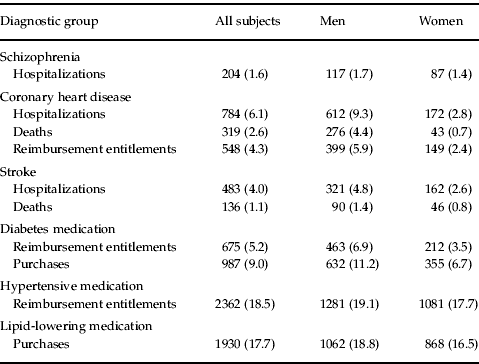
Table 1 shows the number and the percentage of subjects hospitalized or died with the different disorders and illnesses. It also shows the number and percentage of subjects with the different medication reimbursement entitlements and purchases. The final study group included 117 men and 87 women who were diagnosed with schizophrenia. A total of 86 men and 96 women had a diagnosis of only non-schizophrenic psychotic disorder and were excluded from further analyses. The median age at first hospitalization for schizophrenia was 35.3 years (s.d.=9.7), and 55.6 years (s.d.=7.9) for CHD and 56.0 years (s.d.=8.4) for stroke. For CHD and stroke deaths, the median ages were 54.6 (s.d.=7.9) and 55.8 (s.d.=8.2) years, respectively. Furthermore, the median ages at hypertension, diabetes and CHD medication reimbursement entitlements were 49.9 (s.d.=7.5), 53.3 (s.d.=9.5) and 55.0 (s.d.=5.2) years, respectively.
Breakdown of subjects with different diagnoses

Data are given as number of cases (% of subjects).
Men had more often died and been hospitalized for both CHD and stroke compared with women (all p values ⩽0.001). Men also had more reimbursement entitlements for CHD, diabetes and hypertension drugs and more medication purchases for diabetes and lipid-lowering drugs (all p values ⩽0.04). Subjects born in the earlier years had more often died from or been hospitalized for CHD and stroke, had more reimbursement entitlements for CHD and hypertension drugs, and they had more often bought lipid-lowering medication (all p values ⩽0.003). Subjects with a lower socio-economic position in childhood had a higher incidence of hospitalizations for and mortality from CHD, and more reimbursement entitlements for CHD, diabetes and hypertension drugs, and a higher percentage of them had bought diabetes medication (all p values ⩽0.003). On the other hand, hospitalization for schizophrenia was not associated with year of birth, sex or socio-economic position in childhood (all p values ⩾0.16).
Schizophrenia and chronic disease
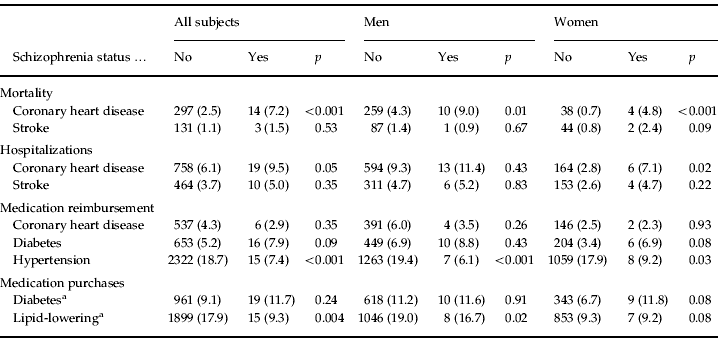
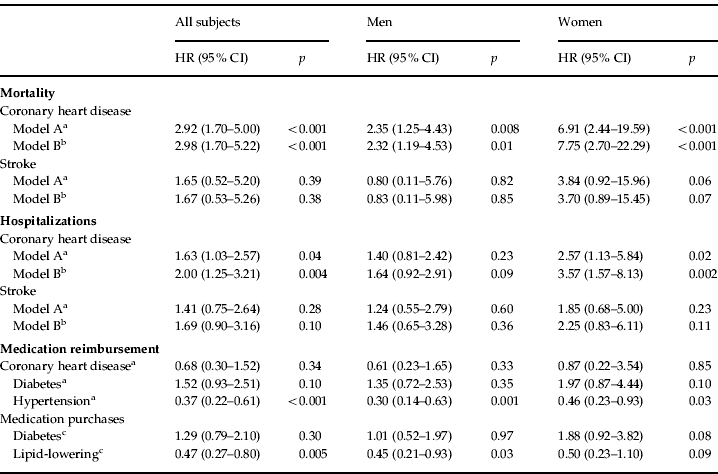
Table 2 shows the number and percentage of subjects with each somatic health outcome assessed in subjects with and without schizophrenia. Table 3 shows the results of the Cox proportional hazards models on the associations between schizophrenia and somatic health outcomes. Subjects hospitalized with a diagnosis of schizophrenia were at markedly increased risk of hospitalization and mortality for CHD. After adjusting for covariates, individuals with schizophrenia had a 2.9-fold mortality from CHD and a 1.6-fold risk of hospitalization for CHD. Both of these associations were stronger among women, who had a 6.9-fold mortality from CHD and a 2.6-fold risk of hospitalization for CHD, in comparison with the 2.4-fold and 1.4-fold risks found among men (the significance of the interaction between schizophrenia status and sex in predicting CHD risk: p=0.09 for mortality, p=0.23 for hospitalization). Among women, both mortality and hospitalization risks were significantly increased, whereas men with schizophrenia showed a significantly increased risk of mortality from CHD only. On the contrary, schizophrenia was not significantly associated with hospitalization for or mortality from stroke (Table 2), although, among women, the mortality risk was 3.8-fold, and marginally increased. Further analyses showed that none of these associations between schizophrenia and cardiovascular morbidity and mortality was age-specific; that is, the risks did not differ significantly between the younger and older age groups (all p values for differences in hazard ratios ⩾0.06).
Subjects with cardiovascular morbidity and mortality, and reimbursement entitlements and purchases of cardiovascular and diabetic medication among subjects with and without schizophrenia

Data are given as number (percentage) of subjects.
a Of subjects alive and in Finland in 1995, when the gathering of data for medication purchases started.
Associations between somatic health outcomes and schizophrenia

HR, Hazard ratio; CI, confidence interval.
Data are given as hazard ratio (95% confidence interval) for schizophrenia v. no schizophrenia, except for medication purchases, where data are given as odds ratio (95% confidence interval), since these data are from logistic regression analyses.
a Stratified for sex and year of birth and adjusted for socio-economic position in childhood.
b Stratified for sex and year of birth and adjusted for socio-economic position in childhood and lipid-lowering and antihypertensive medication usage.
c Odds ratios and 95% confidence intervals adjusted for sex, year of birth and socio-economic position in childhood.
On the other hand, patients with schizophrenia had significantly fewer reimbursement entitlements for hypertensive drugs and fewer medication purchases for lipid-lowering drugs (Table 2). Both men and women with schizophrenia had fewer reimbursement entitlements for hypertension. The association between lipid-lowering medication purchases and schizophrenia was significant among men and marginally significant among women. Medication reimbursement entitlements for CHD or diabetes and medication purchases for diabetes were not significantly associated with schizophrenia (Table 3).
To assess whether the lack of drug treatment explained the increased cardiovascular mortality among patients with schizophrenia, we re-ran the analysis of schizophrenia and CHD/stroke mortality adjusting for lipid-lowering medication purchases and hypertension reimbursement entitlement decisions (Table 3). These adjustments did not attenuate the associations found. Rather, schizophrenia was still a significant predictor of increased mortality from CHD in the whole sample, both among men and women, and a marginally significant predictor of increased mortality from stroke among women.
Discussion
In this register-based study where morbidity, mortality and quality of medical care were followed up for over three decades, we found that patients with schizophrenia had an increased risk of hospitalization for CHD and markedly increased mortality from CHD. While the increased risk of mortality from CHD characterized both women and men, the risk was particularly characteristic of women, who also had particularly increased morbidity for CHD and marginally significantly increased mortality from stroke. However, the patients with schizophrenia received less lipid-lowering and blood pressure medication. While morbidity for CHD was 1.6-fold higher and mortality from CHD was 2.9-fold higher among patients with schizophrenia, the use of antihypertensive drugs was only 0.37-fold and the use of statins 0.47-fold.
This longitudinal cohort study thus provides further evidence on increased morbidity and markedly increased mortality combined with lack of use of antihypertensive and lipid-lowering therapy among patients with schizophrenia. These findings are broadly comparable with the majority of previous research in suggesting that patients with schizophrenia have increased cardiovascular morbidity and markedly increased cardiovascular mortality but they receive poorer treatment for their somatic illnesses (Brown et al. Reference Brown, Kim, Mitchell and Inskip2010; Druss et al. Reference Druss, Bradford, Rosenheck, Radford and Krumholz2000, Reference Druss, Bradford, Rosenheck, Radford and Krumholz2001; Hippisley-Cox et al. 2009; Kisely et al. Reference Kisely, Campbell and Wang2009; Laursen et al. Reference Laursen, Munk-Olsen, Agerbo, Gasse and Mortensen2009; however, see Plomondon et al. Reference Plomondon, Ho, Wang, Greiner, Shore, Sakai, Fihn and Rumsfeld2007 for contradictory findings). We found that these associations hold also when the subjects are followed up for a longer time period than in the earlier studies, from ages 24–35 years onwards until ages 59–70 years.
However, our findings are in contrast to those of a US study (Druss et al. Reference Druss, Bradford, Rosenheck, Radford and Krumholz2001), in that here the effects of schizophrenia on mortality from CHD were not attenuated after adjusting for medication entitlements and/or purchases. The small numbers of patients with schizophrenia, the difference in the length of follow-up, and the difference between the adjusted treatment quality indicators (Druss et al. Reference Druss, Bradford, Rosenheck, Radford and Krumholz2001) may have contributed to the discrepancy of the findings. We are therefore very cautious in interpreting our results to suggest that the increased mortality from CHD in patients with schizophrenia could not be attributed to the lifetime presence or absence of antihypertensive or lipid-lowering treatment. However, our findings do tentatively suggest that in addition to the lack of treatment for dyslipidaemia and hypertension, the markedly increased mortality rates found here may perhaps also be affected by modifiable life-style factors such as obesity, smoking and physical inactivity, levels of which are known to be increased among patients with schizophrenia (McEvoy et al. Reference McEvoy, Meyer, Goff, Nasrallah, Davis, Sullivan, Meltzer, Hsiao, Scott Stroup and Lieberman2005; Kilbourne et al. Reference Kilbourne, Morden, Austin, Ilgen, McCarthy, Dalack and Blow2009; Brown et al. Reference Brown, Kim, Mitchell and Inskip2010; Wildgust & Beary, Reference Wildgust and Beary2010; Brown & Mitchell, Reference Brown and Mitchell2011; Kelly et al. Reference Kelly, McMahon, Wehring, Liu, Mackowick, Boggs, Warren, Feldman, Shim, Love and Dixon2011).
The associations between schizophrenia and hospitalization for and mortality from CHD were stronger among women. Furthermore, while schizophrenia did not associate with stroke morbidity or mortality among men, a marginally increased mortality rate from stroke emerged among women. Such findings indicating stronger associations between schizophrenia and cardiovascular disease among women correspond to those of McEvoy et al. (Reference McEvoy, Meyer, Goff, Nasrallah, Davis, Sullivan, Meltzer, Hsiao, Scott Stroup and Lieberman2005), who found increased rates of two cardiovascular risk factors, metabolic syndrome and abdominal obesity, especially among women with schizophrenia. However, the sex×schizophrenia status interactions in predicting cardiovascular morbidity and mortality were not significant here, and they were not significant either in a recent British long-term follow-up study (Brown et al. Reference Brown, Kim, Mitchell and Inskip2010). While no strong conclusions regarding the possible sex-specificity of the associations can be made, our findings indicate that the associations with cardiovascular mortality may be stronger among women, and further studies should assess the possible moderating role of sex in the associations between schizophrenia and cardiovascular disease more thoroughly.
A large Finnish study showed increased all-cause 11-year mortality among patients with schizophrenia (Tiihonen et al. Reference Tiihonen, Lönnqvist, Wahlbeck, Klaukka, Niskanen, Tanskanen and Haukka2009). Antipsychotic medication use played a modulating role, so that patients not using antipsychotics were at higher risk for all-cause mortality than subjects with antipsychotic medication purchases (Tiihonen et al. Reference Tiihonen, Lönnqvist, Wahlbeck, Klaukka, Niskanen, Tanskanen and Haukka2009). A recent study with similar findings among new schizophrenia patients (Tiihonen et al. Reference Tiihonen, Haukka, Taylor, Haddad, Patel and Korhonen2011) suggested that the findings indeed reflect the benefits of antipsychotic medication use on longevity rather than survival bias, as was suggested by Basu & Aggarwal (Reference Basu and Aggarwal2009). Further studies on cardiovascular morbidity, mortality and schizophrenia may thus also benefit from assessing antipsychotic medication treatment as a possible moderator.
The World Psychiatric Association has drawn up new guidelines on physical health in schizophrenia that highlight the health disparities and the importance of screening for physical co-morbidity (De Hert et al. 2011 a, b). The adoption of these guidelines should enhance physical health in schizophrenia. Our findings are consistent with these new guidelines in that there is now sufficient evidence to show that people with severe mental illness are less likely to receive standard levels of care for their physical co-morbidities. Moreover, the findings that patients with schizophrenia are less likely to be screened for physical co-morbidities (Morrato et al. Reference Morrato, Druss, Hartung, Valuck, Allen, Canpagna and Newcomer2010; Mitchell et al. Reference Mitchell, Delaffon, Vancampfort, Correll and De Hert2012) highlight the importance of developing effective screening programmes to identify these co-morbidities and then to manage them appropriately (De Hert et al. 2011 a). Further, although there is some evidence suggesting that statins show similar health benefits among patients with schizophrenia than in the general population (De Hert et al. Reference De Hert, Kalnicka, van Winkel, Wampers, Hanssens, Van Eyck, Scheen and Peuskens2006), there is a need for further studies to monitor the impact of physical health treatments in schizophrenia. Their effectiveness is largely assumed to be the same as in the general population, yet we know that this population has high rates of smoking and drug and alcohol abuse (e.g. Kelly et al. Reference Kelly, McMahon, Wehring, Liu, Mackowick, Boggs, Warren, Feldman, Shim, Love and Dixon2011). The latest World Psychiatric Association guidelines do not address whether and how drug and alcohol abuse make an impact on physical health monitoring or its management among schizophrenia patients. This would be an important issue for future research.
The autopsy rates in Finland are one of the highest in the world (Nomesco, 2010), which implies that determination of causes of death can be considered reliable. The strengths of this study also include the large, population-based sample and the longer follow-up period than in previous studies. Furthermore, the diagnoses relevant for the current study in the Hospital Discharge Register and the Causes of Death Register are well validated (Mähönen et al. Reference Mähönen, Salomaa, Brommels, Molarius, Miettinen, Pyörälä, Tuomilehto, Arstila, Kaarsalo, Ketonen, Kuulasmaa, Lehto, Mustaniemi, Niemelä, Palomäki, Torppa and Vuorenmaa1997; Mäkikyrö et al. Reference Mäkikyrö, Isohanni, Moring, Hakko, Hovatta and Lönnqvist1998; Leppälä et al. Reference Leppälä, Virtamo and Heinonen1999; Kieseppä et al. Reference Kieseppä, Partonen, Kaprio and Lönnqvist2000; Pajunen et al. Reference Pajunen, Koukkunen, Ketonen, Jerkkola, Immonen-Räihä, Kärjä-Koskenkari, Mähönen, Niemelä, Kuulasmaa, Palomäki, Mustonen, Lehtonen, Arstila, Vuorenmaa, Lehto, Miettinen, Torppa, Tuomilehto, Kesäniemi, Pyörälä and Salomaa2005; Perälä et al. Reference Perälä, Suvisaari, Saarni, Kuoppasalmi, Isometsä, Pirkola, Partonen, Tuulio-Henriksson, Hintikka, Kieseppä, Härkänen, Koskinen and Lönnqvist2007; Tolonen et al. Reference Tolonen, Salomaa, Torppa, Sivenius, Immonen-Räihä and Lehtonen2007; Pihlajamaa et al. Reference Pihlajamaa, Suvisaari, Henriksson, Heilä, Karjalainen, Koskela, Cannon and Lönnqvist2008). However, there are also limitations to the current study. Although the overall sample comprises over 12 900 subjects, the number of patients in the diagnostic categories is rather low. The findings need to be replicated in further studies in larger samples that follow-up schizophrenia patients. Furthermore, this study recorded the use of medication in prescriptions filled in out-patient care. Hence, those patients who have been hospitalized during the whole follow-up period (from 1969 to 2002 or until their deaths) have not been recorded as medication users (because they obtained their medication in the hospital only). However, there were only two such cases, and they were omitted from the statistical analysis.
In conclusion, the results of our longitudinal study suggest that patients with schizophrenia have increased hospitalization rates and markedly increased mortality from CHD. Morbidity and mortality rates are particularly elevated among women. Patients with schizophrenia also show lack of adequate treatment of hypertension and dyslipidaemia.
Acknowledgements
We thank Ms Aija Räsänen for excellent secretarial assistance. This work was supported by grants from the Annual EVO Financing (special government subsidies from the Ministry of Health and Welfare, Finland); the National Doctoral Programme of Psychology; Emil Aaltonen Foundation, Helsinki University Research Funds; the Academy of Finland (grants no. 140278, 135132, 129911 and 129457); the Ministry of Culture and Education; the British Heart Foundation; the Finnish Foundation for Cardiovascular Research; the Finnish Diabetes Research Foundation; the Finnish Medical Society (Duodecim); Finska Läkaresällskapet; the European Science Foundation (EuroSTRESS) (grant no. 129911); Samfundet Folkhälsan; the Päivikki and Sakari Sohlberg Foundation; Juho Vainio Foundation; Yrjö Jahnsson Foundation; Signe and Ane Gyllenberg Foundation; Sigrid Juselius Foundation; Jalmari and Rauha Ahokas Foundation; and the Finnish Foundation for Pediatric Research. The funders were not involved in the conduct of the study or in the collection, management, analysis or interpretation of the data.
Declaration of Interest
J.T. has served as a consultant to Lundbeck, Organon, Janssen-Cilag, Eli Lilly, AstraZeneca, F. Hoffman-La Roche and Bristol-Myers Squibb, has received fees for giving expert opinion to Bristol-Myers Squibb and GlaxoSmithKline, and has received lecture fees from Janssen-Cilag, Bristol Myers-Squibb, Eli Lilly, Pfizer, Lundbeck, GlaxoSmithKline, Novartis and Astra Zeneca. H.W. has undertaken consultancy work for Eli Lilly and Co Ltd. J.E. has served as a consultant and/or lecturer for Eli Lilly, AstraZeneca, F. Hoffman-La Roche, Novo Nordisk, Novartis, Pfizer, MSD and Bristol-Myers Squibb. M.B. has given lectures for and received hospitality from Eli Lilly. R.H. has received research funding and educational assistance from a number of pharmaceutical companies.