Introduction
In keeping with global concerns about the impacts of non-indigenous species (NIS), the management of these species has been given high priority in the Antarctic region. Many sub-Antarctic islands enjoy a high conservation status (de Villiers et al. Reference De Villiers, Cooper, Carmichael, Glass, Liddle, Mcivor, Micol and Roberts2006) and have management plans in place which seek to reduce the number of NIS introductions. They do so by limiting the number of visits per season, the number of visitors permitted ashore at one time, where those visitors land and how long they may spend ashore, and often specify procedures for decontamination prior to shore transfers. In the area south of 60°S, conservation of biodiversity is undertaken by the Antarctic Treaty Consultative Parties under the auspices of the Committee for Environmental Protection (CEP). The conservation significance of NIS introductions has been raised numerous times at meetings of the CEP and, in consequence, preventing non-native species introductions has become one of the CEP's highest priorities (Rogan-Finnemore Reference Rogan-Finnemore2008).
The political impetus to achieve practicable management interventions to reduce the risk of NIS has led to several studies which have investigated pathways of introduction into the region in both the terrestrial (Whinam et al. Reference Whinam, Chilcott and Bergstrom2005, Lee & Chown Reference Lee and Chown2009a, Reference Lee and Chown2009b, Hughes et al. Reference Hughes, Convey, Maslen and Smith2010) and marine realms (Barnes Reference Barnes2002, Barnes & Fraser Reference Barnes and Fraser2003, Lewis et al. Reference Lewis, Hewitt, Riddle and McMinn2003, Reference Lewis, Bergstrom and Whinam2006, Lee & Chown Reference Lee and Chown2007, Reference Lee and Chown2009c). In the terrestrial realm several clear patterns are now emerging as to which pathways pose the greatest risk. For example, for expeditioners, socks, bags and over-trousers typically harbour considerable numbers of seeds and for national science programmes clothing issued by national operators contain fewer seeds than clothing which belongs to individual expeditioners (Lee & Chown Reference Lee and Chown2009a).
To date, most studies have examined inter-continental scale propagule pathways (i.e. from other regions into the Antarctic). However, the movement of species between different regions of the Antarctic is a growing concern (Hughes & Convey Reference Hughes and Convey2010). Passenger ships and expeditions often travel between islands to visit different sites of historical or wildlife interest and such visitation patterns have the potential to transfer species between islands within the same broad biogeographic domain (Frenot et al. Reference Frenot, Chown, Whinam, Selkirk, Convey, Skotnicki and Bergstrom2005). Biota which have already successfully established in, or are indigenous to the Antarctic possess the physiological pre-adaptations and life cycles that are necessary to survive there and are therefore likely to be able to survive in another region with similar abiotic characteristics. Indeed, similarity in climate is a major factor thought to ease introductions and is typically included in risk assessments for the introduction of species (Pheloung et al. Reference Pheloung, Williams and Halloy1999, Duncan et al. Reference Duncan, Blackburn and Sol2003, Richardson & Pyšek Reference Richardson and Pyšek2006). Thus intra-regional transfer pathways probably present a greater establishment risk than inter-regional transfer pathways because the species transported have a higher probability of survival and establishment than species transported from outside of the region. Pre-adapted organisms are well established in some areas of the sub-Antarctic. Some highly invaded islands such as Kerguelen are potential source pools (111 recorded NIS; Frenot et al. Reference Frenot, Chown, Whinam, Selkirk, Convey, Skotnicki and Bergstrom2005) whilst others which have few or no NIS such as Bouvetøya (that has no recorded NIS) are potential sinks. Substantial risks of transfer exist if logistics operations (tourist or science) operate between these regions, as is the case for tourism in the New Zealand sector and operations among the îles Crozet and Kerguelen by the French, and the Prince Edward Islands and Tristan da Cunha archipelago by the South Africans. Indeed, it is thought that the invasive Sagina procumbens L., the subject of a costly eradication programme on Gough Island, may well have reached the island by transfer of cargo containers from Marion Island (Jones et al. Reference Jones, Chown, Ryan, Gremmen and Gaston2003).
Both indigenous and non-indigenous species could be carried by expeditioners between isolated localities and therefore a more subtle consequence of intra-regional propagule movements is homogenisation at the genetic level. In contrast to introduced species which typically have extremely low genetic diversity (e.g. Kliber & Eckert Reference Kliber and Eckert2005, Lee et al. Reference Lee, Janion, Marais, van Vuuren and Chown2009, Vogel et al. Reference Vogel, Pedersen, Giraud, Krieger and Keller2010), many indigenous populations in the Antarctic exist on remote islands, separated from other ice-free habitats either by ocean or ice and preliminary data indicates that there can be substantial genetic variation between these populations (Fanciulli et al. Reference Fanciulli, Summa, Dallai and Frati2001, Stevens & Hogg Reference Stevens and Hogg2003, Myburgh et al. 2007, Van de Wouw et al. Reference Van De Wouw, van Dijk and Huiskes2008). Whilst these populations remain isolated, genetic diversity will be maintained. However, field parties are now able to travel between once isolated islands and if propagules are inadvertently transported between sites the genetic integrity of isolated populations would be lost.
As the numbers of visitors to the Antarctic region continue to increase (Frenot et al. Reference Frenot, Chown, Whinam, Selkirk, Convey, Skotnicki and Bergstrom2005, Hughes & Convey Reference Hughes and Convey2010) and research vessels and tour ships actively travel between geographically discrete locations within the region, it is essential that some measure of the potential for NIS movements between regions of the Antarctic is made so that appropriate advice on mitigation measures can be given. Here we present data on the propagule loads carried by expeditioners (scientists and logistic support personnel who have been working on sub-Antarctic Marion Island). Category of visitor (field- or station-based) and the types of clothing that carry the greatest number of propagules after being used in the Antarctic are identified.
Material and methods
Each year approximately sixty expeditioners visit sub-Antarctic Marion Island. Of these, approximately fifteen stay for the year and forty-five for the short relief period. Over the last eight years there have also been a number of additional voyages transporting personnel employed in the construction of the new station, increasing the island's population to between c.100–150 for portions of the year. Those who visit the island can be classified as either field-based (typically scientists or technicians who spend the majority of their time working across the island at field sites) or station-based (typically personnel who spend the majority of their time in the immediate area surrounding the research station) (Lee & Chown Reference Lee and Chown2009a).
The annual relief voyage to the island takes place between April and May each year and is of approximately five weeks duration. In accordance with the Prince Edward Islands Management Plan (Anonymous 1996) on the voyage from Cape Town to Marion Island every shore-going passenger takes part in a compulsory decontamination procedure whereby all field clothing is inspected and propagules removed ensuring that NIS are not introduced to the island with expeditioner clothing (de Villiers & Cooper Reference De Villiers and Cooper2008). In May 2006 and May 2007 we repeated this procedure on the return voyage to quantify the abundance of propagules on expeditioner clothing following a typical field season and which, in the absence of biosecurity interventions, could be transferred to other islands.
On each voyage, ten field-based and five station-based personnel were randomly selected from a passenger list and asked to submit their field work clothing for inspection. Typically this included: a pair of waterproof over-trousers, waterproof jacket, polar fleece, woolly hat, gloves, socks, bags and footwear. For each item of clothing a nylon mesh filter was fitted between the crevice nozzle and the succession pipe of a vacuum cleaner (Philips, Performer Animal Care or Electrolux Ultima 1700 watt). Each item was then methodically searched using the crevice nozzle of the vacuum cleaner and all material collected was stored at room temperature until it could be sorted and identified. All seeds were identified to the species level using reference material from herbarium specimens (see also Lee & Chown Reference Lee and Chown2009a).
Generalized linear models (GLMs) were implemented using the glm function in the stats library in R2.11.1 (R Development Core Team 2010) first to compare seed load between different items of field clothing and second, for items of clothing where seeds were found, to compare richness of seeds found between items and passenger type. In the first GLM, number of seeds per item was the response variable and year of sampling, item, and whether the passenger was field- or station-based were used as categorical predictors. The best-fit model was identified using the Akaike Information Criterion (AIC) and Akaike weights (Johnson & Omland Reference Johnson and Omland2004). In the second GLM predictors from the best-fit model in the first GLM were used i.e. number of species per item was the response variable and item and whether the passenger was field- or station-based were used as categorical predictors. For both models a Poisson distribution with a log-link function were used.
Results
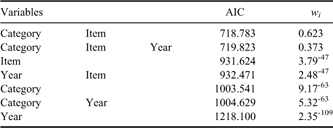
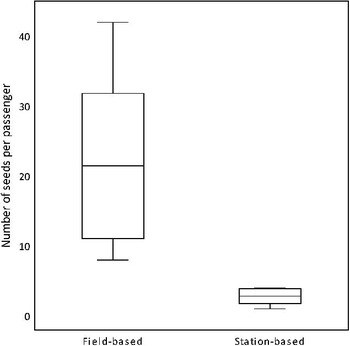
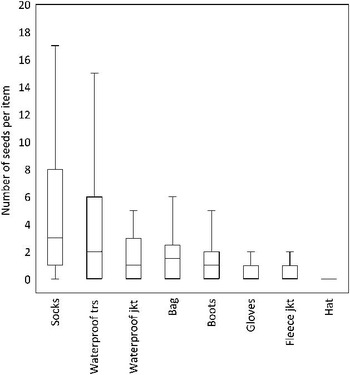
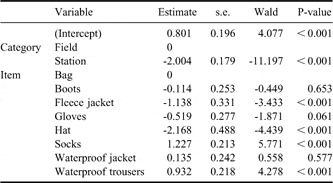
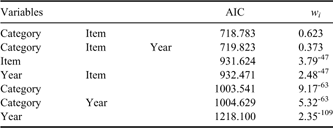
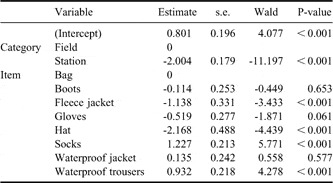
In total 420 seeds were collected from 225 items of clothing. Seeds were found on 52% of items surveyed and soil was collected from 45% of items. The median number of seeds per passenger was 20.5 (Q25 = 12, Q75 = 30) for field-based personnel and 3 (Q25 = 2, Q75 = 4) for station-based personnel. The best fit model describing the number of seeds found in clothing items included terms for item and whether the passenger was field- or station-based (AIC = 718.783, wi = 0.623, see Table I for AIC values and weight for all models). Station-based personnel carried significantly fewer propagules in their clothing than field-based personnel (χ2 = 214.840, df = 1, P < 0.001) (Fig. 1). Item also had a significant effect on number of propagules (χ2 = 297.599, df = 7, P < 0.001) with socks (Wald = 5.771, P < 0.001) and waterproof trousers (Wald = 4.278, P < 0.001) containing the most seeds, and fleece jackets (Wald = -3.433, P < 0.001) and hats (Wald = -4.439, P < 0.001) the least (Fig. 2) (see Table II for all coefficients).
Akaike Information Criterion and Akaike weights for Generalized Linear Models describing the number of seeds found in clothing (assuming a Poisson distribution, using a log link function).
Boxplot showing median (25–75%) and non-outlier range of number of seeds found per passenger for field-based and station-based personnel.

Boxplot showing median (25–75%) and non-outlier range of number of seeds found for different categories of field clothing.

Outcome of the best fit Generalized Linear Model (assuming a Poisson distribution, using a log link function) describing the number of seeds found in clothing.
The number of different species found on a single item of clothing ranged from one to four. Clothing items from station-based personnel contained a lower richness of seeds than clothing items from field-based personnel (χ2 = 10.975, df = 1, P < 0.001). However, seed richness did not differ significantly among items (χ2 = 10.550, df = 7, P = 0.159).
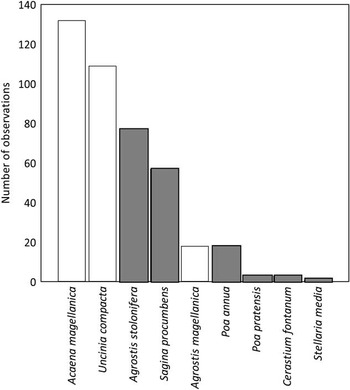
Representatives from nine of Marion Island's thirty-seven established vascular plant species were present amongst samples (Fig. 3) (Gremmen & Smith Reference Gremmen and Smith2008). The most common seeds, together representing 57% of the total sample, were from two indigenous species, Acaena magellanica (Lam.) Vahl. and Uncinia compacta R. Br., which both have seeds adapted for zoochory. The remaining 43% of seeds had no specific adaptations for zoochory and came from seven species, six of which were non-indigenous. Indeed, 37% of all seeds found on clothing were from non-indigenous species, the most abundant of which was the grass Agrostis stolonifera L. which is widespread on the island (Gremmen et al. Reference Gremmen, Chown and Marshall1998).
Frequency of the total number of seeds of vascular plant species collected during clothing surveys. Open bars represent indigenous species, closed bars represent non-indigenous species.

Discussion
Approximately 4000 national Antarctic programme science and support personnel (COMNAP https://www.comnap.aq/facilities, accessed 2009) and 30 000 tourists now land in Antarctica each year (IAATO http://www.iaato.org/tourism_stats.html, accessed 2009). Each visitor has the potential to carry propagules from their port of departure into the Antarctic. Moreover, each visitor that moves between sites within the Antarctic has the potential to transport propagules between areas within the region. Many operators implement stringent pre-arrival biosecurity procedures to limit the introduction of NIS from temperate regions into the Antarctic (de Villiers et al. Reference De Villiers, Cooper, Carmichael, Glass, Liddle, Mcivor, Micol and Roberts2006, Mansfield & Gilbert Reference Mansfield and Gilbert2008) and biosecurity policies have doubtless reduced propagule pressure and NIS establishment. By contrast, although the theoretical risk of intra-regional transfer has been acknowledged for some time, biosecurity interventions for visitors travelling between locations in the Antarctic are often lacking (Hughes & Convey Reference Hughes and Convey2010). Our results clearly demonstrate that expeditioners have the potential to transfer the seeds of vascular plants between regions within the Antarctic and thus provide the first empirical evidence for the urgent need for the development of effective intra-regional biosecurity measures to mitigate this threat. Whilst the study focuses on vascular plant seeds as an exemplar group, and the number of vascular plants on the Antarctic continent is known to be small (Frenot et al. Reference Frenot, Chown, Whinam, Selkirk, Convey, Skotnicki and Bergstrom2005), two reasons exist to consider the implications of our work more general. First, the number of sites at which alien vascular plants are establishing along the peninsula and Scotia Arc islands is increasing (Chwedorzewska Reference Chwedorzewska2008, Smith & Richardson Reference Smith and Richardson2011). Second, microbial species might be similarly or more easily entrained along with soil, as was found on many of the items here (see also Hughes et al. Reference Hughes, Convey, Maslen and Smith2010).
In the case of the Prince Edward Islands, the risk of propagule transfer between the two islands is substantial as Marion Island harbours eighteen non-indigenous vascular plant species, while Prince Edward Island only has three (Gremmen & Smith Reference Gremmen and Smith2008). This risk was recognised by the islands management committee who imposed a total ban of personnel moving directly from Marion Island to Prince Edward Island. However, in the Antarctic Peninsula and Scotia Arc islands, where levels of visitation are some of the highest in the region, different islands fall under different jurisdictions and management. Whilst restriction of movement is possible in a national area, such as South Georgia, it is not possible in areas subject to the Antarctic Treaty. Therefore implementation of effective biosecurity procedures, such as gear cleaning, is generally the only logistically feasible approach.
At within-island scales, the movement of NIS by expeditioners can also have considerable ecological implications. On Southern Ocean islands, populations of NIS commonly establish around research stations, where all cargo and expeditioners are initially offloaded (Bergstrom & Smith Reference Bergstrom and Smith1990, Gremmen & Smith Reference Gremmen and Smith1999). Once a founder population is established, the NIS may further its distribution by natural means such as wind or animal dispersal or in some cases by human movements. Expeditioners travelling from highly invaded areas surrounding research stations to remote field sites may inadvertently facilitate rapid range expansion and jump dispersal, substantially increasing the rate of spread of NIS on a within-island scale. Jump dispersal is thought to have played a major role in the spread of alien species in the region both at an inter-island and intra-island scale (Frenot et al. Reference Frenot, Gloaguen, Masse and Lebouvier2001, Ryan et al. Reference Ryan, Smith and Gremmen2003, Lee et al. Reference Lee, Janion, Marais, van Vuuren and Chown2009).
Although the numbers of seeds carried by expeditioners is considerable, the taxonomic diversity of those species is relatively small. A similar suite of NIS was found on passengers arriving at (see Lee & Chown Reference Lee and Chown2009a for complete list of species found) and departing from the island. This suggests that commonly encountered species are more commonly transported. Indeed, the most commonly entrained non-indigenous species Agrostis stolonifera, Poa annua L. and Sagina procumbens, are ubiquitous at the port of departure (J. Lee personal observation) and are also widespread in the area surrounding the research station on Marion Island (Gremmen Reference Gremmen1975). More generally, three of the six NIS entrained in clothing were from the family Poaceae and included Poa annua which is the one of only two non-indigenous vascular plant species known to have established in the Antarctic Peninsula region (Frenot et al. Reference Frenot, Chown, Whinam, Selkirk, Convey, Skotnicki and Bergstrom2005, Chwedorzewska Reference Chwedorzewska2008). The prevalence of propagules from the family Poaceae reflects not only a family which is known to contain considerable numbers of invasives worldwide (Pyšek Reference Pyšek1998), but also contains 37 of the 108 species known to have been introduced to the Antarctic region (Frenot et al. Reference Frenot, Chown, Whinam, Selkirk, Convey, Skotnicki and Bergstrom2005).
On a practical level, the mitigation of intra-regional propagule movements follows the same principles as mitigation measures aimed to reduce inter-regional movements. Low cost measures including the inspection and cleaning of high-risk items such as socks and waterproof outer clothing of those who have spent substantial amounts of time in the field and ensuring that organisms which have been collected for scientific experiments in one area are not released into another area would substantially reduce the risk of intra-regional transfer. As transits between regions are typically via ship enough time is available for such gear inspections and cleaning (Whinam et al. Reference Whinam, Chilcott and Bergstrom2005, de Villiers & Cooper Reference De Villiers and Cooper2008). Perhaps the greatest challenge for managers seeking to reduce the threat of intra-regional propagule movements is to identify what is an effective spatial scale over which to implement biosecurity procedures. For practical purposes it is often national boundaries which delimit the extent of management interventions, with the majority of interventions taking place between islands or between stations operated by different nationalities. However, in cases where habitats are discontinuous (such as islands within an archipelago or individual nunataks in a mountain range) smaller management units may be required to prevent the movement of species between geographically isolated regions which have substantially different biodiversity within the same national boundary. In the Antarctic this may be especially important given increasing evidence of cryptic species and substantially differentiated populations (Myburgh et al. Reference Myburgh, Chown, Daniels and van Vuuren2007, McGaughran et al. Reference McGaughran, Torricelli, Carapelli, Frati, Stevens, Convey and Hogg2010, Torricelli et al. Reference Torricelli, Carapelli, Convey, Nardi, Boore and Frati2010, Mortimer et al. Reference Mortimer, Jansen van Vuuren, Lee, Marshall, Convey and Chown2011).
Acknowledgements
The South African national Antarctic Programme is thanked for logistic support. Peter le Roux, Anne Treasure and two anonymous reviewers provided helpful comments on a draft version of the ms.