INTRODUCTION
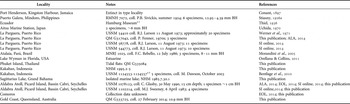
Tripedalia cystophora Conant, Reference Conant1897 is a small box jellyfish from the family Tripedaliidae, commonly known as the Caribbean box jellyfish. It was originally described in Jamaica (Conant, Reference Conant1897) where it was reported to exist in great abundance in summer (Mayer, Reference Mayer1910). It has since been recorded from other parts of the world (Table 1), suggesting a broad pan-tropical distribution (Kingsford & Mooney, Reference Kingsford, Mooney, Pitt and Lucas2014).
Known distribution for Tripedalia cystophora. Atlas of Living Australia (ALA); bell height (BH); Encyclopaedia of Life (EOL); The Natural History Museum (NHM); Rijksmuseum van Natuurlijke Historie, Leiden (RMNH); Smithsonian Institution (SI); Smithsonian National Museum of Natural History (USNM).

*1, search at Hamburg Museum could not locate any of these specimens from Ecuador, only specimens from Puerto Rico collected in 1971; *2, these specimens were incorrectly listed in Bentlage et al., Reference Bentlage, Cartwright, Yanagihara, Lewis, Richards and Collins2010 as USNM 1124454 and 1124457.
Curiously, however, it has not been previously found in Australian waters. Stiasny (Reference Stiasny1926a) recorded it from the northern Pacific in the Philippines, but tellingly did not report it in Australia (Stiasny Reference Stiasny1926b). In fact other Australian researchers did not notice it (Moore, Reference Moore1988 in the Northern Territory; Yamaguchi & Hartwick, Reference Yamaguchi, Hartwick, Tardent and Tardent1980; Hartwick, Reference Hartwick1991 in Tropical Queensland; Gershwin, Reference Gershwin2005 across northern Australia; Kingsford et al., Reference Kingsford, Seymour and O'Callaghan2012 in the Great Barrier Reef; Underwood et al., Reference Underwood, Taylor and Seymour2013 from numerous localities in Queensland).
The most recent record from the literature is from the estuarine Lake Wyman in Florida, USA (Orellana & Collins, Reference Orellana and Collins2011). The Gold Coast latitude of 28 degrees south is subtropical bordering on temperate, suggesting it is either increasing its range due to increased resilience or warming sea temperatures, or it was carried to higher latitudes than desirable southwards on the East Australian Current. Either way, one would have suspected unless it was transported via international shipping ballast water, that it would have been noticed in tropical Northern Australia first.
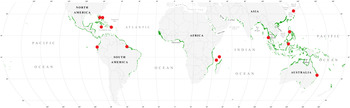
Tripedalia cystophora is common and widely distributed throughout the tropics of the world (with the exception of a single record from Japan decades ago) (Figure 1; Table 1). It therefore seems interesting that this species has recently been reported in the non-tropical habitats of the continental USA (Orellana & Collins, Reference Orellana and Collins2011), and now Australia. The purpose of this paper is to report on the presence of Tripedalia cystophora in Australia for the first time, as well as several other previously unreported tropical occurrences of this species from Thailand, Indonesia, Bahamas, Puerto Rico, Comoros and Seychelles.
Distribution map for Tripedalia cystophora based on records including this publication from around the world (red dots) superimposed on mangrove distributions of the world in green (Giri et al., Reference Giri, Ochieng, Tieszen, Zhu, Singh, Loveland, Masek and Duke2011).

MATERIALS AND METHODS
All taxonomic observations, digital photographs, and measurements were made on living and preserved material under a dissecting microscope, with the exception of the swimming photograph which was taken with a Canon 7D with 18–55 mm lens (Canon Australia Pty Ltd.). Microscope photographs were taken with a Tuscen TSC 5.0 camera (Xintu Photonics Co., Ltd.) mounted on an Olympus SZ60 dissecting microscope. All photographs in this paper are of the specimen lodged at the Queensland Museum registered as QM G333725. Measurements were made with digital callipers to the nearest 0.01 mm. Bell height (BH) was measured from the apex of the bell to the velarial turnover. Diagonal bell width (DBW) was measured across diagonally opposite pedalia on a flattened specimen, at the height of the pedalial lamella. Interrhopalial width (IRW) was measured between adjacent rhopalia, with the specimen flattened, at the root of the rhopalial stalk. Tentacle base width (TBW) was measured across the widest diameter at the uppermost part of the tentacle, immediately below the pedalium. Sex was determined by biopsy.
Abbreviations used: Queensland Museum (QM); Natural History Museum (NHM); Rijksmuseum van Natuurlijke Historie, Leiden (RMNH); and Smithsonian National Museum of Natural History (USNM).
RESULTS
SYSTEMATICS
Phylum CNIDARIA Verrill, 1865
Class CUBOZOA Werner, Reference Werner1973
Order CARYBDEIDA Lesson, 1843
Family TRIPEDALIIDAE Conant, Reference Conant1897
Genus Tripedalia Conant, Reference Conant1897
Tripedalia cystophora Conant, Reference Conant1897
MATERIAL EXAMINED
The original and subsequent descriptions of this species did not refer to type material. Searches of collections where material would have logically been deposited including the Natural History Museum, the Hamburg Museum and the Smithsonian National Museum of Natural History were unfruitful. We therefore assume that no type material exists. Unfortunately, the type population at Kingston Harbour, Jamaica, has been locally extinct for many years due to development (R.J. Larson, personal communication 2000).
NEW RECORDS
Australia: QM G333725. On the 27 January 2014, a single female individual was found in the Gold Coast Canals, Queensland, Australia (28°3′18.09″S 153°25′32.138″E). This location was 17 km via the canal network from the ocean and approximately 1.5 km from the nearest mangroves. The jellyfish was observed in a canal, where a member of the public, Ian Hulme mistook it for some floating plastic rubbish and only once he had scooped it into an empty glass did he realize it was a box jellyfish.
Puerto Rico: QM G317042 from La Parguera, Puerto Rico collected by R. J. Larson and forwarded to Peter Fenner, collection date unknown (suspected 1970s). This consists of three separate specimens (two females and one male with bell diameters of 9.1, 9.8 and 10.0 mm, respectively). Absolute bell heights 5.8, 7.9 and 6.2 mm. Bell heights to rhopalial niche 4.11 and 5.84 mm.
Thailand: QM G335084 from the tidal flats of Phuket Island, Thailand. Collected 28 March 2009 by L. Gershwin, S. Bussarawit, K. Moss and A. Jones, in reed fish traps on a falling tide; hundreds of specimens collected.
Indonesia: NHM 1995.2-5 60 km off north-east coast of Borneo, in a former lagoon of an uplifted atoll named Kakaban, East Kalimantan, Indonesia, 29 September 1993, coll. T. Tomascik; 4 specimens, 4–6 mm BH.
Bahamas: NHM 1985.7.30.1 Sagittarius Lake, Grand Bahama, isolated marine lake; 7 July 1984, coll. Sarah Cunliffe (shoaling in shallows, relatively strong swimming movements and evasive tactics; no detectable sting); gravid female, 9.71 mm BH, 11.98 mm DBW, 5.33 mm IRW, 7.49 mm rhopalial-apex.
MORPHOLOGY
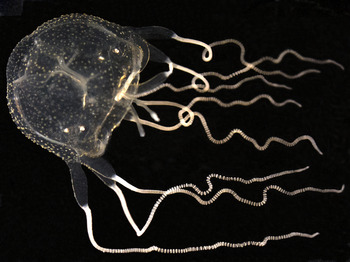
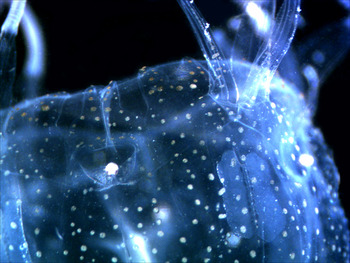
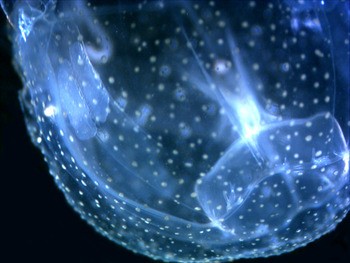
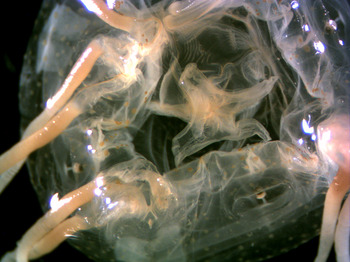
All examined specimens showed the following characteristics which place them undoubtedly as Tripedalia cystophora, matching the published descriptions (Conant, Reference Conant1897; Mayer, Reference Mayer1910; Kramp, Reference Kramp1961; Williamson et al., Reference Williamson, Fenner, Burnett and Rifkin1996; Gershwin, Reference Gershwin2005; Orellana & Collins, Reference Orellana and Collins2011). There are three pedalia in each of the four interradial corners of the bell, each with single tentacle (Figure 2). The Australian specimen has a cubical bell with rounded edges, total bell height 10.9 mm, niche bell height 8.16 mm, bell width 12.8 mm, inter-pedalial distance 6.8 mm. The pedalia are flattened and approximately half the bell height. The tentacles when preserved and contracted were only 10 mm, but alive the tentacles were at least twice the bell height in length (Figure 2). The velarium had 6 triangular velarial canals per quadrant, with the inner pair, closest to the rhopalia having a more acute triangle than the others (Figure 3). The bell is randomly covered with nematocyst warts (Figures 2, 3 & 4), and the tentacles have bands of nematocysts (Figure 2). The bell has four rhopalial niches containing light sensing organs, each bearing two median lensed eyes and four lateral eye spots, plus a large crystalline statolith. The manubrium extends midway down the centre of the bell and is cruciform in cross-section when contracted; the lips are relatively long triangles (Figures 2 & 5).
Live photograph of Tripedalia cystophora specimen QM G333725 swimming showing the pedalia and bands of nematocysts (bell height 10.9 mm).

Live photograph of Tripedalia cystophora specimen QM G333725 showing the pedalia detail, bell nematocysts, velarial canals, rhopalia and beginning of gonads (bell width 12.8 mm).

Live photograph of Tripedalia cystophora specimen QM G333725 through the bell showing the uncontracted manubrium and gonads.

Tripedalia cystophora specimen QM G333725 preserved velarium, manubrium and interior of bell (bell width 12.8 mm).

The specimen had paired sets of gonads (Figures 3 & 4) (Werner, Reference Werner1973) on each corner, indicating it was on the way to sexual maturity. The presence of eggs indicates it was a female; however it did lack visible spermatophores as has been seen in other specimens (Orellana & Collins, Reference Orellana and Collins2011; Straehler-Pohl et al., Reference Straehler-Pohl, Garm and Morandini2014).
DISCUSSION
Box jellyfish in the order Carybdeida typically display a single pedalium, each with a single tentacle, on each corner of the box-shaped body. However the genus Tripedalia has multiple pedalia on each corner. The genus is typified by T. cystophora which has four groups of three pedalia on each corner of the ‘box’, with each of the three unbranched pedalia on each corner giving rise to a single tentacle (Kramp, Reference Kramp1961). The second species in the genus (T. binata) as the name suggests has two pedalia on each corner, each giving rise to one tentacle. Thus T. binata has a total of eight tentacles.
Tripedalia cystophora was the first cubomedusa to have a full life cycle known (Werner et al., Reference Werner, Cutress and Studebaker1971) and is a cubozoan with a well-developed visual system, enabling it excellent control of its direction of travel (Petie et al., Reference Petie, Garm and Nilsson2011). It is actively phototactic and spends the daylight hours close to the surface amongst mangrove roots hunting copepods, but at night time they sink to the muddy bottom of the mangrove lagoon (Garm et al., Reference Garm, Bielecki, Petrie and Nilsson2012). They are excellent navigators using visual clues through the surface of the water to navigate back to the mangroves when washed out (Garm et al., Reference Garm, Oskarsson and Nilsson2011).
Tripedalia cystophora is well known to occur in mangrove habitats. It was found in the Gold Coast Canals, many kilometres from the sea and a few kilometres from the nearest mangrove. They are excellent swimmers (Garm et al., Reference Garm, O'Connor, Parkefelt and Nilsson2007) and it will be interesting to see if they become more readily reported just in mangroves or in easily spotted canals such as the Gold Coast waterways.
Tripedalia binata was described relatively recently from Northern Australia and India (Moore, Reference Moore1988), and has since been found further south in Queensland (Underwood et al., Reference Underwood, Taylor and Seymour2013). The lack of any observations of T. cystophora indicates that it must have been a recent introduction as it would likely have been previously noticed as many researchers have looked in Northern Australia before (Moore, Reference Moore1988; Underwood et al., Reference Underwood, Taylor and Seymour2013; personal communications with numerous other researchers).
It is likely that the recorded sightings and suspected distributions of these medusae are always less than the true extent, as their small size, transparent bell and preferred habitat of mangroves make them difficult to detect, despite their coastal, shallow water habitat.
Whether this first single occurrence is the result of a single introduction possibly in the ballast water from the Caribbean or elsewhere, or is the start of a pelagic movement of these box jellyfish to new waters, remains to be seen, indeed it may be part of a larger now resident population.
ACKNOWLEDGEMENTS
We gratefully acknowledge the assistance of people and organizations that were involved in collecting and forwarding the specimens to us, in particular Ian Hulme who discovered it in the Gold Coast Canals. We also thank Allen Collins and Andres Schmidt-Rhaesa for their help in locating specimens.