Introduction
Fruit flies (Diptera: Tephritidae) are among the most important pests worldwide because of their direct economic impact and the strict quarantine restrictions imposed by many countries to prevent their incursion. Fruit flies constitute a major threat to horticulture in Africa and cause extensive economic losses (Ekesi et al., Reference Ekesi, De Meyer, Mohamed, Virgilio and Borgemeister2016). Pest fruit flies in Africa were classified into indigenous and invasive species by De Meyer et al. (Reference De Meyer, Mohamed and White2007), which mainly belong to the genera Ceratitis, Dacus, Trirhithrum, and Bactrocera.
In Western Burkina Faso, fruit production is mainly by smallholder farmers and most fruits are supplied to the local urban markets (Zida, Reference Zida2019). The main fruit exported is mango which is the major fruit product (62.50% of national production) in Burkina Faso (Ouédraogo, Reference Ouédraogo2011). Before the arrival of the oriental fruit fly, Bactrocera dorsalis (Hendel), fruit fly damage was mainly caused by the marula fly, Ceratitis cosyra (Walker) (Ouédraogo, Reference Ouédraogo2011). Following the detection of B. dorsalis in 2005 (Ouédraogo et al., Reference Ouédraogo, Vayssières, Dabiré and Rouland-Lefèvre2010), fruit damage has worsened and can reach worrying proportions. For example, the average rate of damage to the mango varieties Keitt and Brooks has been reported to reach 100% in the middle of the rainy season (Ouédraogo, Reference Ouédraogo2011). Therefore, the implementation of fruit fly management programs with the use of GF-120, male annihilation, and application of various food baits is undertaken in mango orchards to control infestation by fruit flies (Zida, Reference Zida2019). Unfortunately, despite the control methods deployed, the damage caused by fruit flies on mango remains a concern for small farmers (Zida, Reference Zida2019). In order to develop an IPM program, data on and a clear understanding of the use of the potential different hosts available in a given area is a necessity (Mwatawala et al., Reference Mwatawala, De Meyer, Makundi and Maerere2009).
In Burkina Faso, previous studies have identified 18 fruit flies in mango orchards by trapping using a wide range of lures (Ouédraogo et al., Reference Ouédraogo, Vayssières, Dabiré and Rouland-Lefèvre2011) and only eight indigenous host fruits (Ouédraogo et al., Reference Ouédraogo, Vayssières, Dabiré and Rouland-Lefèvre2010) in plant formations around mango orchards. However, some earlier rearing studies in other West African countries found 35, >30, 20, and 17 fruit hosts infested with B. dorsalis, respectively, in Benin, Senegal, Côte d'Ivoire, and in Togo (N'Dépo et al., Reference N'Dépo, Hala, Gnago, Allou, Kouassi, Vayssières and De Meyer2010; Ndiaye et al., Reference Ndiaye, Vayssières, Rey, Ndiaye, Diedhiou, Ba and Diatta2012; Gomina, Reference Gomina2015; Vayssières et al., Reference Vayssières, De Meyer, Ouagoussounon, Sinzogan, Adandonon, Korié, Wargui, Anato, Houngbo, Didier, De Bon and Goergen2015). There is therefore still no comprehensive knowledge of the range of indigenous hosts and infestation indices for any of these species especially in Burkina Faso. According to Mwatawala et al. (Reference Mwatawala, De Meyer, Makundi and Maerere2009), although mango appears to be a preferred host for several fruit fly species on the continent, several other host fruit also act as refugia, often becoming important sources at the onset of the mango season. There is also a lack of information on relative occurrence of suitable hosts throughout the year and the plant formations in which they are found. The relative abundance and seasonal phenology of fruit flies are highly dependent on the availability of host plants, prevailing weather conditions, and the presence or absence of natural enemies that limit pest population growth (Rwomushana et al., Reference Rwomushana, Ekesi, Gordon and Ogol2008; Mwatawala et al., Reference Mwatawala, De Meyer, Makundi and Maerere2009; Mohamed et al., Reference Mohamed, Ekesi and Hanna2010; Geurts et al., Reference Geurts, Mwatawala and De Meyer2012; Badii et al., Reference Badii, Billah, Afreh-Nuamah, Obeng-Ofori and Nyarko2015; Vayssières et al., Reference Vayssières, De Meyer, Ouagoussounon, Sinzogan, Adandonon, Korié, Wargui, Anato, Houngbo, Didier, De Bon and Goergen2015; Gnanvossou et al., Reference Gnanvossou, Hanna, Goergen, Salifu, Tanga, Mohamed and Ekesi2017).
In addition to mango orchards, this study takes into account two plant formations most common in Western Burkina Faso; the natural formations that abound with the greatest diversity of indigenous fruit species and the agroforestry parks that mainly comprise shea tree (Vitellaria paradoxa C.F. Gaertn.), which is considered the most important woody species in the agroforestry systems (Lamien and Vognan, Reference Lamien, Vognan, Pasternak and Shlissel1999). According to Geurts et al. (Reference Geurts, Mwatawala and De Meyer2012), the diversity of fruit fly species in a biotope depended on the diversity of the host fruits. Manrakhan et al. (Reference Manrakhan, Daneel, Beck, Virgilio, Meganck and De Meyer2017) stated that plant formations around mango orchards play a major role in fruit fly population dynamics. By taking these three types of plant formations into account, this study provides a better understanding of the role of each plant formation in the emergence and maintenance of fruit fly pests through its floristic composition. Knowledge about fruit fly species and their respective seasons of occurrence in relation to host plant phenology is crucial for understanding fruit fly population dynamics (Aluja and Mangan, Reference Aluja and Mangan2008). Previous studies showed that fruit fly population dynamics and abundance are mainly influenced by host fruit availability and climatic factors (rainfall, temperature, and relative humidity) (Rwomushana et al., Reference Rwomushana, Ekesi, Gordon and Ogol2008; Mwatawala et al., Reference Mwatawala, De Meyer, Makundi and Maerere2009; Geurts et al., Reference Geurts, Mwatawala and De Meyer2014; Mze Hassani et al., Reference Mze Hassani, Raveloson-Ravaomanarivo, Delatte, Chiroleu, Allibert, Nouhou, Quilici and Duyck2016; Gnanvossou et al., Reference Gnanvossou, Hanna, Goergen, Salifu, Tanga, Mohamed and Ekesi2017).
The distribution of fruit fly species is also influenced by competitive interactions between invasive and indigenous species (Aluja and Mangan, Reference Aluja and Mangan2008). The introduction and successful adaptation of a species out of its natural range of distribution produce drastic changes in the abundance and distribution of competitors (Williamson, Reference Williamson1996; Juliano and Lounibos, Reference Juliano and Lounibos2005). Invasive species can modify native biodiversity, shaping new interspecific interactions either directly or indirectly (Kenis et al., Reference Kenis, Auger-Rozenberg, Roques, Tims, Péré, Cook, Settele, Augustin and Lopez-Vaamonde2009).
This study aims to monitor the seasonality and establish the importance of the different host fruits for fruit fly population development in three types of plant formations in Western Burkina Faso. By doing so, host–fruit fly interactions will also be identified to provide preliminary insight into potential competition for resources between fruit fly species.
Materials and methods
Study sites
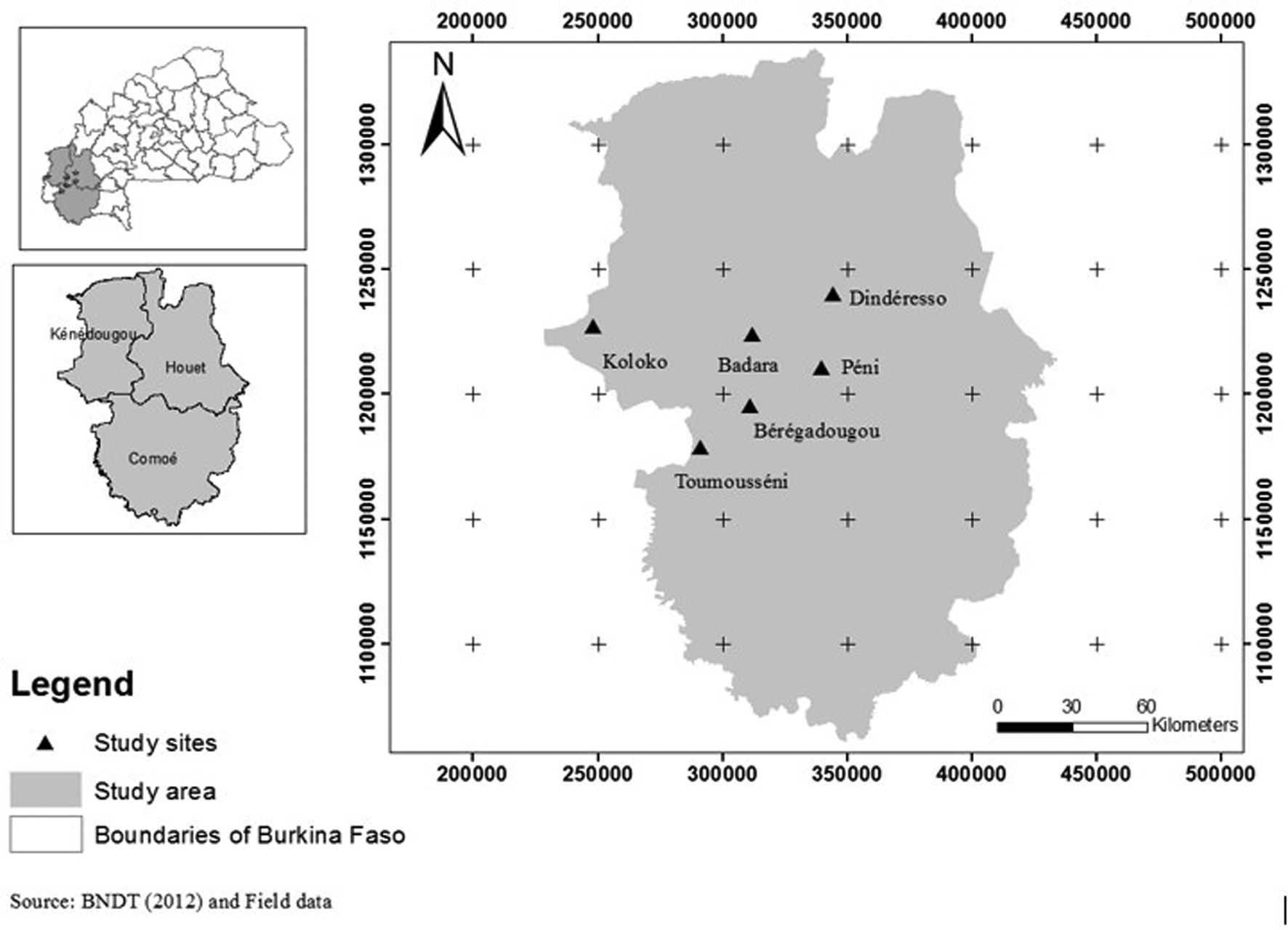
The current study was carried out in Western Burkina Faso. A total of six sites in Houet, Kénédougou, and Comoé provinces were chosen for sampling (fig. 1). This area is the major fruit-producing area in Burkina Faso, which borders the republics of Mali and Ivory Coast. In this area, there is an alternation of two distinct seasons: a wet season that extends for 5–6 months (from May to October) and a dry season. It belongs to the South-Sudanian climatic zone and is characterized by an annual average rainfall between 900 and 1200 mm and average monthly temperatures ranging from 25 to 32°C. The vegetation of this area is a wooded savannah with clear forest and patches of dry dense forest and gallery forest (Tankoano et al., Reference Tankoano, Hien, N'Da, Kaboré, Ouoba, Karlson, Sokeng and Somda2016). Three types of plant formations including natural fallows, mango orchards, and agroforestry parks were chosen for fruit sampling in each of the six study sites. In each of the six natural fallow sites, three circular plots of 25 m2 were selected for woody species inventory and fruit sampling during the study.
Location of study sites in Western Burkina Faso where infestation of fruit with tephritid fly larvae was determined.

Sampling effort
Fruits of any plant species in the plant formations were sampled every 2 weeks during their fruit-bearing phase from May 2017 to April 2019. In all plant formations, whenever possible 30 fruits per host species were sampled. Nevertheless, in natural fallows, the number of fruits per sample and the number of samples reared depended mainly on fruit availability and abundance during the season. All samples comprised either tender skinned mature fruits or tender skinned immature fruits (mainly the case for cucurbits and Saba senegalensis). Collected fruits were transported to a rearing unit established at Farako-ba Research Station (Bobo-Dioulasso), Institut de l'Environnement et de Recherches Agricoles (INERA).
Laboratory rearing of fruit flies
Each fruit batch was weighed per fruit species, per site, and per date. In each fruit batch, the number of fruit was counted. Fruit samples were then placed in plastic boxes containing sieved and sterilized sand. Larvae leaving the fruit burrowed into and pupated in the sand. Each rearing box was covered with a fine-mesh cloth to prevent dispersing larvae from escaping. Fruit were kept for 6 weeks and the sand was sifted every 5 days to recover tephritid puparia. Large, moist fruit were examined for larvae or puparia before being discarded. Pupae were recovered and counted with soft forceps and placed in Petri dishes (94 mm × 15 mm). Petri dishes containing the pupae were placed in rectangular cages (15 cm × 15 cm × 20 cm) stored in a controlled environment room at 25 ± 1°C and 65 ± 2% relative humidity. Emerged adults were collected when full body coloration was reached and were removed from a rearing cage and kept in pill boxes containing 70% ethanol.
Fruit fly identification
Fruit flies were identified with physical (White, Reference White2006) and electronic (Virgilio et al., Reference Virgilio, White and De Meyer2014) identification keys. Specimens that we could not identify with certainty were sent to the Royal Museum for Central Africa, Tervuren, Belgium for identification. The number of individuals of each fruit fly species was recorded.
Data handling and statistical analysis
Tephritid incidence and infestation rates were determined for all sampled fruit species. Incidence is the number of infested batches (i.e., batches from which fruit flies emerged) in comparison to the total number of batches per fruit species. The infestation rate (used as infestation index) was taken as the number of adult flies per unit weight (1 kg) of fruit. We used generalized linear mixed models to test the impacts of the season (wet and dry), plant formations (natural fallows, mango orchards, and agroforestry parks), and their interactions on two response variables: (1) species richness (number of species) and (2) the number of emerged fruit flies (corrected by the number of collected batches). We included the different sites and the year of collections as random factors in models. Due to overdispersion of the data, a negative binomial distribution was used for the two models (‘glmer.nb’ command, R-package lme4). We used ‘plotweb’ command in R-package bipartite to illustrate fruit fly–host plant associations.
Results
A total of 945 batches were collected from 61 plant species belonging to 24 plant families for a total of 29,960 fruits, weighing 1903.95 kg.
Host range
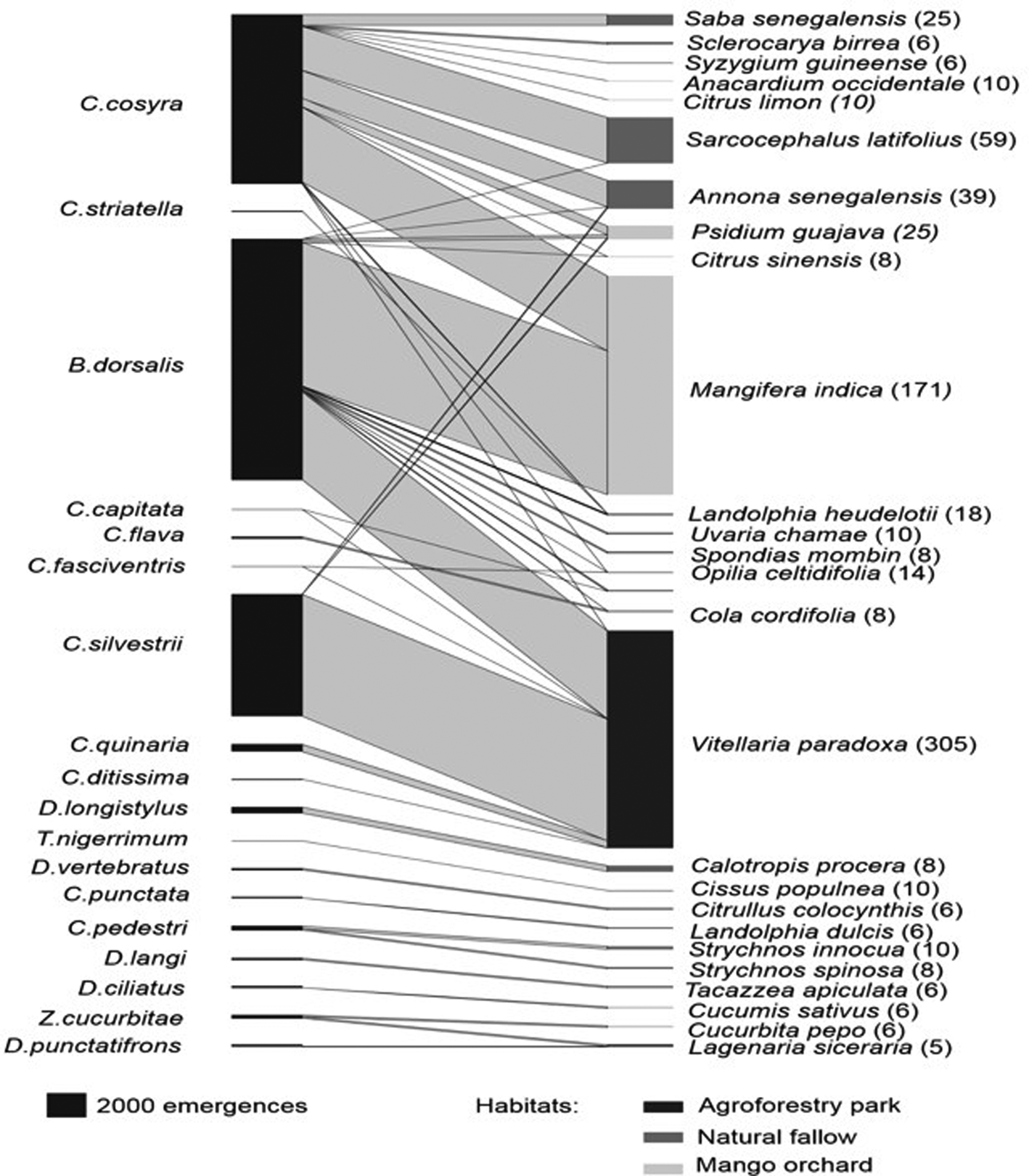
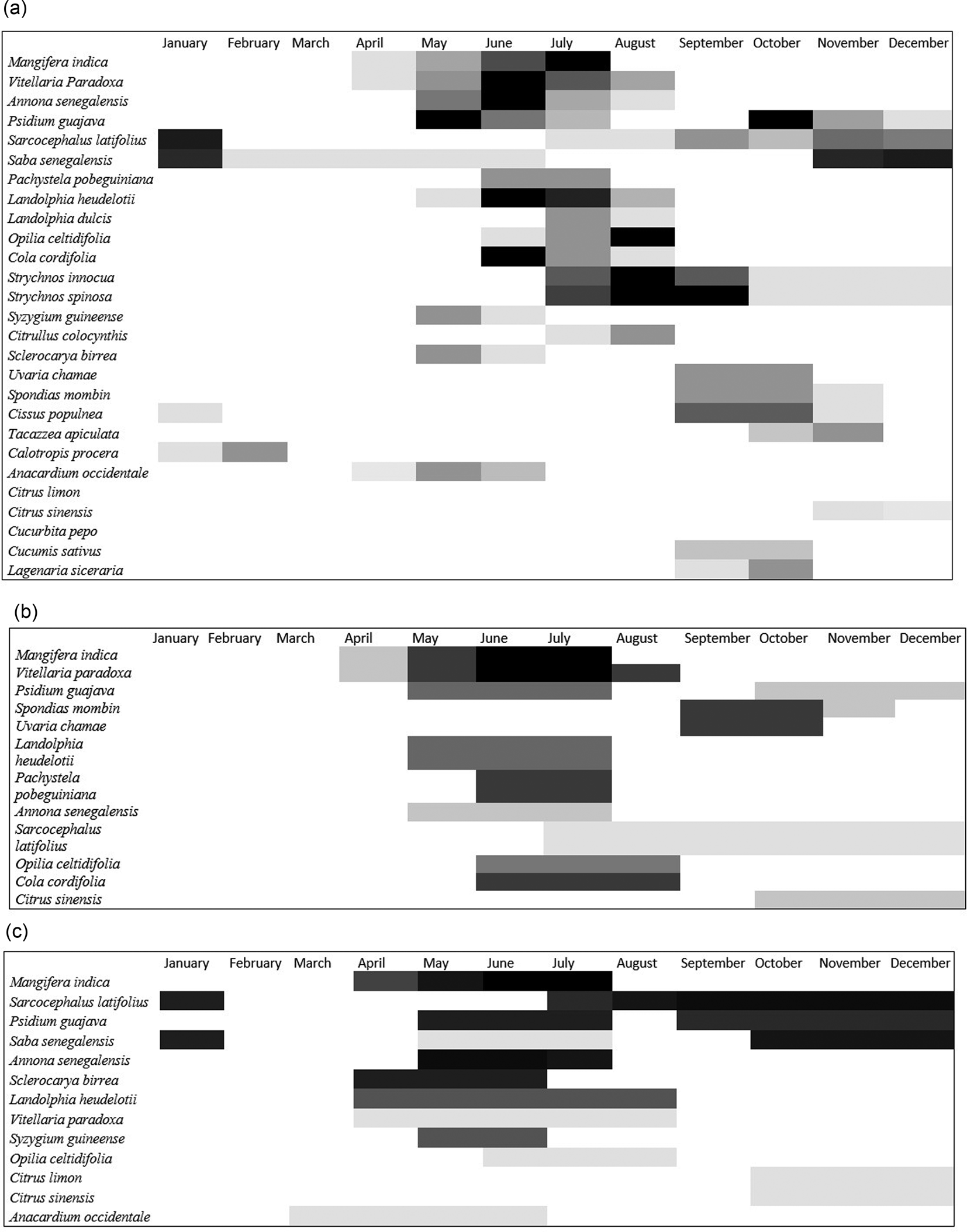
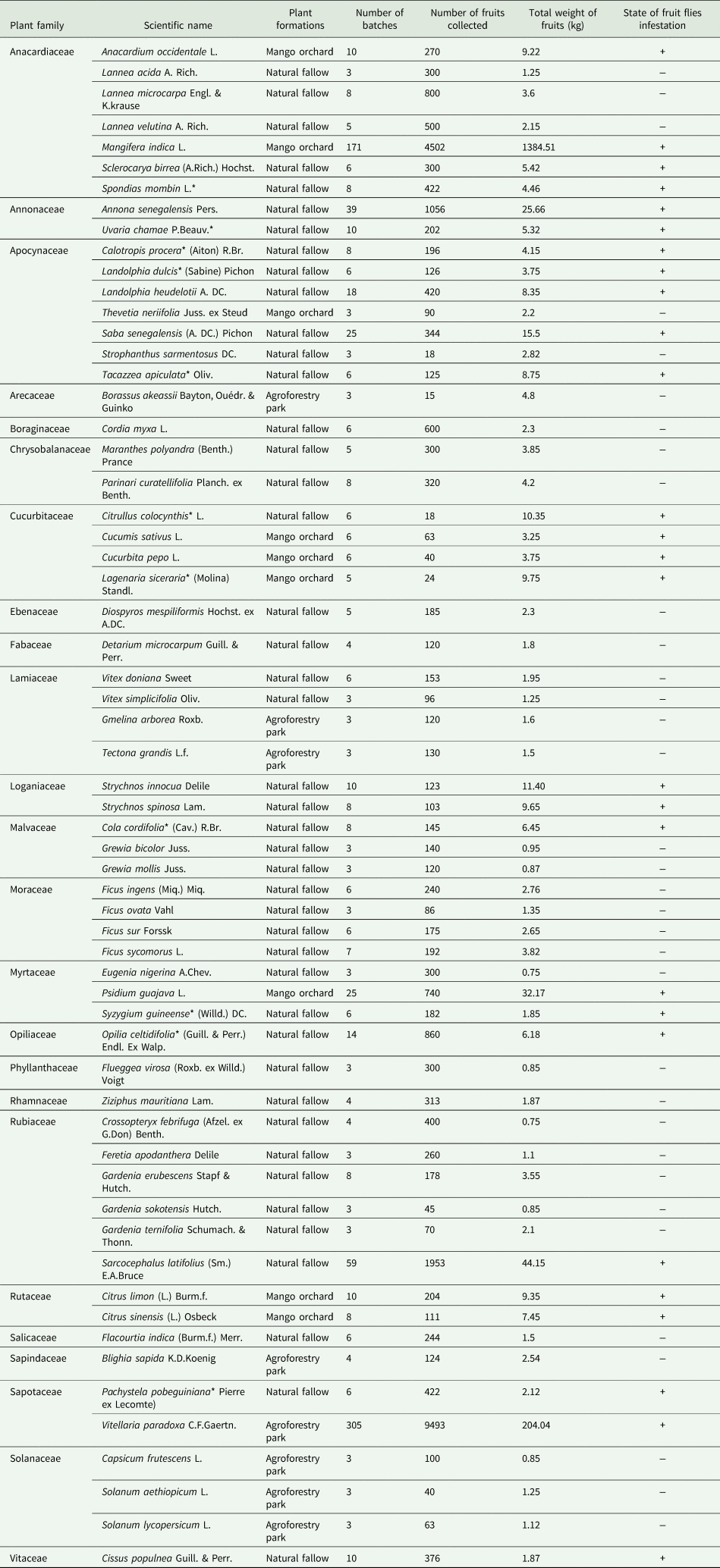
Among the 61 fruit species sampled, 27 in 12 families were infested with fruit fly species (table 1). The main plant families infested were Anacardiaceae, Apocynaceae, Cucurbitaceae, Annonaceae, Myrtaceae, and Sapotaceae. Among indigenous fruit species, V. paradoxa (shea fruit), Annona senegalensis, S. senegalensis, Sarcocephalus latifolius, and Sclerocarya birrea were the main suitable fruit fly hosts while Mangifera indica (mango) and Psidium guajava (guava) were the most infested cultivated host fruit (fig. 2). According to the fruiting calendar of plants use by fruit flies (fig. 3a), suitable hosts were available throughout the year for fruit fly larval development. However, most suitable host fruit were present during the wet season between May and August. From September, host fruit availability decreased as the March dry season approached. The fruit of various sampled plant species (34/61 fruit species) did not support fruit fly development during this study (table 1). The plant families with more than two uninfested species were Moraceae, Lamiaceae, and Solanaceae. The highest host diversity was found in natural fallows (66%, n = 18/27).
Fruit fly–host network: the diagram shows the interaction between host plant (right) and fruit flies (left). The width of linkages and boxes are proportional to the number of emerged fruit flies. Species have been ranked to minimize overlap linkages as possible.

Seasonal availability of host fruit used by tephritid fruit flies in Western Burkina Faso. (a) Fruiting calendar of host fruit used by all fruit flies. (b) Fruiting calendar of host fruit used by Bactrocera dorsalis (Hendel). (c) Fruiting calendar of host fruit used by Ceratitis cosyra (Walker). The incidence rate of each host fruit was evaluated during its fruiting season. Light gray bars: fruit with low incidence rates; intermediate colors: fruit with intermediate incidence rates; black bars: fruit with high incidence rates. Non-colored space: no suitable host fruit present.

Plant species sampled during the study in Western Burkina Faso to establish tephritid fruit fly infestation

+, infested with fruit flies; −, not infested.
(*) Host fruits detected for the first time in Western Burkina Faso.
Fruit flies
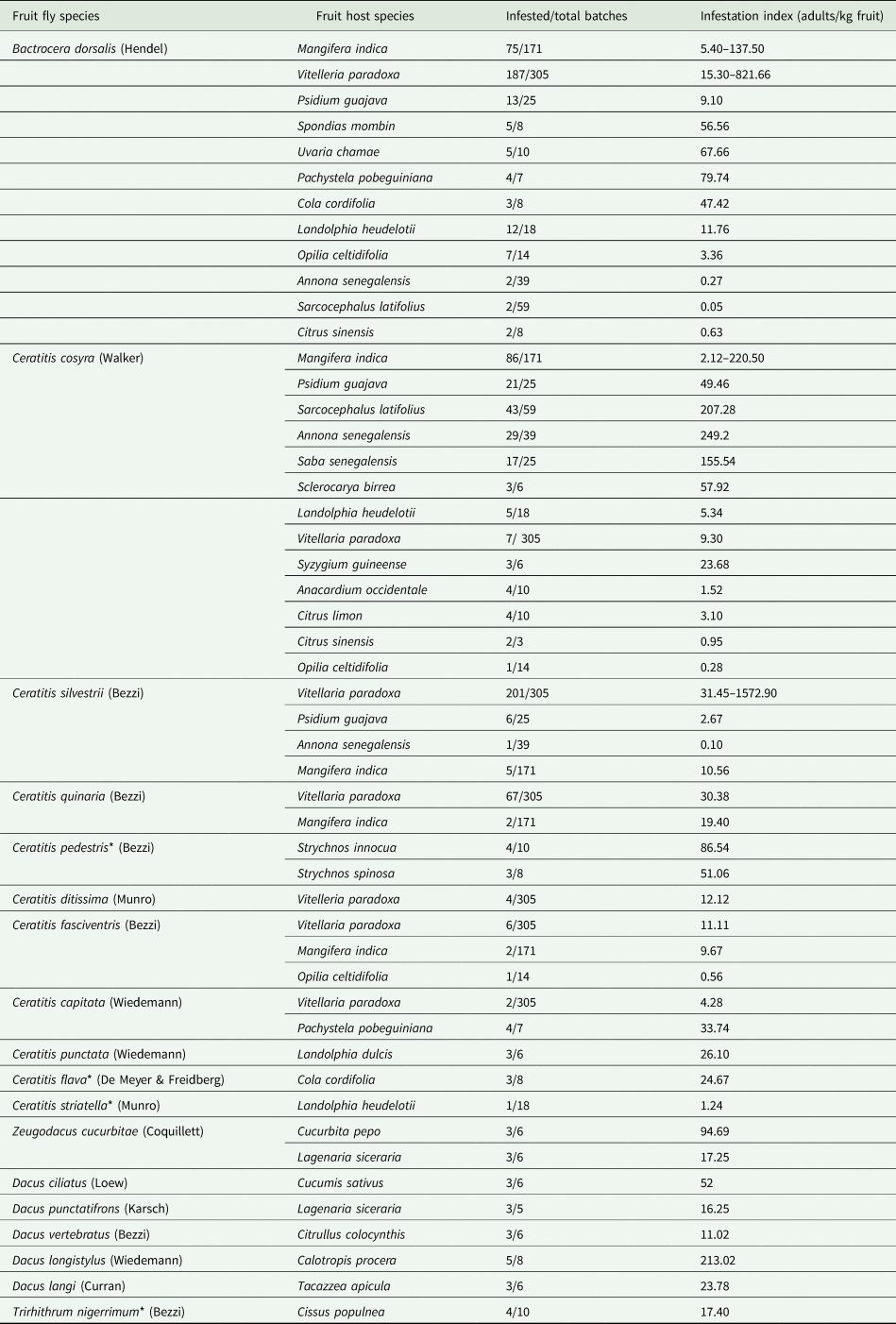
A total of 18 fruit fly species emerged from the 27 host fruit species, comprising ten species of the genus Ceratitis, five species of the genus Dacus, one species of the genus Bactrocera (B. dorsalis), one of the genus Zeugodacus (melon fly, Z. cucurbitae (Coquillett)), and one of the genus Trirhithrum (T. nigerrimum (Bezzi)) (table 2).
Host fruit with which tephritid fruit flies were associated in Western Burkina Faso

(*) Fruit fly species detected for the first time in Western Burkina Faso.
Fruit fly species richness varied between plant formations. In mango orchards, agroforestry parks, and natural fallows, we found seven, seven, and 15 fruit fly species, respectively. However, the type of plant formation and tested interaction had no impact on fruit fly species richness (respectively,  ${\rm \chi }_2^2 $ = 0.665, P = 0.717 and
 ${\rm \chi }_2^2 $ = 0.407, P = 0.816). In contrast, fruit fly species richness was significantly higher during the wet season than during the dry season (χ21 = 14.416, P < 0.005).
Based on the number of fruit fly adults emerged from pupae, three fruit fly species were predominant (fig. 2). In mango orchards, B. dorsalis most commonly emerged (62.11% of adult flies) from mango followed by C. cosyra (35.57%). In agroforestry parks, C. silvestrii represented 55.41% of adults emerged from shea fruits, followed by B. dorsalis (40.68%). In natural fallows, C. cosyra represented 81.04% of adults emerging from wild host fruit. Among the 46,493 fruit fly individuals recorded from all three plant formations, B. dorsalis accounted for 19,965 individuals (42.94%), C. cosyra was represented by 13,896 individuals (29.93%), and C. silvestrii accounted for 10,367 individuals (22.33%) (fig. 2). We observed a significant effect of season ( ${\rm \chi }_1^2 $ = 13.920, P < 0.005) and the interaction of season and plant formations (
 ${\rm \chi }_1^2 $ = 66.658, P < 0.005) on the number of adult fruit flies that emerged. More fruit flies emerged from fruit collected during the wet season than the dry season, particularly from mango orchards. The main effect of plant formations had no impact on the number of emerged fruit flies (
 ${\rm \chi }_2^2 $ = 5.490, P = 0.064).
Host–fruit fly interactions
The indigenous fruit fly, C. cosyra was found in 13 of the 27 infested fruit species (fig. 2), representing eight plant families. A total of 225 batches were infested with C. cosyra. The most infested fruit species were guava (84%, n = 25), S. latifolius (72.88%, n = 59), A. senegalensis (74.35%, n = 39), S. senegalensis (68%, n = 25), mango (47.36%, n = 171), and S. birrea (50%, n = 6). The highest number of fruit flies per kg of fruit was from A. senegalensis (249.2 flies kg−1). It was followed by mango (220.50 flies kg−1), S. latifolius (207.28 flies kg−1), S. senegalensis (155.54 flies kg−1), and S. birrea (57.92 flies kg−1). According to the fruiting calendar of plant use by C. cosyra (fig. 3c), suitable hosts are available throughout the year for this pest species.
Bactrocera dorsalis was reared from 328 batches belonging to 12 fruit species representing nine plant families. Shea fruits (61.31%, n = 305), mango (43.85%, n = 171), guava (52%, n = 25), Landolphia heudelotii (66.67%, n = 18), Spondias mombin (62.50%, n = 8), Uvaria chamae (50%, n = 10), Pachystela pobeguiniana (57.14%, n = 7), and Cola cordifolia (37.5%, n = 8) were most infested with B. dorsalis (table 2). The highest infestation index for B. dorsalis was recorded from shea fruits (821.66 flies kg−1) followed, respectively, by mango (137.50 flies kg−1), P. pobeguiniana (79.74 flies kg−1), U. chamae (67.66 flies kg−1), S. mombin (56.56 flies kg−1), and C. cordifolia (47.42 flies kg−1). The fruits from which B. dorsalis emerged were often co-infested with Ceratitis species including C. cosyra, C. silvestrii, C. capitata, and C. striatella. According to the fruiting calendar of plant use by B. dorsalis (fig. 3b), no host fruit were available for breeding from February through to April.
A total of 208 fruit batches were infested with C. silvestrii, 201 of which were shea fruits. Fruit hosts for breeding C. silvestrii were available from April to August. Shea fruits had a high infestation rate for C. silvestrii (n = 1572.90 adults kg−1).
Discussion
Host range of fruit flies in three plant formations
The number of host plants was higher in the natural fallows (18 host plants) as compared to the mango orchards (eight host plants) and the agroforestry parks (one host plant). These findings could be explained by the composition in plant species of each type of plant formation. Natural fallows mainly comprise several native and wild fruit species. Mango orchards are essentially made up of different mango varieties and sometimes other cultivated host plants (table 1). Shea tree (V. paradoxa) was the main fruit species found in the agroforestry parks in addition to vegetable crops grown under the shade of large shea trees (table 1). The seasons had a strong effect on the availability of resources as host fruit for Tephritidae with the highest fruiting period being observed during the rainy season (From May to August) (fig. 3a). A drop in the host fruit availability was observed with the arrival of the dry season (fig. 3a). Mwatawala et al. (Reference Mwatawala, De Meyer, Makundi and Maerere2006) note that rainfall is considered to be the most important factor for growth and quality of host plants. This seasonality in host fruit occurrence has a drastic effect on population dynamic of fruit flies (Rwomushana et al., Reference Rwomushana, Ekesi, Gordon and Ogol2008). Eleven fruit species with asterisk in table 1 were identified in this study as fruit fly hosts for the first time in Burkina Faso.
Fruit fly species richness according to plant formations
Fruit fly species richness was higher in natural fallows than in mango orchards and agroforestry parks. Fruit fly species were distributed among the three plant formations but some species including C. pedestris, C. flava, C. punctata, T. nigerrimum, C. striatella, D. longistylus, and D. langi were reared exclusively from fruit species sampled in natural fallows. It can be seen that fruit fly species richness was influenced by the host plant diversity in plant formations. Similar results were obtained by Manrakhan et al. (Reference Manrakhan, Daneel, Beck, Virgilio, Meganck and De Meyer2017) who pointed out that the diversity of tephritid species was higher in natural environments than in commercial orchards in South Africa. According to Geurts et al. (Reference Geurts, Mwatawala and De Meyer2012), the diversity of fruit fly species in a biotope depended on the diversity of the host fruit. However, the type of plant formation had no impact on the diversity of fruit flies in the current study. In our study area, many fruit-growing areas are often surrounded by natural vegetation or agroforestry parks where a number of host plants are found. This reason could explain the lack of significant differences between plant formations in fruit fly species richness. In contrast, fruit fly species richness was significantly higher during the wet season than during the dry season. The availability of suitable host fruits during the wet months could explain these findings. Host availability has been shown to have an impact on seasonal abundance of fruit flies in earlier studies (Mwatawala et al., Reference Mwatawala, De Meyer, Makundi and Maerere2006; Geurts et al., Reference Geurts, Mwatawala and De Meyer2014; Vayssières et al., Reference Vayssières, De Meyer, Ouagoussounon, Sinzogan, Adandonon, Korié, Wargui, Anato, Houngbo, Didier, De Bon and Goergen2015). According to Vayssières et al. (Reference Vayssières, Kori, Coulibaly, Temple and Boueyi2008) and Rwomushana et al. (Reference Rwomushana, Ekesi, Gordon and Ogol2008), the availability and suitability of host plants were found to exert a strong impact on fruit fly population dynamics. Four fruit fly species with asterisk in table 2 were recorded for the first time in our sampling in Burkina Faso.
In order of abundance, B. dorsalis, C. cosyra, and C. silvestrii were the species that emerged from most of the cultivated and wild host plants. These three tephritid species caused important damage on two fruit species of major economic importance in Western Burkina Faso: mango and shea fruits.
The main suitable host fruits for B. dorsalis were shea fruits in the agroforestry parks and mango in mango orchards which were available from May to early August. The availability of mango fruits is the most important factor governing population increase in this species (Mwatawala et al., Reference Mwatawala, De Meyer, Makundi and Maerere2006, Reference Mwatawala, De Meyer, Makundi and Maerere2009; Rwomushana et al., Reference Rwomushana, Ekesi, Gordon and Ogol2008; Fadlelmula and Ali, Reference Fadlelmula and Ali2014; Bota et al., Reference Bota, Fabião, Virgilio, Mwatawala, Canhanga, Cugala and De Meyer2018). In Northern Ghana, Badii et al. (Reference Badii, Billah, Afreh-Nuamah and Obeng-Ofori2014) argued that among indigenous host fruits, shea fruits recorded the highest infestation index of B. dorsalis. In Northern Benin, Shea fruits are considered to be the primary host for B. dorsalis (Vayssières et al., Reference Vayssières, Kori, Coulibaly, Temple and Boueyi2008), confirming our findings. After mango and shea fruit fruiting seasons, it moved on the fruit of S. mombin and U. chamae in natural fallows from September to early November. These two fruit species could be considered as its alternative host fruits. In Eastern Africa, Tropical almond (Terminalia catappa L.) might act as an important reservoir host for B. dorsalis (Rwomushana et al., Reference Rwomushana, Ekesi, Gordon and Ogol2008; Mwatawala et al., Reference Mwatawala, De Meyer, Makundi and Maerere2009). The three plant formations have therefore an impact on seasonal abundance of B. dorsalis and its population dynamic.
Suitable hosts for C. cosyra were found in mango orchards (mango and guava) and natural fallows during the early rainy season. The abundance of this species coincides generally with the early-mango season in several African countries (Mwatawala et al., Reference Mwatawala, De Meyer, Makundi and Maerere2006, Reference Mwatawala, De Meyer, Makundi and Maerere2009; Ouédraogo et al., Reference Ouédraogo, Vayssières, Dabiré and Rouland-Lefèvre2011; Badii et al., Reference Badii, Billah, Afreh-Nuamah, Obeng-Ofori and Nyarko2015; Vayssières et al., Reference Vayssières, De Meyer, Ouagoussounon, Sinzogan, Adandonon, Korié, Wargui, Anato, Houngbo, Didier, De Bon and Goergen2015). During the dry season, its suitable host fruit were found only in natural fallows including S. latifolius and immature fruits of S. senegalensis, with their fruiting season extending from September through January. In South Africa and Swaziland, C. cosyra distribution generally follows a similar pattern to the distribution of marula tree (S. birrea) (De Villiers et al., Reference De Villiers, Manrakhan, Addison and Hattingh2013; Magagula and Ntonifor, Reference Magagula and Ntonifor2014). In Tanzania, soursop (Annona muricata L.) acts as an important host for C. cosyra after the mango season (Mwatawala et al., Reference Mwatawala, De Meyer, Makundi and Maerere2009; Geurts et al., Reference Geurts, Mwatawala and De Meyer2012). This tephritid species of sub-Saharan African origin is well adapted to the climatic conditions and indigenous fruit species (Mwatawala et al., Reference Mwatawala, De Meyer, Makundi and Maerere2009; Geurts et al., Reference Geurts, Mwatawala and De Meyer2012, Reference Geurts, Mwatawala and De Meyer2014). In agroforestry parks, this species presented a very low incidence rate on shea fruits.
Ceratitis silvestrii, usually considered an oligophagous species, was reared from four fruit species belonging to four plant families. In mango orchards, it attacked mango and the fruit of P. guajava while the fruit from A. senegalensis were infested in natural fallows. In all cases mentioned above, the incidence rates were very low. These findings are in agreement with those of Vayssières et al. (Reference Vayssières, Kori, Coulibaly, Temple and Boueyi2008) in Northern Benin. Shea fruits in agroforestry parks remained its main host fruit with a higher incidence rate. The highest infestation index recorded for C. silvestrii on that fruit was twice the amount found for B. dorsalis (n = 1572.90 flies kg−1 and n = 821.66 flies Kg−1, respectively). This is the first study which highlights the economic importance of C. silvestrii on shea fruits in West Africa.
Interspecific competition between fruit fly species
Our findings revealed that many fruit fly species shared the same host fruit. The species that were most abundantly reared and that were possible competitors included B. dorsalis and C. cosyra on mango, and B. dorsalis and C. silvestrii on shea fruits.
Bactrocera dorsalis (62.11%) and C. cosyra (35.57%) accounted for about 98% of adult flies reared from mangoes. It can be seen that 15 years after its first detection in Western Burkina Faso, B. dorsalis did not displace C. cosyra on mango fruit. In our sampling area, the fruiting period of early-mango varieties corresponds with the period when mature fruit of A. senegalensis and S. birrea are present in natural fallows. Ceratitis cosyra could move from mango to infest these indigenous hosts and thus avoiding strong competition. Mwatawala et al. (Reference Mwatawala, De Meyer, Makundi and Maerere2009) in Tanzania also found that C. cosyra move from mango to soursop (A. muricata L.) to avoid interspecific competition.
On shea fruits, B. dorsalis (40.68%) and C. silvestrii (55.41%) represented more than 95% of adult fruit flies that emerged. This could be caused by the fact that mangoes and shea fruits are available in the same period in our study area. Mango fruit being the preferred host of B. dorsalis, this could give an advantage to C. silvestrii in using shea fruit.
Our results showed that B. dorsalis did not displace the indigenous species C. cosyra and C. silvestrii from mango and shea fruits, respectively, in Western Burkina Faso, but had led to a decrease of their infestation rates. This had also been concluded by Zida et al. (Reference Zida, Nacro, Dabiré and Somda2020). The results of this study therefore corroborate previous studies showing that, where exotic tephritid species have been introduced into areas already occupied by a native tephritid species, interspecific competition occurs and result in a decrease in numbers and niche shifts of the indigenous species, albeit without leading to complete exclusion (Duyck et al., Reference Duyck, David and Quilici2004; Ekesi et al., Reference Ekesi, Billah, Nderitu, Lux and Rwomushana2009; Mwatawala et al., Reference Mwatawala, De Meyer, Makundi and Maerere2009). Our results did not concur with those of Ekesi et al. (Reference Ekesi, Billah, Nderitu, Lux and Rwomushana2009) who indicated the rapid displacement of C. cosyra by B. dorsalis at Nguruman, Kenya, 4 years after its detection in the African continent. Despite its high polyphagy, this major invasive fruit fly did not displace any other indigenous Ceratitis spp. on indigenous fruit species or on major cultivated crops, but it increased the overall pest pressure on them in Western Burkina Faso.
Conclusion
This study identified 27 fruit species infested with 18 fruit fly species in three plant formations in Western Burkina Faso. Suitable hosts are mainly available from May to August during the hot and rainy season. The invasive and polyphagous fruit fly species, B. dorsalis was the predominant fruit fly species emerged from host fruits followed, respectively, by C. cosyra and C. silvestrii. Our findings suggest probable interspecific competition between B. dorsalis and C. cosyra on mango, and between B. dorsalis and C. silvestrii on shea fruits. Native species of the genus Ceratitis dominated the invasive species B. dorsalis on indigenous fruit species during our samplings. This study highlighted the importance of the three types of plant formations on seasonal abundance of the main fruit fly species of economic importance in Burkina Faso.
Aknowledgment
We are grateful to Adama Sow, Marcel Soubeiga, Boukary Ouedraogo (Institut de l'Environnement et de Recherches Agricoles) for their assistance in field data collection. Many thanks to Dr Marc De Meyer (Royal Museum of Central Africa) for identifying and confirming some fruit fly species identity. This work was financially supported by Plan Régional de lutte et de contrôle des mouches des fruits en Afrique de l'Ouest (SPLM) and the International Foundation for Science (IFS Grant N° D/5909-1). Special thanks to Dr Dona Dakouo, who initiated this study and who died before it was completed.