Introduction
According to the World Health Organization (WHO), as of 26 January 2009, there were 400 cases of highly pathogenic avian influenza (HPAI) resulting in 252 deaths worldwide.1 The high mortality rate of 60% strikes fear in people, including health professionals, worldwide. If a global pandemic of influenza that was caused by a similar influenza virus to that of the 1918–1920 pandemic, an estimated 62 million people would be killed.Reference Murray, Lopez and Chin2 However, countermeasures against avian influenza (AI) pandemics caused by the highly pathogenic avian influenza A subtype H5N1 are insufficient.Reference Aris3–Reference Mounier-Jack and Coker5 Outbreaks of influenza in several Asian countries, including person-to-person transmission of the H5N1 virus in China, have raised concerns over an AI (A/H5N1) pandemic.Reference Wang, Feng and Yu6 The threat that the H5N1 virus might acquire the capability to be transmitted easily from person-to-person by hybridization with another attenuated virulence H1N1 virus still is present. It has been hypothesized that, in the advent of a pandemic of AI (A/H5N1), a huge number of infected individuals would visit hospitals, many staff would become infected, and, consequently, medical services could fail.Reference Sellwood, Asgari-Jirhandeh and Salimee7 This inability of medical services to cope with the demand would result in a disaster. Compounding the problem would be that in comparison with disasters caused by natural hazards, external assistance could not be expected.
The (US) Centers for Disease Control and Prevention (CDC) and the WHO have suggested precautions to protect healthcare providers who care for patients with known or suspected AI (A/H5N1).8,9 Similarly, there also is the Pandemic Influenza Preparedness Action Plan of the Japanese Government and Guidelines for the Prevention and Control of Pandemic Influenza (Phase 4 onwards) of the Ministry of Health, Labor and Welfare (MHLW).10,11 However, on 14 February 2009, the Ministry of Education, Culture, Sports, Science, and Technology reported that only 61 out of 140 university hospitals (44%) in Japan had prepared action plan manuals to be followed in the event of an influenza pandemic. Thus, many hospitals are not prepared. Furthermore, medical professionals experience conflicts regarding their responsibilities between their duties and families.Reference Wong, Koh and Cheong13–Reference Irvin, Cindrich and Patterson15 However, medical services do not solely rely on physicians and nurses; all types of staff are essential for treatment, payment, and healthcare operations. Regarding this problem, some research has reported that maintaining enough healthcare personnel during a pandemic will be too difficult.Reference Ehrenstein, Hanses and Salzberger16–18 An imbalance in demand versus supply of medical services is one of the most serious issues during a disaster due to natural hazards.
When countermeasures to cope with an influenza pandemic are prepared in a hospital, it is essential to anticipate the potential rate of absence among health professionals. The purpose of this study was to be able to estimate the number of medical professionals who would report to work during a pandemic, and factors that could help to secure adequate human resources.
Methods
From September to December 2008, questionnaires were sent to five private hospitals and one public hospital, which served as core hospitals in the regions of Kyoto, Osaka, and Hyogo Prefectures. Participants included all types of hospital staff, including: physicians, nurses, pharmacists, radiological technologists (RTs), physical therapists (PTs), occupational therapists (OTs), clinical laboratory technologists (CLTs), caregivers, office clerks, food service workers, and others. The questionnaire included questions regarding demographic information and attitudes pertaining to a pandemic.
Statistics
Demographic data are presented as means ±standard deviation (SD). The data distribution was determined using the chi-square test. A p-value of <0.05 was considered to indicate statsistical significance. The processing software used was SPSS for Windows version 16.0 (SPSS Inc., Chicago, IL).
Ethical issues
The Ethics Committee of Kyoto Prefectural University of Medicine reviewed and approved the study protocol.
Results
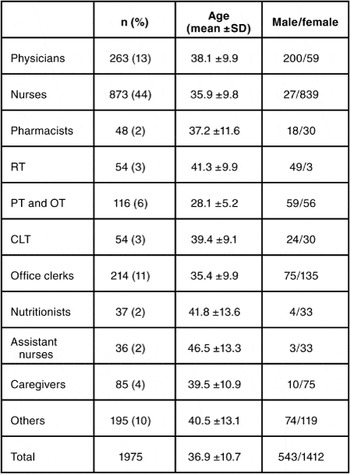
A total of 3,152 questionnaires was distributed to all hospital staff of the five hospitals, and 1,975 completed surveys were received (62.7%). The characteristics of participants and the distribution of professionals are shown in Table 1. The mean value for the ages of total subjects was 36.9 ±10.7 years, the number of males was 543, and that of females was 1,412. Twenty participants did not state their gender. There were 263 out of a total of 745 (35.3%) physicians that responded, 873 of 1,265 (69.0%) nurses; 48 of 63 (76.2%) pharmacists, 54 of 67 (80.6%) RTs, 116 of 149 (77.9%) PTs and OTs; combined, 54 of 65 (83.1%) CLTs; 214 of 356 (60.1%) office clerks, 37 of 53 (69.8%) nutritionists, and 316 of 389 (81.2%) assistance nurses, caregivers, and others.
Demographic characteristics of the participants (CLT = clinical laboratory technologists; OT = occupational therapists; PT = physical therapists; RT = radiological technologists)

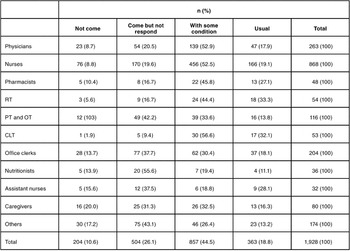
The answers regarding attitudes toward a pandemic are in Table 2. Of the 1,928 participants, 204 (10.6%, 95% CI = 0.092–0.120) answered that they would not report to their hospitals at the time of a pandemic; 504 persons (26.1%, 95% CI = 0.242–0.281) answered that they would come to their hospitals but not treat AI patients; 857 persons (44.5%, 95% CI = 0.422–1.467) answered that they needed some essential conditions to be met before they would perform their duties; and 363 (18.8%, 95% CI = 17.1–20.6%) answered that they would perform their duties as usual without any specific conditions. Regarding attitudes, >90% of physicians and nurses would come to hospitals during a pandemic.
Attitudes toward an avian influenza pandemic Not come = I will not come to the hospital; Come but not respond = I will come to the hospital but not treat AI patients; With some condition = I will work and treat AI patients with some conditions; Usual = I will work during a pandemic without any conditions. (CLT = clinical laboratory technologists; OT = occupational therapists; PT = physical therapists; RT = radiological technologists)

A total of 204 of 1,928 (10.6%, 95% CI = 9.2–12.0%) respondents stated that they would not come to their hospital during a pandemic, including: 23 out of 263 physicians (8.7%, 95% CI = 5.3–12.2%), 81 out of 909 nurses and assistant nurses (8.9%, 95% CI = 7.1–10.8%), 28 out of 214 office clerks (13.7%, 95% CI = 8.6–17.6%), and 70 out of 589 other medical professionals including pharmacists, RTs, PTs, OTs, CLTs, nutritionists, and caregivers (11.9%, 95% CI = 9.3–14.5%).
The reasons personnel would not come to the hospital during a pandemic (n = 204) are in Figure 1. The reasons include the belief that: (1) their family might contract AI (A/H5N1) through them or their work (“family's infection”; 111 persons, 54.5%, 95% CI = 46.7–61.2%); (2) they might become infected (“my infection”; 101, 49.5%, 95% CI = 42.6–56.4%); (3) they will have to care for their family members (“care for family”; 56, 27.5%, 95% CI = 21.3–33.6%); (4) they were not specialists (“specialty”; 55 persons, 27.0%, 95% CI = 20.9–33.1%), including 13 of 23 (56.5%, 95% CI = 36.3–76.8%) physicians and 10 of 81 (12.3%, 95% CI = 5.2–19.5%) nurses; (5) they lacked physical strength (“physical strength”; 49, 24.0%, 95% CI = 18.2–29.9%); and they lived far from the hospital (“long distance”; 47, 23.0%, 95% CI = 17.3–28.8%).
Reasons that health workers would not come to a hospital during a pandemic (multiple choice, n = 204)

There were no statistically significant differences between occupation and concern about “my infection” (χ2 = 0.58, p = 0.90) and “family's infection” (χ2 = 3.03, p = 0.39); “physical strength” (χ2 = 7.43, p = 0.06); and “farness” (χ2 = 5.26, p = 0.15). However, there were statistically significant differences regarding “specialty” (χ2 = 20.283, p < 0.01) and “care for family” (χ2 = 15.67, p <0.01). In particular, physicians tended to be concerned about “specialty”, and physicians and nurses tended to be concerned about “care for family”.
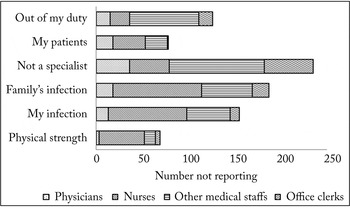
A total of 504 (26.1%, 95% CI = 0.242–0.281) respondents stated that they would come to the hospital, but not treat AI patients. The distribution of the reasons is in Figure 2 (n = 504). The most common reason for reporting to the hospital and not treating patients with AI was that they were not specialists in AI treatment (235 persons, 46.6%, 95% CI = 42.3–51.0%), common among physicians (36, 66.7%, 95% CI = 54.1–79.2%), office clerks (53, 68.8%, 95% CI = 58.5–79.2), and other medical professionals (103, 53.9%, 95% CI = 46.9–61.0%). The second most important reason was that their family might contract AI through them (187 persons, 37.1%, 95% CI = 32.9–41.3%). The third most important reason was that they themselves might become infected (155 persons, 30.8%, 95% CI = 26.7–34.8%). One hundred and twenty-six persons (25.0%, 95% CI = 21.2–28.8%) answered that AI treatment was outside the scope of their duties. Seventy-nine persons (15.7%, 95% CI = 12.5–18.8%) answered that they had to care for their patients. Sixty-nine persons (13.7%, 95% CI = 10.7–16.7) answered that they lacked physical strength.
The reasons they would come to a hospital, but not treat AI patients (multiple choice, n = 504)

Physicians tended to select “speciality” (36, 66.7%, 95% CI = 54.1–79.2%) and “my patients” (18, 33.3%, 95% CI = 20.8–45.9%) for reasons that they would not treat AI patients. Nurses were concerned about “physical strength” (49, 26.9%, 95% CI = 20.5–33.4%), “my infection” (85, 46.7%, 95% CI = 39.5–54.0%), and “family's infection” (96, 52.7%, 95% CI = 45.5–60.0). There were statistically significant differences between the type of occupation regarding the following: “physical strength” (χ2 = 42.24, p <0.01); “my infection” (χ2 = 37.67, p < 0.01); “family's infection” (χ2 = 31.28, p <0.01); “specialty” (χ2 = 66.75, p <0.01); “my patients” (χ2 = 28.20, p <0.01); and “outide my duties” (χ2 = 39.83, p <0.01).
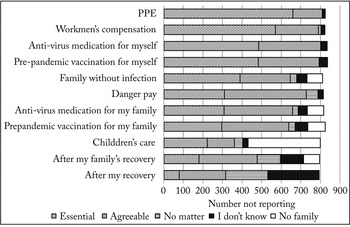
The conditions that 857 (44.5%, 95% CI = 0.422–0.467) would require in order to perform their duties are in Figure 3. The most essential condition was that PPE be supplied to them; 660 (80.0%, 95% CI = 77.3–82.7%) answered that they would not perform their duties without PPE. The second was that workmen's compensation would be provided if they got infected (570, 69.3%, 95% CI = 66.1–72.4%). The next frequently selected factor was that anti-virus medication would be supplied to them (485, 58.2%, 95% CI = 54.8–61.5%) and that they could get a pre-pandemic vaccination (483, 57.8%, 95% CI = 54.4–61.1%).
Conditions that must be met for staff to perform their duties (multiple choice, n = 857; PPE = personal protective equipment)

Discussion
The MHLW compiled a Guideline for Countermeasures Against AI (A/H5N1) pandemics, and estimated a maximum worker absence rate of 40% at the peak of a pandemic using the guidelines developed by the US Department of Health and Human Services.Reference Kuntz, Holley and Helms19 As for the characteristics of healthcare duties, the main differences are that in such circumstances, the workplace itself is a source of infection, and that the duties are hazardous. Thus, the rate of absence from the workplace and/or infection would be higher than among the general public. This study indicates that about 10% of the staff, including physicians and nurses, would not report to the hospital due to concerns of infection. On the other hand, RTs and CLTs answered that they would perform their duties as usual without any conditions. This might be because they do not treat AI patients directly.
There was no significant differences between physicians, nurses, other medical professionals, and office clerks in all categories, except for “specialty” and “care for family”. Physicians tended to adhere to their specialties, and physicians and nurses tended to select the reason for not reporting to work being that they had to care for their families.
There were significant differences among respondents concerning the reasons they would not treat AI patients despite the fact that they would come to hospital. Physicians tended to be concerned about “specialty” and “my patients”; nurses tended to consider “physical strength”, “my infection”, and “family's infection”, other medical professionals tended to consider “outside my duty”; and office clerks tended to consider “specialty”. However, depending on the circumstances, medical professionals might be required to respond to AI patients; and physicians and nurses might be required to care for and treat AI patients regardless of their specialty.
Physicians would likely not treat patients' avian influenza because they consider it outside of their duties or outside their specialty. This is a significant issue since specialties such as obstetrics, surgery, rehabilitation, etc. normally would not be expected to treat patients with AI. Therefore, the observation that many clinicians would not treat patients during a pandemic may be falsely elevated. On the other hand, physicians get hung up on their specialties, and it is misunderstood that any physician can treat patients with AI. Additionally, physicians view pandemics as abnormal. For physicians who answered that they would not come to the hospital for work, or that they would come but not treat AI patients because of their “specialties”, it is essential to identify the physicians who would be available to serve as a backup, who will support other sections, how specialties can be transcended, and how to ensure and maintain daily medical services as a part of pandemic preparedness.
The essential conditions motivating medical professionals to perform their duties are PPE, workmen's compensation, and access to anti-virus medication and pre-pandemic vaccination.Reference Kuntz, Holley and Helms19–Reference Miller, Randolph and Patterson20 Thus, this study suggests that ensuring adequate human medical resources will be difficult without satisfying these conditions. The safety of life and compensation are essential during a pandemic, just as during a response to a disaster caused by natural hazards.22 How to ensure that these conditions are met is the most important issue for preparing for a pandemic. Although, PPE is easy to obtain and can be low priced, compensations are difficult to be established.
Limitations
One limitation is that only 62.7% responded to the survey, with a particularly low physician response rate (physicians = 35.3%; nurses: = 69.0%; other medical staff = 79.5%; office clerks = 60.1%). It is not clear whether the physicians were merely too busy, or whether they were not interested. Although 10% of the responding medical professionals answered that they would be absent from work because of a fear of infection, there were few who actually were absent during the 2009 A/H1N1. This was because of some preparedness for the A/H5N1, and the availability of information regarding the low case fatality rate of A/H1N1. Although there was a little confusion and high volume of patients, almost of all medical professionals kept working without complaining compared to their prediction of behavior demonstrated by this questionnaire.
Conclusions
This study indicates that about 10% of medical professionals would not perform their duties, 20% would perform their duties as usual, 30% would perform their daily duties but not treat AI patients, and 40% needed some conditions to be met. The maximum absence rate (40%) was estimated to be due to hospital staff's concerns about the risk their own and their family acquiring the infection. Additionally, this study notes that >10% of medical professionals might be absent because of a fear of infection. It is expected that personnel shortages associated with AI infection would be problematic. Under these circumstances, replacement of personnel and relevant training would recommended.
Acknowledgements
The authors thank our partners within Sonoda Hospital, the Ishinkai Yao General Hospital, Fukuyama Hospital, Nishi Hospital, and Shimada Hospital for their assistance in data acquisition.
This research was supported by an educational grant from Kyoto Prefectural University of Medicine. All authors reported no conflicts of interest relevant to this article.
Abbreviations:
AI = avian influenza
CLT = clinical laboratory technologist
HPAI = highly pathogenic avian influenza
MHLW = Ministry of Health, Labor, and Welfare
OT = occupational therapist
PT = physical therapist
RT = radiological technologist
WHO = World Health Organization
The PDM Editorial Staff thanks the following people who reviewed papers for the Journal in 2010. Although they are not members of the Editorial Board, they contributed their expertise to PDM.
Mr. Jonathan Abrahams
Dr. Bruria Adini
Ashley Anderson, Jr., MD, MS, FACS, CPE
Stacy Arnesen
David Baker, M Phil, DM, FRCA, FRSM
Menachem Ben-Ezra, PhD
Jan Beyer, RN, SSN, CCRN
William Bograkos, DO, FACOEP
Mal Boyle, M ClinEpi
Todd Cole, EMT-P
Jeff Clawson, MD
Elaine Daily-Birnbaum, RN, BS, FCCM
Gerard Doyle, MD, MPH
Kristine Gebbie, DrPH, RN
Dan Gryth, MD, PhD
Azita Hamedani, MD, MPH
Clayton Hauser, MD
Karen Hein, MD
Lee Faucher, MD
Dr. Nila Kapor-Stanulovic
Hisayoshi Kondo, MD, PhD
Victor Koscheyev, MD, PhD, ScD
Sarah Laditka, PhD
Donna Lotzer, RPh
Deb Martin-Lightfoot, RN, BSN
Col. Theo Ligthlem, MPA, B Soc Sc (Hon), Dip H Ed, Dip Adv Nur, RN
Lidia Mayner, BSc, BScHons, Grad Cert Tert Ed, PhD, MRCNA
K. Joanne McGlown, RN, MHHA, PhD, FACHE
K.A. Kelly McQueen, MD, MPH
Satoko Mitani, RN, PhD
Ann O'Rourke, MD, MPH
Christopher Olola, PhD
Susan Olson, RN, BSN
Per Örtenwall, MD, PhD
Patricia Padjen, RN, MBA, MS, PhD
Edward Pasman, MD
James Paturas, CEM, EMTP, FACCP
Kobi Peleg, PhD, MPB
Robert Powers, BS, RN, EMT-P
Ernie Pretto, MD, MPH
Nancy Robinson, RN, MS
Nobhojit Roy, MS, MPH
Kim Shoaf, DrPH
James Shultz, MS, PhD
CAPT Lynn Slepski, PhD, RN, CCNS
Erin Smith, PhD
Karl Sporer, MD, FACEP, FACP
PhDr Š těpán Vymětal
Robert Waddell II, EMT-P
Andreas Ziegler, MSc(RCDM), EuM(DM), MBA
Kathryn Zeitz, PhD, MD
Thank you for your continuing support of PDM!