Introduction
Cumulated dataReference Guha-Sapir, Below and Hoyois 1 , 2 show an exponential increase in the number of natural disasters in parallel with the number of people affected by them. Over the last 20 years, 13,395 recorded disasters claimed more than 2.2 million lives, affected more than 4.2 billion people, with more than 95 million rendered homeless.
A key concept in disaster preparedness is that the impact of a specific hazard will depend on the vulnerability of the community; in other words, the disaster is part of that particular community. Evaluating the disaster management system in Sri Lanka, Kurita et alReference Kurita, Nakamura, Kodama and Sisira 3 found that more than 90% of residents lacked tsunami knowledge, that the lack of disaster knowledge transgressed generations through folklore, and that school education was seen as essential for disaster mitigation. In addition, about 30% of school children did not yet understand what causes a tsunami, yet 90% of school children were keen to study natural disasters.
Mitigating the effects of disasters requires an educated community in relation to the hazards, risks, and protective measures, and the special skills required to adapt to the new environment; disaster reduction education (DRE) is one of the priorities of the Hyogo Framework for Action 2005-2015. 4
In contrast to their traditional vulnerability, children are not passive witnesses to surrounding events, and by empowering them to learn and contribute to disaster mitigation and preparedness efforts, they are empowered to develop personal and community strategies to respond adequately to the effects of a disaster.Reference Jaber 5 In the post-disaster environment, avoiding becoming a secondary victim and safety are broad concepts, ranging from food and safe water procurement, to establishing communication, shelter, and sanitation, to the provision of emotional support for self and others.
The synergistic increase of the number of people affected by disasters and the number of disasters, per se, have prompted a new approach to the preparation for, mitigation of, and response to, disasters. In the last two decades, numerous national and international organizations have determined that DRE constitutes an educational priority. 4 , 6 – 11
To this extent, teaching disaster-related subjects in schools is mandated by law in Romania, Mexico, and New Zealand, and it is estimated that about half the nations in the world have some form of educational programs about natural hazards and safety in some of their schools. 11
More than two decades after the United Nations' International Decade For Natural Disaster Reduction (IDNDR) declaration, the published evidenceReference Codreanu, Celenza and Jacobs 12 regarding the reduction of the disaster informational vulnerability of teenagers, and the related problem solving skills and behavior, is piece-meal in design, approach, and execution in spite of consensus in the detrimental effects on injury and survival. Furthermore, school leavers’ deficient knowledge, knowledge of skills, and adaptive behavioral change are detrimental to their chances of survival. The educational programs, whether in the context of a school curriculum or national, wide-reaching projects, need to be based on targeted information pertinent to the community to which they are addressed. 13
Adolescence is characterized by a significant increase in flexible thinking and reasoning, in adapting to challenging situations, and in analyzing multiple pieces of information resulting in better planning and organization, better control of impulses, and allocating attention to a specific task. By late adolescence, this formal operational stage of development equips the individual with the adequate knowledge and attitudes to “reason better, plan for the future, and foresee consequences,” to the extent of choosing what he/she “thinks about, when and where to do so, and how to allocate their mental effort.”Reference Bernstein, Penner, Clarke-Stewart and Roy 14 , Reference Luciana, Conklin, Hooper and Yarger 15
However, to date, there has been no published evidence regarding the baseline disaster knowledge of teenagers; thus, the educational programs might be based on unfounded assumptions of a pre-existing knowledge-base.
Among school curricular subjects, disaster education may be looked upon as a pariah, that is, a subject which needs to be taught yet there is a very limited scope for formal testing of knowledge, knowledge of skills, or attitudes during a disaster. In addition, the probability that the student will ever be subjected to a real-life disaster situation is anticipated to be very low. This association of factors results in an educational conundrum in which the end result is expected to be an observation of the student’s behavioral change towards DRE activities. However, such behavioral changes are difficult to witness for they are most likely exhibited at individual levels. One probable facet of behavioral change would be the student’s engagement in discussions about disasters with friends and family.
This multinational study of the terminal year of high school students aimed to find the relationship between engaging in discussions about disasters, as primary outcome, and a series of independent predictors: disaster education through school lessons, the existence of national educational disaster programs, the ability to accurately name a disaster, age, and gender, in association with additional country-specific characteristics.
Methods
This study was an international, multi-center prospective, cross-sectional study of final year high school students using a written, purpose-designed questionnaire. The study has been coordinated from Western Australia using additional local research personnel in each country.
Subjects
The sample population studied was representative of the final year high school students, in state schools, at country level. The rationale of this selection was determined by the fact that upon graduation, their compulsory education in a national system will have ended, together with the last opportunity for a systematic, group-wise, educational intervention. The reason for selecting only state schools is that all these schools will have a national, common, educational curriculum; therefore, the selected sample of the population will be representative for that country.
Survey Questionnaire Design
Data were collected using a specifically designed questionnaire which contained 26 closed- and open-ended questions, multiple-choice questions, and questions requiring the answer to be entered in free text form (Appendix 1). It was based on the expected knowledge, attitudes, and skills necessary for survival in the first 72 hours after a disaster. 16
The questionnaire was short to prevent survey fatigue. Where a close-ended or a multiple choice question tested an item of knowledge of which answers could be affected by social desirability bias, the item was re-tested using another open-ended or free-text question. To control for different response patterns, data analysis used a template valid for each respective country (ie, existing published data or manuals and other educational materials available to those respective students). The questions used simple and clear language using the expected literacy and numeracy skills of the population studied. Where required, translation was performed by native speakers.
Control for collusion was achieved by conducting the survey in the presence of a school teacher and administered at prima vista. Although a guarantee could not be given, it is extremely unlikely that collusion was present. None of the questions were controversial (to control for variability) or asking for a biased answer. Furthermore, the questionnaire was anonymous, thus making personal gain impossible by answering a specific question in any particular way.
It is reasonable to expect that the questions did not suffer from external bias as they were not influenced by current news reports, community information, or other political concerns, nor were subject to historical bias.
In order to obtain information from different educational systems, from countries with different risk of exposure to disasters, and from countries with varied economic development status, the survey was applied to students from Bahrain, Croatia, Cyprus, Egypt, Greece, Italy, Portugal, Romania, and Timor-Leste.
Pilot Testing
The initial design was distributed to the academics of the faculty of the European Master in Disaster Medicine (EMDM) and the EMDM Alumni (EMDM-A) for comments and suggestions for revision. The final draft was piloted in Scotland (by TC) and the Kingdom of Bahrain (by AA) in order to validate the understanding of the questions and the usability of the returned data.
Determining the Required Sample Size
The sampling size was determined for each country based on the estimated roll of students in the last year of secondary education. The roll was difficult to quantify exactly as the number of children enrolled in the last year of secondary education is not a nationally reported statistic; therefore, an estimate (CL=95%, CI=5-15) was obtained by dividing the reported population aged 10 to 19 years into 10 equal tiers. 17 As the questionnaires were anonymous and the follow-up of the non-responders was impossible, an arbitrary percentage of 15% was added to account for non-responders.
Conducting the Survey and Data Collection
During 2010, the final version of the survey was translated into the native language of the targeted sample population. Ethical Committee approval was sought from the relevant national institutions (Bahrain, Croatia, Cyprus, Egypt, Greece, Italy, Portugal, Romania, and Timor-Leste). Attempts to conduct the study in Singapore and Australia were unsuccessful.
From 2010 through 2014, the questionnaire was distributed using volunteer members of the EMDM-A, high school teachers, and Consulate staff within their respective countries. The random sampling of the target population was deemed satisfactory by the random domicile of the data collector. Furthermore, as the survey was only applied to governmental schools, the school curriculum was deemed identical, or very similar, in any of the country’s schools. Although all questionnaires were anonymous, where the local ethical committee’s guidelines required, formal informed written consent was obtained from the participant and/or his/her parents/legal guardians.
Each survey was conducted during class hours in the presence of the EMDM-A data collector or a local school teacher.
One author (TC) collated all data into a purpose-designed Excel (2007: Microsoft Corporation; Redmond, Washington USA) file, and then coded it according to a purpose-designed codebook which contained the label, the description/definition of the variable, and the possible values. A list of acceptable words and reasonable synonyms was compiled in order to code the qualitative data captured by systematic elicitation of free lists as proxy for individual experiences (ie, examples of disasters). Componential analysis was used to validate the answers (ie, “earthquake” was not acceptable as an example of disaster discussion, rather “Haiti earthquake.”) Analysis of the data was performed using dedicated statistical software IBM SPSS ver. 20 (2011: IBM Corporation; Armonk, New York USA). In addition to the survey data, one author (TC) collected and coded relevant published data 11 , 18 for each country: DISPROG - the existence of a national disaster educational program (Yes/No); CEG - the country’s economic development classification (CEG1 - high income non-Organization for Economic Co-operation and Development [OECD], CEG2 - high income OECD, and CEG3 - lower middle income); YLIT - youth literacy rates (%); WRI - the country’s disaster risk index (very low - VL, low - L, medium - M, high - H, and very high - VH); and SPENDE0810 - the country’s spending on education during 2008-2010 (percentage of gross domestic product [GDP]).
Data Screening and Error Correction
All data were scrutinized for validity. One author (TC) screened the categorical variables for errors using their count (valid and missing cases) and dispersion (minimum and maximum), whereas continuous variables were screened for their maximum, minimum, mean, and standard deviation. All discrepancies were identified subsequently by their unique identification number and verified manually against the original paper questionnaire. Where applicable, correction(s) were made to the database. Since this method could not identify all the possible database input errors, one author (AC) selected 100 random cases and manually checked them against the original paper questionnaires.
Management of Missing Values and Data Manipulation
Each system-missing value of a variable was labeled “No response“ or “Not declared.” User-missing values were coded “Not applicable.” In order to avoid unnecessarily limiting the sample size, cases with missing values were excluded pair-wise.
Answers about discussions about disasters with friends and/or family, and participation in school lessons about disasters, could record more than two values (ie, “Yes,” “No,” and “Don’t remember”). For linear regression analysis purposes, these values were binned into two categories (BINDISCUSS and BINSCHLESS), respectively.
Assessing Distribution Normality
Normality was assessed by descriptive numerical methods of testing, formal theory-driven normality tests (Shapiro-Wilk),Reference Razali and Wah 19 , Reference Park 20 and graphical methods (histogram and normality distribution Q-Q plots).
Descriptive Statistics
Cumulative general descriptive statistics (count, minimum, median, maximum, mean, and standard deviation) were obtained for age (AGE), and frequencies for gender (SEX), examples of perceived disasters (EXDISASTER), discussions about disasters (DISCUSS), and participation in school disaster education (SCHLESS).
Relationship and Correlation Analysis
All hypotheses were tested at a significant confidence interval of 95% and a level of significance P<.05. A series of logistic regressions were run to examine the relationship between the likelihood of discussing disasters with friends and family (dependent variable) and a series of independent variables (captured by the questionnaire or available as published data).
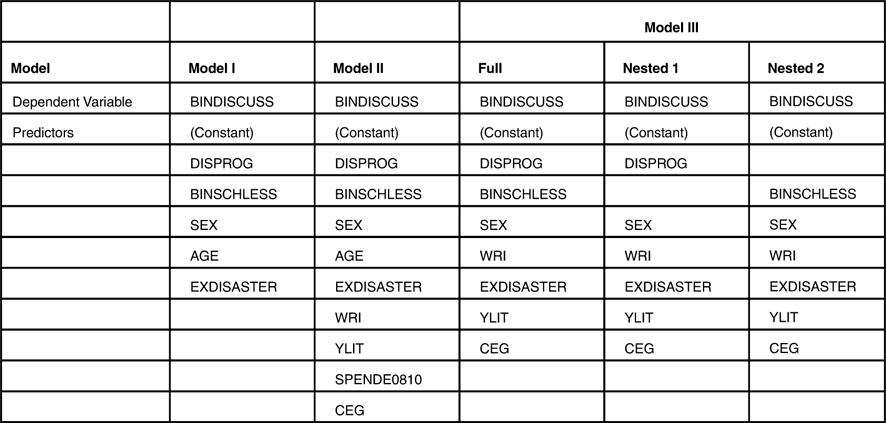
Model I tested the relationship between discussions and disaster program, age, gender, listing of disaster examples, and school lessons. Model II tested the relationship between discussions and additional variables not captured by the questionnaire, that is the country's disaster risk index, economical developmental group, the youth (aged 15-24) literacy rate, and the public spending as percentage of the national GDP allocated to education during 2008-2010.
Since there were two educational interventions tested by the model (school lessons and national educational disaster program), a further series of regression analyses (Model III Nested 1 and Nested 2) were run to test the relationship between discussions about disasters and school lessons, national program, and the country's risk index (Table 1).
Regression Models

Abbreviations: CEG, the country’s economic development classification; DISPROG, the existence of a national disaster educational program; EXDISASTER, examples of perceived disasters; SPENDE0810, spending on education during 2008-2010 as percentage of gross domestic product; WRI, the country’s disaster risk index; YLIT, youth (15-24) literacy rates (%).
A bivariate correlation analysis was used to compare the two nested models between themselves, and their predictive utility was compared using a Hotellings t-test for non-independent correlations.
Results
There were no variables with more than five percent missing values, and there were no patterns identified in the missing data; therefore, those values were considered missing at random and pair-wise exclusion was appropriate.
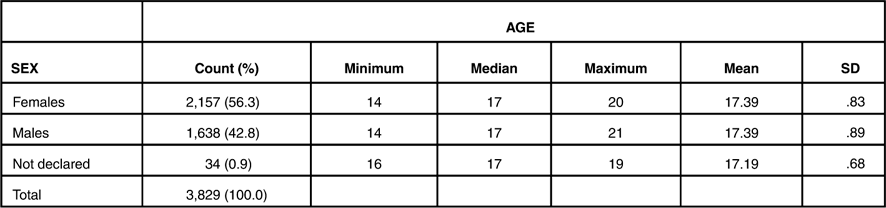
A total of 3,829 valid questionnaires were analyzed from Bahrain, Croatia, Cyprus, Egypt, Greece, Italy, Portugal, Romania, and Timor-Leste. General descriptive statistics for age and gender are summarized in Table 2.
Frequencies and Univariate Statistics for AGE and SEX

All valid entries for age (M=17.39; range=14-21; 95% CI, 17.36-17.41; SD=.85) were suitable for further analysis as they plotted along a reasonably straight Q-Q line and the very few outliers did not have any influence on the mean. Three hundred thirty-two respondents (8.7%) recorded no correct example of a disaster, whereas 521 (13.6%) recorded one, 894 (23.3%) recorded two, and 2,009 (52.5%) recorded three. Two thousand two hundred thirty-one (58.3%) reported discussing disasters with friends and/or their families, whereas 967 (25.3%) did not, and 630 (16.5%) did not remember. Only 1,337 (34.9%) took part in school lessons about disasters, 2,023 (52.8%) did not, and 461 (12%) could not remember.
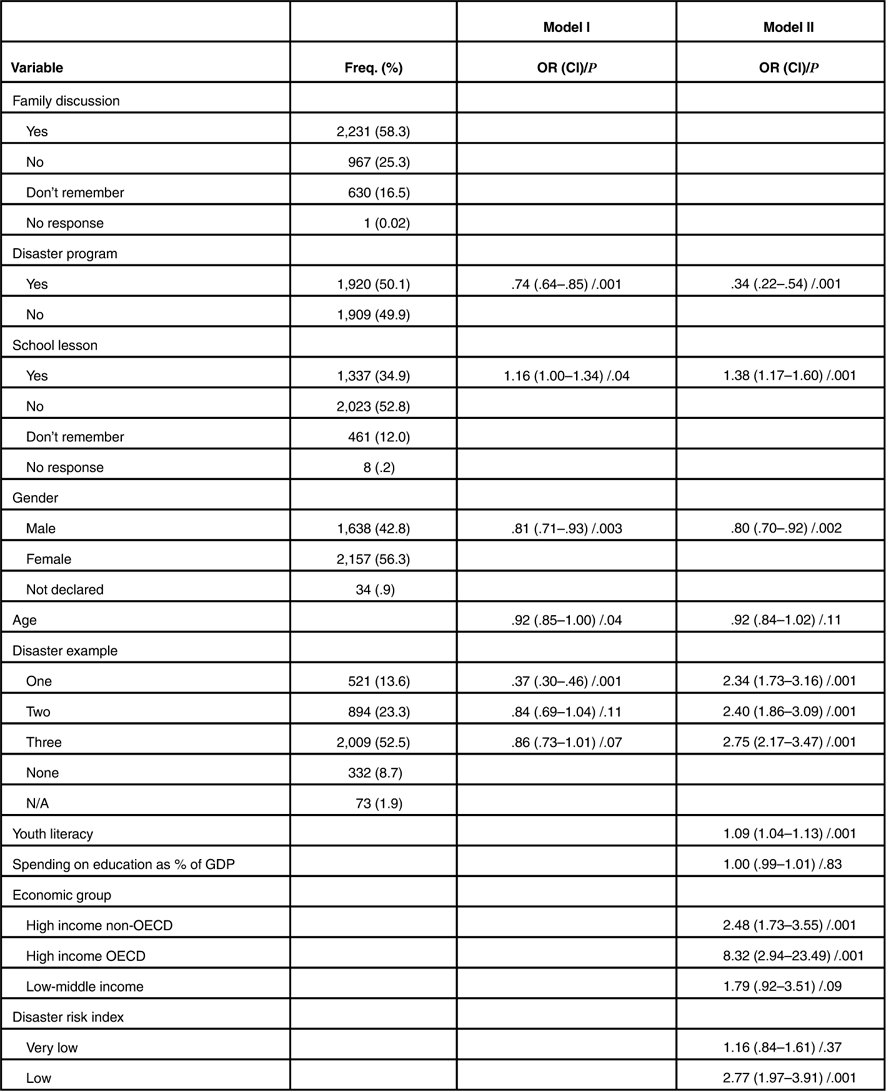
The summary of frequencies and the results of regression analyses are shown in Table 3. Model I did not show any intercorrelation between the dependent variable and the predictors as the multicollinearity test returned tolerance values between .923 -.966. The model was statistically significant, χ2 (7, N=3,753)=110.900; P<.001, and was able to distinguish between students who reported having had discussions about disasters and those who hadn’t. The model explained between 2.9% (Cox and Snell R square [CSR]) and 3.9% (Nagelkerke R square [NR]) of the variance in discussions about disasters, and correctly classified 61.7% of cases. All of the independent variables made a unique statistically significant contribution to the model, the strongest predictor being participation in school lessons.
Summary of Frequencies and Results from the Regression Analysis of Model I and Model II

Abbreviations: CI, confidence interval; GDP, gross domestic product; N/A, not applicable; OECD, Organization for Economic Co-operation and Development; OR, odds ratio; P, significance value.
Although Model I was statistically significant when compared to the non-predicted model (overall percentage of 61.7 compared to 58.5), a new model was tested incorporating youth literacy, country disaster category, country’s economic group and disaster risk index, and expenditure on education (Table 1). Model II was also statistically significant, χ2 (14, N=3,753)=245.673; P<.001, and explained between 6.3% (CSR) and 8.5% (NR) of the variance in discussions, correctly classifying 62.0% of cases and supported by the Hosmer and Lemeshow goodness of fit test (HLT) with a χ2 (8)=9,983; P=.266. All variables made a unique statistically significant contribution to the model, with the exception of age and expenditure, which were removed from subsequent analysis. The strongest predictors were living in a low disaster risk, high income OECD country.
Model III was statistically significant, χ2 (12, N=3,786)= 244.399; P<.001. It returned an R2=.047, F(7; 3,779)=26.768; P<.001 and was supported by a HLT with a χ2 (8)=4.299; P=.829. It explained between 6.3% and 8.4% of the variance in disaster discussions, correctly classifying 62.2% of cases. Nested models were employed to analyze the individual relationship of each educational intervention on the likelihood of discussing disasters. The first hypothesis was that a model not including school lessons (Nested Model 2) would perform as well as the full model. This Nested Model 1 had an R2=.044, F(6; 3,779)=28.766; P<.001, with disaster program and disaster risk index having a unique significant contribution. However, this hypothesis was not supported as this nested model had a significantly lower R2, R2-change=-.004, F(1; 3,779)=14.177; P<.001.
The second hypothesis was that the Nested Model 2 with disaster program removed would perform as well as the full model. This reduced model had R2=.045, F(6; 3,779)=30.564; P<.001. As hypothesized, this nested model performed as well as the full model. The R2-change=-.001, F(1; 3,779)=3.852; P=.05, with both predictors having a significant contribution to the model.
To study the difference in the variance between the nested models, a bivariate correlation analysis was used. The correlations between the models, for Nested Model 1 and Nested Model 2, were ρ1=.208, ρ2=.949, and ρ=.2123, respectively; P<.001. The Hotellings t-test for non-independent correlations returned a t(3,786, P=.05)=.789 and a Z=.79.
Discussion
To the best of the authors’ knowledge, this was the first study which analyzed the relationship between the existence of a national disaster educational program, participation in school lessons about disasters, and a country’s disaster risk rank with reported discussion about disasters with family and/or friends in teenagers. Since the IDNDR declaration, various public and private organizations have developed projects, programs, and activities in an attempt to reduce the disaster informational vulnerability of teenagers. Largely, such efforts have mirrored the initiators' view on disaster education, which, for all intents and purposes, were laudable. Yet, the ultimate effect on such educational activities, namely a change in behavior, has not become overt, nor has it been explored. The current study analyzed a representative sample of teenagers from nine countries, all in the terminal year of state high school education.
Model I supported the hypothesis that disaster education, whether at school or as a national program, together with age, gender, and the ability to list pertinent examples of disasters, are statistically significant predictors for a behavioral change (ie, discussion about disasters with friends and family). The results suggest that teenagers who took part in school lessons were 1.16 times more likely to embark upon such a discussion topic, controlling for all other factors in the model. However, the model explained a very small degree of the variance.
The inclusion of other independent variables in the equation (Model II) returned two significant and counter-intuitive findings. The hypothesis that with increase in age, one’s awareness of one’s surroundings, planning for the future, and foreseeing consequences of events would result in discussions about potential hazards and risks with friends and/or family was rejected as age did not have a unique significant predicting influence. Additionally, the budgetary allocation for education in the countries studied did not have a statistically significant influence on discussions.
Model II indicated that teenagers who lived in a high income OECD and low risk for disaster country, and able to list three pertinent examples of disasters, were more likely to discuss disasters after controlling for all other factors in the model.
Similarly, Model III returned high odds ratios for the same predictors. The result for the predictive value of a low disaster risk country is, again, counter-intuitive, as it would have been expected that living in a high risk area would result in higher levels of discussions. This finding is in keeping with some of the previously published, yet unexplained, data regarding a placid attitude towards disasters of teenagers living in high risk areas, in developed countries.Reference Olympia, Rivera, Heverley, Anyanwu and Gregorits 21 , Reference Shaw, Shiwaku, Kobayashi and Kobayashi 22
While either school lessons or a national disaster education program had a unique significant contribution to the model, neither of the nested models had a better predictive utility.
Limitations
The questionnaire design and the process of data collection were conducted in such a way that significant collusion, external bias, socially desirable responding, and issue position unreliability were controlled for, yet such instances could not be excluded completely. The sampling size was determined by logical extrapolation of the current published data. The exact size of the population studied could not be obtained; however, the sample size was appropriate for even a significantly higher study population. A rigorous random sampling was impossible to achieve owing to the international character of the study.
The primary outcome of disaster discussion is a surrogate measure of behavior change. Whether the participants had better preparation for a disaster situation requires further study.
This study only shows an association between factors and the primary outcome. The true influence of these factors would only be studied definitively using a prospective interventional design, which is unlikely to be feasible in an international study.
There may have been other factors potentially influencing likelihood of disaster discussions which were not studied. These include, for example, access to, and use of, media technology, exposure to disaster situations, local folklore, and self interest in disaster education, as well as others.
Conclusion
The current study suggests that traditional delivery of educational interventions to teenagers might not be adequate and sufficient in obtaining a paradigm shift in their approach to disasters. As the proposed models were only able to predict 62% of cases, further efforts in identifying the elements of this complex concept are required. Future research is needed to better model the factors responsible for a change in behavior towards disaster education and knowledge of the teenage population, and the best methods to deliver such interventions.
Acknowledgements
The authors’ deepest gratitude and thanks are extended to all those who have tirelessly and selflessly given up their time to distribute, invigilate, collect, translate, code, and transcript the survey. In no particular order, and with apologies for any omissions: Dr. Alessandra Revello (Sandro Pertini Hospital, Roma, Italy), Dr. Luca Ragazzoni (Research Center in Emergency and Disaster Medicine, Università del Piemonte Orientale, Novara, Italy), Dr. Stelios Lampakis (NCEMS, Crete, Greece), Dr. Marijana Geets-Kesic (Zdravstvena Škola Split, Croatia), Dr. Steve Photiou (Sant’Antonio Hospital, Padua, Italy), Dr. Atef M. Radwan (Faculty of Medicine, Zagazig University, Egypt), Dr. Andrea Orlandini (Santa Maria Nuova Hospital, Reggio Emilia, Italy), Dr. Francesco Foti (Azienda Regionale Emergenza Urgenza, Regione Lombardia, Italy), Dr. Florentia Zeitouni (Ammochostos General Hospital, Cyprus), Mr. Costas Demetriades (Zephyros Greek School of Greek Language and Culture, Perth, West Australia), Dr. Marcos Agostinho II (CUF Torres Vedras Hospital, Portugal), Dr. Ana Pimentel Silva (USF Gama, Torres Vedras, Portugal), Prof. Teofil Vultur (Colegiul Naţional Matei Basarab, Bucharest, Romania), Prof. Maria Dan (Liceul Dante Alighieri, Bucharest, Romania), Prof. Laura Dumitru and Prof. Cosmina Novac (Colegiul Naţional Octavian Goga, Sibiu, Romania), Prof. Maria Gabriela Dietrich (Liceul Gustav Gundisch, Cisnădie, Romania), Prof. Constantin Vulcu (Liceul Tehnologic Cisnădie, Romania), Prof. Gabriel Octavian Negrea (Colegiul Naţional Gheorghe Lazăr, Sibiu, Romania), Prof. Marinela Violeta Zamfir (Liceul Nicolae Bălcescu, Cluj-Napoca, Romania), Prof. Codruţa Negruţiu (Colegiul Economic Iulian Pop, Cluj-Napoca, Romania), Prof. Carmen Sinc (Colegiul Tehnic Alexandru Domşa, Alba Iulia, Romania), Prof. Ramona Retegan (Colegiul Tehnic Apulum, Alba Iulia, Romania), Prof. Adriana Constantin (Şcoala Gimnazială Mihail Eminescu, Alba Iulia, Romania), Prof. Dr. Steliana Codreanu (Universitatea Babeş-Bolyai, Cluj-Napoca, Romania), and His Excellency Francisco José Dos Remedios Ramos Filipe (Consul General of Timor-Leste in Australia).
Appendix 1. Questionnaire
Disaster knowledge, attitudes, and survival skills in the final year high school population.
A multinational survey.
Abbreviations: M, male; F, female; Y, yes; N, no; DR, don’t remember; DK, don’t know.