Introduction
Research commitments to the study of parasite communities in Kashmir Himalayan waters have received little consideration from ecologists and have been sporadic and inadequate considering the fish wealth of the waters (Shah, Reference Shah2005, Reference Shah2010; Shah & Yousuf, 2007). The outcome of these discrepancies is that comparative datasets are discouragingly incomplete to furnish firm baseline data at the basic infracommunity level, which is considered to be the most appropriate level for comparison between different host species (Kennedy et al., Reference Kennedy, Bush and Aho1986; Kennedy & Pojmanska, Reference Kennedy and Pojmanska1996). Furthermore, detailed analyses of infracommunity structure may well be necessary for understanding helminth community structure at higher levels (Moore, Reference Moore1987). Factors that have been shown to promote the richness of parasite communities include host features such as host body size, age and breadth of diet (Esch et al., Reference Esch, Bush and Aho1990; Poulin, Reference Poulin1995). In addition, numerous studies have indicated that parasite populations and communities may provide insights on the environment that the host inhabits and can be used as potential bioindicators of environmental quality (Wiśniewski, 1958; Esch, Reference Esch1971; Hanek & Fernando, Reference Hanek and Fernando1978a, Reference Hanek and Fernandob; Valtonen & Koskivaara, Reference Valtonen and Koskivaara1994; Valtonen et al., Reference Valtonen, Haaparanta and Hoffmann1994, Reference Valtonen, Holmes and Koskivaara1997, Reference Valtonen, Holmes, Aronen and Rautalahti2003; MacKenzie et al., Reference MacKenzie, Williams, Williams, McVicar and Siddali1995; Bagge & Valtonen, Reference Bagge and Valtonen1996; Rumyantsev, Reference Rumyantsev1997, Reference Rumyantsev2000; Landsberg et al., Reference Landsberg, Blakesley, Reese, McRae and Forstchen1998; Marcogliese et al., Reference Marcogliese, Compagna, Bergeron and McLaughlin2001; Marcogliese, Reference Marcogliese2005; Blanar et al., Reference Blanar, Munkittrick, Houlahan, MacLatchy and Marcogliese2009; Pech et al., Reference Pech, Vidal-Martínez, Anguirre-Macedo, Gold-Bouchot, Herriera-Silveira, Zapata-Pérez and Marcogliese2009). In view of the fact that parasitism can be used as an evaluation metric to assess the trophic quality of lakes, the present study is an attempt to describe the composition and assemblage patterns of parasite infracommunities in some cyprinid fish species inhabiting three lakes of defined eutrophic gradient in the Kashmir Himalayas.
Materials and methods
Study sites
The valley of Kashmir, situated in the midst of the Himalayas between the geographical coordinates of 33°22′07″–34°49′27″N latitude and 73°48′05″–75°35′26″E longitude, is a well-known lake district. The lakes of the region present a gradient in elevation, depth, nutrient status, as well as proximity to human habitations, and range from oligotrophic through mesotrophic to eutrophic lakes. Fish were sampled from three lakes named Anchar (34°07′31″–34°10′11″N and 74°46′23″–74°48′00″E), Dal (34°04′56″–34°08′57″N and 74°49′48″–74°52′51″E) and Manasbal (34°14′38″–34°15′24″N and 74°39′06″–74°41′19″E), which show varying degrees of human-related activity associated with them and lie within the floodplain of the River Jhelum. The three lakes depict different grades of eutrophication – Anchar is a hyper(eu)trophic lake; Dal, a eutrophic lake; and Manasbal, a meso(eu)trophic lake (Zutshi et al., Reference Zutshi, Subla, Khan and Wanganeo1980; Pandit & Yousuf, Reference Pandit and Yousuf2002) – and differ widely from each other in relation to their catchment impacts. While Dal and Anchar lakes are drainage-type with perennial inflow and outflow channels, the Manasbal lake is semi-drainage type with only an outflow channel. Details of the limnology of these water bodies are presented in Shah (Reference Shah2010).
Collection and examination of fish
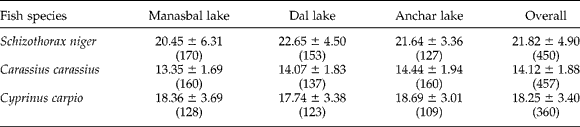
Fish species examined in this study included Schizothorax niger Heckel, Carassius carassius (Linnaeus) and Cyprinus carpio Linnaeus. The former is an endemic lacustrine fish whereas the latter two are exotic. Fish were selected on the basis of their common occurrence in all the three localities and similar feeding habits (Yousuf et al., Reference Yousuf, Firdous, Peerzada and Pandit2002). Fish samples of comparable size-class were obtained from the catches of local fishermen and were examined within 4–8 h of capture. A total of 1267 specimens of the three species were examined for parasites from June 2006 to May 2008 on a monthly basis. Details of size (total length) of the fish species sampled with the number of individuals dissected (N) per species for the purpose of study are presented in table 1. Fish were examined for helminth parasites according to the protocol adopted from Schmidt (Reference Schmidt1992). In the laboratory, fish were measured (total length) to the nearest millimetre and examined externally, including the mouth and gill chamber, for ectoparasites or any type of metacercariae, using a hand lens. After external examination, fish were eviscerated and gills, digestive tract and associated organs were removed. Gills were kept in Petri dishes containing physiological saline (0.90% w/v of NaCl) and slightly teased using a brush to detach any adhering parasites. Thereafter, the alimentary canal of each fish was opened longitudinally in Petri dishes containing physiological saline. Its contents were then removed and checked carefully for parasites. Living parasites were kept briefly in physiological saline, cleared and identified using the methodology and the keys provided in Fotedar (Reference Fotedar1958), Yamaguti (Reference Yamaguti1958, Reference Yamaguti1959, Reference Yamaguti1963a, Reference Yamagutib), Kaul (Reference Kaul1983, Reference Kaul1986), Fayaz & Chishti (Reference Fayaz and Chishti1994, Reference Fayaz and Chishti2000) and Ara et al. (Reference Ara, Khan and Fayaz2000).
The total body length (mean ± SD) in centimetres of three fish species from lakes Manasbal, Dal and Anchar from June 2006 to May 2008; in parentheses, number of fish examined (N).

Data analysis
The level of parasite infection was assessed according to the terminology outlined in Bush et al. (Reference Bush, Lafferty, Lotz and Shostak1997). Helminth community structure was studied at infracommunity level, which included all the infrapopulations within an individual host. As a measure of diversity, the following descriptors were used: mean number of species/fish (infected only), mean number of species/fish (all fish), mean Brillouin's index/fish (infected only) and mean Brillouin's index/fish (all fish). Data on individual hosts are essential for an analysis of diversity; therefore, indices were calculated for infected fish only, as well as for all fish (Kennedy et al., Reference Kennedy, Bush and Aho1986). Brillouin's index was selected as it is the most appropriate index for fully surveyed communities (Pielou, Reference Pielou1975), and each host represents a fully surveyed community. The calculation of indices was performed following Washington (Reference Washington1984). The SPSS software (Statistical Package for Social Science) version 12.0 for Windows (SPSS Inc., Chicago, Illinois, USA) was employed for data entry and statistical analysis. In the majority of the host–parasite systems analysed in this study, there was an indication of change in abundance patterns of parasite species along the seasonal gradient of water temperature. Therefore, inter-lake comparisons were based on all data combined for the whole investigation period so as to present a general picture of community structure in each lake, rather than comparing the data from the same or closest months in each year. The Kruskal–Wallis non-parametric ANOVA was used to test differences in total length of fish, species richness and diversity (Brillouin's index) among the localities, and cross-tests between each pair of lakes used the Mann–Whitney non-parametric test. Relationships between various variables were evaluated using a Spearman's rank order correlation. The influence of host body size (total length) on helminth abundance was also examined. To assess the generality or repeatability of community structure across the localities, pairwise interspecific associations (i.e. Spearman correlations between the number of individuals of each parasite species in a host sample) between the most common helminth species, excluding fish that did not harbour at least one of the two species in a pair, were explored according to Vidal-Martínez & Poulin (Reference Vidal-Martínez and Poulin2003). The significance of all statistical analyses was established at P values < 0.05.
Results
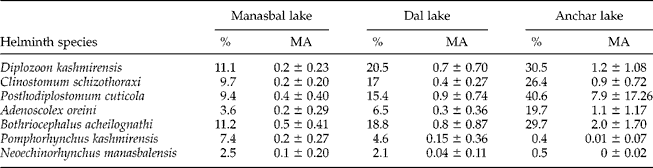
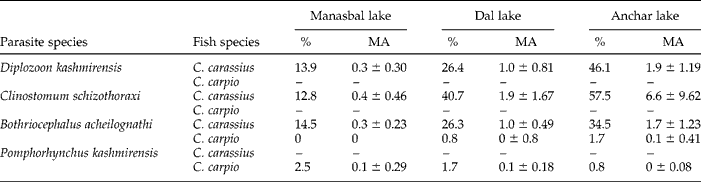
A total of seven metazoan parasite species were recorded during the study period. These included three trematodes: Diplozoon kashmirensis Kaw, Clinostomum schizothoraxi Kaw and Posthodiplostomum cuticola Dubios ( = Neascus cuticola Nordmann); two cestodes: Bothriocephalus acheilognathi Yamaguti and Adenoscolex oreini Fotedar and two acanthocephalans: Pomphorhynchus kashmirensis Kaw and Neoechinorhynchus manasbalensis Kaw. No nematode parasite was reported from any of the fish specimens collected from the three lakes. Data on prevalence and mean abundance of different helminth species in different fish hosts are depicted in tables 2 and 3.
The prevalence (%) and mean abundance (MA ± SD) of helminth parasites in Schizothorax niger from lakes Manasbal, Dal and Anchar from June 2006 to May 2008.

The prevalence (%) and mean abundance (MA ± SD) of the helminth parasites in Carassius carassius and Cyprinus carpio from lakes Manasbal, Dal and Anchar from June 2006 to May 2008.

Schizothorax niger
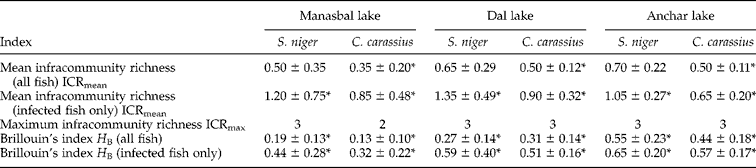
Overall, the host body size was significantly correlated with the total parasite abundance (r S= 0.284, P= 0.018). The infracommunity in this fish had a maximum of three parasite species in all the three lakes. The overall percentage of infected fish was higher in Anchar lake (68.7%) followed by Dal lake (46.4%), whereas the fish from Manasbal lake (34.5%) were the least infected with parasites. On the contrary, the percentage of zero infections was the highest in Manasbal (65.5%) followed by Dal (53.6%) and Anchar (31.3%). Furthermore, the fish population from Anchar lake harboured a higher proportion of triple (25.1%) and double (31%) species infections than the fish from either Dal (9.2 and 24.8% for triple and double species infections, respectively) or Manasbal (3.7 and 17% for triple and double species infections, respectively). Overall, the percentage of single species infections was higher in Manasbal (13.8%) compared to Dal (12.5%) and Anchar (12.6%). Thus, the frequency distribution of co-existent helminth infections reveals that the most frequently encountered infracommunity richness in fish from all the three lakes was two species, followed by three species in Anchar, and one species in both Dal and Manasbal. The overall mean infracommunity richness (ICRmean) of all fish (table 4) did not vary significantly among the lakes, although the value was comparatively lower for Manasbal than both Dal and Anchar (Kruskal–Wallis test, H= 3.807, df = 2, P= 0.149). Data on ICRmean of infected fish only (table 4) revealed the highest values for Dal, followed by Manasbal and Anchar, the differences were significant (Kruskal–Wallis test, H= 7.044, df = 2, P= 0.030). A positive relationship was found between ICRmean (all fish) and ICRmean (infected fish) in all the lakes; however, the correlation was significant only in Manasbal and Dal (r S= 0.859, P< 0.001 in Manasbal; r S= 0.418, P= 0.042 in Dal; r S= 0.274, P= 0.229 in Anchar).
Diversity indices of the helminth infracommunities of Schizothorax niger and Carassius carassius from lakes Manasbal, Dal and Anchar from June 2006 to May 2008.

Values are expressed as mean ± SD; * values significant at P< 0.05.
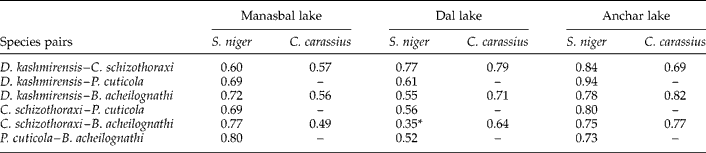
The mean Brillouin's index (H B) for all fish (table 4) indicated low infracommunity diversity in Manasbal lake and high in Anchar lake. Inter-lake differences were significant (Kruskal–Wallis test, H= 31.926, df = 2, P< 0.001). Considering infected fish only, the Brillouin's index depicted the same trend (table 4) and the inter-lake differences were statistically significant (Kruskal–Wallis test, H= 10.546, df = 2, P= 0.005). However, Anchar lake differed significantly only from Manasbal (Mann–Whitney test, U= 101.000, P= 0.001), the differences between Manasbal and Dal, and Dal and Anchar were not significant (Mann–Whitney test, U= 220.500, P= 0.162, and Mann–Whitney test, U= 186.500, P= 0.136, respectively). When lakes are considered separately, the correlation between ICRmean (all fish) and H B (all fish) was highly significant in the three lakes (r S= 0.955, P< 0.001 in Manasbal; r S= 0.774, P< 0.001 in Dal; r S= 0.644, P= 0.002 in Anchar). The correlation between ICRmean (infected fish only) and H B (infected fish only) was also highly significant at all the localities (r S= 0.816, P< 0.001 in Manasbal; r S= 0.716, P< 0.001 in Dal; r S= 0.671, P= 0.001 in Anchar). Among the 21 possible pairwise combinations of helminths, 13 combinations were positively correlated. However, only ten of these pairs had a high degree of significant association in Anchar and Dal, and seven in Manasbal. Pairwise associations between the four most common helminth species are given in table 5. A significant positive relationship was found between pairs of the most common parasite species in the three localities. These pairs were D. kashmirensis–C. schizothoraxi, D. kashmirensis–P. cuticola, D. kashmirensis–B. acheilognathi, C. schizothoraxi–P. cuticola, C. schizothoraxi–B. acheilognathi and P. cuticola–B. acheilognathi.
Pairwise associations among pairs of the most common helminth species for Schizothorax niger and Carassius carassius from lakes Manasbal, Dal and Anchar from June 2006 to May 2008.

All values are significant at P< 0.05 except the one marked with asterisk.
Carassius carassius
Overall, the host body size did not influence the total parasite abundance (r S= 0.192, P= 0.107) as the relationship was not significant. Infracommunities of the three lakes revealed clear differences in that uninfected fish were more numerous in Manasbal (65.2%) than in Dal (39.4%) and Anchar (23.8%). Triple infections were not reported from Manasbal, with a higher percentage of single-species infections (25.2%) than double-species (9.6%) infections. In contrast, three-species infections were higher in Anchar (12.1%) than in Dal (3%), although the proportion of triple infections was much lower than both double- and single-species infections in both lakes. Data revealed significant differences in the infracommunity richness for all fish (Kruskal–Wallis test, H= 10.991, df = 2, P= 0.004) as well as infected fish (Kruskal–Wallis test, H= 10.125, df = 2, P= 0.006) among the water bodies (table 4). The mean infracommunity richness (all fish) varied over a very narrow range between Dal and Anchar, and differences were not significant (Mann–Whitney test, U= 263.000, P= 0.589). However, the results were only significant when infected fish were considered in Dal and Anchar (Mann–Whitney test, U= 151.000, P= 0.004) and between Manasbal and Anchar (Mann–Whitney test, U= 165.000, P= 0.010) but not significant for Manasbal and Dal (Mann–Whitney test, U= 272.000, P= 0.733). Moreover, as only a small proportion of fish from Anchar were uninfected, the mean infracommunity richness for all fish did not differ significantly from the infracommunity richness for infected fish only. There was a significant positive correlation between ICRmean (all fish) and ICRmean (infected fish only) in Manasbal and Anchar, while the correlation was not significant in Dal (r S= 0.718, P< 0.001 in Manasbal; r S= 0.350, P= 0.094 in Dal; r S= 0.670, P< 0.001 in Anchar).
The mean Brillouin's index (all fish and infected fish) was highest in Anchar (table 4) and inter-lake differences were highly significant (Kruskal–Wallis test, H= 36.378, df = 2, P< 0.001, and Kruskal–Wallis test, H= 14.777, df = 2, P= 0.001, respectively). Although the Brillouin's index for all fish differed significantly among the lakes, for infected fish only differences were not significant between Dal and Anchar (Mann–Whitney test, U= 259.500, P= 0.556). Data also revealed positive correlations between ICRmean (all fish) and H B (all fish) in the three lakes but differences were not significant in Dal (r S= 0.718, P< 0.001 in Manasbal; r S= 0.350, P= 0.094 in Dal; r S= 0.670, P< 0.001 in Anchar); while those between ICRmean (infected fish only) and H B (infected fish only) were highly significant in Manasbal (r S= 0.651, P= 0.001 in Manasbal; r S= 0.257, P= 0.225 in Dal; r S= 0.289, P= 0.171 in Anchar). All the three possible combinations of helminths were positively correlated in the three lakes. These include D. kashmirensis–C. schizothoraxi, D. kashmirensis–B. acheilognathi and C. schizothoraxi–B. acheilognathi, and all the three pairs had a high degree of association at all the localities (table 5).
Cyprinus carpio
Infracommunities of C. carpio were very poor. The infracommunity in all the lakes was plainly occasional and comprised only one species (B. acheilognathi or P. kashmirensis) whenever present. The results were not even comparable among the lakes because the species diversity was mostly zero due to the uninfected nature of fish or occasional presence of single-species infections.
Discussion
The results show that parasite infracommunities of the fish examined were not similar and exhibit inter-lake variations, suggesting possible effects of organic enrichment due to eutrophication. Infracommunities were mostly composed of cestode and trematode species, which displayed the highest positive numerical response in Anchar lake followed by Dal and Manasbal lakes. The results agree with the findings of Zander (Reference Zander2004) in that parasites with high infection indices (prevalence and mean abundance) are the most common species at infracommunity level in multi-species infections. Differences in abundance patterns of these helminths, as well as the observed response of their infracommunities, seem to be coupled to nutrient concentration in each of the lakes (Marcogliese, Reference Marcogliese2005). The shallow and highly productive basin of Anchar seems to provide an ideal environment for the local success of these parasites. In this study, it is suggested that the differences in the population density of the invertebrate intermediate hosts of the parasites in the lakes examined are sufficient to reveal the above-mentioned relationship. In a comparative study, Shah (Reference Shah2010) noted a positive effect of eutrophication on the abundance of invertebrate intermediate hosts, such as gastropods, tubificid oligochaetes and copepods, at Anchar compared to Dal or Manasbal. This could account for the differences in prevalence and abundance pattern of these parasites at the three localities. The results also agree with those of Zander & Reimer (Reference Zander and Reimer2002), Johnson et al. (Reference Johnson, Townsend, Cleveland, Glibert, Howarth, McKenzie, Rejmankova and Ward2010) and Vidal-Martínez et al. (Reference Vidal-Martínez, Pech, Sures, Purucker and Poulin2010) in that a species reaches its highest abundance in the habitat where optimal conditions for survival and reproduction exist. According to Lafferty's analysis (Reference Lafferty1997), an increase in abundance of parasites with complex life cycles occurs because of increases in intermediate host density following nutrient-mediated changes in primary and secondary productivity of a water body. Furthermore, it has been shown in a number of studies elsewhere that the density of intermediate hosts significantly influences the rate of parasite infections in fish, i.e. the higher the density, the higher the prevalence (Marcogliese & Cone, Reference Marcogliese and Cone1991, Zander & Kesting, 1996; Zander et al., Reference Zander, Reimer, Barz, Dietel and Strohbach1999, Reference Zander, Reimer, Barz, Dietel and Strohbach2000, Reference Zander, Kocoglu, Skroblies and Strohbach2002; Sandland et al., Reference Sandland, Goater and Danylchuk2001; Zander, Reference Zander2004).
Differences between the numbers of species described from fish in each lake are not pronounced, although patterns with regard to infracommunity structure were identified depending on the grade/degree of eutrophication. Data analyses do not depict vast inter-lake differences in the infracommunity structure of helminth parasites in S. niger and C. carassius in terms of the maximum number of species present in multiple infections, which was mostly three at all the lakes. However, the majority of fish harboured no helminth species in Manasbal and the great majority of infracommunities in Manasbal could thus be described as species poor and exhibiting low diversity. In other words, high proportions of uninfected fish and fish infected only by single species appear to be the characteristic of Manasbal lake. The higher proportion of uninfected fish in Manasbal also suggests that vacant niches in the fish were the norm in the lake. In contrast, a greater proportion of fish were infected at Anchar compared to Dal and Manasbal. The higher proportion of mixed species infections inflated the ICRmean values in Anchar. Thus, infracommunities from Anchar were, on average, richer than those from Dal and Manasbal. This was particularly shown by the Brillouin's index (all fish and infected fish only). Data indicated that the values were higher in Anchar, intermediate in Dal and low in Manasbal. Thus, the Brillouin's index was always low in Manasbal (the least eutrophic lake), confirming the low infracommunity diversity in the lake. The highest values in Anchar (the hypereutrophic lake) for Brillouin's index reflected the presence of more fish with single- and multiple-species infection. It appears that Brillouin's index was the best infracommunity characteristic available in this study and could be employed as an evaluation metric in monitoring the level of eutrophication in other sensitive lakes of the Kashmir Himalayas.
The fish host C. carpio displayed no pattern of community structure whatsoever, due to either its uninfected nature or occasional single-species infection at the three localities. Similar findings were reported by Kennedy & Pojmanska (Reference Kennedy and Pojmanska1996). Data analysis at the infracommunity level showed that the native fish (S. niger) harboured richer infracommunities compared to the exotic ones (C. carassius and C. carpio). Our results agree with those of Guegen & Kennedy (Reference Guegan and Kennedy1993). Poor water quality can promote increased parasitism in fish due to decreased host immune response (Khan & Thulin, Reference Khan and Thulin1991) leading to greater parasite acquisitions. If this is, in fact, the case, it seems that richer parasite infracommunities in fish of Anchar compared to Dal and Manasbal may be due to the bad water quality, which leads to immunotolerance to greater parasite loads in these fish. It has been shown that exotic and native fish compete for food resources (Yousuf, Reference Yousuf, Khan and Pandit1996; Yousuf et al., Reference Yousuf, Firdous, Peerzada and Pandit2002), and the species-poor parasite communities in C. carpio might put them at an advantage when in competition for food and other resources against the native fish.
The results of the present study showed that the host body size had minimal effect on the total parasite abundance. Certainly, we should stress that the different populations of the three fish species used in this study were of relatively uniform or comparable size. This could account for the lack of relationship or consistent pattern between total abundance and body length of the host species under analysis. Thus, host habitat was a good predictor of infracommunity richness, whereas host size was not a significant predictor of infracommunity richness in this study. As regards the pairwise associations between the most common helminth species in the three lakes, a repeatable pattern was found at the three localities. This is in contrast to the findings of Vidal-Martínez & Poulin (Reference Vidal-Martínez and Poulin2003) who observed no spatial and temporal repeatability in the parasite communities of some tropical fish hosts. According to these authors, distances between the localities are an important determinant of predictability in parasite community structure. However, it should be emphasized that we studied a system of three interconnected lakes that lie in the flood plain of the River Jhelum, and included data on total communities. We observed positive pairwise associations between dominant parasite species inhabiting different microhabitats on the host, and interactions between these parasites were not competitive at all. The repeatability of pairwise associations indicates that the fish were exposed to the same local pool of parasites at the three localities. The local success of parasites is, in turn, dependent on the environmental conditions of the lakes. Furthermore, most of the parasites found in pairwise associations utilize the intermediate hosts that generally increase in abundance in eutrophic habitats, and the study observed a higher degree of associations in the highly eutrophic Anchar lake. In this sense, our results support the idea that the associations are repeatable in the three lakes because the helminths are abundant enough in the localities to display generality and the strength of associations varied according to the gradient of eutrophication. Thus, local habitat conditions could be considered as important determinants affecting the repeatability in community structure in the three localities, and our results agree with those of Vidal-Martínez & Poulin (Reference Vidal-Martínez and Poulin2003) in that interspecific associations are not important determinants of species composition for the metazoan parasite communities.
Therefore, it seems that habitat degradation due to organic enrichment and a decline in species richness or species diversity does not necessarily apply to parasite infracommunities of fish, at least at the level of degradation due to cultural eutrophication found in the current study. The fish in Manasbal contained fewer species in infracommunities, most of which were less abundant, reflecting better water quality. In other words, the higher proportion of multiple-species infections in fish may provide clues to habitat degradation in lakes. However, it is important to stress that these interpretations are highly cautionary and it is anticipated that predicting the influence of cultural eutrophication on parasites may become increasingly complex and context-dependent (Marcogliese, Reference Marcogliese2005). Addition of nutrients initially results in an increase in biotic production, including invertebrate intermediate hosts, and leads to an increase in parasitism (Marcogliese, Reference Marcogliese2001). It is likely that with further increase in eutrophication level due to continued inputs of excess nutrients into lakes, water quality may decrease biotic diversity and the availability of different intermediate hosts, and may result in a decline in species diversity of helminth parasites in the lakes. Several workers have agreed that helminth infracommunity patterns are useful tools to monitor the impact of anthropogenic pollution on ecosystems (Lafferty, Reference Lafferty1997; Marcogliese, Reference Marcogliese2005; Pech et al., Reference Pech, Vidal-Martínez, Anguirre-Macedo, Gold-Bouchot, Herriera-Silveira, Zapata-Pérez and Marcogliese2009). Indeed, our results also suggest that differences in helminth infracommunity patterns in fish populations can be utilized as valuable information units to assess the higher scale/grade of eutrophication in lakes, and clearly this is an aspect which merits further study in other Himalayan lakes of this region in the future.
Acknowledgements
We are very grateful to the following people who helped us in different ways until the completion of the work: Professor Azra N. Kamili (Director, Centre of Research for Development, University of Kashmir), Professor M.K. Raina (Ex-Head, P.G. Department of Zoology, University of Kashmir), Ms Bilquees Qadri (Scientific Officer, Centre of Research for Development, University of Kashmir), Ms Sumaira Tayub (Senior Technical Assistant, Centre of Research for Development, University of Kashmir), Dr Sabba Mushtaq (Research Scholar, P.G. Department of Environmental Science, University of Kashmir) and Dr Arshid Jehangir (Assistant Professor, P.G. Department of Environmental Science, University of Kashmir).