Introduction
Bilingual speakers choose their languages differently for monolingual and bilingual interlocutors. If both speakers and interlocutors are bilinguals, they choose the language in which they both are proficient. This raises the possibility that bilingual speakers evaluate the relative proficiency of their interlocutors when they plan their own language. Such adaption into the interlocutor's language has recently been highlighted in the adaptive control hypothesis (Green & Abutalebi, Reference Green and Abutalebi2013). It is important that speakers not only choose a particular language suitable for the interlocutor (e.g., s/he speaks Persian) but also a language in which the interlocutor has greater fluency (e.g., s/he speaks Persian better than English). Although a few studies have revealed that bilinguals tag particular languages with specific interlocutors (Hartsuiker & Declerk, Reference Hartsuiker and Declerck2009; Molnar, Ibáñez-Molina & Carreiras, Reference Molnar, Ibáñez-Molina and Carreiras2015), it remains unexplored if such interlocutor awareness extends to the evaluation of language proficiency. Further, it is not clear how such awareness influences voluntary language selection in bilingual speakers. To demonstrate the influence of interlocutors on speakers' language planning, we performed two experiments with Telugu (L1) – English (L2) bilinguals using a voluntary object-naming paradigm (Gollan & Ferreira, Reference Gollan and Ferreira2009; Gollan, Kleinman & Wierenga, Reference Gollan, Kleinman and Wierenga2014).
Interlocutors can influence bilingual speakers only if the speakers uniquely tag a particular language with them. Bilinguals are sensitive to visual cues such as faces (Woumans, Martin, Bulcke, Assche, Costa, Hartsuiker & Duyck, Reference Woumans, Martin, Bulcke, Assche, Costa, Hartsuiker and Duyck2015) or to an interlocutor's identity which they use to predict a language (Molnar et al., Reference Molnar, Ibáñez-Molina and Carreiras2015; Zhang, Morris, Cheng & Yap, Reference Zhang, Morris, Cheng and Yap2013). For instance, Molnar et al. (Reference Molnar, Ibáñez-Molina and Carreiras2015) familiarized bilingual or monolingual interlocutors to both early and late bilinguals. Later, during an audio-visual lexical decision task, these interlocutors either produced the language used during familiarization or changed their language. Bilinguals benefited in the lexical decision task when the interlocutor's language during the test phase matched with what s/he had used during familiarization. This indicates that the interlocutors' identity primed the language as the bilingual speakers were able to establish an association between interlocutors and their language, further predicting context-appropriate language. Thus, bilinguals could retrieve the language of the interlocutor during the following task. Similarly, culture-specific faces have been shown to influence language planning in bilinguals. Li, Yang, Scherf, and Li (Reference Li, Yang, Scherf and Li2013) demonstrated that, when Chinese–English bilinguals see a Chinese face, they are faster in naming in Chinese but slower in naming in English. Zhang et al. (Reference Zhang, Morris, Cheng and Yap2013) observed that there was disruption of fluency in English during speech production in the presence of a Chinese face when compared to a Caucasian face. Previously, Hartsuiker and Declerck (Reference Hartsuiker and Declerck2009) observed that Dutch–English bilinguals faced more language intrusion errors when they had to utter a sentence in Dutch involving a famous American movie star. Thus, bilingual speakers show high sensitivity towards an interlocutor's language identity.
Bi and multilingualism in India are very different in nature as compared to other western countries where one finds bilingualism (Mohanty & Central Institute of Indian Languages, Reference Mohanty1994; Bhatia & Ritchie, Reference Bhatia and Ritchie2016). Unlike in the West where bilinguals have to interact with a majority of monolinguals, in India, almost all speakers are either bilinguals or multilingual. However, not all Indian bilinguals have similar language proficiency in their L2 (English, as in this study). Therefore, bilinguals need to select the more proficient language of the interlocutor for communication and switch between the languages. This is relevant to our study since our cartoons and the speakers both are bilinguals. Furthermore, the university students we have studied develop much higher fluency in English and display dominance, as shown in our subjective and objective measures. This variable would influence language selection and naming latency. Therefore, in this context, we expected that when participants adapt to interlocutors, they would overcome their language dominance while selecting an appropriate language.
In our experiments, we hypothesize that bilingual speakers evaluate the relative language proficiency of the interlocutors going beyond just tagging a particular language to them. This is particularly important when bilinguals interact with other bilinguals, as is the norm in India. All bilinguals do not have similar proficiency in both the languages. The adaptive control hypothesis (Green & Abutalebi, Reference Green and Abutalebi2013) presumes that bilinguals switch into a different language depending on the communicative demands of the situation. Thus, different kinds of control mechanisms may set in regarding neural efficiency as a function of different interactional contexts. These contexts could involve a single language, dual language or demand random shifting between languages most of the time. Therefore, language management for a bilingual is an outcome of a particular context's demands. While the hypothesis directly links contextual awareness to executive control, it also suggests that bilinguals remain alert and sensitive towards cues that help them choose the correct language. Likewise, Grosjean (Reference Grosjean and Nicol2001) suggests that bilinguals adjust to other bilinguals or monolinguals considering their language proficiency. However, Grosjean's theoretical framework assumes that when a bilingual speaker interacts with another bilingual or monolingual interlocutor, the speaker selects a language for communication, which Grosjean defines as the language mode. In other words, speakers and interlocutors adapt to a particular language for communication.
We explored the cartoon interlocutor's influence on speaker's own language planning. Previous studies with bilinguals indicate that the speakers switch between languages voluntarily during object naming (Gollan & Ferreira, Reference Gollan and Ferreira2009; Gollan et al., Reference Gollan, Kleinman and Wierenga2014). Variables like language dominance and fluency may influence the choices during such a task. In a recent study using this paradigm, Bhatia, Prasad, Sake, and Mishra (2016) showed that task-irrelevant cartoons influenced bilingual speaker's voluntary choice of language. In this study, cartoon characters waved at color patches that were linked to language responses. Previous studies have reported that passive presence of even inanimate agents and their actions influence voluntary choices of agents (Dolk, Hommel, Prinz & Liepelt, Reference Dolk, Hommel, Prinz and Liepelt2013). In another recent study where joint switching task was used revealed that bilinguals who had to name in a single language were influenced by their partner's language switching between two languages (Gambi & Pickering, Reference Gambi and Pickering2013; Gambi & Hartsuiker, Reference Gambi and Hartsuiker2016). This suggests that voluntary action choices are influenced by the knowledge of interlocutor's choices and actions. Given this background, we expect that the cartoon interlocutors may exert influence on the participant's language choice.
Current study
In two experiments, we explored if Telugu (L1) – English (L2) bilinguals were influenced by what they knew about the relative language proficiency of cartoon interlocutors while they freely selected a language to name objects. Participants were familiarized with two types of cartoon interlocutors. The cartoons were introduced either as high or low proficient in English (L2). Each cartoon was presented with pre-recorded speech samples in Telugu (L1) and English (L2). These samples were already rated by a set of bilinguals as high or low fluent in English (L2). These cartoons appeared on the computer screen when participants did a voluntary object naming task. Importantly, the participants did not as such interact with the cartoons during the experiment. It is critical for our study that the participants evaluate the language proficiency of the interlocutors and categorize them. Although bilingualism and proficiency are mostly treated as continuous variables, in this study we made a division between high and low proficient interlocutors. Bilingual researchers have emphasized language fluency (speaking effortlessly in a given language, e.g., Schmidt, Reference Schmidt1992), grammatical accuracy (using the right grammar of the target language, e.g., Skehan & Foster, Reference Skehan and Foster1999) and time lag (the length or number of pauses, e.g., Lennon, Reference Lennon1990) as measures of verbal/oral proficiency of language (Iwashita, Prior, Watanabe & Lee, Reference Iwashita, Prior, Watanabe and Lee2010). Therefore, evaluating an interlocutor as high or low proficient is dependent on the collective judgment on these variables. We operationalized participants' understanding of cartoons based on their subjective responses on a specified questionnaire to the speech samples that they heard from each cartoon in both the languages. Since all the participants themselves were high proficient bilinguals, we reasoned that they would know what another high proficient bilingual would speak like.
We predicted that the speaker's language choice would be influenced by their awareness of the corresponding cartoon's English (L2) language proficiency. Following past studies, (Molnar et al., Reference Molnar, Ibáñez-Molina and Carreiras2015; Martin, Molnar & Carreiras, Reference Martin, Molnar and Carreiras2016; Hartsuiker & Declerck, Reference Hartsuiker and Declerck2009; Woumans et al., Reference Woumans, Martin, Bulcke, Assche, Costa, Hartsuiker and Duyck2015) we expected that participants would learn if the cartoon was low or high proficient English (L2) and this would influence their own language choice. Since our participants were high proficient in Telugu (L1) – English (L2) bilinguals (dominant in English), we expected them to choose English (L2) when the cartoon was also perceived to be a high proficient English (L2) speaker and choose Telugu (L1) when it was perceived to be low proficient in English (L2). In sum, the participants should adapt to the language proficiency of the interlocutor when they plan their own language. In this case, English (L2) proficiency was the main variable since Telugu (L1) proficiency was kept constant across the cartoons. Bilinguals often switch between two languages. Language switching is defined as shifts between two different lexicons belonging to two languages linked to a single concept. For example, when a bilingual see a line drawing of an object in a naming task, two different lexical words become active simultaneously. When a bilingual is asked to voluntarily name the objects in any language, they need to choose one language over the other. On another trial, the selection may go to the other lexical word which was not selected previously. This is technically a shift from one lexical representation to another. In cued object naming tasks, language cues explicitly induce such shifts in different trials (example, Bhatia et al., Reference Bhatia and Ritchie2016; Gollan et al., Reference Gollan, Kleinman and Wierenga2014). Recent studies have demonstrated that patterns of language switching are determined by the level of proficiency or language dominance (Gollan et al., Reference Gollan, Kleinman and Wierenga2014).
In Experiment 1, participants first indicated their language choice explicitly and then named the object. In Experiment 2, participants named the objects directly. Indicating an explicit choice before an action indicates commitment for performing an action. We explored if interlocutor's influence is seen during explicit choice and object naming. Many non-linguistic voluntary task switching studies have incorporated an explicit choice stage (Arrington & Logan, Reference Arrington and Logan2005, Experiment 6; Demanet & Liefooghe, Reference Demanet and Liefooghe2014; Orr & Weismann, 2011). In this “double registration paradigm”, participants first indicate the selection of a task and then execute it. Arrington, Reiman, and Weaver (Reference Arrington, Reiman and Weaver2014) note that “this procedure is thought to allow for better isolation of processes associated with the task selection and task performance” (p. 118 – 119). The mechanisms involved in the selection of a task are different from those involved in the execution of that task. For instance, using a go-no-go paradigm, Philipp and Koch (Reference Philipp and Koch2016) found that language switch costs occurred only when participants articulated the object names (go trials). No switch costs were observed following trials in which a response was prepared but not articulated. Thus, choosing the language and then naming the object can be treated as separate processes. In Experiment 1, we wanted to examine whether the interlocutor has a distinct influence on these two processes. If the interlocutor influences only the language selection stage, then we should not see any effect of the interlocutor on naming latency. However, if both the stages are susceptible to interlocutor's influence then we should see the effects on both the proportion of choices and naming performance.
In the second experiment, participants directly named the object with a language of their choice. This was to explore if the cartoon's influence was direct on the language used for naming without an intervening choice stage. In both the experiments, we measured the percentage of choices of English (L2), switchrate, switch cost and errors. We presented the cartoons in mixed blocks because, in a natural communicative context, a speaker may have to adapt to the language of different interlocutors. We predicted that if speakers adapt to the cartoons, their choice of English (L2) would vary as a function of the cartoon. In turn, switchrate should be higher into the language optimal for the concerned cartoon. We expected the latency in English (L2) to be in general faster than Telugu (L1) since the participants were dominant in English (L2). We also predicted that the speakers would be faster in naming if the language they chose was congruent with the language they linked with the cartoon. Similarly, we expected switch cost to be associated with voluntary naming in both the experiments.
Further, to examine voluntary switching patterns without any external influence, we did two control experiments for each experiment. In these experiments, participants voluntarily chose their languages and named objects. The control experiments were simple voluntary object-naming experiments. We intended to measure the natural switching tendencies of the speakers when there was no influence of interlocutor for comparison. Further, these control experiments were also designed to reveal naming latencies for each language to be compared with the main experiment. We expected that participants would choose English (L2) a greater number of times in these experiments and also expected English (L2) naming latencies to be faster compared to Telugu (L1) considering their dominance in English (L2).
Experiment 1
Methods
Participants
Forty-four Telugu (L1) – English (L2) bilinguals from the University of Hyderabad community (23 male, 21 female, Mean-age = 22.4 years, SD = 2.6 years) participated in the main experiment. All the participants were students at the University of Hyderabad and voluntarily participated in the study by providing their written consent. The study was approved by the institutional ethics committee (IEC) at University of Hyderabad.
Language environment in the University
The lingua franca of the university is English, L2 of all participants. Use of Telugu (L1) is greater than English (L2) in Hyderabad apart from Hindi and Dakshini (a dialect spoken widely by the Muslim population of Hyderabad). Since the University of Hyderabad is a big research university of national importance, most students who come here are fluent in English (L2) apart from their mother tongues. However, we selected only speakers who had Telugu (L1) as their first language. All the teaching and instruction at the university is in English, which also influences the choice of language during conversations.
Control tasks
The Lextale test (Lemhöfer & Broersma, Reference Lemhöfer and Broersma2012), which is an online vocabulary test, was administered to measure proficiency in English (L2). Participants' mean score on the Lextale test was 76.7%, (SD = 9.12%). A semantic fluency task was administered to adjudge the language fluency of the participants in Telugu (L1) and English (L2). In this task, speakers were asked to produce as many words as they could in two different categories. For word generation in Telugu (L1), we chose the categories “vegetables” and “birds”, and for English (L2) “fruits” and “animals”. Categories were counter-balanced between languages. We calculated the number of words produced per minute in each language for each category and the scores were averaged out for two categories for each language. Participants' semantic fluency score in English (L2) (M = 13.31, SD = 2.14) was significantly higher than Telugu (L1) (M = 12.52, SD = 1.88), t(1, 43) = 3.47, p < 0.001.
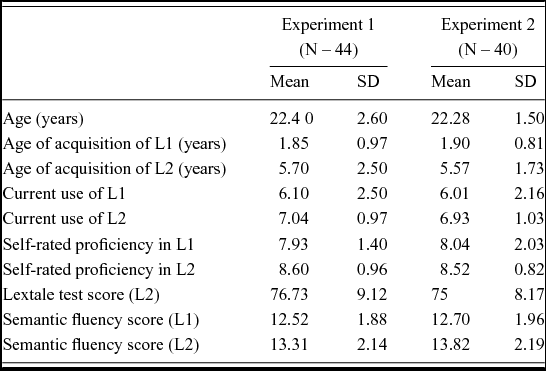
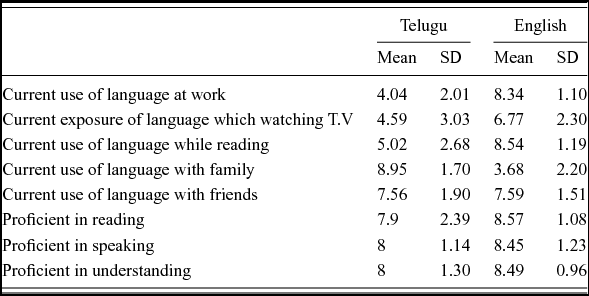
We administered a language questionnaire to measure demographic details and language (L1 and L2) related data from the participants. It consisted of questions regarding language proficiency, current use of language, age of language acquisition (Table 1, 2). We calculated the composite score for each language based on the questionnaire data (e.g., Ma, Chen, Guo & Kroll, Reference Ma, Chen, Guo and Kroll2017) by taking the sum of the z-scores of each language proficiency measure (semantic fluency, self-rated proficiency and self-rated current use of language) and dividing it by the square root of its sum of variances and covariances of each proficiency measure. The participants' composite score in English (L2) (M = 0.01, SD = 2.01) was significantly higher than Telugu (L1), (M = -0.36, SD = 1.3), t(1, 43) = 6.52, p < 0.001. This suggests participants’ higher proficiency in English (L2).
Characteristics of the participants in Experiments 1 and 2

Participants' self-report based on language questionnaire (Experiment 1 & 2)

Stimuli
We selected 160 black and white line drawings each measuring 300 x 300 pixels from Snodgrass and Vanderwart (Reference Snodgrass and Vanderwart1980) as well as Google Images. We avoided objects that shared phonological onsets and those that had multiple names. Twenty Telugu (L1) – English (L2) bilinguals studying at the University of Hyderabad (Mean-age = 23.41 years, SD = 2.60 years) were randomly selected and a language questionnaire was administered to obtain their language profile (Supplementary file: Table 1). The raters were a representative sample of Telugu (L1) – English (L2) bilinguals in the university and did not differ significantly from the participants who had participated in the main experiments on self-rating of language proficiency (English (L2), F(2,101) = 0.34, p = 0.71; Telugu (L1), F(2,101) = 0.10, p = 0.90) (Supplementary file: Table 2). The self-rating scores indicated that raters rated themselves to be proficient and active users of English (L2). These raters rated the images on name agreement, familiarity and frequency of use in both the languages on a 10 point scale (1-lowest and 10-highest). Based on the ratings, 120 images were selected whose average ratings were above 7 (out of 10) (Appendix: 1).
A professional animator sketched four animated cartoons to be used in the main experiment. Four Telugu (L1) – English (L2) bilingual speakers were asked to provide short speech samples in Telugu (L1) and English (L2) to be used along with the cartoons. The videos were created by superposing recorded speech samples over the animated cartoons that made lip movements, and eye blinks. Further, to objectively determine the speakers’ language proficiency in English (L2), a language questionnaire, Lextale, and semantic fluency test were administered to these bilinguals (Supplementary file: Table 3). These bilinguals were categorized into high (1 male, 1 female) and low English (L2) proficient (1 male, 1 female). Ten Telugu (L1) – English (L2) bilinguals rated the speech samples on a 10 point scale for perceived Telugu (L1) and English (L2) proficiency. These raters did not differ significantly from the participants of the main experiments on self-rating of language proficiency (English (L2), F(2,91) = 0.15, p = 0.86; Telugu, F(2,91) = 0.06, p = 0.94) (Supplementary file: Table 1 for language profile; Table 2 for mean values). Average scores were calculated for each speech sample. There was no significant difference between the ratings for speech samples in Telugu (L1) by high (M = 8.10, SD = 0.82) and low (M = 8.30, SD = 0.31) English (L2) proficient speakers, t(1,9) = -0.68, p = 0.50. Whereas, the speech samples in English (L2) by high English (L2) proficient speakers (M = 8.05, SD = 0.81) were rated significantly higher than low English (L2) proficient speakers (M = 3.75, SD = 0.58), t(1,9) = 15.87, p < 0.001. Hence, the perceived proficiency of only the English (L2) speech sample significantly varied between the two types of cartoons.
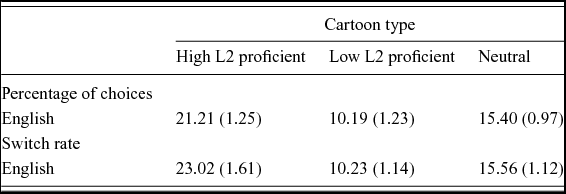
Means and standard errors (in parentheses) of Percentage of language choices and Switchrate across cartoon types – Experiment 1

Each cartoon character was attached with one English (L2) and one Telugu (L1) speech sample. Thus, we created cartoons that could be categorized as either low or high-L2 proficient, as is evident from their speech samples, while Telugu proficiency for all was same. Two more cartoons were sketched (1 male, 1 female) of which no video samples were made. These two cartoons were designated as “Neutral cartoons”, and they were used as interlocutors whose linguistic identity was unknown to the participants. On an average, each video-clip was 40–50 seconds long.
Procedure
For the familiarization phase, participants saw the video-clips of cartoons. Participants listened to both Telugu (L1) and English (L2) speech samples of each cartoon. After the familiarization phase, the participants were given a questionnaire to rate their perceived language proficiency of each cartoon in Telugu (L1) and English (L2) on a 10 point scale (1-low proficient, 10-high proficient). The high-L2 proficient cartoons were rated to be more fluent in English (L2) (M = 8.61, SD = 0.64) compared to the low-L2 proficient cartoons (M = 4.05, SD = 0.60), t(1,43) = 36.84, p < 0.001). However, the ratings for Telugu (L1) proficiency did not differ between the cartoons (p = 0.23). Ninety-one percent of the participants reported that speech samples of cartoons were perceived as having low proficiency in English (L2) and made many language errors along with delayed speech, repetitive words and incorrect pronunciation of words in English (L2). During the main experiment, only the image of the cartoons appeared without their corresponding speech samples. This was done to see if the participants could tag a particular language with the cartoons based on the familiarization and if this knowledge influenced their language choice.
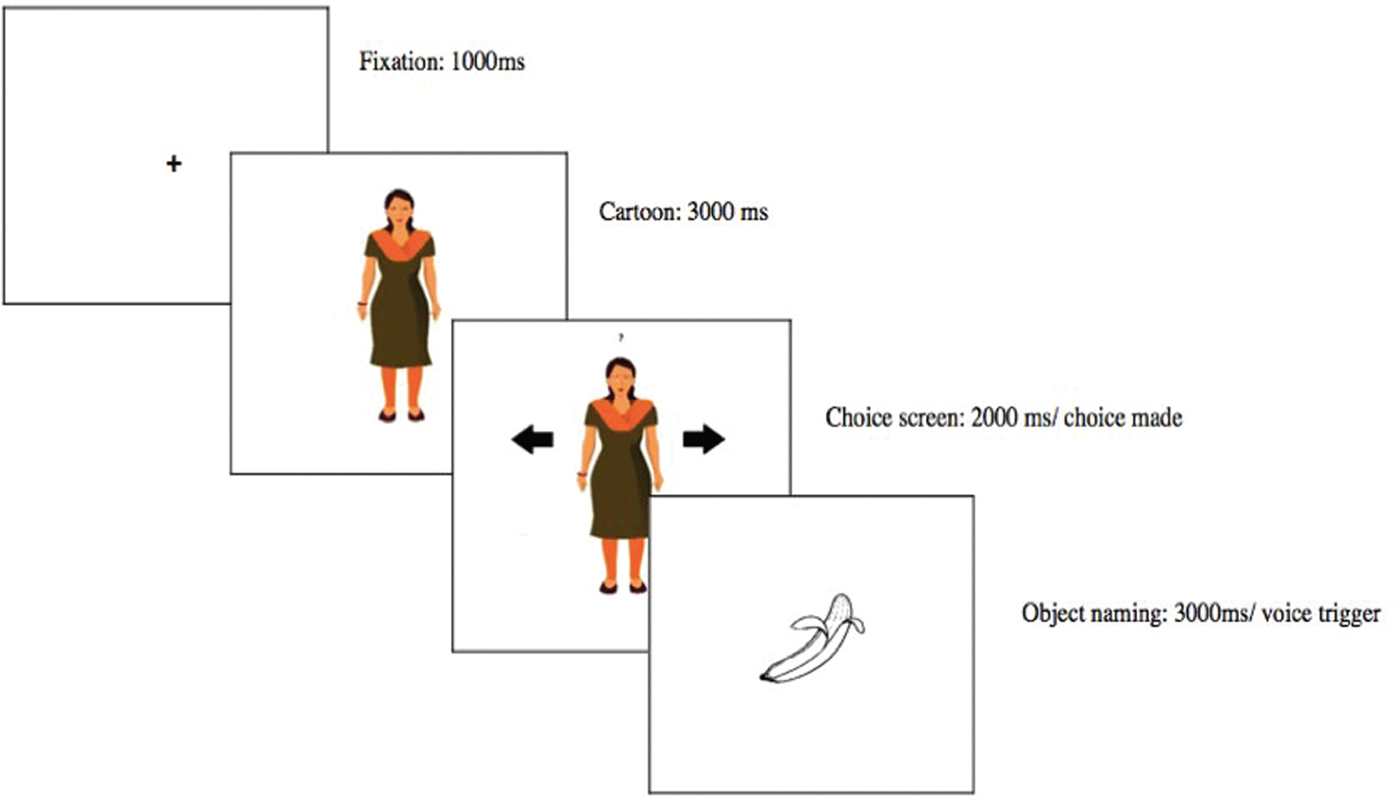
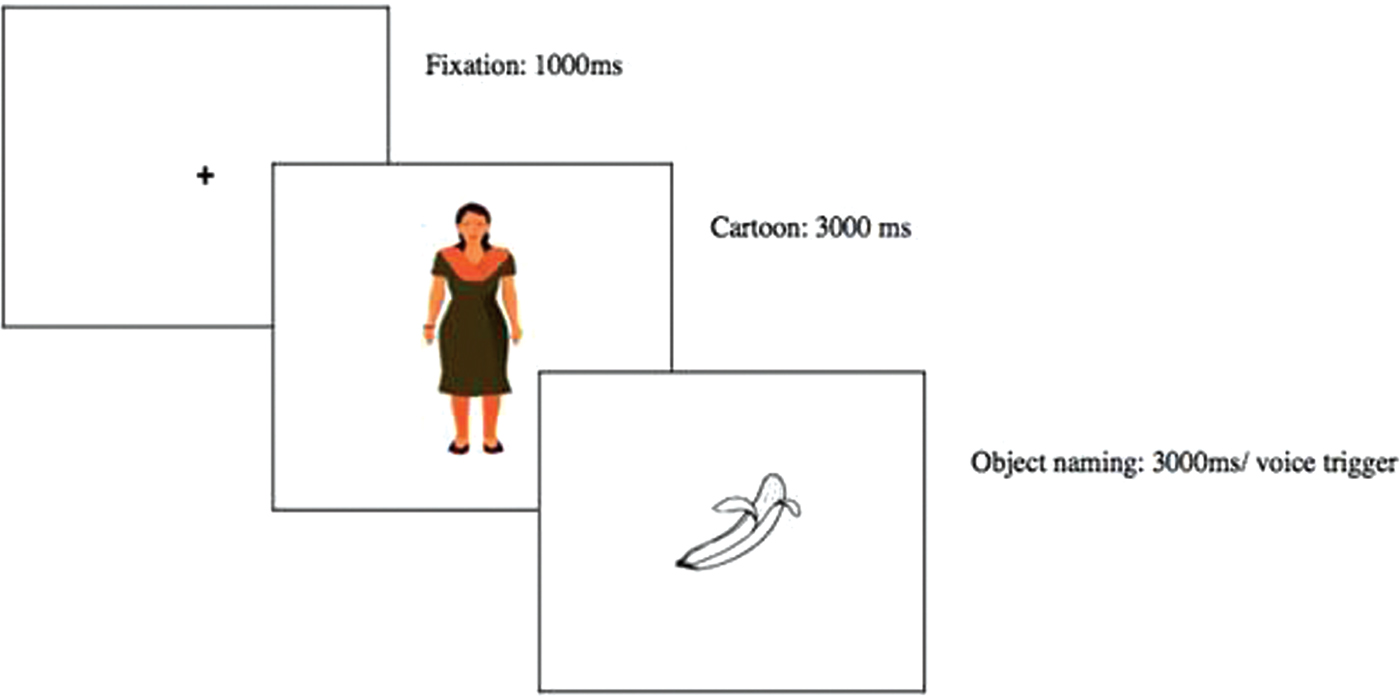
The stimuli were presented using DMDX software developed at the University of Arizona by J.C. Forster (Forster & Forster, Reference Forster and Forster2003) version 5.1.1.3 with DirectX 9.0 on a 19" DELL square monitor with 1280 x1024 pixel resolution and 60 Hz refresh rate. Participants were comfortably seated on a chair at a distance of 75 cm from the monitor. Manual and verbal responses were recorded by DMDX through a button press and voice trigger using-ball M-27 table microphone. Every trial started with a fixation cross at the center of the screen for 1000ms, followed by an image of the cartoon for 3000ms. Then a choice screen was displayed till key-press or for a maximum duration of 2000ms. After the key-press, a picture to be named was presented at the center of the screen. The object disappeared as soon as the voice key registered a response or stayed for a maximum of 3000ms (Figure 1).
Schema of Experiment - 1 with explicit choice before picture naming task.

Speakers pressed “left-arrow” or “right-arrow” keys for indicating choice of Telugu (L1) or English (L2) respectively. This mapping was counter-balanced across participants. An intertrial interval was included for 1000ms. The participants were instructed to make a language choice as a response to the cartoon (that is, what language would they choose if they were to speak to the cartoon) and name the given objects. The participants were also asked to choose freely and spontaneously but maintain balance in choices between the languages (e.g., Arrington & Logan, Reference Arrington and Logan2004; Reference Arrington and Logan2005). Verbal responses during object naming were recorded using audacity-win-2.0.5.
Twenty-four practice trials were presented before the main experiment, and the stimuli pictures in the practice trials were not repeated in the main experiment. The whole experiment took about one hour including the control tasks. Participants were given breaks in between the sessions. The experiment consisted of 120 trials, with 40 trials for each cartoon condition. Cartoons appeared randomly for each participant during the experiment.
Data analysis
The data was filtered before the analysis. 0.5 % of the trials were discarded due to delayed manual responses during language choice (reaction times greater than 2000ms). Reaction times of verbal responses smaller than 150ms were discarded (1.37% of trials) due to auto triggering of voice key or nonverbal responses. Further, 4.63% of the trials were excluded, if the participants' verbal response time was greater than 3000ms during object naming or if there was no response. Additionally, trials were excluded if the participants made object-naming errors (4.01%) (named the objects wrong) or language-errors (7.83%) (trials on which the participant chose a language during explicit choice but named in the other). Error analysis was performed on the language-errors and object-naming errors (the verbal responses over 3000ms were also included). Overall 16.99 % of the data was filtered out. On the remaining data, the following analysis was performed.
Results
Language choice
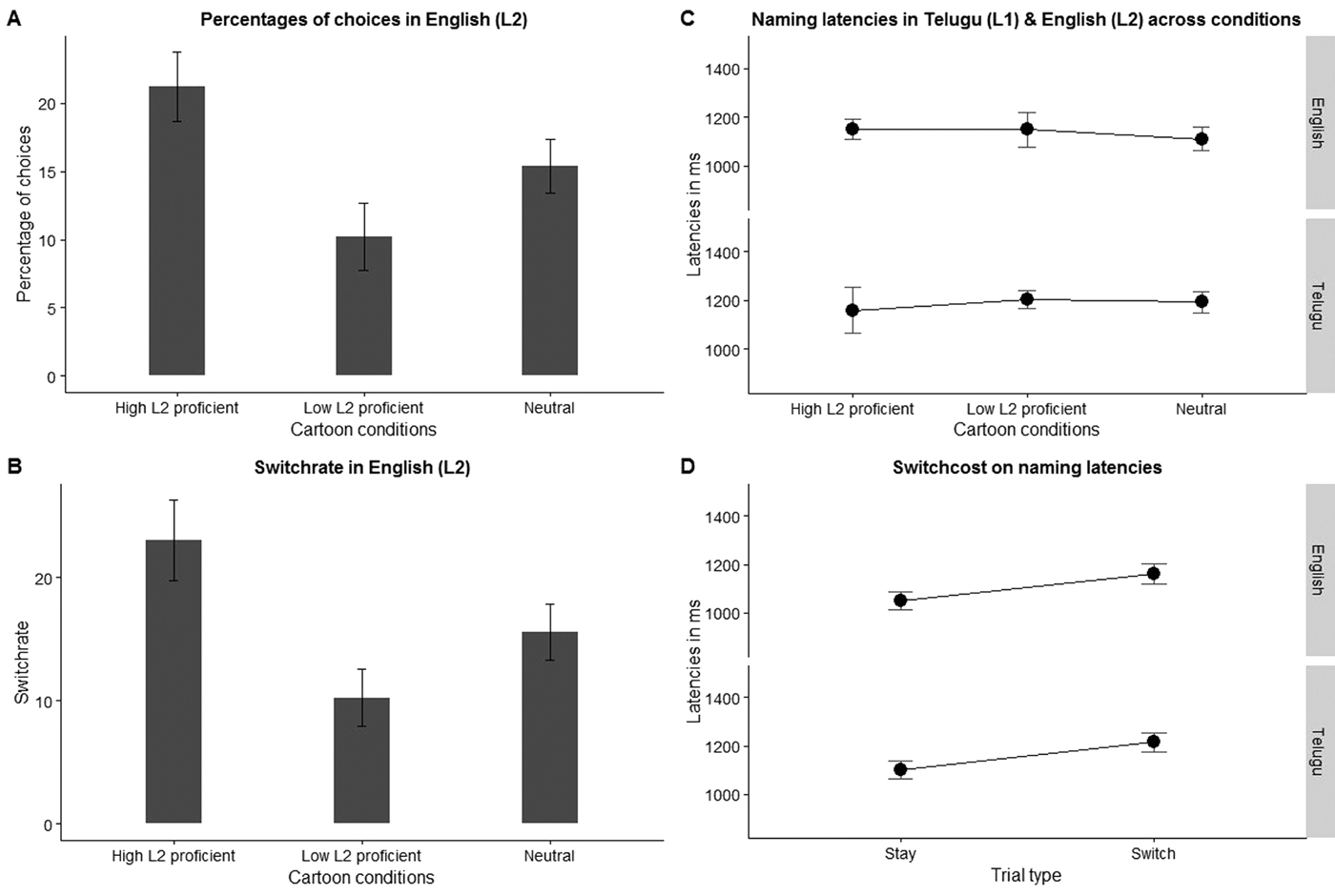
We calculated the percentage of language choices in English (L2) by dividing the total number of language choices in English (L2) by the total number of trials. We chose to do this since English (L2) was the dominant language of the participants. Single factor ANOVA was performed on the percentage of choices in English (L2), and cartoon type (high-L2 proficient, low-L2 proficient and neutral). Percentage of language choices in English (L2) significantly differed for cartoon types, F(2,129) = 22.55, p < 0.001, n2 = 0.06. Post hoc comparisons using Tukey HSD test showed that the participants chose English (L2) significantly higher number of times when they perceived the cartoon as high proficient in English (L2) (M = 21.21%, SE = 1.25%) compared to when the cartoon was perceived as low proficient in English (L2) (M = 10.19%, SE = 1.23%, p < 0.001) or neutral (M = 15.40%, SE = 0.97%, p = 0.002). Participants also selected English (L2) a greater number of times in the presence of neutral cartoons (M = 15.40%, SE = 0.97%) compared to low-L2 proficient cartoons (M = 10.19%, SE = 1.23%, p = 0.005) (Table 3 and Figure 2A).
Graph A - Participants choose the language that they perceived to be appropriate to the cartoon. Graph B – Language switches were modulated due to the perceived linguistic ability of the cartoons. Graph C – There was no effect of cartoon on naming latencies in English and Telugu. Graph D - Naming latencies on stayed trials were significantly faster than switch trials.

Switchrate
We analyzed switchrate of English (L2) as a function of choice and cartoon types. ANOVA revealed significant differences in the percentage of language switches to English (L2) for different cartoon conditions, F(2,129) = 23.90, p < 0.001, n2 = 0.003. A Tukey post hoc test showed that voluntary switches to English (L2) when the participants perceived the cartoons to be high proficient in English (L2) was significantly greater (M = 23.02%, SE = 1.61%) compared to when they perceived the cartoons to be low proficient in English (L2) (M = 10.23%, SE = 1.14%, p < 0.001) and neutral cartoons (M = 15.56%, SE = 1.12%, p < 0.001) (Table 3 and Figure 2B).
Naming latency
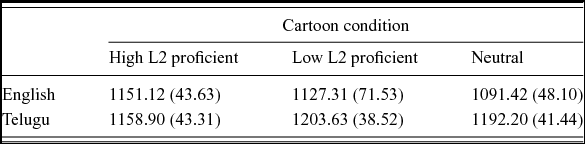
Naming latencies were calculated from the onset of picture to the voice trigger due to verbal responses. ANOVA (subjectwise (F1) and itemwise (F2) with cartoon type (high-L2 proficient, low-L2 proficient and neutral), Language (English, Telugu) and Trial type (stay, switch) as factors, revealed main effect of language with significantly faster naming in English (L2) (M = 1105.22ms, SE = 46ms) compared to Telugu (L1) (M = 1189.49ms, SE = 43.64ms), F1(1,43) = 13.67, p = 0.001, n2 = 0.24; F2(1,119) = 16, p < 0.001, n2 = 0.12. Additionally, latencies were significantly faster in stay trials, (M = 1089.31ms, SE = 43.24ms) compared to switch trials (M = 1200ms, SE = 50.21ms), F1(1,43) = 10.27, p = 0.003, n2 = 0.19; F2(1,119) = 47.13, p < 0.001, n2 = 0.28 (Figure 2D). Participants perceived awareness of cartoon's English (L2) proficiency did not influence naming latency, F1(1,43) = 0.006, p = 0.94, n2 < 0.001; F2(1,119) = 0.01, p = 0.91, n2 < 0.001 (Table 4 and Figure 2C). No other interactions were significant.
Means and standard errors (in parentheses) of naming latencies (in milliseconds) in English and Telugu across cartoon types– Experiment 1

Switch cost
Switch cost was the latency difference between “stay” and “switch” trials. ANOVA with cartoon type and language as factors revealed no main effect either for cartoon type F(1, 43) = 0.58, p = 0.45, n2 < 0.001 or language F(1, 43) = 0.96, p = 0.33, n2 < 0.001, suggesting that switch costs were symmetrical. Also there was no interaction between cartoon type and language F(1,43) = 0.73, p = 0.40, n2 < 0.001.
Errors
For language-errors, there was an effect of cartoon type F(1,43) = 3.00, p = 0.09, n2 = 0.06, or language F(1,43) = 0.68, p = 0.41, n2 = 0.01, on the errors that were related to change of plan. The interaction between cartoon type and language was not significant, F(1,43) = 0.48, p = 0.49, n2 = 0.01. Similarly, neither cartoon type, F(1,43) = 0.47, p = 0.49, n2 = 0.01, nor language, F(1,43) = 0.22, p = 0.64, n2 = 0.001, have any effect on object-naming errors. Cartoon type and language interaction was not significant, F(1,43) = 0.05, p = 0.82, n2 = 0.001.
Control experiment 1
A control experiment was conducted on the same set of participants in order to examine participant's language choice, switching behavior and naming latencies in Telugu (L1) and English (L2) in the absence of cartoons. This was to explore baseline performance without the cartoon's presence. The control and main experiment sessions were counterbalanced across participants.
Procedure
One hundred and twenty line drawn images of objects used in Experiment 1 were presented for naming. Participants were familiarized with the pictures and were asked to freely choose the language to name them. Similar to the main experiment, they were instructed to maintain a balance between the languages when choosing. Pictures were presented in random across participants.
Data analysis
The procedure of data filtering and analysis used in the main experiment was followed. Language errors (5.57%) and object-naming errors (2.98%) were excluded, and error analysis was performed. Additionally, 3.4% of trials were discarded due to no response, non-verbal response or delayed responses.
Results
Language choice and switchrate
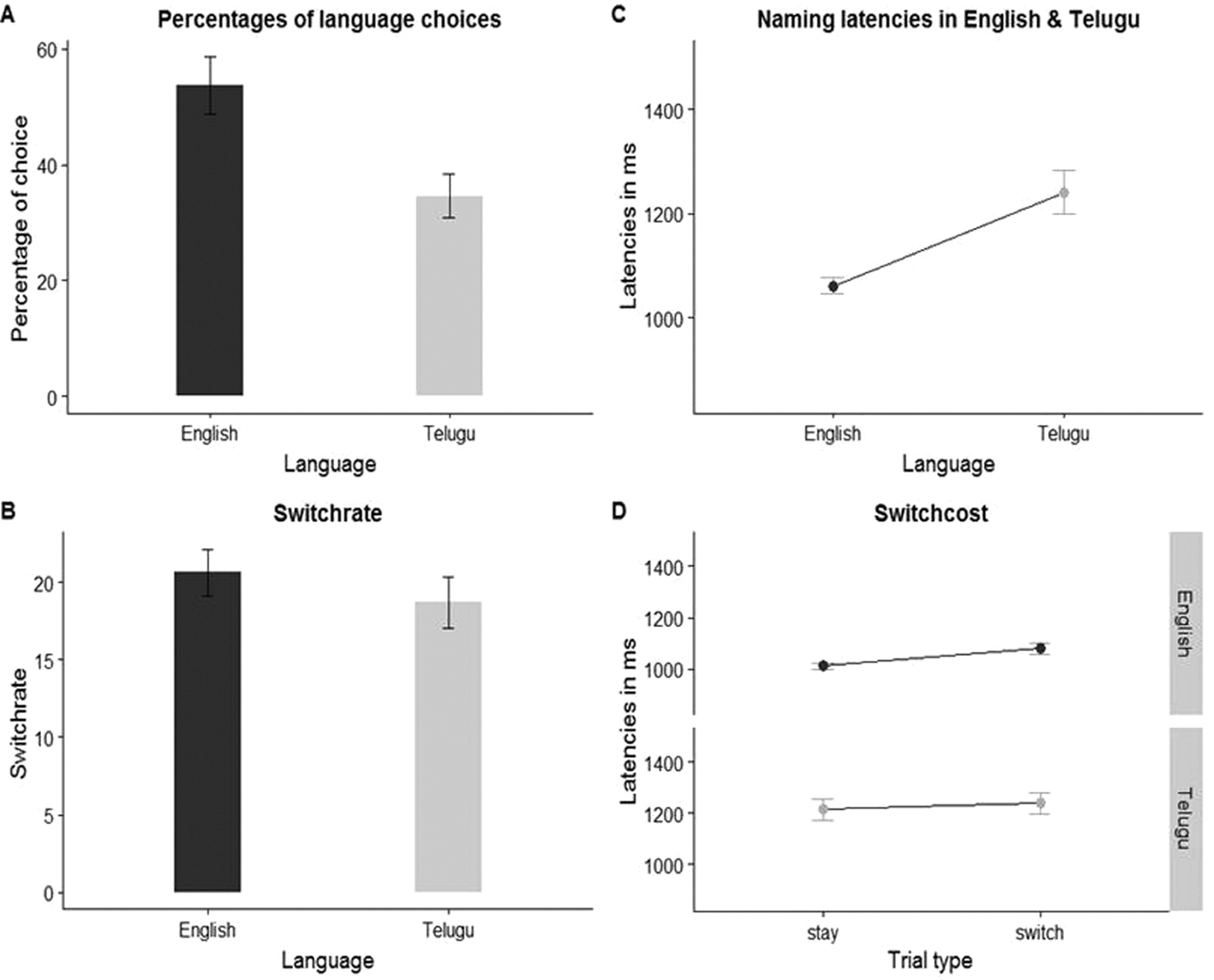
Participants chose to name objects in English (L2) (M = 53.67%, SD = 16.08%) a significantly higher number of times than Telugu (L1) (M = 34.51%, SD = 12.42%); t(1, 43) = 5.11, p < 0.001, d = 0.77 (Figure 3A). Switches to English (L2) (M = 20.63%, SD = 4.86%) were significantly higher than to Telugu (L1) (M = 18.71 %, SD = 5.38%); t(1,43) = 5.17, p < 0.001, d = 0.8 (Figure 3B).
Graph A – Participants choose English significantly higher number of times than Telugu. Graph B – Language switchrate in English was significantly higher than Telugu. Graph C – Naming latencies in English were significantly faster than Telugu. Graph D - Naming latencies in switch trials were significantly higher than the stay trials.

Schema of Experiment 2 trial in without explicit choice.

Naming latency
Naming latencies in English (L2) (M = 1045.94ms, SE = 15.75ms) were significantly faster compared to Telugu (L1) (M = 1231.41ms, SE = 41.75ms), indicating a significant main effect of language, F1(1, 43) = 13.09, p < 0.001, n2 = 0.42; F2(1, 119) = 12.29, p < 0.001, n2 = 0.94 (Figure 3C). Naming latencies for switch trials (M = 1113.36ms, SE = 18.44ms) were significantly higher compared to stay trials (M = 1163.93ms, SE = 20.27ms) revealing a significant main effect of trial type, F1(1, 43) = 23.80, p < 0.001, n2 = 0.17; F2(1, 119) = 26.63, p < 0.001, n2 = 0.18 (Figure 3D). There was a significant two way interaction of language and trial type, F1(1,43) = 2.03, p = 0.01, n2 = 0.18; F2(1,119) = 6.57, p = 0.01, n2 = 0.52. Latency for stay trials in English (L2) (M = 1012ms, SE = 13.52ms) was significantly faster than for switch trials (M = 1079.70ms, SE = 20.01ms, p < 0.001). Latency for stay trials (M = 1214.64ms, SE = 42.18ms) in Telugu (L1) was faster than for switch trials (M = 1248.52ms, SE = 42.59ms, p = 0.3) but the effect was not significant.
Switch cost
Switch cost for English (L2) (M = 67.70ms, SD = 19.19ms) was significantly higher than Telugu (L1) (M = 33.81ms, SD = 7.08ms); t(1,43) = 2.04, p = 0.04, d = 0.30.
Errors
Language-errors in Telugu (L1) (M = 3.26%, SD = 3.26%) were significantly higher than English (L2) (M = 2.31%, SD = 2.41%), t(1,43) = 1.93, p = 0.06, d = 0.04. Similarly, object-naming errors for English (L2) (M = 1.18%, SD = 1.62%) and Telugu (L1) (M = 1.80%, SD = 2.41%) were significantly different, t(1,43) = 1.88, p = 0.06, d = 0.28.
Discussion
In the main experiment, participants’ voluntary language choice was influenced by their awareness of the cartoon's language proficiency in English (L2). When the participants perceived the cartoon as high-L2 proficient, they chose English (L2) a greater number of times compared to when the cartoon was perceived to be low-L2 proficient. This influence of cartoon on participant's choice behavior indicates their adaptation into the cartoon's more fluent language. Thus, switching into English (L2) varied as a function of participants' perceived awareness of second language proficiency. These data provide strong evidence for adaptive control in bilingual language selection in a voluntary naming task as a function of interlocutor awareness (Green & Abutalebi, Reference Green and Abutalebi2013). Participants were faster in naming in English (L2), as they were dominant in this language. This replicated previous studies in voluntary naming where language dominance has been shown to influence choice and latency (Gollan & Ferreira, Reference Gollan and Ferreira2009). Importantly, cartoons did not influence switch cost. Thus, switch cost was symmetrical in the presence of an interlocutor. The control experiment showed that participants often chose their dominant language (English) and were faster in naming. Therefore, the main experiment's results indicate a definite influence of the cartoon on language choice. We investigated if the absence of any effect on latency was due to the choice stage. In Experiment 2, we replicated the experiment without the choice stage, where speakers directly named objects. We were also interested in exploring if interlocutor awareness would influence language choice during naming when participants were not first asked to mention their choice.
Experiment 2
In Experiment 2, we asked participants to voluntary name objects without explicitly mentioning their language choice (there was no explicit choice stage). We predicted that, even in this case, interlocutor awareness would influence language choice. We asked the speakers to maintain a balance between the languages while naming.
Methods
Participants
Forty Telugu (L1) – English (L2) bilinguals, (22 male, 18 female, Mean-age = 22.28 years, SD = 1.5) from the University of Hyderabad community participated in the experiment. All the participants completed the control tasks and language questionnaire similar to Experiment 1 (Table 1). Participants' mean score on Lextale test was 75%, (SD = 8.17%). Their semantic fluency score in English (L2) (M = 13.82, SD = 2.19) was significantly higher than Telugu (L1) (M = 12.70, SD = 1.96), t(1, 39) = 4.08, p < 0.001. Based on the scores obtained on control tasks the participants’ cumulative score for English (L2) (M = 0.02, SD = 0.43), was significantly greater than Telugu (L1) (M = - 0.39, SD = 0.50), t(1,39) = 6.16, p < 0.001.
Procedure
The procedure was similar to Experiment 1. After the familiarization phase, participants rated the cartoons on perceived language fluency. Ratings for English were higher for the cartoons with high-L2 proficiency (M = 8.58, SD = 0.62) when compared to cartoons with low-L2 proficiency (M = 3.99, SD = 0.74), t(1,39) = 34.96, p < 0.001. Ratings for Telugu (L1) proficiency did not differ between the cartoons (p = 0.32). All the participants reported that they were able to understand the content of videos. Ninety-five percent of the participants reported that low-L2 proficient cartoons made many language errors, had delayed speech, had repetitive words and incorrect pronunciations of words in English.
Data analysis
Trials with no response, trials with latencies smaller than 150ms, and trials on which the responses were given after 3000ms were discarded from further analysis (9.01%). Object-naming errors (4.25%) were filtered out and analyzed. Since this experiment did not involve explicit choice, the language in which the object was named was considered as the language participant selected for naming for analysis. ANOVA was performed on the dependent measures and factors explained in Experiment 1 results.
Results
Percentage of responses in English (L2)
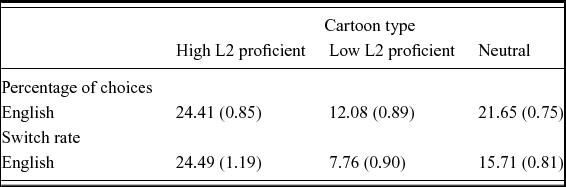
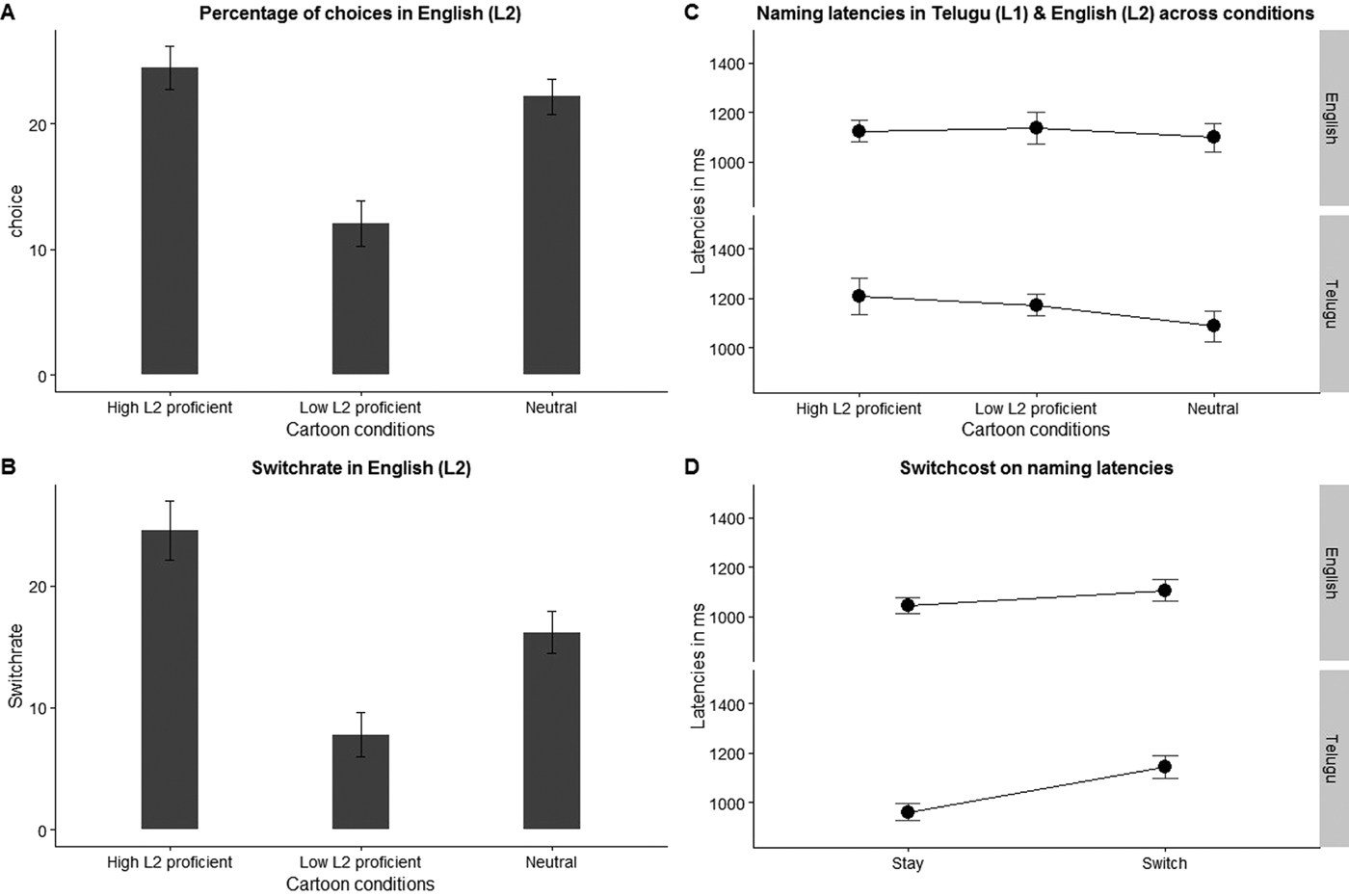
Participants awareness of the cartoon's language proficiency influenced their naming in English (L2), F(2,38) = 60.07, p < 0.001, n2 = 0.67. Tukey test indicated that the participants named the objects a higher number of times in English when they perceived the cartoon as high proficient in English (L2) (M = 24.41%, SE = 0.85%) compared to cartoons perceived as low proficient in English (L2) (M = 12.08%, SE = 0.89%, p < 0.001). The percentage of responses in English (L2) was also significantly higher in the presence of high-L2 proficient cartoons (M = 24.41%, SE = 0.85%) compared to neutral cartoons (M = 21.65%, SE = 0.75%, p = 0.05) (Table 5 and Figure 5A).
Means and standard errors (in parentheses) of Percentage of language choices and Switchrate across cartoon types – Experiment- 2

Graph A – Participants named the object in the language the cartoon was perceived to be proficient in. Graph B – Language switches were modulated according to the cartoon condition. Graph C – There was no effect of cartoon on naming latencies in English and Telugu. Graph D - Naming latencies on stayed trials were significantly faster than switch trials.

Switchrate
Cartoon type also influenced switchrates to English (L2), F(2,38) = 72.05, p < 0.001, n2 = 0.26. Voluntary switches to English (L2) in the presence of low-L2 proficient cartoons (M = 7.76%, SE = 0.90%) were significantly lower compared to high-L2 proficient cartoons (M = 24.49%, SE = 1.19%, p < 0.001) and neutral cartoons (M = 15.71%, SE = 0.81%, p < 0.001) (Table 5 and Figure 5B).
Naming latency
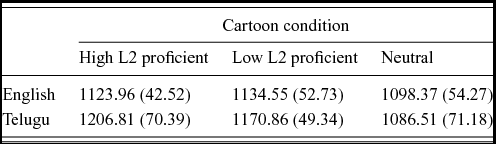
Naming latency was faster in English (L2) (M = 1053ms, SE = 42.23ms) than Telugu (L1) (M= 1117ms, SE= 37.15ms), F1(1,39) = 3.38, p = 0.08, n2 =0.18; F2(1,119) = 0.36, p = 0.54, n2 = 0.02. Additionally, naming latencies faster in the presence of high-L2 proficient cartoons (M = 1039ms, SE = 38.46ms) compared to low-L2 proficient cartoons (M = 1100ms, SE = 42.22ms) and neutral cartoons (M = 1116ms, SE = 39.70ms), F1(1,39) = 5.89, p = 0.02, n2 = 0.05, F2(1,119) = 0.001, p = 0.96, n2 < 0.001. The naming latencies were significantly faster for stay trials (M = 1031.92ms, SE = 33.41ms) than switch trials (M = 1139ms, SE = 42.82ms), F1(1,39) = 14.88, p < 0.001, n2 = 0.34; F2(1,119) = 37.46, p < 0.001, n2 = 0.38 (Figure 5D). Other interactions were not significant (Table 6 and Figure 5C).
Means and standard errors (in parentheses) of naming latencies (in milliseconds) in English and Telugu across cartoon types – Experiment 2

Switchcost
There was no significant main effect of cartoon type on switchcost F(1,39) = 0.78, p = 0.38, n2 = 0.01. Main effect of language on switch cost was marginally significant, F(1,39) = 3.42, p = 0.07, n2 = 0.02. There was no significant interaction between language and cartoon type on switchcost, F(1,39) = 3.01, p = 0.09, n2 = 0.02.
Errors
There was no main effect of cartoon type, F(1,39) = 2.49, p = 0.12, n2 = 0.02, as well as language, F(1,39) = 0.43, p = 0.51, n2 = 0.005, on object-naming errors. There was no significant interaction between cartoon type and language, F(1,39) = 0.53, p = 0.47, n2 = 0.01.
Control experiment 2
The procedure was similar to the main experiment, except for the presence of interlocutors. The control and main experiment sessions were counterbalanced across participants.
Data analysis
Trials where participants gave no response and trials with latencies smaller than 150ms or greater than 3000ms (8.8 %) were discarded. Object-naming errors were 2.9% were discarded and analyzed.
Results
Percentage of responses in English (L2) and switchrate
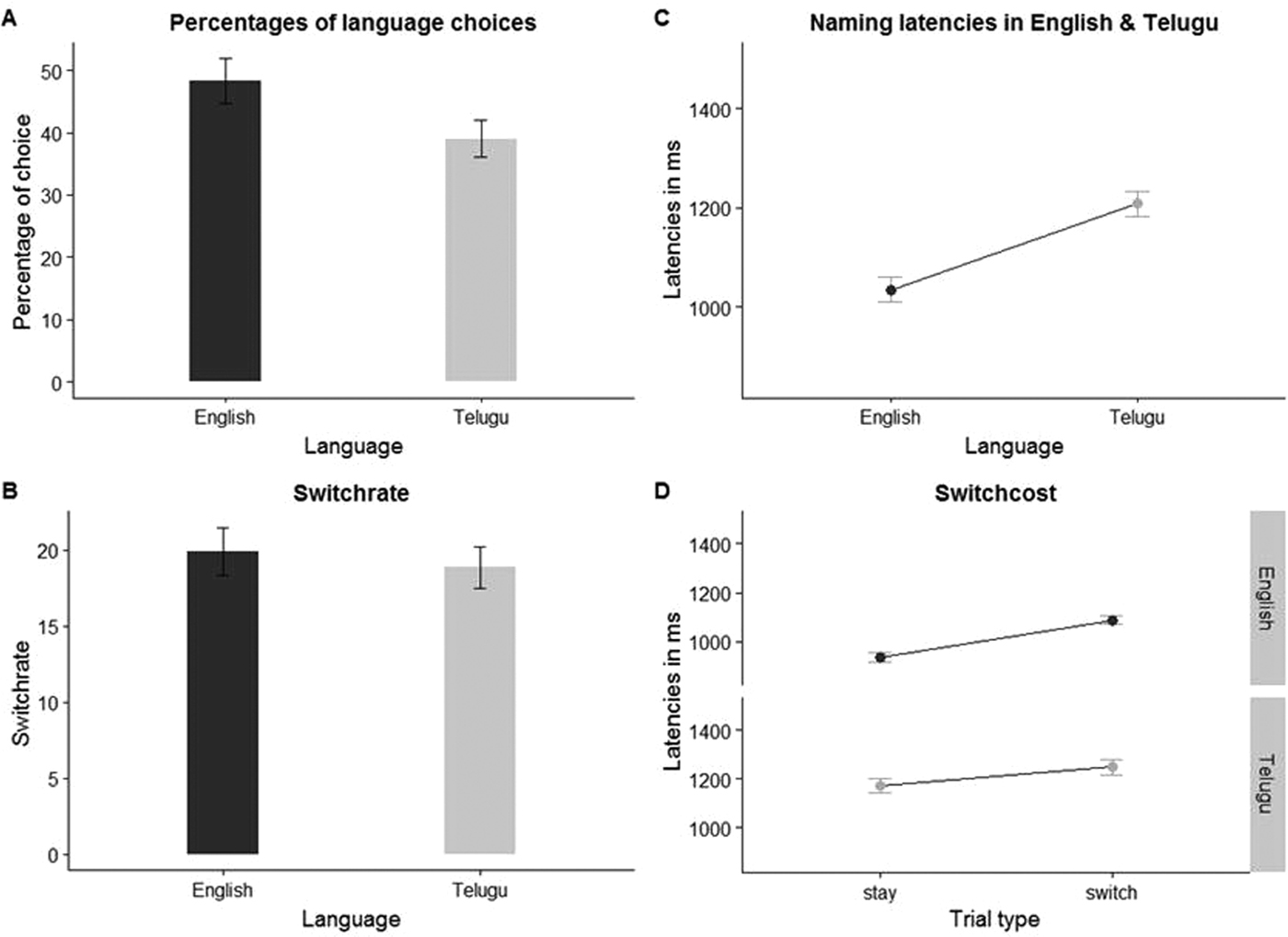
Participants named the objects in English (L2) (M = 48.19%, SD = 11.36%) a significantly greater number of times than Telugu (L1) (M = 38.94%, SD = 9.25%); t(1,39) = 3.14, p = 0.003, d = 0.49 (Figure 6A). Switchrate to English (L2) (M = 19.91%, SD = 4.94%) was significantly higher than Telugu (L1) (M = 18.89 %, SD = 4.27%); t(1,39) = 2.25, p = 0.03, d = 0.36 (Figure 6B).
Graph A – Participants choose English significantly higher number of times than Telugu. Graph B – Language switchrate in English was significantly higher than Telugu. Graph C – Naming latencies in English were significantly faster than Telugu. Graph D - Naming latencies in switch trials are significantly higher than the stay trials.

Naming latency
Naming latency was faster for English (L2) (M = 1012.45ms, SE = 32.75.16ms) than Telugu (L1) (M = 1208.87ms, SE = 38.89ms), F1(1, 39) = 27.94, p < 0.001, n2 = 0.41; F2(1, 119) = 17.46, p < 0.001, n2 = 0.12 (Figure 6C). Latencies for switch trials (M = 1161ms, SE = 36.04ms) were significantly higher than for stay trials (M = 1095ms, SE = 30.59ms), F1(1, 39) = 13.47, p < 0.001, n2 = 0.25; F2(1, 119) = 9.91, p = 0.002, n2 = 0.07 (Figure 6D). There was a significant two way interaction between language and trial type on naming latencies, F1(1,39) = 3.82, p = 0.05, n2 = 0.08; F2(1,119) = 2.47, p = 0.04, n2 = 0.06. Naming latencies on stay trials (M = 998.07ms, SE = 34.69ms) were significantly faster than on switch trials (M = 1097.83ms, SE = 32.76ms, p < 0.001) in English (L2), but the stay trials (M = 1192.84ms, SE = 36.32ms) were not significantly faster than switch trials (M = 1242.40ms, SE = 46.11ms, p = 0.7) in Telugu (L1).
Switchcost
Switchcost for English (L2) (M = 99.01ms, SD = 16.49ms) was significantly higher than Telugu (L1) (M = 49.87ms, SD = 18.65ms), t(1,39) = 2.27, p = 0.02, d = 0.08.
Errors
Object-naming errors in English (L2) (M = 2.62, SD = 1.58) were marginally lesser than Telugu (L1) (M = 2.90, SD = 1.98); t(1,39) = -1.91, p = 0.06, d = 0.35.
Discussion
Even in the absence of explicit choice, participants named the objects in English (L2) more often when they perceived the cartoon as high proficient in English than when it was not. Speakers also choose English a greater number of times when the cartoon was neutral. This can be linked to their being dominant in English (L2). Switchrate was therefore influenced by the presence of the cartoons. However, there was no influence of the cartoon on switch cost in the main experiment. In the control experiment, switch cost was higher when speakers chose to name in English (L2). These data further support the observation that bilingual speakers use their awareness of interlocutor's relative language proficiency to select their own language.
General discussion
In two experiments we examined if bilinguals take into account their interlocutor's English (L2) proficiency in language selection. Our data strongly suggested that the participants were sensitive to the English (L2) proficiency of the cartoon that influenced their language choice. In Experiment 1, when participants had to make an explicit choice before naming the objects, they chose and switched to English (L2) a greater number of times when the high English cartoon was presented. This also suggests that, in spite of being L2 dominant, participants chose and switched to Telugu (L1) more often when the cartoons were low-L2 proficient as opposed to high-L2 proficient. In Experiment 2, when the participants had to name the objects without an intervening choice stage, similar effects were observed for language choice. Importantly, when participants had no idea about an interlocutor, they chose English (L2) a greater number of times. This could be linked to their dominance in English (L2). These results can be taken as evidence for contextual influence on bilingual language choice. During interactions with the cartoons, participants evaluated their relative proficiency in both the languages and tagged a language for the cartoons. This tagged language was the one they perceived the cartoon was more comfortable with. When the cartoon appeared during choice, this language was highly active and influenced the participants' choice of language. We suspect this led to a systematic effect of the cartoons’ presence on language choice behavior. Previous studies showed that language users tag certain language with certain interlocutors (Molnar et al., Reference Molnar, Ibáñez-Molina and Carreiras2015). Thus, our data suggested dynamic adaptation during speech planning in bilinguals. We show how mere knowledge of interlocutors can influence a voluntary task.
Our participants were more dominant in English (L2) than Telugu (L1), which was confirmed in both subjective and objective measures that were administered. Their dominance in English was further corroborated by their short naming latencies of English in control experiments. Probably the dominance led them to choose English a greater number of times when there was a neutral cartoon as no particular language was tagged with that cartoon. This suggests interlocutors influenced the mechanism of language selection, which is otherwise modulated by language dominance. However, participants chose English (L2) a fewer number of times in both the experiments when they saw a cartoon that was low proficient in English (L2) in spite of their dominance in English (L2). A good test of the interlocutor's influence is to check if the participants chose their non-dominant language in the presence of a low L2 proficient cartoon more often when compared to the high L2 proficient, neutral or the no cartoon (control) condition. To examine this we compared the proportion of Telugu choices and naming latency in Telugu (L1) across the 4 different cartoon conditions (high L2, low L2, neutral, control). No effect was found on naming latency. But the proportion of Telugu choices was the highest in the low L2 cartoon condition (Supplementary material: Comparisons between experiment and control experiment). Such data confirmed that in-spite of their natural dominance in English (L2), participants exercised control and selected Telugu (L1) which was appropriate for the cartoon that was low proficient in English (L2). We also observed the cartoon's influence on language switching. Let us assume that there is some internal model of switching which governs frequency of switching behavior in bilinguals. How often and when to switch, when asked to choose and name in any language freely? It has been observed that speakers frequently switched into their dominant language (Gollan et al., Reference Gollan, Kleinman and Wierenga2014). This is what we observed in the control experiments where speakers switched more into English (L2) (their dominant language) and where they were faster. So, we can assume that if there is no requirement of adapting to anyone else, speakers will prefer to use their dominant language. It is important to note that in our experiments, both the speakers and the cartoons were similarly fluent in Telugu (L1). In such a situation, we observed speakers only switching into Telugu when they perceived the cartoons to be less proficient in English. We can conclude that this tendency in language selection is a result of adaption.
It is important to explain why participants seem to be sensitive to the cartoon's language capability when they had a voluntary task to do. It is known that voluntary decision-making requires higher decision making and executive control (Arrington & Logan, Reference Arrington and Logan2004). Choosing freely a language on each trial (with the instruction to maintain a balance between the choices) requires greater top-down control than being cued to name in a particular language. In spite of these constraints, the participants seem to have accommodated the potential interlocutor's perspective. Citing Clark (Reference Clark1996), Green and Abutalebi (Reference Green and Abutalebi2013) write:
‘The prototypical use of language is conversation and conversations are joint actions in which the participants seek to minimize joint effort in achieving a shared situation model (e.g., Clark, Reference Clark1996). Taking this perspective as our point of departure, we considered what we term the ‘‘interactional cost'' as a factor that motivates adaptive changes in control processes’ [pp. 520-521].
This means bilinguals accommodate others' perspectives even when they have their own top-down goals and task-related constraints. Our data supported such a hypothesis and extended it to include instances where bilingual speakers are sensitive to other bilingual speaker's language competency. That they modulated their language to accommodate the interlocutor seemed to be at the heart of shared communication. If that was not the scenario, then bilinguals with different language competency would not be able to communicate with one another. Our data suggested that bilingual speakers are able to include others' perspectives into their own voluntary choices even if it is not an active conversational scenario.
Interestingly, in both the experiments, there was no influence of cartoon on naming latency or switch cost. Switch cost was also symmetrical for both the main experiments. However, when there was no influence of the cartoons, as in the control experiments, we observed asymmetrical switch cost with higher English (L2) switch cost. Based on the inhibitory control model, higher English (L2) switch cost in the control experiments suggests that participants incurred more difficulty while switching to English (L2) because of the higher magnitude of inhibition applied on English (L2) previously. The lack of this asymmetry in the main experiments could then potentially be attributed to the presence of the cartoon. However, it is not clear why the cartoon's presence would lead to symmetric switch costs but not influence naming latencies in any way. The mixed block design of our experiments probably makes it difficult to interpret the switch cost. Since the cartoons appeared randomly, there was a switch between the type of cartoons as well as in the language selected by the participant. Blocking the cartoons might have shown clearer effects. We are considering this for our future experiments.
One of the central proposals of the adaptive control hypothesis (Green & Abutalebi, Reference Green and Abutalebi2013) is that depending on the bilingual context and switching practices bilinguals develop a different type of executive control requirements. Although we did not measure executive control explicitly, it is important to explain why these particular sets of bilingual speakers showed this effect. These bilinguals adapted to both high proficient and low proficient cartoons. It is important to note that our participants were all high proficient Telugu (L1) and English (L2) bilinguals. They had acquired English (L2) early in life and were students at a large research university where lingua franca is English. These bilinguals are shown to have higher executive control than bilinguals with low language proficiency (Singh & Mishra, Reference Singh and Mishra2012, Reference Singh and Mishra2013, Reference Singh and Mishra2015). What would have happened if the participants were low proficient bilinguals? It is interesting to explore the links between executive control and proficiency to the kind of adaption we saw in our experiments. We assume that the high proficient bilinguals will be able to adapt better to others, considering their superior executive control. Further, since they had good competence in two languages, they could choose freely between them when they had to adapt to someone's requirement. It is not clear how a low proficient English (L2) speaker will adapt to a highly proficient English (L2) speaker at the earliest point that s/he may not be able to carry on a conversation in English (L2). In this case, the high proficient participant should inhibit their English (L2) and adapt to facilitate conversation. These intricacies need further experimentation. The Indian context offers a good opportunity to examine these possibilities since one does not find in India any monolingual to contrast with a bilingual, but only bilinguals with different levels of language proficiency. Therefore, the currency of adaption is not just the language of the interlocutor but his/her relative language proficiency. In this case, when speakers see the faces of other potential interlocutors they not only think of what language the person speaks but which language to use with him based on his level of proficiency. Our claims are restricted to those bilinguals who use English (L2) as a second language and who come with divergent proficiency levels in this language. More studies should be done with Indian bilinguals with non-English language combinations.
In sum, our experiments suggest that bilingual speakers remain sensitive towards their interlocutors. This awareness goes beyond just knowing which language the interlocutor was speaking to which language he was good at. Therefore, bilinguals do this sort of mental analysis about speaker's language proficiency when they encounter them. Very interestingly, we found the effects on voluntary choices when the interlocutors did not matter as such. This brings a new angle to the whole question of contextual adaption as far as bilingual control is concerned. We have to remember that this data has come from India, where the practice and reality of bilingualism could be very different from that in other areas. Therefore, the type of influence and control could vary with populations and practices. Nevertheless, we found the influence to be on choices but not on actions themselves (object-naming). We asked the participants to maintain balance during their choice based on standard instructions in voluntary task switching studies (Arrington & Logan, Reference Arrington and Logan2005). We understand that this instruction must have influenced their choice behavior. In this sense, the task could not be called entirely voluntary in nature. Further, a possible limitation could be that we asked speakers to first choose a language and then name the object. This was unlike other studies where participants choose their language upon seeing the object. Future studies should look into such methodological aspects. These factors may have influenced the naming behavior of bilinguals.
Appendix
A1

A2

Supplementary material
To view supplementary material for this article, please visit https://doi.org/10.1017/S1366728918000731