This narrative review aims to provide an overview of the literature examining autism spectrum disorder (also referred to as “autism”) in CHD and discusses strengths, limitations, and future directions. Specifically, we outline studies investigating CHD across several clinical symptoms associated with autism, including the overlap between CHD and neurodevelopmental conditions broadly, the overlap in some domains of the autism phenotype (social cognition, pragmatic language, and social behaviour), symptomatic expression of autism in CHD, and co-occurrence of an autism spectrum disorder diagnosis in CHD (including studies utilising screening-based tools for autism spectrum disorder, children with general congenital malformations, children with CHD in particular, and large-scale population-based retrospective case–control study designs). Underlying biological contributions to the phenotypic expression of CHD are additionally discussed. Important to note is that prior work primarily focuses on social communication differences with an apparent lack of investigation into the presence of restricted interests and repetitive behaviours in CHD, which is a key domain of autism spectrum disorder. This substantially limits our understanding of autism in CHD but also offers an essential area for future investigation.
Congenital Heart Disease
Briefly, CHD is a broad term used to describe a variety of conditions that can vary in severity wherein heart development is atypical. It is the most common birth defect affecting 1 in 100 live births, of whom 20–25% require surgery during infancy. Reference Huisenga, La Bastide-Van Gemert, Van Bergen, Sweeney and Hadders-Algra1 With improvements in surgical outcomes, approximately 95% of children survive into adulthood. Reference Oster, Lee, Honein, Riehle-Colarusso, Shin and Correa2 With increased survival rates, 50% of children who undergo cardiac intervention exhibit neurodevelopmental consequences in childhood and later in life, Reference Huisenga, La Bastide-Van Gemert, Van Bergen, Sweeney and Hadders-Algra1,Reference Bellinger, Wypij and duPlessis3–Reference Verrall, Blue and Loughran-Fowlds6 which subsequently impacts psychosocial well-being and quality of life. Reference Kasmi, Bonnet and Montreuil7–Reference Wilson, Smith-Parrish, Marino and Kovacs9 Causes of CHD are multifactorial, with up to 30% of cases attributed to chromosomal anomalies and other syndromic and non-syndromic genetic disorders, Reference Pierpont, Brueckner and Chung10 which increases symptom heterogeneity among patients with CHD. CHD can also range in severity of presentation with more severe neurodevelopmental outcomes in those with cyanotic (versus acyanotic) and single-ventricle subtypes (see below), and with substantial variability existing among those with syndromic genetic conditions. Reference Pierpont, Brueckner and Chung10,Reference Ko11 Indeed, patients with CHD resulting from a genetic syndrome more often present with developmental or structural abnormalities that contribute to symptom severity secondary to their genetic anomaly that extend beyond those resulting solely from their CHD alone. For example, Down syndrome and 22q11.2 deletion syndrome (the most common genetic syndromes among CHD patients) often have intellectual developmental disorder, and behavioural and psychiatric disorders in the context of their genetic syndrome. Reference Capone, Goyal, Ares and Lannigan12,Reference Kates, Antshel and Fremont13 It is therefore important to consider aetiological factors of CHD when treating or studying this patient population.
In 2012, the American Heart Association recommended surveillance for all children with CHD at risk for developmental delays. Reference Marino, Lipkin and Newburger14 The scientific statement strongly recommended screening for neurodevelopmental conditions through brief standardised assessments, which are critical to determine areas of clinical need to improve optimal outcomes. Additionally, more thorough evaluation and re-evaluation is recommended for those falling in the “high risk” category, or those presenting with factors associated with disease severity and therefore poorer neurodevelopmental outcomes. These include infants requiring open-heart surgery and those with cyanotic heart lesions (a group of heart defects resulting in low blood oxygen levels), among other notable risk factors which are also risk factors for autism spectrum disorder, including pre-term birth, seizures, developmental delays, and genetic abnormalities. Reference Marino, Lipkin and Newburger14–Reference Strasser, Downes, Kung, Cross and De Haan16 The impact of CHD is multifaceted, resulting in acute and long-term medical, neural, neuropsychological, and psycho-social symptomatology, with adverse outcomes extending into adolescence and adulthood. Reference Cassidy, White, DeMaso, Newburger and Bellinger17–Reference Schaefer, von Rhein and Knirsch20
CHD and brain development
Consistent with the presence of neurodevelopmental sequelae, research has identified disrupted brain development, particularly for children with more severe subtypes of CHD and those requiring surgical intervention. Reference Verrall, Blue and Loughran-Fowlds6,Reference Mebius, Kooi, Hard and Bos21,Reference Tan, Semmel, Wolf, Hammett and Ilardi22 Alterations in specific white matter maturation have been identified as early as the second trimester of pregnancy, and more notably during the third trimester, Reference Andropoulos, Ahmad and Haq23–Reference Lauridsen, Uldbjerg and Henriksen27 with overall brain volume and cortex development also being impacted. Reference Lauridsen, Uldbjerg and Henriksen27,Reference Sun, Macgowan and Sled28 Additional studies have found that prior to surgery, full-term infants with complex CHD have smaller and less mature brains corresponding to approximately 35 weeks’ gestation compared to their unaffected peers, Reference Guo, Chau and Peyvandi29–Reference Nattel, Adrianzen and Kessler31 with smaller brain volumes in utero predicting neurodevelopmental outcomes at 2-years-old. Reference Sadhwani, Wypij and Rofeberg32 Such abnormalities in brain development can occur through multiple mechanisms, including underlying genetic and environmental factors contributing to shared risk that impacts concurrent heart and brain development during pregnancy. Reference Brossard-Racine, du Plessis and Vezina33,Reference Khalil, Bennet, Thilaganathan, Paladini, Griffiths and Carvalho34 Additionally, chronic prenatal hypoxia resulting from reduced blood flow and oxygenation to the brain can significantly impact the developing brain. Reference Co-Vu, Lopez-Colon, Vyas, Weiner and DeGroff35–Reference Sanchez, Ruiz-Romero and Dominguez37 Acute brain injury, including stroke and haemorrhage, is also commonly observed in these patients, Reference Verrall, Walker and Loughran-Fowlds38 particularly those undergoing surgical repair. Reference Mahle, Tavani and Zimmerman39–Reference Wypij, Newburger and Rappaport41 In association with these abnormal effects on the brain and its development are the related neurodevelopmental consequences now well documented in CHD, such as cognitive, adaptive, behavioural, speech-motor, and executive functioning difficulties, and comorbid conditions, including autism spectrum disorder and other psychiatric conditions. Reference Nattel, Adrianzen and Kessler31,Reference Brewster, King, Burns, Drossner and Mahle42–Reference Semmel, Dotson, Burns, Mahle and King45
CHD and neuropsychological functioning
Atypical brain development can result in neuropsychological outcomes that can present heterogeneously at different stages of development. Overall, while children with CHD tend to perform in the broadly average range in terms of intellectual functioning, when directly compared to their typically developing peers, overall cognitive scores are slightly lower. Reference Huisenga, La Bastide-Van Gemert, Van Bergen, Sweeney and Hadders-Algra1,Reference Karsdorp, Everaerd, Kindt and Mulder46 This also may depend on severity of CHD type, with those with more critical CHD (e.g., single-ventricle defect), demonstrating lower performance. Reference Huisenga, La Bastide-Van Gemert, Van Bergen, Sweeney and Hadders-Algra1 When examining different aspects of cognition, higher verbal relative to visual-spatial skills are often seen in individuals with CHD. Reference Karsdorp, Everaerd, Kindt and Mulder46 Additional neurocognitive effects include difficulties with attention, working memory, motor functioning, social interaction, language and communication skills, and executive functioning as well as elevated rates of hyperactivity, anxiety/depression, and academic problems, particularly in mathematics. Reference Verrall, Walker and Loughran-Fowlds38,Reference Gaynor, Ittenbach and Gerdes47–Reference Walker, Loughran-Fowlds and Halliday51 For a more comprehensive review of neuropsychological outcomes in CHD, see Cassidy et al. Reference Cassidy, Ilardi and Bowen52
Autism spectrum disorder
Despite the well-established association between a diagnosis of CHD in childhood and the development of neurodevelopmental disorders, Reference Verrall, Blue and Loughran-Fowlds6,Reference Mahle53,Reference Mahle and Wernovsky54 studies are limited in their investigations of autism spectrum disorder in the context of CHD. In contrast to CHD which is anatomically defined, autism is a lifelong heterogeneous neurodevelopmental disability that is defined based on behaviours, including social communicative deficits and restricted interests/repetitive behaviours. 55 Autism spectrum disorder is quite common in the general population, occurring in 1 in 36 children in the United States. Reference Maenner, Warren and Williams56 Often, autism is accompanied by intellectual disability and marked impairment in adaptive functioning and daily living skills. Reference La Malfa, Lassi, Bertelli, Salvini and Placidi57 Further contributing to the heterogeneity in autism is the co-occurrence of other neurodevelopmental disorders (e.g., attention-deficit/hyperactivity disorder) Reference Lee and Ousley58 and psychiatric conditions (e.g., depression and anxiety). Reference Leyfer, Folstein and Bacalman59–Reference Ambrosini62 Medical conditions often also co-occur with autism, with certain medical disorders estimated to be present in 30–50% of autistic individuals (e.g., epilepsy). Reference Strasser, Downes, Kung, Cross and De Haan16,Reference Juneja, Gupta and Thakral63–Reference El Achkar and Spence69 Relevant to the overlap in CHD and autism spectrum disorder is the higher prevalence of general congenital anomalies (organ-system anomalies in particular) in autism relative to non-autistic children, Reference Timonen-Soivio, Vanhala and Malm70,Reference Wier, Yoshida, Odonli, Grether and Croen71 thought to be caused by a combination of genetic and/or environmental factors during fetal development. Reference Khoury72,Reference Ploeger, Raijmakers, van der Maas and Galis73 As such, the heterogeneous presentation of autism in the presence or absence of comorbid neurodevelopmental, psychiatric, and/or medical/genetic conditions confers increased difficulty in accurate and timely assessment and diagnosis of the disorder.
The appropriate and timely diagnosis of autism spectrum disorder has proven to be inherently challenging due the heterogeneity within the disorder and co-occurrence of medical/genetic and psychiatric conditions. Reference Bauman74–Reference Simonoff, Pickles, Charman, Chandler, Loucas and Baird76 Accurate diagnosis has important implications for patient care, research, and policy, Reference Falkmer, Anderson, Falkmer and Horlin77–Reference Balogh, Miller and Ball79 including individual prognosis and access to treatment. Reference Elder, Kreider, Brasher and Ansell80 Therefore, it is important for clinical providers working with children with medical conditions, including CHD, to fully understand the phenotypic profile of individuals with autism spectrum disorder.
Autism and neuropsychological functioning
While many autistic individuals present with intellectual abilities falling in or above the average range (e.g., an IQ score above 85), approximately 35% of individuals obtain scores in the range of intellectual disability, with an additional 21% falling in the borderline impaired range. Reference Maenner, Warren and Williams56 Importantly, however, given the heterogeneity in autism and the substantial variability across cognitive functions, overall IQ scores may not provide an accurate estimation of an individuals’ overall level of functioning. In their systematic review, Takayanagi et al. Reference Takayanagi, Kawasaki and Shinomiya81 examined cognitive profiles of children with autism and found that regardless of overall intellectual functioning, autistic individuals demonstrated relative strengths in visual-spatial skills and weaknesses in processing speed. However, those with average or above average IQ scores demonstrated strengths in verbal comprehension in addition to visual-spatial skills while maintaining weaknesses in processing speed. There are also well-documented difficulties with various forms of attention, Reference Sanders, Johnson, Garavan, Gill and Gallagher82 executive functioning, Reference Demetriou, Lampit and Quintana83,Reference Pennington and Ozonoff84 speech and language development, Reference Rees and Taylor85–Reference Venter, Lord and Schopler89 pragmatic language, Reference Tager-Flusberg90–Reference Klusek, Martin and Losh98 fine motor skills, Reference Fournier, Hass, Naik, Lodha and Cauraugh99 and processing speed and adaptive functioning. Reference Haigh, Walsh, Mazefsky, Minshew and Eack100,Reference Hedvall, Fernell, Holm, Asberg Johnels, Gillberg and Billstedt101
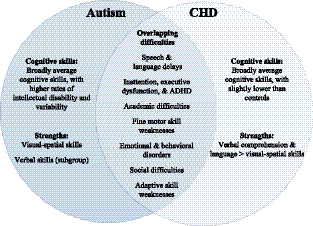
Neuropsychological skills in CHD and autism (Fig 1)
Compared to norm-referenced samples, separate studies have identified divergent and overlapping neuropsychological profiles among autistic individuals and individuals with CHD.
A schematic summary of the cognitive and neuropsychological skills that are distinct and overlapping in autistic individuals and those with CHD.

Overlapping skill weaknesses include delayed speech and language development, difficulties in academic functions and fine motor skills, increased rates of emotional disorders, symptoms of hyperactivity, inattention, and executive dysfunction, and finally social problems. Reference Kasmi, Bonnet and Montreuil7,Reference Cassidy, White, DeMaso, Newburger and Bellinger17,Reference Nattel, Adrianzen and Kessler31,Reference Cassidy, Ilardi and Bowen52,Reference Bellinger and Newburger102–Reference Werninger, Ehrler and Wehrle107 Notably, in CHD, there are verbal relative to visual-spatial strengths. In autism, there are visual-spatial relative to verbal strengths, as well as processing speed weaknesses. While individuals with CHD may also present with processing speed difficulties secondary to white matter damage, Reference Tan, Semmel, Wolf, Hammett and Ilardi22 visual-spatial and processing speed abilities should be further explored as possible differentiating skills between autism and CHD. Thus, phenotypically defining the neuropsychological sequalae across autism spectrum disorder and CHD is needed to inform clinically relevant subtypes and targeted treatment.
Social difficulties in CHD
Social difficulties in autism are intricately tied to deficits in social communication, a core diagnostic feature of the disorder. Interestingly, high rates of social difficulties have also been documented in children with CHD through informant- (teacher and parent) and self-report measures. Reference Schaefer, von Rhein and Knirsch20,Reference Calderon, Bonnet, Courtin, Concordet, Plumet and Angeard104,Reference Bellinger108,Reference McCusker, Armstrong, Mullen, Doherty and Casey109 McCusker and colleagues Reference McCusker, Armstrong, Mullen, Doherty and Casey109 found elevations in social problems (through a parent-reported questionnaire) in children with CHD who underwent surgical intervention during infancy relative to their sibling controls, a finding that held after controlling for other risk factors known to impact neurodevelopment (e.g., CHD subtype). Parents and adolescents with CHD themselves report increased challenges with peer relations (with no difficulties in emotional and behavioural functions) compared to the norm-referenced sample using a questionnaire, Reference Schaefer, von Rhein and Knirsch20 highlighting the specificity of social difficulties in this group. Such social deficits in CHD have been found to persist into adolescence and adulthood, Reference Bellinger, Rivkin and DeMaso110,Reference Bellinger, Wypij and Rivkin111 conferring greater risk for a reduction in quality of life in these individuals. These studies provide initial evidence for the overlap in autism-specific symptomatology in this medical patient population.
Social communication in CHD
Social communication skills (i.e., pragmatic language), in addition to underlying social-cognitive and social-emotional processing, are documented weaknesses in autism spectrum disorder, 55 with emerging evidence that these may be areas of difficulty in CHD and are in need of further investigation.
Social communication. In an observational review, Bellinger Reference Bellinger108 described observations from ongoing studies of children with CHD who were being evaluated at 12 months, 4 years, and 8 years of age. While the CHD group appeared to perform similarly to controls on tasks assessing basic verbal language skills (e.g., word knowledge and sentence structure), they presented with greater pragmatic difficulties at 4 and 8 years, a critical time period for pragmatic language development. Reference Whyte and Nelson112 Specifically, children with CHD produced less coherent story narratives, missed critical information, and included fewer descriptions of affective and cognitive internal states relative to controls. Reference Bellinger108 This pattern bears striking resemblance to the narratives elicited by autistic individuals relative to controls. Reference Capps, Kehres and Sigman113–Reference Tager-Flusberg and Sullivan120 Bellinger Reference Bellinger and Newburger102 also noted free play that was reduced in quality among 4-year-old children and their parents, relative to control parent–child dyads, findings that map onto the known challenges among families with autistic children when engaging in free-play activities together. Reference Bush, Martin, Landau and Losh121 Although pragmatic language is central to autism spectrum disorder, to our knowledge, there are currently no published empirical studies delineating these pragmatic features in CHD.
Social cognition and social-emotional processing. Several studies have, however, examined social-cognitive skills in this group, and like autistic individuals, social-cognitive impairments may underlie the descriptive differences in pragmatic-related skills observed in CHD (although more research is needed). Several groups have found that children with transposition of the great arteries who underwent surgical intervention scored lower on standard tasks of theory of mind. Reference Calderon, Angeard, Pinabiaux, Bonnet and Jambaque103,Reference Calderon, Bonnet, Courtin, Concordet, Plumet and Angeard104,Reference Bellinger, Wypij and Rivkin111 Moreover, Calderon and colleagues’ Reference Calderon, Angeard, Pinabiaux, Bonnet and Jambaque103 case–control study unravelled intriguing evidence for specific deficits in higher-order social-cognitive skills that were present even among older individuals with CHD with fluent structural language skills. Specifically, CHD patients across all ages and language level performed similarly to controls on a facial expression recognition task. In contrast, regardless of age and language level, individuals with CHD presented with significant difficulties in comprehending emotions, highlighting a skill deficit in understanding concealed emotions relative to controls. Finally, greater difficulties in visual memory for faces relative to non-social objects (i.e., dots) observed in CHD relative to a norm-referenced sample was hypothesised to be a function of underlying social-cognitive weaknesses in this group. Reference Cassidy, Newburger and Bellinger105 Although these studies point to overlapping social-communicative and social-cognitive deficits in autism and CHD, none directly compare both groups, highlighting a critically understudied area ripe for future investigation.
Co-occurrence rate of autism in CHD
Despite the strong recommendation by the American Heart Association to implement early screening for potential neurodevelopmental disorders in CHD, and the literature reviewed above documenting some weaknesses in social functioning in CHD, the co-occurrence of autism spectrum disorder and CHD remains largely unknown. Rather, extant studies examining the relationship between autism and CHD typically focus on potential autism symptomatology in lieu of diagnostic status. In particular, these studies have mostly examined social communication deficits with less emphasis on the second defining characteristic of autism spectrum disorder (i.e., restricted interests and repetitive behaviours). Symptomatic traits associated with autism can be assessed through a range of tools, with most studies in CHD relying more heavily on parent or informant report questionnaire metrics as opposed to clinically administered tools such as the Autism Diagnostic Observation Schedule Reference Lord, Rutter, DiLavore, Risi, Gotham and Bishop122,Reference Lord, Rutter and Goode123 or the Autism Diagnostic Interview-Revised. Reference Lord, Rutter and Le Couteur124 For example, Bean-Jaworski and colleagues Reference Jaworski, Flynn and Burnham125 utilised several well-established parent-report questionnaires in 195 4-year-old children with CHD and found a greater likelihood for meeting and exceeding the threshold for “possible ASD” relative to the general population, with several risk (e.g., prematurity) and protective (e.g., language skills) factors. Subgroup analysis in those meeting threshold for “possible ASD” further uncovered comorbidities common to autism spectrum disorder, including a greater rate of developmental difficulties, and more internalising and externalising symptoms. A recent study (n = 125 10-year-olds with CHD) similarly utilised parent-report questionnaires of autism symptoms, with elevations identified across all potential autism symptom domains. Reference Werninger, Ehrler and Wehrle107 Although it is noteworthy that these authors applied screening tools to their samples, diagnosis of autism spectrum disorder requires the complex combination of clinical-based measures outlined above, thus warranting further investigation.
Very few studies have specifically examined prevalence or incidence rates of autism spectrum disorder diagnosis in CHD, yet there is emerging evidence that the risk for an autism diagnosis in children with CHD is significantly higher than the risk for those without CHD. A very recent meta-analysis examined the incidence of autism spectrum disorder and attention-deficit/hyperactivity disorder (ADHD) in CHD, Reference Jenabi, Bashirian, Fariba and Naghshtabrizi126 and found that the estimated odds ratio for autism in CHD was 1.35 (CI = 1.17, 1.52) across the existing six studies that have specifically examined this overlap (see below), highlighting an increased risk of autism spectrum disorder in CHD.
Specifically, a relatively small observational study conducted by Davidson and colleagues Reference Davidson, Gringras, Fairhurst and Simpson127 in the United Kingdom found that children with hypoplastic left heart syndrome were more likely to have a diagnosis of a behavioural disorder (including autism or ADHD, diagnosed by a paediatrician), relative to other functional single-ventricle CHD types. Overall, 4 of the 58 hypoplastic left heart syndrome patients were provided a diagnosis of autism spectrum disorder, whereas none of the non-hypoplastic left heart syndrome patients had received a diagnosis of autism spectrum disorder, based on data obtained from a tertiary specialist referral centre. A larger recent retrospective, hospital-based cohort study of 134 patients with CHD found that autism prevalence was 5.9% among this sample – a diagnosis rate that is more than two times higher than that of the general population (2.3%). Reference Tan, Semmel, Wolf, Hammett and Ilardi22 Notably, 3 of 11 individuals did not follow up with their autism clinic referral, which may have attenuated the samples’ autism spectrum disorder prevalence rates. Because CHD is considered “rare” as defined by the NIH (i.e., fewer than 200,000 people in the United States), 128 large-scale studies are needed to provide sufficient power to detect associations between rare diseases. One such large-scale, case–control study nested within a population-based cohort from the Swedish Birth Register characterised patients with having a diagnosis of infantile autism (n = 408) versus controls (n = 2,040). Reference Hultman, Sparen and Cnattingius129 Authors found that risk for infantile autism was associated with general congenital malformations (7% of cases and 4% of controls had congenital malformations), with an odds ratio of 1.6 (CI = 1.0–2.5). This odds ratio increased for defects specific to the heart and circulatory system (OR = 2.5, CI = 1.1–5.8) and remained significant (albeit attenuated) after adjusting for risk factors (OR = 1.8, CI = 1.1–3.1). Conflicting reports were later found by Wier and colleagues, Reference Wier, Yoshida, Odonli, Grether and Croen71 who did not find a significant association between autism spectrum disorder and heart defects (crude: OR = 1.7, CI = 0.9–3.2; adjusted: OR = 1.5, CI = 0.7–2.8) when using a retrospective case–control design of those born at a specific hospital in California (autism spectrum disorder n = 417; control n = 2,067). It is possible that these studies were not well powered to examine the association between CHD in particular with autism, given their inclusion of all congenital malformations.
Several studies have since addressed this gap by using large-scale, retrospective population-based case–control studies of those with CHD specifically versus controls. Reference Razzaghi, Oster and Reefhuis130,Reference Tsao, Lee and Jeng131 Razzaghi and colleagues Reference Razzaghi, Oster and Reefhuis130 conducted their study based on voluntary parent-report questionnaire responses (which limits the study’s validity) confirming or denying the existence of an autism spectrum disorder diagnosis among their children with or without CHD and found large effects for the association of CHD and autism (crude OR = 4.6, CI = 1.9–11.0). To address this potential reporting bias, a rigorous study conducted using the Taiwanese National Health Insurance Research Database (NHIRD) identified that an autism diagnosis was almost two times higher in those with any CHD (n = 3552) relative to the age- and sex-matched controls (n = 14,208), after adjusting for confounding factors (adjusted HR = 1.97, CI = 1.11–3.52). Reference Tsao, Lee and Jeng131 Interestingly, subgroup analysis indicated that the risk for autism increased significantly in patients with CHD who had exhibited early developmental delays in childhood relative to controls without developmental delays (HR = 80.68, CI = 39.96–176.12). Of note, this hazard ratio increased dramatically from that between patients with early developmental delays only relative to controls (HR = 38.0, CI = 16.5–87.7), highlighting the unique and independent risk that CHD and developmental delay confers on autism. Given that CHD alone confers greater risk for neurodevelopmental disorders, authors concluded that a possible additive risk for autism may result from comorbid CHD and developmental delays, supporting the crucial need for future studies in order to inform treatment and improve outcomes in these patients.
Finally, Sigmon et al. Reference Sigmon, Kelleman, Susi, Nylund and Oster132 used the US Military Health System administrative database to evaluate prevalence of autism by subtypes of CHD, to begin to identify more homogenous subgroups to facilitate identification of higher risk children with CHD for autism spectrum disorder. The authors identified 8,000 autistic individuals who were compared against 26,000 controls on the prevalence and subtype of CHD. The authors found that atrial septal defect and ventricular septal defect, two of the least severe CHD subtypes, were most associated with a diagnosis of autism, even after controlling for common autism-associated risk factors (e.g., prematurity and presence of genetic syndrome). Specifically, children born with CHD were 32% more likely to have autism spectrum disorder than their control counterparts, an odd that increased for those with milder cardiac defects relative to those with more severe defects. Reference Sigmon, Kelleman, Susi, Nylund and Oster132 Of note, the authors point out that this may be due to the higher sample sizes of atrial septal and ventricular septal defects, compared to other less common and often more severe heart defects. Taken together, there is general consensus across all but one prevalence studies that the risk for autism is higher in children with CHD relative to the general population. Furthermore, there is emerging evidence that risk for autism in CHD based on screening measures has ties to delayed sternal closure among those with critical CHD requiring surgical intervention. Reference Jaworski, Flynn and Burnham125 Importantly, however, these studies were inconsistent in their inclusion and exclusion criteria as it relates to known genetic syndromes; therefore, this may undermine the conclusion of a more general association between CHD and autism spectrum disorder.
Underlying genetics in CHD and autism
There are unique and overlapping genetic disorders associated with both autism spectrum disorder and CHD. Genetic disorders that frequently present with CHD include Down syndrome, Williams syndrome, Noonan syndrome, CHARGE syndrome, and 22q11.2 deletion syndrome. A large number of genetic disorders are associated with autism, including but not limited to fragile X syndrome, Down syndrome, Duchenne muscular dystrophy, neurofibromatosis type I, tuberous sclerosis complex, and 22q11.2 deletion syndrome. Reference Al-Beltagi133 Recent efforts have been made to disentangle underlying genetic factors contributing to both disorders Reference Verrall, Blue and Loughran-Fowlds6 as well as ongoing debate regarding the presence of true autism spectrum disorder in some of these disorders (e.g., CHARGE and 22q11.2 deletion) as compared to subclinical symptoms inherent to the behavioural profile of the genetic disorder. Reference Kates, Antshel and Fremont13,Reference Adviento, Corbin and Widjaja134–Reference Smith, Nichols, Issekutz, Blake and Canadian Paediatric Surveillance136 Very importantly, symptom presentation and severity vary widely across genetic syndromes with and without CHD, thus obscuring clarity on the specific nature and extent of phenotypic overlap of autism in the context of genotypic heterogeneity. Thus, exploration of autism spectrum disorder symptomatology in CHD (rather than examining diagnostic criteria of autism spectrum disorder) may be a fruitful avenue to uncover shared underlying aetiologies across CHD and autism.
Interestingly, genes that are highly expressed in the heart were also found to be highly expressed in the developing brain. Reference Homsy, Zaidi and Shen137–Reference Zaidi, Choi and Wakimoto139 Many of these genes overlap with de novo mutations found in neurodevelopmental disorders, with several chromatin-modifier genes present in both CHD and autism. Reference Homsy, Zaidi and Shen137–Reference Zaidi, Choi and Wakimoto139 Chromatin modification contributes to certain genetic syndromes such as 22q11.2 deletion syndrome, Reference Zhang, Shi and Song140 a microdeletion disorder also highly comorbid with autism symptomatology. Reference Antshel, Aneja and Strunge141 Using network genetics, Rosenthal et al. Reference Rosenthal, Willsey and Xu142 identified 101 genes with shared genetic risk for autism and CHD, including seven novel genes that confer risk for both autism spectrum disorder and CHD associated with disrupted ion channels, similar to SCN2A previously linked to autism and other neurodevelopmental and neurological conditions. Reference Sanders, Campbell and Cottrell143 Future work thus warrants large-scale genotype–phenotype associations to uncover underlying genetic mechanisms contributing to the penetrance and severity of clinically relevant presentations across CHD and autism spectrum disorder beyond single-gene mutations. Underscoring the significance of family studies, polygenic scores for autism (i.e., an estimate of an individual’s genetic liability to a disorder based on their genetic profile) have fruitfully delineated genotype–phenotype correlations among relatives of autistic individuals depicting subclinical traits of the disorder. Reference Nayar, Sealock and Maltman144 Polygenic scores and family studies may be particularly relevant in delineating the pathophysiology of both disorders given their substantial genetic and behavioural heterogeneity. Family studies may thus shed light into the influences from common genetic variation and polygenic risk rather than rare single-gene mutations or variation that contributes to the heterogeneity of autism spectrum disorder profiles. Reference Woodbury-Smith, Paterson and O'Connor145,Reference Woodbury-Smith and Scherer146 Finally, it is additionally possible to examine familiality of autistic traits and the broad autism phenotype (i.e., subclinical personality features associated with autism spectrum disorder without clear functional impairment) in the context of family study designs in both these groups.
Strengths, limitations, and future studies
There are several methodological strengths and weaknesses of the extant literature that are important to consider. Strengths of studies conducted to date include the emphasis on the underlying mechanisms of social cognition known to be implicated in autism spectrum disorder. The application of autism-specific screening tools in early studies aimed to delineate risk for autism spectrum disorder in CHD is also a strength, not only given American Heart Association’s 2012 recommendations, but also given that these are widely used tools with strong sensitivity and specificity. These screening measures are important in assisting clinicians in identifying individuals who will benefit from a referral for a more thorough evaluation of autism, including administration of gold standard clinical measures. Reference Thabtah and Peebles147 The two large-scale, population-based incidence studies Reference Tsao, Lee and Jeng131,Reference Sigmon, Kelleman, Susi, Nylund and Oster132 that have been published to date are methodologically rigorous and provide initial evidence for future prospective (rather than retrospective) study designs. Additionally, these population-based studies are well powered to detect differences in rare diseases such as CHD (notably, autism spectrum disorder is not considered a rare disease).
Limitations inherent to retrospective designs utilising either clinical or administrative databases are the concerns of completeness and accuracy of data recording. Reference Cook and Collins148 While one of the studies applied a sensitivity analysis to their data, to re-verify each patients’ diagnostic status and to apply more stringent diagnostic criteria to verify positive associations, Reference Sigmon, Kelleman, Susi, Nylund and Oster132 retrospective study designs may in fact overestimate true incidence or prevalence as a result of ascertainment bias from children with CHD or autism spectrum disorder who more often seek clinical care and thus are more closely followed by medical professionals (including those that routinely screen for autism) than the general population. Additionally, researchers and clinicians may be missing the important features of autism in rare subtypes of CHD, contributing to limited knowledge of autism characterisation among rare subtypes of an already rare disease. As such, future work should focus on identifying the children with CHD who are most at risk of developing autism spectrum disorder. It would be particularly informative to investigate the specific factors that may mediate/modify the relationship between CHD and expression of autism symptomatology (e.g., severity of CHD, cyanotic versus acyanotic CHD, surgical history, etc.), as many of these factors are known to influence brain development more generally. It is also important for the extant literature to clearly differentiate autism spectrum disorder symptomatology from an autism spectrum disorder diagnosis, as well as investigate the potential relationship between CHD and the broad autism phenotype. Finally, the observational studies applying retrospective cohort or case–control designs documented here do not fully elucidate causal mechanisms contributing to the overlap in autism and CHD. As such, controlled intervention trials and longitudinal follow-up are needed to extrapolate causal relationships and to assess the efficacy and cost-effectiveness of applying early screening tools to optimise patient care, resource planning, and service delivery across the lifespan of children with CHD.
Relatedly, missing in all these studies is the aspect of timing of autism spectrum disorder diagnosis. Early detection, and thus early intervention, is essential for determining clinical outcome in autism, including cognitive development, adaptive functioning, and autism symptoms. Reference Dawson, Rogers and Munson149,Reference Elder, Kreider, Brasher and Ansell150 An important consideration for future research would thus be to examine autism-associated traits in longitudinal study designs, including an examination of school-age children with autism spectrum disorder and CHD, relative to idiopathic autism and idiopathic CHD. Such study designs would further disentangle the contributions of CHD-related neurodevelopmental impact from autism-specific pathophysiological mechanisms on disease course and severity. Longitudinal research approaches would further encourage repeated assessment for autism spectrum disorder across development in clinical practice, particularly important for higher risk and medically complex populations with comorbid developmental conditions. Reference Davidovitch, Levit-Binnun, Golan and Manning-Courtney151,Reference Kentrou, de Veld, Mataw and Begeer152
Critical also to interrogating the pathogenesis of autism-associated traits in CHD is the direct comparison of neuropsychological functions between patient groups. This will provide clues into potentially informative brain–behavior relationships that can inform future genetic and neural biomarker studies of autism spectrum disorder in CHD. Alongside neuropsychological frameworks, studies have thus far neglected to examine the second core feature of autism in CHD – restricted and repetitive behaviours. It will be essential to understand how restricted and repetitive behaviours manifest among the CHD population, particularly given that their quality and severity have been shown to differ among other medical conditions with comorbid autism (e.g., epilepsy and genetic syndromes). Reference Ko, Kim, Kim, Song and Cheon153,Reference Moss, Oliver, Arron, Burbidge and Berg154 As previously mentioned, excluding or controlling for known genetic syndromes associated with both CHD and autism spectrum disorder will help to elucidate the underlying relationship between these two conditions independent of these genetic syndromes. Additionally, given known sex differences in autism, Reference de Giambattista, Ventura, Trerotoli, Margari and Margari155–Reference Zhang, Li and Li157 and a recent meta-analysis reporting a sex ratio for children with comorbid autism and epilepsy to be less than 2:1 Reference Lax-Pericall, Bird, Taylor, Lax-Pericall, Bird and Taylor158 (which is notably less discrepant than the sex ratio for autism spectrum disorder overall (3:1), Reference Loomes, Hull and Mandy159 highlights the importance of studying sex-related differences in the rates of autism in CHD as well. Overall, deeply characterising profiles of autism spectrum disorder in CHD will better inform biological and intervention studies, and clinical practice.
Conclusions
Taken together, children born with CHD are at increased risk of developing neurodevelopmental disorders. Reference Mahle53,Reference Mahle and Wernovsky54 Recent studies have found that core features of autism are specifically implicated in children with CHD, namely peer difficulties, with emerging evidence for difficulties with pragmatic language, social cognition, and social-emotional processing in need of future investigation. Reference Schaefer, von Rhein and Knirsch20,Reference Calderon, Angeard, Pinabiaux, Bonnet and Jambaque103–Reference Cassidy, Newburger and Bellinger105,Reference Bellinger108,Reference McCusker, Armstrong, Mullen, Doherty and Casey109,Reference Bellinger, Wypij and Rivkin111 There is emerging evidence of prevalence rates of autism spectrum disorder diagnosis in CHD showing an increased odds of having autism spectrum disorder among children with CHD relative to the general population or matched controls. Reference Tan, Semmel, Wolf, Hammett and Ilardi22,Reference Wier, Yoshida, Odonli, Grether and Croen71,Reference Werninger, Ehrler and Wehrle107,Reference Jaworski, Flynn and Burnham125,Reference Hultman, Sparen and Cnattingius129–Reference Sigmon, Kelleman, Susi, Nylund and Oster132 There also appears to be neural and genetic links to this overlap, with several neural regions and genes identified as being tied to both CHD and autism spectrum disorder. Reference Homsy, Zaidi and Shen137–Reference Zaidi, Choi and Wakimoto139 Together, research points to potentially shared underlying mechanisms contributing to the pathophysiology of clinical traits in CHD and autism. Unpacking such underlying mechanistic features will provide opportunities for translational work. Namely, a greater understanding of the phenotypic traits of autism in CHD, as well as CHD in autism, will increase awareness and appropriate application of rigorous screening and evaluation methods as part of routine clinical care or neuropsychological evaluations, which can significantly enhance patient care outcomes. Reference Dawson, Rogers and Munson149,Reference Rotholz, Kinsman, Lacy and Charles160,Reference Swanson, Warren, Stone, Vehorn, Dohrmann and Humberd161 As such, a critical next step will be to further interrogate putative underpinnings of autism in CHD to understand their mechanistic functions and to develop robust tools for their deep characterisation and clinical applications for intervention. While much remains to be uncovered about the relationship between autism spectrum disorder and social communication in CHD, the literature supports the need for continued attention to this topic in order to best meet the needs of those impacted by CHD.
Author contributions
Dr. Nayar conceptualised, drafted the initial manuscript, and revised the manuscript. Dr. Katz contributed to the conceptualisation and revised and reviewed the manuscript. Drs. Heinrich and Berger revised the manuscript and critically reviewed the manuscript for important intellectual content. All authors approved the final manuscript as submitted and agreed to be accountable for all aspects of the work.
Conflict of interest
The authors have no conflicts of interest relevant to this article to disclose.
Financial support
No funding was secured for this study.