INTRODUCTION
Predation is a fundamental process mediating the flow of matter and energy across food webs and is responsible for the regulation of the spatial distribution and dynamics of many animals in soft sediments. However, the factors controlling the distribution of predatory infauna as well as the interactions between predators and their prey remain poorly understood (Ambrose, Reference Ambrose1984; Kennedy, Reference Kennedy1994; Moens et al., Reference Moens, Herman, Verbeeck, Steyaert and Vincx2000; Hamels et al., Reference Hamels, Moens, Muylaert and Vyverman2001; Gallucci et al., Reference Gallucci, Steyaert and Moens2005). Marine nematode predation has received little recent attention, mainly through experimental studies. Some of these have shown the existence of obligate and facultative predators, differing in prey selectivity and in their ecological roles in meiofaunal communities (Moens et al., Reference Moens, Verbeeck and Vincx1999, Reference Moens, Herman, Verbeeck, Steyaert and Vincx2000). Others have focused on identifying the relative importance of ciliates as a main carbon source in the diet of nematode predators (Hamels et al., Reference Hamels, Moens, Muylaert and Vyverman2001); and still others have found that small shifts in sediment composition may strongly affect the activity of predatory nematodes and thus predator–prey dynamics (Gallucci et al., Reference Gallucci, Steyaert and Moens2005). Some nematode species have been classified into a feeding type named ‘predator’ according to the morphology of their buccal cavity, which includes species possessing oral openings armed with large teeth and/or jaws (Wieser, Reference Wieser1953). This classification has been subsequently elaborated upon and the category subdivided into ‘real predators’ and ‘scavengers’ (Jensen, Reference Jensen1986, Reference Jensen1987) or ‘facultative predators’ and ‘predators’ (Moens & Vincx, Reference Moens and Vincx1997).
Observations of marine nematode feeding behaviour are rare due to their small size and their difficult rearing in laboratory cultures. Moreover, direct in situ observations of interstitial nematodes are considerably challenging; for instance flash freezing of sediment samples has been attempted but the technique may be cumbersome and time-consuming (Kennedy, Reference Kennedy1994). Predation evidence of nematodes under light microscopy gives valuable information about their trophic interactions as well as their role in meiofaunal communities. As part of a large scale research programme aimed to document the diversity of free living marine nematodes of Baja California, Mexico, here we present a record of predation by Synonchiella spiculora Murphy, Reference Murphy1962 on another marine nematode.
MATERIALS AND METHODS
The specimen was sampled July 2007 in the intertidal of Santa Clara beach, on the east coast of the Upper Gulf of California, Mexico (31°41.133′N 114°30.519′W). Santa Clara is a fine sandy beach with sediments ranging from fine sands (near to the water line) to silt (away from the water line). Sediment was classified as median sand with mean grain size of 308 µm and poor in organic matter (mean 1.18% dry weight). It is also part of the Colorado River Delta and Upper Gulf of California Biosphere Reserve and shows unusually large tidal ranges, exceeding 7 m during spring tide. The sediment sample was taken with a transparent corer (2.7 × 10 cm) at the lower limit of the intertidal during spring tide (salinity: 35 psu; temperature: 30.5°C) and immediately fixed in the field in DESS solution for molecular studies (20% dimethyl sulphoxide, 0.25 M disodium EDTA pH 8.0, saturated with NaCl) (Yoder et al., Reference Yoder, De Ley, King, Mundo-Ocampo, Mann, Blaxter, Poiras and De Ley2006). In the laboratory, the nematode was observed under a compound microscope (Olympus BX51) at different magnifications; pictures were taken with differential interference contrast (DIC) microscopy with a coupled digital camera (Olympus U-TV0.5C-3) and measured with the program IMAGE J v.1.38x (http://rsb.info.nih.gov/ij/index.html).
RESULTS AND DISCUSSION
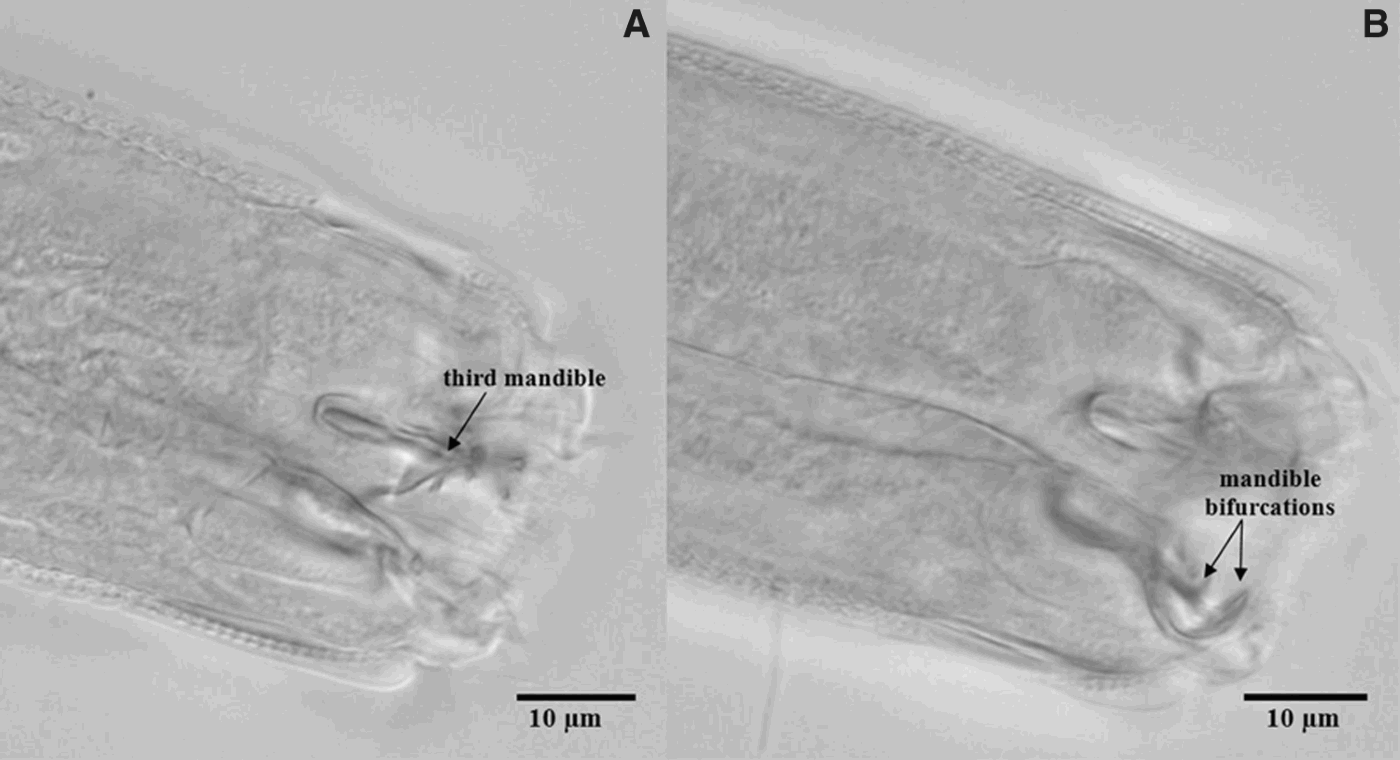
The specimen is an adult male with a total body length of 3.2 mm, spicule length of 109 µm and 17 precloacal supplements. The buccal cavity is large (depth: 24 µm, width: 26 µm) and contains three bifurcate mandibles (or jaws) with five additional pairs of hooks per mandible (Figure 1 a&b). These structures are typical of ‘predators/omnivores’ (Wieser, Reference Wieser1953), ‘real predator’ (Jensen, Reference Jensen1987) or ‘predator’ (Moens & Vincx, Reference Moens and Vincx1997), and may allow Synonchiella spiculora to break larger particles and to ingest other organisms, including marine nematodes, oligochaetes and small polychaetes (Jensen, Reference Jensen1987; Moens & Vincx, Reference Moens and Vincx1997).
(A, B) Cephalic region of the predator nematode Synonchiella spiculora showing buccal cavity featuring the three bifurcate mandibles or jaws with hooks (Photograph: T.J. Pereira).

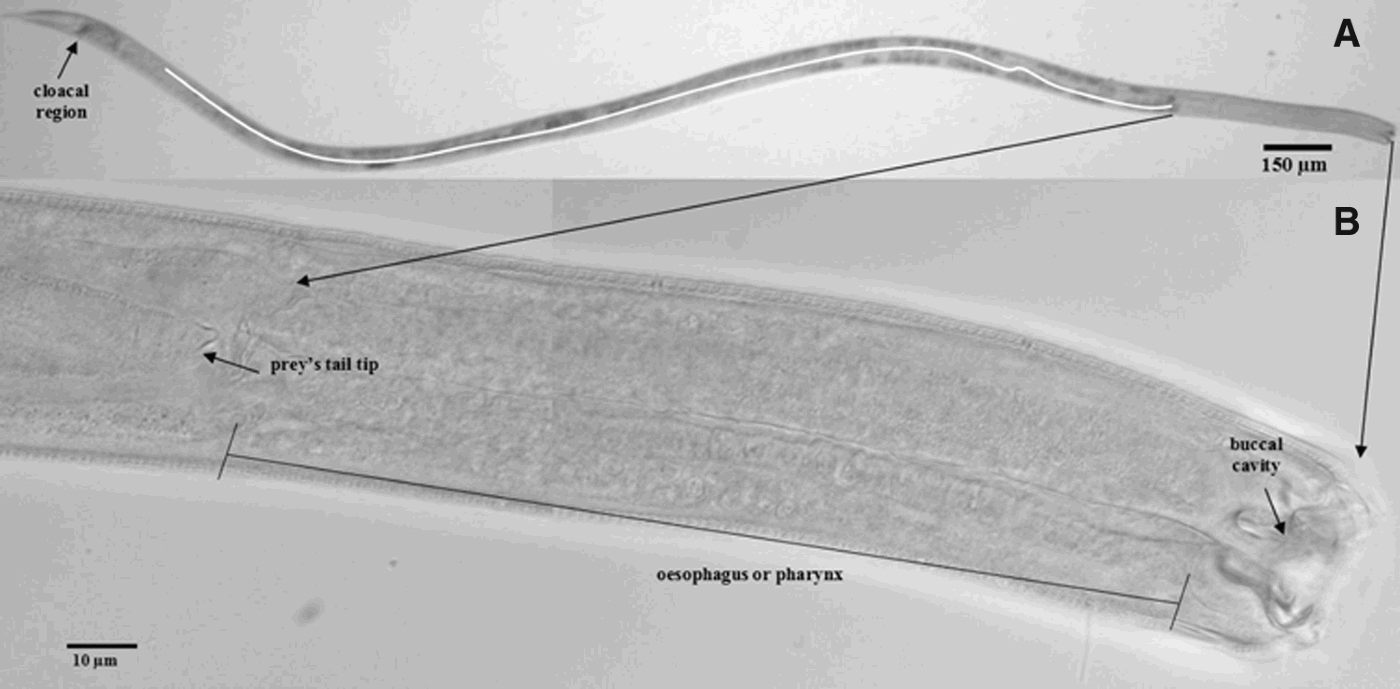
The images suggest that this species probably holds its prey with its denticulate mandibles before engulfing it whole, cephalic region first, by contracting the well developed pharyngeal musculature (Figure 2a&b), given that the prey is well preserved inside the intestine. This feeding behaviour is different from other predators such as Sphaerolaimus, which macerate their prey by means of articulating plates and other sclerotizations, and from facultative predators like Adoncholaimus, which puncture the cuticle of prey with their dorsal tooth to subsequently suck out their internal organs (Jensen, Reference Jensen1987).
(A) Full body of Synonchiella spiculora, the white line indicates the position of the prey item in the gastro-intestinal tract; (B) anterior region of the predator showing the complete pharynx and a detail of prey's tail tip (Photograph: T.J. Pereira).

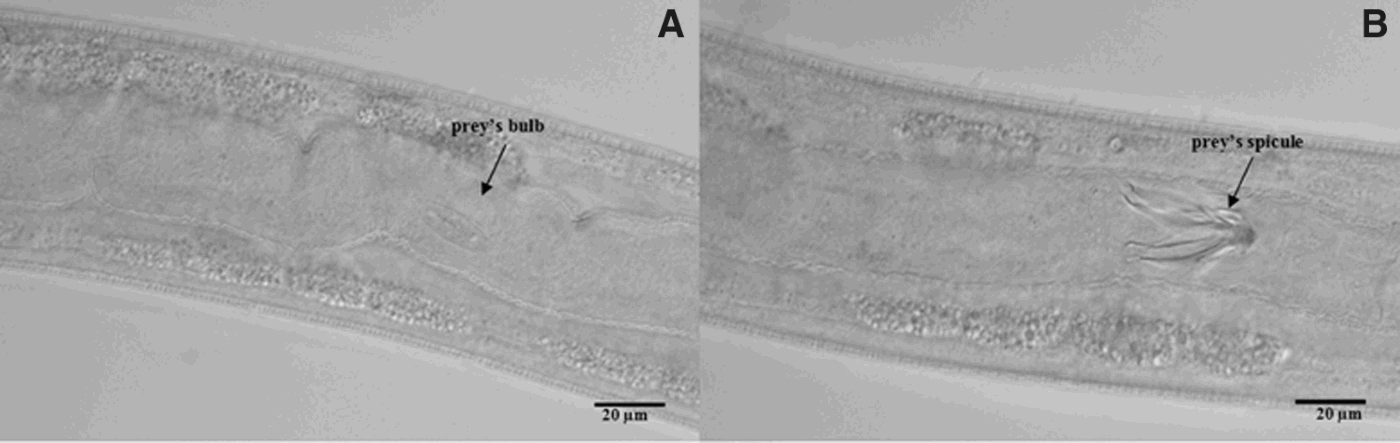
Destruction and partial digestion of the cephalic region prevented accurate measurements and the taxonomic identification of the prey, given that key taxonomic features of marine nematodes are present in the head (e.g. cephalic setae, features of buccal cavity and amphid). However, the remaining prey anatomy reveals a relatively large, male nematode (Figure 2a, white line) extending inside the predator from the oesophagus–intestine junction posteriorly to the cloacal region (Figures 2b, 3a&b). Fixing the sample in the field immediately after retrieval of the sediment core allowed us to preserve the community structure intact at the sampling time. Consequently, the engulfed nematode is highly unlikely to be an artefactual result of post-sampling manipulation. The partial digestion of the prey inside the predator suggests that this predation event occurred shortly before the sampling but not during or after. Even though we think it is unlikely, we cannot completely discard the possibility that the prey was dead before being engulfed. On the other hand, it could be speculated that the cephalic destruction and advanced digestion of the head relative to the rest of the body may reflect a frontal attack by the predator that killed the prey by maiming the cephalic region. Our hypothesis presumes that a nonresponsive nematode carcass would not show evidence of this putative wound.
Anatomical details of the nematode prey, (A) bulb (muscular swelling of the pharynx); and (B) spicule (male copulatory organ) in a ventral view (Photograph: T.J. Pereira).

The intertidal nematode community of Santa Clara features at least 55 genera. Predators include Enoploides (Thoracostomopsidae), Richtersia, Gammanema (both Selachinematidae) and facultative predators such as Viscosia and Oncholaimus (both Oncholaimidae) (Mundo-Ocampo et al., Reference Mundo-Ocampo, Lambshead, Debenham, King, De Ley, Baldwin, De Ley, Rocha-Olivares, Waumann, Thomas, Packer and Boucher2007). In the Gulf of California, the genus Synonchiella had previously been found only on the western coast (Punta Estrella), therefore this is also the first record of the genus in the eastern shore. Some predation events of Selachinematids have been documented in the literature. Chitwood & Timm (Reference Chitwood and Timm1954) reported predation by Halichoanolaimus on other nematodes as did Kennedy (Reference Kennedy1994) for Gammanema conicauda. These observations indicate that nematodes with heavily armed buccal cavities display predatory behaviour on prey items including other nematodes of similar size and suggest that nematode carnivory may be common in this group. We argue that our record validates the classification of S. spiculora in the guild of ‘predators’ sensu Jensen (Reference Jensen1987) and Moens & Vincx (Reference Moens and Vincx1997).
Reports of direct observations of predation among meiofaunal organisms are very scarce, including those involving marine nematodes. The assumptions about the feeding ecology of predatory selachinematids have been based on their buccal anatomy (Tchesunov & Okhlopkov, Reference Tchesunov and Okhlopkov2006), but direct evidence is wanting for most species and the scarce indirect evidence is available for other nematode species outside Selachinematidae (Romeyn & Bouwman, Reference Romeyn and Bouwman1983; Moens et al., Reference Moens, Verbeeck and Vincx1999, Reference Moens, Herman, Verbeeck, Steyaert and Vincx2000). The inferred (Tchesunov & Okhlopkov, Reference Tchesunov and Okhlopkov2006) and factual (Chitwood & Timm, Reference Chitwood and Timm1954; Kennedy, Reference Kennedy1994; this study) ecological role of these predatory selachinematids is consistent with the higher quota of predatory nematode species usually found in coarse-grained sediments such as those found in Santa Clara (Warwick, Reference Warwick1971).
In conclusion, additional direct and experimental observations on feeding behaviour may be necessary to ‘ground truth’ inferences based on their morphological variation and to better understand their feeding ecology, and for instance, to clarify whether S. spiculora is a bona fide predator feeding selectively on other live meiofauna, or a facultative predator and scavenger.
ACKNOWLEDGEMENTS
This research was funded by the project ‘Bioinventario estratégico de la nematofauna costera del Golfo de California’ funded by CONACYT–SEMARNAT grant 2004-C01-300. The paper is derived from the first author's graduate research in the Marine Ecology programme at CICESE, where he was supported by a fellowship from CONACYT.