The formal title of this Rashkind lecture today is The Reimbursement Tsunami: Preserving the Passion. However, Drs Shaddy and Wernovsky gave me the generic instructions to speak about new and sustainable ways to use a “team approach” to optimise the delivery of paediatric and congenital cardiac care.
Our paediatric cardiology practice, Sibley Heart Center Cardiology, was formed in 1990 through the merger of a group of four physicians in a private practice with a group of eight physicians in the Department of Paediatrics of Emory University School of Medicine. This new practice became a wholly owned subsidiary of the children’s hospital, with a mandated academic appointment at Emory University School of Medicine for each physician. This new practice combined the entrepreneurial drive of the group in private practice with the academic quest of the department of the university. This merger meant that we functioned, day in and day out, like a private practice, and ran a financially sound business, overseen by a Board constituted with members from the hospital, the school of medicine, and the cardiology practice. Later this month, we will be celebrating the 20th anniversary of this very successful practice.
Over the past 10 years, we have invested in the development of leadership and effective teams. It is this investment that has been responsible for much of our success. I have been given the opportunity today to speak about what I know and what I think about the value of our teams in our practice and environment.
It is my pleasure and honour today to present the 9th Annual William J. Rashkind Memorial Lecture. I never met Dr Rashkind personally, but have taken this opportunity to read more about him. In 1968, Dr Rashkind and colleagues developed the “balloon atrial septostomy”, a palliative procedure for patients with transposition of the great arteries. Our patients still benefit from this palliative procedure today.
Dr Rashkind was described as enthusiastic, witty, and possessing unparalleled determination. He was the consummate teacher with a passion for clinical care. Isn’t this who we all want to be?
The Perfect Storm
I am now old enough to be referred to as “seasoned”. I still can remember the “good ole days” of paediatric cardiology, during my fellowship in the early 1980s. Times were easier then, with:
• lower volumes of patients,
• lower acuity of patients,
• fewer external rules and regulations regarding research, and
• a simpler world of finance with predictable full reimbursement for our clinical services.
We could, in fact, practice our passion, clinical cardiology and teaching. Now, however, it is rough sailing. The new norm of the business of medicine sometimes seems like a tsunami, a giant wave in the ocean, which may drown us all. We are almost overwhelmed with the following challenges:
• Non-compliance,
• The Health Insurance Portability and Accountability Act,
• Maintenance of Certification,
• Marketing,
• Competencies,
• Appropriate utilisation driven by data,
• Decreasing reimbursement,
• Electronic medical records interoperability, etc.
How we deal with these issues effectively will determine how we preserve our passion. None of us went into paediatric cardiology either trained or equipped to deal with these issues that involve the business of medicine, but dealing with them is not optional. Paediatric cardiologists will need new strategies in order to effectively address the future demands of the “new business” of medicine. Remember the movie The Perfect Storm. Inattention to the evolving crisis ended in death as the storm capsised the boat of the fishermen. I see another perfect storm on our horizon.
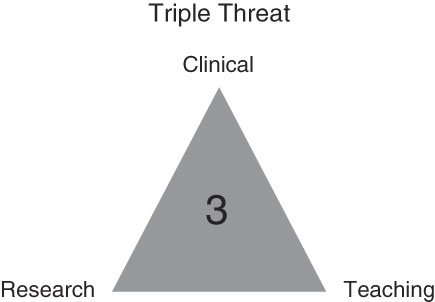
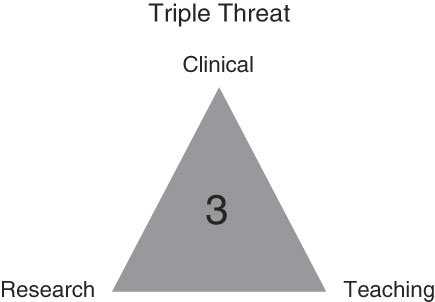
In the early 1980s, cardiology was dominated by “triple threat individuals” (Fig 1). You remember these doctors, the person who was the very best clinician, very best researcher, and very best teacher. This type of individual usually became the director of the division. For me, these were physicians such as Dr Amnon Rosenthal and Dr Tom Graham.
Triple threat.
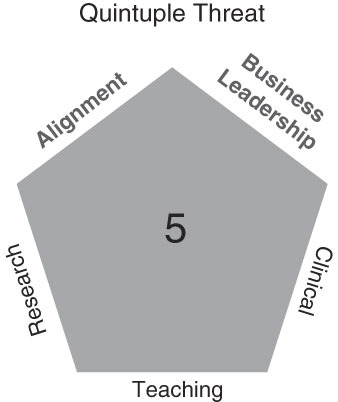
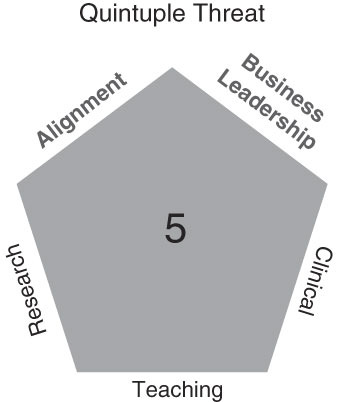
Now, however, the amount of knowledge and specialisation in each of these three areas of expertise has exploded. I am not certain that triple threat individuals can or do exist today. Instead, I think we need to be aiming higher, for a “quintuple threat profession” (Fig 2). Not only do we need expertise in clinical care, teaching, and research, but also we now require business leadership and alignment. No single person can be expert in all five of these areas.
Quintuple threat.
Are we waiting for life to return to normal? That just will not happen. We must realise that paediatric cardiology is now, more than ever, a business, which requires rigorous financial accountability and forward thinking strategic planning. However daunting this viewpoint seems, I am optimistic that we can address these issues for the future, since paediatric cardiology is at its core a business about people. We are people providing care for people, and it is people working as teams to address issues to derive best decisions. Jim Collins, the author of Good to Great,1 states that we need “the right people on the bus, in the right seats”. In paediatric cardiology we need to invest in these right people. Our new “quintuple threat profession” needs to match the expertise and passion of the right people with our current and future needs.
A plan for the future
Going forward I would like to propose that we should focus on Leadership, Teams, and Alignment. Let me discuss each of these in more detail.
The first step
First let me speak about leadership. This term is frequently used, but is sometimes hard to define. Let me share with you a quotation from John Kotter, which I believe well describes who our leaders should be and what they should do.
Leaders establish the vision for the future and set the strategy for getting there; they cause change. They motivate and inspire others to go in the right direction and they, along with everyone else, sacrifice to get there.2
Leaders will need to use brutal honesty, courage, and wisdom, and not just simply curse the darkness.
I believe that we need to identify, develop, and empower leaders at all levels within our profession, including physicians, nurses, and hospital administrators. Ultimately, we need a profession that remains clinically led, but professionally managed. Leaders will move us from avoidance to preparation and from observation to action. Leaders will need to identify issues and frame the change.
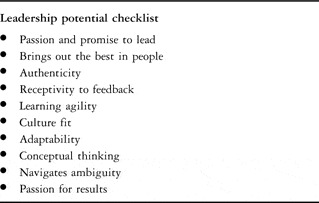
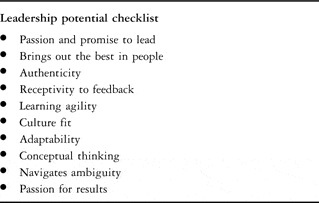
We are fortunate at Children’s Healthcare of Atlanta to have the Center for Leadership programme. This course lasts for 10 months and serves to identify leaders from all areas of the hospital and then provide on-the-job training and development. The Center for Leadership programme utilises a checklist of leadership potential to identify those individuals with a passion and promise to lead. We have identified several individuals from our cardiology practice, including Drs Pete Fischbach, Pat Frias, Bill Mahle, Bob Vincent, and Mike McConnell, who have assumed major leadership roles within our practice and the hospital. The checklist of leadership “potential” (
Table 1) also evaluates for “culture fit”; for our cardiology practice we believe that a “team orientation” is most important. Finally, passion for results is important; the best strategy in the world will fail without successful execution.
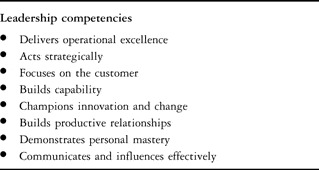
Likewise, the Center for Leadership programme provides a checklist of leadership “competency” (
Table 2). We are not expecting perfection, but this “report card” allows individuals to receive continuous feedback on their leadership abilities. It is important for leaders:

• to deliver operational excellence,
• to champion innovation and change, and
• to communicate and influence effectively.
Clear communication of expectations and feedback on performance and behaviour become critical factors of success for our leaders.
The second step
The second step of the formula is the development of successful teams, and teamwork. Successful “team behaviour” is not a part of traditional medical education. The higher education experience of most physicians and nurses has, in fact, trained us to be competitive with one another, and protective of our base of knowledge and expertise. However, examples do exist of successful teams all around us, sometimes most easily observed on the Entertainment Sports Programming Network. Even the most successful driver of a racing car will never win a race without a perfectly coordinated and practiced crew in the pit.
Several years ago, I was quite dissatisfied with my job and my performance. I personally believed that it was my responsibility to do all of the leading, and make all of the decisions. Others in the group were likewise dissatisfied with my performance and agreed that I was trying to do too much. It became quite apparent that I needed to develop a team and to rely on this additional expertise. It made me understand that a leader “can’t do all of the doing or the leading”.
In addition to standard teams for each clinical subspecialty, Sibley Heart Center Cardiology also has formed a “Leadership Team”. Nine physicians and the Business Director from the Children’s Healthcare of Atlanta Cardiac Service Line comprise this team. Roles and responsibilities are defined by business and leadership functions. These roles and responsibilities include, but are not limited to, quality, advocacy and legislation, education, research, finance, human resources, and informational technology. The mechanism by which our most recent physicians were added to this leadership team was by nomination by their partners, after evaluating each other using the checklist of “leadership potential”. The use of this process of nomination has identified the best candidates for the leadership team, and has ensured that these new members of the leadership team were representatives for the group. This process has increased the acceptance and confidence of these doctors in these roles.
While browsing through a bookstore in the airport about 6 years ago, I noticed a book entitled The Five Dysfunctions of a Team by Pat Lencioni.3 I am a strong believer in destiny, and when this book was calling me and said “buy me”, I did as instructed.
It was eye opening to read this book and to realise that it could have been written about our leadership team. The similarity of the dysfunctions described and those of our leadership team at that time was shocking.
Since that time, we have analysed and enhanced our leadership. The book describes five characteristic dysfunctions of a team, which build one upon another:
• The most basic foundation of dysfunction is the absence of trust, defined in this case as a lack of vulnerability and the inability to admit interpersonal shortcomings, lack of knowledge, or deficiencies of skill. Basically, individuals are unable to say “I don’t know”.
• In the absence of trust, teams manifest a fear of conflict, and do not address differing opinions and perspectives that may ultimately lead to the best decisions.
• Groups that cannot engage in constructive conflict lack commitment to a final plan. These teams move forward with hesitancy, if at all.
• Members of the team show an avoidance of accountability with themselves or others on the team for behaviours and performance.
• Finally, these teams are inattentive to results and never become a team of action.
Another way of looking at the team is to inspect the role of the leader. Leaders should go first, be the most vulnerable. The leader should mine for conflict and force clarity and demand closure. The leader must insist that the team confronts difficult issues and reaches decisions that will focus on collective outcomes.
This task is more easily said than done. It requires a continual commitment to improving the function of the team. Becoming a successful team is in fact a journey, not a destination. It is always a work in progress.
The third step
The third step is alignment. Alignment can be defined as representing the degree to which physicians and organizations, such as hospitals, acting out of enlightened self-interest, operate inside a common vision, mutual goals, and the acceptance of a shared destiny, as defined by “Navigant Consulting”.4
I believe that there are two new aligned teams that we should consider. Locally, each of our centres may be moving towards “Accountable Healthcare Organizations”. These Accountable Healthcare Organizations will require tight alignment between our paediatric cardiac services and the administration of the hospital around the five points of the quintuple threat organisation. Clinicians and administrators each will provide their own expertise and passion, and will partner for the most comprehensive business and clinical services. We will ultimately need to consolidate our resources. We will need to be able to track and analyse our outcomes, and hence our quality, with robust and interlinked databases. Data and databases will have to prove that our outcomes provide highest value. Electronic medical records and best practices will become critical as we may be moving towards systems of reimbursement based on pay-for-performance. Cardiac services is usually one of the largest and most profitable lines of service at any hospital for children. We need to partner together in order to survive and thrive.
On the national level I would like us to consider a “North American Paediatric Cardiac Services Organization”. For as long as I can remember, paediatric cardiac programmes have competed among each other, one versus another. Why are we not organised like the National Football League? In the National Football League, 32 teams are separately owned and operated, and compete one versus another for fans, talented players, and championships. However, these 32 teams are also organised under the rules and regulations of the league, which define, among other things, standards of competition, caps on salary, and schedules. The league, when needed, speaks as a singular voice for all 32 teams.
Our colleagues in paediatric haematology and oncology are organised very differently. For clinical services, they operate through the American Society of Paediatric Hematology and Oncology, and for research activities, through the Children’s Oncology Group.
Many paediatric cardiologists are members of large paediatric and/or cardiac organisations including the American Heart Association, the American College of Cardiology, and the American Academy of Paediatrics. These organisations have large national agendas. Paediatric cardiologists make up only a small minority of the total membership of these national organisations. Are our specific professional concerns, related to our profession of paediatric cardiology, best represented through these national organisations, which may have different priorities?
What would be the function of a “North American Paediatric Cardiac Services Organization”? Issues related to advocacy and reimbursement immediately come to mind. Last summer, I flew to Baltimore with representatives from Pediatrix to discuss with representatives of the Centers for Medicare & Medicaid Services the proposed cuts in reimbursement for services related to echocardiography and the elimination of codes for consultation. The financial impact of these cuts on our programme of paediatric cardiology would be profound. While on the plane, I kept wondering who I was representing. I knew I was sharing my own personal concerns, and those of my practice, but did I in fact speak for other members of the profession of paediatric cardiology? How could I be sure? Who was going to speak for the profession regarding these issues?
A national organisation could also be a clearinghouse for new initiatives in evidence-based medicine. Let me applaud those who have been instrumental in organizing many of the new initiatives of quality and databases of outcomes that we currently use, including, but not limited to:
• the Society of Thoracic Surgeons Congenital Heart Surgery Database,
• the Joint Council on Congenital Heart Disease,
• the IMPACT Registry™ (IMproving Paediatric and Adult Congenital Treatment) of the National Cardiovascular Data Registry of The American College of Cardiology, and
• the Paediatric Heart Network, to name just a few.
Only with true objective data will we ever be able to define our best outcomes. We also need to address appropriate utilisation, including overuse/misuse/abuse, as well as possibly underuse of appropriate diagnostic testing, treatments, and follow-up. The organisation can help us, as a profession, define best value, which may be defined as the relationship of benefit to cost, when we speak about the paediatric differential and the need for codes with congenital modifiers.
This organisation could also help with other issues such as the establishment of standards of training and the creation of postings to aid in searching for jobs.
This new organisation needs to facilitate communication among all providers of paediatric cardiac care inclusively, and to promote the active engagement of our profession. We need to define the true value of paediatric cardiac services.
Conclusion
Using the formula of leadership, teamwork, and alignment, we can return our focus back to our original passion, patient-centred clinical care. We all want to provide high-quality comprehensive clinical care, teaching, and research. What would Dr Rashkind expect us to do? Will we, in fact, ensure that the profession of paediatric cardiac services is providing the highest value it could and should?
I do not believe that I really learned everything that I needed to know in kindergarten. I am still learning, and let me share with you some of what I have learned:
• “Triple threat individuals” just will not suffice today.
• We need to identify and develop leaders at all levels of our new aligned organisations.
• We need to form new teams.
• We must promote alignment with local hospital systems.
• We need collaboration within a North American organisation to define and defend the value of paediatric cardiac services.
In summary, we need to come together as a profession. Overall, what unites us is stronger than what divides us. The time is right to tame the tsunami of the new business of medicine, in order that we preserve the passion of our profession. It has been my intent today to discuss new and sustainable ways to use a “team approach” to optimise the delivery of paediatric and congenital cardiac care. Imagine the benefits to our profession and our kids if we can provide a new level of leadership, teamwork, and alignment going forward.
Thank you.