Implications
The Malaysian palm oil industry produces over three million tons of palm kernel cake (PKC) by-product annually and the majority is exported, mainly to Europe, for use in diets of dairy and beef cattle. Only a small proportion of the yearly production of PKC is used within Malaysia. This is because the Malaysian dairy and beef industries are relatively small and only 30% inclusion of PKC is allowed in sheep diets. This is due to the high Cu concentrations in PKC and, compared to cattle, to the relatively low tolerance of sheep to excessive dietary Cu. Unlike other feeds, the Cu in PKC is highly soluble in the rumen and highly available for absorption and tissue, mainly liver, deposition. Therefore, dietary PKC is a potential cause of chronic copper toxicity mainly in sheep and to a lesser extent in goats. Although bovines can tolerate a relatively high dietary Cu concentration, the accumulation of Cu in their soft tissues, especially liver, is not desirable. It is well established that PKC is an excellent and affordable feed for all ruminants, but contains high Cu concentrations with a uniquely high bioavailability. To increase the use of PKC and to develop strong sheep and goat production industries within Malaysia, research efforts are being made to develop safe technologies to reduce Cu absorption in ruminants, especially in sheep, from the dietary PKC. The presently reported results are part of the effort.
Introduction
The nutritional quality of dietary palm kernel cake (PKC) and the potential risk of its high dietary proportion in diets of sheep due to chronic Cu toxicity have been well documented (Rahman et al., Reference Rahman, Wong, Zaini and Sharif1989; Jalaludin et al., Reference Jalaludin, Jelan, Abdulah and Ho1991; Hair-Bejo and Alimon, Reference Hair-Bejo and Alimon1992; Jalaludin, Reference Jalaludin1995). The fact that treatments with tetrathiomolybdate (Gooneratne et al., Reference Gooneratne, Howell and Gawthorne1981), Fe + S (Phillipo et al., Reference Phillipo, Humphries and Gathwaite1987), Zn (Bremner and Marshall, Reference Bremner and Marshall1974; Bremner et al., Reference Bremner, Young and Mills1976), and with Mo and S alone and in combination (Dick, Reference Dick1954; Ross Reference Ross1966 and Reference Ross1970; Hogan et al., Reference Hogan, Money and Blayney1968; Suttle, Reference Suttle1974 and Reference Suttle1975) can decrease the dietary Cu bioavailability and accumulation in the liver has been known for decades. More recently, it was reported that the dietary supplement of bentonite reduced the accumulation of dietary Cu in the liver of sheep by 29% (Ivan et al., Reference Ivan, Dayrell and Hidiroglou1992). However, such reduction in sheep fed a PKC-based diet was not sufficient to prevent chronic Cu toxicity (Ivan et al., Reference Ivan, Rusihan, Alimon, Hair-Bejo, Jelan and Jalaludin1999). In addition, the Fe concentration in PKC is very high (800 to 6000 mg/kg dry matter (DM)), but the chronic Cu toxicity persists in sheep fed higher concentrations (over 30%) of the dietary PKC, while the supplementation of a PKC diet with S was not effective in reducing the accumulation of Cu in the liver (Alimon et al., Reference Alimon, Ivan and Jalaludin2011). Therefore, the use in sheep of the dietary Fe supplement to reduce the bioavailability of Cu in the dietary PKC appears not to be logical, while treatments with tetrathiomolybdate are no longer appropriate. This is because tetrathiomolybdate results in serious health and reproductive complications (Haywood et al., Reference Haywood, Dincer, Jasani and Loughran2004). However, the effects of the other known Cu bioavailability-reducing dietary supplements (Zn, Mo and S) on the absorption, excretion, retention and tissue accumulation of Cu in sheep fed PKC-based diets are not fully understood. Therefore, it was the objective of the present experiment to determine the effects of dietary Zn, Mo and Mo + S supplements on the metabolism and tissue (liver and kidney) accumulation of Cu, Zn and Fe in sheep fed PKC-based diets.
Material and methods
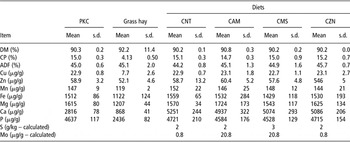
Twelve male Santa Inês × Malin crossbred lambs with live weight (mean and s.d.) of 19.1 ± 2.2 kg were used in a 6-month feeding experiment. The lambs were drenched with Systamex (Wellcome Foundation Ltd, London, UK) to control internal parasites. They were divided into four groups of three lambs each according to live weight; smaller and larger lambs were represented in each group. The groups were housed in individual pens with wooden slotted flooring in an open wooden sheep barn raised above the ground. The lambs had free access to deionized drinking water. Each group was fed one of four experimental diets (Table 1), namely control (CNT), control and ammonium molybdate (CAM), control and ammonium molybdate and sodium sulfate (CMS) and control and zinc sulfate (CZN).
Chemical composition of PKC, grass hay and of experimental diets (DM basis)

PKC = palm kernel cake; DM = dry matter; CNT = control; CAM = control and ammonium molybdate; CMS = control and ammonium molybdate and sodium sulfate; CZN = control and zinc sulfate.
The CNT diet comprised (DM basis) PKC meal (86.1%), short cut guinea grass hay (10%), cobalt – iodized salt (1%), limestone (2.8%) and vitamin mix (0.1%). The mix provided (IU/kg DM) 600, 15 and 440 of vitamins A, E and D, respectively. The diets CAM, CMS and CZN were prepared by additions (per kg DM) into the CNT diet of 97 mg ammonium molybdate ((NH4)6Mo7O24·4H2O), 64 mg ammonium molybdate and 4.4 g sodium sulfate (Na2SO4), and 1.47 g zinc sulfate (ZnSO4·7H2O), respectively. This was in addition to the actual concentration in PKC of approximately 2 g/kg DM S, 0.8 mg/kg DM Mo and 60 mg/kg DM Zn. Therefore, it was calculated for the diets CNT, CAM, CMS and CZN to contain approximately (g/kg DM) 2, 2, 3 and 2 of S (mg/kg DM) 0.8, 20.8, 20.8 and 0.8 of Mo, and 60, 60, 60 and 560 of Zn, respectively.
The PKC used was produced by the method of solvent extraction and the chemical analysis indicated that it was in the middle of the spectrum of the PKC produced in Malaysia. It was first mixed with the appropriate supplements and then with the hay. The diets were prepared every 12 days and kept in a cold room. The sheep were fed ad libitum and the feed was offered twice daily at 0700 and 1400 h. The care of the experimental animals was in accordance with the country standards (including halal slaughter) and the experimental protocol was reviewed by the Institutional Animal Care and Use Committee.
At 3 months of the experiment, the sheep were placed in metabolism cages for a 2-week cage adaptation. Thereafter, total feces and urine were collected from the individual sheep and sampled (10%) for 6 days and the sheep were then returned to their respective pens. The daily fecal outputs were collected in plastic bags and urine in plastic buckets (containing 100 ml of 10% HCl). The urine was then filtered through no. 40 Whatman paper into acid-washed plastic bottles. Feed intakes and refusals were recorded and sampled (10%) daily. Samples of feces, feed and refusals were accumulated in plastic bags. All samples were stored at −20°C for chemical analysis.
At the end of the experiment (6 months), blood was sampled and the sheep were slaughtered (halal method). The liver and kidney were removed from each slaughtered sheep, placed in individual plastic bags and then stored at −20°C.
Blood samples (10 ml) were taken from the jugular vein of each sheep using heparinized vacuum tubes (Becton Dickinson, Franklin Lakes, NJ, USA). Blood plasma was collected after 30 min centrifugation of the samples at 2500×g and stored at 2°C for atomic absorption analysis a few days later; the collected plasma samples were aspirated directly into the atomic absorption spectrophotometer. Samples of feed and feed refusals were dried for 2 days in an oven at 60°C, ground through a 1-mm sieve and collected in plastic containers. Samples of the liver and kidney were thawed, blended in a kitchen blender and oven dried at 60°C for constant cold weight; thereafter, the samples were ground in a blender and collected in plastic containers. All the samples (feed, refusals, feces, urine, liver and kidney) were wet ashed in nitric – perchloric acid mixture and analyzed for mineral elements using atomic absorption spectrophotometry; P was determined colorimetrically by using an auto analyzer (Lachat Instruments, Loveland, CO, USA). The crude protein concentration (N × 6.25) in feed samples was determined using the Kjedahl procedure, whereas ADF was determined according to van Soest et al. (Reference van Soest, Robertson and Lewis1991).
All results were statistically analyzed as one-way ANOVA using the GLM procedure of SAS (SAS Institute, 2004). When the treatment effect was significant, Duncan's multiple range test was used to determine the differences among treatment means and significance was declared at P < 0.05.
Results
Mineral excretion and retention
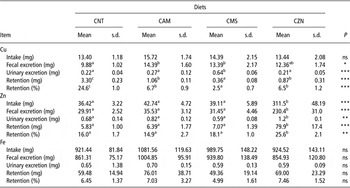
The fecal excretion of Cu was increased by the dietary supplements of Mo and Mo + S (P < 0.05), but not by the dietary supplement of Zn (P > 0.05), whereas the excretion in urine was increased (P < 0.05) only by the dietary supplement of Mo + S (Table 2). This resulted in decreased (P < 0.05) body Cu retention from 24.6% for the CNT diet to 6.7% for the CAM diet, 6.5% for the CZN diet and 2.5% for the CMS diet. The retention was not different (P > 0.05) between the CAM diet and the CZN diet, but that for the CMS diet was lower (P < 0.05) than for all other diets.
Daily trace element intake, excretion and retention in lambs fed different diets

CNT = control; CAM = control and ammonium molybdate; CMS = control and ammonium molybdate and sodium sulfate; CZN = control and zinc sulfate.
a–cMeans within the same row followed by the same superscript letter are not statistically different at P > 0.05.
ns = not statistically significant at P > 0.05.
*P < 0.05.
**P < 0.01.
***P < 0.001.
Since the diet CZN contained dietary Zn supplement, the Zn concentration in this diet was higher (P < 0.05) than in the other diets used. This resulted in a higher (P < 0.05) fecal and urinary excretion and body retention of Zn compared with the other diets (CNT, CAM and CMS). The differences in the fecal and urinary excretion and body retention of Zn among other diets (CNT, CAM and CMS) were not significant.
There were no significant differences among dietary treatments in the intake, fecal and urinary excretion, and body retention of Fe.
Mineral concentrations in blood plasma
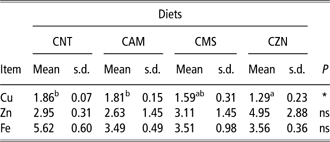
The Cu concentration in plasma was lowest for the CZN diet and significantly different from the CNT and CAM diets, but not (P > 0.05) from the CMS diet (Table 3). The plasma concentrations of Zn and Fe were not different (P > 0.05).
Trace element concentrations (μg/ml) in blood plasma of lambs fed different diets measured at the end of the experiment
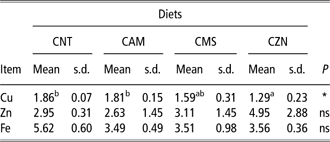
CNT = control; CAM = control and ammonium molybdate; CMS = control and ammonium molybdate and sodium sulfate; CZN = control and zinc sulfate.
a–bMeans within the same row followed by the same superscript letter are not statistically different at P > 0.05.
ns = not significant statistically at P > 0.05.
*P < 0.05.
Mineral concentrations in tissues
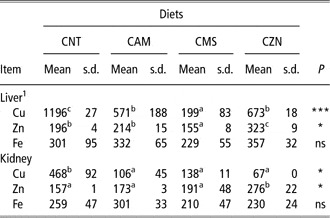
The concentration of Cu in the liver was lower (P < 0.05) for the CMS, CAM and CZN diets than for the CNT diet (Table 4). In addition, the liver Cu concentration for the CMS diet was significantly different from both the CAM and CZN diets, but the differences between the CAM and CZN diets were not significant. The Zn concentration in the liver was lower (P < 0.05) for the CMS diet than for the other diets (CNT, CAM and CZN). The concentration was higher (P < 0.05) for the CZN diet than for the CNT and CAM diets, but the differences between the CNT and CAM diets were not significant. There were no differences (P > 0.05) among the diets in the liver concentration of Fe.
Trace element concentrations (μg/g DM) in tissues of lambs fed different diets measured at the end of the experiment

DM = dry matter; CNT = control; CAM = control and ammonium molybdate; CMS = control and ammonium molybdate and sodium sulfate; CZN = control and zinc sulfate.
1The initial Cu concentration (mean and s.d.) in the liver of eight lambs of same age and same flock was 346 ± 45 mg/kg DM.
a–cMeans within the same row followed by the same superscript letter are not statistically different at P > 0.05.
ns = not statistically significant at P > 0.05.
*P < 0.05.
***P < 0.001.
Compared to the CNT diet, the concentration of Cu in the kidney was lower (P < 0.05) for all the other diets (CZN, CAM and CMS), but the differences among the other diets were not significant. The kidney Zn concentration was highest (P < 0.05) for the CZN diet, but the differences among the other diets (CNT, CAM and CMS) were not significant. There were no differences (P > 0.05) among the diets in the kidney concentrations of Fe.
Discussion
Since liver damage can occur in some sheep breeds at a liver Cu concentration as low as 300 mg Cu/kg DM, the range of 350 to 1000 mg Cu/kg DM is generally indicative of the liver Cu overload and marginal toxicity (Underwood and Suttle, Reference Underwood and Suttle1999). In reported Cu poisoning in sheep flock (Hidiroglou et al., Reference Hidiroglou, Heaney and Hartin1984), the average monthly hepatic Cu concentration in sheep that died of Cu poisoning was between 745 and 1251 μg/g DM. Although the plasma Cu concentration in sheep fed the CNT diet in the present experiment appeared to be normal, the average liver Cu concentration was 1196 μg/g DM. Clearly, the sheep in the control group of the present experiment that were fed a diet with 86% PKC were in danger of developing hemolytic crisis and dying of chronic Cu toxicity. Indeed, in another experiment, three out of five Malin × Dorset crossbred sheep fed a similar PKC-based diet died of Cu toxicity within the 6-month experimental period (Ivan et al., Reference Ivan, Rusihan, Alimon, Hair-Bejo, Jelan and Jalaludin1999). The difference in susceptibility to the chronic Cu toxicity between the former and the present experiment might be due to the effects of breed differences (Wooliams et al., Reference Wooliams, Suttle, Weiner, Field and Wooliams1982) and/or lack of stress to induce hemolytic crisis. Nevertheless, it is evident that high proportions of PKC in the diet of sheep might lead to chronic Cu toxicity. For this reason, PKC is presently allowed to form only up to 30% of the dietary DM in sheep diets in Malaysia. To increase the use of PKC, which is in abundance in Malaysia and a good feed for ruminants (Jalaludin, 1995), the absorption of Cu from the dietary PKC must be reduced. There are several dietary supplements such as bentonite, Zn, Mo and Mo together with S (Hair-Bejo and Alimon, 1992; Ivan et al., 1999) that have been used for this purpose.
Although the dietary bentonite supplement in the PKC-based sheep diet is not harmful to the rumen fermentation and to the duodenal supply of amino acids (Ivan et al., Reference Ivan, Neill, Alimon and Jalaludin2001a), its reducing effect on the accumulation of Cu in the liver appears to be only modest (Ivan et al., Reference Ivan, Dayrell and Hidiroglou1992) and does not give complete protection against the chronic Cu toxicity in sheep fed diets with a high concentration of PKC (Ivan et al., Reference Ivan, Rusihan, Alimon, Hair-Bejo, Jelan and Jalaludin1999). In addition, when combined with supplements of S and Mo, bentonite might bind the S and Mo supplements in the rumen and decrease their effectiveness in reducing the bioavailability of dietary copper (Ivan et al., Reference Ivan, Rusihan, Alimon, Hair-Bejo, Jelan and Jalaludin1999). Therefore, the remaining dietary supplements that reduce the dietary Cu bioavailability are Mo, S, Zn and Fe (Dick, Reference Dick1954; Ross, Reference Ross1966 and Reference Ross1970; Hogan et al., Reference Hogan, Money and Blayney1968; Suttle, Reference Suttle1974 and Reference Suttle1975; Bremner et al., Reference Bremner, Young and Mills1976; Phillipo et al., Reference Phillipo, Humphries and Gathwaite1987). Owing to the fact that the concentration of Fe in PKC is known to range between 800 and 6000 mg/kg DM and was 1512 mg/kg DM in the presently used PKC, and that the excessive dietary concentrations of Fe may result in bent legs of lambs (Hidiroglou et al., Reference Hidiroglou, Dukes, Ho and Heaney1978) and in decreased productivity in dairy cows (Coup and Campbell, Reference Coup and Campbell1964), the use of dietary Fe to reduce the bioavailability of dietary Cu was not considered in the present experiment. It should be pointed out that even though the Fe content in PKC is extremely high, the chronic Cu toxicity in Malaysia in sheep fed diets containing a high proportion of PKC (over 30%) persists and the dietary supplementation with S was not effective in reducing the hepatic Cu accumulation (Alimon et al., Reference Alimon, Ivan and Jalaludin2011). Therefore, only dietary Mo, Mo + S and Zn supplements were the subject of the present investigation.
It was previously reported that dietary Zn reduced the hepatic Cu accumulation and promoted the formation of relatively non-toxic forms of Cu in the liver, such as metallothionein, which is involved in the storage and detoxification of Cu and other heavy metals (Bremner and Marshall, Reference Bremner and Marshall1974; Bremner et al., Reference Bremner, Young and Mills1976). In the present experiment, the urinary Cu excretion in the Zn-supplemented sheep was almost identical to that of the control group, but the body retention was 26% lower due to the increased fecal Cu excretion. In spite of the reduced body Cu retention and the reduced concentrations of Cu in blood plasma and kidney, the reduced liver Cu concentration due to the Zn supplement was still in the range of the liver Cu overload and marginal toxicity (Underwood and Suttle, Reference Underwood and Suttle1999). It should be noted that in the present experiment, supplemental Zn resulted in a relatively high dietary Zn concentration, but it was much lower than that (1 g/kg DM) resulting in a lower feed intake and growth of lambs (Ott et al., Reference Ott, Smith, Harrington and Beeson1966). The high Zn intake resulted in an unusually high concentration of Zn in blood plasma (4.95 μg/ml) in the present experiment. The plasma Zn concentration was also relatively high for the control diet (2.95 μg/ml), probably due to the relatively high Zn concentration in the presently used PKC (59 mg/kg DM). In comparison, the Zn concentration in the PKC used in another experiment (Alimon et al., Reference Alimon, Ivan and Jalaludin2011) was only 35 mg/kg DM and the plasma Zn concentration was only approximately 1.5 μg/ml. Therefore, considering the present high dietary Zn concentration and its inadequate reduction of the liver Cu accumulation, the dietary Zn supplements appear not to be practical or adequate in preventing chronic Cu toxicity in sheep fed PKC-based diets. On the basis of the present results, a similar argument can be made for the dietary supplementation with Mo, without an additional dietary supplement of S, which resulted in almost identical body Cu retention compared to the supplemental Zn. The only differences in comparison with the Zn supplement are that dietary Mo did not affect the plasma Cu concentration and that extra Cu was excreted from the body through both the urine and feces. However, it is not presently known if the effects on the dietary Cu bioavailability of the combination of supplemental S + Mo and Zn are additive.
In a recent experiment (Alimon et al., Reference Alimon, Ivan and Jalaludin2011), graded levels of dietary Mo supplements (without added S) between 0 and 32 mg/kg DM were used in sheep fed a PKC-based diet, but even with the highest level of the supplement the liver Cu concentration increased from the initial 376 μg/g DM to the 6-month final 776 μg/g DM. This is in agreement with the results of the present experiment using 20 mg/kg DM of supplemental Mo. Again, like the case of the supplemental Zn (Table 4) and bentonite (Ivan et al., Reference Ivan, Rusihan, Alimon, Hair-Bejo, Jelan and Jalaludin1999), the use of supplemental Mo also appears to reduce the liver Cu concentration by approximately one half (Table 4), but this is not adequate to prevent the hepatic Cu accumulation and a possible chronic Cu toxicity in sheep fed PKC-based diets for a prolonged time period.
The fact that dietary Mo in the presence of an adequate S can reduce considerably the concentration of Cu in the liver (Dick, Reference Dick1954; Suttle, Reference Suttle1974) or Cu storage in the liver (Ross Reference Ross1966 and Reference Ross1970; Hogan et al., Reference Hogan, Money and Blayney1968), and that both organic and inorganic S could directly affect the absorption of dietary Cu, but to a limited degree only (Suttle, Reference Suttle1974 and Reference Suttle1975), has been established decades ago. The results of the present experiment show that in comparison with the dietary Zn and Mo supplements, the combination of dietary S and Mo appears to be the best solution to control excessive dietary Cu absorption and tissue accumulation in sheep fed PKC-based diets. Thus, the dietary S + Mo supplement decreased the body Cu retention by ninefold through the increased fecal (35%) and urinary (191%) excretions; this resulted in a sixfold decrease in the Cu concentration in the liver and in an approximately threefold decrease in the Cu concentration in the kidney.
It is interesting to note that the urinary Cu excretion for the control and the Mo-supplemented sheep in the present experiment was approximately the same. Similarly, the fecal Cu excretion for the Mo and the Mo + S supplemented sheep was approximately the same. Therefore, the higher body elimination of dietary Cu in the Mo + S supplemented sheep, compared to the Mo-supplemented sheep, was via urine. This might be due to the contribution of S to the formation of thiomolybdates, which would complex with Cu to form cupric thiomolybdates (Gooneratne et al., Reference Gooneratne, Howell and Gawthorne1981; Mason et al., Reference Mason, Lamand, Fressol and Mulryan1988) that were excreted mainly in urine.
Special emphasis should be given to the uniqueness of the Cu toxicity in sheep fed the PKC-based diets, which in comparison with other feeds is due to three unique factors. First, PKC contains an unusually high concentration (11 to 55 μg/g DM) of Cu (Jalaludin et al., Reference Jalaludin, Jelan, Abdulah and Ho1991; Jalaludin, Reference Jalaludin1995); second, the Cu in PKC is rapidly released and highly soluble in the rumen (Jin et al., Reference Jin, Alimon, Abdulah, Ho and Jalaludin1995); and third, PKC reduces or eliminates protozoa from the rumen (Abubakr AR et al., unpublished data) due to a relatively high content of oil that is toxic to rumen ciliate protozoa (Ivan et al., Reference Ivan, Mir, Koenig, Rode, Neill, Entz and Mir2001b, Reference Ivan, Entz, Mir, Mir and McAllister2003). It has been documented (Ivan et al., Reference Ivan, Veira and Kelleher1986; Ivan, Reference Ivan1988 and Reference Ivan1989; Ivan and Entz, Reference Ivan and Entz2007) that elimination of protozoa from the rumen increases the dietary Cu bioavailability and accumulation in the liver of sheep by 15% to 50%. Although from all ruminants sheep are most sensitive to excessive dietary Cu (Suttle, Reference Suttle2010), feeding of PKC has a high potential for the development of chronic Cu toxicity not only in sheep, but also in other ruminants. This is especially so in Europe where the majority of the Malaysian PKC is exported for use in diets of dairy and beef cattle and where the chronic Cu toxicity in cattle is an increasing condition.
Conclusion
On the basis of results from the present experiment, it can be concluded that supplements of S and Mo are a potential remedy for prevention of the chronic Cu toxicity in sheep fed PKC-based diets. However, supplemental S resulted in an increased liver Mo concentration (Alimon et al., Reference Alimon, Ivan and Jalaludin2011); therefore, an excessive dietary Mo supplement together with S supplement may result in an excessive accumulation of Mo in the internal organs, mainly liver. This is not desirable to consumers. In addition, an excessive dietary supplement of ammonium molybdate (100 mg/kg DM) and sodium sulfate (4.5 g/kg DM) to induce a secondary Cu deficiency resulted in an impaired reproductive performance of ewes (du Plessis et al., Reference du Plessis, van Niekerk and Coetzer1999).
The present experiment established that the Mo + S supplement appears to be the best remedy to control the chronic Cu toxicity in sheep fed PKC-based diets, but the amount of the presently used dietary Mo supplement could be toxic. Therefore, a much lower optimal concentration of the supplemental Mo, in addition to supplemental S, to the dietary PKC needs to be established. Indeed, on the basis of the present results, a follow-up experiment has been completed in this laboratory to establish such a concentration (Alimon et al., Reference Alimon, Ivan and Jalaludin2011).