1. IntroductionFootnote 1
This research explores the complementation patterns of the verb prevent in contemporary English, with a focus on the late 20th and early 21st centuries. While it is commonly followed by from -ing (e.g. Freelin said his schedule prevented him from going to the polls early . . . [USA Today, 4 November 2020]), alternative constructions without from also occur (e.g. They must carry out a forensic examination of these failings to prevent them happening again [The Daily Mail, 22 December 2020]). When the subject of -ing is overt, it typically appears in the objective case, as this example illustrates (them happening), although the possessive is also possible (e.g. Grosjean’s injuries may prevent his taking part in either . . . [The Daily Mail, 30 November 2020]).Footnote 2 These constructions are mentioned in usage guides and other reference works. Butterfield (Reference Butterfield2015, 654), for example, inherits the description given by Burchfield (Reference Burchfield1998, 622), stating that there are three constructions: (a) ‘prevent + object + from + -ing,’ (b) ‘prevent + object + -ing,’ and (c) ‘prevent + possessive + -ing,’ and that the last is ‘largely falling into disuse.’ Hence, the complementation patterns of prevent today are generally restricted to (a) and (b). For the purposes of this paper, constructions (b) and (c) will collectively be referred to as from-less (-ing) constructions.
Interestingly, there appears to be a fairly clear difference in the choice of complements between British and American English: American English almost exclusively employs the construction with from (i.e. [a]), whereas British English uses both (a) and (b) (cf. Quirk et al. Reference Quirk, Greenbaum, Leech and Svartvik1985, 1194–1195).Footnote 3 Furthermore, some studies have demonstrated that from-less -ing constructions increased in British English in the late 20th century (Tajima Reference Tajima1995, 10–11; Mair Reference Mair, Carls and Lucko1999; Mair Reference Mair2002, 112–115). This suggests that the gap between the two varieties may be widening in contemporary English – an intriguing development given that in other respects the gap has tended to narrow in recent years, e.g. the increasing use of bare infinitives as complements of help in British English as well as in American English (Mair Reference Mair, Aarts and Meyer1995; Mair Reference Mair2002).
However, studies on contemporary trends in the complementation of prevent are based on a relatively small number of examples. Mair’s (Reference Mair2002) statistics include 89 examples from British English and 84 from American English, extracted from the 1960s and 1990s. Mair and Leech (Reference Mair, Leech, Aarts, McMahon and Hinrichs2021) add 38 British examples and 27 American examples from 2006, updating Mair (Reference Mair2002), but the overall number remains limited. The same applies to Tajima (Reference Tajima1995), who examines 81 examples dating from the 1980s onwards. Given the limited scope of previous research, further investigation is needed to determine how from-less -ing complements are used in British English. The present study contributes to the discussion by providing additional data from around the turn of the 21st century.
2. Some preliminaries
2.1. The expansion of prevent+ -ing without from in present-day English
This section surveys the current usage of prevent, focusing on the competition between -ing complements with and without from in British English. Developing Mair’s (Reference Mair, Carls and Lucko1999) research on the absence of from in complementation, Mair (Reference Mair2002, 112–115) analyzes data from four parallel corpora: LOB (British English, 1961), FLOB (British English, 1991), Brown (American English, 1961), and Frown (American English, 1992).Footnote 4 He demonstrates that from-less -ing complements have been increasing in contemporary British English. The data in Table 1 are drawn from Mair (Reference Mair2002, 112):.
The complementation of prevent in British English (LOB, FLOB) and American English (Brown, Frown)

Table 1 shows that the preposition from is almost consistently present in American English, a trend that remained steady from the 1960s to the 1990s. In British English, by contrast, from-less -ing constructions were already widely used in the 1960s, and their frequency increased over time. By the 1990s, when constructions with and without from occurred with equal frequency in British English, the gap between British and American English had become even more pronounced. Thus, the findings suggest a rise in from-less -ing in recent British English
The same applies to Tajima (Reference Tajima1995, 10–11), whose work, written in Japanese, is less frequently cited in the previous literature. He analyzes the KB Corpus (Konomi-British-English Corpus) and the KA Corpus (Konomi-American-English Corpus)Footnote 5, which contain texts from the 1980s onwards, and shows that there are 30 examples with from vs. 14 examples without from in British English, and 34 examples with from vs. 3 examples without from in American English. From-less -ing complements in KB are clearly more common than in LOB in Mair’s statistics, though less common than in FLOB. The lower frequency of from-less complements in KB compared to FLOB may be attributable to the slight difference in the dates of the corpora. Alternatively, the overall proportions of these constructions may vary considerably depending on the datasets examined.
There are also other studies that suggest a significant rise in from-less -ing constructions in British English. Sellgren’s (Reference Sellgren, Lenker, Huber and Mailhammer2010, 53) analysis of the British National Corpus, which contains data from the late 20th century, identifies 128 examples of from -ing compared to 113 examples of from-less -ing.Footnote 6 Rudanko (Reference Rudanko, Leistyna and Meyer2003, 280) also supports this trend. Although he does not specifically address the expansion of from-less -ing constructions, he notes that -ing constructions with and without from are ‘approximately of the same frequency’ in the spoken British English component of the Bank of English (a monitor corpus) compiled by COBUILDFootnote 7, suggesting how fully established from-less -ing constructions were in British English around the turn of the 21st century.
There are, however, some studies that present slightly contradictory results, although they all show a fairly frequent use of from-less constructions in British English. Mair and Leech (Reference Mair, Leech, Aarts, McMahon and Hinrichs2021, 266–267), updating Mair (Reference Mair2002), investigate British English 2006, which contains data from 2003 to 2008Footnote 8, and finds 23 examples of from -ing and 15 examples of from-less -ing. The from-less variant is still noticeably frequent, but not as frequent as the from -ing variant. Likewise, Heyvaert et al. (Reference Heyvaert, Rogiers and Vermeylen2005, 84–85) present the statistics shown in Table 2, drawing on data from earlier studies and comparing them with their own data extracted from two components (Times and UKspoken) of COBUILD.
Prevent and three gerundial constructions in previous studiesFootnote 9

As their methodology differs significantly from that of the studies mentioned above, the results in Table 2 are not directly comparable with those in other studies. First, they are mainly concerned with the relationship between the possessive and objective cases in the subject of -ing forms in from-less constructions, rather than with the contrast between from -ing and from-less -ing. Second, they examine only those examples in which the subject of -ing is a personal pronoun. Still, it is probably worth noting that their recent data, extracted from the COBUILD Corpus, yield a notably high proportion of from -ing complements. Hence, it will be interesting to conduct further research into how extensively from-less constructions are employed around the turn of the 21st century, which is the aim of the present study.
Incidentally, the sharp decline in the ‘possessive subject + -ing’ construction around the turn of the 20th century, as shown in Table 2, is also intriguing. Although the possessive type is now very rare in contemporary English, this variant will still be taken into account in the following discussion. The data in Aarts et al. (Reference Aarts, Wallis, Bowie, Seoane, Fariña and Palacios–Martínez2018, 152–153) drawn from the London-Lund Corpus and the British Component of the International Corpus of English show that the possessive type accounts for only about 4% of all possessive/objective + -ing constructions.Footnote 10 Moreover, the possessive type is generally considered more formal in contemporary English (cf. Quirk et al. Reference Quirk, Greenbaum, Leech and Svartvik1985, 1063–1064; Huddleston and Pullum Reference Huddleston and Pullum2002, 1192).
2.2. Data
The primary dataset in this study is drawn from two relatively casual contemporary newspapers: The Daily Mail (British) and USA Today (American). Using the electronic database Lexis+ Footnote 11, I extracted all forms of prevent from all issues published between October and December 2020, obtaining 912 examples from The Daily Mail and 267 examples from USA Today, after removing clear duplicates. It is interesting to note that prevent occurs significantly more frequently in The Daily Mail than in USA Today, which may be attributable to various factors, such as differences in overall word counts, subject matter, and other variables. However, I leave this issue outside the scope of the present research, partly because the focus is on variation in the complementation of prevent, and partly because Lexis+ is a database rather than a corpus, meaning that the full text is not accessible to users. Therefore, standard corpus linguistic methodologies based on word counts cannot be applied. Nevertheless, it remains a powerful resource for linguistic analysis.
In addition to the main dataset, I will also examine the British Academic Written English (BAWE) corpus as a supplementary resource. The corpus was released in 2008 and comprises data from 2000 to 2007. It consists of academic assignments written by students, including native and non-native speakers of English, and ‘was developed at the Universities of Warwick, Reading and Oxford Brookes under the directorship of Hilary Nesi and Sheena Gardner (formerly of the Centre for Applied Linguistics, Warwick), Paul Thompson (formerly of the Department of Applied Linguistics, Reading) and Paul Wickens (School of Education, Oxford Brookes), with funding from the ESRC (RES-000-23-0800)’ (https://warwick.ac.uk/fac/soc/al/research/collections/bawe/how_to_cite_bawe/).Footnote 12 The use of this corpus is intended to substantiate the discussion through the examination of unpublished, and therefore largely unedited, texts. I will extract examples of prevent only from the assignments written by native speakers in this corpus and use them in the following analysis (details in Section 4). Most of the writers in this corpus were born in the 1990s. Assuming that they were around 20 years old when they drafted the assignments, the data obtained from this corpus provide a useful perspective on the usage of prevent in a period largely comparable to that represented by the data from The Daily Mail and USA Today (December 2020), since the generation that contributed to BAWE is likely to have been actively involved in social interactions in 2020. In other words, the generation that contributed data to BAWE and the generation represented in the two newspapers should at least partially overlap. It will be interesting to observe how the usage of prevent differs across datasets of different types.
2.3. Relevant examples
This section defines the criteria for the examples examined in this study. First, all instances of the verb prevent are considered relevant as long as they include complements. Hence, both finite (1) and non-finite (2) forms of prevent are counted as examples:
(1) A decent career has incorporated 42 England caps and a £16million move to Arsenal, but injuries prevented it from becoming great and Brighton was his best option in October after being released by Watford. (The Daily Mail, 23 Nov 2020)
(2) It is 70 per cent effective at preventing people falling ill with Covid, initial results suggest. (The Daily Mail, 9 Dec 2020)
Second, the main part of the discussion focuses on -ing forms used as complements of prevent. Other examples, such as the following, in which the verb governs a noun phrase, are excluded from the analysis:
(3) The U.S. Food and Drug Administration authorized the first vaccine to prevent the disease Friday night. (USA Today, 14 Dec 2020)
Examples in which -ing is used as a noun are also excluded. See, for example:
(4) Alexa also shares tips to prevent the spreading of the virus. (USA Today, 3 Nov 2020)
Third, I restrict the discussion to those examples in which the subject of -ing is explicit, since this is the context in which the alternation between -ing constructions with and without from occurs. Therefore, examples such as (5) are excluded, whereas (6) and (7) are included:
(5) . . . as earnings surged even though Government interventions have prevented sweeping insolvencies. (The Daily Mail, 19 Nov 2020)
(6) The craft were used to form a barrier to prevent them from travelling upstream. (The Daily Mail, 2 Oct 2020)
(7) . . . and Twitter users were prevented from liking or replying to the tweet. (USA Today, 4 Nov 2020)
The subject of an -ing form can appear in the possessive or objective case in the active voice, whereas in the passive voice it becomes the grammatical subject and therefore takes the nominative case.
Finally, the unedited texts in BAWE contain several examples of to-infinitival complements, which serve as an alternative to the -ing construction. In addition, they include an example of a that-clause functioning as the complement of prevent. These examples are excluded from the analysis of -ing forms, although they are discussed as separate but related constructions in Section 4.
3. Prevent with -ing forms in The Daily Mail and USA Today
3.1. Prevent in the active voice
Of the 912 examples of prevent in The Daily Mail, 464 occur with -ing complements that meet the conditions stated in Section 2.3. Likewise, among the 267 examples of the same verb in USA Today, 96 are relevant. Furthermore, most of the relevant examples are found in the active voice, namely 437 in The Daily Mail and 94 in USA Today, which will be examined in this section. As expected, the frequent occurrence of from-less -ing is a notable feature of British English. Table 3 presents the raw frequencies of -ing complements with and without from in the two newspaper datasets:
Prevent + (from) -ing in The Daily Mail and USA Today (raw frequencies)

All relevant examples in USA Today exhibit the from -ing construction, whereas The Daily Mail makes extensive use of from-less examples, which are in fact more frequent than from -ing ones. The use of from-less examples in British English appears to have advanced even further in recent years than in the data examined in previous studies (cf. Section 2.1). It is therefore likely that the use of from-less -ing is continuing to expand in contemporary British English, at least in relatively casual styles such as that found in The Daily Mail.
In this construction, the subject of -ing appears in either the possessive or the objective case. The data presented by Heyvaert et al. (Reference Heyvaert, Rogiers and Vermeylen2005, 84) (see Section 2.1) show a clear rise in objective subjects as opposed to possessive ones from the 18th to the 20th century. In the present study, I will examine personal pronouns used as subjects of -ing separately from other noun phrases. This is because the possessive use of the subject of -ing in general (not specifically restricted to its use with prevent) is more frequent with pronouns than with other noun phrases (Quirk et al. Reference Quirk, Greenbaum, Leech and Svartvik1985, 1063–1064).Footnote 13 The Daily Mail and USA Today provide a single example each in which the subject of -ing consists of both a personal pronoun and a noun (see [8]), which I include in the category of other noun phrases:
(8) . . . and prevented me and my lead scout from getting serious injuries or death. (The Daily Mail, 10 Nov 2020)
When the subject of -ing is her as in (9), it is practically impossible to determine whether it is possessive or objective. Such examples are treated separately.
(9) . . . but a local court prevented her seizing it. (The Daily Mail, 29 Nov 2020)
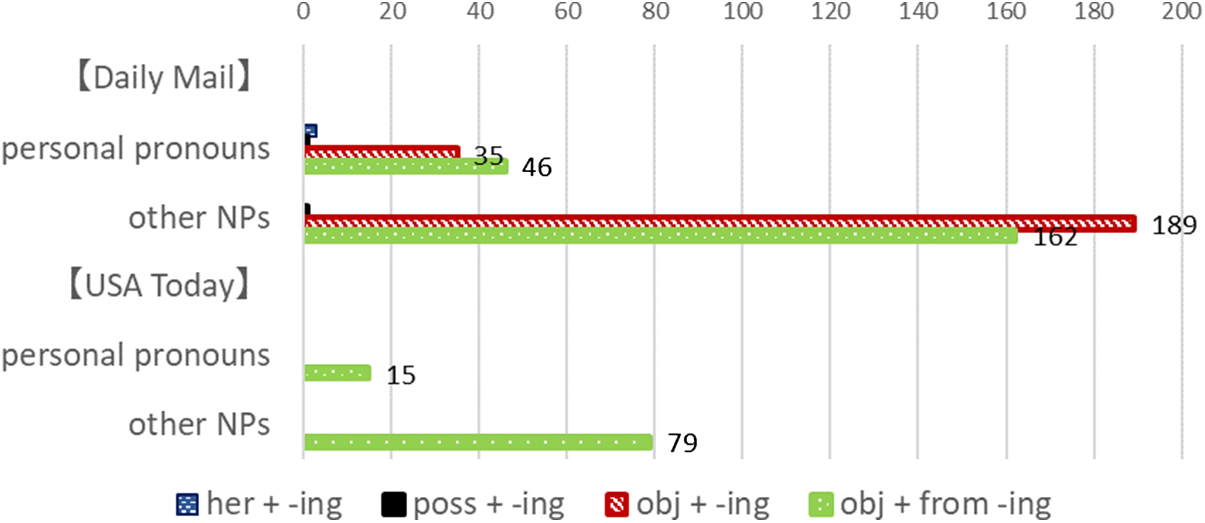
See Figure 1, which presents the raw frequencies of all relevant types of -ing constructions:
Occurrences of prevent with -ing in the active voice in The Daily Mail and USA Today (raw frequencies).

This graph is principally intended to illustrate the structural variation in British English, since USA Today consistently uses the from -ing construction regardless of whether or not the object of prevent, which also serves as the subject of -ing, is a personal pronoun. In The Daily Mail, constructions are more varied, but as expected (cf. Section 2.1), possessive subjects of -ing are nearly extinct. In other words, the competing constructions in the datasets under examination are now limited to from-less -ing with objective subjects and the from -ing construction. There appears to be a notable contrast between personal pronouns and other noun phrases. With personal pronouns, the construction with from remains dominant, whereas with other noun phrases, the from-less construction is more prevalent. The recent increase in from-less -ing constructions thus seems to be driven primarily by noun phrases other than personal pronouns.
3.2. Prevent in the passive voice
Relevant examples of prevent in the passive voice are very infrequent: The Daily Mail provides 27 examples, while USA Today contains only two. In the passive, there is a strong tendency for -ing to be preceded by from, as illustrated in (10) and (11):
(10) They are also prevented from slamming doors . . . (The Daily Mail, 13 Sep 2020)
(11) By contrast I, aged 69, am prevented by law from taking the very minor risks with my life or yours . . . (The Daily Mail, 8 Nov 2020)
In the dataset used in this study, all relevant examples exhibit the from -ing construction, irrespective of whether the subject is a personal pronoun or a noun phrase of a different type.
Although the passive use of prevent itself is very infrequent, it is probably safe to conclude that the tendency to use the from -ing construction is firmly established even in British English. Rohdenburg (Reference Rohdenburg1995, 86) identifies three passive examples in LOB, all of which show the from -ing construction. Likewise, Rudanko (Reference Rudanko, Leistyna and Meyer2003, 281) investigates rare examples of the passive use of prevent in the Spoken British English section of the Bank of English and observes that ‘they are quite regularly of the from -ing type’. See also Huddleston and Pullum (Reference Huddleston and Pullum2002, 1238), who state: ‘Passivisation is restricted to the prepositional construction’. The results of the present study align with these previous findings. Thus, the complementation of this verb in the passive voice appears to be independent of the ongoing change in its active usage.
4. Prevent with -ing forms in BAWE
4.1. Prevent in the active voice
Since the constructions of prevent are notably varied in British English, I have decided to examine an additional British English dataset to gain a clearer understanding of this phenomenon. BAWE serves this purpose. I have extracted only the documents written by native speakers from BAWE, which I refer to as BAWE (L1) hereafter. This dataset differs from The Daily Mail and USA Today, as it consists of writings by students in academic settings. In other words, BAWE (L1) represents unpublished and relatively unedited language use in contemporary British English, although the assignments in the dataset are generally of high quality, having received grades of merit or distinction. Chronologically, it is broadly comparable to The Daily Mail (cf. Section 2.2).Footnote 14
BAWE (L1) provides a total of 327 relevant examples in the active voice, none of which involve the possessive subject plus -ing construction. Ambiguous examples with her as the subject of -ing are also absent. Thus, in this corpus, the structural competition in the active voice is essentially between from -ing and from-less -ing, insofar as -ing complements are concerned, as in:
(12) Limited space prevents me from providing an exhaustive study of each and every one of the rituals employed . . . (BAWE)
(13) In order to prevent boundary effects distorting the model, the main box was surrounded by 26 ‘ghost’ boxes. (BAWE)
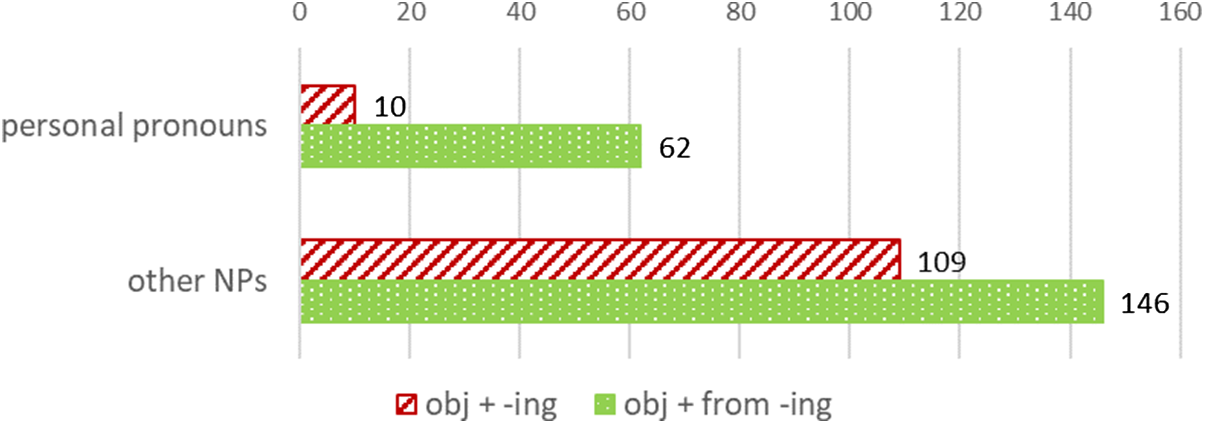
Here again, there appear to be differing tendencies depending on whether the subject of -ing is a personal pronoun or not, as shown in Figure 2:
Occurrences of prevent with -ing in the active voice in BAWE (L1) (raw frequencies).

The from-less construction is more extensively used when the subject of -ing is a noun phrase other than a personal pronoun, as in The Daily Mail (see Section 3.1). However, the extent to which from-less -ing occurs differs noticeably between The Daily Mail and BAWE (L1): from-less examples are less frequent in BAWE (L1) than in The Daily Mail.
It is not immediately possible to determine the cause of this difference. The difference in dates may be one factor. As mentioned in Section 2.2, the authors represented in BAWE and those in The Daily Mail (2020) are indeed largely comparable, but it is also true that BAWE (L1) predates the dataset of The Daily Mail used in this study. However, from-less examples occur even less frequently in BAWE (L1) than in Mair’s (Reference Mair2002) data from the 1990s, which are earlier. Thus, the date of BAWE (L1) does not necessarily explain this difference in tendency.
Stylistic factors may play a role: the expansion of from-less constructions may be more prevalent in printed materials than in academic assignments. If so, this may be due either to a probable prescriptive sense in academic writing – a factor in favour of from -ing – or to a possible preference for brevity in newspapers – a factor in favour of from-less -ing. Alternatively, it could be attributed to the relatively informal nature of the tabloid The Daily Mail.
Another relevant factor may be that newspaper English tends to be ‘receptive to (and in a good many instances also productive of) innovations or changes “from below”’ (Hundt and Mair Reference Mair, Carls and Lucko1999, 236).Footnote 15 On the other hand, the absence of possessive subjects of -ing in BAWE (L1) may represent a more advanced stage than in The Daily Mail, since the possessive form, as opposed to the objective form, is generally more archaic (cf. Section 2.1).
Finally, BAWE includes a small number of rare constructions that do not involve -ing and are therefore excluded from the above analysis. The most striking is example (14), in which prevent is followed by a finite clause introduced by the conjunction that. This instance comes from a third-year student whose education was entirely in the UK.
(14) . . . and therefore more likely to take action to ensure that she does or prevent that she doesn’t. (BAWE)
Obviously, this usage appears to have been influenced by ensure that she does, which directly precedes and parallels prevent that she doesn’t. Still, the use of a that-clause is noteworthy, as it represents an older complement form with this verb – one that was subsequently replaced by the to-infinitive and later by the -ing construction (cf. Section 5). This construction is, however, not wholly obsolete. The Oxford English Dictionary (OED) notes that prevent occurs ‘occasionally with that-clause,’ although -ing constructions are more usual (s.v. prevent, II.9.b).Footnote 16
The second type is more common and therefore not necessarily exceptional. Prevent is also followed by infinitival complements in BAWE (L1), and this occurs repeatedly. The dataset provides seven examples of this type in the active voice, as in:
(15) RV helps to maintain alveolar patency by preventing all the air to be expelled . . . (BAWE)
This is interesting, since infinitival constructions are not recognized in usage guides for contemporary EnglishFootnote 17, although they are attested in historical data (cf. Section 5). All seven examples show a subject of -ing other than a personal pronoun. Hence, structural variation appears to be greater when subjects other than personal pronouns are involved. Furthermore, overall complementation patterns exhibit greater variation in the relatively unedited texts of BAWE (L1) than in The Daily Mail, although examples of possessive subjects are absent in the former.
4.2. Prevent in the passive
Examples of the passive voice are very infrequent and, as in The Daily Mail, the structural patterns of the passive are less varied. BAWE (L1) provides a total of 19 examples with -ing, all of which include the preposition from, as illustrated in the following example:
(16) under which a contract was prevented from conferring rights upon anyone except the parties to it. (BAWE)
Interestingly, one of the 19 examples features both from -ing and to-infinitival complements:
(17) Women providing capital for investment were prevented from acting as representatives or to carry out long-distance trade themselves, removing their ability to ensure the safety of their returns. (BAWE)
Apart from these 19 examples, there is one example in which prevent directly takes a to-infinitive:
(18) if they are prevented to do so the future survival of genetically diverse groups may be put placed in jeopardy. (BAWE)
Infinitival complements are rare with prevent, whether in the active or passive voice, and are generally not recognized in usage guides or dictionaries of contemporary English. Whether the construction found in BAWE (L1) represents a sporadic resurgence of an older usage or reflects the influence of the infinitival construction associated with other verbs such as forbid remains a matter of debate. Further discussion is provided in the following section.
5. Some historical perspectives and discussion
The discussion has thus far focused on contemporary trends in the complementation of prevent. Before turning to the conclusion, it is worth considering this phenomenon in the context of the history of English, as this may offer a more nuanced interpretation of the findings presented in the preceding sections.
An immediate question concerns the status of from-less -ing forms. The discussion in the preceding sections reveals an increase in this construction exclusively in British English. Some previous studies consider it to result from the omission of from: the OED (s.v. prevent, II.14.b) holds this view, as does Dixon (Reference Dixon2005, 258).Footnote 18 Quirk et al. (Reference Quirk, Greenbaum, Leech and Svartvik1985, 1194–1195) suggest the same, albeit implicitly, when they state that the use of from is optional. It is also relevant that from-less -ing is often considered more informal than from -ing (Weiner and Delahunty Reference Weiner and Delahunty1993, 159), a perception that can easily be associated with the view that the construction without from results from its omission.
In the history of English, however, -ing complements without from, whether their subjects are in the possessive or objective, have a well-established status, whereas from -ing is a more recent development. De Smet (Reference De Smet2013, 191–192) dates the earliest attestation of from-less -ing complements with prevent to around 1600. Iyeiri (Reference Iyeiri2010, 79–117) examines the OED (2nd edition) quotation base for prohibit, prevent, hinder and refrain, and shows that for all these verbs, -ing complements with and without from competed in the Modern English period, eventually resulting in the dominance of from -ing. With prevent in particular, the from-less type remained more prevalent than from -ing until the 18th century (Iyeiri Reference Iyeiri2010, 85–87).
It is, therefore, likely that the recent expansion of from-less -ing in British English – contrary to its historical decline – represents a new trend. This may have been encouraged by a renewed perception that such constructions result from the omission of from (see above), though in fact, the rise of from-less -ing, i.e. ‘objective subject + -ing’ is more likely a result of the decline of ‘possessive subject + -ing’ in the history of English (Iyeiri Reference Iyeiri2010, 91–99). This perception may have emerged in a context where structural variation was virtually restricted to two alternatives, namely ‘objective subject + -ing’ and from -ing, following the significant decline of the ‘possessive subjects + -ing’ construction. It is plausible that from-less -ing with subjects in the objective case gained prominence as a competitor to from -ing, although it had principally competed with the ‘possessive subject + -ing’ construction in earlier periods.
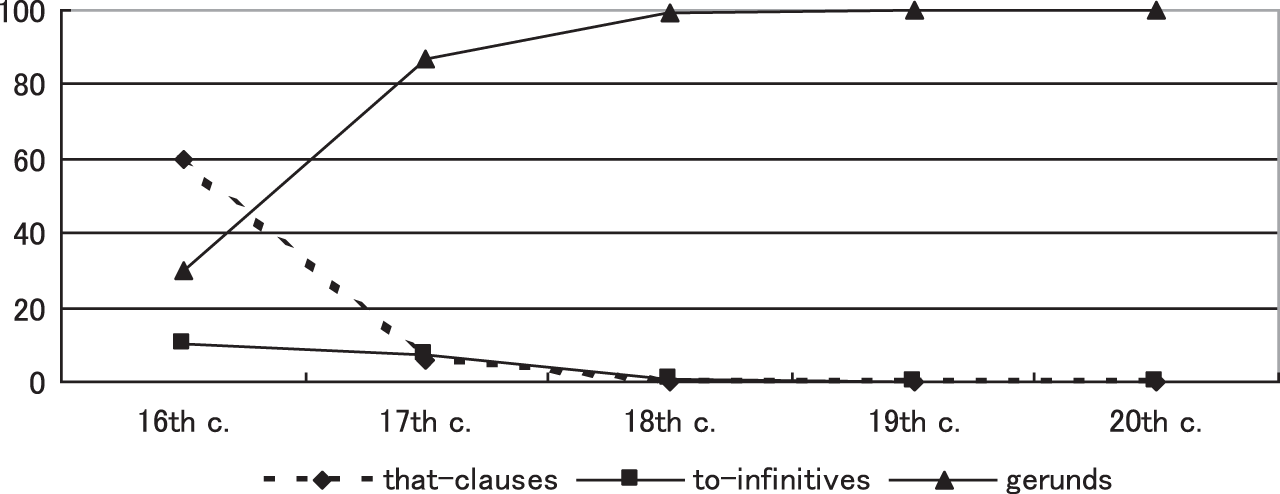
The sporadic occurrences of that-clauses and to-infinitives as complements of prevent in contemporary English are also interesting from a historical perspective. Complementation patterns of various verbs were more diverse in earlier stages of English than they are today. Throughout the history of English, a number of verbs – including prevent and other semantically related verbs such as prohibit – underwent a shift in complementation from that-clauses to to-infinitives, and then from to-infinitives to -ing forms (cf. Fanego Reference Fanego2004, 39–40; Iyeiri Reference Iyeiri2010). Iyeiri (Reference Iyeiri2010) refers to the former as the First Complement Shift and the latter as the Second Complement Shift, while Rohdenburg (Reference Rohdenburg, Dalton–Puffer, Kastovsky, Ritt and Schendl2006, 159–160) uses the more inclusive term the Great Complement Shift, which encompasses the rise of -ing complements at the expense of that-clauses and infinitives in the history of English. Prevent also went through a stage in which it was complemented by that-clauses and to-infinitives, although this was brief, as the loanword dates back only to the end of the Middle English period. Iyeiri (Reference Iyeiri2010) identifies that-clause and to-infinitive complements occurring with prevent in earlier periods, using the OED quotation base, and presents the graph shown in Figure 3:
Three complementation patters of prevent in the OED (%) (Iyeiri Reference Iyeiri2010, 90).

Although Iyeiri (Reference Iyeiri2010, 89) acknowledges that the evidence for the 16th century is not very strong, given that there are only ten examples, Figure 3 shows that complements of prevent in the Early Modern English period were more varied than they are today, including that-clauses and to-infinitives as well as -ing forms – the term ‘gerund’ in this graph encompasses -ing forms both with and without from. It may not be entirely illogical, therefore, to interpret the sporadic occurrences of that-clauses and to-infinitives in BAWE as remnants of earlier usage.
At the same time, the repeated occurrence of the to-infinitival construction in the dataset may also have been influenced by the to-infinitival complement of forbid, a semantically similar verb. Both to-infinitival and -ing constructions have historically been associated with verbs of forbidding and hindering in English, although -ing is more dominant in contemporary English. The -ing construction is characteristic of verbs such as prevent and prohibit, whereas to-infinitives are more typical of forbid.Footnote 19
All in all, the existence of varied complementation patterns in contemporary British English, as described above, may serve as a basis for further language change. As far as the usage of prevent is concerned, British English exhibits potential for change, whereas American English shows a fairly frozen state. This may be one reason why the verb itself is used only to a limited extent in the latter.
6. Conclusion
This study has thus far examined the complementation of prevent in contemporary English, showing that from-less -ing constructions are increasing in British English around the turn of the 21st century. The same trend is not observed in American English. Overall, the complementation patterns of this verb are more versatile in British English, including that-clauses and to-infinitives, and -ing forms both with and without from. When from is absent, the subject of -ing may appear in either the possessive or objective case, although examples with possessive subjects are very infrequent.
Whether the versatility of the complements of prevent in British English is a remnant of the historical development of the complementation of this verb remains an open question. That-clauses and to-infinitives, both attested in BAWE, were certainly available with prevent in the past and may have remained in occasional use throughout the history of English. On the other hand, it is also possible that the complementation patterns of semantically related verbs influence those of other verbs within the same semantic group – the verb forbid typically employs to-infinitival constructions. This may be one reason why prevent occasionally occurs with to-infinitives, especially in unedited texts such as those found in BAWE.
Whether the from-less construction arises as a result of the omission of from is difficult to determine. The history of English shows that -ing constructions without from have always existed. Its recent expansion relative to from -ing in contemporary English is, however, noteworthy. If there exists a perception among contemporary English users that the from-less form results from the omission of from, this may be one of the driving forces behind the expansion of from-less -ing in British English today. By contrast, the construction with from appears to be relatively fixed in American English, where the use of prevent itself is considerably more restricted. Overall, the findings suggest that the same verb is more dynamic in British English, where its versatility appears to be contributing to ongoing change in usage.
 YOKO IYEIRI is Professor of English at Kyoto University, Japan. Her research focuses on language variation and change, the syntactic development of English (both medieval and modern), and historical sociolinguistics. She is the author of: Negative Constructions in Middle English (Kyushu University Press, 2011); Verbs of Implicit Negation and their Complements in the History of English (John Benjamins, 2010); and Benjamin Franklin’s English: Form to Function Analyses (Routledge, 2025). She has also co-edited Pepysian Meditations on the Passion of Christ: Edited from Cambridge, Magdalene College, MS Pepys 2125 (Universitätsverlag Winter, 2019). Email: yiyeiri@bun.kyoto-u.ac.jp