This article is an updated and extended version of the electoral forecasting model devised by Lafay, Facchini, and Auberger (Reference Lafay, Facchini and Auberger2007) as applied to the French presidential election of 2007. In that article, the authors argued that the economy had made an impact on the election results, and that the Socialist Party (SP) approval ratings were another crucial complementary factor worth investigating. As a minor contribution to current debates, the article focused on the popularity of political parties, an aspect typically overlooked by both political analysts and economists. On the basis of an inductive approach, it inferred that the SP candidate generally wins elections in cases when its approval ratings poll more than 50% by March—two months before the first round of the election. By 2007, that index helped to forecast Nicholas Sarkozy’s victory over Ségolène Royale. If the index had been updated in time, it could have been used to forecast Francois Hollande’s victory over the incumbent Sarkozy, as well as Benoit Hamon’s 2017 failure to reach the second round (see appendix figure A1).
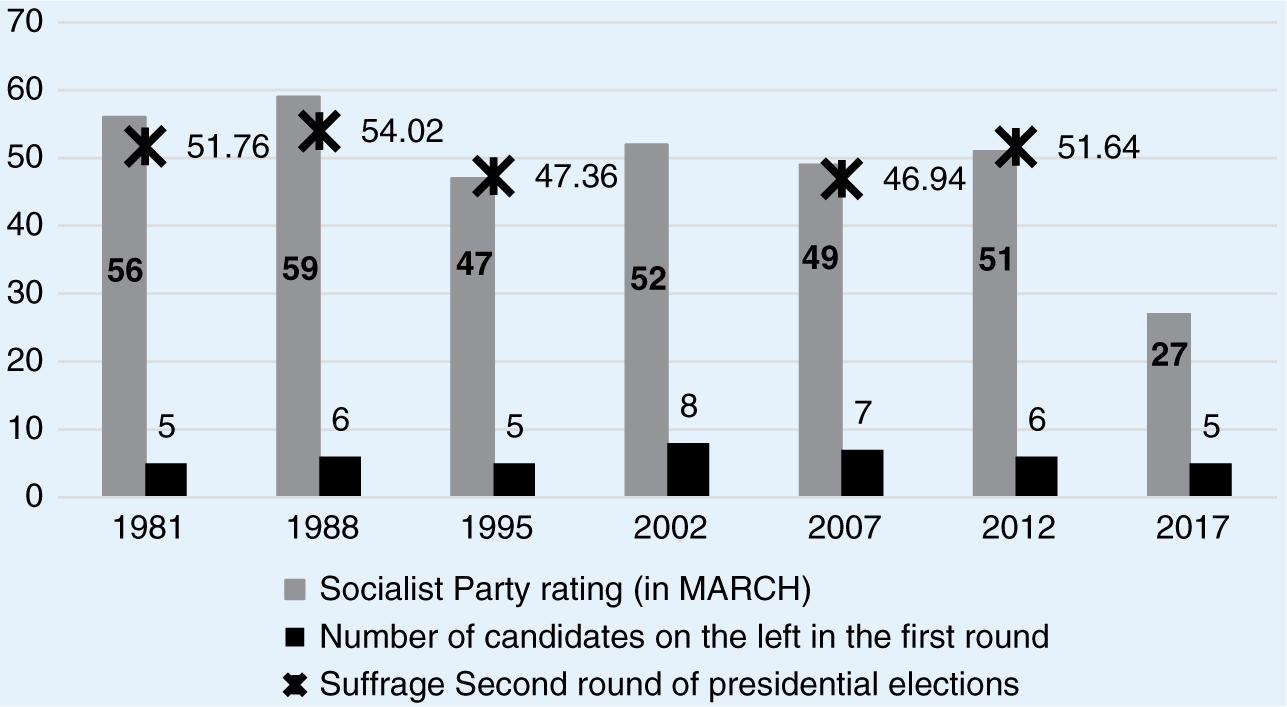
Figure 1 displays SP approval ratings in March for the 1981–2017 period, the Left’s electoral results in the second round of presidential elections, and an index showing the splits on the Left to account for Lionel Jospin’s 2002 fiasco (Facchini Reference Facchini2022). As of 2002, the SP was credited with 52% approval ratings, as opposed to 51% in 2012. However, whereas the Left had only six candidates in 2012, it was fielding as many as eight in 2002, which split the left-wing vote and prevented the SP-affiliated candidate to qualify for the second round. If Jospin had reached the second round, however, he would have been a likely winner in view of his party’s popularity.
Popularity Rating of the Socialist Party Two Months Before the Elections and Political Fragmentation of the Left
Sources: France Politique is the source for the electoral result. All SP ratings are from Political Barometer in Figaro Magazine. The TNS SOFRES Figaro Magazine political barometer became the Kantar-One Point Figaro Magazine political barometer. Since 1978, it was initially published in the first issue of the month of Figaro Magazine. The survey for Figaro Magazine was based on a national sample of 1,000 to 2,000 people, depending on the year, and representative of the entire population ages 18 and older, interviewed in person at home by the SOFRES network of pollsters. The rating of the political parties or opinion on the parties was based on the question: “What is your opinion of each of the following parties?” (very good, somewhat good, somewhat bad, or very bad). The rating is the sum of the “very good” and “somewhat good” opinions.

The SP approval ratings, however, could not have foreshadowed the success of Emmanuel Macron’s success in adopting a Centrist strategy in the 2017 election. That particular electoral result runs counter to the idea that the SP’s popularity is a solid indicator of who wins elections in France. Indeed, the SP approval ratings also revealed the balance of political forces competing in the 2022 presidential election. Does this suggest that examining the approval ratings of political parties has become a pointless exercise for those trying to forecast the electoral fate of a candidate?
The answer in this article is negative. Party rating always can be of use to predict the results of French presidential elections. The article’s introduction examines the topic at hand in light of the 2007 model. The next section justifies the central role given to party ratings in explaining and predicting candidates’ scores in elections. It reminds us that the more political capital a party transmits to its candidate, the more important it is that the candidate has a low profile. The third section uses the proxy model based on political-party ratings to predict the first round of the 2022 election. The article concludes with a second-round prediction based on the previous results. If the Left in its entirety were to come out in support of the outgoing president and the Extreme-Right voters likewise fell back on the right-wing candidate in the second round, the balance of power would be in Macron’s favor by 53.7%. The odds of Valérie Pécresse (Les Républicains, or LR) winning the second round were conditioned on (1) massive abstention on the Left (i.e., the 1969 scenario); and (2) systemic vote transfers from Extreme-Right voters to the Mainstream-Right candidate.
INTERPLAY BETWEEN PARTY AND CANDIDATE
What is the rationale for using party ratings to predict election outcomes? Elections are essentially unequal in that they are slanted in favor of those candidates whose reputation already is established or who benefit from a party platform bolstering their political capital. This discussion reminds readers of the intricate interplay between a party’s political capital and a candidate’s social capital, which explains the reasons why we should pay close attention to political parties’ approval ratings.
Ever since the late-nineteenth century, political parties have had a central role in the political life of liberal democracies. As an offshoot of labor movements, labor unions actively funded political actions conducted by the incipient SP. Therefore, when investigating the range of existing political agendas in France, giving particular prominence to the SP approval ratings was a sound approach. The invention of political parties contributed to widening the range of competing political agendas and to reshaping the socio-professional and sociopolitical composition of assemblies. Over time, the notables or amateurs of politics gradually gave way to professional politicians. Elected officials finally could live off politics instead of living for politics because their parties were in a position to subsidize their campaigns using stipends collected from party members.
Socialists’ efforts to raise the amount of subsidies afforded to politicians gave additional strength to political parties, notably regarding candidate selection. This led to the view that instead of voters selecting their representatives, representatives in fact were imposing their choices on voters.
In these conditions, it is crucial to determine the extent to which political parties account for an individual candidate’s success. Every candidate owes their success to both their own personal reputation and their affiliated party’s reputation. Candidate reputation depends on factors including local roots, history, and a record of past electoral victories. The better funded a party, the better equipped it is to campaign for and promote the candidates that it fields.
Politicians’ favorability ratings are one way to estimate the reputation of candidates, whereas party approval ratings are indicative of a party’s political capital. An election victory may be achieved once a candidate has amassed sufficient social capital (i.e., high-fame ratings) and/or is fielded by a party with high political capital. Political figures low on popularity nevertheless may win an election as a result of their affiliated parties’ high-reputation capital.
Given the history of partisan organizations, it is not surprising that the SP as an organization tends to garner higher approval ratings than the candidates it fields (see online appendix figure A1) and, therefore, the importance for left-wing candidates to benefit from their party’s endorsements. Conversely, Centrist parties including the Union for French Democracy (UDF) (launched in 1978) and right-wing parties including the Rally for the Republic (RPR) (launched in 1976) garner lower approval ratings (see online appendix figure A2). This implies that, unlike their left-wing counterparts, right-wing candidates must overcome their party’s comparatively lower prestige. For that reason, supplementing party approval ratings with individual candidate approval ratings is beneficial. How candidates fare depends on both their own reputation (i.e., approval ratings) and their parties’ reputation and perceived trustworthiness.
PARTIES, CANDIDATE RATINGS, AND FIRST-ROUND ELECTION RESULTS
Based on the political capital of parties and the social capital of candidates, this approach explains why the SP approval rating was a good predictor of presidential election results from 1981 to 2012. To a certain extent, it could be remodeled to fit the framework of the 2022 French presidential election.
In a two-round plurality election, it is vital for first-round candidates to rally support from their base if they have any ambition of reaching the second round, much less win the election.
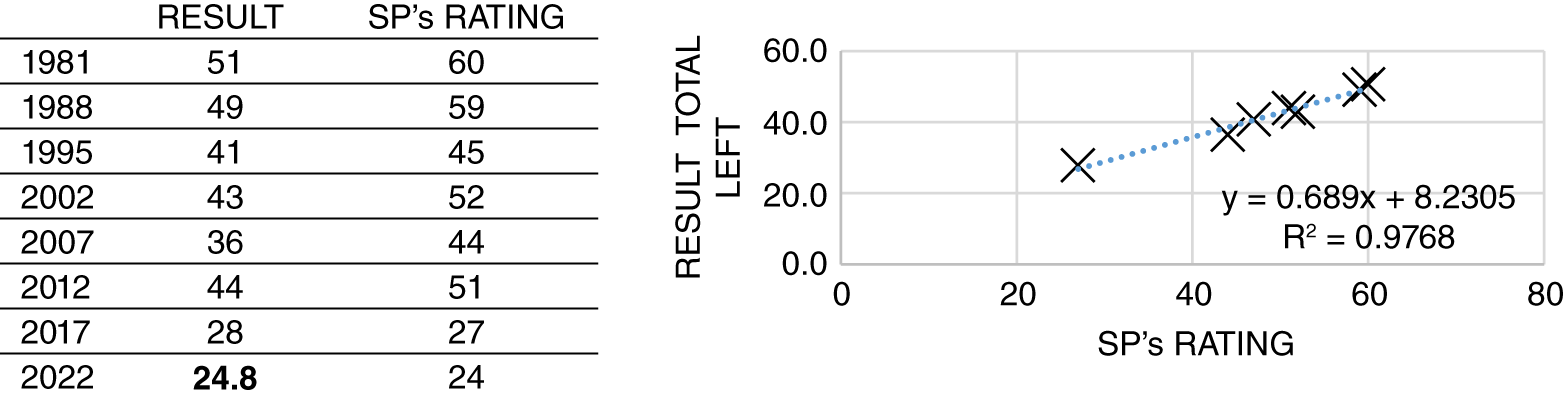
Prior to the 2017 presidential election, the SP managed to coalesce the Left, the Greens, and the Far Left (i.e., the French Communist Party, or PCF). Since 1981, the total left-wing vote tally has been highly correlated with SP’s approval ratings, which always have been a robust tool for predicting the balance of power between the Left and the Right as well as the Left’s electoral performance in general. Figure 2 illustrates the robustness of this relationship.
The Electoral Weight of the Left in the First Round of Elections (1981–2017) and the Rating of the SP and Its Candidate
Source: France Politique and Political Barometer Kantar-One-Pont Figaro Magazine. The SP approval rating was for the month of March. The number of observations on presidential elections was 7 (N = 7). R² = the coefficient of multiple determination.

The year 2017 was also when the Right split away from the Center. Until 2017, the Center and the Right had been in office together. During elections, they made common cause to gain and retain power. Their results logically reflected a function of the weakness of the Left. A strong Left weakened the Center and the Right; the reverse also was true. It was on this empirical trend that the Lafay, Facchini, and Auberger model (Reference Lafay, Facchini and Auberger2007) was predicated. Extreme-Right success since the 1998 election, leading up to Jean-Marie Le Pen’s unprecedented breakthrough in the second round in 2022, left a lasting impact on the political balance for right-wing parties.
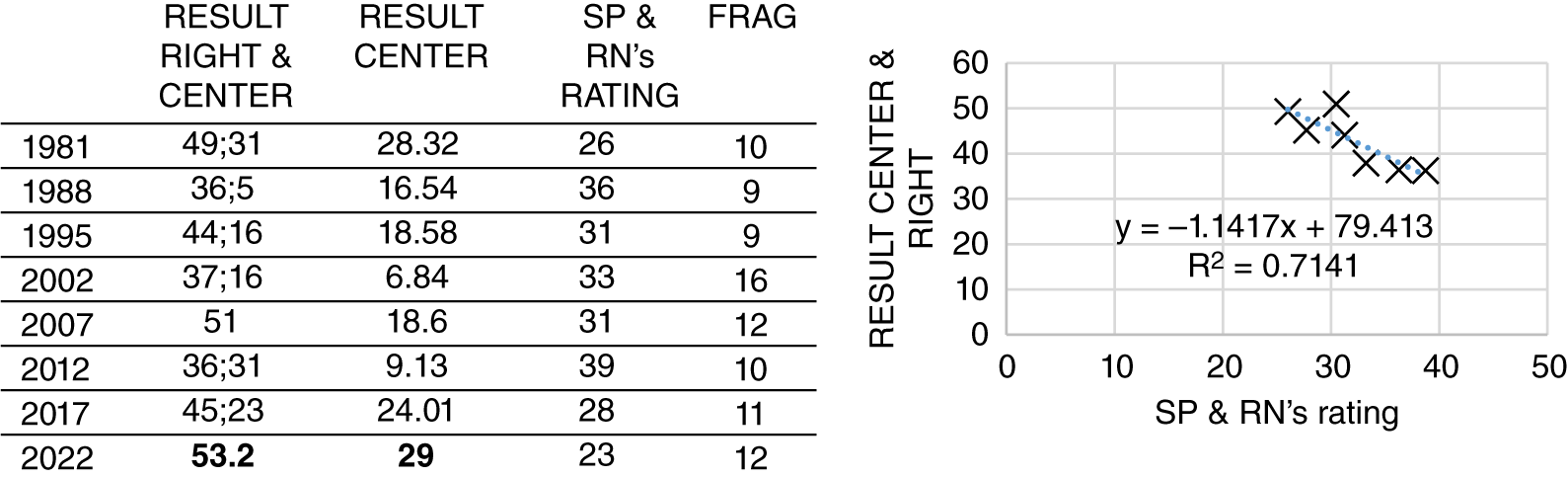
The scores of the Center and Right-Wing parties are a function of the popularity of both the Left-Wing parties and the Extreme Right. Whenever the SP and the Far Right are strong, the Center and Mainstream Right are predictably weak. A strong SP and Far Right weaken the Center and the Right. Figure 3 illustrates this interconnection by showing the concomitant evolution of the scores of the Center and the Right as well as the average ratings of the SP and the Far-Right parties and candidates.
Electoral Weight of the Center and the Right in the First Round of the Presidential Elections and Average of SP’s Rating FN/RN’s Rating and Their Candidate
Sources: France Politique and Political Barometer Kantar-One-Pont Figaro Magazine with
 $ SP\ \&\hskip0.35em R{N}^{\prime } s\ rating\hskip0.35em =\hskip0.35em \frac{\left( P{S}^{\prime } s\ rating+ R{N}^{\prime } s\ rating+ P{S}^{\prime } s\ candidaterating+ R{N}^{\prime } s\ candidaturerating\right)}{4} $
. N = 7. The score of the Center (Center Results) refers to the score of the candidate fielded by the UDF, Democratic Movement (MODEM), and Republic Onwards (LREM). In chronological order, the candidates were Valéry Giscard d’Estaing (1981), Raymond Barre (1988), Edouard Balladur (1995), François Bayrou (2002, 2007, 2017), and Emmanuel Macron (2017). The Right and Center scores are a combination composed of the Center scores with the scores of the Right (i.e., RPR; Union for a Popular Movement, or UMP; and The Republicans, or LR), whose candidates were Jacques Chirac (1981, 1988, 1995, 2002); Nicolas Sarkozy (2007–2012); and François Fillon (2017–), as well as the scores of the weaker right-wing candidates (Debré and Garaud 1981; de Villiers 1995; Lepage, Boutin, and Madelin 2002). The approval rating of candidates is their future rating or cote d’avenir des personnalités politiques. This rating was based on the answer to the following question: “For each of the following political figures, would you like to see him or her play an important role in the months and years to come?”

If the Right Wing and the Center were still allied, this coalition would win the 2022 election with a 53.2% share of the vote. Today, however, the Right and the Center no longer govern together. The Center governs on its own, unaided by neither the Left nor the Right.
The data in figure 3 were used to distinguish the LR candidate from the incumbent. The results of the Center evolve concomitantly with (1) the number of candidates for the presidential election (i.e., political fragmentation, or FRAG); and (2) the average of the popularity and future ratings of the SP and the National Rally (RN) Party with future ratings of their respective fielded candidates. Centrist candidates are weak when the number of candidates running is high and when the ratings of the parties and candidates of the Left and of the Extreme Right are high. The greater the political fragmentation, the less attractive the Center becomes because voters can endorse a candidate who better fits their preferences.
Centrist candidates are weak when the number of candidates running is high and when the ratings of the parties and candidates of the Left and of the Extreme Right are high.
The proxy model (Nadeau, Lewis-Beck, and Bélanger Reference Nadeau, Lewis-Beck and Bélanger2012) is as follows:
 $$ {\displaystyle \begin{array}{c} SCORECENTER=-1,4722\times \left[ SP\&R{N}^{\prime } s\ RATING+ FRAG\right]\\ {}\hskip5em +\hskip1.5pt \mathrm{80,685}\hskip0.6em with\ {R}^2=0,9514\end{array}} $$
The value of 12 is the number of candidates in the first round of the election. It is important to state that if the number of candidates were higher (e.g., 14), the percentage for Macron would be 26%. The Right could expect three points more votes. On this basis, the candidate Macron was forecasted to garner 29% of the vote in April 2022, leaving 24.2% of the vote for the right-wing candidate, Valérie Pécresse.
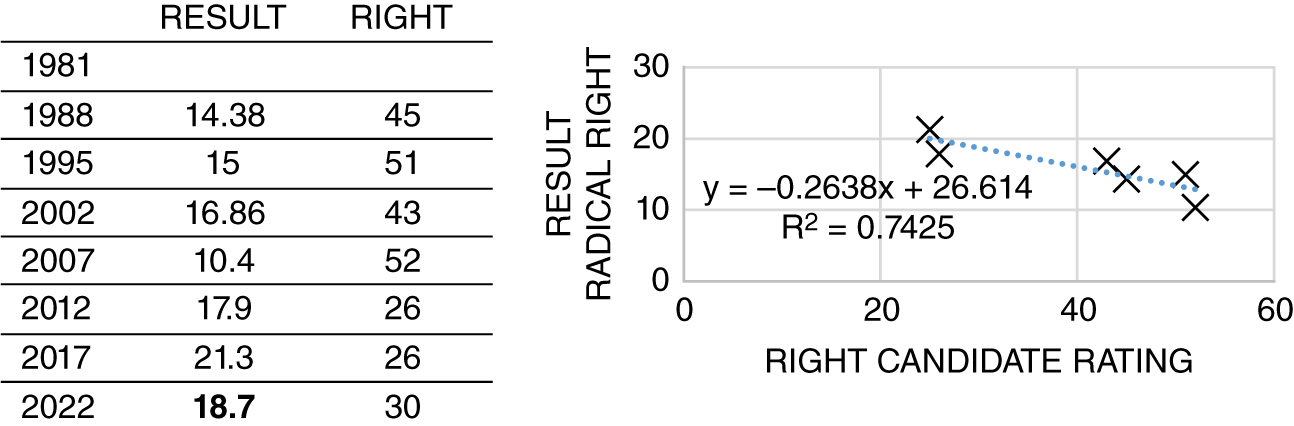
In turn, the Far Right gains strength whenever the Mainstream Right is weak. Far-Right results in the first round of elections evolves in the opposite direction of the individual candidate approval ratings of the Mainstream Right. On the basis of the equation in figure 4, Marine Le Pen was predicted to receive 18.7% of the votes.
The Electoral Weight of the Extreme Right in the First Round of the Presidential Election and the Ratings of Mainstream Right-Wing Parties (FN/RN and RPR/UMP/LR) and Their Leaders
Sources: France Politique and Political Barometer Kantar-One-Pont Figaro Magazine with
 $ RIGHT=\frac{\left( RPR, UMP\hskip0.35em \&\hskip0.35em L{R}^{\prime } s\; ratio+ Candidat{e}^{\prime } s\hskip0.2em rating\right)}{2} $
. N = 6.

Regarding the first-round results, candidates were expected to finish in the following order in terms of vote share: Emmanuel Macron, Valérie Pécresse, and Marine Le Pen, a left-wing candidate. Smaller candidates of the Mainstream and the Far Right might garner as much as 3.3% of the vote; it might be that around 3.3% of the vote would go to weaker Right and Far-Right candidates. It was expected that the second round would pit Pécresse against Macron. The assumption was that Pécresse needed to receive all of the right-wing votes—that is, not lose more than 5.5% of the votes to the Right (to candidates such as Eric Zemmour)—lest she be overtaken by Le Pen as early as the first round (18.7%). However, what about the second round?
DISCUSSION OF SECOND-ROUND PREDICTIONS
Second-round results typically depend on the transfer of votes. Voters generally repeat their first-round choices. Nonvoters would abstain and voters sympathetic to Macron and Pécresse would vote for them again. Voters settle for the candidate who is closest to their preferences. Voters on the Far Right were expected to vote for Pécresse and Mainstream and Left voters were expected to support Macron. As a consequence of these two rules, the second-round results would place Pécresse at 46.2% (24.2 LR+18.7, RN+3.3 other Right) and Macron at 53.8% (24.8 total Left+29 LREM). A Macron victory, therefore, was the most likely outcome.
Macron’s victory, nonetheless, should not have been taken for granted because the Left could still have massively abstained, handing victory to Pécresse. On the one hand, defeated left-wing candidates well might have declined to instruct their voters to rally behind Macron as they did in 2012. This could have happened because no republican front could be reasonably invoked in the case of the second-round pitting the Center against the Mainstream Right. On the other hand, abstention could be explained by a vote on priorities. If voters chose the candidate closest to their political preferences, the shift would be from the Left to the Center. If voters based their choices on a single issue (e.g., exiting nuclear energy), they would not cast a vote in the second round; neither Macron nor Pécresse were willing to abandon nuclear energy. Moreover, a Macron–Pécresse second round would place left-wing voters in an uncomfortable situation that some had experienced 1969—that is, choosing between two right-wing candidates, the consequences of which had been widespread abstention. In 1969, Duclos-Rocard and Krivine (i.e., Left and Extreme Left, respectively) instructed their voter base “not to vote”; 62% of these fringe parties complied, and the same could have applied in April 2022. More generally, since 1965—when the vote share of left-wing parties was low at the first round—the second-round abstention rate has been high. In 2017, only 54% on the Jean-Luc Mélenchon voters settled on Macron (Jaffré Reference Jaffré and Perrineau2017). Macron’s victory depended to a large extent on the decision of left-wing voters on the second ballot.
Use of the Foundation for Political Innovation (2022) voting simulator could clarify the conditions of a Pécresse victory. The simulator requires prior knowledge of the first-round results. The proxy model developed in this research provides first-round results of the following four major political forces: (1) first-round supporters of Macron and Pécresse plausibly would repeat their first-round decisions (100%); (2) on the Right, voters who initially voted in favor of Marine Le Pen and Nicolas Dupont-Aignan overwhelmingly would vote for Pécresse (i.e., approximately 80%, with 20% abstaining); (3) on the Left, votes (26%) would be distributed as follows: 15% for La France Insoumise and other Far-Left forces (i.e., Poutou and/or Arthaud), 3% for the SP, and 8% for the Green Party; 70% of Melenchon’s voters were predicted to abstain and 30% would vote for Macron; and (4) 40% of Green Party and SP voters would vote for Macron with the remainder abstaining. Abstainers on the one hand and voters who had cast a spoiled ballot on the other hand would do the same in the second round. In this scenario, Pécresse would win the election by 51.58%.
DATA AVAILABILITY STATEMENT
Research documentation and data that support the findings of this study are openly available at the PS: Political Science & Politics Harvard Dataverse at https://doi.org/10.7910/DVN/7PVGLC.
Supplementary Materials
To view supplementary material for this article, please visit http://doi.org/10.1017/S1049096522000440.
CONFLICTS OF INTEREST
The author declares that there are no ethical issues or conflicts of interest in this research.