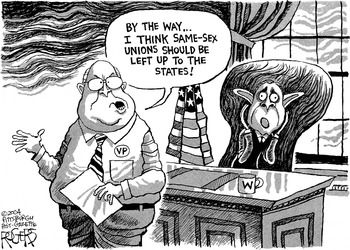
To what extent do political cartoonists use popular culture references to make sense of political culture? Seeing images in 2004, depicting Vice President Dick Cheney as Darth Vader from Star Wars, John Edwards as the Cheshire Cat from Alice in Wonderland, and John Kerry as Frankenstein's monster, it is clear that some editorial cartoonists make connections between our popular culture and our political culture. Why, and with what possible consequences?
The distinction between popular culture and political culture continues to blur, with a recent example being Bill Clinton's demand that television network ABC change its miniseries, “The Path to 9/11,” aired in fall 2006, on the fifth anniversary of the terrorist attacks. Based on the 9/11 Commission Report the film was not a documentary, but Clinton and those who had served in his administration argued that it contained false depictions. Not only does popular culture reflect our political culture, but the attention to the former may impact our impression of the latter.
To be featured in a political cartoon is to be the subject of satire, but when a political campaign is compared to a television reality show such as Survivor, some may consider that to be ridicule of political institutions as well. The 2004 online JibJab animations featuring John Kerry and George W. Bush in their version of “This Land is Your Land,” with references of a “liberal wiener” for Kerry and “right-wing nut job” for Bush, were anything but flattering of the presidential candidates. But the animations were wildly popular and entertaining, and may have reached a broader audience than traditional political messages ever could. Political cartoons that reflect popular culture references work in a similar way; they focus on potentially provocative political issues, but tie them to imagery and references from entertainment that may unexpectedly draw readers to politics.
This paper assesses the use of popular culture references in editorial cartoons of the 2004 presidential election, and analyzes two cartoonists' approaches of reflecting popular culture in their work.
Political Cartoons of Presidential Campaigns
Presidential candidates featured in political cartoons have been the study of past research; contemporary examples include the study of representations of George W. Bush and Al Gore during the 2000 presidential campaign (Edwards 2001), of Bob Dole and Bill Clinton during the 1996 campaign (Sewell 1998), of George H. W. Bush and Bill Clinton during the 1992 campaign (Koetzle and Brunell 1996; Lamb and Burns 1996), of George H. W. Bush and Michael Dukakis during the 1988 campaign (Buell and Maus 1988; Edwards 1997), of Ronald Reagan and Jimmy Carter during the 1980 campaign (DeSousa and Medhurst 1982), and of Jimmy Carter and Gerald Ford during the 1976 campaign (Bormann, Koester, and Bennett 1978; Hill 1984). In 2004, George W. Bush and John Kerry were featured regularly and quite equally in terms of frequency in political cartoon images (Conners 2005), although Ralph Nader rarely made an appearance. Bush and Kerry appeared more than three times as often in cartoons as their running mates, vice-presidential candidates Dick Cheney and John Edwards.
The framework for this paper's visual rhetorical analysis comes from Medhurst and DeSousa's (1981) identification of four themes or “major inventional topoi” (200) in their analysis of the political cartoons of the 1980 presidential election: political commonplaces (tying the campaign to other current events or the political process), personal character traits (physical or psychological exaggeration), situational themes (short-term situations that appear unexpectedly during a campaign), and literary/cultural allusions. This study will explore the use of literary or cultural allusions, what Medhurst and DeSousa (1981) define as “any fictive or mythical character, any narrative form, whether drawn from legend, folklore, literature, or the electronic media” (201) with a specific focus on references made to popular culture allusions.
A quantitative analysis of editorial cartoons of the 2004 presidential campaign (Conners 2005) provides context for this qualitative analysis. Using Medhurst and DeSousa's four themes, a representative sample of 2004 editorial cartoons reflected that political commonplaces were indeed common in cartoons, with 34% of cartoons featuring events from the political campaigns, ranging from politicians kissing babies to the Republican and Democratic National Conventions. Character traits, often physical exaggerations, appeared in approximately 13% of cartoons, such as vice-presidential candidate John Edwards' smile. Situational themes, connecting the campaign to non-political events, appeared in 7% of cartoon images, with references to hurricanes in Florida and volcano Mount St. Helen's rumblings in 2004. Finally, allusions, the primary focus of this current analysis, appeared in approximately 27% of cartoon images examined in the quantitative content analysis. The most common allusions made were sports references, followed by entertainment references to television or advertising, then by literature and holidays (as Election Day follows soon after Halloween).
I analyze here two cartoonists' work which frequently reflects popular culture allusions. Both Rob Rogers of the Pittsburgh Post-Gazette and Steve Benson of the Arizona Republic frequently use popular culture references in political cartoons, and their work during the 2004 presidential campaigns featured many such examples. In addition to analyzing the 2004 election cartoons of these two cartoonists that included popular culture references, I also conducted interviews with both cartoonists to ascertain further insight into these images.1
Phone interviews were conducted with Rob Rogers on September 11, 2006, and Steve Benson on September 5, 2006.
Pop Culture in Presidential Political Cartoons
The political cartoons by Rob Rogers of the Pittsburgh Post-Gazette featuring the 2004 presidential election reflected numerous popular culture references. In considering his use of popular culture images in political cartoons, Rogers said in his interview he remembers growing up with advertisements and stories that would setup the story and then offer the punch line at the end, which formed his thinking about how to present material and how metaphors are used in humor. He says incorporating popular culture allusions into political cartoons “gives you another connection with readers interested in politics. They don't expect to see politics tied to particular movies or images, but the unexpected gets their attention.”
One example of connecting politics with popular culture is Rogers' August 27, 2004, cartoon (see Figure 1) that ties the Bush campaign to Norwegian artist Edvard Munch's 1893 painting The Scream. While the cartoon provides an allusion to the famous artwork, the cartoon also acknowledges the situational theme that the painting had been stolen from the Munch Museum in Oslo on August 22. The background image of the cartoon as well as Bush's facial features both reflect expressionistic details from the painting. One not familiar with the painting, or with the burglary just prior to this cartoon, might “read” the cartoon in a manner considerably different from a reader familiar not only with the artwork itself but also its recent theft. Rogers' comment on this cartoon: “If readers don't get that it's The Scream I don't know where they've been living, I can't draw for them, I draw for people like me who know and enjoy popular culture; but if they don't know it was stolen that week, it won't have quite the ‘punch’ it would with other readers.”

Rob Rogers: © The Pittsburgh Post-Gazette/Dist. By United Feature Syndicate, Inc.
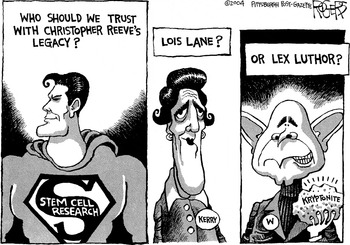
Movie themes appear frequently in Rogers' work, and his October 15, 2004, cartoon features a Superman theme, as seen in Figure 2. Featured shortly after Reeve's October 10, 2004, death, this cartoon may be considered a tribute cartoon to Reeve's memory, but it additionally involves the issue of stem cell research, and includes candidates Bush and Kerry as well. The cartoon does not suggest what candidate responses regarding stem cell research are, although the association of George W. Bush as Lex Luthor, Superman's nemesis, suggests that he would be in direct opposition to it. John Kerry as Lois Lane, Superman's love interest, might suggest the more supportive role, although representing Kerry as a woman also implies passivity or weakness.2
For more on the role that gendered imaging plays in editorial cartoons, see Janis L. Edwards' article in this symposium.

Rob Rogers: © The Pittsburgh Post-Gazette/Dist. By United Feature Syndicate, Inc.
In discussing this particular image, Rogers stated that he hesitated using this cartoon: “I drew it and I liked it but I didn't love it; I'm not sure it's the best use of the Superman metaphor.” While readers might connect that Superman is threatened by kryptonite, Rogers was not sure that most readers would understand who Lex Luthor was.
Rogers' other cartoons of the 2004 campaign featured a reference to Janet Jackson's Super Bowl wardrobe malfunction involving John Kerry and Howard Dean during the Democratic primaries, as well as a Halloween mask of “Osama bin Kerry” in a store titled “W's Fright Shop.” Rogers enjoys being immersed in popular culture: “I take for granted that readers are as well.”
Arizona Republic cartoonist Steve Benson explains his use of popular culture allusions thusly: “In the milieu of current politics and culture and fads, we try to symbolically and instantaneously relate to our audience.” Benson described his choice of visuals as a tool to reach readers in political cartoons: “I use images that linger, I want them to communicate, to be burned in the mind or bellies of readers…. I try to avoid a lot of verbiage.” Benson has faced a number of instances where his powerful and provocative images resulted in a considerable amount of negative responses from the public. His response to such attention, and to the potential of cartoon images to create controversy, is that “cartoonists have a role in democracy to catalyze debate.”
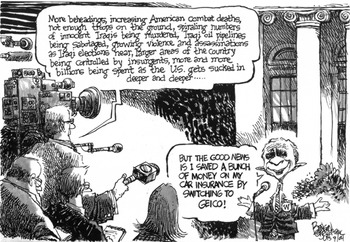
Figure 3 features an image of a George W. Bush press conference, but this time not Bush as a candidate, but rather as the president. This reflects a general pattern of media coverage of incumbents running for office, that they have the advantage or disadvantage of receiving additional media attention as the elected official as well as the candidate for office. The image is quite text heavy, particularly for Benson's work. Benson acknowledged that fact and stated that it would have been much too difficult to visually represent any more than one of those issues, and it was more effective to list the numerous questions the Bush White House faced at that time in text, and then to have Bush give what Benson called “a pithy little advertising line” as his response.

By permission of Steve Benson and Creators Syndicate, Inc.
The cartoon played off of Geico's advertising campaign during that election cycle, which featured people in difficult situations during which they would unexpectedly announce their savings by switching insurance companies. The use of allusion to popular culture here is atypical for an editorial cartoon, because the connection is made in the text rather than from the visuals. However, Geico's slogan was so prominent in television advertising as a verbal phrase that the connection had to be made in text; other advertising by the company, particular messages featuring the talking gecko, would have resulted in a more visually based reference in a political cartoon environment.
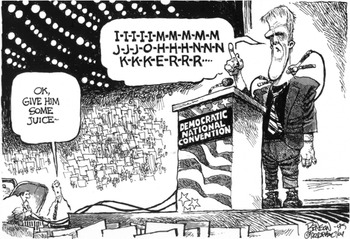
The comparison of Frankenstein's monster to John Kerry in Figure 4 was a common allusion made in the 2004 campaign, suggesting Kerry's stiffness and lack of emotion. For example, his announcement of John Edwards as his running mate was reflected in cartoons as reviving Frankenstein's monster, and in the close timing of Halloween to Election Day, Kerry was sometimes featured in a Frankenstein's monster costume, while Bush was dressed as a cowboy. This image by Benson features Kerry as Frankenstein's monster giving his acceptance speech at the Democratic National Convention. His opening line of that speech was: “I'm John Kerry, and I'm reporting for duty.” While some cartoon images represented Kerry in some type of military uniform following this address, his lack of emotion and energy, often critiqued on the campaign trail by other forms of media, were implied in Benson's image.

By permission of Steve Benson and Creators Syndicate, Inc.
Conclusion
Why are such allusions made so often in political cartoons? Perhaps because then the political cartoonist need not explain an individual's complex qualities or characteristics, but can instead simplify them through these types of allusions, in particular those that are visually based. Benson suggests that he wants his cartoons to be understood by readers even if the “talk bubbles” in the image are absent.
While political cartoonists may not create an image with the key concern being audience comprehension of the image and its potential allusions, Medhurst and DeSousa (1981, 201) remind us that “to decode the cartoon, one must be somewhat familiar with the literary or cultural source to which it refers.” To that point, Pittsburgh Post-Gazette cartoonist Rob Rogers says, “my audience needs to have the same vocabulary, or they're not going to understand” his cartoons. “I try to give my readers credit. If they're like me, and intrigued by the idea but don't understand all of it, they'll Google it” and explore the connection further. Benson acknowledges an attempt to relate to and connect with readers in using popular culture images. He says “because we use icons, because our language is visual shorthand, they are signposts or pegs a reader can relate to or identify. Pop culture helps convey the message to a reader's reality, and tries to communicate to readers on their level.” Whether political cartoonists use references to popular culture in their work based on their own interest in them, or based on their hope that such references will help readers relate to the issues, the intersection of popular culture with our political culture will persist.