Introduction
A lack of social connectedness is a known risk factor for mortality, comparable in magnitude to other established risk factors including smoking and obesity (Holt-Lunstad, Smith and Layton Reference Holt-Lunstad, Smith and Layton2010; Holt-Lunstad et al. Reference Holt-Lunstad, Smith, Baker, Harris and Stephenson2015). A lack of social connectedness has been operationalised as a subjective feeling of loneliness, or objective concept, of being socially isolated. Loneliness has been defined as a discrepancy between the perceived quantity and quality of one's social relationships and one's desire for them (Scharf and De Jong Gierveld Reference Scharf and De Jong Gierveld2008). Social isolation has been defined as less than weekly contact with family, friends or neighbours (Victor, Bond and Bowling Reference Victor, Bond and Bowling2003). A meta-analysis of 70 longitudinal cohort studies found that loneliness and social isolation each independently increase mortality risk by almost 30 per cent in a large and age-diverse sample, though objective social deficits were more detrimental to adults under age 65 (Holt-Lunstad et al. Reference Holt-Lunstad, Smith, Baker, Harris and Stephenson2015). It is widely recognised that loneliness and social isolation are related but conceptually and empirically distinct; one can be socially isolated but not feel lonely and vice versa (Cornwell and Waite Reference Cornwell and Waite2009; Havens et al. Reference Havens, Hall, Sylvestre and Jivan2004; Wenger and Burholt Reference Wenger and Burholt2004).
Social disconnectedness is seen in both younger and older adults. The United Kingdom (UK) has a higher prevalence of loneliness in younger (less than 25 years) and older adults (over 65 years), with around 9 per cent in both groups reporting feeling severely lonely, but only 5 per cent of those aged 25–44 years feeling severely lonely (Victor and Yang Reference Victor and Yang2012). A recent analysis of representative UK-based data from the Opinions and Lifestyle Survey presented the same pattern in loneliness prevalence across 5,159 individuals (Thomas Reference Thomas2015). The prevalence of social isolation, about 5 per cent, is similar across younger adults (Caspi et al. Reference Caspi, Harrington, Moffitt, Milne and Poulton2006) and middle-aged and older adults (Jivraj, Nazroo and Barnes Reference Jivraj, Nazroo, Barnes, Banks, Nazroo and Steptoe2012).
While preventing or alleviating loneliness and social isolation is important across the lifespan, population ageing has led to an increased focus on identifying effective ways to achieve this in older age (e.g. Dickens et al. Reference Dickens, Richards, Greaves and Campbell2011). Evidence suggests that, in older age, loneliness might have more severe health consequences than social isolation (Holwerda et al. Reference Holwerda, Beekman, Deeg, Stek, Van Tilburg, Visser and Schoevers2012; Tilvis et al. Reference Tilvis, Routasalo, Karppinen, Strandberg, Kautiainen and Pitkala2012). Longitudinal studies of older populations show that loneliness increases the risk of all-cause mortality, while social isolation does not (Holwerda et al. Reference Holwerda, Beekman, Deeg, Stek, Van Tilburg, Visser and Schoevers2012; Tilvis et al. Reference Tilvis, Routasalo, Karppinen, Strandberg, Kautiainen and Pitkala2012). Loneliness increases the risk of peripheral vascular disease mortality (Patterson and Veenstra Reference Patterson and Veenstra2010), cognitive decline (Boss, Kang and Branson Reference Boss, Kang and Branson2015) and results in a greater number of physician visits (Newall, McArthur, and Menec Reference Newall, McArthur and Menec2015), irrespective of social isolation. These health effects may occur through the mechanism of biological stress brought on by the psychological experience of loneliness (Steptoe et al. Reference Steptoe, Owen, Kunz-Ebrecht and Brydon2004). A meta-analysis of 91 prospective studies demonstrated that increased social contact frequency (the reverse of social isolation) had only a minimal effect on longevity (Shor and Roelfs Reference Shor and Roelfs2015).
There is some controversy within the literature, however, which may stem from inconsistent definitions of social isolation. Steptoe et al. (Reference Steptoe, Shankar, Demakakos and Wardle2013) found social isolation to be predictive of all-cause mortality, while loneliness was not. In this study, social isolation included a measure of social participation, an active component which broadens the more common definition of social isolation as the quantity of social contact. Social participation has been analysed as a separate concept from social isolation and found to have had a different longitudinal influence on mortality in an older Finnish population (Tilvis et al. Reference Tilvis, Routasalo, Karppinen, Strandberg, Kautiainen and Pitkala2012).
Loneliness has been conceptualised in various different ways. The cognitive perspective of loneliness conceptualises loneliness as arising from maladaptive cognitive and psychological processes, resulting in the negative interpretation of social cues, even when they are not (Cacioppo, Hawkley and Berntson Reference Cacioppo, Hawkley and Berntson2003; Peplau and Perlman Reference Peplau, Perlman, Peplau and Perlman1982). Using this perspective, several dimensions of loneliness have been formed. De Jong Gierveld, van Tilburg and Dykstra (Reference De Jong Gierveld, van Tilburg, Dykstra, Vangelist and Perlman2006) conceptualised loneliness as two-dimensional: a lack of social contact (‘social loneliness’) and a lack of emotional support (‘emotional loneliness’). Cacioppo et al. (Reference Cacioppo, Grippo, London, Goossens and Cacioppo2015) argued a further differentiation: a perceived lack of social contact from the closest others (e.g. spouse; ‘intimate loneliness’), friends or other family (‘relational loneliness’) and one's wider social network (‘collective loneliness’). Despite this theoretical complexity, a uni-dimensional concept of loneliness as a subjective satisfaction with one's total level of social contact had also been applied in many large studies (Fokkema, De Jong Gierveld and Dykstra Reference Fokkema, De Jong Gierveld and Dykstra2012; Sundström et al. Reference Sundström, Fransson, Malmberg and Davey2009; Tilvis et al. Reference Tilvis, Routasalo, Karppinen, Strandberg, Kautiainen and Pitkala2012; Victor and Yang Reference Victor and Yang2012; Victor et al. Reference Victor, Scambler, Bowling and Bond2005), and is used in the current study.
Researchers have also identified various social network types: ‘friend’, ‘congregant’, ‘family’ and ‘diverse’-centred networks (‘diverse’ being a combination of all contact types) (Litwin and Shiovitz-Ezra Reference Litwin and Shiovitz-Ezra2011). Different sources of social relationships (e.g. family or friends) have been seen to offer different levels of support for older Europeans (Wenger Reference Wenger1997). Isolation from these different types of social networks may therefore also differ in their consequences on older adult health and wellbeing and in their predictors. In this paper, we focus on isolation from one's family and from one's friends and neighbours, to explore if they are experienced by older people with different personal and social characteristics.
Despite a growing awareness that social isolation and loneliness are conceptually distinct (Cacioppo et al. Reference Cacioppo, Grippo, London, Goossens and Cacioppo2015), this is not yet reflected in policy and practice. National UK policy documents consistently use loneliness and social isolation interchangeably, or ‘loneliness and social isolation’ as one construct (House of Lords 2013). This is also true for many local policy documents in the UK (e.g. Devon County Council 2013; Norfolk County Council Reference Alabady, Hillman and Rennie2013; Wiltshire Council 2013). Building on this, public interventions targeting social isolation may not benefit many individuals at risk/suffering from loneliness due to maladaptive social cognition (Cacioppo and Cacioppo Reference Cacioppo and Cacioppo2014). A systematic review found that only interventions addressing maladaptive social cognition were successful at lowering loneliness, whereas interventions focusing on social contact were able to widen individuals' social networks, but not lower loneliness (Masi et al. 2011). Similarly, the group interventions effective at reducing loneliness identified by Cattan et al. (Reference Cattan, White, Bond and Learmouth2005) had an educational focus or provided targeted support activities for participants at risk, for example for widowed individuals. Thus, it may be that it was not just the bringing together of peers in a group setting which reduced loneliness, but that the interventions stimulated a cognitive shift to better handle their particular social context.
Identifying independent predictors of loneliness and social isolation may aid practitioners to recognise individuals at risk and tailor interventions appropriately. In a longitudinal study, worsening loneliness eight years after baseline measurements was significantly related to being no longer married, and showed a trend of relation to deterioration in social activity, increasing chronic illness, no longer co-habiting and a decrease in number of confiding relationships for UK older adults (Victor and Bowling Reference Victor and Bowling2012). Cross-sectional, UK data show older age loneliness to be related with lower socio-economic status, less contact with one's children (Demakakos, Nunn and Nazroo Reference Demakakos, Nunn, Nazroo, Banks, Breeze, Lessof and Nazroo2006), lack of transport and living in a rural area (Drennan et al. Reference Drennan, Treacy, Butler, Byrne, Fealy, Frazer and Irving2008). Increasing social isolation over time was predicted by being male, less wealthy and living in rural areas in the English Longitudinal Study of Ageing (ELSA) (Jivraj, Nazroo and Barnes Reference Jivraj, Nazroo, Barnes, Banks, Nazroo and Steptoe2012).
Despite research findings that older adults living in rural areas are more likely to experience loneliness (Drennan et al. Reference Drennan, Treacy, Butler, Byrne, Fealy, Frazer and Irving2008) and social isolation (Jivraj, Nazroo and Barnes Reference Jivraj, Nazroo, Barnes, Banks, Nazroo and Steptoe2012) than their urban counterparts, few studies have been devoted to understanding loneliness and social isolation in a rural population (Burholt and Dobbs Reference Burholt and Dobbs2012). Rural areas, defined as settlements with a population below 10,000 (Department for Environment, Food and Rural Affairs (DEFRA) 2013), house a higher proportion of adults over the age of 65 (25.0%) than urban areas in the UK (15.3%), a gap expected to widen further in the near future (DEFRA 2015). Rural areas are also characterised by less accessible public transport, public facility maintenance (i.e. roads and pavements), commercial outlets, and health and social care services, as well as greater income inequality and fewer households with children living at home (Age UK 2013; Le Mesurier Reference Le Mesurier2003; Philip and Gilbert Reference Philip and Gilbert2007). These factors may put rural residents at risk of declining social opportunities and possibly loneliness and/or social isolation as they age.
While a few studies compared predictors of loneliness and social isolation in older, rural populations (Wenger and Burholt Reference Wenger and Burholt2004; Havens et al. Reference Havens, Hall, Sylvestre and Jivan2004), these relate to Welsh and Canadian older adults, respectively, and their findings are now dated. As different cultures, societies and time-dependent political contexts influence the experience of loneliness (Yang and Victor Reference Yang and Victor2011), there is a need to re-investigate predictors of both social isolation and loneliness in recent UK-based data. This study explores the differences in predictors of loneliness and two types of social isolation (from one's family and from one's community) in an older, rural-living population living in the UK.
Methods
The Grey and Pleasant Land data-set
The Grey and Pleasant Land (GaPL) study was designed to capture diversity in a representative sample of older adults living in rural areas in the south-west of the UK, where population ageing is more pronounced (Brown Reference Brown2005). The data were collected in 2009 and comprised quantitative survey responses from 920 adults aged 60 and over living across three rural communities in south Wales and three in south-west England (Economic Social Research Council 2015). The survey included items on demographic, socio-economic, personal, social, environmental and transport-related factors (Shergold and Parkhurst Reference Shergold and Parkhurst2012). In each country, three areas were selected according to their fit to pre-defined types of rurality: Type A (remote and deprived), Type B (less remote and deprived) and Type C (less remote and less deprived). These rurality types were constructed by taking into account: the 2005 DEFRA urban/rural definition of settlements (Office for National Statistics (ONS) 2016); social, cultural, political and economic differences; lifestyle differences (e.g. retirement retreats or dynamic commuter areas); the proximity to cities or large towns, nature of work (e.g. agriculture reliant) and the presence of older people using Census data (Hennessy, Means and Burholt Reference Hennessy, Means and Burholt2014). Type A areas adhered to DEFRA's Rural 80 classification, and both Type B and Type C areas adhered to the Rural 50 classifications (ONS 2016). For an in-depth account of the characteristics of each rural type, see Burholt (Reference Burholt2012).
Using Census data, every resident aged 60 and over in the selected areas was posted information about the study and given the choice to opt out. All residents who did not opt out were visited by researchers and, if consenting, asked to complete the survey in their native language (Curry and Fisher Reference Curry and Fisher2013). The estimated response rate for households containing people age 60 and over was 68 per cent (Hennessy, Means and Burholt Reference Hennessy, Means and Burholt2014).
Study design
The present secondary analysis of GaPL data was exploratory in nature, given the scarcity of recent findings about predictors of loneliness and social isolation in rural settings (Burholt and Dobbs Reference Burholt and Dobbs2012). Multivariate binary logistic regression models were constructed to explore the associations between an array of socio-demographic, socio-economic, health-related and behavioural variables and three dependent variables: loneliness, isolation from family and isolation from the community. The sample was analysed as a whole in order to test potential predictors of loneliness and social isolation in a variety of rural settings (not testing between different types) and to attain the strongest possible statistical inferences. Potential clustering by rural dwelling was controlled for in the models. Data from 884 respondents was used, excluding 38 cases with incomplete data-sets.
Dependent variables
Loneliness
A unidimensional variable (‘lonely’, ‘not lonely’) was created from the question ‘I experience a general sense of loneliness’ with response options ‘agree’, ‘disagree’ or ‘don't know’. As self-rating scales for loneliness tend to underestimate loneliness due to a propensity for lonely individuals to not want to admit their loneliness consciously or unconsciously (Perlman Reference Perlman2004), the ‘I don't know’ response was interpreted as an indication of some level of loneliness, even if unconscious. Thus, consistent with the coding approach used for De Jong Gierveld's loneliness measure (De Jong Gierveld and Kamphuis Reference De Jong Gierveld and Kamphuis1985), ‘agree’ and ‘don't know’ were combined. A single-item loneliness measure has been used in large English (Victor and Yang Reference Victor and Yang2012; Victor et al. Reference Victor, Scambler, Bowling and Bond2005) and European studies (Fokkema, De Jong Gierveld and Dykstra Reference Fokkema, De Jong Gierveld and Dykstra2012; Sundström et al. Reference Sundström, Fransson, Malmberg and Davey2009; Tilvis et al. Reference Tilvis, Routasalo, Karppinen, Strandberg, Kautiainen and Pitkala2012).
Social isolation variables
Variables (‘isolated’, ‘not isolated’) were constructed using the social isolation definition: ‘having less than weekly direct contact with family and friends’ (Victor, Bond and Bowling Reference Victor, Bond and Bowling2003). This definition has been used in other large studies (Jivraj, Nazroo and Barnes Reference Jivraj, Nazroo, Barnes, Banks, Nazroo and Steptoe2012; Holwerda et al. Reference Holwerda, Beekman, Deeg, Stek, Van Tilburg, Visser and Schoevers2012; Tilvis et al. Reference Tilvis, Routasalo, Karppinen, Strandberg, Kautiainen and Pitkala2012). Isolation from family was defined as ‘having less than weekly direct contact with family’ and constructed using the question ‘How often do you see any of your children or other relatives?’ Isolation from the community was defined as ‘having less than weekly direct contact with friends and neighbours’ and constructed using the questions ‘If you have friends in this community how often do you have a chat or do something with one of your friends?’ and ‘How often do you have a chat with or do something with your neighbours?’
Explanatory variables
Due to the exploratory nature of this analysis, a range of explanatory variables were chosen. Some variables were chosen because they have previously been found to be related to loneliness or social isolation in urban, mixed or rural populations, and it is important to see whether these predictors are also valid in a more contemporary rural context. Predictors of loneliness include widowhood (Demakakos, Nunn and Nazroo Reference Demakakos, Nunn, Nazroo, Banks, Breeze, Lessof and Nazroo2006; Golden et al. Reference Golden, Conroy, Bruce, Denihan, Greene, Kirby and Lawlor2009; Victor and Yang Reference Victor and Yang2012; Victor et al. Reference Victor, Scambler, Bowling and Bond2005, Reference Victor, Scambler, Marston, Bond and Bowling2006; Wenger and Burholt Reference Wenger and Burholt2004), poor physical health (Drennan et al. Reference Drennan, Treacy, Butler, Byrne, Fealy, Frazer and Irving2008; Victor and Bowling Reference Victor and Bowling2012; Wenger and Burholt Reference Wenger and Burholt2004), poor psychological health (Victor et al. Reference Victor, Scambler, Bowling and Bond2005), low education level (Victor and Yang Reference Victor and Yang2012; Victor et al. Reference Victor, Scambler, Bowling and Bond2005), low wealth status (Demakakos, Nunn and Nazroo Reference Demakakos, Nunn, Nazroo, Banks, Breeze, Lessof and Nazroo2006), recent immigration (Wenger and Burholt Reference Wenger and Burholt2004) and lower levels of community participation (Newall et al. Reference Newall, Chipperfield, Clifton, Perry, Swift and Ruthig2009). Predictors of social isolation include being unmarried (Golden et al. Reference Golden, Conroy, Bruce, Denihan, Greene, Kirby and Lawlor2009; Jivraj, Nazroo and Barnes Reference Jivraj, Nazroo, Barnes, Banks, Nazroo and Steptoe2012), not being widowed (Jivraj, Nazroo and Barnes Reference Jivraj, Nazroo, Barnes, Banks, Nazroo and Steptoe2012), low wealth/socio-economic status (Jivraj, Nazroo and Barnes Reference Jivraj, Nazroo, Barnes, Banks, Nazroo and Steptoe2012; Wenger Reference Wenger1995) and having a physical disability (Golden et al. Reference Golden, Conroy, Bruce, Denihan, Greene, Kirby and Lawlor2009). The access to a car (Lee, Steinman and Tan Reference Lee, Steinman and Tan2011) and public transport (Shergold and Parkhurst Reference Shergold and Parkhurst2012) explanatory variables were included because they have been shown to be specifically important for the maintenance of social functioning in rural areas.
Some explanatory variables were chosen due to hypothesised relationships between certain behaviours and either loneliness of social isolation. Contact with children, either face to face or over the phone, was a significant cross-sectional predictor of loneliness data from the ELSA (Demakakos, Nunn and Nazroo Reference Demakakos, Nunn, Nazroo, Banks, Breeze, Lessof and Nazroo2006), and the authors argued that phone contact with children was important for parents who lived far from their kin. In a rural context, it can be expected that many children have moved away to find better employment opportunities and affordable housing (Wenger Reference Wenger2001). Thus, access to a telephone was chosen as a predictor variable.
Physical activity variables were included as it is argued that individuals who feel lonely due to maladaptive social cognition may withdraw themselves from the company of others, perceiving the social exchanges to be of a negative nature, and that this may then lead to less accumulated physical activity (Hawkley and Cacioppo Reference Hawkley and Cacioppo2010). In the reverse direction, less engagement with physical activity for any reason could also decrease the opportunities for social contact, and in this manner increase both social isolation and loneliness.
The range of explanatory variables were grouped thematically in order to perform a stepped regression analysis, and to exclude collinear variables within thematic groups. The themes included (a) socio-demographic and socio-economic (SDSE) variables; (b) health-related variables; and (c) behavioural variables.
The SDSE variables comprised: ‘widowhood’ and ‘household car access’ (both ‘yes’/‘no’), ‘years of residence in the community’ (‘less than 5’, ‘6–10’, ‘11–20’, ‘21–30’ and ‘more than 30 years’), ‘educational attainment’ (‘no qualifications’, ‘primary’, secondary’, ‘college level’, ‘tertiary’), ‘perceived financial coping’ (‘living comfortably’, ‘doing all right’ and ‘experiencing some to many problems’) and ‘neighbourhood deprivation rating’ (membership of national quintiles of the English 2007 Indices of Multiple Deprivation (IMD) and Welsh 2008 IMD scores). The English IMD scores include Census information on: income; employment; health and disability; education, skills and training; barriers to housing and services; living environment; and crime (Communities and Local Government 2007). The Welsh IMD scores include Census information on: income; housing; employment; access to services; health; environment; education; and crime and fire (Statistics for Wales 2008).
Two health-related variables were used: perceived physical and mental health over the last four weeks. ‘Perceived physical health’ was constructed by combining two questions: ‘How much did physical problems limit your usual physical activities?’ and ‘How much energy did you have?’ Five response categories were constructed by taking the minimum response for both questions: ‘not at all’, ‘very little’, ‘to some extent’, ‘quite a lot’ and ‘very limited’ physical health. ‘Perceived mental health’ was constructed using responses to: ‘How much did emotional problems limit your usual physical activities?’, merged into four response categories: ‘not at all’, ‘slightly’, moderately’, ‘quite a lot or very much’. The physical and mental health variables were only weakly correlated (Spearman's rho = 0.229, p < 0.001).
Eight behavioural variables were computed: ‘local social participation’ (sum of weekly engagement in 12 types of community-based activities, e.g. residents’ association, school, voluntary and charity group: ‘0’, ‘1’, ‘2’, ‘3’, ‘4 or more’ types); frequency of ‘walking in the countryside’, frequency of ‘gardening’ (both ‘never’, ‘at least once a month’, ‘at least once a week’ and ‘most days’); ‘total outdoor active pursuits’ (sum of weekly engagement in nine physically active, outdoor pursuits, e.g. gardening, collecting (door-to-door visits to collect for charity), walking in the countryside: ‘0’, ‘1’, ‘2’, ‘3’, ‘4 or more’). Other variables were ‘telephone use’ (‘never/don't own one’, ‘less than once a week’, ‘weekly’ and ‘daily’), ‘use of public transport’ (‘less than once a month’, ‘in last month’, in last week’) and ‘assisting others’ and ‘caring for pets’ (both ‘yes’/‘no’).
Control variables
Older age (Demakakos, Nunn and Nazroo Reference Demakakos, Nunn, Nazroo, Banks, Breeze, Lessof and Nazroo2006; Drennan et al. Reference Drennan, Treacy, Butler, Byrne, Fealy, Frazer and Irving2008) as well as female gender (Victor and Yang Reference Victor and Yang2012) have been associated with loneliness, and older age (Golden et al. Reference Golden, Conroy, Bruce, Denihan, Greene, Kirby and Lawlor2009; Jivraj, Nazroo and Barnes Reference Jivraj, Nazroo, Barnes, Banks, Nazroo and Steptoe2012; Wenger et al. Reference Wenger, Davies, Shahtahmasebi and Scott1996) and being male (Jivraj, Nazroo and Barnes Reference Jivraj, Nazroo, Barnes, Banks, Nazroo and Steptoe2012) have been associated with social isolation for adults over age 60. Age categories (‘60–69’, ‘70–79’, ‘80–89’, ‘90–99’) and gender were therefore included as control variables so as to discount any potential influence of age and gender on social network size and loneliness while looking at the modifiable explanatory variables. Country (England or Wales) was also controlled for because the area deprivation variable (IMD) was constructed using different parameters in England and Wales.
Statistical analysis
The Stata 12.0 statistics package was used for all analyses. Cases with missing responses for any of the dependent variables were excluded (N = 38). To assess potential selection bias, the responses of excluded and included cases were compared using the appropriate parametric tests (t-tests for continuous and binary variables and one-way analysis of variance for ordinal variables with three or more levels). The proportion of respondents in each category of SDSE and rurality variables are presented for the whole sample and stratified by gender. The overlap between the three dependent variables was explored descriptively by cross-tabulation.
Binary regression modelling, adjusted for clustering for the six geographical areas to obtain robust standard errors (Rabe-Hesketh and Skondral Reference Rabe-Hesketh and Skondral2012: 591), was used in all analysis. The resultant odds ratios (OR) and associated 95 per cent confidence intervals (CI) are reported, with statistical significance set at p < 0.05. Separate regression models were constructed for each dependent variable to test their associations with explanatory variables. Collinearity, defined as Spearman's rho greater than or equal to 0.3, between all explanatory variables was tested prior to modelling.
Each dependent variable underwent five modelling steps (Models A–E) and all models were adjusted for age, gender and country.
-
• Model A: The dependent variable was entered with each explanatory variable into different univariate models.
-
• Model B: The explanatory variables in each sub-category (e.g. SDSE variables) with significant associations to the dependent variable in Model A were force-entered as a group into an adjusted multivariate model.
-
• Model C: Explanatory variables with persisting significant individual associations in Model B of each sub-category (Wald test p-value) were force-entered simultaneously in a multivariate model.
-
• Model D: Where collinear explanatory variables were both brought forward, a different model was constructed with each and the collinear variable with the highest statistically significant effect size was retained in subsequent models.
-
• Model E: Explanatory variables with persisting significant associations in Models C and D were force-entered into a fully adjusted model with either global social isolation (isolation from both family and the community) added to the loneliness model, or loneliness added to the isolation sub-type models as another confounding variable. This was done to assure independent influences by the predictors, distinct from any potential overlap between loneliness and social isolation.
Missing responses of explanatory variables were coded as 999 (‘missing’) and retained in the logistic models to maximise the sample size. In each step, explanatory variables with ordered categories were entered as ordinal variables (to derive measures of effect size for each level). The missing values categories were tested against the reference category, but not included in the tables. Next, the logistic regression tests were repeated with the missing cases excluded, entering the explanatory variable as a continuous variable to test the overall trend of increasing category membership of these variables.
Results
Participant characteristics
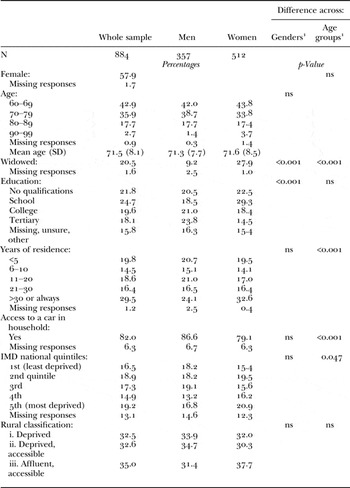
Table 1 summarises the participant characteristics. The gender distribution was relatively equal (57.9% women), though younger respondents were over-represented. The average age was 71.5 (standard deviation = 8.1, range = 60–97) and respondents were evenly distributed between the three pre-defined rural area types.
Sample characteristics

Notes: 1. Independent samples t-test for continuous or bivariate variables, one-way analysis of variance for ordered variables. SD: standard deviation. ns: not significant. IMD: Indices of Multiple Deprivation.
The excluded cases were more likely to live alone (included 30% versus excluded 47%, p = 0.047) and in more deprived communities (p = 0.011), and had better levels of perceived mental health (p = 0.013) compared with included cases. All other variables did not differ significantly between included and excluded cases.
Prevalence of loneliness and isolation variables
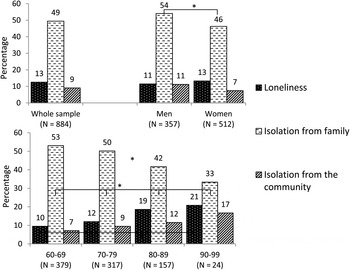
Figure 1 shows the prevalence of the loneliness and isolation: 13 per cent (111/884) were classified as lonely. Eight per cent of the respondents (70/884) responded positively and 5 per cent (41/884) showed uncertainty (‘don't know’) to the direct loneliness question; 49 per cent (437/884) were isolated from their family; 9 per cent (80/884) were isolated from their community; and 5 per cent (45/884) were isolated from both family and community. While significantly more men were isolated from their family than women (54.1% versus 46.3%, p = 0.024), no gender differences were observed for loneliness or isolation from the community (Figure 1). Significantly higher proportions of older respondents reported loneliness (p = 0.018), and to a lesser extent isolation from family (p = 0.040), although no differences were observed in isolation from the community (Figure 1).
Prevalence of loneliness and two types of isolation for the whole sample and across genders and age groups.

Only 1.4 per cent (12/884) of respondents were lonely and isolated from both family and the community. Around a third of people who reported feeling lonely (36.0%, 40/111) were not isolated in any way. A large proportion of those isolated from their family (85.6%, 374/437) or isolated from the community (75.0%, 60/80) were not lonely. Few of those isolated from their family were also isolated from the community (13.2%, 45/341); while around half of those isolated from the community were also isolated from their family (56.3%, 45/80).
Factors associated with loneliness
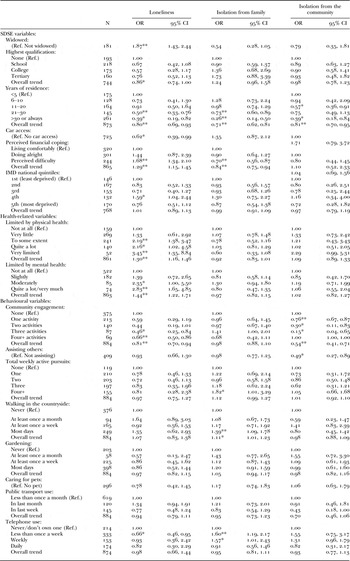
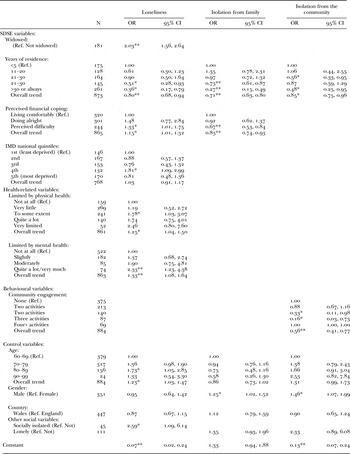
In preliminary univariate models all six SDSE variables, both physical and mental health variables, and two behavioural variables (community engagement, telephone use) were significantly associated with reports of being lonely (Table 2). However, in the final, fully adjusted model (Table 3), car access was dropped due to collinearity with widowhood and community engagement was dropped as it suppressed the effect of perceived financial difficulties. In both cases the retained variable showed the strongest effect. Factors which independently increased the odds of loneliness were: being widowed (OR = 2.03, 95% CI = 1.56, 2.64), perceived financial difficulties (OR = 0.36, 95% CI = 0.17, 0.79 for highest category versus lowest), living in the fourth highest deprivation quintile versus lowest (OR = 1.81, 95% CI = 1.09, 2.99), and feeling more limited by physical health (OR = 1.12, 95% CI = 1.04, 1.50) or mental health (OR = 2.33, 95% CI = 1.23, 4.38 for highest category versus lowest). The only factor that reduced the odds of loneliness was a longer residence in the community (OR = 0.80, 95% CI = 0.68, 0.94 for each ten-year increase, and OR = 0.36, 95% CI = 0.17, 0.79 for being resident 30 years or over, versus less than five years). When social isolation was added to the fully adjusted model, it significantly increased odds of loneliness (OR = 2.59, 95% CI = 1.09, 6.14), and seemed to exert a very small moderating effect (increasing the strength of associations) between widowhood and loneliness, and between poorer mental health and loneliness. Further, it demonstrated a very small mediating effect (decreasing the strength of associations) between older age and loneliness. For the control variables in the fully adjusted model, each ten-year increase in age raised the odds of loneliness (OR = 1.23, 95% CI = 1.03, 1.47), but gender and country were not associated with loneliness.
Univariate, controlled associations for each independent and dependent variable

Notes: OR: odds ratio. CI: confidence interval. SDSE: socio-demographic and socio-economic. Ref.: reference category. IMD: Indices of Multiple Deprivation.
Significance levels: * p < 0.05, ** p < 0.01.
Final multivariate models showing the factors significantly related to loneliness, isolation from one's family and isolation from the community

Notes: OR: odds ratio. CI: confidence interval. SDSE: socio-demographic and socio-economic. Ref.: reference category. IMD: Indices of Multiple Deprivation.
Significance levels: * p < 0.05, ** p < 0.01.
Factors associated with isolation from one's family
In preliminary univariate models (Table 2), two SDSE variables (length of residence, perceived financial coping) and three behavioural variables (total weekly active pursuits, walking in the countryside, telephone use) were significantly associated with being isolated from one's family. However, in the fully adjusted model (Table 3), only the two SDSE variables remained significant. A longer residence in the community decreased the risk of being isolated from one's family (OR = 0.71, 95% CI = 0.63, 0.80 for each ten-year increase, and OR = 0.27, 95% CI = 0.15, 0.49 for being resident 30 years or over, versus less than five years). Counter-intuitively, perceiving financial difficulty also reduced the likelihood of being isolated from one's family (OR = 0.67, 95% CI = 0.53, 0.84 for the highest versus lowest category). When adding loneliness to the final model, it did not predict isolation from family, and did not change any of the associations between the predictors and isolation from family. For the control variables in the fully adjusted model, being male increased odds of family isolation (OR = 0.25, 95% CI = 1.02, 1.52) but age and country were not associated with isolation from family.
Factors associated with isolation from the community
In preliminary univariate models (Table 2) only one SDSE variable (length of residence) and two of the behavioural variables (community engagement, assisting others) were significantly associated with being isolated from the community. In the fully adjusted model (Table 3), only length of residence and community engagement remained significant. A longer residence in the community decreased the risk of being isolated from the community (OR = 0.85, 95% CI = 0.75, 0.96 for each ten-year increase, and OR = 0.48, 95% CI = 0.25, 0.95 for being resident 30 years or over, versus less than five years). Each extra community engagement activity engaged in decreased the odds of community isolation (OR = 0.56, 95% CI = 0.41, 0.77), with three or more community engagement activities decreasing the odds by over 80 per cent (OR = 0.16, 95% CI = 0.03, 0.73). When loneliness was added to the final model, it did not significantly predict community isolation, but showed a very small mediating effect (reducing the associations) between community engagement and community isolation, and a strong mediating effect between older age and community isolation. For the control variables in the fully adjusted model, being male increased the odds of community isolation (OR = 1.46, 95% CI = 1.07, 1.99) but age and country were unrelated to community isolation.
Discussion
This study explored the differences in predictors of loneliness and two types of social isolation (from one's family and from one's community) in adults aged 60 and older living in rural areas of the south-west of the UK. This is the first UK study to explore co-factors of these social variables in a large, diverse rural sample since the late 1980s (Burholt and Dobbs Reference Burholt and Dobbs2012; Stockdale Reference Stockdale2011). As hypothesised, loneliness and the two isolation types had different, independent cross-sectional predictors, as supported by previous research (Havens et al. Reference Havens, Hall, Sylvestre and Jivan2004; Wenger and Burholt Reference Wenger and Burholt2004). Being a newcomer in the community was the only predictor common to all three social deficit variables. Widowhood, older age, and poor mental or physical health were only related to loneliness.
In our rural sample, 8 per cent agreed to being lonely and 5 per cent showed uncertainty (‘don't know’) to the loneliness question, which was interpreted as an underlying loneliness not expressed due to the taboo associated with loneliness (Perlman Reference Perlman2004). The proportion of definite cases of loneliness seems similar to the 9 per cent who were ‘severely’ lonely in a nationally representative sample of UK older adults, which included more urban than rural-living participants (Victor and Bowling Reference Victor and Bowling2012). However, it is not possible to compare these questions due to their difference in wording and response categories. The level of social isolation (from both family and the community) was comparable to UK nationally representative data at around 5 per cent (Jivraj, Nazroo and Barnes Reference Jivraj, Nazroo, Barnes, Banks, Nazroo and Steptoe2012), though again, the constructs used to measure these were also worded differently, precluding accurate comparison. We found that gender was not associated with loneliness, supporting previous findings in UK older adults (Victor et al. Reference Victor, Scambler, Marston, Bond and Bowling2006). Men were, however, more likely to experience both types of social isolation, supporting previous findings that older men in England were almost twice as likely as women to become socially isolated over time (Jivraj, Nazroo and Barnes Reference Jivraj, Nazroo, Barnes, Banks, Nazroo and Steptoe2012). The trend of higher odds of loneliness with increasing age also confirms previous evidence from the ELSA (Jivraj, Nazroo and Barnes Reference Jivraj, Nazroo, Barnes, Banks, Nazroo and Steptoe2012; Shankar et al. Reference Shankar, Hamer, McMunn and Steptoe2013) and cross-sectional Irish data (Drennan et al. Reference Drennan, Treacy, Butler, Byrne, Fealy, Frazer and Irving2008). Given the over-representation of adults aged 60–69, it may be that a large percentage of younger respondents were still working (Emmerson and Tetlow Reference Emmerson, Tetlow, Banks, Breeze, Lessof and Nazroo2006). This could play a part in the age difference in feelings of loneliness, as retirement correlated positively with loneliness in several American data-sets, despite this association not necessarily being of a cause and effect nature (Kerwin Reference Kerwin2004).
Widowhood is one of the most empirically supported predictors of loneliness in studies of older populations (Demakakos, Nunn and Nazroo Reference Demakakos, Nunn, Nazroo, Banks, Breeze, Lessof and Nazroo2006; Dykstra, Van Tilburg and De Jong Gierveld Reference Dykstra, Van Tilburg and De Jong Gierveld2005; Victor et al. Reference Victor, Scambler, Bowling and Bond2005). The current findings and previous reports show that rural-living individuals are not different in this regard (Wenger and Burholt Reference Wenger and Burholt2004; Wenger et al. Reference Wenger, Davies, Shahtahmasebi and Scott1996). The relation of widowhood only to loneliness, not types of social isolation, supports the differentiation of Cacioppo et al. (Reference Cacioppo, Grippo, London, Goossens and Cacioppo2015) between loneliness arising from loss of an intimate relationship from that arising from a lack of wider relations or the collective community. A review of 39 qualitative studies of bereavement concluded that the relationships widow/ers have with close others cannot replace that which is lost (the spouse) (Naef et al. Reference Naef, Ward, Mahrer-Imhof and Grande2013). Thus, adaptation to widowhood might not be as easy as gaining other close social contacts.
Physical and mental health has frequently been linked to the prevalence of loneliness across British, other European and American samples (Hawkley and Cacioppo Reference Hawkley and Cacioppo2010). While the current study's cross-sectional association between perceived physical and mental health and loneliness cannot infer causality, longitudinal studies have found that loneliness is associated with the risk of being diagnosed with depression (Cacioppo et al. Reference Cacioppo, Hawkley and Thisted2010) and Alzheimer's disease (Boss, Kang and Branson Reference Boss, Kang and Branson2015), and with lower self-rated health (Hawkley, Thisted and Cacioppo Reference Hawkley, Thisted and Cacioppo2009). In a 20-year follow-up of older adults in rural Wales, deteriorating health was related to the onset of loneliness, but not social isolation (Burholt and Wenger 2004). Longitudinal analysis of Dutch, American and English samples have also reported that improvements in physical health and function were associated with a reduced risk of being lonely (Dykstra, Van Tilburg and De Jong Gierveld Reference Dykstra, Van Tilburg and De Jong Gierveld2005; Luo et al. Reference Luo, Hawkley, Waite and Cacioppo2012; Victor and Bowling Reference Victor and Bowling2012). Poor physical function and physical or mental health may be a way for health professionals to identify individuals at risk of loneliness. The promotion of healthy lifestyles and physical activity could also have a role in preventing the onset of loneliness through preserving better physical health and function.
This study's finding that perceived financial difficulties increased odds of loneliness confirm other cross-sectional observations of English (Demakakos, Nunn and Nazroo Reference Demakakos, Nunn, Nazroo, Banks, Breeze, Lessof and Nazroo2006) and other European older samples (Drennan et al. Reference Drennan, Treacy, Butler, Byrne, Fealy, Frazer and Irving2008; Fokkema, De Jong Gierveld and Dykstra Reference Fokkema, De Jong Gierveld and Dykstra2012; Losada et al. Reference Losada, Márquez-González, García-Ortiz, Gómez-Marcos, Fernández-Fernández and Rodríguez-Sánchez2012). The lack of association between financial difficulties and isolation from the community is similar to findings that wealth was not related to overall social isolation across five waves in the ELSA (Jivraj, Nazroo and Barnes Reference Jivraj, Nazroo, Barnes, Banks, Nazroo and Steptoe2012) and in a cross-sectional analysis of older adults in rural Canada (Havens et al. Reference Havens, Hall, Sylvestre and Jivan2004). The association between greater perceived financial difficulties and more contact with one's family has not been previously reported. It could be that rural-dwelling individuals with financial issues tend to get instrumental help from their family but that this type of support is not emotionally beneficial, as odds of loneliness are worse. Similar differences between types of social support were seen in a six-year study of 2,255 Dutch middle-aged and older participants, for whom emotional support, but not instrumental support, offered protective cognitive effects and loneliness relief (Ellwardt et al. Reference Ellwardt, Aartsen, Deeg and Steverink2013).
Engagement with more community activities was found to be associated with a lower risk for isolation from one's community. Community participation and altruistic behaviours, such as volunteering, inextricably involve social contact and have been related to increased psychological wellbeing and reduced all-cause mortality (Barron et al. Reference Barron, Tan, Yu, Song, McGill and Fried2009; Cattan, Hogg and Hardill Reference Cattan, Hogg and Hardill2011). The lack of association with loneliness was therefore a little surprising, given Canadian findings that greater weekly social participation was associated with less loneliness in both a cross-sectional analysis of 1,243 older adults, and a five-year longitudinal analysis of 688 older adults (Newall et al. Reference Newall, Chipperfield, Clifton, Perry, Swift and Ruthig2009). A possible explanation might be related to the classification of loneliness by Cacioppo et al. (Reference Cacioppo, Grippo, London, Goossens and Cacioppo2015) in three dimensions: intimate, relational and collective. It may be that community engagement activities can decrease the collective loneliness, which refers to ‘a person's valued social identities or “active network” wherein an individual can connect to similar others at a distance in the collective space’ (Cacioppo et al. Reference Cacioppo, Grippo, London, Goossens and Cacioppo2015: 241). Intimate loneliness, which relates to the perceived absence of a significant close other, and relational loneliness, which relates to the perceived absence of quality friendships or family connections, are more likely to be related to widowhood and distance from kin. In this study, loneliness was measured as a uni-dimensional concept. Further investigation of dimensions of loneliness is needed to differentiate further its predictors in a rural setting.
Similar to the findings of this study, Burholt and Wenger (2004) found that for the 30 survivors of a 20-year study in rural Wales, the indigenous to the area were least likely to be lonely or socially isolated over time. Individuals who have lived longest in an area might have developed more meaningful friendships over time than newcomers. An earlier study of 240 older adults in rural north Wales found that long-term residents' social networks were made up of family and friends living locally, while newcomers' social networks comprised social contacts living further afield or contained very few contacts (Wenger Reference Wenger1995). Newcomers in rural communities may be at risk of both social isolation and feelings of loneliness as the social networks between long-standing villagers may be strong and closed to new members. Length of residence in a rural community may be an important index for practitioners to use to identify individuals who may benefit from some form of social intervention or assistance in relation to both loneliness and social isolation.
This study clearly reiterated the conceptual independence of loneliness and social isolation also reported in other studies (Cornwell and Waite Reference Cornwell and Waite2009; Havens et al. Reference Havens, Hall, Sylvestre and Jivan2004). However, overall social isolation did independently predict loneliness and exert a small moderating influence on the effects of widowhood and poor mental health on loneliness. This supports Wenger and Burholt's (Reference Wenger and Burholt2004) conclusion from their 20-year rural follow-up study that, despite the conceptual independence of loneliness and social isolation, certain situations (widowhood and deteriorating health) predispose older individuals to both loneliness and social isolation, and that at these points in life individuals need increased support.
Practical implications
Our findings strongly support the need to stop using the terms loneliness and social isolation interchangeably. They are conceptually distinct, occur in different population sub-groups, and are associated with different health and social outcomes. Together with longitudinal findings from large European studies (Holwerda et al. Reference Holwerda, Beekman, Deeg, Stek, Van Tilburg, Visser and Schoevers2012; Jivraj, Nazroo and Barnes Reference Jivraj, Nazroo, Barnes, Banks, Nazroo and Steptoe2012; Tilvis et al. Reference Tilvis, Routasalo, Karppinen, Strandberg, Kautiainen and Pitkala2012), our data support the need for a shift in policy focus to include loneliness as well as social isolation, but to measure these independently. It is likely that practitioners and policy makers have focused on social isolation in the past because it is more easily represented by routinely recorded data, such as the number of people living in a household.
The current study's predictors of loneliness suggest factors which may be used to identify those at risk of loneliness in a rural older population. Nevertheless, this should not replace health practitioners directly discussing loneliness issues with their patients. Identifying and addressing loneliness is an important aspect of the emerging ‘social prescribing’ movement in which primary care services refer patients with social, emotional or practical needs to a range of local, non-clinical services, often provided by the voluntary or community sector (Jopling Reference Jopling2015). Primary care practitioners are in a prime position to identify those at risk of loneliness, as they are often the first to know about an older adult's declining physical or mental health or bereavements which are important predictors of loneliness.
The findings of this study also highlight the importance of ageing in place with regards to social connections. Our data and previous reports show that migrating to a new area at an older age may put both rural (Wenger et al. Reference Wenger, Davies, Shahtahmasebi and Scott1996; Wenger and Burholt Reference Wenger and Burholt2004) and urban-dwelling (Jivraj, Nazroo and Barnes Reference Jivraj, Nazroo, Barnes, Banks, Nazroo and Steptoe2012) individuals at risk of loneliness and/or social isolation. In a qualitative case study comparison between urban and rural-living older English adults, we found that the presence of supportive local social contacts was beneficial to staying actively engaged in their communities, regardless of setting (de Koning, Stathi and Fox Reference de Koning, Stathi and Fox2015). However, rural-living older adults may be particularly prone to relocating at an older age and so losing touch with their neighbourhood community, given longitudinal Welsh findings that rural-living older adults are over 30 per cent more likely to move (either to a rural or urban place) than those living in major conurbations (Wu et al. Reference Wu, Prina, Barnes, Matthews and Brayne2015). Ageing in place is already a central focus of UK policy as stated in the ‘Ready for Ageing?’ report by Age UK and the International Longevity Centre (Sinclair and Watson Reference Sinclair and Watson2013). However, increased effort is necessary to facilitate the ability for rural-living older adults to remain in their communities. This may help preserve their social network, prevent loneliness, and optimise long-term wellbeing and ultimately health. Practically, such facilitation may take the form of greater provisions of public transport suitable for older adults, so that adults who have lost access to a car may remain independent (Shergold and Parkhurst Reference Shergold and Parkhurst2012), and the provision of assisted-living arrangements for those in need. Furthermore, public health interventions could also focus on ways of assisting newcomers to rural areas to forge strong and long-lasting connections with existing residents. Such ideas need to be tried and tested with community intervention studies.
Strengths, limitations and recommendations
The GaPL data-set represents a large, diverse sample of people aged 60 and over living across six geographically and demographically different rural sites across one of the UK's most rapidly ageing regions, the south-west (Office for National Statistics 2012). Nevertheless, by design the six case studies approach, though well motivated, does not provide a probability sample and therefore strong generalisations for ageing in rural areas cannot be made. The over-representation of adults aged 60–69 years likely means many respondents were still employed, and that the findings apply mostly to the retirement transition period, rather than to later adulthood. Furthermore, the cross-sectional nature of the data precludes any inference of causality. Our findings add important value to an under-researched field of ageing research, however, the hypotheses generated here should be tested with newly collected large, representative and ideally longitudinal data of rural-living older adults in the UK.
As with any secondary analysis, we were constrained by the existing measures available. For example, the wording for the social isolation questions regarding contact with family (specifying face-to-face contact) was different from questions reporting contact with neighbours and friends in the community (not specifying face-to-face contact). This may have exaggerated the difference between isolation from one's family and one's community members. Another limitation was the ‘outdoor active pursuits’ variable, which was a proxy for physical activity, and the ‘community engagement’ variable which was constructed from nine pre-defined activities. Thus, these behavioural independent variables may not have been valid or sensitive enough to detect associations that have been identified in previous research (Newall et al. Reference Newall, Chipperfield, Clifton, Perry, Swift and Ruthig2009, Reference Newall, Chipperfield, Bailis and Stewart2013). Future investigations using physical activity levels as predictors of loneliness or social isolation should use objective physical activity measurements, as self-reported physical activity is limited by recall accuracy (Colbert et al. Reference Colbert, Matthews, Havighurst, Kim and Schoeller2011), and measure social activity through activity diaries. The findings of our study support the need to investigate the predictors of different dimensions of loneliness in rural populations as these are presented by Cacioppo et al. (Reference Cacioppo, Grippo, London, Goossens and Cacioppo2015), and different dimensions of social isolation (i.e. from family or from the community). As IMD is calculated differently across England and Wales, the findings of this study in relation to how area deprivation (IMD) co-varies with loneliness or social isolation need to be treated with caution.
Conclusions
The findings of this study strongly support the conceptual difference between loneliness and social isolation, whether from one's community or family, and highlight a range of important predictors of loneliness and social isolation in rural-living older adults. Researchers and practitioners are urged to use the appropriate measure of social isolation or loneliness depending on the focus of their programme. Widowhood, declining mental or physical health, and financial difficulties were related independently to loneliness, regardless of social isolation, and so may be used to identity older people at risk of loneliness in rural communities. A longer duration of residence seems an important aspect that strongly and independently lowered the odds of loneliness and both types of isolation, warranting focused public strategies to facilitate ageing in place and successful social integration of newcomers in rural areas.
Acknowledgements
This paper was written during a PhD study period funded by the Economic and Social Research Council (ESRC). The project for which the Grey and Pleasant Land (GaPL) data-set was collected was also funded by the ESRC (grant number RES-353-25-0011). We would like to thank the GaPL research team for giving us access to this data-set. Access to the GaPL data-set can be obtained through sending a formal email request to Catherine Hennessy, the principal investigator of the GaPL project (chhennessy1@gmail.com).