Each year, emergency and disaster situations claim a heavy toll in human lives and economic loss. According to the United Nations, over 200 million people worldwide are exposed to the potential harm of natural disasters, and an estimated US $100 billion worth of damage is reported as a result of these events each year. In 2010 alone, the human death toll from natural disasters was estimated at 300 000. Emergency situations have the capacity to substantially disrupt the lives of many, cause much harm to infrastructure, and wreak havoc in the daily lives of those affected by them. 1
Scholars agree that civilian populations that are more prepared for emergencies also react better in the face of one, and are therefore less vulnerable to their adverse effects.Reference Peek and Mileti 2 , Reference Hemond and Robert 3 Previous studies have also emphasized the importance of household preparedness for emergencies.Reference Trost and Hultaker 4 - Reference Kirschenbaum 7 It is widely accepted that households engaging in preparedness activity toward emergencies are more resilient than others when confronted with an actual crisis, because of both increased level of awareness and actual household adjustments that contribute to the survivability of family members in the aftermath of disaster.Reference Coffman 8 - Reference Miller 11 Indeed, much effort is made in research and policy making in order to increase household preparedness for emergencies.Reference Peek and Mileti 2
Nonetheless, despite wide agreement over the importance of household preparedness for emergencies, a growing number of publications indicate low levels of household preparedness.Reference Lindell and Perry 12 - Reference Ablah, Konda and Kelley 22
Researchers agree that the essence of this problem, that is, the gap between desired and reported levels of household preparedness, can be explained by the fact that although ample knowledge regarding the components of emergency preparedness exists, there is insufficient understanding of the sociopsychological elements involved in preparedness behavior. In other words, scholars can say who is getting prepared, but not why. The research in this field has yet to fully decipher the circumstances in which people are motivated to adopt preparedness behavior during routine times.Reference Peek and Mileti 2 , Reference Paton 23 Thorough understanding of the reasons for which people get involved in home adjustments toward emergencies can help save lives and increase the public’s resilience in the face of crisis. Additionally, better understanding of these sociopsychological components can facilitate the effective adjustment of resources currently invested in efforts to increase household preparedness.Reference Peek and Mileti 2 , Reference Hemond and Robert 3
In attempting to deduce which factors contribute to increased household preparedness levels, numerous studies have been performed. These studies show positive correlations with the following factors: (1) threat perception, including likelihood and severity assessmentsReference Lindell and Perry 12 , Reference Eisenman, Wold and Fielding 15 , Reference Turner, Nigg and Paz 24 - Reference Miceli, Sotgiu and Settanni 28 ; (2) threat intrusiveness, that is, the extent to which a certain threat is prevalent in one’s perception of personal riskReference Lindell and Prater 14 ; (3) prior exposure to threatReference Diekman, Kearney and O’Neil 17 , Reference Kapucu 19 , Reference Lindell and Hwang 27 , Reference McGee, McFarlane and Varghese 29 - Reference Lopez-Marrero and Tschakert 31 ; (4) response perception, that is, the attitudes one holds with regards to the possible actions that could be done to avert the adverse effects of emergency, in terms of cost-effectiveness, adaptability, and self-capacityReference Lindell and Prater 14 - Reference Paek, Hilyard and Freimuth 38 ; (5) perception of preparedness responsibility, specifically the tendency to either assume or to project preparedness responsibilityReference Garcia 33 , Reference Mulilis and Duval 34 , Reference Lindell and Whitney 36 , Reference Duval and Mulilis 39 - Reference Perry and Lindell 42 ; (6) prior acquaintance with relevant preparedness knowledgeReference Lindell and Whitney 36 , Reference Jackson and Mukerjee 43 , Reference Davis 44 ; (7) willingness to actively search for preparedness informationReference Turner, Nigg and Paz 24 , Reference Perry and Lindell 42 , Reference Mileti and Fitzpatrick 45 , Reference Mileti and Darlington 46 ; and (8) communality, that is, the strength of social bonds within the community.Reference Paton, Smith and Johnston 41 , Reference Mileti and Fitzpatrick 45 - Reference Bihari and Ryan 53 Additionally, a number of demographic factors were found to correlate with household-adjustment behavior, including marital status and number of children under 18 years old,Reference Eisenman, Wold and Fielding 15 , Reference Dooley, Catalano and Mishra 54 age,Reference Lindell and Whitney 36 , Reference Dooley, Catalano and Mishra 54 level of education,Reference Eisenman, Wold and Fielding 15 , Reference Edwards 55 ethnicity,Reference Eisenman, Wold and Fielding 15 , Reference Edwards 55 socioeconomic status,Reference Page, Rubin and Amlôt 20 , Reference Edwards 55 and gender.Reference Page, Rubin and Amlôt 20 , Reference Fothergill 56 - Reference Soffer, Goldberg and Adini 58
Although these factors were found to correlate with preparedness behavior mostly for natural hazards (eg, earthquakes, floods), some of them were also applicable for manmade disasters. For example, Eisenman et alReference Eisenman, Wold and Fielding 15 reported that ethnicity, having a household dependent under 18 years of age, place of birth, education, and higher perceived likelihood of the threat were all factors associated with preparedness for terrorism among a Los Angeles (California, United States) cohort. Socioeconomic status and gender were reported as correlates of preparedness behavior among Londoners (United Kingdom) in a longitudinal study following the London bombings.Reference Page, Rubin and Amlôt 20 More specifically, Kirschenbaum’sReference Kirschenbaum 59 study of Israeli perception of preparedness for war indicated that age, gender, education, religion, income level, and prior exposure to the threat were correlates of war preparedness.
Given that armed conflicts are a chronic threat to the Israeli public, and that some might even consider this threat to be the predominant one to the safety of the Israeli public, it is essential, in our view, to explore the level of preparedness of the Israeli public for this threat. The purpose of our study was therefore to provide a situation awareness of the level of preparedness of Israeli households for war and to examine the correlation between this preparedness and known factors. Subsequently, the research questions were: (1) What is the current level of households’ preparedness for war in Israel? (2) Which variables contribute to this preparedness and can best predict one’s preparedness behavior?
METHODS
Sample
A random-digit-dial sample of telephone numbers, drawn from the population registry of all area codes in Israel, was conducted by a polling company during October 20-25, 2013. The telephone survey resulted in a sample of 503 households representing the population of the State of Israel and indicating a response rate of 23%, which is common in telephone-based surveys.Reference Johnson and Owens 60 The sampling took place amid rising tensions on the Syrian-Israeli border following the use of chemical weapons by the Syrian regime on the Syrian population, which intensified the aggressive posturing in the region. These rising tensions, in turn, led to a surge in demand for gas masks in Israel and increased the level of awareness among the Israeli public for a possible armed conflict.
Tools
A questionnaire examining the threat perception and preparedness of responders was developed on the basis of an extensive literature review. The final version of the questionnaire was attained following preliminary studies that examined the clarity of the different items to different participants using a focus group and a pilot study involving 226 people.
The majority of the questionnaire was multiple-choice questions, in which a Likert-based scale was applied. Items requiring a more decisive answer by responders were assigned an even number of choices, thus eliminating a midscale option, which is known to distort the response distribution in some cases.Reference Kulas, Stachowski and Haynes 61 Other items were either yes/no, more/less, or open questions.
The following variables were measured: threat perception: likelihood perception, 2 items; severity perception, 5 items; and threat intrusiveness, 1 item (Cronbach alpha: 0.854); prior exposure to the threat, 2 items; perception of responsibility, 6 items (Cronbach alpha: 0.792); willingness to search for information, 4 items (Cronbach alpha: 0.629); sense of preparedness, 5 items (Cronbach alpha: 0.718); and communality, 1 item. In addition, demographic and socioeconomic variables were examined.
The willingness to search for information index was calculated as the mean score of agreement with 4 statements: (1) When I read or hear the news, I find interest mostly in news concerning possible war in Israel in the near future; (2) I often look for preparedness information on my own initiative; (3) If I were to be invited to a preparedness seminar I would attend; (4) I will be willing to accept a Home Front Command representative at my home to learn more about emergency preparedness.
The sense of preparedness index was similarly calculated for the following items: (1) To what extent do you know how much time you have to reach the nearest shelter, according to the recommendations of the Home Front Command? (2) To what extent do you think you are familiar with the recommendations for preparedness for war of the Home Front Command? (3) To what extent do you feel mentally and emotionally prepared for war? (4) To what extent do you think you are actually prepared for war?
Participants were asked to specify their compliance with the recommendations of the civil defense authority, that is, the Home Front Command, for household adjustment for a war scenario including extensive high-trajectory (rockets and missile) fire. The dependent variable was the preparedness index (PI), which was calculated as the number of preparedness actions reported by a participant as complied with from a list of 14 recommended actions. This list includes identifying the nearest shelter or safe room in the house, obtaining a gas mask, preparing a family response plan, and an additional 11 items recommended to either have or be implemented in the safe room (see Box 1).
List of Action Items Suggested by the Israeli Civil Defense Authorities for Households’ Preparedness For a War Scenario (in Alphabetical Order)
Acquiring a fire extinguisher
Acquiring bottled water (4 L per person)
Acquiring canned or wrapped food items
Acquiring emergency flash light
Acquiring first aid kit
Acquiring gas mask(s)
Acquiring items for sealing the safe room (nylon sheets, adhesive tape)
Acquiring radio and batteries
Creating backup copies of important documents
Identifying the safe room in the house
Preparing a family response plan and exercising it
Preparing an evacuation bag with personal necessities
Preparing communication means in safe room
Preparing entertainment solutions for lengthy stay in safe room
Statistical Analysis
Statistical analysis of the results was performed using SPSS version 19. The analysis included both descriptive and analytical statistics to explore the research hypotheses. Prior to analysis, indexes were generated and their reliability was assessed using the Cronbach alpha. The statistical tests were chosen according to the variables’ distribution. Correlations between categorical variables were examined using the χ2 test. Correlations between categorical and continuous variables were examined with the t test for independent samples or the analysis of variance test (with Bonferroni multiple comparisons correction) according to the numbers of categories of the independent variable. The Pearson correlation test was used to examine correlations between continuous variables.
In addition, a multivariant linear regression analysis was used to predict the number of recommended actions an individual would comply with. The regression was performed in stepwise mode with 2 blocks, so that the first step included demographic variables and the second step included attitudes of threat perception. Only variables that were found to be associated with the PI were introduced into the regression analysis (according to the single-variable tests) and following negation of multiple colinearity.
In all statistical analyses performed, a P value of 0.05 or less was determined as statistically significant.
RESULTS
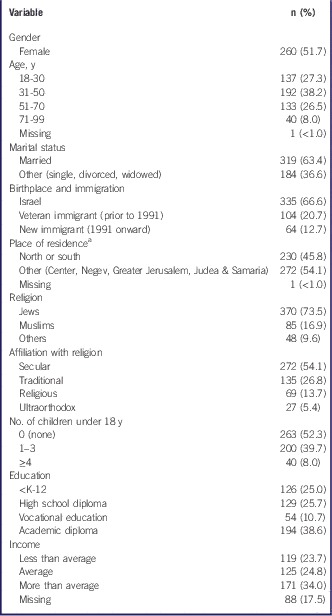
Table 1 shows the demographic and socioeconomic characteristics of the study sample. The distribution of measured parameters in the sample corresponds with that of the general population of Israel, with the exception of the geographical distribution. 62
Sociodemographic Distribution of Studied Sample (n=503)

a For the purpose of this study, the geographical distribution of participants was determined according to regions of past conflicts: the northern and southern areas were those affected by the Second Lebanon War (2006) and the “Cast Lead” (2009) and “Pillars of Defense” (2011) operations.
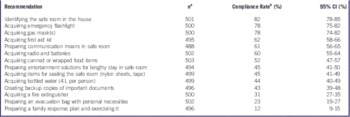
The findings demonstrated a wide amplitude of compliance with the different recommendations of the Home Front Command (12%-82%; Table 2). The most common recommendations complied with were identifying the safe room in the house (82%), acquiring an emergency flashlight (78%), and obtaining a gas mask (78%).
Compliance Rate of Studied Sample With the Home Front Command’s Recommendations for Household Adjustment for a War Scenario and Calculated 95% Confidence Interval for Expected Compliance in the General Public

a Number of responses after deduction of “not-relevant” answers. Maximum missing per item is 3%.
b Compliance rate measured as the percentage of yes responses out of n.
In order to obtain a broader view of the results, a PI was generated indicating for each participant the amount of actions reported as complied with out of the total 14 examined. The mean PI was 7.1 (±0.13 SD) and the median was 7. The data show that more than half (53%) of the sample reported complying with 7 or fewer of the civil defense recommendations issued by the Home Front Command for proper household adjustment toward war.
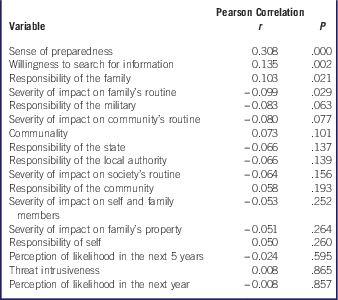
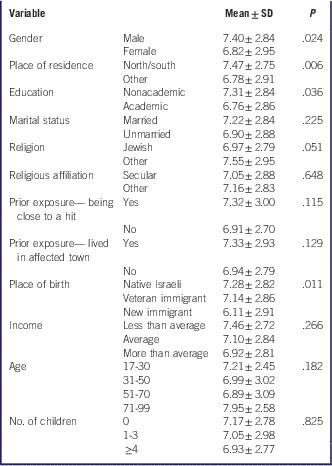
Tables 3 and 4 summarize the correlates identified in this study between household preparedness and other variables, including demographic variables and attitudes towards risk perception, responsibility, communality, searching for information, and sense of preparedness. The results indicate that household preparedness for a war scenario in Israel is negatively associated with the perceived severity of impact on the family’s routine and positively associated with the perception of the family cell’s responsibility to prepare. In addition, willingness to search for further information and one’s perception of personal preparedness were also positively correlated with actual preparedness. The findings also demonstrate that higher levels of preparedness were reported among men, residents of the northern or southern regions, people who were born in Israel, and people with no academic education.
Correlates of Attitude and Perception Factors With Household Preparedness for War

Correlates of Sociodemographic Variables With Household Preparedness for War

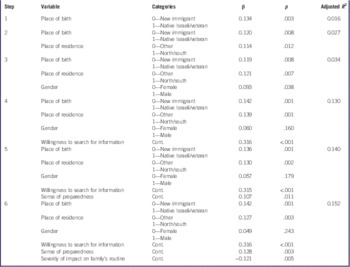
In order to predict the number of recommendations an individual will comply with, a multivariant linear regression analysis was performed. The regression included the following variables: gender, age, place of residence, religion, education, place of birth, perceived severity of impact on the family’s routine, responsibility perception of the family, willingness to search for information, and sense of preparedness. Table 5 shows the results of the regression analysis. Ultimately, it was found that 15.4% of the variability of the PI could be predicted by place of birth, place of residence, willingness to search for information, sense of preparedness, and perceived severity of impact on the family’s routine. The predominant variable in predicting the number of recommendations an individual would comply with was willingness to search for information (β=0.316).
Results by Step of Linear Regression Analysis to Predict Preparedness Behavior Among Households

Regression analysis performed in stepwise mode with 2 blocks. The variables entered into the analysis were: first block: gender, age, education, place of birth, and place of residence; and second block: perceived severity of impact on family’s routine, responsibility perception of the family, willingness to search for information, and sense of preparedness. Cont. indicates continuous.
DISCUSSION
Household Preparedness
To the best of our knowledge, this research is the first to report the level of household preparedness for war in Israel. The most important finding of our research is that half of the sample population has complied with half or fewer of the civil defense authority’s recommendations for household adjustment for war. This result suggests a mediocre level of preparedness in the general population.
When compared with other Western populations in the world, mainly the United States and several European countries, the Israeli public is relatively more prepared for its main threat. The level of preparedness reported in the literature for civilian populations toward a specific threat, usually the main one that it faces, ranges from 17% to 48%.Reference Eisenman, Wold and Fielding 15 , Reference Page, Rubin and Amlôt 20 Compared with these data, the Israeli population demonstrates higher levels of compliance with civil defense recommendations.
However, although the reported level of preparedness in this study may indicate a heightened level of preparedness among the Israeli population, it is important to note that most of the reported actions can be considered as routinely performed, meaning that they were complied with by chance or for reasons other than emergency preparedness. Among these, we can include the acquiring of canned food, bottled water, emergency light, first aid kit, etc. Additional actions reported relatively high on the compliance scale can also be considered as routinely performed tasks, because they relate to the preparation of the safe room for emergency by preparing entertainment solutions for long durations of stay, or having means of communication in the safe room, such as a computer or a TV set. These actions are normally performed because the safe room is used as a bedroom for 1 or more of the family members. When closely examining action items that require special emergency preparedness attention, for example, devising a family response plan or preparing an emergency evacuation bag, it is clear that the vast majority of Israelis do not comply with the civil defense recommendations.
These findings are important in understanding the mechanisms of preparedness behavior. They suggest that among the general Israeli public, emergency preparedness is not well established despite the apparent tangibility of the threat. The preparedness behavior patterns of the Israeli public illustrate the ad hoc fashion in which people make their household adjustments by paying closer attention to this issue only when the threat is dangerously real and imminent. For instance, this study was performed amid rising tensions at the Syrian-Israeli border following the use of chemical weapons on the Syrian population by the Syrian regime and the threats made by the United States to react militarily to this atrocity. In reaction to these “drums of war,” the Israeli public rushed to the gas mask distribution stations, queuing in line for hours to get the masks they could have easily ordered before by phone.
Preparedness Correlates
Our findings support several of the findings concerning correlates of preparedness reported in earlier studies and refute others. The most significant finding in this respect is the fact that household adjustment behavior is positively correlated with (1) willingness to search for information and (2) an increased sense of preparedness. Moreover, willingness to search for information emerges as the most important factor in predicting preparedness behavior. However, although the preparedness-promoting qualities of willingness to search for information are already known in the literature, the fact that the same qualities can be also attributed to simply feeling prepared is somewhat surprising. In other publications, this index of self-perception of preparedness is usually used to illustrate the gap between the overestimated sense of preparedness and the actual levels of preparedness.Reference Kapucu 19 , Reference Ablah, Konda and Kelley 22 , Reference Paton, McClure and Bürgelt 63 , Reference Redlener, Abramson and Stehling-Ariza 64 Yet, our study suggests that the Israeli public does not tend to overestimate individual preparedness level; rather, Israelis are quite aware of their personal level of preparedness. This finding suggests that among the Israeli population, at least for the war scenario, it can be argued that whoever is prepared knows it, and whoever is ill prepared chooses it, or at least acknowledges it.
Although significant correlation was demonstrated between the perception of familial responsibility and reported level of preparedness, this finding alone does not support the notion that elevated sense of personal responsibility supports household preparedness. Nonetheless, it is important to note that the literature supports the viewing of the family cell as a major building block of preparedness, attributing to it qualities that promote preparedness behavior.Reference Kirschenbaum 57 In addition, the fact that significant findings concerning the family cell are repeatedly demonstrated in both the severity perception and the responsibility perception factors can further serve to illustrate the influence of the family cell on one’s motivation for preparedness.
The differences found between men and women in this study confirm similar reports in previous studies published in Israel and elsewhere.Reference Page, Rubin and Amlôt 20 , Reference Fothergill 56 - Reference Soffer, Goldberg and Adini 58 Soffer et al, in particular, demonstrated the tendency of Israeli men to have more confidence in their preparedness level than women.Reference Soffer, Goldberg and Adini 58 The literature often tends to explain this difference between the genders on the basis of their classical roles in the familial structure, and in Israel, in particular, on the military background of men compared to women. However, we suggest a different point of view, saying that this difference can be attributed to the measurement method applied in most studies, including this one, which relies on subjective reports. Men report higher preparedness levels than women, but are they actually more prepared? We argue that the level of reported preparedness of a given household is influenced by the gender of the reporting subject.
The findings of the linear regression analysis performed in this study shed additional light on the motivational aspects of preparedness behavior. The main conclusion of the regression analysis is that one’s attitudes, rather than one’s demographical background, are predominant in one’s preparedness behavior. This conclusion is evident through the increase in explained variance (adjusted R 2) of the PI when attitudinal factors are introduced into the regression analysis (see step 3 in Table 5). However, the most prominent conclusion we can propose based on the results of the regression analysis is that despite that this study integrates most factors reported in the literature to be correlated with preparedness behavior, the fact of the matter is that these factors explain only 15.2% of the variance of this behavior among the Israeli public, at least for the war scenario. This finding leads us to conclude that other factors, perhaps psychosocial ones, are more significant in explaining preparedness behavior of the Israeli public. Further research into this issue is required in order to portray a more comprehensive account of the psychology behind preparedness behavior.
In addition, although the factors included in this study account for only 15.2% of the variance in the PI variable, we can still conclude the importance of promoting emergency preparedness among the public to advance household adjustment to emergency. In the particular instance of preparing for war, the risk communication strategy should encourage the active search for information and work to increase the threat perception to the family’s routine as well as to increase the individuals’ awareness of their sense of preparedness.
We found no statistically significant correlation between the likelihood perception or the threat intrusiveness and the actual level of preparedness reported by individuals. In addition, no positive correlation was observed between any of the severity perception elements and household preparedness. The negative correlation between the perceived severity of impact on the family’s routine and actual preparedness has been reported for the Israeli public in the literature before.Reference Kirschenbaum 26 For example, Kirschenbaum claims that a heightened sense of risk works to reduce the preparedness components of physical protection and planning.Reference Kirschenbaum 26
The research findings also do not support any correlation between prior exposure to the threat and preparedness. Nevertheless, when we examined prior exposure for correlation with place of residence, significant difference was reported between northern and southern residents of Israel, who have experienced numerous rocket attacks in the past decade, and residents of other regions. The north and south residents also scored significantly higher on the PI. Subsequently, we suggest that simply being exposed to the threat does not necessarily generate enough motivation for preparedness behavior. However, if the exposure to the threat becomes prolonged and repetitive, as is the case with the northern and southern residents of Israel, enough motivation for household adjustments might be elicited.
The lack of correlation between the communality index and reported preparedness does not eliminate the positive influence that a strongly bound community has on the individuals comprising it; rather, it suggests that this bond is probably not sufficient to create the necessary motivation for preparedness behavior. The findings here are relatively similar to those reported by Kirschenbaum, who indicated no significant contribution for social networks (in their classic sense) on the individual level of household preparedness, except for one planning element—willingness to participate in communal planning forums.Reference Redlener, Abramson and Stehling-Ariza 59 In 2004, Kirschenbaum published another study stating that a positive correlation was found between the density of social ties in the community and individual household preparedness, but this finding was very limited.Reference Kirschenbaum 48
Research Limitations
This study had several limitations. First, despite the considerable efforts made to verify the applicability of the tool used in this study, its validity remains debatable because of the novelty of the questionnaire and the lack of validity of its measures. Second, in order to assure the representation of Arab Israelis in the sample, most of the phone-call attempts were made in the Galilee region, which has a large Arab population. Although this assured their representation in the sample, it tipped the balance of the distribution of Arab participants into that region. As a result, a trend of higher preparedness levels in the Arab versus the Jewish population was observed. Third, this study was performed shortly after rising tensions in the Syrian border. This, in turn, led to an increase in the level of threat awareness. As a result, temporary changes in participants’ attitudes may have been assessed.
CONCLUSIONS
The findings of this current study highlight the shortfall existing in the level of household preparedness for war in Israel. There is a need to improve individual household preparedness for this and other threats in order to increase Israeli resilience and reduce to a minimum the expected negative effects. Despite growing efforts by the Israeli government and the Home Front Command to advance public preparedness for emergencies, the overall achievements have been limited. In addition, several themes emerging from our findings could shed new light on preparedness behavior and suggest we should examine different approaches in promoting individual preparedness. This calls for additional sociopsychological research to deepen our understanding of the mechanisms and motivation of emergency preparedness that could assist in bringing forward alternatives to promote preparedness among households and individuals.
Acknowledgments
The authors acknowledge the financial support from the Department of Disaster Medicine at the School of Public Health, Sackler Faculty of Medicine, Tel-Aviv University. This research was performed as part of a thesis dissertation of the first author in supervision by Shulamith Kreitler and Kobi Peleg.