Introduction
There has been a positive shift of focus toward social health in dementia care (Dröes et al., Reference Dröes2016; Wolverson et al., Reference Wolverson, Clarke and Moniz-Cook2016). This new conceptualization of health introduced by Huber et al. (Reference Huber2011) emphasizes the capability to maintain some degree of independence and social activities despite a chronic condition. Living well in spite of dementia is not only important for the person with dementia (PwD), but also for their caregivers who face physical, emotional, and economical challenges during different phases of the disease (Schulz and Martire, Reference Schulz and Martire2004). Maintaining social engagement next to the caregiver role enhances feelings of well-being (Au et al., Reference Au2009; Lou et al., Reference Lou, Kwan, Chong and Chi2013) and may delay nursing home placement of PwD (Mittelman et al., Reference Mittelman, Haley, Clay and Roth2006).
However, research shows that dementia caregiving is associated with social isolation and loneliness (Beeson, Reference Beeson2003; Zwaanswijk et al., Reference Zwaanswijk, Peeters, van Beek, Meerveld and Francke2013), indicating that actual social support is not always available. Primary caregivers of PwD often find it difficult to initiate requests for support (Brown et al., Reference Brown, Chen, Mitchell and Province2007) because of the associated stigma (Mackenzie, Reference Mackenzie2006) or fear of the PwD's reactions (Pollitt et al., Reference Pollitt, Andersont and O'Connor1991). Research indicates that the non-use of formal service is caused by the PwD's refusal, a lack of caregiver awareness, or no perceived need for such services (Brodaty et al., Reference Brodaty, Thomson, Thompson and Fine2005; Wolfs et al., Reference Wolfs, de Vugt, Verkaaik, Verkade and Verhey2010). In contrast, studies into the use of informal social support within the context of caregivers’ own social network are underdeveloped. This is an important research venue because informal caregivers must provide longer care in the community (Fortinsky and Downs, Reference Fortinsky and Downs2014) and increasingly rely on the assistance and support from their social network (Lou et al., Reference Lou, Kwan, Chong and Chi2013).
To improve caregiver interventions and caregiver social health capabilities (Vernooij-Dassen and Jeon, Reference Vernooij-Dassen and Jeon2016) we further need to examine factors that increase acceptance and lower the threshold to use informal social support. To date, most studies only focus on perspectives of the primary caregiver and do not investigate views of secondary or tertiary network members (Greenwood and Smith, Reference Greenwood and Smith2015) or only apply quantitative network approaches (Miller and Guo, Reference Miller and Guo2000; Koehly et al., Reference Koehly, Ashida, Schafer and Ludden2015).
To fill this void, the present qualitative study applied a social network perspective to investigate determinants of supportive behavior. Although both the stress-coping model (Lazarus and Folkman, Reference Lazarus and Folkman1984) and the modified adaptation-coping model for dementia care (Dröes, Reference Dröes1991; Finnema et al., Reference Finnema, Dröes, Ribbe and Van Tilburg2000), describe social support as a coping resource to adapt to care-related distress, additional research into social support suggest that the association between supportive behavior and psychological distress varies across sources of support (e.g. spouses, children, friends, neighbors) and types or functions of support (practical, emotional support, companionship) (Thoits, Reference Thoits2011). Therefore, we gathered specific network information from different support sources (children, friends, neighbors) by using an ecogram.
In sum, we aimed to explore network perspectives on social support by (1) examining spousal caregivers’ needs, perceptions and experiences regarding informal support; (2) gain insight into the social network members’ needs, perceptions and experiences regarding informal support toward spousal caregivers; and (3) identify determinants involved in seeking and provision of social support within the informal care network.
Method
Participants
Data saturation occurred after inclusion of ten spousal caregivers of PwD and two members of their social network (n = 17). All spousal caregivers were recruited by the memory clinic of Maastricht University Medical Centre (MUMC+). Two network members of the spouses were included to gain insight into the perspectives of both near and, when available, more distant network members. All of the recruited spousal caregivers and PwD cohabited in the community. There were no restrictions for the duration and type of dementia diagnosis. It was not possible to recruit the network members of two spousal caregivers. Either they could not think of a significant other or the network members themselves did not accept the invitation because of their busy schedule or unwillingness to participate in the research. One spouse provided three network members for inclusion. The medical ethical committee of MUMC+ approved this study (METC 13-4-124).
Procedure
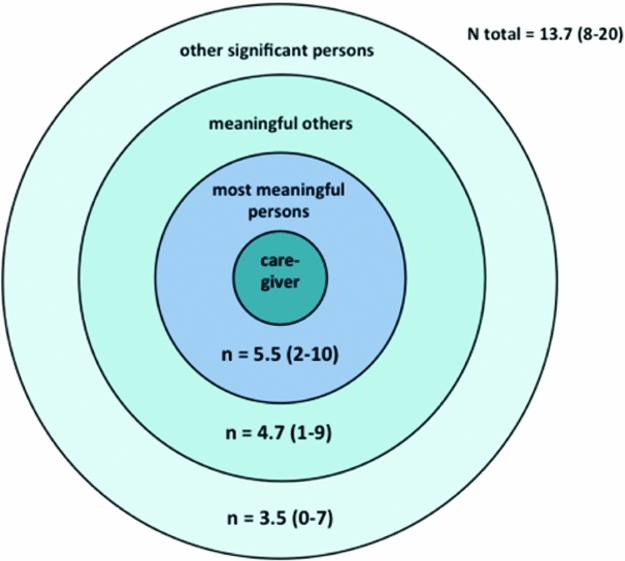
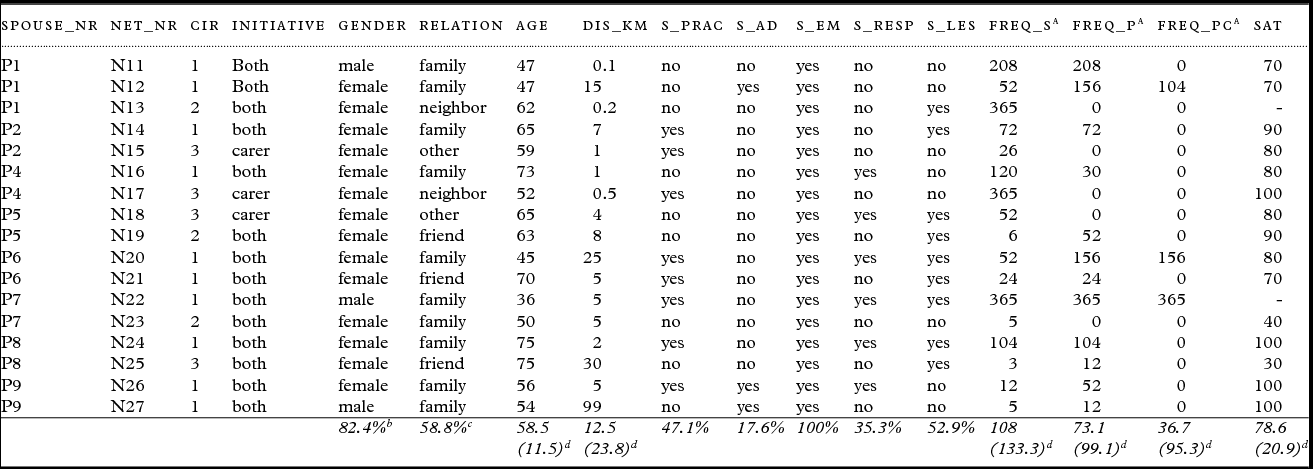
The clinician invited the spousal caregivers for participation while visiting the memory clinic, and/or the researcher called them. Subsequently, they received a letter regarding their participation. Written informed consent was obtained prior the interview. A psychologist (AD) conducted the 1- to 2-h semi-structured interviews, which were audiotaped. Depending on the participant's preference, the interviews were conducted either at the MUMC+ or in the participant's home. When the spousal caregiver provided permission, two members from his or her social network were approached and invited by a letter to participate in an interview. The interviews were structured according to a topic list (Appendix) developed for this interview, based on the above described theoretical models (Lazarus and Folkman, Reference Lazarus and Folkman1984; Dröes, Reference Dröes1991; Thoits, Reference Thoits2011), extant literature and experience from clinical practice. The interviewer made notes to structure key points and asked tailor made explanatory questions. At the commencement of the interview with the spousal caregivers, an ecogram and social network card based on the Maastricht Social Network Analysis (Baars et al., Reference Baars, Uffing and Dekkers1990) were completed to gain insight in available support persons and support functions in the social network. On the ecogram, the spousal caregivers named the people who were (1) very closely involved/or essential in providing support to the spousal caregiver, (2) somewhat less closely involved/providing support to the spousal caregiver on a regular basis, and (3) acquaintances who provided support only sporadically. Figure 1 shows the average ecogram size. Subsequently, a social network card was completed describing the characteristics of the persons listed on the ecogram, including the relationship to the spousal caregiver, age, geographical distance, type of support, frequency of support. Furthermore, the importance of each person on the network card was indicated on a scale ranging from 0 (not important) to 100 (extremely important). Table 4 shows the network characteristics of the interviewed network members. The ecogram and network card were not only completed to map the sources and function of the social network but more specifically to probe the caregivers’ thoughts and feelings regarding the availability of social support experiences. Additionally, data were collected on age, gender, education, total time spent on caring, satisfaction with the social network, and burden rated on a scale ranging from 0 (no burden at all/not satisfied) to 100 (the highest imagined burden/very satisfied).
The ecogram that was completed during the interviews with the spousal caregiver. n = the mean number of contacts in every circle (i.e. with either individuals, couples or leisure clubs), followed by the range.

Data analysis
We performed a qualitative analysis to identify the codes, categories, and themes (Boeije, Reference Boeije2005; Tong et al., Reference Tong, Sainsbury and Craig2007; Evers, Reference Evers2015). The interviews were transcribed verbatim and were coded independently by two authors (AD and LB), using Atlas.ti 1 (Scientific Software Development GmbH, Berlin). Both researchers used an inductive content analysis in which the codes and categories were derived from the data employing constant comparison and inductive reasoning (Elo and Kyngäs, Reference Elo and Kyngäs2008). First, open codes were created covering all text fragments. Second, overlapping codes referring to a similar phenomenon were grouped into categories. Subsequently, higher-order themes were identified (Boeije, Reference Boeije2005). After coding the 27 interviews, saturation occurred because no new codes emerged from the data. In order to check inter-rater reliability, the categories and interpretations from both independent analyses were discussed in a consensus meeting with the last author (MdV) to reach agreement regarding the categories, themes, and emerging relationships. Subsequently quotes were selected by the first author and translated to English for the purposes of this paper.
Results
Participants
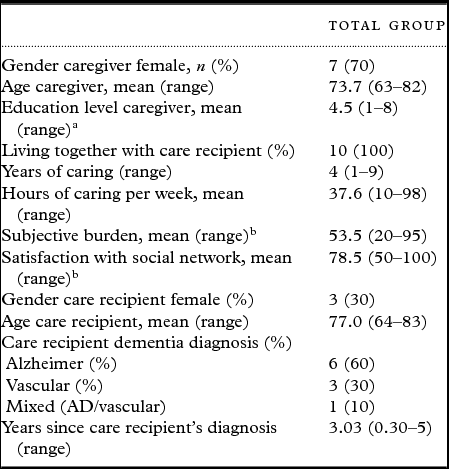
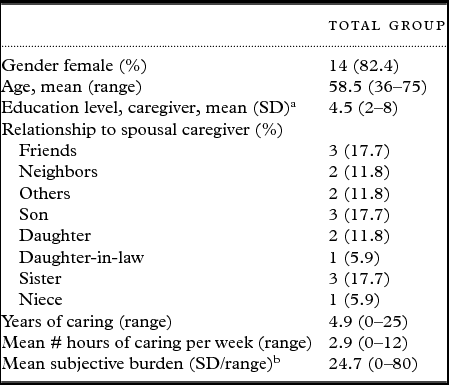
The characteristics of the ten spousal caregivers (mean age = 73.7 years) and their 17 network members (mean age = 58.5 years) are depicted in Tables 2 and 3. The majority of the spouses (70%) and network members (82.4%) were female and from Caucasian ethnicity living in the Netherlands. The care recipients’ diagnosis included Alzheimer's dementia (n = 6) or other dementias (n = 4); the duration of time from the diagnosis ranged from 3 months to 5 years.
Table 4 shows the network members’ characteristics as reported on the network card. The spouses reported to be satisfied with their overall social network (mean = 78.5; range 0 not satisfied to 100 very satisfied) and reported a moderate level of burden (mean = 53.5; range 0 no burden to 100 high burden).
Interviews with spousal caregivers and their social network members
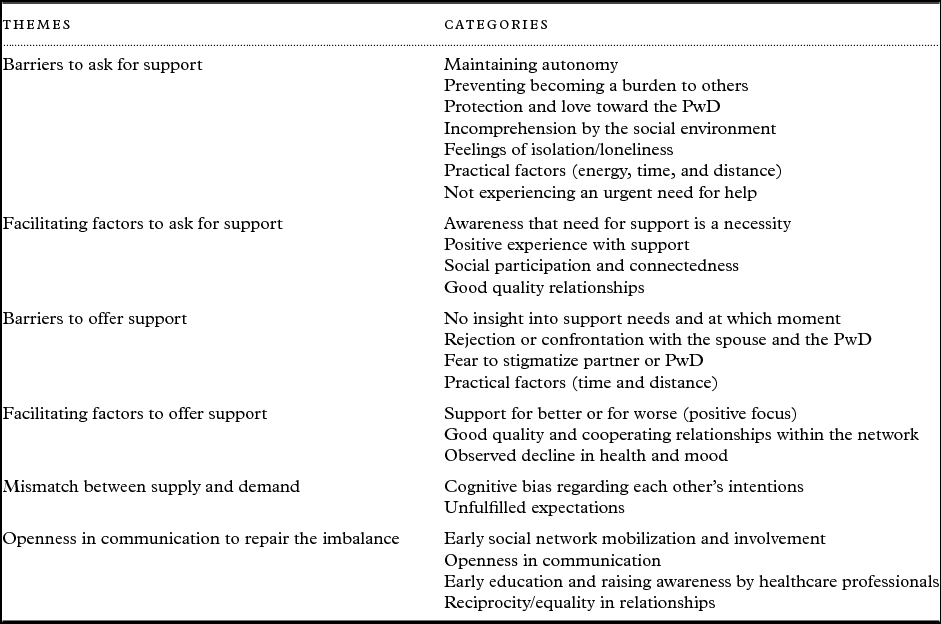
Sixth themes were identified: (1) barriers to ask for support; (2) facilitators to ask for support; (3) barriers to offer support; (4) facilitators to offer support; (5) a mismatch between the supply and demand of support, and (6) openness in communication to repair the imbalance.
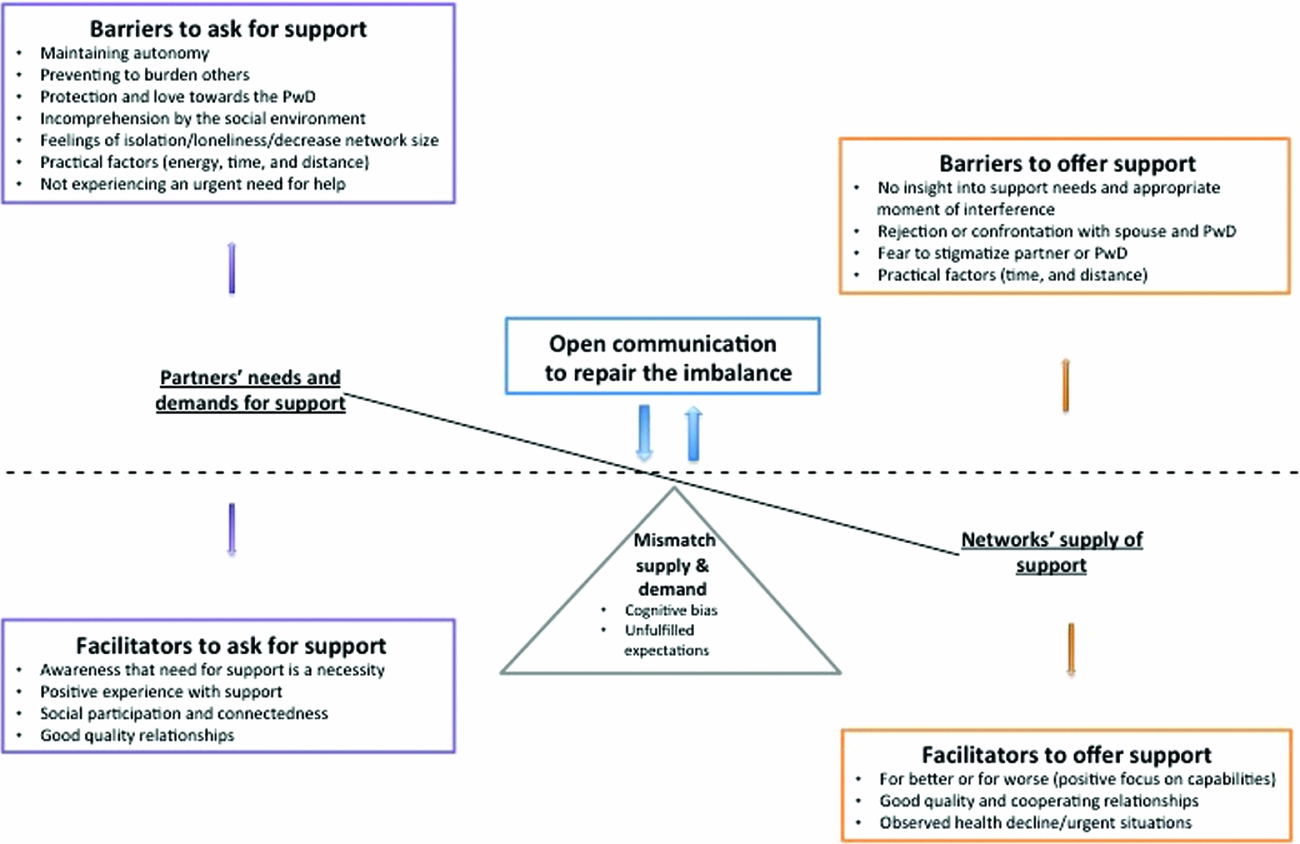
The themes and categories (Table 1 and Figure 2) are clarified by the quotations in the following sections. Each quotation is marked by codes to anonymously specify the caregivers’ contextual background (e.g. P = partner, N = network member, F = female, M = male, age, tsd = time since diagnosis, tsc = self-reported duration of caring). More detailed information can be found in Tables 2–4.
Overview of categories and major themes

The proposed model of the mismatch between supply and demand of social support.

Background characteristics of the spousal caregivers (n = 10) and care recipients (n = 10)

a Educational level ranges from 1 (unfinished primary education) to 8 (university degree), a mean of 4.5 corresponds to an average education level.
b Mean score ranging from 0 to 100.
Background characteristics of the interviewed network members (n = 17)

a Education scores range from 1 (unfinished primary education) to 8 (university degree), a mean of 4.5 corresponds to an average education level.
b Mean score ranging from 0 to 100.
Characteristics of the interviewed social network members as reported on the network card

Spouse_nr = spousal number; net_nr = number of network members; cir = position of the interviewed network member in circle of the ecogram; initiative = the person that is seeking contact; dis_km: distance in kilometers between the living area of the spouse and their network member; S_prac = practical support; S_ad = advice or informational support; S_em = emotional support; S_resp = respite care; S_les = support received from joining leisure activities; freq_sa = frequency of face to face contact; freq_pa = frequency of telephone contact; freq_pca = frequency of contact by the computer (e-mail); sat = satisfaction ranging from 0 (not satisfied) to 100 (very satisfied), a days per year; b percentage of female; c percentage of family members; d mean (standard deviation).
Partners’ needs and demand for social support
In general, interview data demonstrate that spousal caregivers experience a need for social support varying from respite care and emotional support to practical support.
Maintaining a social network enabled caregivers to experience feelings of usefulness, worthiness, and belongingness next to the caregiver role as follows:
“I take care of my relationships, I don't want to be only the partner of a husband with dementia. I always want to maintain a part of my own life and interest for others and in life itself . . . and I am also afraid that it is not good for me. I always have been a very active person with lots to talk about. And I think it is also not good for my husband because then I might put pressure on him.” (P, 4; F; 63yr; tsd = 2yr; tsc = 5yr)
Barriers to ask for support
Despite the general need for support, spousal caregivers experienced barriers to ask for support because of practical reasons such as time and distance, as well as personal values or normative beliefs. For example, autonomy and independence were values deeply rooted in one's upbringing. Spouses often insisted on managing their own care tasks to prevent them from being a burden to others:
“Why it is difficult? Because I am a person capable of arranging my own affairs. And then you somehow have to be humble. Do you want to do that? (Sigh) Argh . . . and then I think I can do it myself. I prefer that.” (P, 6; F; 73yr; tsd = 2yr; tsc = 1yr)
Another hindering factor was that spouses wanted to protect the PwD or delayed asking for help to maintain their long-lasting bond:
“I can talk about the situation with my family, but I try to protect my wive to some extent. I don't want them to provide an overload of care to her.” (P, 1; M; 75yr; tsd = 4yr, tsc = 3yr)
“We will cross that bridge when we get to it. I can manage it at the moment. Therefore, in my view you do not ask other people for a favour. I think we are married for 52 years, if you truly love someone, then everything is possible. If you don't love someone, it would be very difficult to carry on.” (P, 10; 77yr; tsd = 5yr; tsc = 9yr)
Furthermore, spouses experienced misunderstanding with respect to their situation, leading to feelings of stigmatization, isolation or loneliness:
“Few people show understanding; they can be counted on one hand. Because they have not experienced the same situation, you avoid those people or you stop talking about it at all. It makes no sense. Also, they don't feel like listening, you notice that this is even the case in the family. They say my mom this, my father that . . . and they don't even let you finish talking. Then, I wonder. . . don't you understand? I want to tell something about myself. Thus, I automatically keep silent.” (P, 3; 74yr; tsd = 3yr; tsc = 4yr)
Facilitators to ask for support
In addition to the barriers to seek support, several facilitators were identified. Especially, growing awareness that support is essential, positive support experiences, and good quality relationships stimulated support-seeking behavior:
“Let's say the longer it takes, the easier it gets to call on people. I can't do everything . . . I have to accept things; I have no choice, so to say. That is what I call a lesson in humility, it was necessary, and I saw and felt that I had to be wise and had no choice. So, that means that I can ask for help more easily.” (P, 4; F; 63yr; tsd = 2yr; tsc = 5yr)
“It changed, when I was ill myself, I noticed that people spontaneously would call me and say: ‘I heard you are ill, can I do something for you?’ If I had not experienced that, it would be more difficult for me. I am not that kind of person. I am used to fighting my own battles, that's part of me, as long as I can do it, I will do it myself. Now I see, it is getting easier. I think experience is the best teacher. The next time I will not be afraid to ask.” (P, 6; F; 73yr; tsd = 2yr, tsc = 1yr)
In sum, spousal caregivers often did not acknowledge support needs because they were afraid to lose autonomy or put a burden on others. Additionally, they were confronted with feelings of loneliness and misunderstanding. Reports demonstrate that support seeking was shaped by the time since diagnosis, cultural values and normative beliefs. Nevertheless, during the progression of the disease caregivers’ willingness to seek support changed due to shifts in personal beliefs or positive support experiences.
Networks’ perspectives on supply of social support
In general, people in the social environment were often willing to help. They either wanted to diminish the burden for the spousal caregiver or considered support to be an enriching experience:
“Especially by emphasizing emotional support, you can enrich life. We could lower the threshold by emphasizing that we don't doubt his abilities, but we want to do something fun to unburden and add something.” (N, 13; daughter-in-law; 47yr; tsd = 4yr; tsc = 8yr)
Barriers to offer support
Providing support was often hampered because there was no insight into what kind of support was needed at which moment in time:
“There is kind of a ‘debt of honor’, like my mother-in-law cared for him for years, now the roles are reversed and he protects her very strongly, but imagine my father-in-law won't be there anymore. We don't know what is happening, we don't know which care strategies he uses, what he did. I was shocked that there is no plan for when he cannot be there anymore. So, I mentioned this a few times to my brothers-in-law, talk about this together; how to break through the shield.” (N, 13; daughter-in-law; 47yr; tsd = 4yr; tsc = 8yr)
“For us, the point is, we are searching for the most appropriate moment and the best approach to offer support. We are confronted with this for the first time, and this is our first experience.” (N, 12; son; 47yr; tsd = 4yr; tsc = 2yr)
Moreover, they were afraid of violating privacy or stigmatizing the spouse in the caregiver role:
“The problem or the only danger I see is that I don't want to intervene in their daily life with each other. So, he has to be open for support. I mean that remains the point.” (N, 12; son; 47yr; tsd = 4yr; tsc = 2yr)
Other hindering factors to offer support were rejection by the spouses or PwD and emotional confrontation through role and relationship changes inherent to dementia:
“We ran into a wall, my sister and I. So, we said we can't do anything. We noticed aversion. She is suspicious that my sister arranges things behind her back. Since we ran into this wall, we changed to a hands-off approach and just try to be son and daughter and nothing else.” (N, 27; son; 54yr; tsd = 0.5yr; tsc = 1yr)
Facilitators to offer support
Several factors contributed toward the provision of support, especially a prevailing attitude that you offer support for better or for worse. Other factors included a positive focus toward providing support, observed health decline, and good quality relationships:
“Whether or not the caregiver can ask for help depends on the relationship of the caregiver with the environment and vice versa. In my situation, we are the youngest in this neighbourhood. We are open-minded; there are two ways of looking at people: you can just look at people and say hello or you can really care about people, you know what I mean?” (N, 11; neighbour; F; 62yr; tsd = 4yr; tsc > 5yr)
In sum, reports show caregiving is viewed as a process with no clear path or end. Although the involved network members were willing to offer support, there often was a lack of insight into the exact type of support needs during the disease trajectory. They faced practical limitations as well as confrontation and rejection. Moreover, provision of support depended on network members’ personal beliefs. A positive and open view toward caring as being a normal process and a focus on opportunities, instead of limitations, facilitated network involvement.
A mismatch between supply and demand of informal support
The data demonstrated a mismatch between the need and provision of social support. To translate this imbalance in a model, we use the economical connotations of supply and demand of support (Figure 2). Reports indicate that intentions to ask for support or provide support were frequently not translated into action. This mismatch was strengthened by a cognitive bias observed in the spouses and their network members. They tended to think for others and might hold incorrect or unverified presumptions concerning each other's needs and intentions, which prevented tangible support seeking and support provision:
“Sometimes I can't leave because he is sleeping until late. Then you just feel that people think: ‘again something like that, she is always talking about the same thing’. Thus when I do go somewhere I don't talk about my own situation and try to keep it in.” (P, 8; F; 80yr; tsd = 5yr; tsc = 8yr)
“We contemplate things in advance: what should I do? On which day? Can I do it? Am I able to live up to what I promised to do? And he might think exactly the same . . . such as how will they treat my love, they are already busy, they have this and that and already have enough worries.” (N, 13: daughter-in-law; 47yr; tsd = 4yr; tsc = 8yr)
Moreover, spouses and network members did not always communicate their thoughts and feelings. Consequently, they experienced unfulfilled expectations leading to disappointment:
“One of the biggest disappointments was with one of our friends. They were the first couple I told about the situation when my husband was present. They both work in dementia care settings and then you expect . . . and I think that is wrong to expect that they would just come by . . . like ‘How are you doing and can we help you? We might take your husband for a walk so you have some spare time.’ I think I expected too much. However, if I asked them, they probably would help. So there I experience some kind of disappointment.” (P, 4; F; 63yr; tsd = 2yr; tsc = 5yr)
In sum, the observed mismatch in care networks is strengthened due to cognitive biases. People make unverified presumptions about each other's needs and abilities, leading to unfulfilled expectations and disappointment.
Openness in communication to repair the imbalance
To compensate for the observed mismatch spousal caregivers and network members emphasized that more openness in communication is required in both informal social networks and formal healthcare settings in an earlier phase of the disease. As reported sharing needs and wishes and mapping support opportunities might increase involvement and awareness of support needs:
“Now I communicate more open about several points with people compared to before. For example, now I tell things to my neighbours which I wouldn't have done previously. Imagine that he would walk away one day. Then, you start to realise and feel that you have to be wise. You have no choice. So now I ask for help more easily.” (P, 4; F; 63yr; tsd = 2yr; tsc = 5yr)
“When he (caregiver) saw that we (neighbours) noticed the situation and asked him: ‘how do you experience it?’ Then there came an opening for him. He thought now I can show it, because now they think of me and I am safe. That is what he had told us later. Do you understand? Because we were open somehow by asking questions directly. From that moment the doors could be opened for him as well. He had a strong need for verbal contact, a good conversation. That was what he valued most.” (N, 11; neighbour; F; 62yr; tsd = 4yr; tsc > 5yr)
Additionally, healthcare professionals should create awareness that support is essential. The caregivers tend to accept an independent expert opinion more easily as opposed to informal advice from a close network member:
“It should not come only from informal helpers. However, also from let's say the medical side, they have to manage that caregivers are triggered to think about which persons can help, with what kind of tasks and how to share support needs. When there is one person to help, then it might get more easy to examine which other people can be involved to set the stage.” (N, 11; neighbour; F; 62yr; tsd = 4yr; tsc > 5yr)
Moreover, data demonstrate that relationships based on equality and a willingness to receive help were valued:
“I find it difficult to offer support because the caregiver is reluctant. She does not want to ask for support. She wants to maintain our relationship as it used to be. That is a sore point. ‘You can lead a horse to water, but you can't make him drink.’ My friend wants to continue our relationship and needs the enjoyment that our friendship offers. She does not want to be judged as being a burden or a person in need. She wants to maintain an equal friendship.” (N, 19; friend; F; 63yr, tsd = 2yr; tsc = 25yr)
In sum, to resolve the observed mismatch, our data demonstrate that openness in communication in both informal and formal care networks is required early in the dementia care trajectories. Furthermore, to maintain quality care relationships, equality, and reciprocity are prerequisites.
Discussion
A model of the mismatch between supply and demand of support
The aim of this study was to explore the needs, perspectives, and experiences regarding informal social support of both spousal caregivers and social network members. Furthermore, we examined determinants involved in seeking and provision of informal social support. We can conclude that spousal caregivers had different support needs, such as the need for emotional support, practical support, respite care, company, and relaxation. Although, social network members were willing to provide support, often no actual support was delivered. Our data demonstrate a mismatch between supply and demand of support described in a model, including sixth themes: (1) barriers to ask for support; (2) facilitators to ask for support; (3) barriers to offer support, and (4) facilitators to offer support; (5) a mismatch between the supply and demand of support, and (6) openness in communication to repair the imbalance.
The barriers to ask for support were partly similar to those identified in earlier research, such as a fear of stigma, the fear to lose independence (Clement et al., Reference Clement2015), or negative attitudes toward accepting support, such as a sense of responsibility and unwillingness to relinquish support to prevent burdening others (Greenwood and Smith, Reference Greenwood and Smith2015). Unraveling the barriers and facilitators showed that caregivers go through different phases in the care trajectory. Network members had no clear insight into what support was needed at which particular moment in time. Consistently, caregiving is described as an unexpected career (Aneshensel et al., Reference Aneshensel, Pearlin, Mullan, Zarit and Whitlatch1995). Our data demonstrate that normative beliefs and Western values of autonomy, independence, individualism and privacy play a role in supportive behavior. Similar to previous findings, our data show that during the caregiving process these normative beliefs were susceptible to change (Smyth and Milidonis, Reference Smyth and Milidonis1999; Boots et al., Reference Boots, Wolfs, Verhey, Kempen and de Vugt2015), and may also facilitate social support. For example, the growing awareness that support is inevitable and a focus on opportunities rather than limitations resulted in supportive behaviors, enrichment of relationships, and the feeling of being meaningful in daily life. In line with literature on social health, feelings of engagement contribute to better health (Au et al., Reference Au2009; Roland and Chappell, Reference Roland and Chappell2015; Dröes et al., Reference Dröes2016) and more positive support experiences (Wolverson et al., Reference Wolverson, Clarke and Moniz-Cook2016).
Nevertheless, our data reveal a mismatch between the supply and demand of informal support. Frequently no actual support was received or delivered because of the experienced barriers. The identified mismatch was strengthened by an observed cognitive bias. Both the spousal caregivers and the social network members tended to think for others and exhibited unverified and sometimes incorrect thoughts concerning each other's intentions. Consequently, both parties may not explicitly communicate their support wishes because of an anticipated burden, rejection or violation of privacy, thus causing disappointment and unfulfilled expectations. Our data highlight that open communication in formal and informal care systems could repair the observed mismatch between the supply and demand of informal support. This is partly similar to findings in the social psychology literature demonstrating that social exchange is influenced by relationship intimacy, fulfilled expectations (Coriell and Cohen, Reference Coriell and Cohen1995), and openness to receive or provide support (Simpson et al., Reference Simpson, Rholes, Oriña and Grich2002). This relatively new finding in dementia caregiving research deserves attention in future studies.
Practical implications
According to Beck's cognitive theory, people can become susceptible to interpreting the intentions of others in a distorted or biased way because meanings are derived from personal experiences and the way people structure the world (Beck, Reference Beck1976). Therefore, future caregiver, support interventions may include cognitive behavioral techniques such as cognitive restructuring and positive reappraisal concerning support seeking. Addressing biased perceptual thinking (Baldwin, Reference Baldwin1992) may cultivate awareness that support seeking or giving does not only impose a burden or stigma but, in contrast, might lead to a reciprocal enrichment of relationships and increased social functioning.
Our data indicate that open communication can repair the observed mismatch in support behavior. As shown in previous research maintaining an open attitude might be hindered, since caregivers find it difficult to acknowledge and accept care needs in an early phase of dementia (Boots et al., Reference Boots, Wolfs, Verhey, Kempen and de Vugt2015). Our findings suggest that healthcare professionals should raise awareness regarding the importance of open communication, mobilization of social support, and positive support interactions at an earlier stage of the disease. Consistently, future caregiver intervention research might increasingly focus on strengthening aspects of social health. The newly developed concept of social health emphasizes the dynamic balance between opportunities and limitations (Huber et al., Reference Huber2011; Vernooij-Dassen and Jeon, Reference Vernooij-Dassen and Jeon2016; Dröes et al., Reference Dröes2016). Our data confirmed that a positive focus toward support and participation in social activities parallel to the process of caregiving was highly valued. Innovative online communication tools for caregivers and health professionals, such as social media platforms, might be a new venue for improving positive social engagement and openness in communication in dementia care networks (Boots et al., Reference Boots, de Vugt, van Knippenberg, Kempen and Verhey2014; Dam et al., Reference Dam, de Vugt, Klinkenberg, Verhey and van Boxtel2016).
Methodological strengths and limitations
This study is unique in integrating the perspectives of both the spousal caregivers and their involved network members. By using an ecogram, we collected in-depth information on sources and types of experienced social support (Thoits, Reference Thoits2011). The spousal caregivers were triggered to reflect on present and past support experiences within the context of their social network, which guided the interview process. Interviewing acquaintances might have prompted a response bias. However, the interviewer explicitly emphasized that the data would remain anonymous. Adding a ten-point VAS-scale alongside our virtual scale, ranging from 0 to 100, might increase face-validity and user-friendliness in future studies (Preston and Colman, Reference Preston and Colman2000). We did not collect network data from all spouses, which might reduced the transferability. Participants were from Caucasian ethnicity and lived the southern regions of the Netherlands holding Western normative beliefs. Additionally, we only included spousal primary caregivers. Although the literature indicated that, the majority of dementia caregivers are spouses (Aneshensel et al., Reference Aneshensel, Pearlin, Mullan, Zarit and Whitlatch1995), additional perspectives of other primary caregivers with more diverse ethical and religious backgrounds and from other cultural settings would have enhanced the generalizability of our findings. Since previous studies have demonstrated that supportive behavior differs across ethnicities and cultures (Valle et al., Reference Valle, Yamada and Barrio2004). Inevitably, social support needs are closely related to time since diagnosis. Nevertheless, we decided to impose no limitations on the disease duration, since we wanted to cover the full range to increase transferability of our findings. The fact that the included exemplars were translated from Dutch into English might have induced some bias. However, the translation process was done twice by two independent authors.
Conclusion
We identified a model explaining the mismatch between supply and demand of informal social support in dementia caregiver networks. A novel finding is that openness in communication might repair this observed mismatch. This finding underscores the importance of early caregiver education by health professionals on social support needs and network mobilization. Early access to social network interventions may facilitate social engagement and caregiver capabilities to maintain social health.
Conflicts of interests
None.
Description of authors’ roles
The original proposal for this study was developed by A. Dam, M. de Vugt, M. van Boxtel, and F. Verhey. A. Dam collected the data, performed the qualitative analyses and wrote the manuscript. L. Boots performed the second independent qualitative analysis. M. de Vugt supervised the data collection and analysis. L. Boots, M. de Vugt, M van Boxtel, and F. Verhey provided valuable comments during the writing of the manuscript.
Acknowledgments
This study was supported in part by Alzheimer Research Fund Limburg.
Appendix
Topic list of the interview with the spousal caregiver
1. What are your social support needs?
2. Do you know where to find social support?
3. Looking at your own network (point at the ecogram, completed in the first part of the interview), how does your network provide support?
4. What does this support mean to you?
5. Do you receive most support from people close or at a distance?
e.g. Would you wish that you ecogram or the division of people on the ecogram looks different?
6. Are there people close to you? (e.g. such that could you call them)
7. When/under which circumstances are you able to ask for support?
e.g. Do you feel that you can ask all the support you need? Did this change?
8. Do you experiencing difficulties to ask for support? (why, when)
9. What circumstances could change your request for support?
10. Do you want to give something in return for the support you receive?
11. In general, how is the interaction with people in your social network going?
e.g. how do you share things?
e.g. do you have experience with using the internet? (how)
12. Do you experience difficulties in social interactions with others?
13. Did the contact with you spouse change?
14. Did your social network change? (pointing at the ecogram)
15. How would your ‘dream network’ look like? (how could this be reached?)
16. Looking at the ecogram how satisfied are you with your overall network on a scale from 0 (not satisfied at all) to 100? (highest possible satisfaction)
Topic list of the interview with other network members
1. How do you provide support to your family member, friend, or neighbour caring for a person with dementia?
2. How do you experiencing providing this support?
3. How much time do you spend caring approximately?
4. Is the support you deliver accepted, wished?
5. Do you experience difficulties offering support? (why, when)
6. Would you like to offer more or less support than you currently provide? (why, how)
7. When should support be offered?
8. When the situation is changing are you willing to change the amount of support you provide?
9. In general, how is the interaction with your family member, friend or acquaintance going?
e.g. are you able to share things?
e.g. do you have experience with using the internet? (how)
10. Would you prefer to keep in contact with other network members?
11. Do you expect something in return for the support you offer?
12. How could support be organised better?