Peter Gourevitch once wrote that “for social scientists who enjoy comparisons, happiness is finding a force or event that affects a number of societies at the same time. Like test-tube solutions that respond differently to the same reagent, these societies reveal their characters in divergent responses to the same stimulus.”Footnote 1 It is hard to imagine a better candidate for comparative analysis than the advent of Uber. The ride-sharing app arrived on the American scene in 2009, and launched its first overseas operation in 2011. Over the next six years, the company had expanded its reach to well over 700 cities in 84 countries.Footnote 2
Uber is one of the more visible examples of a broader class of new “platform” business models that create value not by producing “things” or even by providing services in the traditional way, but instead by enabling producers and consumers to interact directly. Alongside a host of other enterprises including Airbnb, Crowdflower, TaskRabbit, and others, Uber poses some knotty new regulatory challenges. Policy makers in the rich democracies have watched with consternation and concern as the entrepreneurs associated with “digital capitalism” probe the bounds of existing rules and create wholly new markets beyond the reach of current policies. The existence of parallel “gray” markets outside the formal regulatory framework puts new pressures on actors inside that framework as well.
The case of Uber—with its sprawling international presence—provides an especially valuable window on the politics of the platform economy. Within the advanced capitalist world, different countries have responded in wildly different ways to this new service—from welcome embrace and accommodating regulatory adjustments to outright rejection and legal bans. Even where the company maintains operations, if you open the Uber app in different countries, you are presented with quite different options. In the United States, local menus vary but almost always include UberX, the company’s low-budget option—ordinary drivers (vetted by the company but not commercially licensed) driving their own cars. While this service is available in Estonia, Poland, and other middle-income and developing countries, its European equivalent (UberPop) did not survive in other rich democracies, although in Sweden it lived on for a time, “by invitation”—i.e., the option appeared on your app, but only if Uber invited you.Footnote 3 Some countries have particularly sparse offerings. In Germany, unless you are in Berlin or Munich, your nearest driver is hundreds of miles away, and in Berlin the Uber that shows up is indistinguishable from any other taxi but for the payment method. Other countries featured options that are relatively unknown in the United States; for example, in Amsterdam you could select Uberbike to order a car outfitted with a rack; in Oslo ordering UberEL would bring an electric car to your door.
The diversity of offerings is partly a reflection of local tastes and markets, but the most important cross-national differences are the legacy of political conflicts, as Uber first confronts and then adapts itself to the regulatory environment in individual cases. These conflicts typically follow a rather standard script: Uber sets up operations in a country, initially offering only high-end services, followed quickly by its trademark budget option, launched under the Silicon Valley motto: “don’t ask permission, ask forgiveness.” Almost everywhere, Uber’s arrival has provoked immediate and intense opposition from established taxi and transport companies. From that point onward, however, the politics and the outcomes begin to diverge. An analysis of these differences can teach us a great deal not just about how different countries are confronting the challenges posed by the advent of digital capitalism, but also about the conduct of comparative analysis more generally.
The conventional approach in much of the comparative political economy literature is to begin with a “shared shock” like Uber and to attribute variation in outcomes to differences in the relative power of the affected groups in the countries under examination. In the case of Uber, for example, we might focus on the strength of the taxi lobby and its capacity to defend its privileged position in the face of a powerful new competitor. Alternatively, we might explain different outcomes with reference to the relative strength of unions and their ability to impose conditions on the terms of employment in what is widely seen as an unregulated and precarious form of work.Footnote 4
Embedded in these practices, however, are two critical assumptions that merit scrutiny. The first is that the interests of the relevant actors are the same across different countries. However, as Swenson in particular has emphasized, assuming equivalence in the interests of the same actors in different countries can be misleading.Footnote 5 For example, while Uber’s arrival generated ferocious resistance from established transportation providers in the United States and Germany, the head of marketing at Stockholm’s oldest taxi company greeted the company’s arrival in Sweden as “good for the market by pushing the industry to use a different technique, a new platform.”Footnote 6
Second, much conventional comparative research proceeds from the unexamined assumption that shared shocks like Uber translate into essentially the same problem cross-nationally. However, as Locke and Thelen have shown, common pressures do not necessarily manifest themselves in the same problems but are often “refracted into divergent struggles over particular national practices.”Footnote 7 For example, in the United States, a central point of contention concerns the employment status of Uber drivers—whether they should be considered employees of the company or, as Uber insists, “independent contractors.” However, this issue has not always been the central sticking point in other countries, even countries where unions are far stronger than in the United States. In universalistic welfare states such as Sweden and Denmark, receipt of core social benefits such as healthcare and pensions does not depend as heavily on a worker’s employment status. In these cases, other issues entirely—notably taxation—dominate in the politics surrounding Uber.
The case of Uber thus reveals the limits of some traditional “matched comparison” approaches and underscores the importance of attending to differences in the political salience of specific issues in different national settings. An examination of the advent and growth of Uber makes clear that the institutional arrangements that characterize different political economies do not simply channel the same conflict in distinctive ways. Instead, these institutions sometimes translate seemingly common trends into wholly different problems in divergent national contexts. These differences are consequential, I argue, because the specific regulatory “flashpoints” that Uber provokes in different countries mobilize different actors, inspire the formation of different coalitions, and shape the terms on which conflicts over Uber are framed and fought.
My analysis focuses on three rich democracies that exhibit three different regulatory responses to Uber. In the United States, despite some variation across cities and states, the modal response to Uber has been a broad deregulation of local transportation markets, with city (and, in some cases, state) governments mostly adapting their regulatory frameworks to accommodate Uber. Germany, by contrast, has taken a sharply different path. In this case, the response to Uber has been a vigorous defense of existing regulations that have all but shut down the company. Social-democratic Sweden, finally, has responded with a two-way adaptation, adjusting some aspects of existing regulations to allow for Uber’s continued operation, alongside other measures to bring the service into compliance with national laws on licensing and taxation. I explain these different regulatory outcomes with reference to the different coalitional alignments that the arrival of Uber inspired among various interest groups as they interacted with each other and with consumers.
The analysis proceeds in four steps. First, I outline how the existing literature might account for the divergent outcomes we observe. Second, I introduce my alternative framework and describe the research strategy I adopted to explain these outcomes. Third, I delve into the specific conflicts Uber provoked in each case to show how differences in institutional arrangements channeled these conflicts into different flashpoints, mobilizing different actors, and producing different coalitions cross-nationally. A final section summarizes the argument and reflects on the broader lessons this analysis holds for understanding the politics of the platform economy and for comparative analysis generally.
The Comparative Political Economy of Uber
What explains the variation we observe in how Uber is received in different countries? A first obvious possibility is that outcomes simply reflect differences in starting conditions. For example, Uber should have an easier time entering local transportation markets that are less regulated to begin with. However, previous levels of regulation cannot explain the difference between Germany and the United States, two countries with heavily regulated taxi markets but widely diverging outcomes. Moreover, while the Swedish taxi market was less regulated than the American one before Uber’s launch, the two countries in the meantime have essentially switched positions. Uber wound up with clearer sailing in the (previously much more heavily regulated) American market, while Sweden imposed more restrictions, without, however, shutting down Uber.
One could also imagine that the availability of a reliable and extensive transportation infrastructure might dictate outcomes, since Uber should have a tougher time entering markets with a well-developed public alternative. However, the three cases considered here again cast doubt on such arguments. A well-developed public transportation infrastructure may have inhibited Uber’s advance in Germany, but why would it not have the same effect in Sweden, or for that matter, New York City? These anomalies, as well as the intense political conflicts that Uber has inspired virtually everywhere, suggest that we need to look beyond differences in starting conditions and consider explanations that are more political.
The literature on the political economy of advanced capitalism offers two broad possibilities. The first, anchored in a prominent liberalization thesisFootnote 8 suggests that the advent of these new business models drives deregulation, as fast-moving technology allows firms like Uber to exploit gaps in existing regulatory frameworks. On this account, flat-footed government regulators often find themselves a step behind these agile companies as they roll out new technologies and business practices that the existing regulatory framework did not anticipate and thus does not cover.Footnote 9 Such firms can exploit these regulatory gray zones to establish a robust ground operation, cultivating a large and enthusiastic consumer base so that by the time lawmakers begin to consider new legislation, they face intense political pressure to devise rules that retroactively render these practices legal. This model appears to fit the American case, but it does not capture the dynamics in many European countries where Uber had more difficulty establishing a foothold.
An alternative line of argument can be found in the “varieties of capitalism” framework, which predicts greater cross-national variation.Footnote 10 “Liberal market economies” (LMEs) such as the United States could be expected to be more receptive to Uber than “coordinated market economies” (CMEs) in Europe that feature a denser organizational landscape. However, the diversity of outcomes across Europe’s CMEs should give us pause. As already noted, the taxi market in Sweden actually was much less tightly regulated than that in the United States before Uber arrived. Moreover, the regulatory responses to Uber in Germany and Sweden, though both CMEs, were very different. While Germany steadfastly defended existing rules and service providers, Swedish regulators were more open to Uber, eventually barring UberPop but also adapting existing taxi regulations to accommodate the continued operation of UberX.
If the usual political-economic arguments fail to explain these outcomes, more purely political arguments—based on an electoral logic—might be brought to bear. The political economy literature tends to emphasize interest group politics, possibly overlooking dynamics that are rooted instead in the incentives that politicians face as they confront citizens as voters and as consumers. Yet the response to Uber in all three countries was largely consensual, with few differences between the main parties. Across the United States, for example, Collier et al. find that legislation on Uber typically was “bipartisan . . . with most bills garnering over 70 percent support from both parties.”Footnote 11 In Germany as well, policy-makers from the major political parties of the right and left also mostly struck a common chord, in this case more critical of Uber, though sometimes for different reasons.Footnote 12 In Sweden, the center-right parties were overall more open to Uber,Footnote 13 but the Social Democratic Minister for Infrastructure also made clear that the Swedish government was not intent on blocking Uber and was open to all forms of “healthy competition” within the context of existing laws and regulations.Footnote 14
If not partisan politics, maybe differences in electoral arrangements have shaped these outcomes. Rogowski and Kayser have suggested that politicians are more attentive to consumers in majoritarian systems because of the need to assemble electoral majorities that appeal to the median voter. Footnote 15 In proportional representation systems, producers are more powerful, because parties have stronger incentives to ally with organized interests and face fewer constraints from voters for doing so. Rogowski et al. employed this framework to explain relative prices, but one could apply the argument to Uber—with politicians in majoritarian systems more attentive to the advantages Uber offers consumers (particularly on price). The analysis below confirms that consumers are important, even if the variation we observe does not map onto electoral systems (again, the difference between Sweden and Germany calls that explanation into question) so much as it draws attention to who “channels” the preferences of consumers and in the interests of what specific goals.Footnote 16 Rogowski et al.’s framework captures something important, but voters can be mobilized either as consumers or as taxpayers, and it turns out this difference is consequential for the politics surrounding Uber.
The Politics of Uber: Flashpoints and Coalitions
The explanation offered here combines elements of both political-economic and political explanations, emphasizing coalitional alignments across the producer-consumer divide.Footnote 17 National political-economic arrangements refracted “the Uber problem” into conflicts over different issues in the three countries analyzed here—mobilizing different actors and shaping the way in which struggles over Uber were framed and fought. Regulatory outcomes depended on the specific alliances Uber inspired among interest groups and politicians as they interacted with each other and with consumers.
In the United States, conflicts over Uber were channeled into decentralized battles, typically played out in city councils or state assemblies. In this context, the company was able to exploit (and foment) jurisdictional competition, leveraging the technology to organize its users and mobilize them politically. In this way, Uber was able to isolate an unpopular “taxi monopoly” and portray itself as the champion of consumer choice. The company framed the issue as one that pitted “innovation” and “choice” against “stifling regulation”—and then challenged politicians to declare their loyalties. Labor groups mobilized against Uber in some cities, but in the American context, they were sidelined as employment issues were hived off and relegated to the courts, where they have languished, not least because of Uber’s own dilatory strategies.
In Germany, by contrast, swift and coordinated action by the association representing the taxi industry nationalized the conflict almost immediately. These actions prevented the onset of competition across cities, pre-empting any serious mobilization of consumers and blocking the self-reinforcing cycle of increased supply (of drivers) and increased demand (by users) that in the United States had allowed the company to drive down prices and cultivate a loyal user base even under conditions of legal uncertainty. These moves also channeled the conflict into closed administrative and legal venues, where the taxi association was able to highlight Uber’s flagrant disregard for the rules, cementing an alliance with transportation authorities and politicians in defense of the rule of law. German unions mostly remained on the sidelines, as Uber was shut down before the labor-regulatory issues still being played out in the United States had emerged as a problem.
In Sweden, finally, prior taxi-market deregulation allowed Uber (including, initially, the low-cost UberPop) to establish a more robust “ground game” than in Germany. In this case, conflicts also played out in more visible and politicized venues, but a different issue—taxes—emerged as a central flashpoint. The tax issue brought together a diverse coalition of actors that in the other cases were not always aligned. This coalition included taxi operators, who viewed the possibility of tax evasion by Uber drivers as a source of unfair competitive advantage. However, it also included unions, who opposed Uber’s efforts to avoid social contributions through what they consider “fake self-employment.” Alongside tax authorities, these groups appealed to the interests of the public not as consumers but as taxpayers with the argument that the Swedish social model was viable only so long as everyone paid their fair share.
The next section lays the groundwork for a comparative analysis of Uber’s arrival and political reception, exploring differences in how the “Uber problem” was framed and in the political coalitions that mobilized around these different framings.
The Case of Uber: Issues and Actors
We can begin by identifying the range of regulatory issues that Uber raises. In an initial round of research, I consulted public documents including press coverage across a range of countries. Based on this broad canvassing, I developed an inventory of the various regulatory problems that Uber triggers, among which the following figure most prominently.
1. Competition: Almost everywhere, Uber has encountered fierce resistance from established taxi and transportation companies. In most contexts, this is a heavily regulated market, one that in the past has featured especially steep barriers to entry, e.g., through arrangements that limit the number of service providers who may operate within a particular jurisdiction. Established companies have fought the entry of Uber into these protected markets on grounds that the company’s practices constitute unfair competition.
2. Employment and labor issues: Like other app-based services, Uber raises a number of issues about what exactly constitutes an employment relationship. Whereas traditional business models are premised on firms organizing the production and distribution of goods or services to consumers, platform business models create value by linking service providers directly with clients. In the case of Uber, labor issues typically revolve around the question of whether drivers should be considered employees of the company or, as Uber insists, independent contractors or freelancers.
3. Social policy: Related to the employment question, Uber often raises issues connected to social policy, especially but not exclusively in countries in which social benefits are closely tied to the employment relationship. In the United States, for example, a wide range of benefits (from health care to retirement) is directly tied to employment status. In Bismarckian welfare states in Europe as well, benefits are financed through contributions by employees and employers.
4. Taxation policy: Uber also often activates issues relating to the capacity of the state to monitor the income of service providers and collect the taxes on this income. Taxation is almost always an issue with other platform-based services such as Airbnb, where income from this house “sharing” service frequently goes unreported. However, it is also an issue with Uber in many countries because income from this form of self-employment also can go unreported.
5. Consumer safety: Finally, Uber often raises issues of consumer safety. The issue has taken many forms in different contexts but typically revolves around conflicts over whether drivers may be asked to submit to additional checks (e.g., fingerprinting) that go beyond the background checks run by the company itself. However, the valence of this issue differs radically cross-nationally. In some developing and middle-income countries that are plagued by crimes such as kidnappings and taxi hijackings, Uber is often viewed as the safer option (e.g., parents feel more confident putting their children in a car in which the technology allows them to identify, track, and monitor drivers).
Interviews with representatives of the interest associations that were directly involved in the conflicts over Uber provided additional crucial insights—including a mapping of the regulatory starting point in each county, the interests of the relevant actors, and their relationship to other actors in the regulatory space. These initial explorations revealed that almost everywhere, competition policy emerged as an important first battleground, but beyond this shared flashpoint, Uber triggered conflicts over different regulatory issues in different national (or local) contexts. As a result, it mobilized different actors (both pro- and anti-Uber) and it inspired the formation of different alliances. Thus, although the outcomes are recognizable as variations on a shared theme, significant variations on that theme reflect both the specific regulatory obstacles that Uber encountered along the way and the particular political coalitions it confronted.
To assess the relative importance of different issues cross-nationally, I assembled an original dataset of all articles reporting on Uber from among the largest national newspapers for each of the three countries. The articles capture published coverage of Uber’s operations in that country since the company’s launch.Footnote 18 For each country, I included newspapers with different political leanings in order to minimize the possibility of media bias in the analysis. I included as well the main newspaper for each country’s capital city in order to capture not just local dynamics but also national-level debates over Uber. I included cities with significant public transportation systems in order to assess whether this affected Uber’s fate. The U.S. dataset includes three major outlets with national coverage;Footnote 19 the German dataset includes the country’s seven most widely circulated (non-tabloid) newspapers;Footnote 20 the Swedish dataset similarly includes the country’s top seven newspapers.Footnote 21
I excluded articles that dealt with Uber’s reception in other countries—e.g., articles published in Germany but reporting on Uber in the United States or China—since the point of the analysis was to capture the issues that figured most prominently in domestic conflicts. I also excluded articles that did not address regulatory issues at all, but focused instead on topics outside the scope of my analysis—company financing, reports on Uber’s expansion into new markets, the announcement of new services, personnel and biographical accounts of the company’s colorful (then) CEO Travis Kalanick that did not bear directly on regulatory debates and conflicts. This produced a final dataset composed of 631 articles, 358 for the United States, 184 for Germany, and 89 for Sweden.
Each article was hand-coded on a number of variables including (a) whether the article discussed conflicts or debates over one or more of the five regulatory issues just enumerated, (b) which actors were mentioned as being involved in the debates and events depicted, (c) the level and regulatory venues in which conflicts were played out, and (d) whether or not a social media campaign was deployed and if so by whom.
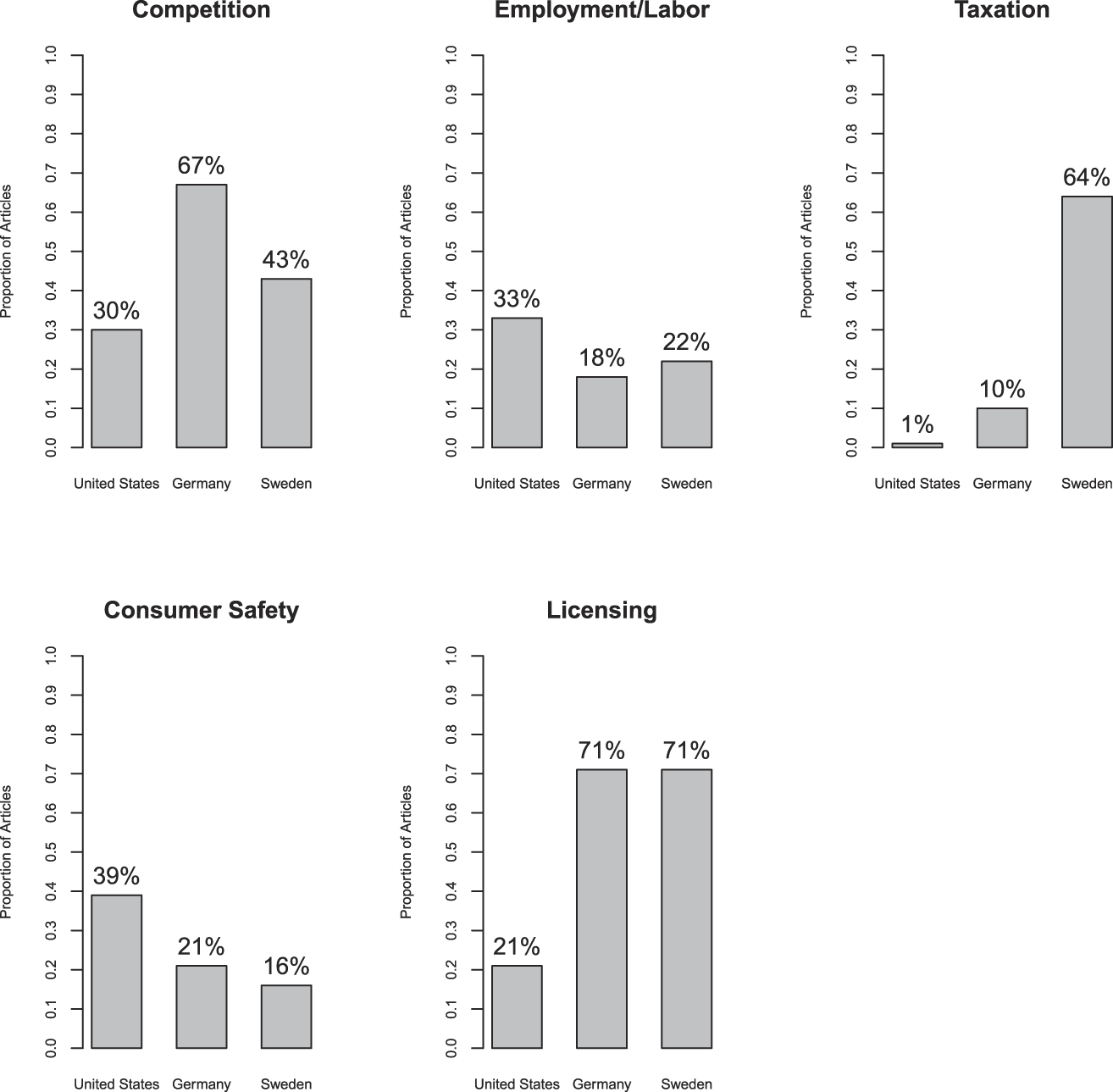
Figure 1 reports the share of all Uber articles within a country that were devoted to each of the five regulatory issues, and provides a first indication of which of these issues emerged as central political flashpoints in each country. As expected, “competition” (which captures the clash between local transportation providers and their disruptive new competitor), was an issue in all three cases, but figured especially prominently in Germany. Licensing issues also show up consistently across all three cases, though less so in the United States than in Germany and Sweden. Consumer safety was a somewhat more important theme in the United States than in Germany or Sweden, and the same is true for employment issues. Most strikingly, taxation emerged as a major issue in Sweden, but not in either of the other two countries.
Frequency of appearance of different regulatory issues, as share of Uber articles

Other differences across these cases emerge from a second, qualitative source of evidence, based on a reading of these articles to capture their tone and content. The qualitative analysis is crucial to interpreting the quantitative scores, because it reveals important differences in the valence (positive or negative) of the same issue in different contexts that is obscured behind otherwise similar-looking scores. For example, articles that identified “competition” issues as an important flashpoint in Germany mostly cast Uber in a very negative light—as introducing unfair, even ruinous competition into an otherwise well-functioning (because well-regulated) market. In the United States, by contrast, some of the articles depicted the company as enhancing competition in a field in which excessive regulation was associated with poor service and inferior quality. Similarly, while “consumer safety” was a more prominent theme in the American case than in the other two countries, only in the United States did a significant number of articles on this subject suggest that Uber improved consumer safety (e.g., by reducing drunk driving, or by providing working parents with a secure way to get their children to activities across town).
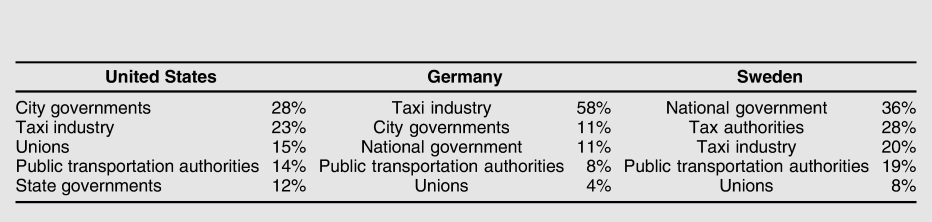
Other important differences can be observed in the actors who figured most prominently in the conflicts that Uber inspired. Table 1 lists the five actors cited most frequently in the articles, and reveals some important cross-case differences. First, among the state actors who were involved, in the United States city governments clearly figured most centrally, while in Germany and especially Sweden the national government played an important role as well. In terms of interest groups, unsurprisingly, taxi associations figured prominently in all three cases, but they were by far the most important actors in Germany. Only in Sweden do tax authorities figure among the central players.
Top five actors mentioned in individual articles, as share of all articles

Explaining these differences, and how they relate to the different regulatory outcomes we observe cross nationally requires that we delve into the specific political dynamics that Uber’s launch provoked in each case. Case studies and process tracing are well suited to identify the coalitions that formed in the clashes over Uber and the way different actors framed the debate.Footnote 22 The following sections therefore draw on a range of sources—interviews, government and other documents, and press coverage—to trace the politics surrounding Uber’s arrival and reception in each of the three countries.
Uber’s Arrival: Reception and Reaction
The United States
Uber was founded in the United States in 2009 and launched its first services in San Francisco in June 2010. In the meantime, the company has established operations in 257 American cities and counting.Footnote 23 Despite the reputation of the United States as a lightly regulated liberal market economy, in fact the taxi market historically has been heavily regulated. In most major cities, the number of taxis has been limited by a medallion system, in which the city issues a finite number of permits (medallions) that allow drivers to pick up passengers. Owning a medallion was previously an ultra-secure investment, but with the advent of Uber and similar services, the value of taxi medallions plummeted—for example in New York City from approximately $1.3 million in 2014 to around $250,000 just two years later.Footnote 24
Uber’s arrival came as a shock to this well-insulated system, and almost everywhere, it was greeted with ferocious opposition on the part of local taxi companies and limo drivers. The ensuing conflicts have unfolded differently in different cities,Footnote 25 but in comparative perspective, Uber’s reception in the United States stands out as unusually welcoming. Most notably and as already mentioned, the United States is the only country among the rich democracies in which the company’s low-budget option (ordinary cars driven by ordinary drivers without a commercial license) continues not just to survive but also to thrive. Even in cities that initially rebuffed the company, Uber is now up and running.Footnote 26 Some jurisdictions have extracted concessions from the company, but these still leave Uber far less regulated than in Europe.Footnote 27
As in Europe, the company confronted formidable opponents in local taxi providers who were well organized and often well connected in local politics. Different from Europe, however, jurisdictional fragmentation allowed Uber to isolate local taxi providers by inspiring competition across cities and states for access to a popular new service.Footnote 28 In this context, Uber benefited from (and promoted) a politicization of the issue, mobilizing its users to lobby politicians, sometimes through social media campaigns. The most famous example was the “DeBlasio” app, named for the New York City mayor who proposed limiting the number of Ubers. The company responded by adding a tab to its app through which users could register their disapproval to the city government with the push of a button. In the United States, this tactic has been deployed in a wide range of jurisdictions from Oregon to Illinois to Virginia.Footnote 29 As Collier et al. emphasize, Uber itself channeled the way in which the preferences of “the public” were presented through the aggressive use of social media, “solving” consumers’ collective action problems while also controlling the message they sent to policy makers.Footnote 30
Forging a powerful alliance with its users, Uber was able to frame the debate, such that the politics in the United States played out on a rhetorical plane heavily skewed toward the company. Thus, in contrast to Europe, the American debates more often counterposed “stifling” regulation against efficiency, innovation, and consumer choice.Footnote 31 Given these alternatives, it is no surprise that politicians across the spectrum rushed to position themselves on the “right” side of the issue. At the state and local levels, policy makers from both parties strained to avoid being viewed as hostile to technology and to project a consumer- and business-friendly image.Footnote 32 At the national level, prominent Republicans heralded Uber as a champion of free markets, while Democrats (with an eye toward their millennial base) embraced it as urban, progressive, and innovative.Footnote 33 Jurisdictional competition fueled a competitive deregulatory spiral, with state legislatures in some cases even overruling local authorities who sought stricter regulations.Footnote 34
Other actors have been disinclined to confront Uber, or they have been sidelined. For example, transit authorities, which in Europe can be counted on to be skeptical, are often more positive in the United States, as evidenced for example in remarks by the CEO of the American Public Transportation Association: “Together with companies like Lyft and Uber, we are integral to creating a dynamic multimodal lifestyle.”Footnote 35 In Atlanta, Dallas, and St. Petersburg, local transit authorities have concluded formal partnerships with the company.Footnote 36
Labor groups in the United States have criticized Uber on grounds that it creates an army of workers without any of the usual rights and benefits. However, organized labor’s influence has been limited both by features of American labor law and by labor’s weakness in the political economy. Uber insists that drivers are not employees, but instead independent contractors, a group over which American labor law gives unions no jurisdiction.Footnote 37 Indeed, unions that attempt to organize drivers are themselves at risk of being charged with price fixing.Footnote 38
More importantly, however, in the United States the labor issues that Uber raises have mostly been relegated to the courts.Footnote 39 The venue is important because it takes the employment issue out of the public spotlight while Uber proceeds to grow its consumer base and to use its app to amplify the voices of drivers who value the flexibility the job affords while suppressing critical voices that raise concerns about arbitrary deactivations and relentless price reductions that cut into drivers’ pay. Tellingly, in the one case (Seattle) in which a city government passed pro-union legislation allowing Uber drivers to organize, the company immediately challenged the law. That case has been tied up in protracted legal battles ever since.
Overall, the differences to Europe are stark. Whereas the European press is filled with concerns about Uber operating illegally and introducing unfair competition into well-functioning markets, in the United States Uber is frequently depicted as enhancing competition and increasing consumer choice.Footnote 40 Worries in Europe that Uber will contribute to traffic and pollution stand in contrast to expressions of hope that it will reduce car use in the United States.Footnote 41 In the United States., Uber is often credited for providing a superior service—cleaner cars, greater efficiency, and speedier pickup—and sometimes even for functioning as a “job creator.”Footnote 42 Most remarkably, despite some high profile crimes involving Uber drivers, the company is by no means always portrayed as a threat to consumer safety in the United States. On the contrary, some observers maintain that the service enhances safety, for example by reducing the number of drunk drivers on the streets at night, and by providing busy parents with a way to get their children to activities across town safely.Footnote 43
Of course, Uber has confronted obstacles along the way. One of these was strong criticism of its pricing policies, in particular in the immediate aftermath of emergencies of one sort or another. For example, when prices surged in some cities during Hurricane Sandy, the company was portrayed as cynically capitalizing on a natural disaster. Uber was also rocked by a public relations crisis after one of its drivers went on a killing rampage in Michigan. Another crisis, this one self-inflicted, revolved around an off-hand remark by a top Uber executive about tracking the rides of a journalist who had been critical of Uber, triggering worries about privacy.Footnote 44
These and similar episodes notwithstanding, one is struck by how little impact these events had on Uber’s forward march in the American market.Footnote 45 The scandals centering on revelations about the company’s misogynistic workplace culture arguably had the biggest impact. However, while the #DeleteUber campaign certainly put a dent in the company’s market share, it appears not to have triggered any rethinking of the basic business model, let alone any re-regulation of local transportation markets.
In sum, in a context in which conflicts over Uber have played out in decentralized and highly politicized venues, Uber has been able to inspire competition across jurisdictions and play on politicians’ fears of appearing hostile to technology. Most importantly, by organizing its users and mobilizing them as a political weapon, the company largely succeeded in isolating its main competitor, local taxi companies. By framing the conflict as a struggle between innovation, efficiency, and consumer choice on one hand, and rent-seeking and competition-stifling monopoly on the other, the company has presented politicians with a choice that tilts heavily toward the kind of deregulatory response that the company has sought and that state and local politicians in the United States have largely delivered.
Germany
The German taxi market resembles its pre-Uber American counterpart in many important respects. City governments grant concessions to operate taxis and set limits on the number of taxis allowed, while also imposing various obligations to ensure that all areas and hours are served. As in the United States, some taxi drivers in Germany are independent owner-operators, while others work for larger taxi companies. However, Germany diverges sharply from the United States in outcomes. While Uber encountered resistance in many American cities, it almost always prevailed. In Germany by contrast, the company only attempted a launch in a few locations and it was effectively banned nationwide within a year.
Uber Deutschland began operations in Berlin in January 2013, offering a high-end luxury service to coincide with the city’s Fashion Week. Uber’s limo service was unproblematic in Germany but by April 2014, the company was offering its low-cost UberPop service as well.Footnote 46 Local taxi companies responded immediately with legal action, and while the case was being heard in Berlin, Uber pressed ahead, launching operations in Hamburg, where it was greeted with an immediate injunction days after its July 2014 arrival. Undeterred, the company announced plans to expand operations to additional cities including Cologne, Stuttgart, and Düsseldorf.Footnote 47
These efforts never got off the ground. The national mobile taxi hailing service, Taxi Deutschland, filed a suit calling for a nationwide ban, citing the company’s unfair competitive behavior. In September 2014, the court agreed, and issued an injunction against the company. Uber contested the ruling even as taxi companies organized sting operations to expose illegal drivers who faced enormous fines.Footnote 48 By March 2015, a general ruling by the Frankfurt state court (Landesgericht) confirmed earlier decisions, effectively banning Uber across all of Germany.Footnote 49 This effectively ended Uber’s German operations.Footnote 50
The politics surrounding Uber in Germany differed starkly from those in the United States both in the venues in which the conflict was played out and in the terms on which it was fought. Like its American counterpart, the German taxi industry is well organized and powerful, but an important difference is that German taxi companies are represented at the national level by no fewer than three centralized associations. The Verband Deutscher Verkehrsunternehmen (VDV) is the oldest and most important actor in the transportation sector, and includes not just taxi companies but all companies providing public passenger and rail freight transportation. The Deutscher Taxi- und Mietwagenverband represents the specific interests of taxi operators and rental car companies, managing relations with government ministries and the public. Finally, the Taxiverband Deutschland represents companies operating on a regional basis in national politics.
These overarching associations facilitated a swift and coordinated response, nationalizing the conflict and preempting the kind of competition across jurisdictions that gave the company such momentum in the United States. Coordinated action by established taxi providers interfered with Uber’s ability to recruit drivers and build up sufficient supply to drive prices down, a strategy that had been enormously successful in winning over customers in the United States. Even in large cities like Munich, a dearth of drivers meant that Uber users experienced long wait times for rides, so that the service failed to generate the cycle of increased supply (of drivers) and increased demand (by users) that in the United States had allowed the company to establish a powerful presence even under conditions of legal uncertainty.
Equally important, immediate cease-and-desist orders also shifted the conflict to closed legal and administrative venues, where the issue would be settled as a technical-legal matter rather than a political issue. Representatives of taxi operators forged an alliance with local transportation authorities as defenders of high quality, reliable service that they portrayed as under siege by a company that was acting in a dangerous, anything-goes way outside the law. In these conflicts, the German taxi industry portrayed itself not as a defender of its own sectional interests but as part of a public transportation network under threat by what it characterized as a profit-seeking behemoth.Footnote 51 Thus, in stark contrast to the United States, the dominant framing of the Uber issue in Germany cast the company as a threat to the public interest for the way it invaded well-ordered local transportation markets with unfair, ruinous competition.Footnote 52 In an inversion of the more common American narrative that often denounces powerful taxi “monopolies,” Germans were more likely to see Uber as a powerful Goliath, backed by deep-pocketed investors and intent on world domination.Footnote 53
This context and this framing elicited a very different political reaction from German policy makers, as representatives of the major political parties on the right and left unified in defense of existing regulations. The Minister of Transportation (a member of the conservative Christian Democratic Union, CDU) and the Minister of Labor and Social Affairs (member of the Social Democratic Party, SPD) were both heavily critical of Uber.Footnote 54 In contrast to the United States, where politicians were at pains to portray themselves as open to innovation, in Germany the main political parties together condemned Uber’s flagrant disregard for the rules.
There were some dissenting voices. The head of the Federal Cartel Office (Bundeskartellamt), an independent authority established in 1958 whose task is to protect competition, greeted Uber’s arrival and suggested that some reform of the taxi market might be in order.Footnote 55 Germany’s Monopolkommission (an independent board of experts that advises the government on competition law) warned against “overregulation” and a “defense of outdated business models,” while also acknowledging the need for regulations.Footnote 56 The European Commission adopted an overall more sympathetic stance, arguing that outright bans of service providers such as Uber ought to be a measure “of the last resort.”Footnote 57 The Commission’s accommodating language was taken as a glimmer of hope for Uber, although the recent ruling by the European Court of Justice ultimately confirmed that Uber is a taxi company, and as such, needs to adhere to local rules governing the sector.Footnote 58
In any event, Uber had already basically given up on the German market. The company maintains operations in Munich and Berlin with very limited services designed to work around German regulations. As in Sweden, UberPop is entirely gone, but in Germany UberX (licensed drivers) survived only in Munich. In Berlin, what is left is UberTaxi, which simply offers an app that connects consumers to established taxi operators. The company tried reconfiguring its low-end UberPop service to comply with Germany’s very restrictive regulations governing ride sharing. However, this move failed as the number of Uber drivers willing to work on these terms shriveled.Footnote 59 Uber’s (then-) CEO Travis Kalanick admitted that establishing a presence in Germany has been even more difficult than in France, where the company has faced similar bans alongside more visible and sometimes violent street protests.Footnote 60
Reading the German press coverage against that of the American, it is striking how little sympathy Uber was able to summon. Newspapers of different political leanings often emphasized the benefits of well-regulated markets and “fair” competition. Uber came in for criticism for a range of ills, ranging from privacy concerns to the potentially negative consequences of surge pricing to the company’s deleterious impact on small businesses.Footnote 61 An especially prominent and common criticism across the spectrum was the company’s aggressive in-your-face style and strategies.
In sum, Uber confronted a very different political landscape in Germany than it had in the United States. Whereas in the United States, Uber picked off cities one at a time, in Germany national associations representing local taxi operators mounted a quick, coordinated response. Cementing a national-level alliance with transportation authorities and leaders from both sides of the aisle, they mounted a spirited defense of the existing regulatory framework. Together they opposed Uber’s advance under the banner of protecting the public’s interest in well-ordered markets against a destructive new actor operating in flagrant defiance of the law.
Sweden
The status quo ante in the Swedish taxi market was quite different from that in both the United States and Germany. A law passed decades earlier (July 1, 1990) had deregulated the taxi market with three important changes.Footnote 62 First, it removed all restrictions on the maximum number of taxis in an area. Second, it replaced previous constraints to allow for price competition across different providers. Third, it allowed for freelancing in a market in which drivers previously had to be members of a (restricted) consortium in order to offer taxi services. Since that time, the Swedish taxi market has operated on a franchise model that distinguishes between “taxi operators” and “taxi companies.” The former own no vehicles but control the brands (essentially the markings on the car), the prices charged by taxis operating under that brand, and some features of the equipment (e.g., credit card devices). The taxi companies, with fleets of varying sizes, contract with these operators to connect them with clients and pay the operator a monthly (per car) fee, as well as a share of each ride. Taxi drivers work not for the operator, but instead for the taxi company.
The differences to the medallion system in Germany and the pre-Uber United States are stark. The deregulation of 1990 had created a much more fluid and competitive market. Localities could not impose restrictions on the number of taxis in an area, and the franchise system if anything encouraged a proliferation of drivers, because the taxi operators receive a monthly fee for each car regardless of actual rides provided. These differences account for Uber’s smoother rollout in Sweden. Similar to other (existing) operators, Uber owns no vehicles and employs no drivers but simply offers a link to clients under a new brand. Although Uber cars do not bear the usual markings, like the other operators, the company sets prices and controls the payment method. As a senior civil servant in the transport division of the Ministry of Enterprise and Innovation put it, “from an official standpoint Uber is just another operator” connecting people who want rides with drivers.Footnote 63 This explains why even as the company faced bans and protests in Germany and France, it “eased its way into Scandinavia’s biggest city with next to no friction.”Footnote 64 Unlike in the United States, the employment status of Uber drivers also did not provoke opposition because taxi operators in Sweden anyway do not employ drivers. A representative of the union that is responsible for the taxi industry (Svenska Transportarbetareförbundet, or Transport for short) confirmed that the employment status of the drivers was not the main issue in Sweden.Footnote 65
Despite the fact that its (default) designation as taxi operator shielded Uber from many of the regulatory obstacles it faced elsewhere, some rules still applied. Commercial licensing was one such rule, but this did not seriously inhibit Uber’s growth in Sweden. Drivers who had been licensed to work for other companies were often happy to switch to Uber because this relieved them of the monthly fee that other taxi operators charged and because Uber claimed lower per-ride fees (20% per ride rather than 35%). Drivers also benefitted from Uber’s payment system, which eliminated the problem of riders failing to pay their fare at all. Swedish regulators also required that Uber cars bear special license plates and list the prices on the rear window, like other taxis.Footnote 66 In addition, they called for Uber cars to be outfitted with taximeters, a requirement with which drivers formally complied even though the meters served no function.
The more permissive regulatory context allowed Uber to establish more of a ground game and consumer base than in Germany. It was not all smooth sailing, however, and the issue of taxation soon emerged as a major point of conflict. Under the old system, taximeters provided a record of earnings not just for taxi operators to claim their share, but also for tax authorities to track earnings. A large majority of drivers worked as employees of the taxi companies, and as such had their taxes automatically withheld. The Uber system upset this situation by dispensing with the taxi company that once stood between drivers and taxi operators. This created an important regulatory problem for Swedish tax authorities, because with the app the entire payment went directly to Uber, after which 80% was transferred back to the driver. Crucially, because Uber maintains its European headquarters in the Netherlands, the Swedish government had no record of these transfers, which meant that the Swedish tax agency did not have access to the data needed to assess tax burdens.Footnote 67
The issue of taxes also mobilized unions, since most of the country’s generous social policies are tax financed. For American unions the employment status of drivers is crucial because most benefits are contribution-based and accrue only to workers on standard employment contracts. In Sweden, by contrast, most benefits are universal; all citizens are eligible regardless of employment status. So unions did worry about Uber’s reliance on “bogus” or “fake” self-employment, but also, relatedly, about the revenue base on which the social system is premised. As a representative of the union that organizes Swedish taxi drivers put it, “Uber is here to stay, but the big issue is who is going to pay the taxes in Sweden?”Footnote 68
The tax issue thus became a central flashpoint in Sweden, and a hub around which a broad coalition of interests could coalesce. Taxi companies railed at the possibility that Uber’s competitive advantage was in fact underwritten by massive tax evasion on the part of drivers. However, in the Swedish context, tax authorities and unions emerged as important allies in the fight. In contrast to the United States, taxi providers could attach their concerns to a much broader coalition that channeled the interests of “the public,” with arguments that appealed to citizens not as consumers but as taxpayers. In other words, far from a rhetoric of defending particular interests, the discourse in Sweden was much more about preserving community norms of fairness and defending a system of social protection that only works if everyone chips in.Footnote 69
Uber recognized the power of these arguments and offered to partner with tax authorities, suggesting that the company devote a part of its training programs to instructing drivers on how to calculate and submit their taxes. At the same time, however, the company insisted that because drivers are independent contractors, it is not the company’s problem if they fail to declare their earnings. As noted, all vehicles transporting passengers (including Uber cars) have to be outfitted with a taximeter. However, because the Uber app records the ride and calculates the fare, these meters were never running. Instead, drivers typically set the meter to SEK90 (the minimum fixed-price fare) regardless of the length of the trip.Footnote 70
Undercover sting operations brought tax evasion to light, and resulted in litigation against several Uber drivers. Heightened public attention to this issue brought Swedish political parties around to a more skeptical view of the company. Members of the Center-right Moderate party stressed that “all actors, even new companies, have to follow the law and pay taxes like everybody else,” suggesting “if there is systematic abuse among UberPop drivers, we have to demand some form of responsibility from Uber as a company for employing their services.”Footnote 71 The Social Democratic Minister of Infrastructure Anna Johansson responded to the conviction of twenty-one Uber drivers by emphasizing that the cases were “first and foremost about the Swedish model, about paying taxes, social fees and decent salaries.”Footnote 72
The government passed stopgap legislation that requires all drivers (including Uber drivers) to report on a regular basis to a government office to empty their taximeters. However, it also appointed a government commission to produce recommendations to guide policy over the longer term.Footnote 73 After extensive research and consultation, the commission proposed what was called “progressive” legislation that would allow Uber to continue operating while also adjusting the regulatory framework to ensure a level playing field.Footnote 74 Specifically, it recommended that app-based services such as Uber be regulated (as before) as taxi operators, but it also proposed abandoning the mandatory taximeter in favor of alternative equipment that could communicate directly with platform-based apps to provide authorities with the data they need to assess taxes.Footnote 75 The report made no proposals regarding the employment status of drivers, and left existing licensing rules in place. The chair of the commission emphasized that the proposals her committee developed were forward-looking in the sense that they could be adapted to a wide range of platform business models. As this article goes to press, the government is reportedly planning to introduce legislation that creates a new category of taxi that can use “alternative equipment” (instead of the traditional taximeter). The new law would thus allow UberX to continue operation, while also however safeguarding “fair competition” by making sure the company complies with existing licensing and tax policies.Footnote 76
In short, the Swedish response to Uber has charted a course somewhere between that of the German one (which essentially shut Uber down in defending existing regulations and service providers) and the American one (which mostly deregulated local taxi markets to accommodate Uber). The rhetoric surrounding Uber was less rapturous than among the enthusiasts in the United States, but also less apocalyptic than in Germany. Most importantly, a broad coalition of public officials and well-organized interests played the key role in framing the debates to identify and address the specific problems Uber posed in the Swedish context. The regulatory result was neither to banish nor to accommodate Uber, but rather to adjust existing regulations to envelop the company in a framework aimed at reconciling its continued operation with the Swedish model.
Conclusion
Uber is just one of a growing number of companies associated with the advance of digital capitalism. However, the company’s rapid expansion makes it a particularly valuable case for a comparative analysis of the politics of the platform economy—both the regulatory problems these new business models pose and the responses they elicit. I have analyzed Uber’s arrival and reception the United States, Germany, and Sweden, documenting three very different responses to this disruptive new actor. Understanding these divergent outcomes, I argue, requires that we attend to differences in the specific points of contestation around which the regulatory politics centered. Uber is a shared shock in Gourevitch’s sense but it turns out that such common events are translated through national institutional arrangements into different struggles over particular national practices. The central salience of different issues mobilized different actors, inspired different coalitions, and ultimately drove different regulatory responses.
In the fragmented and politicized U.S. context, Uber was able to hold regulators at bay while it cultivated an alliance with consumers. Positioning itself as a champion of free markets and consumer choice, the company rallied its users against unpopular taxi lobbies in one jurisdiction after another, pressuring politicians while tying up labor advocates in protracted court battles. In Germany’s denser organizational landscape, taxi associations were able to mount a swift and coordinated response. Together with allies in public transportation, they positioned themselves as defenders of consumers whose interest in high quality, reliable services was best served by well-regulated markets, and isolated Uber as a threat to public order and the rule of law. In Sweden, finally, taxes emerged as the central regulatory flashpoint, and served as a common focal point for a broad coalition that included taxi companies, labor unions, and state actors in defense of the norms of fairness on which the Swedish social system rests.
The foregoing analysis is but a first foray into the politics of digital capitalism. Much research remains to be done, especially on the way in which platform business models interact with different labor regimes. I have already suggested that differences in the way social benefits are structured and financed affects the particular problems that platform businesses pose in different countries. A second important line of research would explore the general political-economic conditions that provide more and less congenial environments for such business models to thrive.Footnote 77 I have focused on the regulation of taxis and local transportation markets, but the success of platforms like Uber also turns heavily on features of the labor market. Where wage and income inequality is low, it should be difficult to find workers who are willing to drive people around for modest pay.Footnote 78 At the same time, however, and as the case of France shows, platforms like Uber can gain a foothold where labor markets are heavily regulated but also strongly dualized or plagued by high levels of youth unemployment or both.Footnote 79
Finally, it is worth investigating how immigration and race play into the politics surrounding Uber and similar ventures. In the UK, conflicts over Uber have exposed rifts within the labor movement by pitting middle-class white drivers of London’s black cabs against immigrants and people of color who in many cases have turned to platform employment in response to labor market closure.Footnote 80 Similar dynamics are evident in France as well.Footnote 81 In these cases, and arguably in the United States and other countries as well, race and immigration have clearly emerged as central cleavages in defining the battle lines over Uber.