Introduction
In recent years, supercapacitors have drawn considerable attention from researchers as an alternative energy storage device. They offer benefits such as high-power density, fast charge/discharge capability, and excellent cycling stability.[Reference Liao, Li, Jin, Yang and Wang1, Reference Choi, Yang, Hong, Choi and Huh2] Some of their diverse applications include brake energy recuperation, power tools, and uninterrupted power supply.[Reference Jin, Wang, Gu and Polin3, Reference Dam, Wang and Lee4] Supercapacitors (pseudocapacitors) primarily store energy via Faradic pseudocapacitance arising from the reversible redox reactions on the surface of the electrode materials. Transition metal oxides are frequently studied as the electrode materials for pseudocapacitors, such as NiO, Co3O4, ZnO, Fe3O4, SnO2, CuO, and MnO2.[Reference Dam, Wang and Lee4–Reference Maiti, Pramanik and Mahanty10] In addition, the conducting polymers have also been investigated as the electrode materials for pseudocapacitors, which include polyaniline, polypyrrole, poly[3,4-ethylenedioxythiophene], and so on.[Reference Hao, Xia, Lei, Wang and Qiu11–Reference D'Arcy, El-Kady, Khine, Zhang, Lee, Davis, Liu, Yeung, Kim, Turner and Lech13] The mechanism of energy storage in the conducting polymers is based on both the electrical double layer and the rapid faradic charge transfer. Co3O4 is of special interest for investigation primarily due to its high theoretical-specific capacitance and excellent redox activity. However, low-power handling capability and poor cycling performance significantly hinder its application in high-performance supercapacitors. One of the effective solutions to these challenges is to fabricate three-dimensional Co3O4 electrodes with the porous nanostructure, which shortens the transport pathway lengths of the electrons and the ions and thus enhances the kinetics of the Faradaic redox reactions. High surface-to-volume ratio of the nanostructure provides additional electroactive sites for the redox reactions, and the interconnected pores enable the facile diffusion of the electrolyte and accommodate the volume change during the cycling process. In addition, the internal resistance of the supercapacitor cell can be reduced by the direct electrical contact of the electrode material with the conductive substrate.
State-of-the-art synthesis methods for the preparation of porous nanostructured Co3O4 are hydrothermal, co-precipitation, biomorphic, and electrodeposition.[Reference Jang, Ameen, Akhtar and Shin14–Reference Rakhi, Chen, Hedhili, Cha and Alshareef19] However, several disadvantages are associated with these methods, which include the complex time-consuming steps and the difficulty in scaling-up due to the nature of batch production. In addition, it often requires a slurry coating process to fabricate the electrodes with the nanostructured Co3O4 in the powder form, which involves the mixing with the binder material and/or the conductive additives in organic solvent(s) to prepare the slurry, the casting of the slurry onto the conductive substrate (i.e., nickel foam, carbon cloth), and the appropriate drying steps of the coated electrodes. To eliminate the use of the binder material and enhance the electron transport and the ion diffusion, the binder-free three-dimensional Co3O4-based electrodes have been prepared by the hydrothermal synthesis coupled with electrodeposition, chemical vapor deposition, or chemical etching assistant method.[Reference Qu, Zhao, Khan, Han, Hercule, Yan, Liu, Chen, Wang, Cai and Xu20–Reference Hong, Wang, Gong, Sun, Niu, Yang, Wang and Yang23] In an effort to significantly reduce the processing steps of fabricating the three-dimensional electrodes with porous nanostructured active materials, a novel flame combustion-based synthesis method in the open atmosphere is developed, namely Reactive Spray Deposition Technology (RSDT), which also brings the benefits of cost reduction and throughput increase. Due to the continuous and economical nature of this process, it is feasible to scale it up to the industrial-level manufacturing. In addition, no chemical waste is generated from the synthesis process of RSDT since the precursor materials and the organic solvents used in this method are completely combusted.
During the operation of RSDT, the porous nanostructured electrode materials are synthesized via a rapid thermochemical conversion process of the organometallic precursors. Upon combustion, the precursors rapidly decompose in the high-temperature flame, followed by the phase transition to vapor and the homogeneous reactions to form the metal oxides. The particle growth generally takes place in the following order of mechanisms: nucleation, surface growth, cluster formation, coalescence, aggregation, and agglomeration.[Reference Roth24, Reference Strobel and Pratsinis25] The synthesized active materials are directly deposited onto the conductive substrates to form the electrodes. The high combustion heat from the flame provides in situ annealing to the electrodes and thus eliminates the need for post-deposition heat treatment. In the meantime, since no binder is required in the fabrication process, the capacitance loss from the blockage of the electroactive surface by the binders is avoided, whereas the commonly employed slurry coating method is only capable of producing binder-enriched electrodes.
In this study, the binder-free three-dimensional Co3O4 electrodes are fabricated by RSDT. The crystal structure of the as-synthesized active material is analyzed by x-ray diffraction (XRD). The surface morphologies and the microstructures of the electrodes are investigated by means of scanning electron microscopy (SEM) and transmission electron microscopy (TEM). Electrochemical properties of the as-prepared electrodes are evaluated by cyclic voltammetry (CV), chronopotentiometry (CP), and electrochemical impedance spectroscopy (EIS) in conventional three-electrode configuration.
Experimental
Electrode fabrication
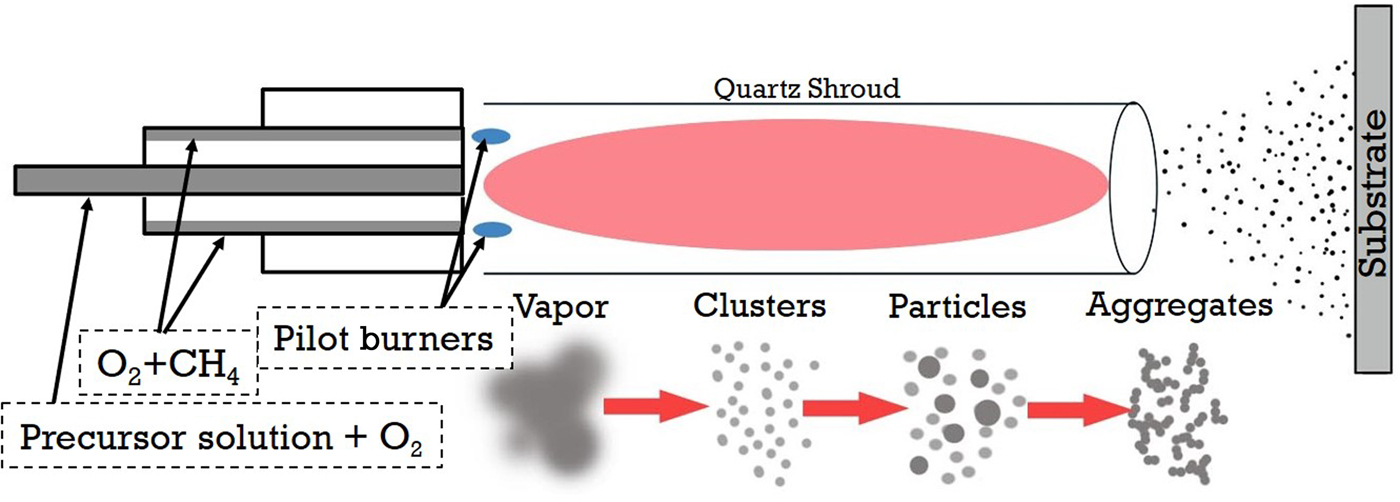
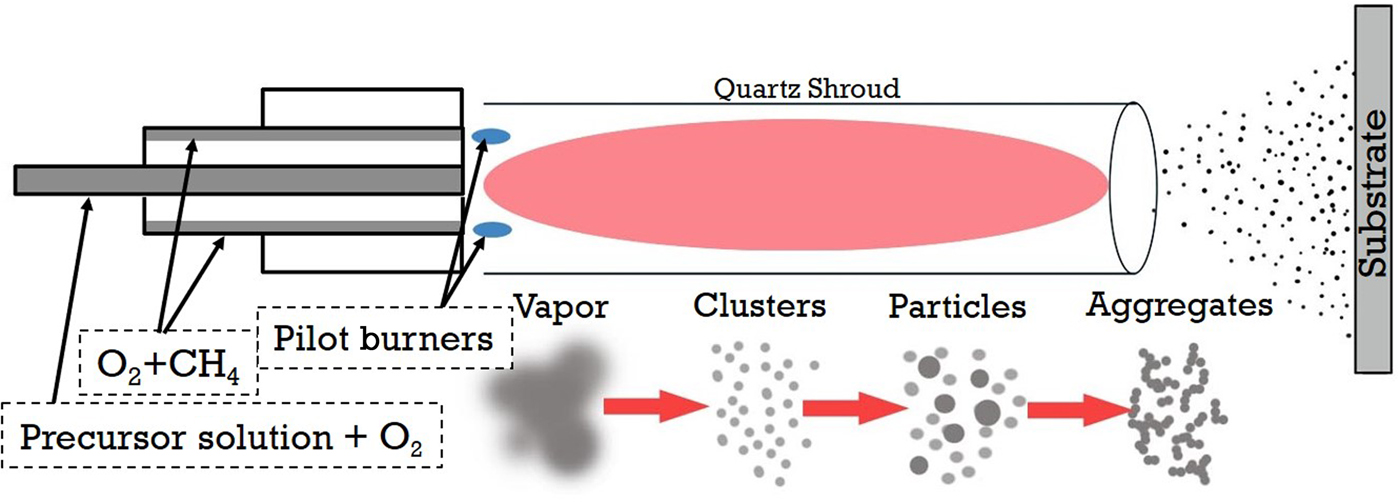
The binder-free three-dimensional Co3O4 electrodes were fabricated by RSDT for the first time. The schematic illustration of RSDT synthesis process and the mechanisms of particle formation and growth during the process are shown in Fig. 1. A jet-diffusion flame is generated by the ignition of the atomized precursor solution. High-purity oxygen (Airgas East Inc., Cheshire, Connecticut, USA) flows co-axially with the precursor solution at a rate of 12 L min−1 to support the combustion. The flame is sustained by six pilot burners as the continuous ignition source, which use the mixture of oxygen (Airgas East Inc., flow rate: 1.15 L min−1) and methane (Airgas East Inc., flow rate: 1.15 L min−1) as the fuel. A quartz shroud is used to enclose the flame to reduce the escape of combustion heat. The precursors decompose in the high-temperature flame and undergo a phase transition to form the vapor. The homogenous reaction of the vapor followed by nucleation lead to the formation of the clusters. The subsequent surface growth and coalescence result in the nano-sized particles. The final stage of the synthesis process involves the aggregation and the agglomeration of the particles. The residence time of the particles in the flame is extremely short, which is only of the order of a few milliseconds. The product materials are directly deposited onto the three-dimensional substrates to form the electrodes. The combustion heat from the flame provides the in situ annealing to improve the crystallinity and the adhesion of the synthesized materials.
Schematic representation of RSDT synthesis process and the mechanisms of particle formation and growth during the process.
The precursor solution was prepared by dissolving the cobalt acetylacetonates (Sigma Aldrich) into a solvent mixture of 50:50 wt.% methanol/xylene (Fisher Scientific, Certified ACS Grade) to obtain a concentration of 25 mM, which was assisted by water bath sonication. A custom-built pressure vessel was used to hold the precursor solution and the liquefied propane (Airgas East Inc.) free of sulfur was added to the solution (16.5 wt.%). A high-pressure syringe pump was used to flow the precursor solution through a capillary tube to the atomization nozzle at a rate of 8.0 mL min−1. The temperature of the precursor solution was elevated to 50–60 °C by the induction heating coil before reaching the nozzle. The atomization of the precursor solution was achieved by the pressure drop of the solution at the exit orifice (mechanical atomization) and the supercritical expansion of the liquefied propane. The resulting aerosol spray was ignited to generate the jet-diffusion flame. The nickel foam conductive substrates were mounted on a custom-made stainless-steel substrate holder, which was attached to a computer-controlled motion platform. The substrate holder traveled in a raster pattern to ensure the uniform deposition. A piece of the zero-diffraction silicon substrate was also mounted on the substrate holder to collect the synthesized material for XRD analysis.
Physical characterization
XRD analysis of the nanostructured Co3O4 that was collected on a zero-diffraction silicon substrate was carried out by Bruker D8 Advance diffractometer with Cu Kα (λ = 1.5451 Å) radiation. Surface morphology of the three-dimensional Co3O4 electrode was characterized using FEI Quanta 250 FEG SEM. TEM images were acquired using FEI 200 kV Metrios TEM equipped with Super-X EDS package. TEM samples were prepared by removing the active material from the electrode, fully dispersing in ethanol, and drop-casting onto 400 mesh carbon film-coated copper TEM grids (Ted Pella Inc.). The particle size distributions were obtained by the analysis of the TEM images using the image processing software ImageJ.
Electrochemical measurements
Electrochemical measurements of the three-dimensional Co3O4 electrodes were carried out in a conventional three-electrode electrochemical cell with 1 M KOH aqueous solution as the electrolyte. CV, CP, and EIS were performed on CHI 760E Electrochemical Workstation with the standard Ag/AgCl electrode as the reference electrode and the platinum foil as the counter electrode. CV was performed in the potential window between −0.1 and 0.5 V at multiple scan rates from 5 to 50 mV s−1. CP was measured in the potential window between 0 and 0.45 V at various current densities from 1.5 to 30 A g−1. EIS was performed in the frequency range between 100 kHz and 0.1 Hz with AC excitation signal of 5 mV.
Results and discussion
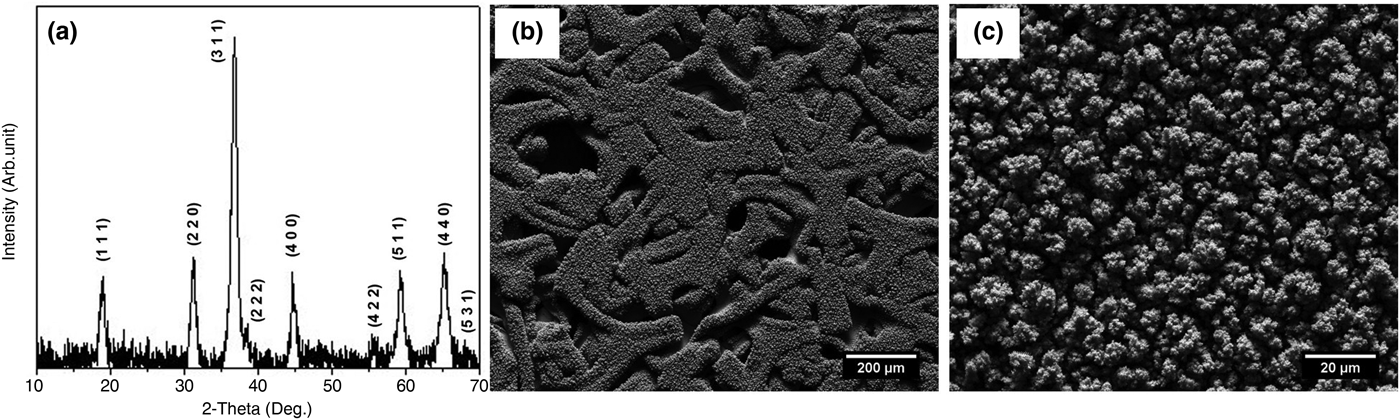
Figure 2(a) shows the XRD pattern of the nanostructured Co3O4 synthesized by RSDT. The diffraction peaks can be indexed to the (2 2 0), (3 1 1), (2 2 2), (4 2 2), (5 1 1), and (4 4 0) crystal planes of FCC phase Co3O4 with space group of Fa3m (JCPDS card No. 43-1003). The broadening of the peaks is primarily resulted from the small crystallite sizes of the Co3O4 particles. Secondary peaks are not observed in the XRD pattern, indicating the complete decomposition of the precursors to form the pure phase Co3O4.
(a) XRD pattern of the nanostructured Co3O4 synthesized by RSDT. (b, c) SEM images of the binder-free three-dimensional Co3O4 electrodes.

SEM images showing the top view of the as-prepared Co3O4 electrodes are present in Figs. 2(b) and 2(c). It can be observed that the cauliflower-shaped Co3O4 aggregates, which are composed of the nano-crystallites, are uniformly deposited on the three-dimensional nickel foam conductive substrate. The large openings in the nickel foam allow the penetration of the Co3O4 particles into its inner structure to form a three-dimensional architecture that increases the mass of the active material per unit area of the substrate without significantly increasing the thickness of the electrode. As a result, the diffusion pathway lengths of the electrons and the ions in the binder-free three-dimensional Co3O4 electrodes are shorter than those in the conventional binder-enriched composite electrodes with similar mass loadings of the active materials. The interconnected pores between the aggregates should facilitate the deep penetration of the electrolyte into the electrode, which provides the excellent accessibility of the OH− ions for fast redox reactions and enables a highly effective utilization of the active material.
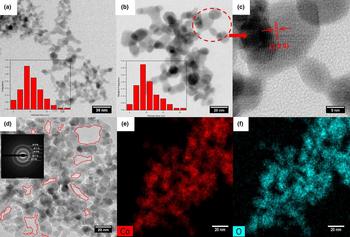
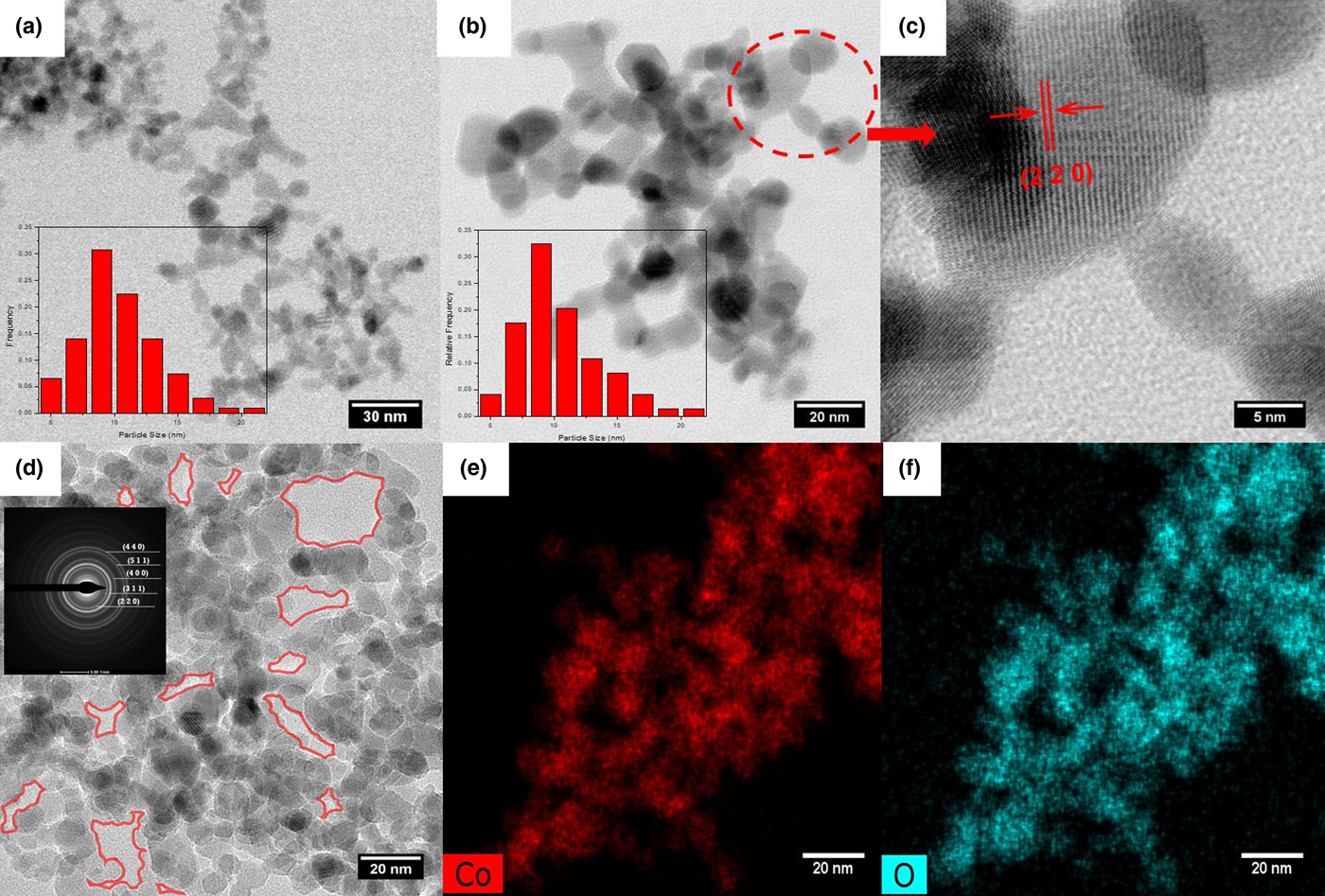
TEM images of the Co3O4 aggregates are shown in Fig. 3. The aggregates are composed of interconnected Co3O4 nanoparticles that have a relatively narrow distribution of particle sizes between 4 and 21 nm [Figs. 3(a) and 3(b)]. Polydispersed sheet particles are observed, demonstrating the highly crystalline nature of the as-synthesized Co3O4. From the high-resolution TEM image of the individual primary particles in Fig. 3(c), the lattice fringes can be clearly spotted and the measured interplanar space of 0.29 nm is matched with the (2 2 0) plane of Co3O4. It can be observed that the irregular-shaped pores are distributed randomly between the Co3O4 particles [Fig. 3(d)]. In addition, the diffraction rings in the selected area electron diffraction (SAED) demonstrate the polycrystalline nature of the Co3O4 particles. In Figs. 3(e) and 3(f), the EDS elemental mapping confirms the uniform distribution of Co and O in the aggregates.
TEM images of the nanostructured Co3O4 aggregates synthesized by RSDT: (a) an overview of the morphology; (b) high-magnification TEM image; (c) high-resolution TEM image; (d) low-magnification TEM image shows the irregular-shaped pores and the inset image shows the SAED pattern; (e, f) EDS elemental mapping of Co and O.
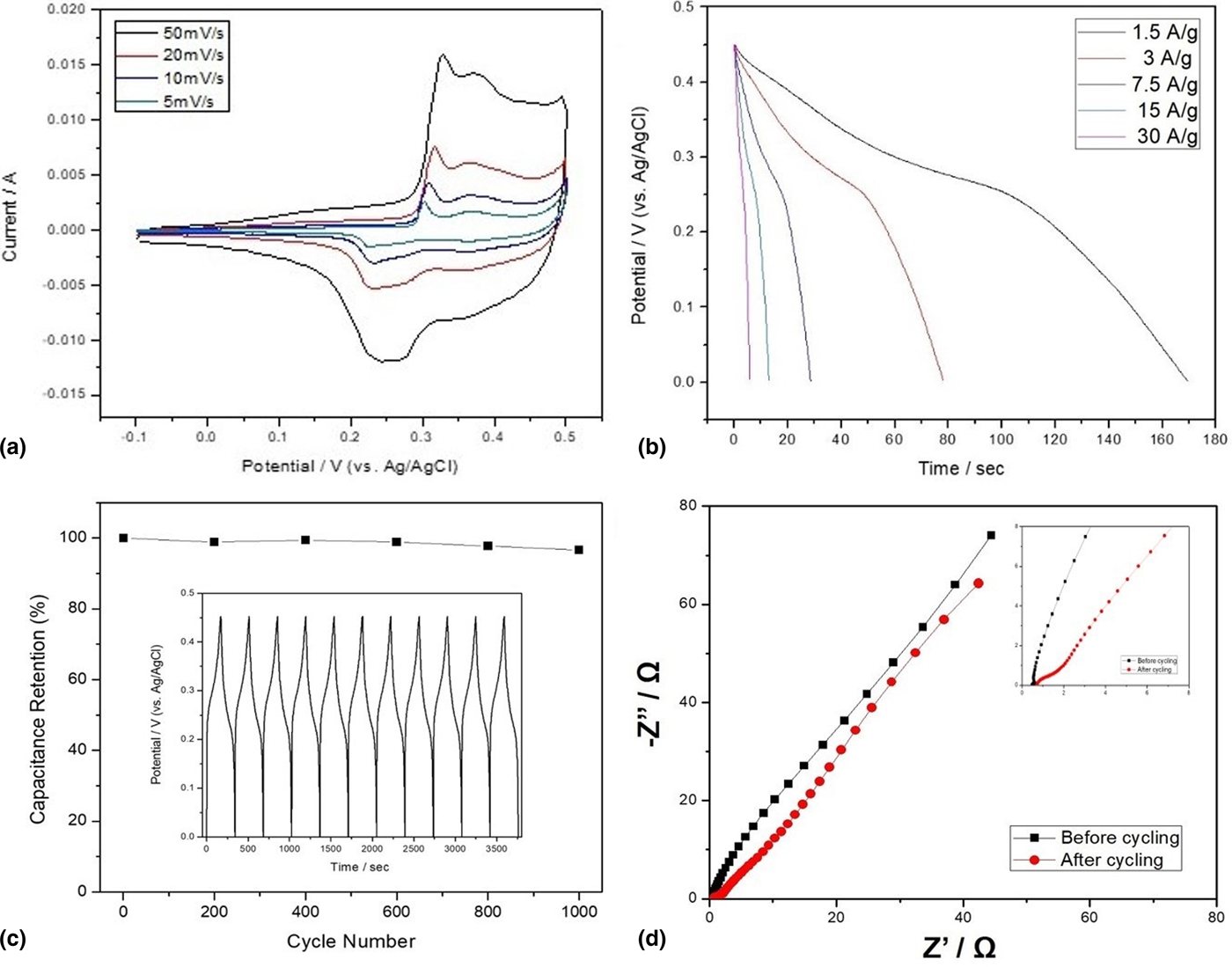
CV curves of the three-dimensional Co3O4 electrodes in the potential window between −0.1 and 0.5 V at different scan rates are shown in Fig. 4(a). The redox peaks observed in the CV curves correspond to the conversion reactions between the oxidation states of cobalt in the alkaline electrolyte, which include Co2+/Co3+ and Co3+/Co4+. The following reactions can be used to illustrate the redox processes during the CV sweeps[Reference Švegl, Orel, Hutchins and Kalcher26, Reference Wang, Lei, Li, Gu, Yuan and Xiao27]:
 $${\rm C}{\rm o}_3{\rm O}_4 + {\rm O}{\rm H}^ - + {\rm H}_2{\rm O} \leftrightarrow 3{\rm CoOOH} + e^ -, $$
 $${\rm CoOOH} + {\rm O}{\rm H}^ - \leftrightarrow {\rm Co}{\rm O}_2 + {\rm H}_{\rm 2}{\rm O} + e^ -. $$
(a) CV curves of the three-dimensional Co3O4 electrodes at multiple scan rates. (b) CP curves at different current densities. (c) Capacity retention during 1000 cycles, inset image showing the CP curves. (d) EIS spectra of the three-dimensional Co3O4 electrodes before and after cycling. The inset images show the magnified EIS spectra at the high-frequency region.
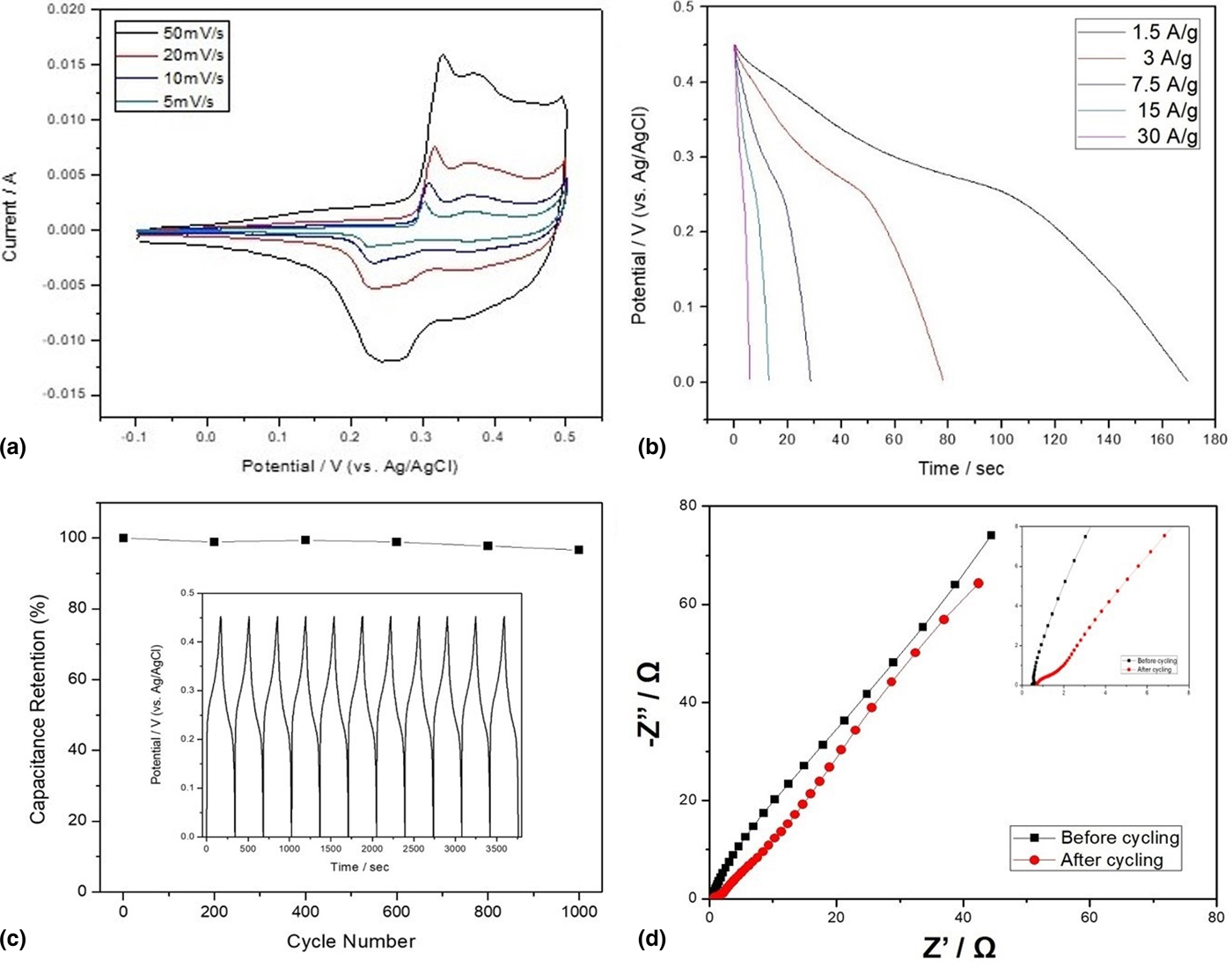
While two distinguishable current peaks are observed in the anodic sweep, only one broad peak can be identified in the cathodic sweep, which is likely due to the overlapping of the reduction peaks. The asymmetry observed between the anodic and the cathodic peaks indicates the irreversibility in the kinetics of the redox processes, which might be caused by the electrode polarization and the ohmic resistance of the porous nanostructure.[Reference Roth24] When the scan rate increases from 5 to 50 V s−1, the anodic peaks gradually shift toward the positive potential and the cathodic peaks move slightly toward the negative potential. This phenomenon is also related to the polarization of the electrode due to the limited ion diffusion rate, which only allows the conversion reactions to occur at the outer surface of the electrode. However, the shape of the CV curves remains unchanged at the high scan rate, indicating the fast kinetics of the electrode material.
The rate capability and cycling performance of the three-dimensional Co3O4 electrodes are investigated by CP measurements. The resulting CP curves at multiple current densities in the potential range between 0 and 0.45 V are shown in Fig. 4(b). Unlike the linearity in the discharge curves of the double-layer capacitors, the sloping voltage plateaus in the discharge curves of the Co3O4 electrodes result from the redox reactions at the interface between the electrode and the electrolyte. The specific discharge capacitance (C s) is calculated from the CP curve using the equation below:
 $$C_{\rm s} = \displaystyle{{I{\rm \; \Delta} t} \over {m{\rm \Delta} V}},$$
where I is the applied current, Δt is the time of the discharge process, m is the mass loading of the nanostructured Co3O4 on the conductive substrate, and ΔV is the potential range. At the current densities of 1.5, 3, 7.5, 15, and 30 A g−1, the corresponding specific discharge capacitance of the three-dimensional Co3O4 electrodes are 567, 526, 499, 465, and 452 F g−1, respectively. In the absence of any further optimization on the processing conditions, the obtained capacitance value of the as-prepared electrodes at 1.5 A g−1 is higher or comparable with those values of the nanostructured Co3O4 synthesized by another state-of-the-art methods.[Reference Du, Jiao, Wang, Yang, Guo, Si, Wang and Yuan28–Reference Qorbani, Chou, Lee, Samireddi, Naseri, Ganguly, Esfandiar, Wang, Chen, Chen and Moshfegh30] It can be observed that the specific discharge capacitance gradually decreases with the increasing current density, which can be attributed to the more pronounced voltage (iR) drop at the higher current density. The OH− ions can only penetrate deeper into the electrode material and access the majority of the pores at lower current density, enabling a highly effective utilization of the active material. However, Faradaic charge storage is only limited to the outer surface of the electrode at high current density. The capacitance at 30 A g−1 still retains 80% of its value at 1.5 A g−1, demonstrating the excellent rate capability of the three-dimensional Co3O4 electrodes fabricated in a single step by RSDT. The interconnected pore networks within the nanostructured Co3O4 enable facile penetration of the electrolyte and provide easy accessibility of the OH− ions to the electroactive sites for the rapid redox reactions. The absence of any binder in the electrode also avoids the blockage of the electroactive surface, which otherwise would hinder the utilization of the active material and lead to the loss of the capacitance. In addition, small sizes of the primary particles shorten the diffusion pathway lengths of the electrons and the ions, which enhance the kinetics of the Faradic charge storage process.
The cycling stability and the corresponding charge/discharge curves of the three-dimensional Co3O4 electrodes at the current density of 1.5 A g−1 are presented in Fig. 4(c). The capacity retention ratio of 96.7% at the end of 1000 cycles is obtained. The stable cycling performance can be attributed to the well-maintained structural integrity of the porous nanostructure, which enables facile diffusion of OH− ions from the electrolyte and effectively accommodates the volume change induced by the redox reactions. High combustion heat from the reactive flame provides in situ annealing during the fabrication process, which enhances the adhesion of the nanostructured Co3O4 to the nickel foam and eliminates the need for any post-deposition heat treatment.
The changes in the resistance of the three-dimensional Co3O4 electrode from the galvanostatic cycling are investigated by EIS measurements. Figure 4(d) shows the Nyquist plots before and after the cycling test. The intercept of the Nyquist plot on the real axis corresponds to the equivalent series resistance (ESR), which is the sum of the intrinsic resistance of the electrode material, the contact resistance between the active material and the conductive substrate, and the ionic resistance of the electrolyte. It can be observed that the initial ESR of the Co3O4 electrode is rather small, which provides additional explanation to the excellent rate capability obtained in the three-electrode testing. The change in the ESR is almost negligible after the cycling test, which suggests that the binder-free three-dimensional Co3O4 electrode is structurally stable during the redox reactions. The semi-circle in the high-frequency region that corresponds to the interfacial impedance is almost inappreciable, indicating the near-ideal capacitive behavior of the nanostructured Co3O4. The inclined line at the low-frequency region reflects the diffusion of the OH− ions into the bulk of the electrode, which is known as Warburg impedance. It is evident that the slope remains almost unchanged upon cycling, which suggests that the decrease in the diffusion rate of the OH− ions in the Co3O4 electrode is negligible.
Conclusion
Binder-free three-dimensional Co3O4 electrodes for application in high-performance supercapacitors are successfully fabricated by a simple one-step flame combustion method, namely RSDT. This novel synthesis route significantly reduces the complex processing steps required to prepare the nanostructured electrode materials and eliminates the use of any polymeric binder or post-deposition heat treatment. The as-prepared electrodes are composed of nanostructured Co3O4 directly grown on the nickel foam conductive substrates, which shortens the diffusion pathway lengths of the ions and the electrons and thus enhances the kinetics of the Faradaic charge storage process. The interconnected pore network observed in the electrode facilitates the penetration of the electrolyte and provides access to additional electroactive sites. High specific capacitance and stable cycling performance have been demonstrated in the conventional three-electrode half-cell testing. Further investigation on the structure–property relationship of the three-dimensional Co3O4 electrodes fabricated by RSDT can provide insights to the optimization of the processing parameters and bring additional improvements to the electrochemical performance of the as-prepared electrodes.
Acknowledgments
The authors gratefully acknowledge the School of Engineering and Center for Clean Energy Engineering at the University of Connecticut for the financial support and facility use.
Conflicts of interest
None.