Introduction
One of the initial goals of the Diagnostic and Statistical Manual of Mental Disorders, Fifth Edition (DSM-5) was classification of disorders based on their shared neuronal patterns and other endophenotypes characteristics. In this regard, an interesting development in the classification of DSM-5 was taken in the field of anxiety and related disorders, namely the decision to separate them.
Previous editions of the DSM bonded disorders such as posttraumatic stress disorder (PTSD), generalized anxiety disorder (GAD), panic disorder (PD), social anxiety disorder (SAnD), and obsessive compulsive disorder (OCD) under anxiety disorders. DSM-5 established 3 separate classifications for these disorders: The Anxiety group (eg, PD, SAnD, GAD, specific phobia etc.), the Trauma and stress-related disorders (eg, PTSD, acute stress disorder (ASD), adjustment disorders, etc); and the Obsessive compulsive and related disorders (eg, hoarding disorder, skin-picking disorder, OCD, body dysmorphic disorder, trichotillomania etc.). This decision reflects a growing body of biological evidence, suggesting that these are distinguishable groups of disorders.Reference Regier, Narrow and Clarke 1 , Reference Bryant, Creamer, O’Donnell, Silove, McFarlane and Forbes 2
Identifying PTSD, along with ASD as distinct diagnostic entities, reflects a conceptualization in which stress-related responses are different from anxiety disorders (such as panic disorder or social anxiety disorder) biologically and cognitively.Reference Gil, Caspi, Ben-Ari, Koren and Klein 3 Moreover, it is intended to make the point that PTSD symptoms, such as dissociations, flashbacks, and hyper alertness, need to be referred to and consequently treated differently.
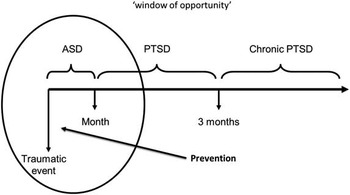
Furthermore, PTSD and stress-related disorders have a unique feature that separates them from anxiety disorders, mainly clear and identifiable onset—the traumatic event. Another relevant aspect is that PTSD cannot be diagnosed until 1 month following the trauma. Thus, the combination of a pin-pointed onset and the factor of required time to diagnose the disorder introduces a “window of opportunity” to intervene before the disorder manifests itself. This intervention is based on the “golden hours” concept.
The Traumatic Memory
The ability to acquire, store, and retrieve information is fundamental for survival, as remembering emotionally arousing and fearful events helps to prime individuals for future threats.Reference de Kloet, Oitzl and Joels 4 , Reference McGaugh 5 However, if the retention of fearful events is extreme and pathological, ie, centers on persistent fearful memories of life-threatening events, we define this condition as PTSD. In this regard, unlike anxiety, PTSD is defined not only by the actual event but more importantly by the memory of it. Indeed, when individuals suffering from traumatic brain injury with amnesia of the traumatic event were compared to individuals without amnesia, it was found that only 6% of the former group presented PTSD symptoms at a 6 months follow-up, as opposed to 23% of the latter. Reference Gil, Caspi, Ben-Ari, Koren and Klein 3 A low prevalence of PTSD was also found among individuals with a cognitive style that mimics amnesia, namely repressive coping style. Repressive coping style is defined as an emotional and cognitive strategy aimed at ignoring or diverting attention from the threat.Reference Roth and Cohen 6 In this study, myocardial infarction patients with repressive coping style showed significantly lower rates of PTSD (7%) when compared to patients with anxiety or defensive coping style (20% or 17%, respectively).Reference Ginzburg, Solomon and Bleich 7 These naturalistic studies suggest that interventions focused on preventing traumatic memory consolidation may offer relevant opportunities for treatment, and perhaps secondary prevention (ie, to prevent the disorder before it is diagnosed) of stress-related disorders.
Indeed, animal studies aimed at intentionally interfering with memory consolidation of traumatic events (by infusion of anisomycine—a protein synthesis inhibitor that prevents memory consolidation) showed reduced PTSD-like behavior in rats but only if injected immediately following the exposed trauma.Reference Nader, Schafe and Le Doux 8 , Reference Tronson and Taylor 9
Golden Hours
Studies showing the importance of timing of intervention in treating PTSD symptoms lend further support to the concept of the “golden hours” or “window of opportunity” (Figure 1).Reference Nader, Schafe and Le Doux 8 , Reference Debiec, LeDoux and Nader 10 These studies, which emphasize timing, are driven by evidence of a time frame in which the storage of acquired fear takes place.Reference Tronson and Taylor 9 The element of time is therefore a critical aspect of intervention in stress-related disorders, as an identical intervention may be beneficial or not beneficial if given at different times.
A Window of opportunity (golden hours), in which the focus is on early and targeted intervention aimed at secondary prevention in PTSD.

Actually, the concept of golden hours is well accepted in other areas of medicine, most famously in cerebrovascular accidents (CVA). In CVA, a breakthrough in treatment was achieved by the understanding that intervention by administration of a thrombolytic agent might be very useful only if given in the first 3 hours following the CVA. The same intervention would be harmful if given later and it is markedly opposite from the intervention (thrombophilies) recommended at a later phase (4 hours on). 11
Adapting the golden hours concept in relation to memory consolidation and its impact on the prevalence of PTSD suggests possible new insights regarding novel treatments. Moreover, treatments that are given immediately following exposure need to take into account their impact on the spontaneous recovery process. For example, psychological intervention, such as debriefing, enhances memory of the traumatic event. Indeed, a single debriefing session was found to be harmful in several studies.Reference Mayou, Ehlers and Hobbs 12 – Reference Sijbrandij, Olff, Reitsma, Carlier and Gersons 15 In one of these studies, a subset of motor vehicle accident victims who received a psychological debriefing as immediate intervention showed significantly more PTSD symptoms (as measured by Impact of Event Score) at 4-month and 3-year follow-up assessments, as compared to individuals who did not receive debriefing. That is, the expected and welcome spontaneous recovery process was hampered by this intervention, which actually enhances memories of the traumatic event. A meta-analysis for studies using single-session debriefingReference van Emmerik, Kamphuis, Hulsbosch and Emmelkamp 16 also supported the caution that one should exercise in regard to indiscriminate utilization of single-session debriefing immediately following exposure to the traumatic event.
Additional evidence for the relevance of the golden hours concept in PTSD comes from examining the hypothalamic–pituitary–adrenal (HPA) axis activity in general, and its interaction with the use of benzodiazepines (BNZ), during the golden hours in particular.
HPA Axis
The HPA axis plays a central role in the neuroendocrine response to acute stressReference Matar, Zohar, Kaplan and Cohen 17 : in response to stress, a chain of reactions stimulates the adrenal cortex to synthesize and release glucocorticoids, in particular cortisol. These hormones are instrumental in adaptation to stress.Reference Lupien, Maheu, Tu, Fiocco and Schramek 18 HPA axis activation appears to be implicated in the regulation and containment of the sympathetic and parasympathetic responses to stress, which include changes in heart rate, blood pressure, and respiration. In animal studies, it has been demonstrated that blunted HPA axis response increased PTSD-like reactions in rats exposed to trauma,Reference Cohen, Zohar and Gidron 19 while a hyperactive HPA axis was associated with significant reduction of PTSD-like behavior after exposure to the same trauma.
The data supporting a potential low reactivity (plasticity) of the HPA axis as a potential risk factor for PTSD does not derive only from animal studies. In a study examining the trajectory of PTSD in motor vehicle accident victims,Reference Delahanty, Raimonde and Spoonster 20 it was found that patients who developed PTSD had significantly less urinary cortisol compared with individuals who experienced a similar trauma but did not develop PTSD. Taken together, the human and animal data suggest that a proper reactivity (plasticity) of the HPA axis is instrumental for spontaneous remission after exposure to a traumatic event. These findings suggest that an intervention aimed at bolstering this natural response (ie, the HPA axis response) immediately following the trauma could be instrumental as a secondary prevention intervention aimed at reducing the risk of developing PTSD.
Benzodiazepines and the Golden Hours Concept
Benzodiazepines (BNZ) are frequently used as a symptomatic (anxiolytic) treatment in the first few hours after exposure to trauma. How do BNZs affect the HPA axis? BNZ interferes with the activation of the HPA axis; it actually abolishes it. Since the HPA reactivity was found to be instrumental in decreasing the risk of developing PTSD,Reference Lupien, Maheu, Tu, Fiocco and Schramek 18 , Reference Cohen, Zohar and Gidron 19 how does the use of BNZ in acute stress reaction fit in? Indeed, Gelpin et al Reference Gelpin, Bonne, Peri, Brandes and Shalev 21 compared individuals who received BNZ following the exposure to trauma (clonazepam 2.6 mg/day or alprazolam 2.5 mg/day) with those who did not receive it. Out of the 13 who received BNZ, 9 developed PTSD, as compared with only 3 of the 13 controls. These findings were replicated by Mellman et al Reference Mellman, Bustamante, David and Fins 22 in a small human study and by several other naturalistic studies.Reference Rothbaum, Price and Jovanovic 23 – Reference Baranyi, Krauseneck and Rothenhausler 25
In a unique animal model, which is based on “setting affected (rats) apart” from the unaffected rats,Reference Cohen, Zohar and Matar 26 administration of alprazolam 1 hour following an exposure to a “traumatic event” (cat odor) was also associated with significantly more extreme behavioral response (the behavioral equivalent of PTSD) for the rats who were given alprazolam as compared with those who received saline.Reference Matar, Zohar, Kaplan and Cohen 17 Hence, contrary to its immediate calming effect, early administration of BNZ during the golden hours following trauma might interfere with normal potent spontaneous recovery, and therefore its use within the first few hours of the exposure to the traumatic event should be re-evaluated.
Secondary Prevention in the Golden Hours
The golden hours concept is not only relevant for not harming the spontaneous recovery (primum non nocere), but also holds potential in secondary prevention of PTSD: hypoactivation of the HPA axis following trauma is implicated in emotional memory formationReference Matar, Zohar, Kaplan and Cohen 17 and therefore influences the trajectory of PTSD.Reference Lupien, Maheu, Tu, Fiocco and Schramek 18 , Reference Cohen, Zohar and Gidron 19 However, interventions aimed to normalize such hypoactive HPA axis may prove beneficial, but only if administered during the appropriate timeframe. Indeed, rats that were treated with a single dose of cortisol immediately following exposure to a traumatic event were less likely to exhibit PTSD-like behaviors in comparison to saline injected rats.Reference Cohen, Matar, Buskila, Kaplan and Zohar 27 Moreover, when the same dose of cortisol was administered 14 days following the stressor and 1 hour after presenting a reminder, the results were strikingly different: cortisol given outside the golden hours timeframe was completely ineffective in reducing the undesired (PTSD-like) behaviors. Mirroring these results in humans, a double-blind, prospective-pilot study that investigated the influence of cortisol injection in the first 6 hours following a traumatic event (motor vehicle accident) found the same resultsReference Zohar, Yahalom and Kozlovsky 28 : fewer patients who received a single injection of hydrocortisone (100–120 mg) developed PTSD in the 3 months follow-up as compared to patients who received placebo.
Conclusion
Separating stress-related disorders from anxiety disorders highlights the traumatic event as a clear point of onset. Focusing on the traumatic event and consequently on the related neural mechanism at the “golden hours” timeframe may lead to new technologies concerning possible treatments and prevention options of PTSD. Animal models and human studies may be useful in examining further golden hours interventions, such as sleep deprivation, early administration of SRI, and cortisol intake. These may enhance our understanding in regard to efficient intervention, as well as non-helpful (and potentially harmful) procedures in these golden hours and also the boundaries of this window of opportunity.
Disclosures
Joseph Zohar, Lior Carmi, Leah Fostick, Shimon Burshtein, and Shlomit Cwikel-Hamzany do not have anything to disclose.