


1. INTRODUCTION
An important function of early modern states was to provide for an adequate supply of «good» money: money that reliably transferred value, large and small from place to place and over time. Results varied widely, as shown by the monetary history of Western Europe in the early modern period. Currency depreciation in one form or another was widespread. In some cases, governments depreciated their clipped and worn currency to keep the legal value of coin in line with its market value, while in others, governments depreciated their currency to generate new tax (seigniorage) revenuesFootnote 1. At the end of his detailed study of the 16th century English coinage, Challis concluded that it was marked by periods of government failure, when «…events were allowed to conspire so that either no coinage at all was produced or that which was did not have the full confidence of the community…»Footnote 2.
This paper aims to contribute to our understanding of how well states managed commodity money in the early modern period. We focus on two American colonies: the Viceroyalty of Peru and Massachusetts Bay. At a time when commodity moneys were dominant (silver and gold coin and bullion), the Spanish American colony had what would appear to be an advantage in the form of a very large endowment of the metallic commodity resource—silver. Massachusetts Bay had none. A comparison of the path followed by these two colonies allows us to highlight the effect that the resource endowment had on monetary outcomes. This is an issue that has been largely understudied in the theoretical and empirical literature on money production, particularly with respect to its impact on the incentives that key players (coinage producers and monetary authorities) faced. The key questions we aim to address in this paper are: Did the availability of the silver endowment matter for the production of good quality coinage and small change? And if so, how?
Interestingly, both colonies chose to establish a mint as a profit-making semiprivate venture that could share profits with the state, while also delivering a public service in the form of providing an adequate supply of good coinage for the domestic economy. Although the original monetary purposes of these two colonial coinages were similar, their outcomes were not. We identify two critical characteristics of «good» money. First, whether it consistently had the weight and fineness required by law. Such a coinage would not have to be tested for weight or fineness before being accepted in payment, and it would be hard to counterfeit. Second, whether it included the smaller denomination coins needed for petty commerce, wage payment and some tax payments. At mid-century, and despite its early success in world markets, the Potosi coinage fell short on both fronts, having been illegally debased for decades and consisting mostly of the large peso coin. In Massachusetts Bay, merchants responded by establishing their own mint and recoining Potosi pesos into New England shillings. Importantly, the Bay shillings passed the «honesty» and petty coinage tests, and circulated as money, largely in the foreign trade sector, both at home and abroad.
Given the complexity of the issue at stake and the limitations of this venue, we do not aim to discuss all factors that might have shaped the observed outcomes. We mostly focus on how the relative abundance—or scarcity—of the resource endowment affected the incentives of coin producers and monetary authorities. Undeniably, the relative scarcity of silver in Massachusetts Bay shaped key monetary policies, for example, the reliance on a light coin, and the scale of the mint operations. Indeed, the Boston mint processed an estimated 1,200 troy pounds at its peak, a meager output compared to the 315,540 troy pounds of silver processed by the Potosi mint. Potosi had a large workforce and a well-developed internal division of labour, while the Boston mint was essentially a silversmith's shop. The paper suggests that the abundance of the resource, and the consequent sheer size of the mint operation in the Viceroyalty of Peru, produced a perverse mix of incentives that favoured the underproduction of small change and fraudulent activities at the mint. In contrast, in Massachusetts Bay, the scarcity of the resource was associated with incentives better aligned with the production of good money.
The rest of the paper is organised as follows. The next section describes our basic analytical framework. Section 3 discusses the Potosi mint and section 4 takes on the Massachusetts Bay coinage. The final section concludes.
2. EARLY MINTS, RESOURCE ENDOWMENTS AND INCENTIVES
Both Massachusetts Bay and the Viceroyalty of Peru contracted with, or instituted, a profit-making semiprivate venture to provide an adequate supply of good coinage for the domestic economy. In the case of the Viceroyalty of Peru, the office of the mintmaster was auctioned off (as well as those of lower officials at the mint), and seigniorage was shared according to a pre-determined rate. In the Massachusetts Bay colony, in contrast, John Hull, the mintmaster, was the only silversmith in town, and the only candidate to take over the mintFootnote 3. As a consequence, the contract between the mintmaster and the colonial state was delineated through a bargaining process between the two parties.
In both, North and South, the Crown or the state (the principal) sought a certain outcome—good money or seigniorage—in its coinage legislation and executive rulings but depended on its agent(s) to carry out its policy. Only the producer of the money (the agent) knew exactly what was going on inside the mint. He controlled mint production and his incentives and opportunity set were such that he could potentially increase his net income from the coinage by lowering the quality of the coin.
Importantly, the labour-intensive technology of coinage production before full-mechanisation created a tradeoff between the profitability of the coinage and the quality of the coinage, heightening the principal-agent problem. The basic steps in coin production were assaying of silver to determine its fineness; melting it; refining it or adding alloy as needed; pouring the melted silver into moulds to create strips with the right thickness for the legislated weight of the coin; cutting the strips into planchets and striking images onto the planchets by hand. If the production team worked more quickly and less carefully, with fewer quality controls, their coins would be less uniform, but their daily productivity and net profit would be greaterFootnote 4. Or, if the team produced a coinage with fewer low denomination coins, its quality would be lower by being less responsive to all levels of money demand in society, but it would be a more profitable coinage as the team could produce more coinage, valued in the unit of account, in a given period of time. By setting the gross margin of coin value over silver bullion (the gross seigniorage rate) and the state's share of revenue from coinage, the principal influenced the profitability of minting and therefore the strength of the incentive to compromise on quality.
The gross seigniorage rate was set by the monetary authority (the Spanish Crown in the case of the Viceroyalty of Peru, and the colonial state in the case of Massachusetts Bay). The mint equivalent (ME) was the amount of unit-of-account money or unit of account value in pesos or pounds produced from a given physical quantity of silver with the required fineness. The mint price (MP) was the amount of unit-of-account money (pesos or pounds) returned for each physical quantity of silver with the required fineness consigned by an individual to be coined. While the state set all of the variables in the gross seigniorage rate: (ME − MP)/ME, net seigniorage revenue depended on the volume of silver that the public brought to the mint to be coined and the mint's operating efficiency. Net seigniorage revenue was split between the state and the mintmaster, typically in shares as defined in coinage legislation.
Given the principal-agent nature of the organisation of coinage production, and the technological constraints discussed above, the mintmaster had strong incentives to compromise on quality. One way to do this was to produce fewer small coins, or to produce lower-quality small coinsFootnote 5. The mintmaster could also boost his returns through fraud: he could illegally reduce the silver content (weight and/or fineness) below that required by law, assuming he had a good chance of evading detection. Producing an illegally debased coin had more serious ramifications for the monetary authority, as it endangered long-term seigniorage if the public rejected the monetary authority's coin.
Cheating on the fineness of the coin, as opposed to the weight of the coin, was particularly tempting at the time. Weight could be evaluated relatively simply using scales and with relatively good precision. But fineness was much harder for the users of the coin to assess, especially on the periphery of the emerging global monetary systemFootnote 6. To assess the fineness of silver coins, special instruments and expertise were required (touchstones or, for greater accuracy, assay by fire), and these instruments were not widely owned in Massachusetts Bay, although they were relatively accessible in Spanish AmericaFootnote 7. The problem was compounded by the fact that the naked eye could not distinguish the difference between a broad range of alloys down to 80 per cent finenessFootnote 8. Thus, the level of fineness of Massachusetts Bay and Potosi's coins, 92.5 and 93 per cent respectively, allowed ample room for debasement practices that went unnoticed at first sight.
In sum, the technology and the principal-agent nature of coinage production incentivised agents in both colonies to produce a relatively low-quality coinage. We now turn to the discussion of how the relative abundance or scarcity of the resource endowment (silver) affected these basic incentives.
2.1. Resource Endowments and Incentives
Massachusetts Bay followed largely the English monetary regulations (more on this later). An important point to highlight, however, is that the relative scarcity of the silver endowment called for a relatively light coin to attract silver to the mint. Its coins followed the English standard for sterling fineness (92.5 per cent) but weighed around 75 per cent of their English counterparts. Massachusetts Bay defined its coinage in terms of pence and troy ounces (1 troy ounce = 31.10 g). It sanctioned the shilling as its largest denomination coin, and it originally incorporated two additional denominations to its coinage mix: the 6 pence coin and the 3 pence coin. Consigners of silver to the mint received 74 pence per troy ounce of sterling silver and the mint was authorised to produce coins valued at 80 pence for each troy ounce consigned, making the gross seigniorage rate (6 pence/80 pence), or 7.5 per cent.
The Viceroyalty of Peru defined its coinage according to Spanish law and in terms of reales and marks (1 mark was equivalent to 230.05 g, or 7.4 troy ounces). For every mark a consigner of silver brought to the mint, they received 64 reales, and the mint produced 67 reales, for a gross seigniorage rate of (3 reales/67 reales) or 4.4 per cent. Potosi reales were minted to 93 per cent fineness. The original monetary regulations did not sanction the production of the silver peso of 8 reales. Its production in the colonies was vaguely contemplated for the first time in the Real Cédula of 1537, but it only started to be consistently produced in the 1570sFootnote 9. Importantly, the reality on the ground at Potosi was shaped by the sheer amount of silver available at the Cerro Rico mines. Indeed, we show below that producing primarily pieces of eight was the only way that Potosi could have kept up with the large and continuous flow of silver to its mint. In contrast to the intermittent operations of the Massachusetts mint, the Potosi mint operated virtually all the time.
The Potosi and Massachusetts Bay mints had to cover their operating costs with their share of gross seigniorage revenue. In the case of Potosi, the Spanish Crown viewed as its prerogative to collect seigniorage from its mints and reserved 1.4 per cent for itself, leaving 3.0 per cent as the gross seigniorage rate for the coin producers. Massachusetts Bay, in contrast, did not collect seigniorage from its coinage (more on this in section 4). Although the gross seigniorage rate was lower in Potosi than in Massachusetts Bay, its gross seigniorage revenue was many orders of magnitude larger than in Massachusetts, given the sheer size of its coinage.
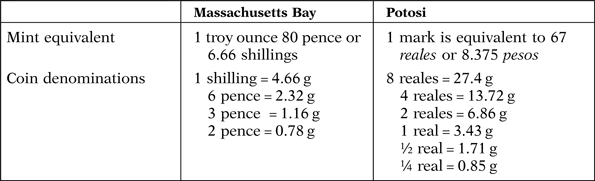
Given the technology, the principal-agent nature of the mint organisation, and the basic monetary regulations described above, minting the largest coin boosted mint productivity and profitability in both areas. In Table 1 we show the coins’ denominations and their respective weights for both colonies. As mentioned earlier, the largest coin sanctioned in Massachusetts Bay was the 1 shilling, which weighed 4.66 g; the smallest coin was the 2 pence of 0.78 g. Thus, a day of minting 1 shilling coins processed six times the amount of silver, and produced six times the amount of money, of a day of minting the 2 pence coin. In Potosi, the productivity difference was much larger, as the largest coin, the piece of eight, weighed 27.4 g and the smallest coin, the quarter-real (cuartillo), weighed only 0.85 g. A day of minting the large peso coin processed thirty-two times the amount of silver and produced thirty-two times the amount of money, of a day of producing only cuartillos. Because the difference in weight between the largest and smallest coin was so much larger in Potosi than in Massachusetts, the opportunity cost of producing small coin was much larger in the former than in the latter.
COIN DENOMINATIONS AND WEIGHTS IN GRAMS

Note: 1 troy ounce = 7.4 marks.
With respect to the weight or the fineness of the coins, because the legal fineness of the coin was essentially the same in the two places (0.925 in Massachusetts and 0.93 in Peru), cheating yielded similar potential returns per unit of silver consigned in the two colonies, 13.5 per cent in Massachusetts Bay and 14 per cent in the Viceroyalty of Peru. However, when scale of production is factored in, the returns to cheating diverge by several orders of magnitude. Converting our lower-bound estimates of the return to cheating in Potosi and in Boston to troy ounces of silver, we find that Potosi's return to cheating was around 300 times that of Boston's (roughly 250,000 compared with 850 troy ounces, per decade).
In sum, the incentives to cheat on weight or fineness were markedly affected by the availability of silver in the two colonies. The following sections elaborate further on these basic insights.
3. THE POTOSI COINAGE
Shortly after the conquest of America, the Spanish Crown attempted to support trade in the colonies with Spanish coinage, but these attempts were unsuccessfulFootnote 10. At the time, commerce in Spanish America rested on a number of local produce like coca, cacao, cotton and textilesFootnote 11. Silver circulated as a means of payment, particularly after the discovery of silver deposits in Potosi (Alto Peru) in 1545, and in New Spain, shortly after; but irregular silver bars did not help much with the reduction of transaction costs, and were particularly unhelpful for small-scale domestic transactions.
The Spanish American cabildos (municipal governments) repeatedly lobbied the Crown for the institution of local mintsFootnote 12. Their key concern was the lack of a trusted currencyFootnote 13. As a response to mounting requests, Phillip II issued a Royal Order (Real Cedula) for the establishment of a minting house in Lima, in 1565. Shortly after, in 1572, Viceroy Toledo instituted the Potosi mintFootnote 14. The latter became the main producer of silver coinage in the viceroyalty in the Habsburg periodFootnote 15.
The monetary institutions that regulated coinage production in Spanish America were directly informed by the Castilian monetary system instituted in the Pragmática de Medina del Campo of 1497Footnote 16. Minting houses in Spanish America operated through a similar system that ruled in the peninsula: concessionaires were in charge of the mint, and the minting process was regulated and supervised by royal officials. The key offices at the mint included the office of the mintmaster (tesorero), the assayer (ensayador), engraver (tallador), the weight specialist (balanzario), the scribe (escribano) and the guards. The head of each office received a specified compensation for their work (per mark of silver) and were in charge of operating costs within their respective officesFootnote 17.
The Royal Order of 1565, that instituted the early colonial mint, deviated somewhat from the Pragmática de Medina del Campo with respect to the denominational mix. It dictated the precise percentages of each denomination to be produced: 25 per cent coins of 4 and 2 reales, 50 per cent coins of 1 real and 25 per cent fractionary coins of ½ and ¼ reales (cuartillos). The Castilian regulations contemplated only the production of reales, ½ reales, cuartillos and ½ cuartillos Footnote 18. Neither the Pragmática de Medina del Campo nor the Royal Order contemplated the production of the peso of 8 reales Footnote 19.
The regulations established the silver content of the real at 3.19 g of pure silver (93 per cent fineness), which remained the official silver content until the 1720s. The mint equivalent for each silver mark brought to the mint was set at 67 reales. The mint price (the amount of money returned to the supplier of silver) was 64 reales per mark. The three remaining reales were divided in the following manner: 1 real for the king, and 2 reales for operating costs (brassage costs)—this amount was divided among the heads of all offices at the mint, including the tesorero or mintmaster. The latter received around 0.64 reales Footnote 20. Gross seigniorage, therefore, was 4.4 per cent, and net seigniorage was divided between the mintmaster (1 per cent), and the king (1.4 per cent).
3.1. Monetary Outcomes
3.1.1. The Potosi coinage denominational mix
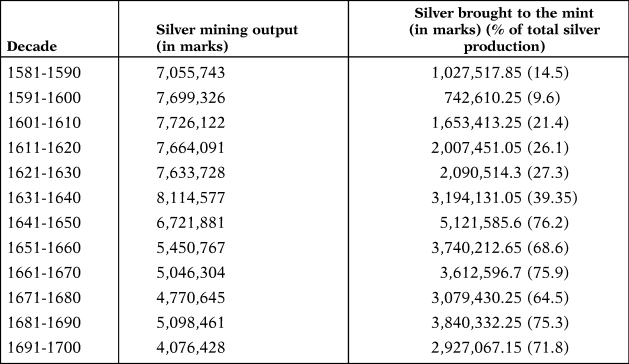
As mentioned above, the abundance of silver at the Cerro Rico mines allowed for large consignments of silver at the Potosi mint. In Table 2, we present silver output in Upper Peru, as well as silver brought to the mint for 1581-1700. Upper Peru's silver production was astounding, although, as it is well known, it decreased considerably starting in the 1640s. Silver merchants brought sizable amounts of silver to the mint. The latter received an average of around 3 million silver marks per decade. Since the 1640s, minting dominated other options. At its peak, in the 1640s, the Potosi mint processed over 5 million silver marks. It is apparent that it would have been challenging, if not impossible, to process such high volumes of silver relying primarily on small denominations, let alone fractionary coinage.
UPPER PERU SILVER MINING OUTPUT AND SILVER BROUGHT TO THE MINT 1581-1700

Source: Data from TePaske and Brown (Reference Tepaske and Brown2010, pp. 258-259). We converted the data from kg to marks.
As mentioned earlier, the denominational mix sanctioned in the Peruvian viceroyalty implied a relatively high opportunity cost of producing the small denomination coins. To illustrate, a standard silver consignment consisted of twenty-four bars of about 140 marks each or 3,360 marks. Each consignment would have yielded a total of around 28,140 peso coins in around 2 weeks (recall that the mint equivalent dictated the production of 67 reales or 8.375 pesos per mark)Footnote 21. Surely, we can estimate the upper-bound of the opportunity cost of producing smaller denominations. For example, coining one standard silver consignment into cuartillos would have required the production of 900,480 coins, which would have been at the very least thirty-two times more costly to produce than coining pesos of 8, and would have taken around 64 weeks to complete. Another way to express such tradeoff: for every cuartillo produced in lieu of the peso coin, the coinage producer would give up the production of 7.75 reales. As we discussed in section 2, the opportunity cost should have been even higher than the latter figure, given the well documented evidence on the higher costs of producing smaller denominations with the technology available at the time.
Thus, perhaps not surprisingly, the production process at the Potosi mint was tailored to produce the peso of 8 up-front. Lower denominations were coined with the remnants of silver that the production process of the large peso coin left behind. After the melted metal was poured into moulds to create strips of silver of the right thickness, it was cut into pieces close to the weight of a peso and hammered until the individual pieces enjoyed the width of a peso. Any faulty pieces were set aside to be coined into pieces of 4 reales, and the metal remnants from these processes were used for the production of the lower denominationsFootnote 22.
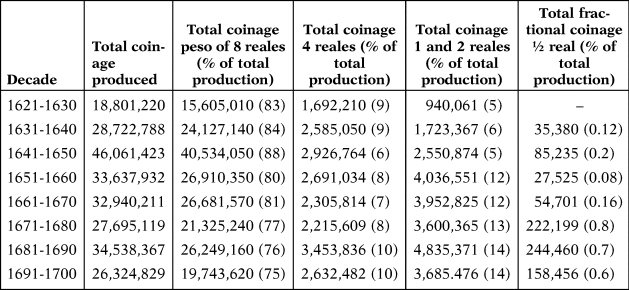
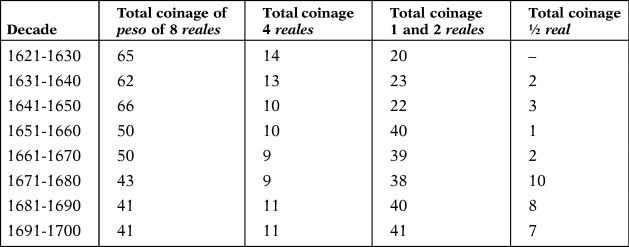
Hence, we suggest that the Potosi coinage producers were heavily incentivised to produce the larger denomination coins and acted accordingly. In Table 3 we present the denominational mix produced at the Potosi mint in our period of study. The official reports show that the peso coin largely dominated coinage production in the 1600s. The proportion of silver pesos was never lower than 75 per cent of the value produced, and in terms of volume (or the number of coins) it was between 41 and 65 per cent of the total—see Table 4. Table 4 also shows that the number of coins of 4 reales produced was above 10 per cent, and that the production of 2 and 1 reales combined reached a level close to 40 per cent of the total in the second half of the 1600s.
POTOSI MINTAGE 1620-1700 (COINAGE PRODUCTION IN PESOS OF 272 MARAVEDIS)

Source: Elaborated from Potosi mint accounts. The values provided in the table do not add to the total figures because of «otras monedas» (other coins) whose denomination is not specified in the accounts. The accounts are reproduced in Lazo (Reference Lazo García1992).
POTOSI MINTAGE 1620-1700 (PERCENTAGE OF TOTAL NUMBER OF COINS PRODUCED)

Source: Based on the Potosi mint accounts. The accounts are reproduced in Lazo (Reference Lazo García1992). We note that according to Lazo, the entry for 1 and 2 reales was mostly composed of 2 reales coins although he does not give the specific relative weights. The numbers have been rounded up, and they do not necessarily add up to 100.
These production levels were seemingly a function of the production process itself (as the smaller denominations were produced with silver remnants from the production of the large denomination coins). After the large coins were accounted for (first and foremost the peso, and then the 4 reales coins), the 2 and 1 reales took precedence. In contrast to the former, which were heavily destined to international markets, the latter circulated domestically and were used to address a number of expenditures of the Real Hacienda, including «typical payments», and war expendituresFootnote 23. The 1 and 2 reales coins were still relatively large, however, and above the value of small transactions, such as hourly wages, wage goods, etc.Footnote 24. Fractionary coinage, the ½ reales and cuartillos, which were the ones needed by the poor for most domestic transactions, were limited or all together absent—see Table 3 and Table 4Footnote 25.
This result was not consistent with the original ordinances. So, why the laxity of the Spanish Crown in enforcing its original regulations? First, the evidence suggests that the Crown's interests and goals shifted over time. To be sure, over the years, the Spanish monetary system became increasingly dependent on the quality and reliability of the Spanish American large denomination coinsFootnote 26. By the late 16th century, the silver peso was already largely accepted as a medium of exchange in the world economyFootnote 27. Moreover, by the first decades of the 17th century, the peso became essential to finance the Spanish wars in Europe, particularly of armies in north-central EuropeFootnote 28. As the silver peso gained ascendancy in international markets, the Crown's incentives became increasingly aligned with those of coinage producers.
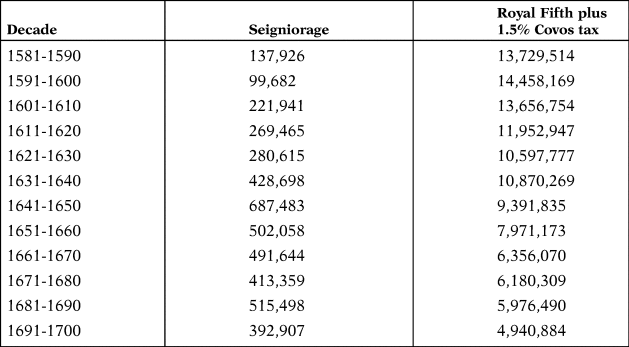
An additional issue that might have played a role in the Crown's apparent leniency in enforcing its regulations, is its fiscal incentives as a collector of seigniorage. As discussed in section 2, the higher the amount of small coinage produced, the lower the volume of silver processed into money and the lower the gross seigniorage produced per unit of time. In Table 5 we present estimates of the Crown's seigniorage from the Potosi mint and the Royal Fifth in the 1600s. Seigniorage as a source of revenue was relatively modest compared to the Royal Fifth and other sources of revenuesFootnote 29. Notwithstanding, in the context of the major financial pressures the Spanish Crown experienced in the period, any losses on this front would not have been taken lightlyFootnote 30.
CROWN'S SEIGNIORAGE AND ROYAL FIFTH FROM POTOSI 1581-1700 (SILVER PESOS)

Source: Seigniorage estimates based on figures from Table 2 and the seigniorage rate derived in the text. Royal Fifth figures from Moreyra (Reference Moreyra Paz Soldán1980, pp. 264-268).
All in all, our findings support the general perception that the coinage denominational mix advanced mostly the interests of the elite. Notwithstanding, we want to highlight the fact that the abundance of silver, and the technological constraints of coinage production at the time, largely shaped the observed outcomes.
3.1.2. Fraud at the Potosi mint
As discussed in section 2, the coinage producers were not only incentivised to produce large denomination coins, but they also faced incentives to cheat on the weight or fineness of the coinage. Indeed, several sources document that Potosi coins were lacking in fineness in the first half of the 1600s. Detection of fraud occurred early on in Seville, where bars and silver coins were found not to comply with basic standardsFootnote 31. The main mechanism was to alter the fineness of the coins with the addition of an excessive amount of copperFootnote 32.
Detection of debasement by the public was, in principle, more likely in the Peruvian viceroyalty than in Massachusetts Bay. The suppliers of silver to the mint, the silver merchants, were relatively well-versed in basic silversmithing technologies, thus fraud might have been easily detected by these individuals. Notwithstanding, as we discuss below, the evidence suggests that a good number of them colluded with mint officers and supervisors, sharing in the profits from fraudulent activities and assisting with the «passing» of the fraudulent coin in global markets. There is evidence of the silver merchants' vast network of financial and personal relationships with key local judicial and executive authorities, which perhaps gave them a somewhat overblown sense of impunity, despite the harsh stipulated sanctionsFootnote 33.
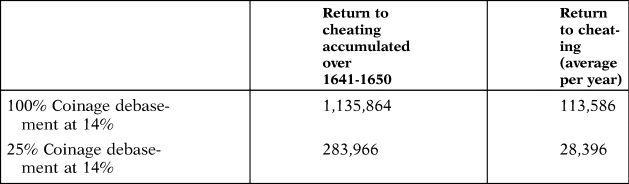
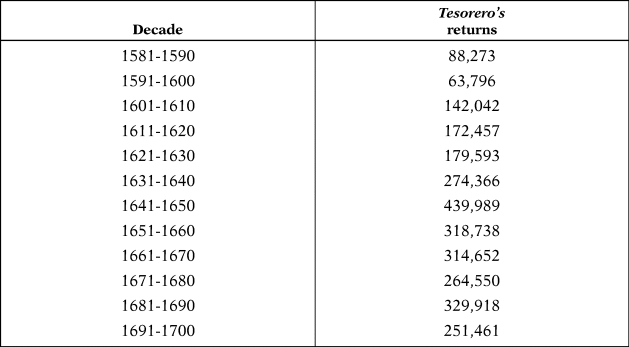
In Table 6 we show rough calculations of the potential returns to altering the fineness of the coinage in the 1640s—at the peak of the fraud scandal. To estimate these returns we use as a benchmark the maximum possible level of debasement that would have eluded detection by the general public (20 per cent copper content, or 14 per cent debasement—see section 2). The large supply of silver that the Potosi mint enjoyed would have allowed the mintmaster, or those who colluded to defraud the public, to enjoy large returns. The upper bound (20 per cent copper content per coin and debasement of 100 per cent of coinage) would have produced 1,135,864 additional pesos in 10 years, or around 113,586 pesos per year. The lower bound (20 per cent copper content per coin and a debasement of 25 per cent of coinage production) would have produced a return equal to 283,966 additional pesos in 10 years, or around 28,396 pesos per yearFootnote 34. Thus, cheating in fineness would have produced large returns that would have allowed officials at the mint to profit handsomely. Interestingly, Nestares Marín's investigation (more details on this below) estimated the total amount produced by fraudulent activities at the mint to be 472,000 pesosFootnote 35. For comparison, Table 7 presents estimates of the mintmaster or tesorero's legal returns from 1580s to 1700Footnote 36. We see meager returns in the late 1500s, but a positive trend that reaches its peak in the 1640s. The returns to cheating (Nestares Marín's and our average estimates) are above the tesorero's legal income in that decade.
RETURN TO CHEATING IN POTOSI 1641-1650 (PESOS)

Source: Data from Table 2 and a complementary data on mint price, mint equivalent and labour costs provided in the text.
POTOSI MINT SEIGNIORAGE THAT ACCRUED TO THE TESORERO (MINTMASTER) 1581-1700 (SILVER PESOS)

Source: Based on Table 2 and return to tesorero per mark of silver presented in the text.
Given the large returns to cheating, and the apparent relatively low subjective probability of being sanctioned, fraud at the Potosi mint flourished. In contrast to denominational mix violations, this offense was of great concern for the Spanish Crown. Indeed, the debased peso coin threatened to upend the strategic role of the silver peso in the Spanish monetary and commercial system. Thus, the Council of the Indies appointed Don Francisco Nestares Marín as visitador of Potosi with broad powers to investigate fraudulent activities at the mintFootnote 37. Nestares Marín arrived in Potosi in 1648. Shortly after his arrival, he uncovered a huge debasement scam that involved a number of silver merchants, mint officials and employees, along with the city's corregidor (most important executive authority in the area) and many town councilmen. Many members of the Audiencia de Charcas were involved on the fraud as well. They were not direct participants, but they had been corrupted by the debasement's perpetratorsFootnote 38. Nestares conducted further inquiries into the affairs of some of the most prominent silver merchants in Potosi, finding Captain Francisco Gómez de la Rocha as the main orchestrator of the debasement scamFootnote 39. The investigation detected that three consecutive assayers were to be blamed for the Potosi debacle. They apparently had debased the coinage progressively from modest amounts to such high levels as to require a mandate that the coins produced by the latest assayer (Ramírez de Arellano) circulate at half their valueFootnote 40. Gómez de la Rocha and Ramírez de Arellano were sentenced to death as were a few other individuals involved.
Several Royal Orders instructed the colonial authorities how to proceed with the Potosi coinage in circulation. The new ordinances sanctioned the birth of the famous «columnaria» coin, called columnaria because of the two columns engraved on its tailFootnote 41. Shortly after, in 1653, a Royal Order divulged to the public that the Potosi peso would be accepted in all of the Spanish empire. There is evidence that under Nestares' guidance the mint produced an improved coinageFootnote 42. It seems that by the early 1660s the Dutch already carried the new Peruvian coin with renewed confidenceFootnote 43.
3.1.3. The Potosi coinage: conclusion
The sheer volume of silver that was delivered to the Potosi mint created an attractive opportunity for the Crown's agents, the mint officials, to collaborate with silver merchants and local officials to extract larger returns from the coinage by deviating from the standards set by the law. The Crown enforced its silver-fineness standard, but not its denominational-mix standard, in both cases protecting and enhancing its long-term interest in supplying a trustworthy, well-sized and ample global currency.
4. THE MASSACHUSETTS BAY COINAGE
Between 1620 and 1629, a series of charters were granted to the Massachusetts Bay Company, a private company. These charters evolved into the charter of the Massachusetts Bay Colony, which was governed by a limited-franchise representative assembly called the General Court. The charters provided that one-fifth of all gold and silver (of which, it turned out, there was none) was reserved for the Crown. From the beginning, the Colony of Massachusetts claimed monetary powers for itself, initially by defining what would «pass current» and/or serve as «lawful money» in payments to the colony.
In the 1640s, Boston saw an influx of foreign silver, particularly Peruvian «cob» coinage, after Boston merchants developed markets for New England products in Southern Europe and the West IndiesFootnote 44. Cob coins were easily clipped, allowing the owner to pass the coin at tale (or face value) and sell the clipped-off pieces of silver. As discussed earlier, at mid-century the Potosi coinage was fraudulently issued at lower fineness than required. Records from the period reflect a concern in Massachusetts with potential losses to individuals and the Colony from «light» and irregular Spanish coin in particularFootnote 45.
The Assembly's hand was forced when the marketplace rejected all of the cob coinage; according to Hull, trade came to a stop in BostonFootnote 46. The Court then established a mint to supply a colonial coinage that would replace the «cob» coinage with a «better» Massachusetts coinage. The Court «took advantage of the political ambiguities» after the execution of Charles I to assume the authority to coinFootnote 47. Under the Mint Act of 1652, only New England shillings and English shillings were legal tender; Spanish silver coin would not «pass current», overriding Massachusetts law from 1642.
4.1. The Massachusetts Bay Mint
Massachusetts contracted with John Hull to mint coin with a specified weight and fineness. Hull recommended Robert Sanderson, an experienced English silversmith, to be his partner, and the Court accepted. Sanderson migrated and joined Hull in a partnership for both minting and silversmithing. Hull and Sanderson employed between two and five apprentices and journeymen at any one time over the life of the mintFootnote 48.
Massachusetts provided a public subsidy for the mint in its start-up period in the form of funds to construct the mint house and to acquire the necessary equipmentFootnote 49. The Colony initially took no seigniorage but did secure a nominal lump-sum fiscal contribution in the renewals of the mint contract in 1660 and 1667Footnote 50. By taking no or little seigniorage, Massachusetts increased the probability that the mint would be economically viable and an attractive proposition for the mintmaster. However, given the very modest scale of its coinage, it is hard to credit the leaders of Massachusetts with being virtuously willing to sacrifice revenue in order to provide for the liquidity needs of the local economy. If the Colony had negotiated a one-fourth share of the gross seigniorage revenue (the Spanish Crown's share), it would have received an estimated 1,031 shillings annually, or around 50 pounds. This would have made a marginal contribution to its annual budget; the Colony's annual expenses in 1650-1675 averaged between 1,800 and 2,000 poundsFootnote 51.
The initial technology of the Boston mint was very simple. Jordan (Reference Jordan2002) has a careful and detailed discussion of the production process that was likely used, based on numismatic and other evidence. At first, Hull made coins essentially by hand, much as a silversmith would fashion individual spoons and cups. These coins were easily counterfeited, leading quickly to a new directive from the General Court about the coin's physical features. As a result, Hull adopted the more mechanised, but still simple technique of rocker dies and a rocker press for stamping the prepared silver with images. This was an appropriate technology for a mint with intermittent activity and smaller production runs.
As mentioned above, one troy ounce of sterling silver was to be coined into 80 MA pence (compared with the English ratio of 1 oz troy sterling = 62 pence), with 74 pence being returned to the customer and 6 pence retained by Hull to cover minting costs and wastage (silver loss during minting), with any residual going to the «shop» (Hull and Sanderson's silversmith business)Footnote 52. The Massachusetts coin would be light, by English standards, but at least it would be regularly and reliably light—assuming the Colony could trust the mintmaster. Trust was essential, as the colonial government was unable to independently verify the fineness of the coin with assays.
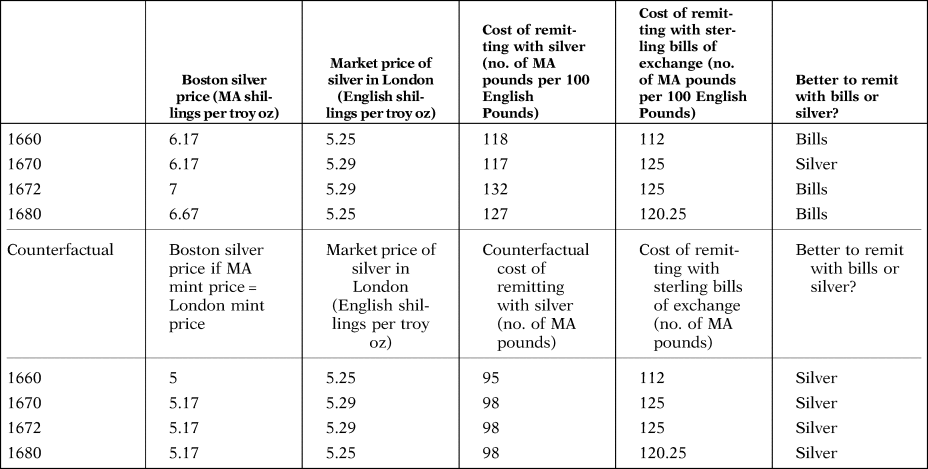
Unlike the Potosi mint, which could count on a large and regular flow of locally mined silver, Massachusetts Bay had to attract and retain silver from abroad in order to have a coin of its own. It accumulated silver through its trade surpluses with southern plantation colonies, net in-migration, and piracy, and retained this silver by setting a mint price that made coining the silver a better option than using it to make remittances to London, spending it in the local market, or exporting it to a foreign market. Table 8 shows that during the period 1652-1672, it was usually better to make payments in London with a sterling bill of exchange instead of pesos. As the lower panel of Table 8 shows, if Massachusetts Bay had set its mint price equal to England's, shipping specie would have been the lower-cost option, so that all of the coin that entered from southern markets would have been exported to pay for imports from England.
COST OF REMITTING WITH SILVER VS. COST OF REMITTING WITH BILLS, 1660-1680

Notes and sources: The Boston silver price is the mint price for 1660 and 1670, and the implicit market price based on the official rating of a 17 pennyweight piece of eight for 1672 and 1680. London silver prices are from Chaudhuri (1978, Table 2, column 1). Prices of sterling bills of exchange in Boston from McCusker (Reference Mccusker1978, Table 3.1, annual average). Transactions costs (shipping and insurance, commissions) are assumed equal for the two options.
At the same time it established its mint, Massachusetts maintained the 1642 official rating of the «full weight» piece of eight at 60 pence and, as mentioned above, it suspended its «current money» status (effectively, its legal tender status)Footnote 53. Over time, pesos may still have been accepted in trade by choice, but the high mint price ensured that owners of pesos would be better off bringing their pesos to the mint than using them in local trade.
4.2. Monetary Outcomes in Massachusetts Bay
4.2.1. The denominational mix
The 1652 Mint Act authorised the production of coins of 1 shilling (12 pence), 6 pence and 3 pence, coins with markedly smaller denominations than the pesoFootnote 54. In 1662, a new denomination was added: not a larger coin, but a smaller one, a 2-pence coinFootnote 55. Clearly, Massachusetts established its mint to do more than provide a reliable and uniform-quality substitute for the problematic Peruvian piece of eight, which was comparable, based on the 1642 official rating of the piece of eight, to a 5 shilling Massachusetts coin. In establishing the mint, the General Court was also responding to the need to transform the large peso coin into smaller coins to pay for humble goods, wages, transportation services and some kinds of taxes. The largest coin that the Massachusetts mint was authorised to produce was small enough to be a useful coin for trade and taxes, and there is no evidence that Hull ever minted a coin larger than 1 shillingFootnote 56.
The key question to address here is whether Hull actually produced small-denomination coins as required by law and demanded by the market. Unfortunately, in contrast to Potosi, we have no direct evidence on the denominational mix produced at Massachusetts Bay, whether official or private. The General Court did not closely monitor coin production despite the physical proximity of the seat of government to the mintFootnote 57. Numismatic evidence from private collections allows us only to confirm that some coins of each denomination were produced in the Massachusetts mint, it does not allow us to infer how many coins of each denomination were struckFootnote 58.
However, the circumstances of the Massachusetts mint suggest that Hull followed the Mint Act rather closely. First, as a member of the Boston merchant elite, Hull himself was interested in the production and circulation of small denomination coins for the advancement of his own businesses (more on this below). Furthermore, Hull faced no significant economic incentive to non-compliance. The intermittent and often limited supply of silver to the mint meant that there was no pressure on the mint driving it to mint only, or primarily, the largest possible coin simply to keep up with consignments. When silver consignments were low, Hull could likely afford the additional time per coin required to produce the 2 and 3 pence coins. Hull's opportunity cost would have been the difference between the gross seigniorage on the small coins and the income the workers could have produced if they had alternative remunerative work to do (i.e. jobs in the silversmith shop). Most importantly, even when the mint was busy, because of the relatively small difference in weight between the largest and smallest coins, and the modest size of the coinage, the impact of small coin production on Hull's income would not have been significant.
4.2.2. John Hull and the honesty test
Alternatively, as discussed in section 2, John Hull, as the primary decision-maker in the firm, could have boosted his personal income from the mint by illegally reducing the silver content (weight or fineness) of the coins below that required by law. The likelihood of local detection by the authorities or private individuals was slimFootnote 59. However, his potential return from producing a debased coin must be assessed within a larger context. Coining money was just one small part of a complex of silversmithing, transatlantic trade, shipping, banking, lending and real-estate investments, all conducted by Hull or by Hull with one or more partnersFootnote 60. He also held numerous elected and appointed public offices in Massachusetts over the yearsFootnote 61. In what follows, we discuss Hull's income from coin production and estimate by how much it could have been boosted if he had produced debased coin. We then discuss how Hull's other businesses and activities affected his incentives as mintmaster.
In contrast to Potosi, there are no records of the volume of coin produced at the Massachusetts mint, or of production costs. However, based on our estimate of annual average coinage of 55,000 shillings, we estimate Hull's net income from coining money over 1652-1682 at between 616.5 shillings and 1,695 shillings, depending on how high production costs were in relation to gross seigniorage income (see online Appendix A for a detailed discussion of how we arrived at these estimates, and Table A.1). Interestingly, Hull's net income as mintmaster ranged between 10 and 28 per cent of his personal wealth at death. Even at the high end of this estimate, Hull accumulated most of his wealth from his other business activities.
Hull's potential return to cheating over the life of the Massachusetts mint ranged between 849 and 3,396 pounds (see online Appendix A for method and Table A.2 for estimates). Hull's potential returns to cheating were significantly constrained by the small scale of the silver consignments to the Massachusetts mint. Even at the upper estimate, Hull's potential return to cheating would have still been significantly less than the wealth he actually accumulated, and would have likely put at risk his returns from honest minting and a host of other enterprises.
Indeed, at about the same time Hull became mintmaster, he started building a transatlantic trade business. Like other Boston merchants, Hull exported furs and masts to England; fish, lumber, horses, flour, salt beef and pork to the West Indies and barrel staves and hoops to Portugal and Spain. He purchased sugar, tobacco, rum, salt, wine, indigo and cocoa from the West Indies and Wine Islands, and sold some on the Boston market and shipped the rest to England, creating credits used to import cloth and clothing, hats, writing paper and hardware. In partnership with other merchants, Hull invested in commercial infrastructure: shipping vessels, a lumber mill, warehouses and wharves. Hull's business relationships with ship captains and merchants in Massachusetts, the Wine Islands and London are recorded in his account books from the 1670sFootnote 62. Importantly, these accounts show that Hull himself made many «mony» payments to and on behalf of ship captains for wages, customs payments and «frait» (freight)Footnote 63.
By the 1670s, as a result of Hull's mercantile, banking and lending ventures, coins that he produced were circulating widely among merchants in Boston, London and the West Indies. Hull's business relationships with other transatlantic merchants were based, in no small measure, on trust. In a letter to Daniel Allin in 1672, Hull observed that «…rectitude proved a business asset in an international trade network, … where a good reputation assured access to credit»Footnote 64. Certainly, if Hull's coins were found to be fraudulent, it would have compromised each of his other businesses. Furthermore, had Hull cheated, it may well have been detected—not in Boston, where no one other than Hull had the required skill and instruments until the early 1670s, but in London. Although it was usually better to meet a London obligation with a bill of exchange rather than silver, bills were not always available in the spotty Boston market. Whenever New England shillings were presented to London creditors, the creditors would take them to a silversmith to be weighed, assayed and converted into English shillings. Any «bad» coins would only be accepted at a discount, imposing a loss on the Boston merchant. News of such an event would have spread quickly within Boston, fostering a crisis of confidence in the mint and its likely closureFootnote 65.
One last point that we would like to highlight is that non-economic considerations were also critically important. As an upstanding member of the Puritan political elite, Hull cared about his reputation in his (Puritan) community, the leading members of which were users of his coin. Social regard and religious identity further aligned the mintmaster's private interest with the public purposeFootnote 66. Violation of the law would have put Hull's social standing at risk. Hull's compliance with the law was, in this sense, overdetermined.
In sum, given the way Hull's coinage was embedded in his other business activities, given the real possibility of detection in London and the meaningful return on the «honest» coin which would have also been sacrificed in event of detection, and considering the importance of his reputation within the Puritan elite, we suggest that cheating was not an attractive option.
4.2.3. Evidence on the quality of the Massachusetts shilling coin
Several sources support the contention that Hull did not cheat on fineness. In fact, there is evidence that the Massachusetts Bay coins improved over time, and that by the 1670s were considered well-made coins by contemporary standards. Three separate assays, taken over 150 years, confirmed the trueness of Massachusetts coins. The New England coin was to be minted to the English standard of fineness, 0.925. In 1660, an assay in Massachusetts of the shilling, sixpence and threepence coins showed that they «were equal in ‹allay› ‹to his majesty's silver coin of England›». In 1685, the Commissioners of the Royal mint reported that they had examined the shilling, sixpence and threepence coins and «found them to be of sterling alloy». Finally, the U.S. mint (established in 1792) assayed Pine Tree money (the last variant of New England coins) and found a fineness of 0.926Footnote 67.
The Massachusetts Bay shillings circulated outside of New England. Merchants in West Indian ports accepted Bay shillings in payment for rum, sugar and other exports; in 1670-1672, the governments of Montserrat, Antigua and Nevis acknowledged the prevalence of Bay shillings in their local economies by granting them «current money» or «lawful money» statusFootnote 68. In effect, a currency area based on the New England shilling was in formation by the 1670s, extending beyond Massachusetts to include the British West Indies and beyond. Overall, the evidence shows that New England produced a trustworthy coinage throughout the period.
4.2.4. The Massachusetts Bay coinage: conclusion
The lack of the resource (silver) endowment and the consequent small scale of the Massachusetts mint helped create the right incentives to produce a high-quality stock of coin. Because his coinage production was relatively small, Hull faced no significant tradeoff between following the colony's coinage laws and the accumulation of private wealth. Similarly, Massachusetts Bay faced no meaningful tradeoff between drawing revenue from the mint and achieving its monetary—or any other—objectives.
5. CONCLUSION
In both the North and the South, improving the quality and availability of small change for the colonial economy was a concern that led to the Crown's (or state's) decision to establish a colonial mint. Notwithstanding the somewhat similar original purposes of the two coinages, the outcomes were markedly different.
In the Viceroyalty of Peru, the abundance of silver created the possibility of an adequate local money supply but given the organisational and technological realities of commodity money at the time, it also generated attractive opportunities for coinage producers to enrich themselves at the expense of the public. The abundance of silver was at the heart of the inflated production of the silver peso coin, which had become an extremely popular export good thanks, in no small measure, to its abundant supply. The Crown, mint officials and silver merchants alike, were incentivised to produce the silver-rich pieces of eight and, consequently, neglected the production of fractionary coinage. In Massachusetts Bay, the relative scarcity of silver was a blessing in this respect, as it set a limit to the mintmaster opportunity cost of producing small change.
Officials at the Potosi mint were also incentivised to enrich themselves through sustained fraud. The ordinances established serious sanctions for such crimes, but these mechanisms were not sufficient to prevent extended illegal debasement. Indeed, the Potosi mint was a large multi-office shop with many opportunities for fraud. De la Rocha (and others) had reasons to believe that the blame would fall elsewhere, even when fraudulent activities at the mint were revealed. At the Boston's small workshop, in contrast, the mintmaster's reputation was on the lineFootnote 69. Hull stood to gain very little and potentially lose a lot. His losses would have been significant, as his mint was embedded into his other, more lucrative, enterprises and the trustworthiness of «his» coins was critical for their success. In contrast, De la Rocha and his accomplices, stood to gain a lot and potentially never lose. But De la Rocha's bet went wrong, he was executed, and the Potosi's coinage reformed.
In the end, neither 17th-century coinage survived the turn of the century. In both cases, the imperial power stepped in. England imposed the principle of a uniform, and uniformly strong coinage in its domain. Massachusetts could not continue to attract silver to its mint under these conditions and adopted a paper money instead. The lack of the silver endowment, undoubtedly, posed a limit to Massachusetts Bay's ambitions. Bourbon Spain, on the other hand, instituted—although progressively—a complete reform of its monetary system, including the taking over of the administration of the colonial mints, stripping the merchants of their previous responsibilities and rights. Although silver production volumes and colonial state revenues revived under the colonial state's direct management, it is not clear whether Bourbon monetary institutions managed more effectively the viceroyalty's monetary needs, particularly with respect to the circulation of small change. We note, however, that the reputation of the Peruvian peso coins improved, and that Spanish American pesos, more generally, were coveted in the 1700s. The evidence so far suggests that technological change (the adoption of the milled coin), combined with the administrative changes instituted by the Bourbons, helped curb some of the pernicious incentives associated with the abundance of the resource endowment.
SUPPLEMENTARY MATERIAL
The supplementary material for this article can be found at https://doi.org/10.1017/S0212610922000076.
ACKNOWLEDGEMENTS
We are indebted to the editors and five anonymous referees for their thorough reading of the paper and thoughtful comments. We also want to extend our appreciation to Kris Lane, participants at the 2020 American Historical Association meetings, the 2019 World Economic History Presidential Session at the Southern Economic Association, the 2019 Congreso Latinoamericano de Historia Económica, CLADHE, the 2019 Business History Conference and the 2018 World Economic History Conference for their insights and encouragement on earlier versions of this paper. All errors are our own.
SOURCES AND OFFICIAL PUBLICATIONS
John Hull's Colony Journal (1669-1687), vol. I, New England Historic Genealogical Society, MS Cb110.