School years, and adolescence particularly, are critical growth periods, with a significant number of psychosocial and developmental challenges. It is also a high-risk period for the development of a range of mental illnesses, including depression, anxiety disorders, and substance use (Australian Bureau of Statistics, 2007). Mental illness continues to be a significant health issue within the community, with rates in Australia and internationally being troublingly high. Australian estimates suggest that one fifth of the population will experience a mental illness at some point in their lives (Australian Bureau of Statistics, 2007), which is consistent with international data (World Health Organisation, Reference Organisation2004). For adolescence, this rate is similar (13.9%; Lawrence et al., Reference Lawrence, Johnson, Hafekost, Boterhoven De Haan, Sawyer, Ainley and Zubrick2015). Of concern, the onset of mental illness is typically in childhood and adolescence; however, access to treatment often does not occur for a number of years after this (Kessler et al., Reference Kessler, Amminger, Aguilar‐Gaxiola, Alonso, Lee and Ustun2007). Indeed, despite significant experience of ill mental health, rates of help seeking from professional sources are generally low and for young people, are typically even lower (Lawrence et al., Reference Lawrence, Johnson, Hafekost, Boterhoven De Haan, Sawyer, Ainley and Zubrick2015; Rickwood, Deane, & Wilson, Reference Rickwood, Deane and Wilson2007).
Help-Seeking Literature
Seeking help for mental health issues is a complex process that requires recognition of the problem, deciding on an appropriate course of action, and engaging in behaviours that are likely to result in a beneficial outcome (Jorm et al., Reference Jorm, Korten, Jacomb, Christensen, Rodgers and Pollitt1997; Rickwood et al., Reference Rickwood, Deane and Wilson2007). Typically, those who are most likely to seek help are individuals who experience higher levels of distress, which has implications for providing treatment that produces a positive outcome (Adelman, Barker, & Nelson, Reference Adelman, Barker and Nelson1993; Amaral, Geierstanger, Soleimanpour, & Brindis, Reference Amaral, Geierstanger, Soleimanpour and Brindis2011). Young people often avoid formal services such as a school counsellor, preferring to seek support among peers (Chandra & Minkovitz, Reference Chandra and Minkovitz2006). This has an impact on the range and depth of support received by young people at a time when mental health concerns might be most amenable to effective interventions.
Given low rates of help seeking, it is important to consider the services that are provided to young people in environments where they spend the largest proportion of their time. The school environment is a critical institution in facilitating the education, both academic and personal, of young people. While services designed to support mental health and wellbeing vary widely depending on the school, it is beneficial for students to be provided with holistic support in their education (Calvert, Reference Calvert2009; Willis, Clague, & Coldwell, Reference Willis, Clague and Coldwell2013).
Counselling Service Use
Typically, many schools are staffed with a counsellor or counselling department, who can have a range of qualifications and provide varying services. These services commonly range from brief social-emotional and academic support, through to more complex and long-term treatment and assessment (Burns et al., Reference Burns, Costello, Angold, Tweed, Stangl, Farmer and Erkanli1995; Farmer, Burns, Phillips, Angold, & Costello, Reference Farmer, Burns, Phillips, Angold and Costello2003; Green et al., Reference Green, McLaughlin, Alegria, Costello, Gruber, Hoagwood and Kessler2013). Estimates internationally vary in terms of the number of students who access counselling services, ranging from 15% (Amaral et al., Reference Amaral, Geierstanger, Soleimanpour and Brindis2011) to 25% (Anglin, Naylor, & Kaplan, Reference Anglin, Naylor and Kaplan1996). Recent Australian data suggest that the number of students who access individual or group counselling at school is approximately 10% (Lawrence et al., Reference Lawrence, Johnson, Hafekost, Boterhoven De Haan, Sawyer, Ainley and Zubrick2015). Despite relatively low rates of school-based counselling, Farmer et al. (Reference Farmer, Burns, Phillips, Angold and Costello2003) found that across all young people, access to counselling services within their education environment were the main pathway to later access of mental health services, suggesting the value of school-based services as an important step in effective and targeted help seeking.
Among those who do access school counselling services, research has attempted to identify patterns in help seeking. Amaral et al. (Reference Amaral, Geierstanger, Soleimanpour and Brindis2011) found that females were significantly more likely to access counselling services than males. This finding is consistent with the research by Chandra and Minkovitz (Reference Chandra and Minkovitz2006), who found that when taking into account mental health experience, females were more willing than males to access counselling services. With regard to age differences, Lawrence et al. (Reference Lawrence, Johnson, Hafekost, Boterhoven De Haan, Sawyer, Ainley and Zubrick2015) found that adolescents (12–17 years) were twice as likely to access individual counselling than children (4–11 years).
Differences in access to counselling suggests that particular groups are likely to experience greater barriers to seeking support. Some reasons suggested for this are poor rates of mental health literacy, which includes the ability for individuals to identify that they are experiencing a mental health difficulty and have the appropriate knowledge and attitudes to engage in help seeking (Jorm, Reference Jorm2000; Jorm et al., Reference Jorm, Korten, Jacomb, Christensen, Rodgers and Pollitt1997). For young people accessing school-based services, availability is important, but it also requires the individual or those within their support network to be able to identify that there is a problem and initiate the help-seeking process (Ryan, Toumbourou, & Jorm, Reference Ryan, Toumbourou and Jorm2014). Stigma is also a significant issue both within the school context and externally. Many people identify a concern about what it means to experience a mental health difficulty and how this is perceived by others (Chandra & Minkovitz, Reference Chandra and Minkovitz2006, Reference Chandra and Minkovitz2007). For an adolescent, this is of even greater importance given the emphasis on developing strong peer relationships and consolidating a valued identity. Finally, many adolescents raise concerns about confidentiality, particularly issues with information required to be disclosed to their parents and the school (Evans, Reference Evans1999; Rickwood, Deane, Wilson, & Ciarrochi, Reference Rickwood, Deane, Wilson and Ciarrochi2005).
Current Research
The school environment provides an important point of intervention to first reduce the barriers to help seeking, and second, to provide critical support to young people in managing their mental health and wellbeing. While many schools have counselling and pastoral care services available, there has been little research to explore rates of service use and to examine any differences between users and non-users of these services. Further, there is minimal literature available that provides a broad, baseline understanding of the service use of a school-based counselling service as well as individual service use trends. As a result, there are limited data available that would allow researchers and counsellors to understand who accesses these services and how they are provided and used within the context of a school.
To this end, the following research aims to create a benchmark of patterns of service utilisation and to make recommendations for other services to collect, report, and strategically use data by demonstrating the value of this data in service planning and provision. An overview of service use for the counselling department at St Peters Lutheran College, a Preparatory to Grade 12 school in Queensland, Australia will be presented at a broad, departmental level, outlining rates of service use within the broader school context. Individual trends in service use and frequency within key demographics will also be explored.
This research provides a practical and useful guide for other counsellors and researchers who are interested in comparing and contrasting service use within other counselling services. It also further enhances our understanding of which individuals make use of a school-based counselling service and insights into how this data can be used to more effectively target services. In addition, the research will provide an example and argument for effective use of counselling service data in the provision of services. The authors also seek, in presenting this discussion of counselling data, to encourage greater sharing and publication of practice and evaluation within school settings to advance knowledge and outcomes in this area.
Method
Sample
The current sample was drawn from St Peters Lutheran College, a large, co-educational, boarding and day school in South-East Queensland, Australia. In 2015, when the data were collected, the school had a total enrolment of 1,979 students from Preparatory (approximately 5 years old) to Grade 12 (approximately 17 years old). St Peters Lutheran College is one of the largest co-educational schools in the area.
The counselling service consists of 3.7 full time equivalent (FTE) counsellors, with a range of formal qualifications, including psychology and social work. The style of counselling provided is a mix of short-term, solution-focused and crisis-management work, through to longer-term interventions and support. The majority of work is provided one on one and information provided in this article is exclusively about individual sessions provided by a counsellor. The main ways that students access the counselling service are through self-referrals made in advance, ‘dropping in’ to request to see a counsellor, or through a referral from a staff member or parent. The service has a policy that students are not required to attend counselling. The experience of the first author is that the counselling service is well known throughout the school. Counsellors regularly speak with various year levels about accessing the counselling service, and staff and parents are encouraged to discuss possible referrals with the counselling team.
A student was considered to have accessed the counselling service when they (or a parent) had a face-to-face session with one of the school counsellors. This will result in a conservative estimate of students who are supported by the counselling service, as a considerable amount of work is done supporting other staff to work with students, while not seeing the student directly.
On the basis of this criteria, a total of 349 students accessed the counselling service, which included 146 males (42%) and 203 females (58%) with an age range of 4–18 years. More detailed demographic information is presented in the results.
Ethical Approval
St Peters Lutheran College routinely collects service utilisation statistics. Ethical approval was granted by the Queensland University of Technology (QUT) to analyse this archival data.
Results
In order to enhance the interpretability of the data presented, some results are also presented with a FTE figure so that the reader is able to clearly identify the service an individual counsellor provides. In addition, we have also included for some results a percentage comparing number of students who accessed counselling relative to the population they were drawn from.
Counselling Service Use Overview
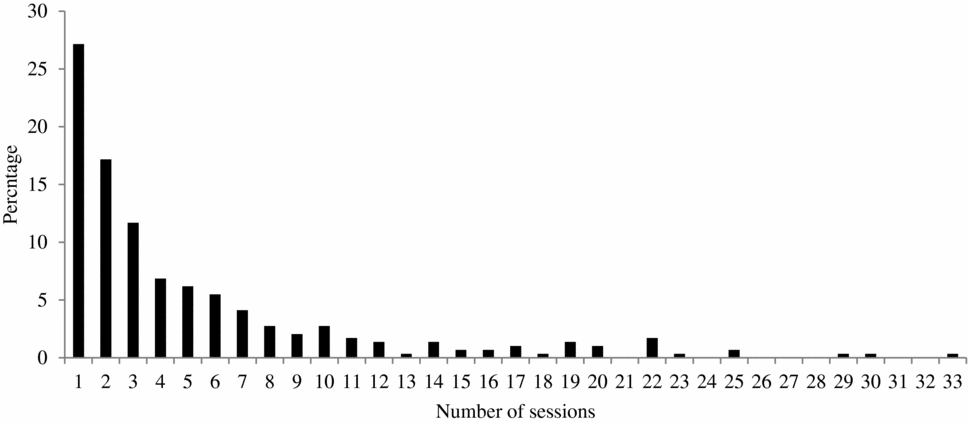
Table 1 outlines the total number of students seen and the number of sessions conducted. As the data show, a considerable number of students accessed sessions within the counselling service. Contact with counselling was also further explored by determining the frequency of sessions students attended, which is presented in Figure 1. As can be seen, a large percentage of students attend for brief contact of one to two sessions (44%), with the remaining 56% engaging in more extended contact with counselling, of which 21% of students engaged in eight or more sessions.
Overview of Counselling Service Use

Frequency of sessions attended by students.

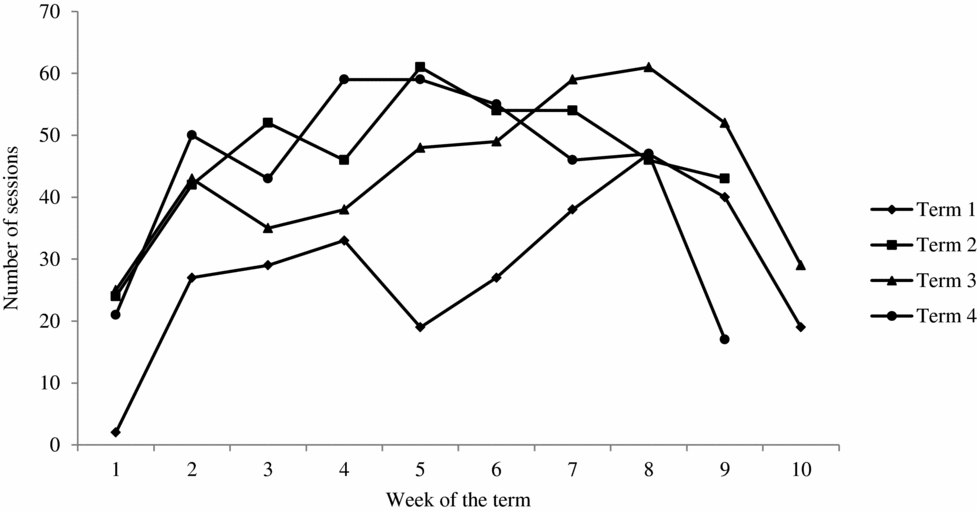
Finally, Figure 2 shows an outline of the number of sessions conducted by week for each term of the year. Note that the first and last week of each term is lower, in part due to it not being a full week, and both Term 2 and Term 4 do not have a week 10. No clear pattern is present when comparing the weekly data across terms. Total number of sessions within each term indicates that Term 2 (420 sessions), Term 3 (439 sessions) and Term 4 (397 sessions) had comparable number of sessions, with Term 1 (282 sessions) having the lowest number.
Number of sessions conducted by week for each term of the year.

Individual Trends
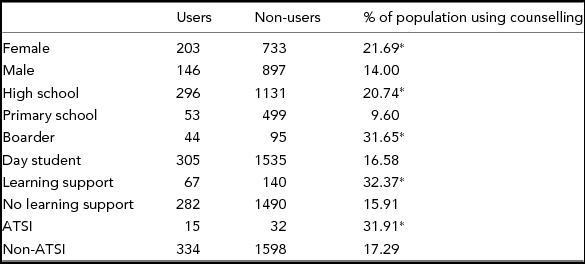
In order to understand how different students made use of counselling, results are presented based on key demographics and presented as user (engaged in counselling) and non-user (did not engage in counselling). Table 2 compares the number of students who accessed counselling compared to those who did not.
Counselling Service Use By Key Demographics

Note: *Significant difference with each demographic (p < .01).
A series of chi-square analyses were conducted to compare different demographics. There was a significant difference between all categories for each demographic; female students, χ² (1, N = 1,979) = 20.08, p < .01, high school students, χ² (1, N = 1,979) = 34.02, p < .01, boarder students, χ² (1, N = 1,979) = 20.23, p < .01, learning support students, χ² (1, N = 1,979) = 34.54, p < .01, and Aboriginal and Torres Strait Islander (ATSI) students, χ² (1, N = 1,979) = 6.76, p < .01, all accessed counselling at higher rates than the relevant remainder of the school population for each demographic. Therefore, as an example, female users represented a significantly higher proportion of their population than male users did for theirs.
Discussion
The school environment provides an important point of entry for young people to access psychosocial support in the form of counselling. Given high rates of mental illness in young people and low rates of help seeking (Australian Bureau of Statistics, 2007; Kessler et al., Reference Kessler, Amminger, Aguilar‐Gaxiola, Alonso, Lee and Ustun2007; Lawrence et al., Reference Lawrence, Johnson, Hafekost, Boterhoven De Haan, Sawyer, Ainley and Zubrick2015), it is important that those who provide a counselling service at school are aware of how their service is being utilised.
The aim of this research was to provide a broad overview of counselling service use in a large Preparatory to Grade 12 school, as well as identify specific trends in service users. It is expected that this data can be used by other counsellors and researchers as a benchmark to compare with, as well as provide an example of the benefits of data collection.
Trends in the Data
At the departmental level, the St Peters Lutheran College counselling service provided a considerable number of sessions, a total of 1,540, and was utilised by almost one in five students at the school. When compared with other estimates of service utilisation, this is in the middle of the range presented in the international literature (Amaral et al., Reference Amaral, Geierstanger, Soleimanpour and Brindis2011; Anglin et al., Reference Anglin, Naylor and Kaplan1996) but is almost twice as high as Australian rates (Lawrence et al., Reference Lawrence, Johnson, Hafekost, Boterhoven De Haan, Sawyer, Ainley and Zubrick2015). While the data do not allow for identification of the severity of the issue the young person presents with, it is noteworthy that the rate of service utilisation is comparable to rates of mental illness in young people (Australian Bureau of Statistics, 2007; Kessler et al., Reference Kessler, Amminger, Aguilar‐Gaxiola, Alonso, Lee and Ustun2007; Zachrisson, Rödje, & Mykletun, Reference Zachrisson, Rödje and Mykletun2006).
Looking more specifically at service use within each term, the results showed that Term 1 had the lowest number of sessions and that the remaining terms were comparable. Further examination of these results showed that the distribution of sessions throughout each week of the four school terms did not follow any clearly identifiable pattern. This is in contrast to the first author's anecdotal experience, which would have predicted that the number of sessions increases across the term, particularly as a result of increases in assessment toward the end of the term. This example demonstrates the benefits of routine data collection to determine patterns in service delivery that are objectively verifiable.
In terms of how frequently students attend counselling, it was found that almost half of all students using the service had brief contact of one to two sessions. When compared with other rates of counselling service use, rates of short-term counselling at St Peters were higher, with 63% attending for one to four sessions compared to 53% in national data presented by Lawrence et al. (Reference Lawrence, Johnson, Hafekost, Boterhoven De Haan, Sawyer, Ainley and Zubrick2015). Use of counselling services for a limited number of sessions is comparable with data from other external providers; for example, the Australian Government youth mental health service, Headspace (Rickwood et al., Reference Rickwood, Telford, Mazzer, Parker, Tanti and McGorry2015).
This finding has implications for how service delivery is conducted, suggesting that counselling resources need to account for a higher volume of students making brief contact compared to a lower number of students engaged in extended contact with counselling. While both of these groups require unique support, it is important to consider the ‘squeaky wheel phenomenon’ to ensure that students with extended contact do not consume a disproportional share of resources (Bradshaw, Buckley, & Ialongo, Reference Bradshaw, Buckley and Ialongo2008) and that counselling staff are appropriately trained to support students who wish to engage in either brief or extended contact with counselling.
Individual Differences
The trends identified also provide insight into specific groups that could benefit from early intervention and ongoing support. Given the unique position of a school, counsellors are well placed to be able to recommend, initiate or facilitate interventions for target groups who are at higher risk for experiencing difficulties in mental health and wellbeing. The identification of ATSI, boarding, and learning support students as groups who are disproportionally accessing counselling compared to their representation within the total school population, provides an argument for re-orienting services to provide additional support to these groups. However, it is also encouraging that the individuals within these groups are accessing counselling services, despite typical barriers to help seeking that can limit their willingness to access help.
The results also provide an insight into which groups are under-utilising the counselling service, though determining the reason for this is beyond the scope of the current data. Both males and primary-aged students utilised counselling at a lower rate than any other demographic. As the research has highlighted, males typically are less likely to seek help (Amaral et al., Reference Amaral, Geierstanger, Soleimanpour and Brindis2011); however, it would be expected that a higher proportion of primary-aged students would engage with counselling, given that research has identified that age range as being a time of identification for mental health issues (Farmer et al., Reference Farmer, Burns, Phillips, Angold and Costello2003). These findings are potentially due to a number of factors, including individual barriers to help seeking, and broader, systemic issues including service availability and school culture.
Limitations
While frequency data provides an important understanding of service use, it does not allow for any conclusions to be drawn about the effectiveness of the service provided. Additional and integrated data collection that assesses counselling outcomes, as well as presenting issues would provide a more complete picture about counselling services provided.
Also of note is that St Peters Lutheran College is a co-educational Preparatory to Grade 12 day and boarding school. While this does not suggest that the findings are not applicable to other schools, it is possible that these factors have some bearing on the cohort of students and families that choose to attend this school, which may impact on how they access counselling services.
Implications and Conclusions
Routine data collection is an important component of the scientist-practitioner model and of effective service evaluation in diverse contexts (Barlow, Hayes, & Nelson, Reference Barlow, Hayes and Nelson1984). As with all data, the quality and fidelity of this information are crucial for meaningful conclusions to be drawn. It is the reflection of the current researchers that establishing clear protocols for what information is collected and how it is recorded are fundamental to developing a robust system. This includes clearly defining inclusion and exclusion criteria so that there is consistency across counsellors with regard to recording data. The collection of even basic service access data can provide valuable information in understanding how a counselling service is accessed, as well as identifying issues for further consideration to more meaningfully deliver this service. This also forms an important baseline for determining whether changes to service delivery have an impact and allows for more comprehensive exploration of service effectiveness.
As previously noted, the current data only consider individual sessions provided by a counsellor. While this is an important component of the role, it is not the entirety of it as there is a strong focus on collaboration with other school staff to support them in their work with the young people at the school. We would suggest that this component of the role is of critical value both in terms of ensuring a more comprehensive support network and also in being able to efficiently increase the reach and impact of the service. Despite being beyond the scope of this article, it is a noteworthy consideration for further exploration in terms of more fully understanding the services a school counsellor provides.
For a service as diverse as school counselling, it is helpful to be able to understand patterns of service use, which can inform how counselling can be more effectively administered. This understanding can directly inform service planning and provision — for example, in providing additional resources for at-risk groups or in identifying patterns of referrals and workflow within a counselling service.
The current data provide a benchmark from which other providers, schools, and departments can make comparisons. More comprehensive data collection across contexts allows for robust comparisons to be conducted, which supports the underpinnings of ongoing research and practice caring for the mental health and wellbeing of young people. It is hoped that this article opens a conversation regarding the utilisation and development of data within school settings.
Acknowledgments
The authors would like to thank St Peters Lutheran College for their support in this research.
Financial Support
This research did not receive any specific grant from funding agencies in the public, commercial, or not-for profit sectors.
Conflicts of Interest
None.