Introduction
Lee, as a resident, is empowered to use an e-petition system to submit proposals on preventing the spread of COVID-19. However, the system’s complex operation leaves him confused and overwhelmed. Therefore, he decides not to make any statement regarding public affairs. This study proposes that if Lee receives supportive resources – such as apps (i.e., technological resources), tutorial videos (i.e., service resources), and laws and regulations (i.e., social norm resources) provided by the government – he may develop the intention to learn and complete online petitions. We refer to such government-provided resources that enable citizens to facilitate their e-participation as e-government resources, and we posit that, under certain conditions, these resources can promote citizens’ e-participation intention.
However, e-government resources exert varying influences on e-participation intention, a finding confirmed by numerous reports and studies. For example, Singapore’s government introduced a ‘one-stop citizen service shop’ to provide a seamless citizen experience, resulting in 96% satisfaction among its citizens, while 4% expressed dissatisfaction (2019 Digital Government Development Report). Similarly, the Chinese government is actively enhancing citizen experience by offering resources (e.g., consultation services) through social media to promote e-participation intention. Despite these efforts, user ratings remain below 3 out of 5, indicating that only a minority of citizens are satisfied. The main reason is the difficulty governments face in providing all citizens with satisfactory e-participation experiences (Noci, Reference Noci2007). This phenomenon has also been observed in other contexts (e.g., Rodrigues, Sarabdeen, & Balasubramanian, Reference Rodrigues, Sarabdeen and Balasubramanian2016). For instance, while information and communication technology can enhance citizens’ e-participation intention in government decision-making and public affairs (Li & Shang, Reference Li and Shang2020), e-technology has also been found to exert negative effects (Charbaji & Mikdashi, Reference Charbaji and Mikdashi2003). Nevertheless, no clear conclusion has yet been reached regarding the underlying causes of these mixed outcomes.
Despite the growing body of research on e-government resources and e-participation intention, no prior study has systematically synthesized these findings using a meta-analytic approach. Existing studies have primarily relied on empirical analyses (e.g., Chen & Huang, Reference Chen and Huang2009; Reddick & Zheng, Reference Reddick and Zheng2017), which provide valuable insights but lack a comprehensive statistical integration of diverse results. The absence of such synthesis limits our understanding of the generalizability and contextual variations in the relationship between e-government resources and e-participation intention. To address this gap, this study employs meta-analysis to quantitatively assess the overall impact of e-government resources on e-participation intention and to identify key moderators that explain the observed inconsistencies.
There are several reasons for employing meta-analysis: (1) It allows for a comprehensive synthesis of findings from multiple studies, offering a more exhaustive and nuanced understanding of the complex relationship between e-government resources and e-participation intention (Çoğaltay & Karadağ, Reference Çoğaltay and Karadağ2015). (2) It enables researchers to quantitatively evaluate the overall impact of e-government resources on e-participation intention, while accounting for the varied results and influencing factors reported across studies. (3) It facilitates the identification of potential moderators that may explain the mixed findings in the literature, thereby clarifying the mechanisms through which e-government resources influence e-participation intention.
Initially, we identify four crucial contingency factors from the perspective of citizen experience – channel (social vs. official), affair (specific vs. general; regional vs. national), environment (collectivist vs. individualist cultures; developing vs. developed countries; unitary vs. federal governance system), and actor characteristics (ordinary vs. professional citizens) – that influence e-participation intention. These factors, individually or in combination, influence e-participation intention in diverse ways. Through a meta-analysis of 517 correlations from 126 publications, we demonstrate that e-government resources are more effective in promoting e-participation intention when delivered through social (vs. official) channels, applied to specific (vs. general) government affairs, implemented at the regional (vs. national) level, and situated in developing (vs. developed) countries.
Notably, we position contextual variables as moderators that influence the strength of the relationship between e-government resources and e-participation intention. This theoretical framing enhances our understanding of context-specific effects in digital governance and highlights the need for more systematically developed frameworks in this domain.
Theoretical Background
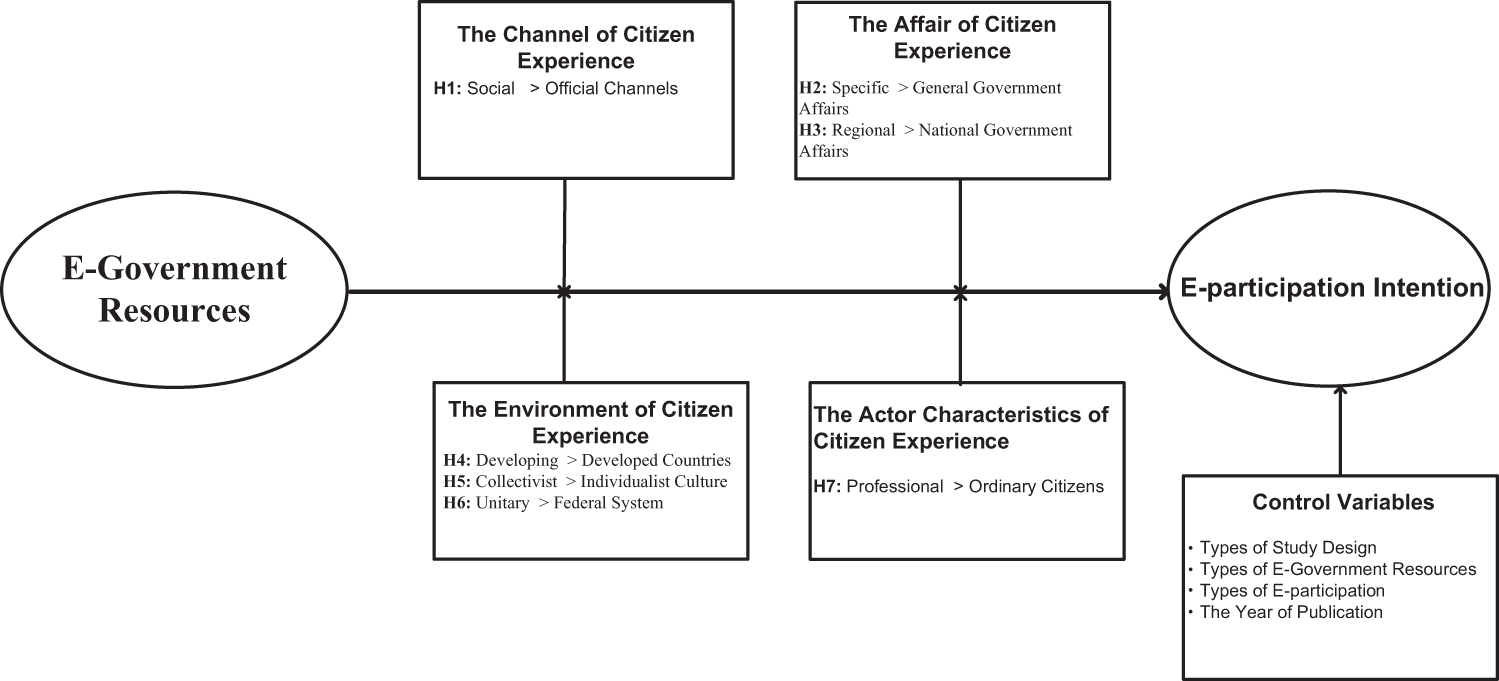
This section focuses on the concepts of e-government resources, e-participation intention, and citizen experience. Figure 1 presents an overview of our conceptual framework, illustrating how various factors shape the impact of e-government resources on e-participation intention.
Influencing factors framework of the current meta-analysis

Figure 1 Long description
A diagram illustrating the relationship between e-government resources and e-participation intention. The central element is 'E-Government Resources', connected to 'E-participation Intention'. Four main factors influence this relationship: 'The Channel of Citizen Experience' (H1: Social greater than Official Channels), 'The Affair of Citizen Experience' (H2: Specific greater than General Government Affairs, H3: Regional greater than National Government Affairs), 'The Environment of Citizen Experience' (H4: Developing greater than Developed Countries, H5: Collectivist greater than Individualist Culture, H6: Unitary greater than Federal System) and 'The Actor Characteristics of Citizen Experience' (H7: Professional greater than Ordinary Citizens). Control variables include types of study design, types of e-government resources, types of e-participation and the year of publication.
The Concept of E-Government Resources
Based on resource-based theory, the resources possessed by an organization determine its performance and provide a competitive advantage (Barney, Reference Barney1991). This theory extends beyond business to the field of digital governance, where governments enhance e-government performance by providing and optimizing essential resources, thereby promoting citizen e-participation (e.g., Ashaye & Irani, Reference Ashaye and Irani2019; Vicente & Novo, Reference Vicente and Novo2014).
Research has shown that government-provided resources play a central role in facilitating citizen e-participation (Zheng & Ma, Reference Zheng and Ma2022). These resources serve as key external supports that shape citizens’ intentions and abilities to engage in e-participation. Specifically, they include technological infrastructure (e.g., government websites and digital platforms) (Ferreira & Coelho, Reference Ferreira and Coelho2022), capacity-building programs (e.g., digital literacy training) (Aichholzer & Rose, Reference Aichholzer and Rose2020), and user-friendly online platforms designed to enhance accessibility and engagement (Ganapati, Reference Ganapati2011).
Therefore, we define the supportive resources provided by governments to facilitate citizen e-participation as e-government resources. These resources include technological, educational, and platform-related components and so on, aiming to reduce participation barriers, increase accessibility, and promote effective digital governance.
In this meta-analysis, we operationalize e-government resources as a single, aggregated independent variable capturing the overall extent of digital resource provision by governments. While prior studies have identified technological, service, and social norm supports as distinct categories, we treat these as control variables in our analysis. This modeling choice allows us to focus on the overarching impact of government-provided digital support while statistically accounting for the influence of different resource types.
To implement this, we systematically review the independent variables from primary studies, retaining only those that directly reflect government digital efforts aimed at facilitating e-participation. Constructs such as political trust or demographic attributes were excluded unless they represented explicit government resource provision.
The Concept of E-Participation Intention
E-participation refers to the use of information technology to facilitate citizens’ engagement in government affairs (e.g., Vicente & Novo, Reference Vicente and Novo2014). It serves as a fundamental tool for achieving participatory, inclusive, collaborative, and consultative public governance. E-participation intention plays a crucial role in its implementation, consistent with the theory of planned behavior (TPB), which identifies individuals’ intentions as a key determinant of their behavior (Conner & Armitage, Reference Conner and Armitage1998). Therefore, in this study, e-participation intention is selected as the dependent variable.
Moreover, building on the concept of citizen e-participation, this study defines e-participation intention as citizens’ willingness to use information and communication technologies (ICT) to engage in government policy, decision-making, service design, and service delivery.
The Content of Citizen Experience
Over the past 20 years, the e-participation literature has evolved through several distinct theoretical perspectives. More details are shown in Table 1.
The details of e-participation development

Table 1 Long description
The table outlines the evolution of e-participation research through three stages: early, later, and recent. Initially, the focus was on the Technology Acceptance Model, emphasizing technological determinants like perceived usefulness and ease of use. Later research incorporated models like DeLone & McLean's Information Systems Success Model, focusing on system, information, and service quality, as well as user satisfaction. Recent studies adopt a public value perspective, viewing e-participation as a collaborative process that enhances transparency and trust between government and citizens. Key literature from each stage is cited, showing a progression from technology-centric to value-centric approaches.
While these perspectives have enriched the field, they also exhibit important limitations. Technology adoption models primarily explain initial acceptance, the IS success framework emphasizes system-level evaluations, and the public value approach focuses on collective outcomes. However, these perspectives often treat citizens either as rational adopters or passive recipients of services, overlooking the ongoing, multidimensional, and experiential nature of citizens’ engagement with e-participation platforms.
To address this gap, this study adopts the citizen experience perspective. Consistent with Moore’s (Reference Moore1997) argument that the quality of interactions between governments and citizens determines public value, e-participation is viewed not only as a functional process but also as an experiential one, in which citizens – similar to customers in service settings – form both cognitive judgments and emotional responses (e.g., Rincon‐Novoa, Rojas‐Berrio, & Robayo‐Pinzon, Reference Rincon‐Novoa, Rojas‐Berrio and Robayo‐Pinzon2022). Drawing on customer experience research (De Keyser, Verleye, Lemon, Keiningham, & Klaus, Reference De Keyser, Verleye, Lemon, Keiningham and Klaus2020), citizen experience can be understood as citizens’ immediate reactions to government interactions, shaped by perceptions of relevance, transparency, trustworthiness, and empowerment.
Prior studies on user (e.g., citizen) experience highlight four broad categories (e.g., Brakus, Schmitt, & Zarantonello, Reference Brakus, Schmitt and Zarantonello2009; Lemon & Verhoef, Reference Lemon and Verhoef2016): experience channel (Hoffman & Novak, Reference Hoffman and Novak1996), affair (Schmitt, Reference Schmitt1999), environment (Bitner, Reference Bitner1990), and user characteristics (Jain, Aagja, & Bagdare, Reference Jain, Aagja and Bagdare2017). Building on these studies, this research categorizes citizen experience into four dimensions: (1) the channel of citizen experience, which includes the experience channel; (2) the affair of citizen experience, comprising the experience field and experience level; (3) the environment of citizen experience, encompassing experience stage, experience culture, and experience system; and (4) the actor characteristics of citizen experience, referring to experiencer characteristics.
This framework provides a conceptual foundation for our empirical research, emphasizing the need for a detailed analysis that accounts for both contextual and individual factors to inform policy-making and citizen e-participation strategies.
Hypotheses Development
The Channel of Citizen Experience
Experience channel: Social vs. official channels
Social channels provide a more interactive and informal platform for participation, enhancing accessibility and reaching a broader audience (e.g., Lee & Kwak, Reference Lee and Kwak2012; Mergel, Reference Mergel2013). Unlike official government communication channels, social media platforms and online community forums enable direct, real-time interaction between citizens and government entities. This immediacy fosters inclusivity and transparency within the e-participation process, creating a more engaging and responsive civic environment (e.g., Arshad & Khurram, Reference Arshad and Khurram2020; Dalakiouridou, Smith, Tambouris, & Tarabanis, Reference Dalakiouridou, Smith, Tambouris and Tarabanis2012). In contrast, official channels, such as government websites and administrative systems, are often perceived as formal and unidirectional, potentially limiting opportunities for meaningful two-way communication and engagement (e.g., Lee-Geiller & Lee, Reference Lee-Geiller and Lee2019).
Furthermore, social channels facilitate peer-to-peer interaction and networking among citizens, enabling the exchange of ideas, experiences, and feedback (Nam, Reference Nam2012). E-government resources delivered through these channels can leverage social influence and collective participation, as citizens are more likely to be influenced by their peers and social networks when considering e-participation (Schmitz & Fulk, Reference Schmitz and Fulk1991). By fostering a sense of community and belonging, social channels encourage more active citizen engagement. In contrast, official government channels may not fully utilize the potential of peer influence and often lack the communal dynamics inherent in social platforms. Therefore, we propose that:
Hypothesis 1 (H1): E-government resources through social channels have a greater effect on e-participation intention than those through official channels .
The Affair of Citizen Experience
Experience field: Specific vs. general government affairs
The experience field is divided into two dimensions – specific and general government affairs – based on the informational distance between citizens and public affairs. Specific government affairs typically address topics directly relevant to particular groups of citizens, such as healthcare (Varda, Shoup, & Miller, Reference Varda, Shoup and Miller2012), education (Kettl, Reference Kettl2001), and e-taxation (Chen & Huang, Reference Chen and Huang2009). These issues carry significant personal relevance, fostering a stronger sense of urgency and emotional connection among affected citizens. When governments prioritize resources for such issues, citizens are more likely to perceive that their concerns are acknowledged and addressed, which can lead to greater engagement in e-government initiatives (Chan & Pan, Reference Chan and Pan2008). Moreover, specific government affairs tend to attract higher levels of public attention, media coverage, and public discussion, stimulating increased interest and participation. Public engagement is further reinforced when individuals perceive that their participation has a direct impact on specific policies or decisions (Stern & Dietz, Reference Stern and Dietz2008). This heightened visibility and perceived efficacy can significantly encourage active e-participation.
In contrast, general government affairs often involve broader, bureaucratic, or administrative topics, such as project proposals (Naranjo-Zolotov, Oliveira, & Casteleyn, Reference Naranjo-Zolotov, Oliveira and Casteleyn2018). While essential for governmental operations, these topics may seem distant and abstract to many citizens, as they often lack the immediate personal relevance characteristic of specific government affairs. Consequently, citizens may feel less motivated to engage in e-government initiatives related to general affairs, perceiving that their participation is unlikely to produce tangible outcomes (Moon & Norris, Reference Moon and Norris2005). Thus, we propose that:
Hypothesis 2 (H2): E-government resources for specific government affairs have a greater effect on e-participation intention than those for general government affairs.
Experience level: Regional vs. national government affairs
This dimension distinguishes between regional and national government affairs based on the geographic scope of citizen participation in e-government initiatives. Regional government affairs include, for example, electronic tax-filing systems in Taiwan Province, China (Wang, Reference Wang2003) and urban government initiatives in China (Zheng & Ma, Reference Zheng and Ma2022). In contrast, national government affairs encompass e-government implementation in Zambia (Bwalya, Du Plessis, & Rensleigh, Reference Bwalya, Du Plessis and Rensleigh2012) and e-government services in the Netherlands (Horst, Kuttschreuter, & Gutteling, Reference Horst, Kuttschreuter and Gutteling2007). Research suggests that a narrower information distance can benefit users by enabling more effective information processing (Zhao & Xie, Reference Zhao and Xie2011). When the information distance between services and citizens is reduced, individuals can access more valuable information independently, which enhances their motivation to engage (Sikora & Chauhan, Reference Sikora and Chauhan2012).
Accordingly, this study assumes that citizens are more likely to access useful information independently in regional affairs, where the information distance is small, leading to higher e-participation intention. In contrast, a larger information distance between national authorities and citizens may reduce their intention to engage in public affairs. Thus, we propose that:
Hypothesis 3 (H3): E-government resources for regional government affairs have a greater effect on e-participation than those for national government affairs.
The Environment of Citizen Experience
Experience stage: Developed vs. developing countries
Developed countries typically possess advanced technological infrastructures, including widespread high-speed Internet access, stable electricity, and mature digital platforms. Citizens in these countries often already have the necessary tools and skills – such as smartphones, computers, and digital literacy – to engage in e-participation independently (e.g., Basu, Reference Basu2004). Consequently, the marginal effect of additional government-provided e-resources may be limited.
In contrast, developing countries often face challenges such as unstable infrastructure, high access costs, and limited digital reach (e.g., Shahab, Bagheri, & Potts, Reference Shahab, Bagheri and Potts2021). In these contexts, government provision of digital platforms, training, and accessible services plays a crucial role in enabling citizen engagement. Therefore, the effect of e-government resources on e-participation intention is expected to be more pronounced in developing countries.
Therefore, we propose that:
Hypothesis 4 (H4): E-government resources in developing countries have a greater effect on e-participation intention than those in developed countries.
Experience culture: Collectivist vs. individualist cultures
In collectivist cultures, there is a strong emphasis on community, cooperation, and group harmony (Triandis, Bontempo, Villareal, Asai, & Lucca, Reference Triandis, Bontempo, Villareal, Asai and Lucca1988). E-government resources for e-participation that align with these cultural values can have a greater impact on motivating individual participation. When governments actively promote digital platforms for collective decision-making or community-driven initiatives, this resonates with cultural preferences for cooperation and mutual support (Zhang, Yu, & Tian, Reference Zhang, Yu and Tian2023). Citizens in collectivist cultures who perceive e-participation as contributing to community well-being or fulfilling social expectations may feel a stronger obligation to engage (Alathur, Ilavarasan, & Gupta, Reference Alathur, Ilavarasan and Gupta2016).
In contrast, individualist cultures place greater emphasis on personal autonomy and independence (Chirkov, Ryan, Kim, & Kaplan, Reference Chirkov, Ryan, Kim and Kaplan2003). If e-government resources excessively intervene in citizens’ personal affairs or decision-making, thereby limiting their autonomy, they may resist or reject such initiatives. Moreover, personal interests are a primary driver of behavior in individualist cultures (Sinha & Sinha, Reference Sinha and Sinha2014). Citizens who perceive that e-government resources do not substantially serve their interests may be less likely to engage. Thus, we propose that:
Hypothesis 5 (H5): E-government resources in collectivist cultures have a greater effect on e-participation intention than those in individualist cultures.
Experience system: Unitary vs. federal systems
In a unitary system (e.g., China, the Republic of Korea, and Singapore), where political power is centralized (Toonen, Reference Toonen1990), e-government resources for e-participation can be deployed more effectively. Centralized governance enables efficient resource allocation, uniform technological infrastructure, and standardized digital participation platforms (e.g., Gerring & Thacker, Reference Gerring and Thacker2004). With a single governing authority controlling public resources, e-government initiatives benefit from greater coordination and scalability, ensuring that citizens across regions have equal access to digital participation opportunities. Consequently, in unitary systems, government resources are more likely to result in higher levels of e-participation.
Conversely, in a federal system (e.g., the US, Malaysia, Nigeria, and Uganda), political power and government resources are decentralized, with responsibilities for resource allocation and digital governance distributed across multiple levels of government (Agranoff, Reference Agranoff and Haider-Markel2014b). While government resources for e-participation are still provided, their effectiveness is influenced by the structural complexity of a multi-tiered governance system. Regional or local governments may have varying financial, technical, and administrative capacities, resulting in fragmented and inconsistent implementation of e-participation initiatives (Toonen, Reference Toonen1990). This variability in resource distribution can create disparities in e-government accessibility and quality, weakening the overall impact of government resources on citizen engagement (Agranoff, Reference Agranoff2014a). Therefore, we propose that:
Hypothesis 6 (H6): E-government resources in unitary systems have a greater effect on e-participation intention than those in federal systems.
The Actor Characteristics of Citizen Experience
Experiencer characteristics: Professional vs. ordinary citizens
This study distinguishes between professional citizens (e.g., government employees) and ordinary citizens (e.g., students and general citizens) based on their level of professional e-government knowledge. This distinction is important because it reflects the varying levels of knowledge and understanding individuals possess when interacting with e-governance platforms. Citizens with professional expertise are more likely to actively engage in public affairs, as they have the necessary information to provide informed opinions and contribute meaningfully to discussions on public issues (Bratton, Reference Bratton1999).
Moreover, the study highlights the significant influence of perceived benefits on e-participation (Khasawneh, Hujran, & Abdrabbo, Reference Khasawneh, Hujran and Abdrabbo2018). Individuals with higher professional knowledge tend to experience greater personal advantages from e-participation, such as improved job performance, enhanced productivity, and an increased sense of value. This suggests that perceived benefits play a crucial role in shaping engagement levels, particularly among those with professional expertise.
Building on these findings, the study suggests that professional citizens, owing to their deeper understanding and proficiency in e-governance, are likely to derive greater personal benefits from e-participation. These benefits serve as key motivators for active engagement in public affairs through digital platforms. Conversely, ordinary citizens, with limited professional knowledge, may perceive fewer personal advantages from e-participation, potentially leading to lower levels of engagement in e-governance initiatives.
The proposed framework suggests that differences in professional knowledge and the associated perceived benefits significantly influence citizen e-participation patterns, explaining the varying levels of engagement between professional and ordinary citizens in the context of e-governance. Therefore, we propose that:
Hypothesis 7 (H7): E-government resources for professional citizens have a greater effect on e-participation than those for ordinary citizens.
Control Variables
In addition to the main variables, several control variables were included to minimize potential bias. First, study design (e.g., questionnaire, database, or crawler) was controlled for, as different methodological approaches may affect the reliability and comparability of reported findings (Cleary, Reference Cleary1997). Second, the year of publication was considered to account for possible temporal effects, since the strength of the relationship between e-government resources and e-participation intention may change over time. Therefore, the year of publication was included as a control variable. Finally, the types of e-government resources (i.e., technology, social norm, and service) and the types of e-participation (i.e., monitoring, agenda-setting, and decision-making) were included as control variables, as variations in resource and participation types can influence perceived effort and trust, thereby shaping e-participation intention (e.g., Lai & Beh, Reference Lai and Beh2025).
By incorporating these control variables, the analysis can more accurately isolate the substantive effect of e-government resources on e-participation intention, reducing the likelihood that the results are influenced by methodological or measurement artifacts.
Methods
The data used in this study have been deposited in the Open Science Framework (OSF) and are publicly available at https://osf.io/9yu7z/?view_only=713587f95ccd48a8a8071dceaaee0a5b
Selection Criteria
First, this study identified relevant literature using Web of Science, ScienceDirect, the ACM Digital Library, and Google Scholar. Search terms included ‘Electronic government’, ‘e-government’, ‘e-gov’, ‘egov’, ‘participation’, ‘e-participation’, ‘intention’, and combinations of these terms with ‘e-voting’, ‘e-petition’, ‘e-democracy’, ‘e-empowering’, ‘e-information’, ‘e-consulting’, ‘e-involving’, and ‘e-collaborating’. Additionally, manual searches were conducted for abstracts published in Transforming Government: People, Process, and Policy (TGPPP), Electronic Government, International Journal (EGIJ), Government Information Quarterly (GIQ), and International Journal of Electronic Government Research (IJEGR), supplementing the electronic searches. Papers from journals focusing on information systems, management, and organizational behavior, as well as conference proceedings, were also examined. References were cross-checked to ensure completeness. To reduce sample bias, working papers from SSRN were accessed, and authors were contacted directly via email to obtain unpublished papers. The literature review covers the period 2000–2025.
A total of 3,764 publications were initially identified as relevant to e-participation intention. After removing 1,739 duplicates, the titles and abstracts of the remaining 2,025 articles were screened for eligibility. Of these, 562 articles were considered potentially eligible and underwent full-text review, all of which were empirical studies. Ultimately, 126 publications met all inclusion criteria, which required measures of e-government resources, available statistical data, and e-participation intention. Following Moher et al. (Reference Moher, Shamseer, Clarke, Ghersi, Liberati, Petticrew and Stewart2015), a flow diagram illustrating the search strategy and final selection process is presented in Figure 2.
Flow diagram of studies selected for inclusion in the review

Figure 2 Long description
The flowchart illustrates the study selection process for a review on e-participation intention. It is divided into four stages: identification, screening, eligibility and inclusion. In the identification stage, 3,661 records were identified through database searching and 103 additional records were identified through other sources. After removing 1,739 duplicates, 2,025 records remained for screening. During the screening stage, 1,463 records were excluded, leaving 562 articles for full-text eligibility assessment. In the eligibility stage, 436 full-text articles were excluded for reasons such as duplicate studies, lack of measurement of government support and absence of available data. Ultimately, 126 studies were included in the qualitative synthesis and meta-analysis, as shown in the inclusion stage.
Variable Coding
Referencing the coding process by Chang and Taylor (Reference Chang and Taylor2016), after establishing definitions and coding standards for variables, both authors independently coded all studies. Table A1 in the Appendix outlines the basic coding criteria for key variables. The Kappa coefficient was calculated to assess the reliability between the two authors (Cohen, Reference Cohen1960). Initially, the independent coding by the two authors showed over 98% intercoder reliability for each component, indicating high reliability among raters (see Table A1 in the Appendix).Footnote 1 Any discrepancies in coding were resolved through discussion. The coding reliability was further assessed for moderators across all studies by a separate coder not involved in the study but knowledgeable about the topic. The reliability rate between the codes of the two authors and the independent coder exceeded 99% for each moderator, demonstrating a high reliability rate in the coding process. Any minor disagreements were resolved through discussion.
In total, 517 correlations between e-government resources and e-participation intention were coded from 126 papers (some details can be seen in Table A2 of Appendix).
Measures
E-government resources
Following meta-analytic practices established in prior studies (e.g., Liu, Guo & Chi, Reference Liu, Guo and Chi2015; Zhang & Chen, Reference Zhang and Chen2023), which applied structured coding and effect size extraction in different research contexts, we systematically classified and coded e-government resources and extracted effect sizes for each study. We examined several types of e-government resources, including (1) technological resources, such as online service platforms and collaboration tools; (2) service resources, such as citizen service channels; and (3) social-norm resources, such as guidance documents and institutional support policies. We identified the measures of relevant studies, and if a study used one or more resources above, we considered these resources as e-government, and recorded their correlations with the outcome variable we examined in our study. For instance, correlations between individual resources and the same outcome variable were retained separately rather than averaged, in order to maximize the amount of data available for analysis (Hunter & Schmidt, Reference Hunter and Schmidt2004). This approach ensures methodological transparency and comparability across studies while providing more robust estimates of the relationships between resources and the outcome.
E-participation intention
This is measured by survey-based indicators capturing citizens’ willingness to engage in e-government, such as behavioral intention, continuance usage intention, intention to use portals or mobile applications, and intention to participate in specific platforms.
Publication Bias
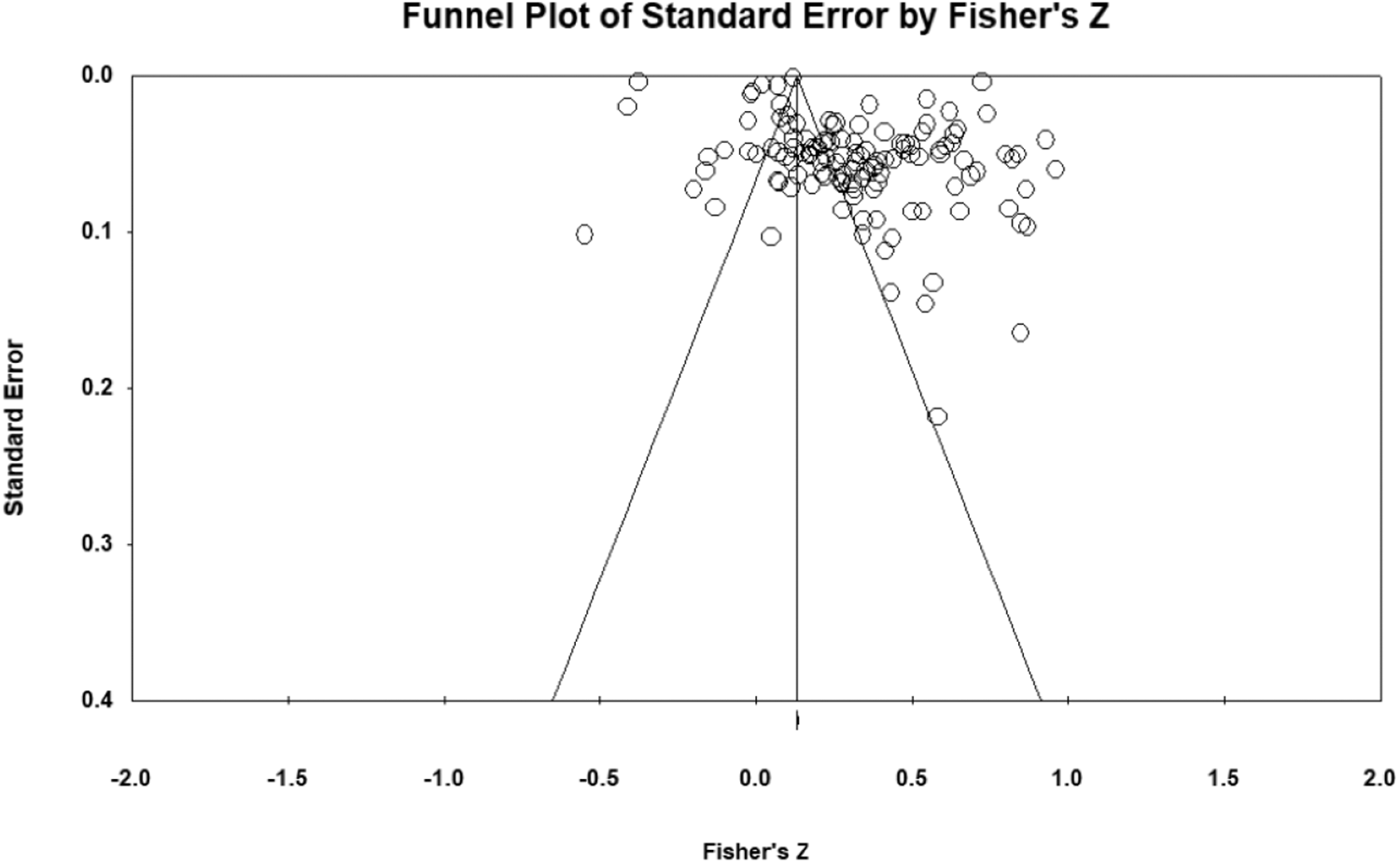
This study employed (a) a funnel plot, (b) fail-safe N, and (c) Egger’s regression test to assess potential publication bias. As shown in Figure 3, most studies cluster near the top of the funnel plot and around the average effect size, with no studies appearing at the bottom, indicating minimal likelihood of publication bias. Additionally, the fail-safe N statistic proposed by Rosenthal (Reference Rosenthal1979) was calculated to estimate the robustness of the results, as presented in Table 2. For example, the fail-safe N for e-participation intention is 68,074, suggesting that 68,074 unpublished studies would be required to nullify the significant results observed. Thus, the findings appear largely unaffected by publication bias.
The distribution of effect value

Figure 3 Long description
A funnel plot showing standard error on the y-axis and Fisher's Z on the x-axis. The plot features a symmetrical distribution of data points, mostly clustered near the top around the average effect size. The x-axis ranges from negative 2.0 to positive 2.0 and the y-axis ranges from 0.0 to 0.4. Two diagonal lines form a funnel shape, indicating the expected distribution of data points if there is no publication bias.
Overview of the e-participation intention relationships

Table 2 Long description
The table examines the relationship between e-participation intention and various statistical measures. It highlights a mean correlation of 0.31, indicating a strong relationship, with a sample size of 126 studies. The confidence interval for the random model ranges from 0.26 to 0.36, while the fixed model is narrower, from 0.127 to 0.132. The heterogeneity is notably high at 99.72 percent, suggesting variability among study results. A fail-safe number of 68,074 indicates the number of additional non-significant studies required to alter the significance of the findings. These results suggest a robust correlation, but the high heterogeneity may imply differing study conditions or methodologies.
Notes: p < 0.05,
** p < 0.01. aRandom model point estimates. bWe used the trim-and-fill method to calculate modified estimates of fixed effects for possible publication bias, as presented in Table 2 (Duval & Tweedie, Reference Duval and Tweedie2000). cThe number of non-significant, unpublished (or omitted) studies to be added to the meta-analysis that are required to transform the total observation from statistically non-significant to significant. dNumber of Effects. eNumber of Observations.
Egger’s regression test further supports this conclusion (intercept = 3.79, 95% CI = [0.24, 7.33], p = 0.04), indicating a low presence of bias. To evaluate the stability of the combined results, the trim-and-fill method was applied using the ‘trimfill’ function in the Comprehensive Meta-Analysis software. A random-effects model was used, with adjustment to the left, resulting in 28 hypothetical studies being added. The effect estimate was 0.31 (95% CI = [0.26, 0.36], p < 0.001) before trim-and-fill and 0.21 (95% CI = [0.16, 0.26], p < 0.001) after trim-and-fill. Although the adjustment affected the effect size, it did not alter the overall findings, indicating that publication bias does not significantly distort the results.
Model Construction
To examine potential moderating effects, hierarchical linear modeling was employed, accounting for within-study error correlations between effect sizes. Fisher z-transformed correlations were regressed on the hypothesized moderating variables as well as study-specific moderators. The specific Model 6 is estimated as follows:
 \begin{equation}{Y_{ij}} = {\alpha _0} + {\beta _1}{x_{1i}} + \ldots + \mathop \sum \limits_{k = 1}^7 {\alpha _k}{X_{kij}} + {u_j} + {e_{ij}}\end{equation}
where Yij represents the Fisher z-transformed correlation coefficient observed in the j study. The term α0 denotes the intercept, while αk corresponds to the estimated coefficients of the moderator variables Χkij. The term uj captures the residual variance at the study level, accounting for between-study heterogeneity, and eij represents the residual error at the measurement level, reflecting within-study variability.
Analyses and Results
Data Analysis
Meta-analysis
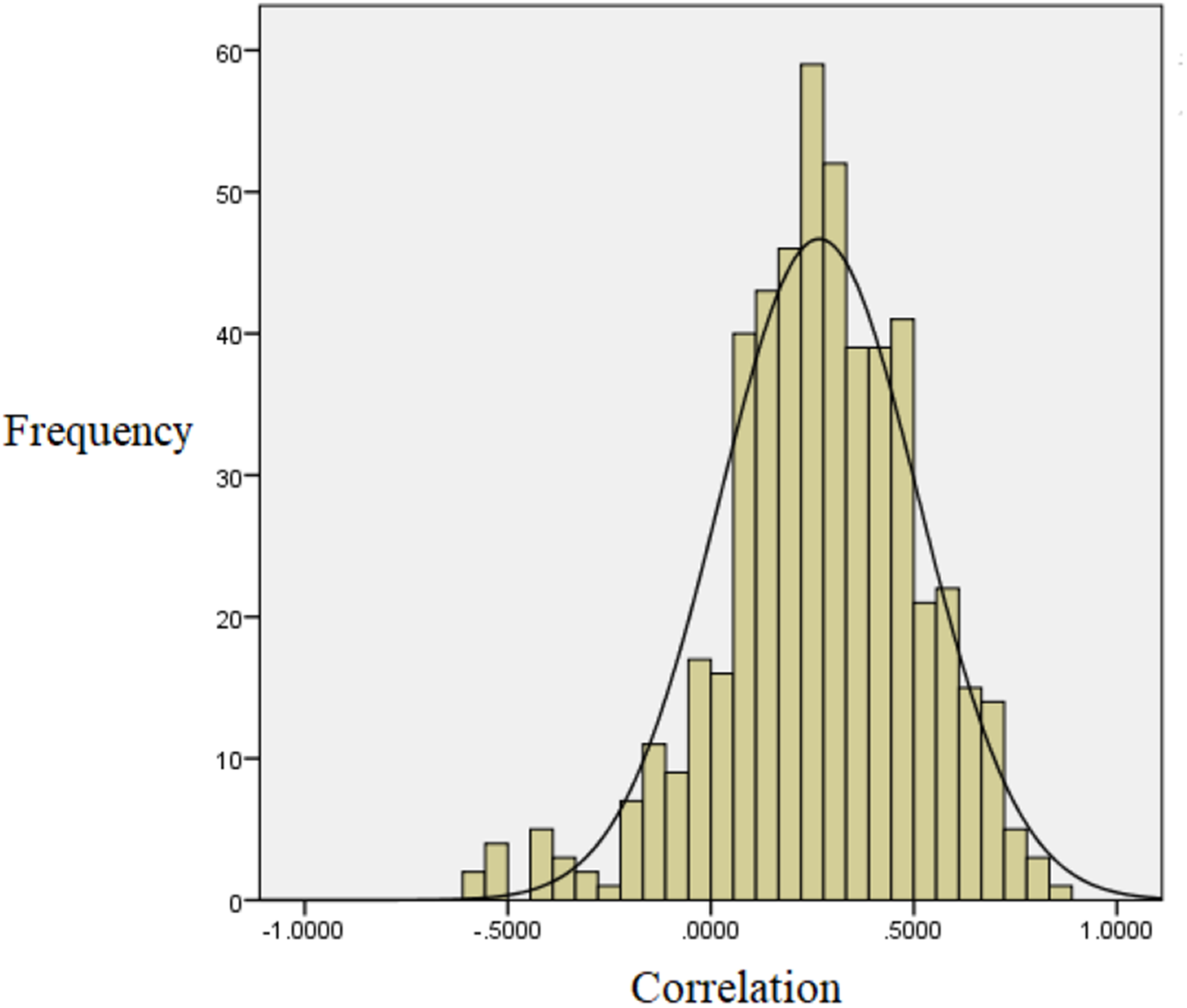
A preliminary analysis examined the central tendency and distribution of effect sizes (Troy, Hirunyawipada, & Paswan, Reference Troy, Hirunyawipada and Paswan2008). The 517 correlations between e-government resources and e-participation intention ranged from − 0.60 to 0.89, as shown in Figure 4. Among these, 4 correlations were 0, and 61 were negative (M = 0.27, SD = 0.25). The distribution deviated significantly from normality, exhibiting mild negative skewness (Z_skewness = − 0.54, p < 0.01) and slight leptokurtosis (Z_kurtosis = 0.87, p < 0.01).
Frequency distribution of correlations

Figure 4 Long description
A histogram displays the frequency distribution of correlations, ranging from negative 1 to positive 1 on the x-axis labeled 'Correlation'. The y-axis is labeled 'Frequency'. The bars show varying frequencies, with a peak around 0.5. A normal distribution curve overlays the histogram, indicating the data's distribution pattern.
Multicollinearity review
Before estimating the model, we assessed the possibility of multicollinearity among the variables. The results, presented in Table 3, indicate no serious collinearity between variables. For all eleven variables, variance inflation factors (VIFs) calculated from regressions using Z-transformed correlations ranged from 1.06 to 1.36, well below the commonly accepted threshold of 5, providing no evidence of multicollinearity.
Pearson correlation matrix for the moderators

Table 3 Long description
The table presents a Pearson correlation matrix for various moderators related to experience and e-government. Notably, Experience Stage and Experience Culture have a strong positive correlation, indicating that developed countries often align with collectivist cultures. Conversely, Year of Publication shows a negative correlation with both Experience Culture and Experience Stage, suggesting that more recent publications are less associated with collectivist cultures and developed countries. Experience System and Experience Culture also exhibit a positive correlation, implying a link between unitary systems and collectivist cultures. The correlations are statistically significant at different levels, highlighting the importance of considering these relationships in the context of e-government studies.
Note: * p < 0.10, ** p < 0.05, *** p < 0.01.
Correlation Analysis
First, we calculated the mean correlation between e-government resources and e-participation intention. Measurement errors in each study were adjusted by dividing the correlation coefficients by the square roots of the variable reliabilities (Therese & Pigott, Reference Pigott2006). The adjusted correlation coefficients were then converted into Fisher’s z-coefficients. To give greater weight to more precise estimates from larger samples, each coefficient was weighted by the inverse of its variance (Hayley, Reference Hayley2009). Finally, the weighted Fisher’s z-coefficients were converted back to correlations. Table 2 presents the average correlations between e-government resources and e-participation intention.
Moderating Analysis
Results of main moderators
Substantial heterogeneity was observed (Q = 44,759.44, p < 0.01; I2 = 99.72%; see Table 2), supporting the need for moderator analyses (Hayley, Reference Hayley2009). Meta-regression was applied to examine the moderating effects (see Table 4). Specifically, as hypothesized in H1, e-government resources exert a slightly greater influence on e-participation intention through social channels than through official channels (β = 0.06, p = 0.08). Resources targeting specific government affairs have a stronger effect on e-participation intention than those targeting general affairs (β = 0.08, p = 0.03), supporting H2.
Moderating effect on the relationship between e-government resources and e-participation intention

Table 4 Long description
The table examines how various e-government resources and experience factors affect e-participation intention. Key findings include that experience in developed countries and specific government affairs significantly enhance e-participation intention, with coefficients of 0.11 and 0.08, respectively. Experience in regional government affairs also shows a positive effect with a coefficient of 0.09. Social channels and collectivist cultures have a positive but less significant impact. Control variables like the type of e-government resources and e-participation show negative or negligible effects. The study uses a random model and includes 517 effects from 126 samples, highlighting the complexity and variability in e-participation intention across different contexts.
Notes:
* p < 0.10, ** p < 0.05, p < 0.01. We employed a random model to analyze the moderating effect.
The influence of e-government resources on e-participation intention for regional government affairs is greater than for national affairs (β = 0.09, p = 0.01), supporting H3. Additionally, the effect is significantly stronger in developing countries than in developed countries (β = 0.11, p = 0.01), supporting H4. However, the impact of e-government resources on e-participation intention in collectivist cultures is greater than in individualist cultures (β = 0.09, p = 0.11), indicating that H5 is not supported. Similarly, H6, which posited a stronger effect in unitary versus federal systems (β = 0.06, p = 0.12), was not supported. Finally, H7, which suggested a greater effect for professional citizens compared to ordinary citizens, was not supported (β = 0.02, p = 0.59).
Results of control variables
The control variables – including types of e-government resources (social norm vs. technology: β = − 0.002, p = 0.97; service vs. technology: β = − 0.03, p = 0.39), types of e-participation (agenda setting vs. monitoring: β = − 0.05, p = 0.34; decision-making vs. monitoring: β = 0.06, p = 0.14), study design (β = 0.04, p = 0.60), and year of publication (β = 0.002, p = 0.94) – all exhibited non-significant effects.
Robustness Analysis
Based on the sample-adjusted meta-analytic deviancy method (Beal, Corey, & Dunlap, Reference Beal, Corey and Dunlap2002), we identified six clear outliers and four potential outliers. To assess their impact, we compared the moderating effects using both the complete dataset and the reduced dataset excluding these outliers (Geyskens, Krishnan, Steenkamp, & Cunha, Reference Geyskens, Krishnan, Steenkamp and Cunha2008). The results indicate that outliers do not significantly affect our findings, as analyses using the reduced dataset produced consistent results with the complete dataset (see Table A3 in the Appendix).
Discussion
This study primarily conducts a meta-analysis to examine the moderating effects across 517 relationships reported in 126 publications on e-participation intention. The findings indicate that e-government resources have a greater impact on e-participation intention when delivered through social (vs. official) channels, applied to specific (vs. general) government affairs, implemented at the regional (vs. national) level, and situated in developing (vs. developed) countries.
Theoretical Implications
This study offers several theoretical implications. First, it systematically develops a conceptual integration of when e-government resources influence e-participation intention from the perspective of citizen experience. This study addresses Kim and Lee’s (Reference Kim and Lee2012: 820) observation that ‘the literature has left significant gaps in our understanding of the relationships among the management of e-participation applications, citizens’ experiences of e-participation, and e-participants’ trust in government’. Through a meta-analysis, we identify four primary contingency factors that shape the relationship between e-government resources and e-participation intention. Building on these factors, the findings confirm that e-government resources delivered via social channels, targeted at specific government affairs, implemented at the regional level, and situated in developing countries can serve as an effective strategy.
Second, from the perspective of the experience channel, the stronger effect of social channels compared to official e-government platforms aligns with technology affordance theory (Anderson & Robey, Reference Anderson and Robey2017). This suggests that informal, interactive platforms facilitate engagement more effectively due to their perceived accessibility and two-way communication features. These findings support prior research (Medaglia & Zheng, Reference Medaglia and Zheng2017), which argues that citizens prefer platforms that allow direct interaction with peers and officials rather than passive information portals.
Third, from the perspective of experience affairs, the finding that e-government resources exert a stronger influence on specific government issues than on general governance matters (e.g., national budgets) extends issue-public theory (Converse, Reference Converse2006) to e-participation. Citizens are more likely to engage when issues directly affect their interests, consistent with selective exposure theories (Chernov, Reference Chernov2022). This suggests that e-government systems should prioritize issue-based segmentation to enhance participation. Furthermore, the stronger effect observed for regional (local) government affairs compared to national affairs supports proximity theory (Denters, Goldsmith, Ladner, Mouritzen, & Rose, Reference Denters, Goldsmith, Ladner, Mouritzen and Rose2014), which posits that citizens engage more when they perceive a direct impact on their daily lives. These findings challenge the assumption that national digital governance uniformly boosts participation, highlighting that decentralized e-government strategies may be more effective.
Fourth, the type of e-government resources did not have a statistically significant effect on e-participation intention. Although resource provision remains a central construct in digital governance frameworks, its direct predictive power may be attenuated or mediated by contextual factors such as developmental stage, institutional capacity, or prevailing civic norms (e.g., Linders, Reference Linders2012). This non-significant effect challenges the assumption that material or technical resources alone can stimulate engagement and instead highlights the importance of structural and environmental enablers of participatory behavior.
Finally, this study contributes to academic discourse by providing a comprehensive meta-analytic perspective on e-participation intention. By synthesizing findings from a wide range of studies, it offers a more robust understanding of the conditions under which e-government resources foster public engagement, thereby paving the way for future research in this domain (Alarabiat, Sá Soares, & Estevez, Reference Alarabiat, Sá Soares and Estevez2021).
Practical Implications
First, our empirical findings help governments determine whether enhancing citizens’ e-participation intention is a viable strategy. The results suggest that governments should focus on strengthening e-government resources through social channels, for specific government affairs, and for regional (rather than only national) government matters. Such targeted efforts are especially effective in increasing e-participation intention among citizens in developing countries. Understanding the specific needs and preferences of different citizen groups can further guide the design of tailored support initiatives.
Second, this research underscores the importance of tailoring e-government strategies to regional rather than solely national contexts. Policymakers should consider the varying effectiveness of e-government resources across administrative levels and cultural settings, enabling more targeted and impactful digital governance initiatives (Tejedo-Romero, Araujo, Tejada, & Ramírez, Reference Tejedo-Romero, Araujo, Tejada and Ramírez2022).
Limitations and Future Research
While this study operationalizes ‘experience stage’ using the Human Development Index (HDI) as a proxy, it is important to acknowledge that HDI may not fully capture the multifaceted nature of digital readiness. For instance, Alharbi, Kang, and Hawryszkiewycz (Reference Alharbi, Kang and Hawryszkiewycz2015) found that factors such as trust and subjective norms significantly influence citizens’ intention to engage in e-participation through e-government websites. These psychological and social factors may vary across different stages of digital maturity, suggesting that alternative or composite measures – such as digital readiness indices or ICT adoption statistics – could provide a more nuanced understanding of the experience stage.
Second, this study controlled for several moderators; however, it is not feasible to incorporate all potential confounding or contextual variables. Beyond factors such as experience channel, experience affair, experience environment, and the characteristic of experiencer, other variables – such as sample characteristics (e.g., age, gender composition, sector), and whether the experience was online or offline – may systematically influence the observed effects. Since these moderators were not consistently reported across studies, they could not be incorporated, which limits the comprehensiveness of the findings.
Finally, this meta-analysis is restricted to English-language publications, which may introduce language bias and limit the generalizability of the findings. Future research should broaden the literature search to include non-English journals and regional databases, employ multilingual search terms and translation support, and, where possible, involve native-language collaborators to capture a more comprehensive and globally representative set of studies.
Data availability statement
All data, materials, and statistical code used in this study have been deposited in the Open Science Framework (OSF) and are publicly available at https://osf.io/9yu7z/?view_only=713587f95ccd48a8a8071dceaaee0a5b
Acknowledgements
Writing original draft preparation, Suli Wang; writing review and editing, Hui Jiang; methodology, Suli Wang; conceptualization, Lifang Peng, Gang Li, and Yubo Peng.
Funding statement
This work was supported by the National Natural Science Foundation of China [grant number: 72171199], Fundamental Research Funds for the Central Universities [grant number: 2072021066], Major project funding for social science research base in Fujian province [grant number: FJ2022JDZ018], and Fujian College’s Research Base of Humanities and Social Science for Internet Innovation Research Center (Minjiang University) [grant number: IIRC20200101; IIRC20200104].
Appendix
Selecting and coding criteria for the variables in the meta-analysis

Table A1 Long description
The table outlines criteria for selecting and coding variables in a meta-analysis, focusing on e-government resources and e-participation intention. E-government resources include services like online voting and e-tax systems, while e-participation intention involves citizens' willingness to engage with government ICT. Both variables have a 100% intercoder reliability, indicating consistent coding across studies. Examples of references for e-government resources include studies by Bwalya et al. (2012) and Bataineh & Abu-Shanab (2016), while e-participation intention references include Almahamid & McAdams (2010) and Zheng & Ma (2022). The table highlights the comprehensive nature of resources and intentions in enhancing citizen engagement with government processes.
A partial sample of experiments in meta-analysis

Table A2 Long description
The table presents a meta-analysis of e-participation experiments across different countries, focusing on factors like experience channel, field, level, stage, culture, system, and characteristic. Sample sizes range from 41 in the U.S. study by Hu et al. to 472 in the Saudi study by Alharbi & Sandhu. Most studies involve official channels and collectivist or individualist cultures, with the U.S. and Netherlands studies highlighting developed countries and federal systems. The studies vary in participant types, from professional citizens in Jordan and the U.S. to ordinary citizens in Saudi Arabia and the Netherlands. The data suggests a trend of e-participation research focusing on national government affairs, with a mix of developing and developed country contexts.
Notes: ECnl, Experience Channel; EF, Experience Field; EL, Experience Level; EStg, Experience Stage; EClt, Experience Culture; ESys, Experience System; ECrt, Experiencer Characteristic; SS, Sample size.
The results of robustness analysis

Table A3 Long description
The table analyzes the impact of removing outliers on the robustness of coefficients related to experience and control variables in government affairs. Key findings include significant coefficients for experience fields and stages, such as specific versus general government affairs and developed versus developing countries, with values between 0.06 and 0.11. The removal of outliers slightly alters the coefficients, but the significance levels remain consistent, suggesting a stable moderating effect. Experience channels and levels also show moderate significance, while control variables like e-government resources and e-participation types exhibit minimal impact. The analysis highlights the importance of considering outlier bias in evaluating the moderating effects of experience variables.
Notes:
* p < 0.10, ** p < 0.05, *** p < 0.01. We employed random model to analysis moderating effect.
Lifang Peng (lfpeng@xmu.edu.cn) is a full professor in the School of Management at Xiamen University, China. Her research interests are in the areas of e-commerce, e-government, and modern services. Her work has appeared in Journal of Electronic Commerce Research, Information & Management, Computers in Human Behavior, Electronic Commerce Research and Applications, Electron Markets, and other journals.
Suli Wang (wangsuli97@163.com) is a PhD student in the School of Management, Xiamen University and Management, China. Her major research areas include consumer behavior and e-government. Her research has been published in Telematics and Informatics, Journal of Information Science, and others.
Hui Jiang (fidojianghui@hotmail.com) is an assistant professor in the Department of Marketing, School of Economics and Management, Tongji University, China. His major research areas include consumer behavior, creativity management, and new product adoption. His research has been published in Journal of Marketing Research, Journal of Creative Behavior, Creativity and Innovation Management, Computers in Human Behavior, and others.
Kaichao Wang (w1285077616@163.com) is a PhD student in the Department of Information Management and Decision-Making Science, School of Business and Management, Shanghai International Studies University, China. His major research areas include consumer behavior, creativity management, and new product adoption. His research has been published in Telematics and Informatics, Journal of Relationship Marketing, and others.
Gang Li (lig@sdas.org) is a professor in the Shandong Computer Science Center, Qilu University of Technology, China.
Yubo Peng (pengyubo2007@126.com) is a doctoral student at the School of Economics and Finance of Xi’an Jiaotong University, China. His major research areas include trade investment, digital economy, and electronic commerce. His research has been published in Psychological Science, Intelligent Internet of Things Computing, Security and Networks, and others.