

1 Introduction
While many have compared Latin American and Asian trade policy since 1950, few have extended the comparison to the preceding century. The best evidence from the long 19th century through World War (WW) 2 reveals tremendous contrasts between the two regions. These demand explanation.
Latin America had the highest tariffs in the world before 1914; Asia had the lowest. The Latin American belle époque also boasted some of the highest growth rates, while Asia registered some of the lowest. What brought the two regions to the opposite ends of the tariff policy spectrum? Was it simply that Latin America had policy autonomy, while most of colonial Asia did not, or was the political economy of tariffs more complex? Why did Asian tariffs catch up with those high Latin American tariffs in the 1920s and 1930s? Do historical patterns of growth and tariff policy in the two regions accord with recent conventional wisdom that free trade fosters growth?
This paper uses the historical record of tariff policy to begin an exploration of all of these questions. We use average ad valorem-equivalent tariff rates and describe their correlates with tariff autonomy and other political economy forces in the two regions. Average tariff rates cannot, of course, settle questions about «protection» more generally, which includes policies other than tariffs, and they lack fine-grained information about relative protection of different industries. Since overall tariffs differed vastly between the two regions, they are certainly a good place to begin.
We first describe our tariff database. We use these data to explore the partial correlations between import duty levels and the conditions under which they were set — including colonial rule, «unequal treaties», world market conditions, geography and the local political economy environments. We find that while limits to Asian tariff policy autonomy certainly lowered tariffs there substantially, they cannot by themselves explain why Asian tariffs were so much lower than the Latin American tariffs before 1914; that natural barriers, domestic political economy and strategic tariff policy seem to have contributed much to the difference and that the origins of Asian post-WW2 import-substitution policies seem to lie in the interwar years when Asian tariffs caught up with those of Latin America. At the end of the paper, we pose a research agenda: Does tariff policy explain most of the differences in industrialisation experience within and between the two regions, or did other factors — like terms of trade trends, the evolution of wage, fuel, and intermediate costs and productivity catch up with the leaders — matter much more?
2 The tariff data
A well-developed international literature makes it clear that trade shares are very poor measures of openness, since they are endogenous and can be driven by demand and supply factors within countries that are completely independent of trade policyFootnote 1. Among the explicit policy measures of openness available, the average tariff rate is by far the most homogeneous protection measure and the easiest to collect across countries and over time. We are, of course, aware that countries can have the same average tariff levels, but very different tariff structuresFootnote 2. Nevertheless, high average tariffs typically meant even higher tariffs on manufactures in primary-product exporting countriesFootnote 3. We are also aware that by the late 1930s every country had learnt how to use non-tariff barriers (NTBs), especially the manipulation of the real exchange rate to favour import-competing industries. However, NTBs were not used very frequently before the early 1930s, and nearly every country was on a fixed exchange standard before WW1 and again in the 1920s. In short, tariffs were the main instrument of trade policy before the 1930s. In any case, high tariffs were also positively correlated with the use of NTBs. Thus, it seems to us that as an overall measure of protection, average tariffs are the place to start any empirical analysis of the political economy of protection, even if they are not the place to finish it. In addition, while high tariffs may not necessarily be the result of explicit pro-industrialisation goals, they are protectionist regardless of their motivation.
This paper uses the computed average tariff rate to explore differences between Asian and Latin American policy experience from shortly after the mid-19th century to WW2. Our country observations from these two regions are part of a larger world sample of thirty-five, extending up to 1950: the United States; three members of the European industrial core (France, Germany and the United Kingdom); three English-speaking European offshoots (Australia, Canada and New Zealand); ten from the European periphery (Austria–Hungary, Denmark, Greece, Italy, Norway, Portugal, Russia, Serbia, Spain and Sweden); ten from Asia and the Middle East (Burma, Ceylon, China, Egypt, India, Indonesia, Japan, the Philippines, Siam (Thailand) and the Ottoman Empire (republican Turkey)); and eight from Latin America (Argentina, Brazil, Chile, Cuba, Colombia, Mexico, Peru and Uruguay). Standard tariff histories focus mainly on seven — Denmark, France, Germany, Italy, Sweden, the United Kingdom and the United States. While the tariff data used here have already been exploited to help redress this big world research imbalance (O'Rourke and Williamson Reference O'Rourke and Williamson2002; Clemens and Williamson Reference Clemens and Williamson2004; Coatsworth and Williamson Reference Coatsworth and Williamson2004a, Reference Coatsworth and Williamson2004b; Williamson Reference Williamson2006b), this paper does much more by focusing in depth on the ten Asian and eight Latin American countries in our sample, which represent the poor periphery, and by exploring the crucial interwar experience as well.
Average tariff rates are calculated as the total revenue from import duties divided by the value of total imports in the same year. In some cases, the sources used do not distinguish between import and export duties, and report only total customs duties. However, total customs duties (instead of import duties) are used in the calculation of average tariff rates only for countries where the value of export duties have historically been an insignificant share of total customs duties. Sometimes, the value of import duties collected is reported for fiscal years, while import data generally refer to calendar years. While making a consistent effort to compare calendar year duties with calendar year import values, in cases where calendar year duties figures are unavailable, fiscal year duties are divided by calendar year imports to calculate average tariff. In these instances, fiscal year import duties are assumed to belong to the calendar year in which most of the fiscal year fallsFootnote 4.
The remainder of this paper defines Latin America as the eight-country sample consisting of Argentina, Brazil, Chile, Colombia, Cuba, Mexico, Peru and Uruguay. Asia is defined as the ten-country sample consisting of Burma, China, Ceylon, Egypt, India, Indonesia, Japan, the Philippines, Siam and Turkey, while East Asia is defined by the sub-sample of China, Indonesia, Japan, the Philippines and Siam.
3 Exploring tariff autonomy
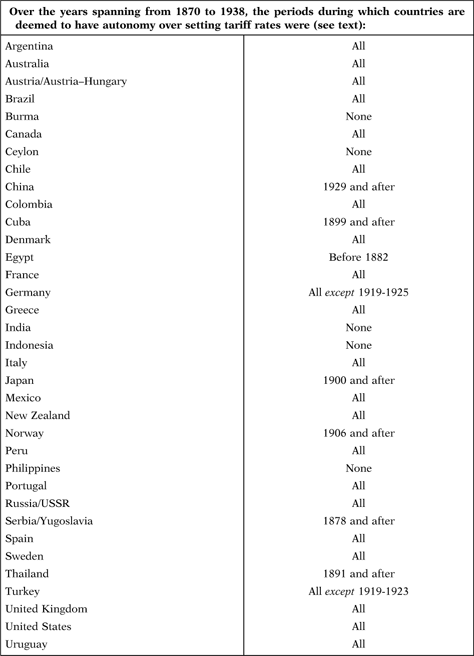
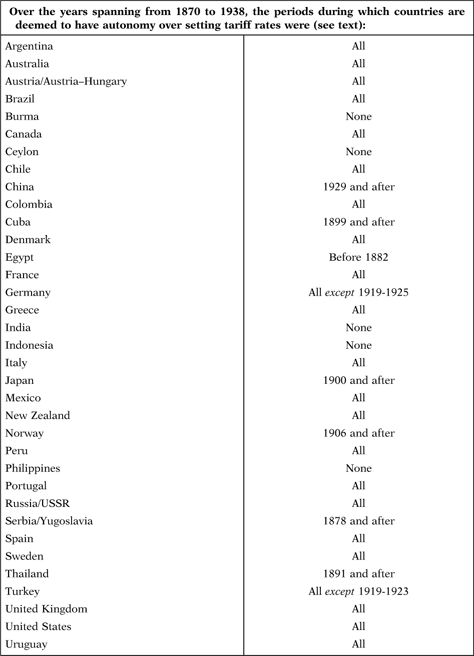
Our analysis requires formalisation of the concept of tariff autonomy, the freedom to set tariff levels independent of another state's military and political power. Table 1 lists the years in which we judge each country to have had tariff autonomy. Burma, Ceylon and India were subject to British imperial tariff collection policies, as Cuba was to the Spanish through 1899, Indonesia (Netherlands Indies) was to the Dutch and the Philippines was to both the Spanish up to 1898 and the United States thereafter. The British Foreign Office in China largely eliminated the tariff restrictions imposed by the treaties of Nanking and Tientsin in 1929. Norway did not have an independent tariff policy under the Swedish crown through 1905. Gradual weakening of Ottoman control in Serbia is construed to imply tariff autonomy following the 1878 Treaty of Berlin. Egypt is taken to hold tariff autonomy under non-interventionist Ottoman rule during the years prior to the British invasion of 1882, but not thereafter. Thailand is taken to recover autonomy from the grasp of the unequal treaties in 1891, following Ingram (Reference Ingram1971, p. 138), and Japan in 1900, following Lockwood (Reference Lockwood1968, p. 539). We take Turkey to have lost tariff autonomy in the brief years between its defeat in WW1 and Mustafa Kemal's establishment of the Turkish Republic thereafter.
TARIFF AUTONOMY 1870-1938
With these definitions of tariff autonomy in mind, we turn next to colonial tariff policy, followed by tariff policy under gunboat diplomacy.
3.1 Did Asian Colonies Simply Mimic their Masters?
This is a good place to explore the tariff autonomy issue within the colonies. There are five colonies in our sample, all in Asia: Burma, Ceylon, India, Indonesia and the Philippines, although foreign influence was strong enough (including occupation) to make Egypt behave like a colony after 1881 (see, e.g. Owen Reference Owen1993, p. 122). To what extent did these six simply mimic their colonial masters?
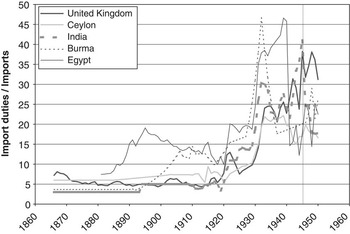
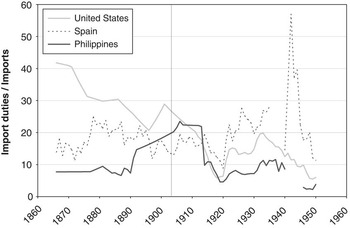
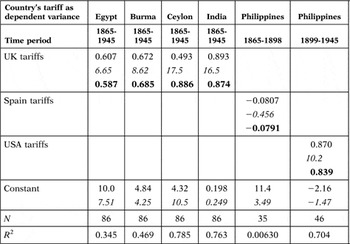
Figure 1 reveals a clear correlation in timing and magnitudes of change in tariff rates between the United Kingdom and her four colonies in the sample (Burma, Ceylon, Egypt and India). Figure 2 shows the same for the Philippines, first for Spain and then for the United States (becoming the imperialist master in 1899). Table 2 reports the master colony tariff rate correlations for these four and for the PhilippinesFootnote 5. Colonial tariff policy did indeed mimic that of the masters: although Spain failed to imprint its tariff rates on the Philippines before 1899 (Figure 2), the United States did afterwards, and Britain did so across all four of its Asian colonies in our sample (Figure 1). Furthermore, the t-statistics are very large, and the slope coefficients are similar across masters and colonies, ranging approximately between 0.5 and 0.9.
BRITISH TARIFFS VS. TARIFFS IN THE EMPIRE

FILIPINO TARIFFS VS. SPANISH AND AMERICAN TARIFFS

CORRELATION BETWEEN TARIFFS IN COLONIES AND THEIR COLONIAL MASTERS

Note: Ordinary least squares regressions. t-statistics are in italics and standardized coefficients are in bold below each coefficient.
However, note the variance across these four at any point in time (Figure 1), and note the country-specific variance in the intercepts reported for the five in Table 2. The Philippine tariff rates were on average approximately two points below the United States after 1898; and compared with Britain, India's tariff rates were approximately the same, Burma and Ceylon were four or five points higher, and Egypt's were ten points higher. Clearly, local conditions mattered even in colonies. Thus, we retain the full Asian sample in all that follows, although we will control for the tariff policy of the masters.
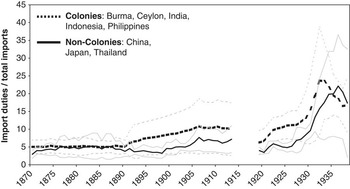
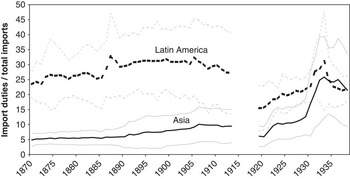
There are three surprises that emerge from this section. First, tariff policy correlates with local conditions even in the colonies. For example, in the 1930s tariff rates ranged between 9.9 per cent in the Philippines and 28.7 per cent in Burma. Second, the colonies in Asia had higher tariffs than the «independents» elsewhere in Asia throughout the eighty years following 1870. For example, if we exclude Egypt and Turkey, in the 1890s Asian colonies had 7.1 per cent tariff rates, while Asian «independents» had 3.8 per cent; in the 1930s, colonies had 19.3 per cent tariff rates, while «independents» had 17.3 per cent (see also Figure 3). Third, tariffs rose to high levels everywhere in Asia during the 1930s, including the colonies. Indeed, the literature has not appreciated that by the end of the 1930s tariffs in Asia were as high as they were in Latin America (Figure 4). This was long before the post-WW2 independence moves to de-link from world markets by policies of import substitution.
AVERAGE AND STANDARD DEVIATION OF TARIFF LEVELS: COLONIES VS. NON-COLONIES IN ASIA

REGIONAL AVERAGE AND STANDARD DEVIATION OF TARIFF LEVELS: LATIN AMERICA VS. ASIA

3.2 Gunboat Diplomacy and the Asian «Independents»
Independence did not necessarily mean tariff autonomy. Although our focus in this paper is tariff experience after the 1860s, we must start a couple of decades earlier to deal with the issue of Asian tariff autonomy.
Transport costs dropped very fast before WW1, accounting for approximately two-thirds of the integration of world commodity markets over the century following 1820, and for all of world commodity market integration in the four decades after 1870, when globalisation backlash offset some of it (see Lindert and Williamson Reference Lindert and Williamson2002; Williamson Reference Williamson2006a, Ch. 3, Reference Williamson2011a, Ch. 2). This political backlash was absent in Asia, partly because of the political influence wielded by native elites who appear to have had at least some control over the natural resources that were the base of their exports, partly because many of the colonialists were free traders, and partly because many Asian «independents» were persuaded to go open and stay open by gunboat diplomacy. As a result, commodity price convergence and trade creation between Europe and Asia were even more dramatic than within the Atlantic economy as shown by O'Rourke and Williamson (Reference O'Rourke and Williamson1999) and in greater detail by Williamson (Reference Williamson2002, Reference Williamson2006a, Reference Williamson2011a) alone.
While the fall in transport costs was dramatic, it was not the greatest globalisation event affecting 19th century Asia. Under the duress of Commodore Perry's American gun ships, Japan signed the Shimoda and Harris treaties and in doing so switched from autarky to free trade in 1858 (see the excellent surveys in Howe Reference Howe1996, Ch. 30; Bernhofen and Brown Reference Bernhofen and Brown2004, Reference Bernhofen and Brown2005). It is hard to imagine a more dramatic switch in trade policy since Japan's foreign trade quickly rose from nil to 7 per cent of national incomeFootnote 6, and its terms of trade improved by a factor of 3.5 times, according to Huber (Reference Huber1971), or 4.9 times, according to Yasuba (Reference Yasuba1996). Lockwood (Reference Lockwood1968, pp. 18-19) documents that between 1866 and 1895 the «unequal treaties» continued to limit Japanese tariffs to 5 per cent ad valorem. Japan regained tariff autonomy in 1899, but «[e]ven the recovery of tariff autonomy in the nineties still left treaty restrictions on the duties applying to many items. Rates were generally no higher than 10-15 per cent until the general tariff revision of 1911» (Lockwood Reference Lockwood1968, p. 539).
Other Asian nations followed the same liberal path, most forced to do so by colonial dominance or gunboat diplomacy. Thus, and even before the Japanese humiliation, China signed a treaty with Britain in 1842 that opened her ports to trade. The treaties of Nanking (1843), Tientsin (1858) and others like them, limited the Chinese ad valorem tariff rate on imports from essentially all of Europe to 5 per cent. In fact, the treaties (and their revisions in 1870, 1902 and 1922) did not set ad valorem rates but rather nominal specific duties that, although initially equivalent to a 5 per cent ad valorem tariff, rapidly declined in effective value as prices rose (Remer Reference Remer1926, pp. 171-181). Siam avoided China's humiliation by going open on its own and adopting a 3 per cent tariff limit in 1855. Between 1865 and 1890, treaties with all the major powers kept import duties below 3 per cent in Siam. Only after 1890 did Siam begin to revise the earlier treaties and increase tariff revenue by raising its tariff rates (Ingram 1971, pp. 34-35, 138). Korea emerged from being the autarkic Hermit Kingdom about the same time, undergoing market integration with Japan long before colonial status became formalised in 1910 (Brandt Reference Brandt1993; Kang and Cha Reference Kang and Cha1996). India went the way of British free trade in 1846, and Indonesia followed Dutch liberalism. Thus, and in sharp contrast with Europe (and its hostile grain invasion response) and Latin America (and its even more hostile manufactures invasion response), sharply declining transport costs were not offset in Asia by a rise in tariffs.
4 Some Latin American belle époque surprises
Coatsworth and one of the present authors (Coatsworth and Williamson Reference Coatsworth and Williamson2004a, Reference Coatsworth and Williamson2004b) recently uncovered some facts that had not been well appreciated: Tariffs in Latin America were far higher than anywhere else in the world during the decades before WW1. This was long before the Great Depression, after which the region retreated into what became known as Import Substituting Industrialisation (ISI). Indeed, tariffs were even rising in the decades before 1914, a period that has been identified by O'Rourke and Williamson (Reference O'Rourke and Williamson1999) the first globalisation boom for the world economy. This fact is surprising, and for three reasons: first, it comes as a surprise given that this region has been said to have exploited globalisation forces better than most of the poor periphery during the pre-1914 belle époque (Bulmer-Thomas Reference Bulmer-Thomas1994, Ch. 4); second, it comes as a surprise since standard economic histories say so little about itFootnote 7; and third, it comes as a surprise since most have always been taught to view the Great Depression as the critical turning point when the region is said to have turned towards protection and de-linked from the world economy for the first time (for three often cited examples, see Diaz-Alejandro Reference Diaz-Alejandro1984; Corbo Reference Corbo1992; Taylor Reference Taylor1998).
These Latin American surprises can be seen in Figure 4, but they can be appreciated even better by comparisons with the rest of the world. As we noted above, conventional wisdom is that Latin American reluctance to go open in the mid-late 20th century was the product of the Great Depression and the anti-global import-substitution strategies that arose to deal with it. Yet, late 19th century Latin America already had by far the highest tariffs in the world. For example, in 1885 the poor but independent parts of Latin America (Brazil, Colombia, Mexico and Peru) had tariffs almost five times higher than those in the poor and dependent parts of Asia (Burma, Ceylon, China, Egypt, India, Indonesia and the Philippines). Perhaps more to the point, in the decades before 1914 tariffs in Latin America were, on average, five times higher than those in the European industrial core of Britain, France and Germany!
At the crescendo of the belle époque, Latin American tariffs were at their peak, and still far above tariffs in the rest of the world. For example, in 1905 tariffs in Uruguay (the most protectionist, land-abundant and labour-scarce country) were approximately two and a half times those in Canada (the least protectionist, land-abundant and labour-scarce country). In the same year, tariffs in Brazil and Colombia (the most protectionist Latin American countries) were almost ten times those in China and India (the least protectionist in Asia). Furthermore, the rise in Latin American tariffs from the late 1860s to the turn of the century was much steeper than was true of Europe, including France and Germany about which so much tariff history has been written by scholars like Gerschenkron (Reference Gerschenkron1943), Kindleberger (Reference Kindleberger1951), Bairoch (Reference Bairoch1989) and, more recently, O'Rourke (Reference O'Rourke2000). For example, the rise in the average tariff rate between the 1870s and the 1890s was 5.7 percentage points in France, up from 4.4 per cent to still only 10.1 per cent, and 5.3 percentage points in Germany, up from 3.8 to still only 9.1 per cent. This heavily researched continental move to protection is pretty modest when compared with the rise over the same period in the four poor Latin American countries (up from 6.9 percentage points to 34 per cent), and this for a region that has been said to have exploited the pre-1914 globalisation boom so well by allowing exports to be an engine of growth.
5 Closed jaguar, open dragon?
Figure 4 reveals the stark difference between Latin American and Asian tariff policy that persisted over the century between the 1860s and the eve of the WW2. Black lines show regional means, while grey bands indicate one (regional) standard deviation above and below that mean.
Note the collapse in tariff rates across WW1, a worldwide phenomenon due to the tendency for wartime inflation to erode the ad valorem equivalent of what were largely specific duties, not principally the result of tariff policy changes. The inflation-induced wartime fall was partially recovered in the post-war deflations of the late 1910s and early 1920s. Note also that the tariff rate surged in the early 1930s, spiking in 1933, again repeated across the globe, as world price levels collapsed, raising the ad valorem equivalent of those specific duties, not the result of tariff policy changes. However, both Latin American and Asian tariff rates continued to rise after the world recovery and price rise: indeed, they rose more in Asia, reaching parity with and even exceeding protectionist Latin America 1934-1939. Of course, tariff rates were raised partly in response to America's Hawley–Smoot Act; however, the main point is that tariff rates rose to high levels in Asia and Latin America even after prices began to inflate during the recovery from the Great Depression.
The impact of inflation and deflation on ad valorem tariff rate equivalents was huge in Asia and Latin America since the poor periphery relied so heavily on specific duties (e.g. pesos per pound, francs per bale, dollars per yard). Why were (and are) specific duties so common in poor parts of the world? There are two possible explanations. First, honest and literate customs inspectors are scarce in poor countries, but honest and literate customs inspectors are needed to implement an ad valorem tariff where import valuation is so crucial. So, legislators imposed specific duties to minimise the «theft» of state tariff revenues by dishonest and illiterate customs agents. Second, specific duties are more effective macro-stabilisation devices in poor countries that rely so heavily on customs duties as a source of total government revenue. During booms, prices rise, lowering the effective tariff rates from specific duties, thus tending to mute the boom in tariff revenues generated by the boom in import demand. During slumps, prices fall, raising effective tariff rates, thus tending to offset the fall in tariff revenues generated by the slump in import demand. These macro-stabilisation forces would be all the more valuable in pre-WW2 Latin America and Asia when both regions were susceptible to great price volatility in their commodity export marketsFootnote 8.
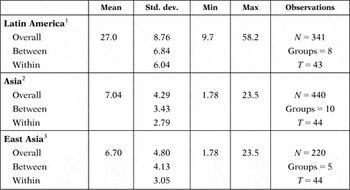
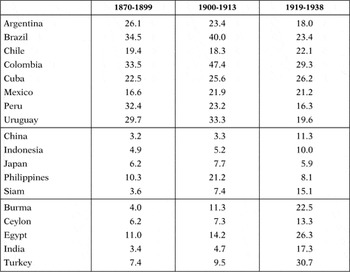
Table 3 summarises the variance in tariff rates before 1914. The average Latin American country had four times the tariff level of the average Asian country. Table 4 gives average tariffs for each country during three different time periods (1870-1899, 1900-1913 and 1919-1938). Setting aside for a moment the relatively high tariffs of the Philippines, every Asian country had lower tariffs than every Latin country before 1914. That was not true after WW1, however, when three Asian countries nudged their tariff rates up in to Latin American ranges (Burma, Egypt, Turkey). Moreover, to repeat, by the late 1930s Asia on average had higher tariffs than Latin America.
REGIONAL SUMMARY OF TARIFF LEVELS, 1870-1913

1Argentina, Brazil, Chile, Colombia, Cuba, Mexico, Peru and Uruguay.
2Burma, China, Ceylon, Egypt, India, Indonesia, Japan, Philippines, Siam and Turkey.
3China, Indonesia, Japan, Philippines and Siam.
AVERAGE TARIFF LEVELS BY PERIOD 1870-1938

Note: Tariffs are expressed as total import duties collected divided by total imports (%).
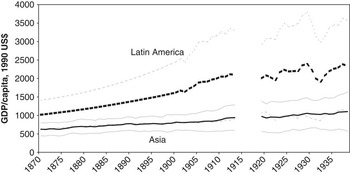
Figure 5 presents cross-sectional unweighted average GDP per capita, in 1990 US$, for the two regions. Despite variation within the sample and interwar troubles, the big morals of Figure 5 are that Latin America started from a far richer resource base and thus a much higher per capita income; her belle époque growth experience left Asia far behind, but the GDP per capita gap between Latin America and Asia stopped widening in the interwar decades.
REGIONAL AVERAGE AND STANDARD DEVIATION OF GDP/CAPITA: LATIN AMERICA VS. ASIA

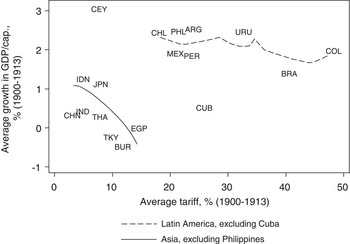
Were high tariffs associated with fast growth? Latin America had enormous tariffs and an impressive growth performance, while Asia had low tariffs and slow growth. However, Figure 6 shows that within these two regions, high tariffs are correlated with slow growth. So it looks like third forces might account for the regional growth differences. Future research might do well to explore this issue at greater length by looking at industrialisation and third factors, a point we will raise again at the end of this paper.
THE TARIFF-GROWTH CORRELATION IN THE YEARS BEFORE WORLD WAR 1
Note: Lines are linear polynomial fits, degree 1, bandwidth 5, Epanechnikov kernel.

6 Why were Latin American tariffs so much higher than Asian tariffs before WW1?
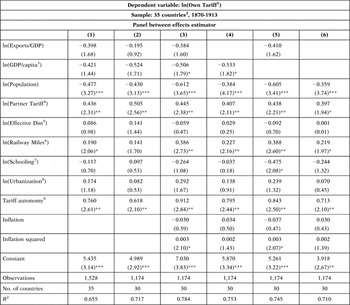
Table 5 seeks to determine some of the correlates of the vastly different tariff levels between Latin America and Asia before 1914. It certainly does not estimate a well-specified reduced-form model of the determinants of tariffs, so the coefficients estimated there cannot be given a simple causal interpretation. Large coefficients can represent the influence of reverse causation or the influence of omitted factors; small coefficients can reflect overlapping and countervailing effects. Nevertheless, it needs to be stressed that corroboration of theory advances the scientific enterprise even when strict hypothesis testing is difficult, as it certainly is in this setting.
WHY WERE TARIFFS HIGHER IN LATIN AMERICA THAN IN ASIA BEFORE WORLD WAR 1?

Notes: Absolute value of t-statistics is in parentheses below coefficient estimates.
*Significant at 10%.
**Significant at 5%.
***Significant at 1%.
1Import duties over imports.
2Argentina, Australia, Austria-Hungary, Brazil, Burma, Canada, Ceylon, Chile, China, Colombia, Cuba, Denmark, Egypt, France, Germany, Greece, India, Indonesia, Italy, Japan, Mexico, New Zealand, Norway, Peru, Philippines, Portugal, Russia, Serbia, Siam, Spain, Sweden, Turkey, United Kingdom, United States and Uruguay.
3In 1990 US$.
4Index of average tariff levels in top five trading partners weighted by exports going to that partner.
5Product of average physical distance to top five trading partners (principal city to principal city) weighted by exports going to that country, and transportation cost index.
6Miles of railway trunk line in country.
7Fraction of the population below the age of fifteen that is enrolled in primary school.
8Fraction of the population living in agglomerations of greater than 50,000 people.
9Indicator variable taking the value 1 if country has the freedom to set own tariff levels independently, or 0 if it does not.
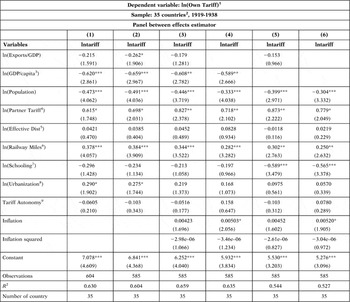
Table 5 explores cross-sectional differences in country tariffs for all thirty-five countries in the world sample, not just those in Asia and Latin America. These regressions use a panel between effects estimator, since the relationships we seek are cross-sectional — Latin America vs. Asia. The first three columns address the fact that coverage of the inflation regressor in our database is limited to thirty of the thirty-five countries. The first column thus analyses the full sample; the second column includes the same regressors, but restricts the sample to data points for which inflation is not missing; and the third column includes inflation. Below, we discuss the last three columns — which reflect an admittedly imperfect effort to approximate the magnitude of endogeneity in the model.
What do we expect? There is no well-specified causal model of fundamental tariff determinants in this period (or others). We use the available data to investigate whether they corroborate broad classes of theories, in order to motivate the development of better theories and better empirics. Table 5 right-hand side variables, suggested by previous work of the authors with others (Blattman et al. Reference Blattman, Clemens and Williamson2002, Reference Blattman, Hwang and Williamson2007; Coatsworth and Williamson Reference Coatsworth and Williamson2004a, Reference Coatsworth and Williamson2004b; Williamson Reference Williamson2006b), are the following (all but dummies in logs)Footnote 9:
• Export share: suppose that governments set tariffs to maximise revenue. This export/GDP ratio is a measure of export boom, where we expect booms in the previous year to diminish the need for high tariff rates this year, thus suggesting negative coefficients in the regressionFootnote 10.
• GDP per capita and Schooling: the latter the primary school enrolment rate. Suppose that governments set tariffs to protect local manufacture of products requiring skilled labour. These variables are taken as proxies for skill endowments, with the expectation that the more abundant the skills, the more competitive the industrial sector, and the less the need for protection — at least in Latin America and Asia where manufacturing was import competing. This suggests a negative coefficient in the regression.
• Population: suppose that governments choose tax instruments to meet a certain revenue target. Large countries have bigger domestic markets (especially interior markets) in which it is easier for local firms to find a spatial niche protected by transport costs. Alternatively, larger populations also imply higher density, a fact that makes domestic tax collection easier and tariff revenues less necessary. In either case, the demand for protection should be lower in such countries, and the regression might produce a negative coefficient.
• Partner tariffs: measured as a weighted average of the tariff rates in the trading countries’ markets, the weight being trade volumes, lagged. Suppose that governments set tariffs in strategic response to trading partner tariffs, as suggested by Dixit (Reference Dixit1987)and Bagwell and Staiger (Reference Bagwell and Staiger2002). Countries might then impose higher tariffs this year if they faced higher tariffs in their main markets abroad last year.
• Effective distance: that is, the distance from each country to either the United States or the United Kingdom (depending on trade volume), that distance adjusted by seaborne freight rates specific to that route. Suppose that governments set tariff rates to protect local firms from foreign competition. In this case, effective distance may have served as a substitute for tariffs, so the regression might yield a negative coefficient.
• Railway mileage: added in kilometres. Suppose again that governments set tariff rates to protect local firms from foreign competition. Poor overland transport connections to interior markets serve as a protective device that might plausibly substitute for tariffs. In this case, the regression might yield a positive coefficient.
• Urbanisation: taken as share of population in cities and towns greater than 20,000. Suppose that governments set tariffs in response to the lobbying power of urban capitalists and artisans in the periphery (urban workers in import-competing industries rarely had the vote) à la Stolper–Samuelson. This might suggest a positive coefficient in the regressions.
• Tariff autonomy: a dummy variable, taking a value 1 if a country has the freedom to set its own tariffs independently and 0 otherwise (see Table 1). Suppose plausibly that countries forced to set tariff rates preferred by their trading partners set those rates lower than other countries. This might suggest a positive coefficient.
• Inflation and inflation-squared: the rates in home markets. Suppose that countries rely to some degree on specific duties and face menu costs of changing them as goods prices shift. This might suggest a negative coefficient. However, very rapid inflation might well have triggered a speedier legislative reaction with increases in specific duties, thus yielding a positive and offsetting coefficient on the squared term in the regression.
All of the signs on the regression coefficients in Table 5 are consistent with prediction and are mostly though not always statistically precise. The coefficient of determination is likewise high for all specifications.
Yet again, these coefficients cannot be given a strictly causal interpretation. Many interlocking pathways of causation could be at work among the variables in these regressions. For example: if tariffs have a causal effect on GDP per capita or on exports (this last through a direct effect on imports coupled with a balance of payments mechanism linking imports and exports). In columns (4) through (6), these variables are piecewise dropped from the regression. The other coefficient estimates change little, with the exception of schooling. This is suggestive but not definitive evidence that reverse causation from income or exports to tariffs may not be primarily responsible for the broad pattern of coefficients in the initial regressions. This certainly does not settle the question of which variables in the regression cause which others, in which direction and with which magnitudes.
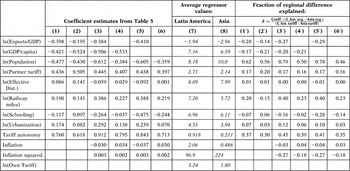
Combined, variance in the regressors of Table 5 explains 65-78 per cent of variance in the world cross-sectional tariff before 1914. What about the differences between Latin America and Asia? The first six columns of Table 6 are simply the coefficient estimates from Table 5, reproduced without modification. The next two columns give the average values of each regressor in both Latin America and Asia, in natural logarithms; at the bottom, the same values for the regressand are shown. Of particular note is the similarity of the figures for effective distance, an average of physical distance to the top five trading partners weighted by exports sent to that partner, multiplied by an index of transportation costs. Asia may have been farther away from the core, but it was doing more intra-regional trading than Latin America. Latin America had a notably higher share of exports in GDP, a much smaller average population, much more railway penetration and a much greater degree of tariff autonomy. It was also richer, more schooled, more urban, faced higher tariffs abroad and underwent much higher rates of inflation.
WHAT ACCOUNTS FOR THE DIFFERENCE IN TARIFFS BETWEEN LATIN AMERICA AND ASIA BEFORE 1914?

Notes: Coefficient estimates in columns (1) through (6) are taken directly from Table 5. Columns (7) and (8) show the average value of the underlying regressor before 1914 in Latin America and Asia, respectively, where Latin America includes Argentina, Brazil, Chile, Colombia, Cuba, Mexico, Peru, and Uruguay and Asia includes Burma, China, Ceylon, Egypt, India, Indonesia, Japan, Philippines, Siam and Turkey. Columns (1′) through (6′) take the difference between columns (7) and (8), multiply this difference by the corresponding coefficient from one of the first six columns and divide by the difference between average ln(Own Tariff) in Latin America and average ln(Own Tariff) in Asia. This value δ can be interpreted as the fraction of the difference between the two regions’ tariffs that is explained by each regressor. Since tariffs were higher in Latin America, a negative value of δ suggests that the regressor cannot explain the observed difference; a large positive value suggests it can.
The italics are to show that these are a different kind of number from the numbers in the other columns.
The final six columns are a linear combination of the previous columns. The result is an estimate of the relative contribution of each variable's association with tariffs in explaining the much higher pre-1914 tariffs in Latin America compared with Asia. It is calculated in the following way. First, we take the difference between the average regressor value in Latin America and its value in Asia, from columns (7) and (8). Second, this difference is multiplied by the corresponding coefficient from the first six columns. Third, this number is divided by the average difference ln(Own Tariff) between the two regions during this period (the last row of columns (7) and (8)). For the resulting ratio δ, a value of zero means that inter-regional differences in that regressor have no partial correlation with inter-regional differences in tariffs. A negative value indicates that inter-regional differences in that regressor have a partial correlation with lower tariffs in Latin America than in Asia, ceteris paribus. For substantial correlates of the broadly higher tariffs in Asia, we are looking for large positive values in those last two columns.
There are five variables whose differences accord strongly with both worldwide correlations between tariffs and country traits, and with the large observed tariff differential between the regionsFootnote 11. These are population size, railroad penetration, urbanisation, partner tariffs and tariff autonomy.
This pattern in the data accords with, though it does not definitively test, classes of theory that have been important in the literature. Start with the first three variables, saving tariff autonomy and partner tariffs for last. Asia's enormous populations provided gargantuan internal markets in which producers could exploit specialisation and scale. Large internal markets tended to diminish the need for tariffs to protect import-competing producers. Latin America's exploding railroad network certainly increased export sector access to foreign markets, but it also exposed interior producers to more foreign competition, encouraging a tariff backlash to offset the impact of the railroads. The railroad system was less extensive in Asia, and in fact we have measured it in a fashion that understates the Asian railroad shortfall (miles of railway trunk line, rather than miles per capita). A less extensive railway system in Asia implied less need for tariffs for protective purposes. It is also argued that Asian railroads were built primarily to foster exports, illustrated by Hurd's (Reference Hurd1975) study of India.
Higher levels of urbanisation in Latin America also accord with the gap in tariff rates between Latin America and Asia under these partial correlations. Rogowski (Reference Rogowski1989) has used the Stolper–Samuelson theorem to suggest that we look to Latin American urban capitalists for the political economy explanation for those extraordinarily high tariffs during the belle époque. Although their economies certainly varied in labour scarcity, every Latin American country faced relative capital scarcity and relative land abundance. As the Stolper–Samuelson theorem has it, «protection benefits (and liberalization of trade harms) owners of factors in which, relative to the rest of the world, that society is poorly endowed» (Rogowski Reference Rogowski1989, p. 3). According to this kind of thinking, urban capitalists should have been looking to form protectionist coalitions as soon as the Latin American belle époque and the pax britannica globalisation forces began to threaten them with freer trade. High urbanisation rates in Latin America gave these interests more power to achieve protection, while low rates in Asia contributed to the opposite result.
Even controlling for so many other factors, tariff autonomy is still associated with higher tariffs. How much did it matter? After all, we have seen a variety of tariff rates even within colonies run by imperialists favouring free trade at home. Yet, policy autonomy implied high tariffs before WW1, with the coefficient on the autonomy variable in the regressions ranging between 0.618 and 0.912 in columns (1) through (6). The model suggests, then, that tariff autonomy might have been associated with higher tariffs by a factor of 1.7-2.5, all else equalFootnote 12. That is, tariff autonomy per se for late 19th century Asia is predicted to correlate with an increase in average Asian tariffs from 7 to 17 per cent. Turning to columns (1′) through (6′), we see that Asia's lack of tariff autonomy accounts for about one-third of the tariff difference between Asia and Latin America. However, that leaves almost two-thirds associated with factors other than tariff autonomy.
Did the Asian countries subjected to unequal treaties, but not formally colonies (China, Japan and Siam), have higher tariffs than those that were colonies (Burma, Ceylon, India, Indonesia and the Philippines)? Surprisingly, they did not, as Figure 3 documents.
With policy autonomy, moving naively along these partial correlations, hypothetical Asian tariff levels might have been half those of Latin America, rather than only a fourth. However, as we have seen, tariff autonomy was not the only variable showing important associations with tariffs. Internal market size and the protection of the market that poor railroads offered domestic producers appear to correlate with lower tariffs. Weak political power of the Asian urban capitalist may also have mattered, a weakness associated with smaller urban presence there compared with Latin America, though the urbanisation proxy used here could well correlate with other competing factors. Finally, after controlling for tariff autonomy, partner tariffs correlate strongly with own tariffs. If your trading partner had high tariffs, so did you. Latin America traded more with protectionist North America, whereas Asia traded more with free trade Europe (especially its free trade colonisers Britain and the Netherlands). This suggests an interesting candidate to further explain the tariff gap between the regions, though it by no means settles the issue.
We cannot leave this section without saying a word about historical persistence, especially in the case of Latin America. Table 5 covers the four decades after 1870, but what about the half century before? Does it seem to matter that this post-independence period was extremely violent in Latin America?
Customs duties, relative to other sources of revenue, are an inexpensive way to finance rising central government expenditures on infrastructure and defence. It is plausible that there might be greater reliance on tariffs than on other sources of revenue in young, recently independent economies with few bureaucratic resources to implement efficient collection, limited access to foreign capital markets, more enemies and no imperialist protection from them. This was certainly true of the newly independent United States and Latin American countries in the first half of the 19th century, although the United States had more success in gaining access to European capital markets. As Centeno (Reference Centeno1997, Table 1) has shown, the average share of customs duties in total revenues across eleven Latin American republics was 57.8 per cent between 1820 and 1890. Furthermore, customs revenues are especially important for land-abundant countries with federal governments since they do not have the population and taxpayer density to make other forms of tax collection efficientFootnote 13. Finally, there was a huge revenue need to bankroll armed conflict in the United States of the 1860s and the newly independent Latin American republics between the 1820s and the 1870s (see Centeno Reference Centeno1997; Mares Reference Mares2001; Bates et al. Reference Bates, Coatsworth and Williamson2007).
The preoccupation with national defence and internal security pushed the newly independent Latin American republics towards higher revenue-generating tariffs. Centeno (Reference Centeno1997) documents that military expenditures quickly rose to consume over 70 per cent and often more than 90 per cent of all revenues. Weak governments, under attack from within and without, abandoned internal taxes that required an extensive and loyal bureaucracy to collect and concentrated instead on tax collection at a few ports and mines. Thus, levels of tariff protection rose in every Latin American country (for which there are data) as did the customs revenues as a percentage of total government revenues.
We stress these facts since we believe that historical persistence matters, and that some part of those very high Latin American tariffs between 1870 and WW1, can be explained by the level of violence in the half century before 1870, violence so particular to Latin America during what was otherwise a pax britannica world.
7 What explains the interwar rise in Asian protection?
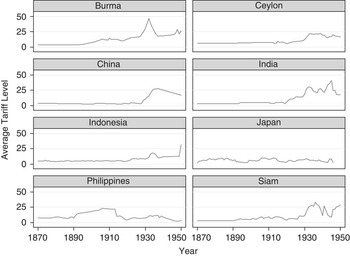
Why did Asian tariffs rise to those high Latin American heights during the interwar years, especially during the 1930s? Note that it was not just one or two Asian countries pushing those tariffs up, since Figure 7 shows that it was ubiquitous across the whole region. Only Japan and the Philippines failed to raise tariffs in the 1930s. But every other Asian country did so in both decades, with the biggest tariff surge taking place for Burma, Ceylon, China, India and Siam (Thailand). What was different about the interwar decades?
TARIFF LEVELS IN ASIA, 1870-1950

Table 7 repeats for the interwar decades the same regressions reported in Table 5 for the pre-WWI decades. The comparison is striking: the coefficients on all the correlates of tariff levels are broadly similar to those before 1914, except one: tariff autonomy. While countries with tariff autonomy had much higher tariffs before WW1, all else equal, they did not thereafter. This suggests that the American and European hegemons may have released their grip on their colonies and dependent partners in the interwar yearsFootnote 14.
WHY WERE TARIFFS HIGHER IN LATIN AMERICA THAN IN ASIA IN THE INTERWAR PERIOD

Notes: Absolute value of t-statistics is in parentheses below coefficient estimates.
*Significant at 10%.
**Significant at 5%.
***Significant at 1%.
1Import duties over imports.
2Argentina, Australia, Austria–Hungary, Brazil, Burma, Canada, Ceylon, Chile, China, Colombia, Cuba, Denmark, Egypt, France, Germany, Greece, India, Indonesia, Italy, Japan, Mexico, New Zealand, Norway, Peru, Philippines, Portugal, Russia, Serbia, Siam, Spain, Sweden, Turkey, United Kingdom, United States and Uruguay.
3In 1990 US$.
4Index of average tariff levels in top five trading partners weighted by exports going to that partner.
5Product of average physical distance to top five trading partners (principal city to principal city) weighted by exports going to that country, and transportation cost index.
6Miles of railway trunk line in country.
7Fraction of the population below the age of fifteen that is enrolled in primary school.
8Fraction of the population living in agglomerations of greater than 50,000 people.
9Indicator variable taking the value 1 if country has the freedom to set own tariff levels independently, or 0 if it does not.
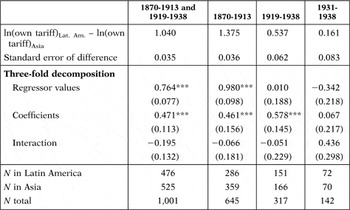
Table 8 offers further evidence of the loosening colonial grip. The first row of the Oaxaca–Blinder decomposition reports the portion of the difference in log tariffs between Asia and Latin America due to differences in the value of the right-hand side variables, the second due to the difference in the coefficients between the two regions, while the third due to both differences at once (interaction). The table confirms what we suggested above: for the 1930s, we cannot reject the hypothesis that all three of these components are zero, meaning that the ability of our endogenous tariff model to meaningfully decompose the correlates of tariff differences between the two regions falls apart in the 1930s (the residual goes way up). Even for the interwar as a whole, it appears that differences in the regressors (e.g. autonomy) are not associated with the regional tariff gap any more, but rather that differences in how the regressors are associated with tariffs (the coefficients) matter much more.
OAXACA–BLINDER DECOMPOSITION OF LN(OWN TARIFF), LATIN AMERICA AND ASIA

It seems to us that the moral is this: if we are looking for the historical origins of inward-looking and anti-market ISI strategies in much of Asia during the post-WW2 period, we should start looking at the interwar transition of the colonies and dependents to policy autonomy, not just in their response to the global crisis of the 1930s. As for the historical origins of the post-WW2 ISI anti-global and anti-market strategies in Latin America, we need not look farther than the very high tariffs that prevailed there over the century before 1950.
8 Did tariff policy influence industrialisation in Latin America and Asia?
In some parts of Latin America and Asia, modern industrialisation started more than a century ago. Latin America had two emerging industrial leaders in the late 19th century (Brazil and Mexico), Asia had four (Bengal, Bombay, Japan and Shanghai) and the European periphery had at least three (Catalonia, the north Italian triangle and Russia). Why did Asian and Latin American industrialisation start in the late 19th century and why in some places and not in others? Undoubtedly, the answer is as complex as any question dealing more generally with the causes of modern economic growth, and certainly any answer should include the much-cited fundamentals like culture, geography, institutions and good or bad government. And certainly those fundamentals would help explain any manufacturing productivity catch-up (or its absence) in Latin America and Asia. However, as to timing and magnitudes, here global forces have a chance to shine. What role did tariffs play? What role did world market forces play?
The economics literature suggests five possible explanations, but that literature is just starting to offer an empirical assessment of their importance between 1870 and 1940 (see Williamson Reference Williamson2011b). The big five are:
• Trade barriers: higher tariffs and non-tariff barriers must have reduced competitive pressure on local import-competing manufacturing, in effect by raising the price of their output in domestic markets. NTBs should include real exchange rate manipulation and the great depreciations during the interwar decades. In contrast, falling transportation costs across sea lanes (effective distance) would have increased competitive pressure on home manufacturing, and railroad development (railway mileage per land area) would have done the same by exposing internal markets to more foreign competition. How big were those effects, and was tariff and exchange rate policy the most important of them?
• Terms of trade and world markets: a secular rise in primary product prices may foster an export boom in the poor periphery — as well as a GDP per capita gain — but it will also cause de-industrialisation. The 19th century offers abundant evidence confirming this effect, whether for India, Mexico or the Ottoman EmpireFootnote 15. However, if a primary product export price boom fostered de-industrialisation in the poor periphery, the secular export price slump between the 1870s and 1890s and the 1930sFootnote 16 should have fostered industrialisation there as well.
• Wage costs: as the poor periphery fell further behind the fast-growing industrial core up to WW1 — what we now call the Great Divergence — wage costs per unit of labour fell in the poor periphery relative to the industrial core. Furthermore, since, without the role of trade barriers, manufacturing prices were similar the world around, the own wage in manufacturing (the nominal wage divided by the price of manufacturing output) must also have fallen in the poor periphery relative to the rich industrial core. This rising gap should have given the poor periphery an increasing cost advantage in their domestic markets, ceteris paribus, fostering industrialisation, led by labour-intensive manufacturing.
• Fuel and intermediate input costs: textile manufacturing needs cotton, wool, flax and silk intermediates, but many countries do not grow some or any of them. Metal manufacturing needs ores, but many countries do not mine them. Since these are high bulk, low-value products, they were expensive to ship long distance in 1870; however, transport revolutions had lowered those costs dramatically by 1940. Manufacturing in natural resource scarce countries in the poor periphery must have benefited by global market integration much more than did the resource-abundant industrial leaders. In addition, modern steam-driven power in industry needed cheap fuel. Those without coal to mine or oil to pump suffered severe competitive disadvantage in 1870, but that disadvantage had almost evaporated for any poor periphery country without coal or oil reserves in the more global world of 1940 when they could import the stuff cheaply.
• Productivity catch-up: given wage, fuel and intermediate costs, given world market conditions and given tariff policy, productivity catch-up of domestic manufacturing on the industrial leaders should surely have fostered industrialisation in the poor periphery. This, one supposes, is where the role of pro-growth institutions and good government should shine.
While these are the big five, any future analysis should also control for domestic market size and the level of human capital — required more intensively in manufacturing than in primary product production — as well as whether the country was a colony — and thus whether it had autonomy over other than just tariff policy. Other forces might include whether parts of interwar Asia were mimicking pro-industrial policies in emerging industrial new comers like Brazil, Mexico and Russia/USSR.
9 Concluding remark
Are there lessons from history here? Perhaps, but we prefer to end instead with the following challenge: any claim that liberal trade policy lies at the heart of recent growth performance in these two regions must also explain why high tariffs did not dampen growth or industrialisation during the Latin American belle époque and why low tariffs did not ignite growth or industrialisation in Asia before 1914.