

A wide variety of commercial foods and indigenous products confer their microbiological safety mainly to the antagonistic action of lactic acid bacteria (LAB). Fermentation is an old process with a complex nature of variable interactions that makes this procedure an art rather than an efficiently controlled operation. In the last decade this bacterial antagonism has received considerable scientific attention as a consequence of the current trends toward less processed and healthy food. However, still today there is a lack of knowledge about the dynamic of microbial populations involved in food fermentation processes. LAB, with GRAS (generally regarded as safe) status, produce lactic acid and other functional antimicrobial metabolites, such as diacetyl, acetoin, hydrogen peroxide, acetate, ethanol, carbon dioxide and bacteriocins, that are potentially useful as natural substitutes for chemical preservatives in the context of biocontrolling the growth of pathogens and spoilage bacteria in food and hence enhancing food safety, quality and extending shelf life (De Vuyst & Vandamme, Reference De Vuyst and Vandamme1994; Gálvez et al. Reference Gálvez, Abriouel, Lucas-López and Omar2007).
The most important biogenic metabolites produced by LAB are lactic acid and bacteriocins. Eklund (Reference Eklund and Gould1989) reported that both the dissociated and the undissociated forms of organic acids may have additive inhibitory effects on bacterial growth with the undissociated forms having more inhibitory activity than the dissociated forms. Bacteriocins are proteinaceous compounds active generally against closely related bacterial species. Recently, studies have reported the broad spectrum antagonistic activity of several bacteriocins (Ogunbanwo et al. Reference Ogunbanwo, Sanni and Onilude2003). Bacteriocin production is regulated via quorum sensing, a peptide-pheromone-based trans-cell membrane signal transduction pathway, characterized by a microbial population density dependence (Quadri, Reference Quadri2002). The efficacy of quorum sensing may be influenced by extrinsic and intrinsic factors, food microbiota, and target bacteria (Gálvez et al. Reference Gálvez, Abriouel, Lucas-López and Omar2007). The effect of the presence of competing microorganisms on the ability of bacteriocin-like inhibitory-substance (BLIS) production is not well known. Maldonado et al. (Reference Maldonado, Jiménez-Díaz and Ruiz-Barba2004) and Rojo-Bezares et al. (Reference Rojo-Bezares, Sáenz, Navarro, Zarazaga, Ruiz-Larrea and Torres2007) demonstrated only the importance of an external stimulus provided by an additional bacterial population and/or inducing factor in the same growth medium for the production of bacteriocin.
Some Escherichia coli strains and Listeria monocytogenes are foodborne pathogens of major health public concern. Although the antibacterial activity of LAB against List. monocytogenes and pathogenic Esch. coli strains in many animal-derived food products is well established (Feresu & Nyati, Reference Feresu and Nyati1990; Jeppesen & Huss, Reference Jeppesen and Huss1993; McMullen & Stiles, Reference McMullen and Stiles1996; Faith et al. Reference Faith, Parniere, Larson, Lorang and Luchansky1997; Bredholt et al. Reference Bredholt, Nesbakken and Holck2001 and Ogwaro et al. Reference Ogwaro, Gibson, Whitehead and Hill2002), studies on the growth dynamics of bacterial populations in mixed cultures are limited. The database ComBase (2009) contains a small number of experimental data sets of mixed cultures, but is generally limited to the quantification of the growth or survival/inactivation of pathogenic strains including Esch. coli and List. monocytogenes. In particular, growth curves of co-cultures of LAB with List. monocytogenes have been generated by different authors (Breidt & Fleming, Reference Breidt and Fleming1998; Pleasants et al. Reference Pleasants, Soboleva, Dykes, Jones and Filippov2001; Vermeiren et al. Reference Vermeiren, Devlieghere, Vandekinderen and Debevere2006) who have also examined the inhibitory mechanism and quantified the inhibitory potential of LAB as function of time.
Successful application of LAB to control the growth of microorganism of health and spoilage significance and improve food safety and stability relies on the understanding of the interactions between the involved microorganisms and between the microorganisms and the food system (Martens et al. Reference Martens, Beal, Malakar, Zwietering and van't Riet1999). Interactions between organisms appear when the presence of one organism influences the growth of another. These interactions may be expressed directly upon physical contact or indirectly by altering the environmental growth parameters. The most relevant mechanisms by which microorganisms can interact are competition for nutrients, tolerance of waste products and production of inhibitory substances. The survival of microbial populations during fermentation processes strongly depends on their ability to adapt to specific changing conditions in the environment. Fredrickson (Reference Fredrickson1977) classified the possible indirect interactions between two bacterial strains as mutualism, competition, commensalism and amensalism. Due to the different types of interactions, mixed cultures show different growth patterns compared with their pure cultures (Leroy & De Vuyst, Reference Leroy and De Vuyst1999; Leroy et al. Reference Leroy, Degeest and De Vuyst2002).
With a number of intrinsic, extrinsic and implicit factors involved in interaction phenomena, it can be expected that mixed microbial cultures in food will exert own behavioural feature. The study of the dynamics of microbial populations through the use of model communities and predictive microbiology is an approach that helps understand microbial interactions and enables the identification of the important driving factors for further dynamic modelling. This type of approach also tends to deliver objective information that could be used to improve strain selection and process design (Leroy et al. Reference Leroy, Degeest and De Vuyst2002).
The purpose of this study was to quantify the inhibitory potential of LAB against Esch. coli and List. monocytogenes, in terms of the modification of the growth kinetic parameters of pure cultures and to elucidate the type of interaction in co-cultures grown in milk. Growth curves of mono- and co-cultures were constructed and kinetic parameters were estimated by curve fitting procedure and compared in order to accomplish these goals.
Materials and Methods
Bacterial strains and inoculum preparation
Lactobacillus plantarum strains WS4174 and LB279, Esch. coli ECO25, and List. monocytogenes LMO26 were isolated from dairy products and identified by reference to 16S rRNA gene sequences. Esch. coli ECO25 and List. monocytogenes LM26 were used as model pathogenic microorganisms. The antimicrobial activity of the Lactobacillus strains studied herein was previously determined against different indicator bacteria by the agar-diffusion (Cintas et al. Reference Cintas, Casaus, Fernandez and Hernandez1998) with culture supernatants produced at 37°C. Lb. plantarum strains WS4174 and LB279 have an autoinducible and a co-culture inducible BLIS production, respectively. The proteinaceous nature of the antimicrobial compound was shown by assessing the antagonistic effect after heat and enzymatic hydrolysis treatment of the supernatants using the agar-diffusion assay (Cintas et al. Reference Cintas, Casaus, Fernandez and Hernandez1998). To activate the strains, one frozen bead (−70°C) was transferred to 5 ml MRS (de Man, Rogosa and Sharpe) broth (Scharlau Chemie S.A., Barcelona – Spain) and incubated without agitation at 37°C for 24 h. The culture was subcultured into 5 ml fresh MRS broth and incubated at 37°C for 24 h to reach ∼9·5 log CFU/ml, as determined by viable plate count method.
Growth curves generation
Growth experiments were performed in 10-ml screw-cap tubes containing 5 ml milk for each sampling time point. Commercial UHT whole milk was provided by Productos Naturales de la Sabana S.A – Alquería (Tabio, Colombia). Pure and co-cultures (binary system 1:1) without pH regulation were started with an initial concentration for each bacterium of 2·55±0·26 log CFU/ml that showed no significant difference (P⩾0·05). The growth curves were constructed from at least three independent time course experiments at 37°C (±1°C) under non-agitated conditions. At each sampling time (every 2 h), one tube was removed and the number of viable cells was determined in duplicates after 48 h of incubation by plate count on MRS agar where the pathogenic and the lactobacilli strains were discriminated on the basis of the appearance of colonies. The colonies of the pathogens were small, round, smooth but with different colour; List. monocytogenes showed translucent pinkish and Esch. coli cream coloured colonies, while those of Lb. plantarum were large, circular, smooth and cream-white (data not shown). After incubation, enumerations at appropriate dilutions were performed and the average count was plotted as log CFU/ml against time.
The pH measurements (pH/Ion Meter CG842 Schott, Germany) were performed at each sampling point throughout the entire incubation course.
Estimation of microbial growth parameters
The Baranyi & Roberts (Reference Baranyi and Roberts1994) model was fitted to growth data and the kinetic parameters, initial and maximum population level, lag time, and maximum specific growth rate, were estimated by non-linear least-squares regression using the DMfit curve-fitting program (available at http://www.ifr.bbsrc.ac.uk/safety/DMFit). The goodness of fit of the fitted equation was assessed by standard error (se), residual analysis, and coefficient of determination (R 2). Though the basic assumption behind the model of Baranyi and Roberts (Reference Baranyi and Roberts1994) is that the growth environment is constant, here we neglect the change of the environment since the purpose of the curve fitting is the demonstration of differences between respective growth parameters rather than mechanistic modelling.
Assessment of the antibacterial activity of neutralized culture supernatants
Supernatants were harvested from co-cultures grown at 37°C after 6, 12, 18, 24, 30, 34, 46, 58, 70, and 82 h of incubation. Cell-free culture supernatants were obtained by centrifugation (12·000 g at 4°C for 10 min), sterilized through 0·2 μm pore-size filters, and stored at 4°C until use in less than 30 min. The antimicrobial activity of neutralized cell-free culture supernatants was evaluated by spot-on-lawn method (Cintas et al. Reference Cintas, Casaus, Fernandez and Hernandez1998) using Esch. coli ECO25 and List. monocytogenes LMO26 as indicator microorganisms.
Statistical analysis
Data were analyzed by ANOVA at a level of significance of P<0·05. The analyses were performed with the SPSS (Release 15.0, SSPS Inc, Chicago, Illinois, USA) statistical program.
Results
Estimation of growth kinetic parameters
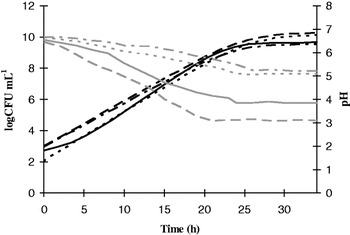
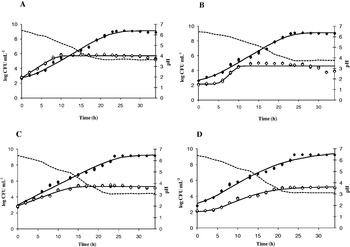
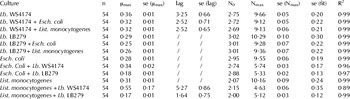
Four growth curves of pure cultures of Lb. plantarum WS4174, LB279, Esch. coli ECO25, and List. monocytogenes LMO26 (Fig. 1) and four growth curves of co-cultures as antagonist/pathogen systems of Lb. plantarum WS4174/Esch. coli ECO25, Lb. plantarum WS4174/List. monocytogenes LMO26, Lb. plantarum LB279/Esch. coli ECO25, and of Lb. plantarum LB279/List. monocytogenes LMO26 (Fig. 2) were generated in UHT milk at 37°C. The regression analysis (Table 1) established that the Baranyi & Roberts (Reference Baranyi and Roberts1994) model described the 12 growth curves satisfactorily with an average se of 0·21 (minimum 0·12 and maximum 0·35). The determined average R 2 was 0·98 (min 0·89 and max 0·99). The residual analysis showed that there was no systematic bias between observed and predicted values nor was there clustering of residuals with the same sign or autocorrelation. The estimated kinetic parameters, maximum specific growth rate (μmax in h−1), initial (N0 in log CFU/ml) and maximum estimated cell concentration (Nmax in log CFU/ml) are shown in Table 1. These kinetic parameters were scientifically plausible and well defined according to the confidence limits and the plots of the fitted functions using the final parameter estimates. Only the estimation of the lag phase presented, in all cases, relatively large se between 0·65 and 0·86 due to its short extension and the scarcity of experimental data.
Modelled growth curves of monocultures in whole UHT milk at 37°C and pH profiles. Lactobacillus plantarum WS4174 (▬), Lb. plantarum LB279 (▬ ▬) Escherichia coli ECO25 (▬ - ▬), and Listeria monocytogenes LMO26 (---). pH profiles in grey respectively.

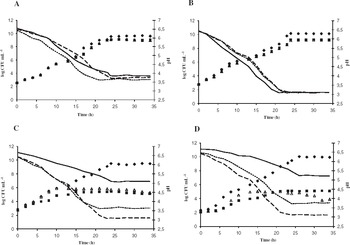
Modelled individual growth curves of antagonist/pathogen co-cultures and pH profiles in whole UHT milk at 37°C. Lb. plantarum WS4174/ Esch. coli ECO25 (A), Lb. plantarum WS4174/ List. monocytogenes LMO26 (B), Lb. plantarum LB279/Esch. coli ECO25 (C), and Lb. plantarum LB279/List. monocytogenes LMO26 (D). Experimental growth data of the LAB strains (⧫), experimental growth data of the pathogenic strains (◊), fitted Baranyi-model (▬), and pH data (---).

Goodness of fit of the Baranyi-model of pure and co-cultures in whole UHT milk at 37°C

Number of experimental growth data (n), maximum growth rate (μmax), lag-phase (lag in h), initial estimated cell concentration (N0 in log CFU/mL), maximum estimated cell concentration (Nmax in log CFU/mL), standard error (se), and absence of lag phase (/)
Growth characteristics of pure cultures
In pure culture, Lb. plantarum WS4174 was the fasted growing bacteria with a μmax of 0·36 h−1 and Lb. plantarum LB279 showed a Nmax that was 0·6 log-cycles higher than that estimated for Lb. plantarum WS4174 (Table 1). List. monocytogenes LMO26 reached similar cells counts compared with Lb. plantarum LB279, with approximately 10·2 log CFU/ml and Esch. coli ECO25 reached a similar Nmax as did Lb. plantarum WS4174 with 9·6 log CFU/ml (Table 1). Only Lb. plantarum WS4174 exhibited a lag phase of ∼3 h. In the pure cultures of Lb. plantarum WS4174 and Lb. plantarum LB279, the pH decreased to ∼4·0 and ∼3·0 units, respectively (Fig. 1). The pH in pure cultures of the pathogenic strains dropped to the final value of ∼5·0 units (Fig. 1).
Growth characteristics of co-cultures
As shown in Table 1, the LAB strains each in co-culture with Esch. coli ECO25 or List. monocytogenes LMO26 exhibited slightly, but significant (CI 95%), diminished yield compared with their pure cultures. The Nmax of Lb. plantarum WS4174 and Lb. plantarum LB279 were 0·5 and 1·0 log CFU/ml below the recorded counts in pure cultures, respectively. Lb. plantarum strains WS4174 and LB279 in association with Esch. coli ECO25 or List. monocytogenes LMO26 showed no significant differences in their μmax according to the calculated 95% confidence limits.
However, the presence of either of the lactobacilli strains studied herein affected the growth of Esch. coli ECO25 and List. monocytogenes LMO26 (Fig. 2). The stationary growth phases of the pathogenic strains in mixed cultures were induced prematurely ∼15 h earlier compared with the pure cultures (Fig. 1 & 2). The Nmax of Esch. coli ECO25 showed a reduction of 3·8 log cycles in both binary systems (Table 1, Fig. 2A & C). Lb. plantarum WS4174 was able to limit the growth of List. monocytogenes LMO26 more effectively with 5·5 log-cycles reduction (Table 1, Fig. 2B). The extent of growth inhibition induced by Lb. plantarum LB279 on List. monocytogenes LMO26 was significantly stronger (P<0·05) with an Nmax reduced by 5 log-cycles (Table 1, Fig. 2D).
Lb. plantarum LB279 depressed the μmax of Esch. coli ECO25 and List. monocytogenes LMO26 by approximately 50% (Table 1). List. monocytogenes LMO26 showed a lag phase when grown in co-cultures. Through comparison of the pH profiles of mono- (Fig. 1) and co-cultures (Fig. 2) it could be established that the pH decrease was mostly influenced by the lactobacilli strains.
Antibacterial activity of neutralized culture supernatants
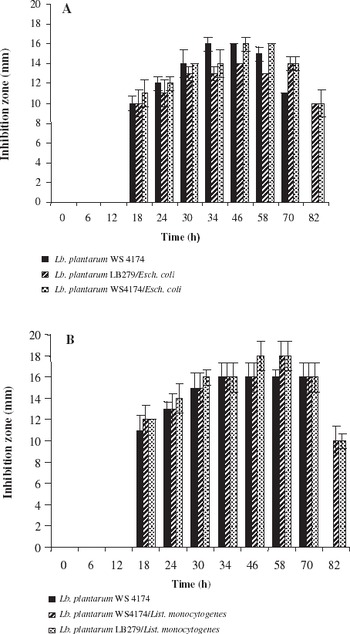
The growth inhibitory capacity of the neutralized supernatants of mono and co-cultures was assessed to provide evidence for the factors that, at a specific moment, could influence the behaviour of the pathogenic strains. The cell-free neutralized supernatants of co-cultures showed antagonistic effect against Esch. coli ECO25 (Fig. 3A) and List. monocytogenes LMO26 (Fig. 3B) after 12 h of incubation. The supernatants of pure cultures of Lb. plantarum WS4174 were active against Esch. coli ECO25 within 58 h of incubation with a peak of activity between 34 and 46 h of incubation. Afterwards, the antibacterial activity of the supernatants diminished and disappeared at 82 h of incubation (Fig. 3A). The supernatants of the co-cultures did not show clear overall improved activity against Esch. coli ECO25 compared with the supernatants of the mono-culture of Lb. plantarum WS4174 (Fig. 3A). Lb. plantarum LB279 presented a co-inducible antagonistic activity and only the supernatants of co-cultures inhibit the growth of Esch. coli ECO25 (Fig. 3A & B).
Antagonistic effect of neutralized supernatants of pure and co-cultures harvested at different inoculations times against Escherichia coli ECO25 (A) and Listeria monocytogenes LMO26 (B).

The response of List. monocytogenes LMO26 to the neutralized supernatants of co-cultures and the mono-culture of Lb. plantarum WS4174 was quite similar to that observed with Esch. coli. A difference relied in the intensity of the suppression of the growth of List. monocytogenes of supernatants of mono and co-cultures. Specially, the supernatants of co-cultures showed enhanced efficacy against List. monocytogenes LMO26 with inhibition zone diameters of ∼18 mm (Fig. 3B).
Discussion
The inhibition of growth of microorganisms in mixed cultures is a complex process with many variables and interactions at different intensity levels. The growth restriction is commonly attributed to an accumulation of toxic metabolic products, the exhaustion of essential nutrients (to consider critical rate of nutrient supply and maintenance of a critical minimal concentration of food per unit of surface or volume), change in pH and redox-potential, and production of antagonistic metabolites. Other factors involve inherent traits of the organism and the requirement for certain amount of physical or biological space (Schiemann & Olson, Reference Schiemann and Olson1984). All these factors might impress unique features of interaction to each mixed culture.
The results obtained in the present study demonstrate the limitation of the growth of potential food-borne pathogens by LAB that produce BLIS at 37°C with proven broad spectrum antimicrobial activity (data not shown). Figure 4 summarizes the growth behaviour and pH profiles of the LAB and the pathogenic strains in UHT whole milk at 37°C and shows the interaction of amensalism taking place in the binary systems studied. The LAB strains maintained their growth pattern of pure cultures practically unaltered (Fig. 4A & B). Although, there were statistical differences (CI 95%) in Nmax for both LAB strains (approximately 6%) between mono- and co-culture this variability could be considered as meaningless in such type of biological system. The stationary phases of Lb. plantarum strains WS4174 and LB279 were coincident with the plateau of minimum pH value. In agreement to the theory stipulating that the lactic acid fermentation is a product inhibited process.
Growth curves of the four bacterial strains in whole UHT milk at 37°C as mono- and co-culture and pH profiles. Lb. plantarum WS4174 (A), Lb. plantarum LB279 (B), Esch. coli ECO25 (C), and List. monocytogenes LMO26 (D). Pure cultures (⧫). Co-cultures of Lb. plantarum WS4174 with Esch. coli ECO25 or List. monocytogenes LMO26 (Δ), of Lb. plantarum LB279 with Esch. coli ECO25 or List. monocytogenes LMO26 (▪). pH profile of pure culture (▬), pH of co-cultures of Lb. plantarum WS4174 with Esch. coli ECO25 or List. monocytogenes LMO26 (---), of Lb. plantarum LB279 with Esch. coli ECO25 or List. monocytogenes LMO26 (▬ ▬).

However, the growth of the pathogenic strains was drastically modified when grown simultaneously with the LAB strains (Fig. 4C & D). In the mixed cultures the pathogenic strains showed restricted growth and an early induction of their stationary phase not caused by a Jameson effect, defined in this case as the cessation of growth of the pathogenic strains when the LAB strains reached the maximum cell concentration (Jameson, Reference Jameson1962).
Malakar et al. (Reference Malakar, Martens, Zwietering, Beal and van't Riet1999) defined the time of interaction in mixed cultures as the time needed to deviate the growth rate of a microorganism by 10% from its growth in pure culture. The level of interaction is then the concentration of the killer microorganism at which the specific growth rate of the sensitive microbial population decreases by 10%. The growth pattern of Esch. coli ECO25 in milk in association with Lb. plantarum WS4174 (Fig. 2A & 4C) showed that Esch. coli ECO25 followed a similar growth rate as in monoculture, but entered the stationary phase prematurely (after 10 h of incubation) at the moment of interaction before the inhibitory activity of BLIS could definitively be detected by the agar-diffusion test and at a pH value >5 units. The level of interaction was observed when the count of Lb. plantarum WS4174 was ∼6 log CFU/ml after 10 h of incubation (Fig. 4C). To our knowledge, few studies reporting on the interference time and level are available. Leroy et al. (Reference Leroy, Degeest and De Vuyst2002) reported for Lb. sakei CR494 a minimum trigger density of 0·2 CDM (cell dry mass)/l for autoinducible bacteriocin production in pure suspension, which corresponds to approximately 8 log CFU/ml. Malakar et al. (Reference Malakar, Martens, Zwietering, Beal and van't Riet1999) also reported a level of interaction due to pH of Lb. curvatus against Enterobacter cloacae of 8 log CFU/ml. In the case of Esch. coli ECO25 with known and experimental tested acid pH tolerance (growth inhibition below 4·5 pH units) the factors affecting its growth in association with Lb. plantarum WS4174 may involve inherent properties. Microbial implicit mechanisms such as density dependent inhibition of growth or a metabolic crowding that prevent a second bacterial community from attaining the Nmax of the control culture have been reported. Schiemann & Olson (Reference Schiemann and Olson1984) explained antagonism in terms of reduction in the Nmax and in terms of difference in the μmax of mixed cultures that derived in a metabolic crowding of the strain with slowest growth. In competition conditions, Aoki et al. (Reference Aoki, Pamma, Hernday, Bickham, Braaten and Low2005) reported for Esch. coli a direct cell-to-cell contact-dependent limitation of growth. Intracellular crowding that interferes with the metabolic flux balance and that is activated in response to environmental changes has been reported for Enterobacteriaceae (Schiemann & Olson, Reference Schiemann and Olson1984; Rohwer et al. Reference Rohwer, Postma, Kholodenko and Westerhoff1998; Beg et al. Reference Beg, Vazquez, Ernst, de Menezes, Bar-Joseph, Barabási and Oltvai2007). Fukushima & Gomyoda (Reference Fukushima and Gomyoda1986) observed suppressed growth of Yersinia enterocolitica in mixed cultures due to metabolic crowding and not as consequence of a depletion of an essential nutrient, an unfavorable pH, or the production of toxic compounds. Growth inhibition due to nutrient depletion, in such a rich medium as milk, could be discarded by two features of the binary systems: the LAB strain was able to continue its growth and the pH continued its descent owing to lactose metabolism.
The behaviour of Esch. coli ECO25 grown simultaneously with Lb. plantarum LB279 was somewhat different. Esch. coli ECO25 showed decreased growth rate and a stable stationary phase could be observed after 18 h of incubation (Fig. 4C, Table 1) coincident with functional BLIS concentration (Fig. 3A). The pH at this point was close to the growth limiting value of 4·5 units in the presence of undissociated lactic acid as reported by Presser et al. (Reference Presser, Ratkowsky and Ross1997). At this stage, nutrient depletion cannot be inhibitory to the growth of Esch. coli ECO25 by the facts mentioned previously. A pathogen's own behavioural inhibitory mechanism cannot be discarded, but the inhibition of the growth of Esch. coli ECO25 by Lb. plantarum LB279 appeared to be induced by the presence of BLIS, undissociated lactic acid and low pH value.
The growth of List. monocytogenes LMO26 in association with the Lb. plantarum strains was delayed from the beginning of the simultaneous growth with the presence of a lag phase (Fig. 4D). The stationary phase started after about 14 h of incubation when grown with Lb. plantarum WS4174. At this point, the low pH value of 4·8 units and the presence of undissociated lactic acid could have an important inhibition effect on List. monocytogenes LMO26 as determined by the authors (not shown) and predicted by the models for growth/no growth of Koutsoumanis et al. (Reference Koutsomanis, Kendall and Sofos2004) and Augustin et al. (2007) as well as the BLIS accumulation. Compared with Esch. coli ECO25, the inhibition of List. monocytogenes LMO26 by Lb. plantarum WS4174 was one log-cycle more effective. These results demonstrated that Lb. plantarum WS4174 exhibited a stronger inhibitory effect against the Gram positive List. monocytogenes LMO26 possibly due to its higher sensitivity to low pH and the BLIS acting additively to lactic acid accumulation. List. monocytogenes LMO26 entered also death phase after 26 h of incubation with Lb. plantarum WS4174.
The restricted growth of List. monocytogenes LMO26 in association with Lb. plantarum LB279 was also from the beginning and the stationary phase entered after 18 h of incubation. At this point of inhibition, the pH was 4·8 and the inhibitory effect of BLIS was detectable by the agar-diffusion test.
Currently there is an increasing interest in the controlled application of LAB for fermentation and biopreservation purposes. Extrinsic, intrinsic, and implicit factors influence the functionality of these processes. Although, the identification of variables has made a considerable advance, interactions between them are still poorly understood. Most of the work has been done on relative simple model systems in broth. On the basis of the observations made in this exploratory study, it can be concluded that the antagonistic activity of LAB against pathogens is a complex interaction. In some cases additional factors like constraints at intracellular molecular level should be considered in order to have as complete as possible view of the system. More studies on mixed bacterial cultures are needed that enable to raise the possible combinations of interaction factors and extend knowledge in this area of biopreservation.
The authors thank the Universidad de La Sabana (Colombia) for the financial support of this study and the Universidad de Los Andes that kindly provided three of the bacterial strains of study.