Background
Delirium is defined as an acute disturbance of consciousness associated with acute illness. Common in hospitalized older patients, with a prevalence ranging from 14 to 56%, its transience belies its health impact.1–Reference Siddiqi, House and Holmes3 The importance of studying delirium in medical in-patients has largely been recognized over the past thirty years. Delirium may be preventable and yet it remains poorly recognized.Reference Bellelli, Morandi and Davis4 Adverse health outcomes may be exacerbated by failure to properly diagnose and appropriately treat delirium. Significant morbidity and mortality (with attendant health care costs) escalate with poor management.Reference Siddiqi, House and Holmes3 The incidence of delirium during hospitalization has even been recognized as a sign of the quality of hospital care.Reference Inouye, Schlesinger and Lydon5
Since the American Psychiatric Association first published diagnostic criteria for delirium in 1981, there has been a wealth of research on the aetiology, diagnosis, treatment, prevention and outcomes associated with delirium. This body of work has yielded a greater understanding of delirium as representing a unique cognitive disorder, albeit with multifactorial causes. However, there clearly remains an essential need to conduct additional research. In particular, an appreciation of the reasons for the poor outcomes associated with delirium is important. This paper will review the literature from 1981 until the present to determine the causes of adverse outcomes associated with medical in-patients diagnosed with delirium and discuss possible mechanisms within and beyond the delirium knowledge horizon.
Search methods
A search of four databases was conducted using the search terms ‘delirium’, ‘outcome’, ‘mortality’, ‘institutionalization’ and ‘long term care’. In addition, bibliographies of each of the articles were reviewed as well as three systemic reviews for further detailed analysis of the topic.Reference Siddiqi, House and Holmes3,Reference Cole, Ciampi, Belize and Zhong6,Reference Martins and Fernandes7 Full details of the search methods can be obtained from the corresponding author.
Changing criteria for delirium diagnosis
Descriptions of delirium abound in medical, religious and literary sources since antiquity.Reference Martins and Fernandes7–Reference Sarma9 However, it was not until the early 1980s that the American Psychiatric Association introduced criteria for diagnosing delirium as a psychiatric disorder in the Diagnostic and Statistical Manual of Mental Disorders, version three (DSM-III).10 While advances were being made in medical treatment for dementia, comparable developments were not witnessed in the field of delirium.Reference Rabins and Fistein11 The DSM-III criteria for delirium focused on clouding of consciousness, perceptual disturbance and incoherent speech, memory impairment and acute onset of clinical features and related etiology.10,Reference Fields, Mackenzie and Charlson12 Utilizing these criteria for diagnosing delirium, authors researched the connection between a diagnosis of delirium with outcomes such as mortality, length of hospital stay, cognitive impairment, persistence of symptoms and increased hospital charges when compared with those suffering from dementia or other controls.Reference Rabins and Fistein11–Reference Rockwood16 These authors struggled with how to disentangle delirium when superimposed upon dementia or other medical illnesses (e.g. urinary tract infections, structural brain diseases).Reference Levkoff, Safran and Cleary15,Reference Koponen, Stenback, Mattila, Soininen, Reinikainen and Riekkinen17
Despite the numerous studies on delirium as a unique mental disorder and the recognition of the correlated adverse outcomes, authors pointed out that delirium continued to go undiagnosed especially among older people. These early studies continued to view delirium as merely a transitory (acute) state from which a patient could recover, die, transition to dementia (chronic), or transition to a functional psychosis.Reference Koponen, Stenback, Mattila, Soininen, Reinikainen and Riekkinen17,Reference Rockwood18 In fact, many of these early studies tied the severity of illness (‘neural noise’ rather than delirium itself) as a key predictor of the likelihood of recovery.Reference Koponen, Stenback, Mattila, Soininen, Reinikainen and Riekkinen17 Given these results, authors repeatedly pointed out that early recognition, assessment and treatment of delirium might result in lower mortality and decreased financial burden on institutions treating delirious medical in-patients.Reference Fields, Mackenzie and Charlson12,Reference Thomas, Cameron and Fahs14,Reference Levkoff, Safran and Cleary15 In addition, early treatment was seen as an effective means of preventing partial or total damage to brain function and decreasing length of hospital stay.Reference Rockwood16,Reference Koponen, Stenback, Mattila, Soininen, Reinikainen and Riekkinen17 Other research confirmed delirium as an independent predictor of outcome.Reference Rockwood16,Reference Francis, Martin and Kapoor19,Reference Ramsay, Wright, Katz, Bielawska and Katona20 Future studies were called for to search for a cause of acute cognitive disorders as well as early recognition of risk factors and potential treatment of delirious older patients.Reference Rockwood16
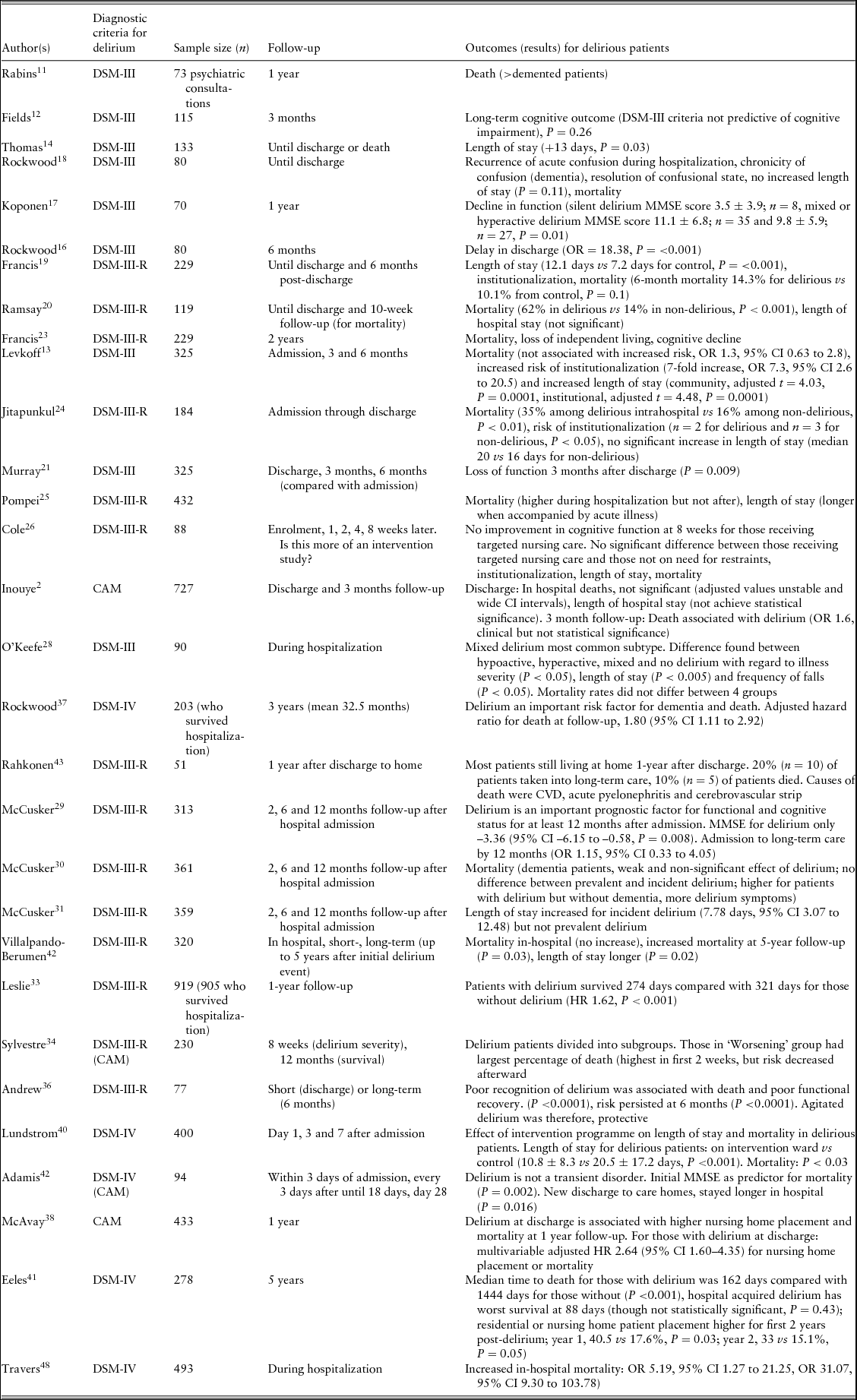
As early as 1986, studies began demonstrating that the DSM-III criteria for delirium could not be utilized adequately to predict whether patients would recover from cognitive impairment.Reference Fields, Mackenzie and Charlson12,Reference Francis, Martin and Kapoor19 In 1987, the APA published the DSM-III-R (revised edition) setting forth additional criteria for delirium. Around this time, authors also started reporting that the symptoms of delirium were less transitory than previously thought and that the adverse outcomes often lasted up to one year post-discharge. In fact, more than one study noted that symptoms persist at time of discharge in many (as high as 95%) of elderly patients who suffer from delirium during hospitalization.Reference Murray, Levkoff and Wetle21,Reference Rockwood22 The studies between 1990 and 2006 largely continued to report on the adverse consequences of delirium among hospital in-patients with respect to increased length of hospital stay, death in hospital, and mortality, institutionalization, cognitive impairment, functional decline and increased need for care after discharge at varying periods (typically during hospitalization as well as at 1 month, 3 months, 6 months, 12 months and 2 years post-discharge).Reference Levkoff, Evans and Liptzin13,Reference Francis, Martin and Kapoor19,Reference Ramsay, Wright, Katz, Bielawska and Katona20,Reference Murray, Levkoff and Wetle21–Reference Sylvestre, McCusker, Cole, Regeasse, Belzile and Abrahamowicz34 Specifically, Murray et al. reported that functional decline could be detected 3 months post-discharge and persist at 6 months. Loss of function alone accounted for reduced activities of daily living (ADLs), dependency on caregivers, increased health care needs, nursing home placements and associated costs.Reference Murray, Levkoff and Wetle35 The main outcome studies for delirium are summarized in Table 1.
Main outcome study results for delirium in terms of risk of functional decline, nursing home placement, dementia and deathReference Renjel, Pandy and Eeles51

It should be pointed out that several of these studies recognized the limitations of the contemporary instruments and criteria utilized to assess cognitive function, as well as the need to differentiate the various subtypes of delirium to accurately describe the prevalence of outcomes.Reference Francis, Martin and Kapoor19,Reference Rockwood22,Reference O’Keefe and Lavan27 Around this time, support for delirium representing a less transient phenomenon gained wider credence.Reference Levkoff, Evans and Liptzin13,Reference Rockwood22,Reference Francis and Kappor23,Reference Murray, Levkoff and Wetle35
The influence of diagnostic criteria on outcomes
In 2000, the APA updated the diagnostic criteria for delirium.39 Utilizing these, studies continued to report adverse outcomes. Studies reporting associated mortality all showed a detrimental effect of delirium even up to 5 years from the index event but by a varying magnitude.Reference Levkoff, Evans and Liptzin13,Reference Francis, Martin and Kapoor19,Reference Pompei, Foreman, Rudberg, Inouye, Braund and Cassel25,Reference Rockwood, Cosway, Carver, Jarrett and Stadnyk37,Reference Eeles, Hubbard, White, O’Mahony, Savva and Bayer41 The need for long-term care following delirium remains a consistent finding in the delirium literature.Reference Inouye, Rushing and Foreman2,Reference Murray, Levkoff and Wetle21,Reference Rockwood22,Reference Cole, Primeau and Bailey26,Reference O’Keeffe and Lavan28,Reference McCusker, Cole, Dendukuri, Belzile and Primeau29,Reference Leslie, Zhang and Holford33,Reference Andrews, Freter and Rockwood36,Reference McAvay, Van Ness and Bogardus38 Delirium outcomes are studied in the context of confounders such as severity of illness, disability and dementia and would appear to remain an independent predictor of adverse event.Reference Adamis, Treloar and Martin42
Conversely, many studies continue to report on improvements in outcomes based on early assessment and targeted interventions. Early and targeted interventions can limit the duration of the symptoms of delirium and prevent adverse outcomes.Reference Lundstrom, Edlund, Karlsson, Brannstrom, Bucht and Gustafson40,Reference Eeles, Hubbard, White, O’Mahony, Savva and Bayer41 Whilst not reaching the same level of confidence in the findings as observed with successful preventative strategies, there have been notable gains. One cohort study conducted by Lundstrom et al., consisting of a nursing intervention programme, showed a reduction in length of hospital stay, reduction in mortality and shorter duration of delirium.Reference Lundstrom, Edlund, Karlsson, Brannstrom, Bucht and Gustafson40,Reference Eeles, Hubbard, White, O’Mahony, Savva and Bayer41
The APA recently reviewed the diagnostic criteria for delirium and the DSM-V was released in May of 2013.1 The new criteria for diagnosing delirium are:
(A) a disturbance in attention (i.e. reduced ability to direct, focus, sustain and shift attention) and awareness (reduced orientation to the environment).
(B) the disturbance develops over a short period of time (usually hours to a few days), represents a change from baseline attention and awareness, and tends to fluctuate in severity during the course of a day.
(C) an additional disturbance in cognition (e.g. memory deficit, disorientation, language, visuospatial ability or perception).
(D) the disturbances in criteria A and C are not better explained by another pre-existing, established, or evolving neurocognitive disorder and do not occur in the context of a severely reduced level of arousal, such as coma.
(E) there is evidence from the history, physical examination or laboratory findings that the disturbance is a direct physiological consequence of another medical condition, substance intoxication or withdrawal (i.e. due to a drug of abuse or to a medication), or exposure to a toxin, or is due to multiple aetiologies.
Our search criteria did not show any studies conducted under these newly released diagnostic criteria for delirium as of 28 February 2014.
Subtypes of delirium
Three subtypes of delirium have been described: hyperactive, hypoactive and mixed.Reference Cole, Ciampi, Belize and Zhong6 Authors have noted that each subtype probably has its own aetiology and pathophysiology, but this awareness has not translated into operationalization of delirium phenomenology. Authors have found that hypoactive delirium often goes undiagnosed and may contribute to poor outcomes associated with this subtype.Reference O’Keeffe and Lavan28,Reference Andrews, Freter and Rockwood36
Again, these studies called for additional investigations into delirium in order to determine the best method to diagnose delirium, the long-term prognosis and define what interventions are possible to prevent or improve the adverse outcomes reported.Reference Francis, Martin and Kapoor19,Reference Rockwood22,Reference Cole, Primeau and Bailey26
Causes of adverse outcomes
The inception of DSM-III diagnostic criteria of delirium has yielded extensive reporting of outcomes but our research did not reveal any articles focusing exclusively on the causes of adverse outcomes. In the study of Rabins et al., the ineffable causes of death in delirium were matched only by their elusive nature.Reference Rabins and Fistein11 In a cohort study by Rahkonen et al., poor outcomes, in the form of institutionalization in delirium, were associated with multiple other factors: another serious illness, poor home management, repeated falls, depression, or progression of cognitive function.Reference Rahkonen, Makela, Paanila, Halonen, Sivenius and Sulkava43 Cardiovascular disorders, acute pyelonephritis and cerebrovascular disorder were associated with mortality.Reference Rahkonen, Makela, Paanila, Halonen, Sivenius and Sulkava43 These findings were, however, secondary to the primary objective of understanding delirium aetiology. At the time of writing, no other study appears to focus exclusively on causes of outcomes.
By contrast, complications associated with delirium have been reported. Injurious falls, infections (including aspiration pneumonia), pressure sores, malnutrition, over-sedation and urinary incontinence have been described as more common in delirium.Reference Francis, Martin and Kapoor19,Reference O’Keefe and Lavan27,Reference O’Keeffe and Lavan28,Reference Lundstrom, Edlund, Karlsson, Brannstrom, Bucht and Gustafson40,Reference Mercantonio, Bergmann, Kiely, Orav and Jones44,45 It is conceivable that each of these complications may contribute independently to adverse outcomes or interact in a multiplicative risk scenario.Reference Lee, Gibbs, Fahey and Whiffen46 Several nursing studies have been performed attempting to show that interventions targeted at these complications may reduce adverse outcomes among delirious patients.Reference Lundstrom, Edlund, Karlsson, Brannstrom, Bucht and Gustafson40,Reference Mercantonio, Bergmann, Kiely, Orav and Jones44 However, it appears that insufficient research has been conducted on the frequency of adverse outcomes resulting from each of these complications in hospitalized delirious patients to allow us to posit whether or not poor outcomes are attributable to complications of delirium or arise from other cause(s) altogether.
Interestingly, studies are again questioning whether the current screening tools are continuing to misdiagnose, detect late or miss many cases of medical delirium. Do the shortcomings of the DSM criteria for diagnosing medical delirium continue to result in adverse outcomes? Are new methods for diagnosis needed? In 2014, Bellelli et al. suggested that the sensitivity and simplicity of the 4 As Test (‘4AT’) may help improve outcomes for medical delirium when compared with the DSM-IV-TR criteria, and a number of other ergonomically promising instruments are on the horizon.Reference Bellelli, Morandi and Davis4
As research has progressed and the diagnostic criteria and tools for identifying delirium improved, clarity of reporting on adverse outcomes with delirium has been established. These consequences following delirium are now routinely documented for medical patients, across a multitude of measures. Good medical practice, including early diagnosis and management, may help ameliorate the burden of adverse outcomes. However, the absence of direct evidence to guide an understanding of adverse events is a frustration; as without this, how can treatments be tailored and sophisticated enough for our patients? Longitudinal studies have provided valuable insights into the interrelationship between delirium and dementia.Reference Davis and Muniz Terrera47 Not only is delirium a risk state for dementia (by an odds ratio of 8.7), but the dementia phenotype is not explained by classical Alzheimer's pathology. Dementia from any sub-type, and certainly not excluding post-delirium dementia, would contribute to the risk of adverse events seen in delirium. Many if not all problems described following delirium might reasonably be shared through the natural history disease of dementia progression. Furthermore, cases of dementia have a prolonged hospital stay. Many of those patients may rightly be termed non-delirious but the nascent dementia and risks it poses in hospital may elevate vulnerability further.
Other possibilities can be considered:
• The sum of numerous complications known to be associated with delirium may be sufficient to drive poor outcomes.
• Impaired communication as part of the delirium syndrome creates obstacles to the identification of patient requirements and their restoration with unmet need a more likely and less obvious predicament.
• The psychopathology incumbent on a diagnosis of delirium poses a barrier to the diagnosis of the condition, its causes and management.
• Delirium itself may represent a global multidimensional risk state, such as advanced frailty, with the inherent risk this poses.
• If a balanced approach to treatment is not assumed then the false paradigm of therapeutic nihilism versus the ‘breaking of the butterfly upon a wheel’48 of an aggressive algorithmic approach may threaten further the patient already in a weakened state (comprehensive geriatric assessment offers the best prospect of optimizing outcomes and avoiding such harm from omission or commission).Reference Travers, Byrne, Pachana, Klein and Gray49,50
• Delirium is a marker of a failing hospital system in relation to an institution that no longer prioritizes the care of older and vulnerable patients. Not only is delirium more likely, but neglect may prove even more detrimental to outcomes 50
Further research
Despite the advances made in diagnosing and understanding the causes of delirium, barriers still exist to a fuller appreciation of the causes of poor outcomes. Each of the potential mechanisms for adverse events in delirium proposed requires dedicated study. Quantification of the dementia syndrome post-delirium would add important insights into post-delirium risk and shine a light on the reciprocity between these two conditions. Any study regarding adverse outcomes associated with delirium must also consider more truculent measures: the trajectory of underlying illness, complications, measure global risk states, such as frailty, and explore the interaction between delirium and clinician. Longer-term clinical follow-up is important. Definitive diagnoses, through rigorous clinical, investigative or pathological undertakings are essential. Delirium does not always reveal its secrets in life and so, supplementary post-mortem investigations will also be helpful. Unless such confounders are taken into consideration, important information may be lost from patients who die with, rather than from, delirium. As such, our group intends to conduct further research on specific causes of adverse events associated with delirium in medical patients.
In the final analysis, much has been improved in relation to the quantification of delirium and measurement of the salient clinical end-points. Amidst this change, unfortunately, the aphorism of ‘the more it stays the same’ pertains to outcomes. Increased interest in the understanding of outcomes in delirium offers the only real prospect of positive change.
Financial support
This research received no specific grant from any funding agency, commercial or not-for-profit sectors.
Conflict of interest
None.