INTRODUCTION
Marine shell is one of the most abundant organic materials available for radiocarbon dating in coastal regions. Obtaining accurate ages from marine shell is complicated by a variety of factors. Ocean waters are depleted in 14C relative to the atmosphere, and, as a result, samples of marine origin yield 14C ages older than do contemporaneous samples of terrestrial origin (Stuiver and Polach Reference Stuiver and Polach1977; Stuiver et al. Reference Stuiver, Pearson and Braziunas1986). Differences in coastal geomorphology, ocean circulation, upwelling, and freshwater inputs produce localized deviations from the global-averaged marine reservoir age. The correction for local offsets, termed ΔR, is estimated by measuring the 14C content of known-age marine materials, or through comparison of 14C ages of contemporaneous terrestrial and marine sample pairs (Ascough et al. Reference Ascough, Cook and Dugmore2005). Reimer and Reimer (Reference Reimer and Reimer2001) maintain an online database of published ΔR values, accessed via mapping software, which 14C researchers can access to facilitate calibration of marine-influenced 14C ages. As a first approximation, ∆R is assumed to be a constant for a given region (Reimer and Reimer Reference Reimer and Reimer2001), although researchers working in diverse coastal settings have demonstrated considerable variability over both long-term and short-term timescales (Austin et al. Reference Austin, Bard, Hunt, Kroon and Peacock1995; Druffel Reference Druffel1997; Kennett et al. Reference Kennett, Ingram, Erlandson and Walker1997; Deo et al. Reference Deo, Stone and Stein2004; Culleton et al. Reference Culleton, Kennett, Ingram, Erlandson and Southon2006).
14C researchers have begun to examine marine reservoir effects in southeastern North America only recently (Thomas Reference Thomas2008; Shanks and Byrd Reference Shanks and Byrd2012; Thomas et al. Reference Thomas, Sanger and Hayes2013; Cherkinsky et al. Reference Cherkinsky, Pluckhahn and Thompson2014; Hadden and Cherkinsky Reference Hadden and Cherkinsky2015). These studies suggested that estimates of ΔR in this region must take into account the marine species being studied, as well as variability in local conditions such as source and volume of freshwater inputs. Hadden and Cherkinsky (Reference Hadden and Cherkinsky2015) previously reported 30 14C dates obtained from modern, pre-bomb marine shells (Busycon sinistrum and Strombus alatus) of known ages collected from northwestern Florida, USA, in order to estimate species-specific ΔR corrections for those taxa. We also presented data on intrashell variability in 14C content of these short-lived (~10–20 yr) mollusks. In this paper, we present a complementary data set of 14C ages from archaeological specimens from this same region to examine variability in marine reservoir effects along the northern Gulf of Mexico, USA, over both short- and long-term timescales, i.e. years and centuries.
MATERIALS AND METHODS
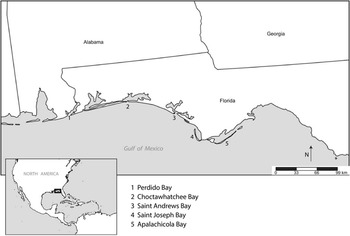
Marine reservoir effects were evaluated from archaeological materials by comparing the measured 14C ages of marine and terrestrial archaeological specimens, which were assumed to have approximately the same dates of death and deposition (Southon et al. Reference Southon, Rodman and True1995; Ascough et al. Reference Ascough, Cook and Dugmore2005). The specimens were excavated from the Bayou St. John (1BA21) archaeological site (30°17′50″N, 87°31′55″W), located approximately 6 km northeast of Orange Beach, Alabama. We assume the shells were originally collected from Perdido Bay (Figure 1), the body of water adjacent to the archaeological site. The site was excavated by Gregory Waselkov and the University of South Alabama Center for Archaeological Studies in 2004–2005. Twenty 14C assays from the Bayou St. John site, summarized by Hadden (Reference Hadden2015), indicate the site was occupied mainly during the Late Woodland period (1300–950 cal BP), with minor Middle Woodland and Mississippian components.
Map of the northern Gulf of Mexico study area

The Bayou St. John site was stripped mechanically, exposing hundreds of small, discrete pockets of shell, bone, well-preserved botanical remains, and ceramics (Price Reference Price2009). Several of these pockets, or microstrata, were interpreted as rapidly deposited primary refuse pits, possibly representing single depositional events. One such deposit, a basin-shaped pit designated Feature 96, measured approximately 80 cm in diameter by 30 cm in depth. Feature 96 showed no evidence of postdepositional disturbance and contained Late Woodland-period ceramics in association with an abundance of animal bones and marine shells (Price Reference Price2009). Analyses of the animal remains suggested the deposit was formed during the warm season, i.e. boreal spring and summer (Reitz et al. Reference Reitz, Hadden, Little, Waselkov and Andrus2013). Five faunal specimens from Feature 96 were selected for 14C dating via AMS: two specimens of the large herbivorous marine gastropod S. alatus (UGAMS-20400 and -20489); one specimen of the large carnivorous marine gastropod B. sinistrum (UGAMS-20401); and two specimens of white-tailed deer, Odocoileus virginianus, a large terrestrial herbivore.
14C ages of the two terrestrial specimens (UGAMS-8557 and -13928) were obtained in 2012–2013 at the Center for Applied Isotope Studies (CAIS) by the authors and reported by Reitz et al. (Reference Reitz, Hadden, Little, Waselkov and Andrus2013). The bones were cleaned by wire brush and washed in an ultrasonic bath. After cleaning, the dried bones were gently crushed to small fragments. The crushed bones were treated with 1N HCl at 4°C for 24 hr. The residues were filtered, rinsed with 0.1N NaOH, then rinsed with deionized water and diluted HCl under slightly acidic conditions, and heated at 80°C for 8 hr. The solutions were then filtered using Whatman 934-AH Glass Microfiber filters and dried in order to isolate the total acid insoluble fractions (“collagen”). The dried collagens were combusted at 575°C in evacuated and sealed Pyrex™ ampoules in the presence of CuO to obtain CO2.
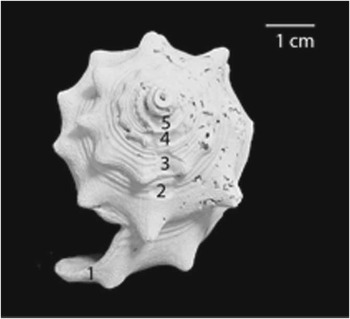
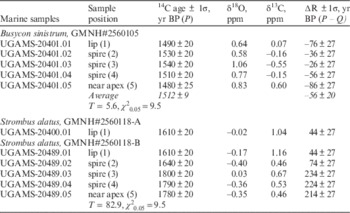
Shell specimens (UGAMS-20400, -20401, and -20489) were pretreated and analyzed by the authors in 2015 at CAIS. The shells were physically cleaned with a wire bristle brush and washed in an ultrasonic bath of deionized water and 1N HCl to remove approximately 10% of the outermost layer. The cleaned shells were rinsed in deionized water and dried. Mollusk shells grow throughout the life of the organism, with new growth accreting onto previous growth, resulting in visibly distinct growth increments. In gastropods, the shell grows in a spiral around a central axis with the earliest growth at the apex and latest growth at the lip of the shell. For UGAMS-20400, a hand-held drill was used to collect ~20 mg of carbonate powder from the exterior lip region of the shell. For UGAMS-20401 and -20489, we sampled five positions on each shell: one from the exterior edge of the shell lip and one from each of four adjacent whorls of the spire (Figure 2). This sampling strategy resulted in a time-series of 14C values representing changes in 14C conditions throughout the life of the animal, which is about 10 yr for the genus Strombus (Berg Reference Berg1976; Appeldoorn Reference Appeldoorn1988) and up to 20 yr or more for the genus Busycon (Eversole et al. Reference Eversole, Anderson and Isely2008). Carbonate samples were reacted with 100% H3PO4 in evacuated vessels to obtain CO2.
Sequential sampling points on S. alatus (UGAMS-20489). The lip (sample point 1) is the most recent growth, and the apex (sample point 5) is the earliest growth.

For both bone and shell samples, the resulting CO2 was cryogenically purified from the other reaction products and catalytically converted to graphite using the method of Vogel et al. (Reference Vogel, Southon, Nelson and Brown1984). Graphite 14C/13C ratios were measured using the 0.5MeV accelerator mass spectrometer at the CAIS, University of Georgia, USA. The sample ratios were compared to the ratios measured from oxalic acid I (NBS SRM 4990). For carbonates, Carrara marble (IAEA C1) was used as the background, and travertine (IAEA C2) was used as a secondary standard. The sample 13C/12C ratios were measured separately using a MAT-253 stable isotope ratio mass spectrometer and expressed as δ13C with respect to PDB, with an error of less than 0.1‰. The error is quoted as 1 standard deviation and reflects both statistical and experimental errors. All 14C dates have been corrected for natural isotope fractionation using the isotope ratio mass spectrometer value.
To determine whether groups of 14C dates and ∆R values were homogenous and could be combined into a weighted average, we used chi-squared (χ2) tests as described by Ward and Wilson (Reference Ward and Wilson1978) and implemented using the R_Combine() function in OxCal v 4.2 (Bronk Ramsey Reference Bronk Ramsey2009). To calculate ∆R, we relied on the following equation:
 $$\Delta {\rm R}\,{\equals}\,P-Q$$
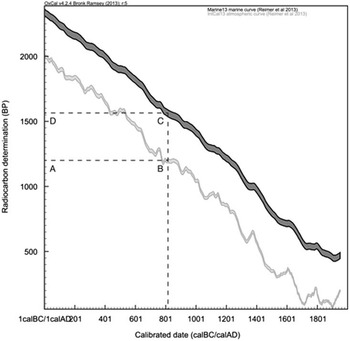
where P is the measured 14C age of the marine sample and Q is the expected marine model age. In this case, Q is the point on the Marine13 curve that corresponds to the calibrated age (cal BP) of the terrestrial specimen on the IntCal13 curve, obtained from Reimer et al. (Reference Reimer, Bard, Bayliss, Beck, Blackwell, Bronk Ramsey, Buck, Cheng, Edwards, Friedrich, Grootes, Guilderson, Haflidason, Hajdas, Hatte, Heaton, Hoffman, Hogg, Hughen, Kaiser, Kromer, Manning, Niu, Reimer, Richards, Scott, Southon, Staff, Turney and van der Plicht2013). The relationships between the measured, calibrated, and marine model ages of the terrestrial specimen are depicted in Figure 3. Uncertainty in ∆R was calculated as
 $\sigma _{R} {\equals}\sqrt {\sigma _{p}^{\,\,\,2} {\plus}\sigma _{Q}^{\,\,\,2} } $
(Stuiver et al. Reference Stuiver, Pearson and Braziunas1986).
Schematic showing relationship between (A) measured 14C age of terrestrial specimen; its intercepts on the (B) atmospheric (IntCal13) and (C) marine (Marine13) calibration curves; and (D) the equivalent marine model age of the terrestrial specimen (Q).

RESULTS AND DISCUSSION
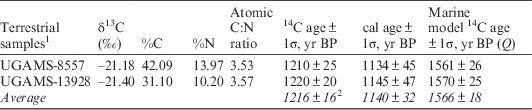
The 14C ages of the terrestrial archaeological specimens are presented in Table 1. The two terrestrial specimen ages were in excellent agreement and therefore were combined into a single weighted average, from which Q was estimated to be 1566 ± 18 14C yr BP. The 14C ages of the archaeological mollusks from Bayou St. John are presented in Table 2.
14C ages of terrestrial samples from Bayou St John Feature 96 and estimate for Q.

1 See Reitz et al. (Reference Reitz, Hadden, Little, Waselkov and Andrus2013) for specimen descriptions.
2
T=0.1,
 ${\rm \chi }_{{\,\,\,0.05}}^{2} {\equals}3.8.$
14C ages of marine samples from Bayou St. John Feature 96 and ∆R estimates assuming Q=1566±18.

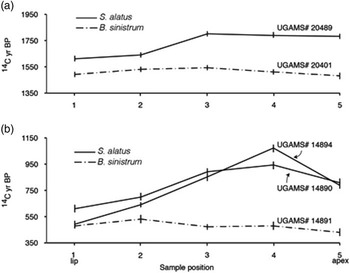
The five 14C age determinations for the archaeological B. sinistrum shell are in excellent agreement with one another, and were combined into a single weighted average of 1512±9 14C yr BP. Among both archaeological and modern specimens of B. sinistrum, there is no difference in shell 14C within individual shells (Figure 4). The weighted mean ∆R of –56±20 14C yr for the archaeological shell from Bayou St. John (Table 2) compares favorably with other ∆R estimates available in the literature. Shanks and Byrd (Reference Shanks and Byrd2012) estimated ∆R=52±32 14C yr using archaeological specimens from St. Andrews Bay, Florida (Figure 1), from sites that are roughly contemporaneous with Bayou St. John. Hadden and Cherkinsky (Reference Hadden and Cherkinsky2015) previously recommended a value of –9±25 14C yr based on multiple pre-bomb specimens from St. Andrews and Choctawhatchee Bays (Figure 1). All three estimates of marine reservoir effects are statistically identical, despite differences in the age and specific collection locales of the specimens. The current data suggest that a single ∆R value of –2±53 14C yr (T=5.05,
 ${\rm \chi }_{{\,\,\,0.05}}^{2} {\equals}5.99$
) be used to correct 14C ages for late Holocene-age B. sinistrum from the northern Gulf Coast.
Intrashell variability in 14C ages of known-age shells from the northern Gulf of Mexico, USA: (A) archaeological specimens collected about AD 810 ± 32; (B) museum specimens collected AD 1929–1946.

The lip samples (position 1) of the two S. alatus specimens yielded identical 14C ages; however, the 14C sequence from UGAMS-20489 exhibits significant variability within the shell with 14C ages ranging from 1610±20 to 1800±20 yr BP (Table 2). Such a great distribution of ages should not be expected because members of the genus Strombus generally do not live longer than 10 yr (Berg Reference Berg1976; Appeldoorn Reference Appeldoorn1988). Hadden and Cherkinsky (Reference Hadden and Cherkinsky2015) previously attributed the fluctuations observed in 20th-century S. alatus shells to a combination of factors including mode of feeding, which may influence the assimilation of organic versus inorganic sources of carbon, localized or short-term fluctuations in dissolved inorganic carbon due to upwelling or freshwater inputs, and the mobility of the animal.
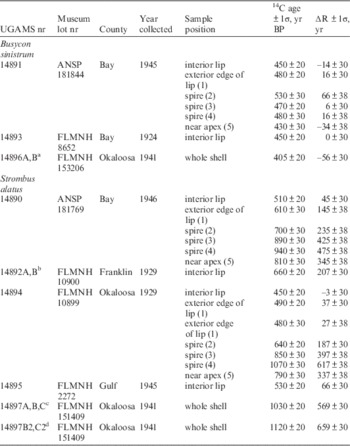
Large-magnitude fluctuations in 14C in marine mollusks from the eastern Pacific are attributed to variability in ocean upwelling over seasonal or longer timescales (Kennett et al. Reference Kennett, Ingram, Erlandson and Walker1997; Andrus et al. Reference Andrus, Hodgins, Sandweiss and Crowe2005; Culleton et al. Reference Culleton, Kennett, Ingram, Erlandson and Southon2006; Jones et al. Reference Jones, Hodgins, Dettman, Andrus, Nelson and Etayo-Cadavid2007, Reference Jones, Hodgins, Etayo-Cadavid, Andrus and Sandweiss2010). Although episodes of upwelling related to El Niño–Southern Oscillation (ENSO) and hurricane events have been documented in the Gulf of Mexico (e.g. Collard and Lugo-Fernández Reference Collard and Lugo-Fernández1999; Walker et al. Reference Walker, Leben and Balasubramanian2005), upwelling is neither pronounced nor regular in this region. Intrashell variability up to 100 yr is not uncommon for areas of the Atlantic coast that exhibit limited upwelling, as seen in oysters (Crassostrea virginica) from the Chesapeake Bay region (Rick and Henkes Reference Rick and Henkes2014) as well as the B. sinistrum from the northern Gulf of Mexico reported here (Tables 2 and 3). In comparison, we observed differences of 190–620 yr within S. alatus shells from the Gulf of Mexico (Tables 2 and 3). Factors other than upwelling likely account for the variability observed in this taxon.
Comparison of reservoir effects along the northern Gulf of Mexico. Data summarized from Hadden and Cherkinsky (Reference Hadden and Cherkinsky2015).

a
Weighted average of two different shells from same museum lot (T=0.13,
 ${\rm \chi }_{{\,\,\,\,\,0.05}}^{\,\,2} {\equals}3.84$
).
b
Weighted average of two replicate samples from same shell (T=0.01,
${\rm \chi }_{{\,\,\,\,\,0.05}}^{\,\,2} {\equals}3.84$
).
c
Weighted average of three different shells from same museum lot (T=3.50,
${\rm \chi }_{{\,\,\,0.05}}^{2} {\equals}5.99$
).
d
Weighted average of two different shells from same museum lot (T=2.00,
 ${\rm \chi }_{{\,\,\,0.05}}^{2} {\equals}3.84$
).
Although multiple factors likely influence shell 14C, from the expanded data set it is now clear that a shift in shell 14C occurs during the juvenile life stage of S. alatus. Juvenile S. alatus shells grow quickly, achieving full length by 2 yr of age (Shawl et al. Reference Shawl, Jenkins, Davis and Main2005). New growth in mature specimens is limited to the lip region, which grows thicker (Davis and Shawl Reference Davis and Shawl2005). In both archaeological and modern shells, samples taken from the spire region, which represent the juvenile life stage, are far more depleted in 14C compared to samples taken from the lip region of the mature mollusk (Figure 2 and Table 3). In addition, we previously reported ages obtained from whole, pre-bomb juvenile S. alatus, which were extremely depleted in 14C (UGAMS-14897A,B,C). S. alatus shells appear to be incorporating much “older” (more depleted in 14C) sources of carbon during the juvenile life stage than they do later in life.
The patterned shift in 14C activity during the juvenile life stage suggests a life-history event, such as a shift in habitat or niche corresponding to life stage changes, in addition to any localized fluctuations in the carbon reservoir. The organism undergoes several important changes from larval (veliger) to mature life stages, including shifts in habitat and food source. Larvae drift in the water column and subsist on planktonic algae for the first several weeks of life. Juveniles settle onto the sea floor, typically in shallow coastal waters, and graze on the epiphytic algae that grows on sea grasses and grains of sand (Davis and Shawl Reference Davis and Shawl2005). Mature S. alatus also graze on algae, but migrate seasonally from deeper water in the winter to shallow water during the summer spawning season (D’Asaro Reference D’Asaro1986; Shawl Reference Shawl2001; Davis and Shawl Reference Davis and Shawl2005). The shallow coastal waters preferred by juvenile S. alatus possibly have greater inputs of old carbon, such as14C-depleted freshwater (Cook et al. Reference Cook, Bonsall, Hedges, McSweeny, Boroneant and Pettitt2001; Rick et al. Reference Rick, Henkes, Lowery, Colman and Culleton2012; Schulting et al. Reference Schulting, Bronk Ramsey, Bazaliiskii and Weber2015). The Choctawhatchee and Apalachicola Rivers, for example, pass through Miocene- and Oligocene-age geologic formations, including limestones (Scott et al. Reference Scott, Campbell, Rupert, Arthur, Missimer, Lloyd, Yon and Duncan2001), on their way to the Gulf of Mexico.
The variability observed both within and among S. alatus specimens precludes a reliable estimate of ∆R and makes this taxon a poor candidate for 14C dating. The relatively “noisy” 14C records of S. alatus shells are problematic because archaeological specimens frequently are recovered in fragmented condition (Russo et al. Reference Russo, Hadden and Dengel2009). Other strombid conchs with similar life-history traits may prove to be unsuitable for 14C dating as well. Metamorphosis and migration are key life-history events in S. gigas (Danylchuck et al. Reference Danylchuk, Mudd, Ingelise and Baldwin2003; Stoner Reference Stoner2003) and S. pugilis (Enriquez-Diaz et al. Reference Enrique-Diaz, Volland, Chavez-Villegas, Aldana-Aranda and Gros2015), which are recovered in archaeological contexts in southeastern North America and the Caribbean (Newsom and Wing Reference Newsom and Wing2004; Luer and Loger Reference Luer and Loger2014; Hadden Reference Hadden2015); as well as S. canarium and S. luhuanus, which are common in archaeological sites in southeast Asia (e.g. Mason Reference Mason1997; O’Connor et al. Reference O’Connor, Barham, Spriggs, Veth, Aplin and St. Pierre2010; Szabó and Amesbury Reference Szabó and Amesbury2011).
CONCLUSIONS
The 14C data from paired terrestrial/marine archaeological specimens largely support our previous conclusions from known-age museum specimens:
(1) S. alatus shells are highly variable in 14C content, even within individual shells, and should be avoided for 14C dating. The specific causes of the intra- and intershell variability are understood poorly, but possibly relate to localized variations in 14C as well as habitat shifts through ontogeny.
(2) Estuaries, being places where fresh and marine waters meet, are potentially influenced by multiple carbon reservoirs. It is difficult to isolate spatial from temporal variability in 14C in mobile taxa such as S. alatus.
(3) B. sinistrum is an inherently better material for 14C dating than is S. alatus, and the data presented herein should be added to the marine reservoir database (Reimer and Reimer Reference Reimer and Reimer2001). These data suggest that ∆R was relatively stable over both the short term (years) and long term (centuries) in this taxon. We recommend and a single ∆R value of –2 ± 53 14C yr for late Holocene-age B. sinistrum from the northern Gulf Coast region.
(4) Carbon reservoir effects in the nearshore waters of the Gulf of Mexico are complex and understood poorly; therefore, samples that derive carbon from the atmospheric rather than marine reservoir continue to be preferred materials for 14C dating in this region. If marine samples cannot be avoided for dating purposes, researchers should focus on species for which ∆R has been estimated, such as B. sinistrum.
ACKNOWLEDGMENTS
This work was supported in part by a National Science Foundation (NSF) Graduate Research Fellowship, NSF Award #BCS 1026167 to Elizabeth J Reitz, and the University of Georgia Center for Archaeological Sciences Norman Herz Grant for Student Research. AMS dating was carried out with the support of CAIS. We wish to thank Jeff Speakman (CAIS) and Elizabeth Reitz (GMNH) for their support. We are grateful to Gregory Waselkov (University of South Alabama) for permitting study of the archaeological specimens, and Gustav Paulay (Florida Museum of Natural History), and Gary Rosenberg (Academy of Natural Sciences) for permitting study of the pre-bomb specimens.