The United States faces a range of serious threats to its national health security from the deliberate use or accidental release of chemical, biological, radiological, and nuclear agents, as well as from naturally occurring and emerging infectious diseases, including pandemic influenza. Therefore, to prevent, mitigate, or treat adverse health effects to the civilian population in case the threats are realized, the US government invests in research, development, and procurement of medical countermeasures (MCMs). 1 MCMs include both pharmaceutical interventions (eg, vaccines, antimicrobials, antidotes, and antitoxins) and nonpharmaceutical interventions (eg, ventilators, diagnostics, personal protective equipment, and patient decontamination) that may be used to prevent, mitigate, or treat the adverse health effects of an intentional, accidental, or naturally occurring public health emergency. The Public Health Emergency Medical Countermeasures Enterprise (PHEMCE) is the coordinating body for federal agencies charged with using MCMs to protect the civilian population from potential adverse impacts of public health threats. The PHEMCE is led by the US Department of Health and Human Services (DHHS) Assistant Secretary for Preparedness and Response (ASPR) and includes 3 primary DHHS internal agency partners: the Centers for Disease Control and Prevention, the Food and Drug Administration (FDA), and the National Institutes of Health. The PHEMCE also includes offices within the ASPR including the Biomedical Advanced Research Development Authority (BARDA) and the Office of Emergency Management, as well as several interagency partners, such as the Department of Homeland Security, the Department of Defense, the Department of Veterans Affairs, and the Department of Agriculture. PHEMCE agencies work together to align and integrate national preparedness for large-scale public health emergencies for MCM research and development, acquisition, stockpiling, and effective use in the field. For more on the establishment of the PHEMCE, see the “Statement of organization, functions, and delegations of authority.” 2 For more information on the structure and governance of the PHEMCE, refer to Appendix 2 of the 2014 PHEMCE Strategy and Implementation Plan. 1
BARDA, as a member of the PHEMCE, is the federal program responsible for advanced development and procurement of MCMs for civilian use during a public health emergency. 3 Some MCM investments by BARDA have routine applications in the health care system, which may generate economic spillover benefits in the day-to-day health care system. According to Jaffe,Reference Jaffe 4 “Market spillovers result when the operation of the market for a new product or process causes some of the benefits thereby created to flow to market participants other than the innovating firm.” Since new innovative products tend to result in higher quality or lower prices, there may be an increase in consumer welfare as a social benefit from a new product that is not captured by the innovator. Economists call this social benefit a positive externality or spillover, in addition to the private benefit enjoyed by innovators. (In essence, spillovers are unintended benefits to market participants other than the innovating firm.) These spillover benefits are outside the scope of the PHEMCE and BARDA core mission to protect the health of the US civilian population during large-scale public health emergencies.Reference Angelucci and Di Maro 5
Public economic theory suggests that government policies should be aimed at addressing “market failure.”Reference Herber 6 Consider the case of MCMs where low or negative private projected investment rate of return and/or a high-risk of failure in developing a product is often a disincentive for private investors. In such cases, innovators are unable to develop and bring their products to market. Economists consider these cases a market failure because market processes do not provide private industry with incentives to invest in what might be a socially optimal allocation of resources. In these cases, a substantially positive social rate of return could be sufficient to make public investment desirable. In cases of market failure, the total economic value to society (ie, social welfare) can exceed the cost of a government subsidy paid to private industry for bringing an innovation to market. Therefore, the government should evaluate subsidy programs to identify technological, organizational, and economic factors that measure social returns to innovation in ways that explicitly capture spillover effects, which is the difference between the social and private rates of return to a proposed project.Reference Jaffe 4 , Reference Jones and Williams 7
Medical consequences resulting from an improvised nuclear device incident may include severe burns that require debridement and skin grafting. The standard of care (SOC) in the United States for removing dead or dying tissue from these burns includes surgical and nonsurgical excision such as tangential excision, dermabrasion, and hydrosurgery.Reference Schnorpfeil 8 These procedures would overwhelm local burn care resources, especially in the operational environment following the detonation of an improvised nuclear device in which some critical infrastructure may be destroyed. While burn wound debridement is standard care for severely burned patients to expedite healing and prepare wounds for grafting, it is a small market and offers little incentive for private industry investment. (Thermal burn debridement products have orphan designation. Orphan designation is for medical conditions that affect less than 200,000 people nationally each year. Orphan markets are small and as a result provide little economic incentive for the private sector to invest in.) However, the benefits of novel, nonsurgical burn wound debridement can reasonably be expected to reduce treatment times and increase the ability to provide care for more patients in the operationally challenging environment following a nuclear detonation.
NexoBrid (MediWound Ltd, Yavne, Israel) is a burn wound debridement MCM currently funded by BARDA to enhance national preparedness in an improvised nuclear device incident. BARDA has awarded MediWound Ltd a 5-year base contract of $24 million to pursue US FDA approval of NexoBrid for use in thermal radiation burn injuries. 9 In this article, we use the burn debridement product as a case study of the potential economic spillover benefits for routine burn care from a public investment designed to enhance US preparedness for an improvised nuclear device incident.
METHODS
We developed an input-output model to project the potential economic spillover effects of a burn debridement product by examining 4 primary inputs: (1) market size, (2) clinical effectiveness and cost-effectiveness (debridement and grafting), (3) product cost, and (4) market adoption rates.Reference Schnorpfeil 8 , Reference Mauboussin and Callahan 10 We used data from 2 primary sources to project potential spillover benefits in the model: (1) the American Burn Association’s 2015 National Burn Repository Annual Report of Data, and (2) published clinical outcome studies that were used to gain European approval for the burn treatment.
Cost
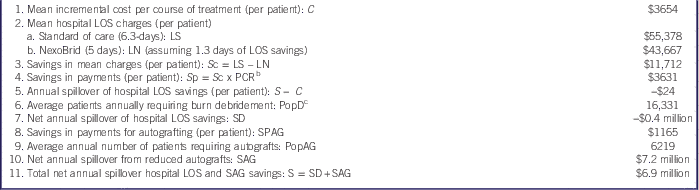
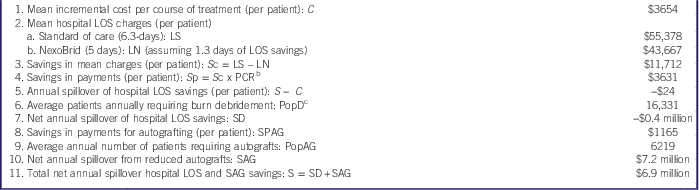
The burn treatment has yet to be approved, launched, and marketed in the United States. Consequently, the price per average course of treatment is uncertain. However, the average cost of NexoBrid in Europe is estimated to be $3654 adjusted for an average burn patient with up to 15% total body surface area (TBSA) burned.Reference Berto, Masellis and Cherubino 11 The mean incremental cost per course of treatment (per patient) includes the price of the product and related additional costs associated with use of the new product, compared to the cost of the current SOC, which is presented in the following section (Table 1, row 1).
Projected Annual Spillover Benefit, Assuming 100% Market Sharea
aAbbreviation: LOS, length of stay. NexoBrid is a burn debridement product (MediWound Ltd, Yavne, Israel). Assuming 100% market share, annual spillover benefit per patient calculated based on the following formulas:
 $$S_{D} \,{\equals}\,\left[ {\left[ {\left( {L_{S} \,{\minus}\,L_{N} } \right){\times}PCR} \right]\,{\minus}\,C} \right]{\times}Pop_{D} \,{\equals}{\minus}\$0.384 \,\rm million$$
 $$S_{{AG}}\,{\equals}\,S_{{PAG}} {\times}Pop_{{AG}} \,{\equals}\,\$7.2 \,\rm million$$
 $$S\,{\equals}\,S_{D} {\plus}S_{{AG}} \,{\equals}\,\$6.9 \,\rm million$$
where PCR is payment-to-charge ratio: 0.31 (Medicare data).
bFrom our data from the American Burn Association, 14 we know that the government insurance payers account as 35.4% and private insurance accounts as 31.1% of patients’ primary insurance payers. Hospitals submit charges and insurers make payments based on established industry standards. PCRs, converting hospital charges to an estimated payment, have been estimated to be about 31% based on fee-for-service Medicare claims data from the Centers for Medicare & Medicaid Services for dates of service in 2011 and 2012.Reference Smith, Friedman, Karaca and Wong 16 The current standard of care in the United States is determined by data from the American Burn Association. 14 According to the American Burn Association, an average of 19,176 patients annually require burn debridement procedures in the United States. On average, out of 19,176 patients, about 70% have excisional debridement of the wound and 30% have nonexcisional debridement of wound. The average LOS is reported as 6.3 days for standard of care and 5.1 days for NexoBrid treatment. 14 , Reference Rosenberg, Shoham and Krieger 15
cFor patients aged 18-69 years with <15% total body surface area burned.
Effectiveness: Debridement
The burn debridement product is an easy-to-use, topically applied treatment innovation for severe burns that removes dead tissue (eschar) in about 4 hours without harming the adjoining healthy tissue. It is approved in Europe for burn wounds covering up to 15% (TBSA). 12 According to the European Medicines Agency, “NexoBrid should not be applied to more than 15% Total Body Surface Area (TBSA) in one session and should be left in contact with the burn for a duration of 4 hours.” A systematic review by Rosenberg et alReference Rosenberg, Krieger and Bogdanov-Berezovski 13 indicates the product is more effective and less aggressive than surgical (excisional) and nonsurgical (nonexcisional) debridement techniques used in the current SOC. According to the American Burn Association, a weighted average of 19,176 patients require burn debridement procedures annually in the United States. 14 About 70% of patients have excisional debridement and 30% have nonexcisional debridement of their burn wound. 14 The calculated weighted average hospital length of stay (LOS) is 6.3 days under the current SOC for patients with less than 15% TBSA requiring burn debridement. For purposes of illustrating our method, we provide potential results using a 5-day LOS, or an average LOS reduction of 1.3 days if the burn debridement product is used (Table 1).
A review from 7 studies, including 4 randomized clinical trials, indicated that the burn treatment efficacy significantly reduced the time from injury to complete debridement (from 8.7 to 2.2 days, P<0.0001) and reduced the number of autografts performed by about 50% (from 34.1% to 17.9%, P<0.01).Reference Rosenberg, Shoham and Krieger 15 Rosenberg et al also reported other clinical outcomes effectiveness such as reduction in the need for surgery (from 70.0% to 24.5%, P<0.0001), the area of burns excised (from 56.7% to 13.1%, P<0.0001), and the need for autografting (from 34.1% to 17.9%, P=0.01) in patients with deep partial and full thickness burns covering up to 67% TBSA. A budget impact study was conducted in Italian hospitals after introduction of the burn treatment using clinical effectiveness findings from Rosenberg et al.Reference Berto, Masellis and Cherubino 11 The budget impact study assumed that for burn patients averaging 10%TBSA, LOS would be reduced by an average of 6.5 days.
The model used information from the 2015 American Burn Association’s National Burn Repository Annual Report of Data. 14 The American Burn Association data show a positive relationship between LOS and percentage of TBSA burned. We calculated a weighted average hospital LOS of 6.3 days for patients with up to 15% TBSA under the current SOC (Table 1, row 2a). We also calculated a weighted mean LOS charge per patient for those using the burn debridement product of $43,667 (Table 1, row 2b). Savings in mean charges per patient were $11,712 when compared with the SOC (Table 1, row 3).
Hospitals submit charges and insurers make payments on the basis of established industry standards. These payments are generally lower than the amounts hospitals charge. Payments, rather than charges, are a better indicator of economic savings or benefit. Payments represent actual outlays of money by payers to providers.Reference Smith, Friedman, Karaca and Wong 16 Medicare pays an average of 31% of hospital charges in the case of treating burn patients based on fee-for-service Medicare claims data from the Centers for Medicare & Medicaid Services (CMS) for dates of service in 2011 and 2012. In this analysis, the payment-to-charges ratio used was 31%. Savings in payments per patient for burn debridement of $3631 (Table 1, row 4) were obtained by multiplying the projected savings in charges per patient ($11,712) by 31%. The annual per patient spillover benefit from hospital LOS savings is minus $24. This was projected by subtracting the mean incremental cost per course of treatment ($3654) from LOS savings in payments per patient of $3631 (Table 1, row 5) associated with a LOS reduction of 1.3 days.
Effectiveness: Grafting
The projected reduction in the number of autografts is about 50% (from 34.1% to 17.9%, P<0.01).Reference Rosenberg, Krieger and Bogdanov-Berezovski 13 Per patient autograft savings of $1165 include (1) a reduction of $773 for an estimated 50% physician payments (50% of $1546=$773) for procedure and routine postoperative care (for repair of wound with skin graft) and (2) a reduction of about $392 for anesthesia (50% of $784=$392). 17
The net annual spillover benefit from reduced autografts is $7.2 million (Table 1, row 10), projected by multiplying the savings in payments from reduced autografting per patient of $1165 (Table 1, row 8) by 6219, the projected annual average number of patients requiring autografts (Table 1, row 9).
Market Size
The 2015 American Burn Association’s National Burn Repository Annual Report of Data shows an average of 19,176 patients annually requiring burn debridement procedures from 2005 to 2014 (ICD-9 86.22 and 86.28). 14 We assume the burn treatment will be approved for the same indication as in Europe for burn wounds, up to 15% TBSA. For our baseline calculations, we projected an annual average of 16,331 patients aged 18 to 69 years with intermediate dermal burns less than 15% TBSA will need debridement (Table 1, row 6). This number was derived by extrapolating missing values based on the relationship between age groups and burn size and adjusting for the percentage of participating US hospital burn centers (99 out of 128) in the National Burn Repository (Table 1, row 6). In addition, 6219 of the 16,331 hospital inpatients were projected to require autografting each year in the United States (Table 1, row 9).
Market Share
The diffusion of new products in the market to potential adopters is often affected by 2 factors: (1) marketing communication efforts (notation=p), and (2) social contagion (notation=q).Reference Van den Bulte and Stremersch 18 A standard diffusion approach is the Bass model, which offers a life cycle model of market share and sales pattern of new technologies.Reference Bass 19 - Reference Van den Bulte 23
The characteristic adoption curve as described by the Bass diffusion model was fitted to the adoption of NexoBrid by using the historical diffusion values for p and q for computed tomography (CT) scans in years 1980 to 1993.Reference Mauboussin and Callahan 10 These values for p and q have also been used for dermatological products in Australia in a simplified two-segment Bass model.Reference Dunn, Braithwaite and Gallego 24 For the adoption model, early adopters (hospitals) of new technology represent one segment of the market, and later adopters (hospitals) represent another segment of the market.Reference Mauboussin and Callahan 10
In Table 2 we show one possible scenario in which patient adoption of the burn treatment reaches 25% of the patient population in 10 years and hospital LOS is reduced by 1.3 days compared to the SOC. If peak market share exceeds 25% and 1.3 days LOS reduction, economic spillovers and return on investment will be larger. Dunn et alReference Dunn, Braithwaite and Gallego 24 used similar values for p and q in an analysis of the adoption of a broad cross-section of 103 drugs using national monthly prescription volumes from Australia. They reported a median time of 8.2 years for full patient adoption of the 103 drugs. As a primary reference for our analysis, we choose a 10-year window for the analysis as a minimal useful life for the product on the market. MediWound Ltd has patent protections on the burn treatment through 2029 and anticipated market exclusivity of 12 years after FDA approval, potentially providing sole marketing rights for 1 or 2 years beyond patent protection (MediWound Ltd, personal communication, December 2015).
Projected Breakeven Spillover Benefit: 1.3-Day Reduction in Average Hospital Length of Stay and 25% Peak Market Share After 10 YearsFootnote a

a Abbreviation: LOS, length of stay. NexoBrid is a burn debridement product (MediWound Ltd, Yavne, Israel). Note: this analysis assumes peak market share of 25% in year 10 as shown in column (2).
b This is $3651 hospital LOS savings per inpatient minus $3654 incremental cost of the burn treatment ($3631−$3654=−$24).
Projections of Economic Spillover
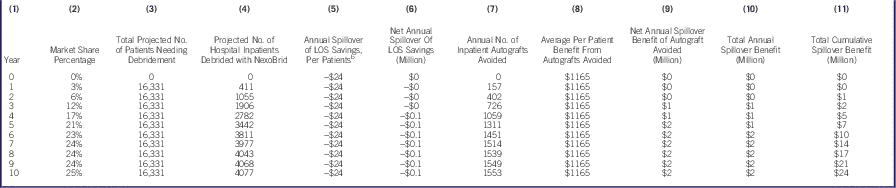
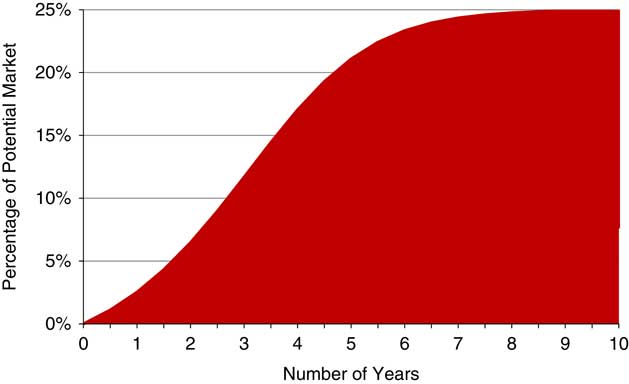
The net annual potential spillover savings from debridement and grafting is projected to be $6.9 million, assuming 100% market share (Table 1, row 11). We assume 100% market share by the burn treatment is impractical. In fact, market share is likely to be very low in the first few years after the product launch. Therefore, we used a simplified version of the Bass diffusion of innovation model to project the market adoption rate in our analyses. Figure 1 shows the potential number of patients needing debridement assuming a 25% peak market share in year 10 based on historical dermatological drugs and CT scanner adoption rates.Reference Mauboussin and Callahan 10 , Reference Dunn, Braithwaite and Gallego 24 Table 2 illustrates the breakeven calculation and assesses a scenario in which (1) hospital LOS is reduced by 1.3 days, (2) 25% peak market share is reached by year 10, and (3) incremental costs are $3654 for the burn treatment. Breakeven in this analysis means that the economic spillover is equal to BARDA’s original investment of $24 million to bring the burn treatment to the US market. For each year, we multiplied the projected number of hospital inpatients adopting the burn treatment (Table 2, column 4) by the net hospital LOS savings, per patient (Table 2, column 5), to derive the net annual hospital LOS spillover benefits (Table 2, column 6, S D).
Projection of Cumulative Patient Adoptions in Years 1 Through 10.

Similarly, multiplying the annual reduction in patient autografts (Table 2, column 7) by autograft savings per patient of $1165 (Table 2, column 8) provides the annual spillover benefit of reductions in autografts (Table 2, column 10).
The total annual spillover benefit (Table 2, column 11) is projected by summing the net annual hospital LOS spillover benefit (Table 2, column 6) and the annual spillover benefit from reductions in autografts (Table 2, column 10). Finally, the cumulative spillover in each of the 10 years (Table 2, column 11) is derived by adding each total annual spillover benefit amount to the previous year’s cumulative amount. In the 10th year, the cumulative spillover benefit is $24 million, the breakeven point for BARDA’s original investment. The sensitivity analysis in the next section demonstrates that larger average hospital LOS reductions or higher peak market share than presented in the scenario above would accelerate the time to break even and provide a larger spillover benefit over the 10-year projection window.
Sensitivity Analyses
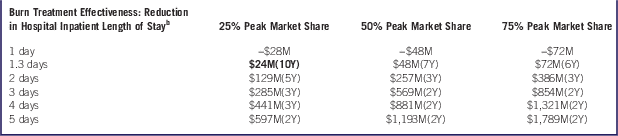
Given the uncertainty around the average LOS reduction and peak market share, we explored variations in results with variations in potential values of the 2 parameters. Table 3 summarizes the 10-year cumulative spillover benefits (and, parenthetically, the year in which the government investment of $24 million would break even) for peak market share and effectiveness (reduction in hospital LOS) for the burn treatment versus the SOC. The case example cumulative benefit of $24 million shown in Table 2 is shown in bold in Table 3 at the intersection of 25% market share and 1.3-day reduction in LOS.
Projected Cumulative Spillover Benefits by Reduction in Hospital Length-of-Stay and Number of Autografts and Peak Market Share (25%, 50%, and 75%) in Year 10a

aNotes: Projections are based on the parameters presented in Table 1. The numbers of years in parentheses [eg, $24 million (10Y)] show when the cumulative spillover benefits are equal to BARDA’s initial investment of $24 million in the burn treatment. Negative cumulative benefits never break even, so the number of years is not applicable. Assumes $3654 incremental cost of the burn treatment.
Formulas and example:
The number of patients in Eq (1) and (2) in Table 1 (PopD and PopAG) per year 0 to 10 are estimated based on the following Bass model formula in Table 2, columns 3 and 6:
 $$Pops(1\hbox-10 years)\,{\equals}\,[B9\,{\plus}\,p{\,\asterisk\,}(m\,{\minus}\,B9){\plus}q\,{\asterisk}\,(B9/m)\,{\asterisk}\,(m\,{\minus}\,B9)]\,{\times}\,Pop$$
where M is market potential (=25%), P is innovation (=4.40%), Q is imitation (=35.00%),c and B is number of adopters (=P+Q), PopD is the annual number of patients requiring debridement (=16,269; data from American Burn Association 14 ), and PopG is the annual number of patients requiring grafting (=6219; data from American Burn Association 14 ).
For example, the number of patients for debridement and autografts in year 10 from Eq (4) would be 4077 and 1553, respectively (Table 2, columns 3 and 7).
PopD (Y=10)=25%×(16,331)=4077
PopG (Y=10)=25%×(6219)=1553
Assuming 25% market share and 1.3-day reduction in average hospital length of stay, Eq (1) and (2) in year 10 in Table 2 columns 6 and 9 will be
Net annual spillover of LOS savings=SD X PopD (Y=10)=−$24 X 4077=−0.1M
Net annual spillover benefit of autograft avoided=SAG X PopAG (Y=10)=$1165 X 1533=$2M
Total annual spillover benefit (TS) in column 9 will be
 $$ TS\,{\equals}\,SD{\plus}SAG$$
TS in column 10=−$0.1 million + $2 million=$2 million Finally, the cumulative spillover in year 10, derived by adding each year’s net annual spillover amount to the previous cumulative amount is presented in Table 2 column 11.
 $$\sum TS_{{(1\hbox-10Y)}} \,{\equals}\,TS{\times}Pops(1-10{\rm }years)\,{\equals}\,\$24 \rm \,million$$
bIncludes reduction in the number of autografts projected to be performed.
cTo project the market adoption rate in our analyses, we used historical diffusion processes for computed tomography scan scanners) in years 1980-1993 in a simplified Bass model where early adopters (hospitals) of new technology represent one segment of the market and later adopters represent another segment of the market per Mauboussin and Callahan.Reference Mauboussin and Callahan 10
To assess the projected cost savings from reductions in LOS using the burn treatment in the United States, we calculated the incremental costs and effectiveness along a continuum ranging from a 1-day to a 5-day reduction in hospital LOS when using the burn treatment (Table 3). Projecting the reduction in hospital LOS is difficult, because the SOC may vary between the United States and the 13 European countries included in the clinical results studies. In addition, several factors might impact the peak market share over 10 years, including the cost-effectiveness of the product, the company’s product marketing strategy, and provider and payer acceptance of the burn treatment.
The study assumed a 3% discount rate and a 3% annual inflation rate. We tested the sensitivity of a higher annual inflation rate on the burn treatment by using a 3% discount rate with a 1% and 5% annual inflation rate on the model. 25 The analysis showed that with a 5% average inflation rate over 20 years, the projected cumulative spillover benefit would be about 16% higher, and with a 1% inflation rate would be about 16% lower than using the 3% inflation rate. Finally, we considered a range from 25% to 75% over 10 years for market share.
Human Subjects Protection
This study was exempt from institutional review board review because no human subjects data were used for modeling economic spillovers of the burn debridement product.
RESULTS
The US federal government invests in the development of MCMs for addressing adverse health effects to the civilian population from chemical, biological, and radiological/nuclear threats. The scope and purpose of our analysis was to project whether economic spillover benefits from routine burn care alone are sufficient to justify public investment in NexoBrid.
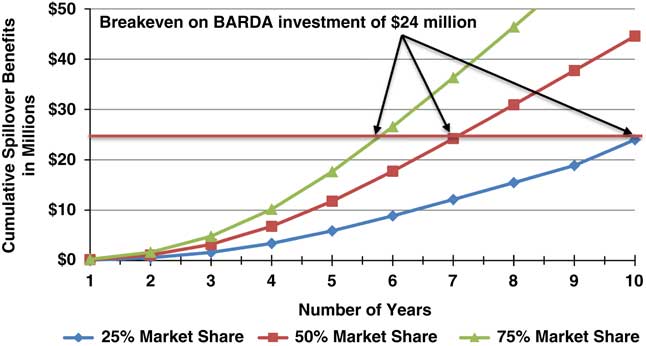
Figure 2 shows the breakeven point of $24 million in spillover benefits, an amount equal to BARDA’s investment for approval of the burn treatment, with a 25%, 50%, and 75% peak market share by year 10 after product launch. The 25% market share scenario breaks even in year 10, the 50% peak market share scenario breaks even in year 7, and the 75% peak market share scenario breaks even in year 6. These results all assume a 1.3-day reduction in hospital LOS for patients using the burn treatment and the incremental cost of $3654.
Projected Cumulative Spillover Benefits of the Burn Debridement Product by Peak Market Share Over 10 Years and a 1.3-Day Reduction in Hospital Length of Stay.
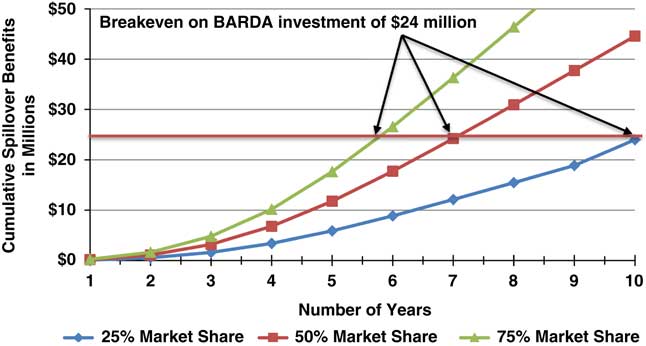
Table 3 provides an expanded array of projected cumulative spillover benefit projections by using different reductions in hospital LOS assumptions ranging from 1 to 5 days and 3 notional cases of 25%, 50%, and 75% peak market share over 10 years. For example, the 50% peak market share column with a 2-day reduction in hospital LOS shows that the cumulative spillover benefit is $257 million (Table 3, row 3). The BARDA investment of $24 million breaks even in this scenario during year 3 as indicated by the (3Y) value immediately after the $257 million value.
The projected array of potential cumulative spillover benefits in Table 3 range from −$72 million to $1.8 billion depending on the extent of reduction in hospital LOS, the reduction in the number of autografts performed, and peak market share achieved in 10 years.
DISCUSSION
Policy Implications
Projecting economic spillovers for MCM advanced development investments provides insights into the full range of potential societal benefits beyond public health emergencies. Consider the case where the trade space is characterized by 2 advanced development MCM investment choices to address different national health security threats, each with a low probability of occurring, and with similar projections of consequence for mortality and morbidity in large-scale public health emergencies. The rate of return will likely be greater for MCM investments with economic spillovers in the day-to-day health care system than for those without spillovers into the health care system. In addition, MCMs that are used day-to-day in the health care system will become more familiar to practitioners. Thus, practitioners will be more likely to effectively administer MCMs during a public health emergency when medical response resources will be scarce.
The analytic approach designed in this analysis could be used to provide projections for MCM investments with economic spillover effects, enabling decisions that increase the economic rate of return with preparedness and response mission space. Government programs can use this approach to internalize potential spillover benefits in their resource allocation decisions.
Limitations
The analysis took an agency and statutory mandate perspective regarding the economic spillover effect into the day-to-day health care system. It did not take the perspective of the private sector innovator, payers, hospitals, or burn surgeon. BARDA is legislatively mandated to invest only in advanced development and procurement of MCMs that increase preparedness for public health emergencies. It is prohibited from investing in projects that provide benefits solely for the day-to-day health care system. Consequently, any benefits accruing to the day-to-day health care system are outside BARDA’s legislative mandate to address public health emergencies and represent a positive economic spillover to society.
The key challenge to our analysis was that we assumed the cost reduction associated with clinical effectiveness and the LOS are endogenous, and hence it was difficult to predict one specific point for estimating of incremental cost-effectiveness of the burn debridement product in day-to-day burn care. We assumed that upon availability of information about the reductions in LOS, insurers would increasingly provide coverage for the burn treatment. Negotiated payments for providers would likely vary from assumptions in the model. In addition, providers have discretion in adopting innovations. As a result, product pricing and market adoption rates may differ based on exogenous decisions made by payers, patients, and providers.Reference Philipson and Jena 26 Additional exogenous variables include regulatory decisions regarding the %TBSA thresholds or approval for outpatient use of the burn debridement product.
NexoBrid has not yet been approved and marketed in the United States. As a result, no data exist on using the burn treatment in the United States. Nevertheless, we have included in the analysis what we think is an informative range of reasonable incremental costs, peak market shares, and effectiveness parameters. Using the burn treatment may reduce the mortality rate for high-risk patients with burn wounds, as a result of the earlier removal of toxic eschar and reduction in and extent of surgical procedures.Reference Rosenberg, Krieger and Bogdanov-Berezovski 13 , Reference Allgöwer, Schoenenberger and Sparkes 27 Lacking data on mortality reduction, we projected spillover benefits solely from reductions in inpatient hospital LOS and professional services associated with the number and extent of autograft surgeries.
Finally, absent primary data on the relationship of charges to hospital LOS reduction, we assumed a linear relationship. The ratio of hospital payments to reductions in LOS may not be linear.
The study used best available evidence and reported findings based on a static, input-output model. It did not project the dynamic interrelationships among incremental cost (price of the product), cost-effectiveness, and market share. For simplicity, we assumed similar discount rates and inflation rates over the projection period, so that their effects cancel. In our sensitivity analysis, the effects of variations in differences between these rates did not substantially impact the order of magnitude of our projections.
We acknowledge that in both private and public health insurance, markups are not determined by the intersection of single demand and supply curves. In our health care system, producers are negotiating with 2 demand sides: the payer adopting the treatment and the patients or doctors using it. Therefore, the optimal allocation of price and quantity will be determined by the price sensitivity of both sets of customers, the payers and the patients and doctors.Reference Philipson and Jena 26
We also considered the impact of an alternate counterfactual scenario that assumed BARDA did not invest in the development of NexoBrid and private investors eventually provided funding later. For illustration, if private investors would have provided funding for NexoBrid approval 5 years after BARDA, any spillover benefits would be limited to the first 5 years after approval. The counterfactual scenario would reduce the level of economic spillover benefits and rate of return from BARDA’s investment.
CONCLUSIONS
BARDA’s mission is to invest in the development and procurement of MCMs designed to improve the federal response to public health emergencies. Some MCM investments have potential economic cumulative spillover benefits in the day-to-day health care system. In such cases, the return on investment is enhanced beyond the mission to protect the nation from large-scale public health emergencies. Our analysis demonstrates that a public investment in MCM development would likely have substantial economic spillover benefits if the NexoBrid burn debridement product is approved for use in the United States and adopted by practitioners for routine use.
The results of economic spillover analyses across the MCM development portfolio can help to inform prioritization of scarce funding for MCM development. Consequently, future MCM development investment decisions could incorporate consideration of potential economic spillovers when a product could be used routinely in the commercial market.
Acknowledgment
We thank the US Department of Health and Human Services Secretary’s Ventures Program for partially funding this study, BARDA’s Thermal Burn Medical Countermeasure Branch, and staff from the Division of Medical Countermeasure Strategy and Requirements in the Office of the Assistant Secretary for Preparedness and Response for their contributions to this work. We thank Dr Nicole Lurie and Dr Sally Phillips for sponsoring this study. We appreciate Dr Scott Farrow’s assistance in reviewing the first version and providing helpful suggestions for final revision. We also thank Dr Narayan Iyer, Dr Julio Barrera-Oro, Dr Martin I. Meltzer, Dr Kenneth Cliffer, Stuart Evenhaugen, Dr Bonny Harbinger, Benoit Stryckman, and MediWound Ltd for providing technical advice. An earlier version of this paper was presented at Public Health Research@Maryland on April 5, 2016, and the University of Maryland, Baltimore County, Economics and Public Policy Seminar Series on May 5, 2016. A poster presentation based on the results of this paper was presented at the International Society of Burn Surgeons biennial meeting August 29 to September 1, 2016, in Miami, Florida.
Disclaimer
The findings and conclusions in this report are those of the author(s) and do not necessarily represent the official position of the US Department of Health and Human Services or other institutions with which the authors are affiliated.