Introduction
Dribbling or excessive salivation can be defined as salivary incontinence or spillage of saliva over the lower lip. The condition affects about 10 per cent of patients with chronic neurological disease, such as cerebral palsy, Parkinson's disease, amyotrophic lateral sclerosis and post-traumatic encephalopathy.Reference Porta, Gamba, Bertachi and Vaj1 There are many factors which contribute to dribbling, such as hypersecretion of salivary glands, impaired neuromuscular control of oral and deglutition activity, and poor head control. A tongue which is enlarged or thrusting with poor control also contributes to the problem. Persistent dribbling is not life-threatening but may result in major hygienic and psychosocial difficulties for patients and their carers. These may include maceration of the skin around the mouth, chin and neck, which may cause secondary bacterial infection. In addition, dribbling can interfere with speech and feeding, thus leading to disabling social problems and a poor quality of life.
The variety of treatments currently available for dribbling is unsatisfactory. Treatment options for dribbling include: oral motor training; modification of situational factors; head re-positioning; anticholinergic agents (such as glycopyrrolate); surgical intervention (such as four duct ligation); and radiotherapy.Reference Kelm and Mair2 Glycopyrrolate lacks end-organ selectivity, causing undesirable side effects such as irritability, dry mouth, epistaxis and headache. Blasco et al. reported that glycopyrrolate treatment was discontinued in 28 per cent of dribbling patients due to side effects.Reference Blasco and Stansburry3 Greensmith et al. prospectively analysed the use of bilateral submandibular duct relocation combined with bilateral sublingual gland excision, and they reported a significant reduction in saliva excretion.Reference Greensmith, Johnstone, Reid, Hazard, Johnson and Reddihough4 However, 18 per cent of their patients developed major complications, such as bleeding requiring exploration, major tongue swelling causing airway obstruction, submandibular abscess requiring drainage, partial lingual nerve division and aspiration pneumonia.
Recent research has promoted the use of intraglandular botulinum toxin A to diminish dribbling.Reference Porta, Gamba, Bertachi and Vaj1, Reference Suskind and Tilton5–Reference Jongerius, Joosten, Hoogen, Gabreels and Rotteveel7
Botulinum neurotoxin A has become a valuable tool in the treatment of neurological disorders associated with increased muscle tone. It has revolutionised the treatment of dystonia and focal spasticity. It acts at cholinergic nerve terminals by cleaving SNAP-25, a protein involved in the fusion of synaptic vesicles with the presynaptic membrane.Reference Naumann, Jost and Toyka8 Cholinergic autonomic parasympathetic and postganglionic sympathetic nerve synapses are also amenable to treatment with botulinum toxin. Neurogenic hyperactivity of secretory glands results in hyperhydrosis, hypersalivation or increased tearing. Botulinum toxin A targets the synaptic nerve endings of cholinergic neurons supplying eccrine sweat glands, salivary glands and lacrimal glands.Reference Naumann, Jost and Toyka8
Within the last few years, a few studies have shown that botulinum toxin A injection is an effective treatment for dribbling in adults and children, regardless of the underlying cause of the condition.Reference Porta, Gamba, Bertachi and Vaj1, Reference Ellies, Laskawi, Rohrbach-Volland and Alglebe6 The use of ultrasound guidance during the injection procedure would seem to enhance accuracy, efficacy and safety. However, these studies have involved small numbers of patients, with descriptive analysis. A study with a bigger sample, statistically analysed, was therefore necessary.
Materials and methods
This study was a clinical trial of the efficacy of ultrasound-guided, intraglandular injection of botulinum toxin A (Botox®, Allergan, Irvine, California, USA) for the treatment of dribbling. It took place from 1 October 2004 to 31 October 2005 within the otorhinolaryngology department of the National University of Malaysia. After receiving approval from the research and ethical committees of the medical faculty of the National University of Malaysia, patients with dribbling were invited to participate in the study. Twenty patients were enrolled, based on the inclusion and exclusion criteria below.
Our inclusion criteria were: severe or profuse dribbling (with a score of more than seven, based on the dribbling rating scale); age greater than 12 years; and the ability to understand the requirements of the study and to supply written consent (from the carer).
Our exclusion criteria were: age less than 12 years; inability to obtain written consent (from the patient or their carer); a history of allergy to botulinum toxin; profound atrophy or excessive weakness of the muscles in the target area of injection; concurrent participation in another investigational drug study, or participation within 30 days of the start of our study; and aminoglycoside antibiotics treatment (which could potentiate the effect of the toxin).
Botox is a crystalline complex containing clostridium botulinum type A toxin with an associated haemaglutinin protein. It is available in vials containing 100 units of neurotoxin, 0.5 mg albumin and 0.9 mg sodium chloride. The powder was reconstituted with preservative-free sodium chloride to make dilutions ranging from 1.25 U/0.1 ml to 10 U/0.1 ml. The powder remained frozen until reconstituted. The reconstituted product was used within four hours. Solution that was discoloured or which contained particulate matter was discarded.
Before commencing the study, subjective information was obtained from the patient or their carer, using rating scales for the severity and frequency of dribbling. All patients recruited to the study received Botox injections, as a single injection to both parotid and submandibular glands on each side, under ultrasound guidance. Patients underwent the procedure without anaesthetic. All injections were performed by the same surgeon.
During their initial visit to the clinic, all patients underwent biological data documentation and physical examination. The risks of botulinum toxin A were explained, and consent was gained from the carer. Any oral medication prescribed for dribbling prior to the study was discontinued one month before the injection. The patients were not allowed to use any other medication to reduce dribbling during the study period. However, other methods to reduce dribbling, such as oral motor training or behaviour modification, were continued throughout the study.
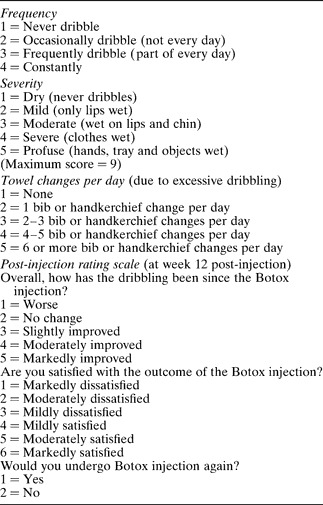
Evaluation of changes in dribbling were measured before and after the injection by calculating the dribbling rating score, dribbling severity score, dribbling frequency score, the number of towel changes in 24 hours, and a visual analogue score (Table I). Twelve weeks after the injection, during their final study visit, the patient or their carer was asked three extra questions ie. the last three questions in Table 1.
Scoring Systems Used to Evaluate Dribbling

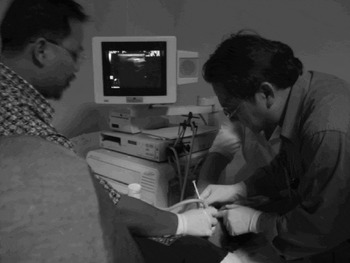
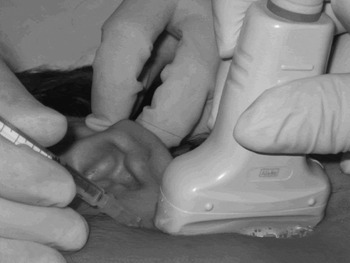
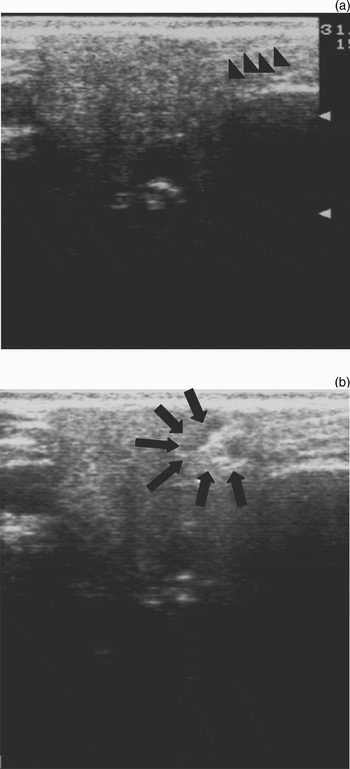
Injections were performed in the clinic without anaesthesia, by the same surgeon in all cases. The study nurse diluted the toxin. An experienced radiologist used ultrasound (Aloka SSD-2000 Multiview, Aloka Co. LTD, Tokyo, Japan) to guide the injection to the precise intraglandular site (Figures 1, 2 and 3). Both pairs of parotid and submandibular glands received a single injection, via a 25 gauge needle, of 25 U Botox. The total dose of Botox for each patient was 100 U.
The injection setting, showing the surgeon, the radiologist and the ultrasound machine.

The injection technique; the needle must remain parallel to the ultrasound probe.

Ultrasonographic images. (a) Linear, echogenic structure representing the needle (arrow heads) in the parotid gland. (b) Post-injection image showing a mixture of hypoechoic solution (botulinum toxin A) and echogenic air bubbles (arrows) within the parotid gland.

The patients were followed up during post-injection weeks two, eight and 12. The spouse or carer recorded any changes at the injection site and any changes in the patient's health, throughout the follow-up period. During each visit, subjective measurements were performed by calculating the dribbling rating score, dribbling frequency score, dribbling severity score, the number of towel changes in 24 hours and the visual analogue score. Any side effects were recorded.
Results and analysis
The changes in dribbling rating sore, dribbling severity score, dribbling frequency score, number of towel changes and visual analogue score, comparing the pre- and post-injection states, were analysed using the Wilcoxon signed rank test, as the data were not normally distributed.
Twenty patients were enrolled in the study. The median (first quartile, third quartile) age was 15 (Reference Jongerius, Rotteveel, Hoogen, Joosten, Hulst and Gabreels12, 74) years. Of the 20 patients, 13 were female and seven were male. They were of differing ethnicity; eight were Malay, eight were Chinese and four were Indian. Fourteen patients had cerebral palsy, four had Parkinson's disease, one had hypoxic ischaemic encephalopathy and one had suffered a cerebrovascular accident. All patients successfully completed the study.
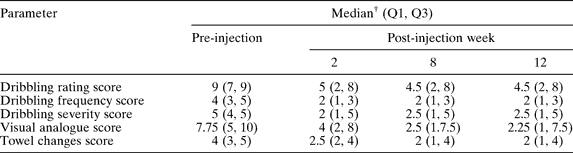
All 20 patients or their carers reported a distinct improvement in symptoms within two weeks of the injection, and 17 experienced a reduction of dribbling within the first week. The median (first quartile, third quartile) pre-injection dribbling score was nine (nine, nine). Eleven out of 20 patients presented with a maximum dribbling score of nine. The median (first quartile, third quartile) post-injection dribbling scores for the second, third and fourth post-injection weeks were five (two, eight), 4.5 (two, eight) and 4.5 (two, eight), respectively. Using the Wilcoxon signed rank test, a significant reduction was found, comparing the dribbling scores before and after injection (p < 0.001). According to the subjective assessment, the effect of botulinum toxin A was persistent until the end of the study (i.e. three months), in all but three patients.
The results for all parameters used to assess severity of dribbling (i.e. dribbling rating score, dribbling severity score, dribbling frequency score, towel changes score and visual analogue score) are summarised in Table II. The pre- and post-injection results were analysed using the Wilcoxon signed rank test, and a significant reduction in dribbling was found for each parameter (p < 0.001 for each parameter).
Statistically SignificantFootnote * Changes in Dribbling Parameters, Comparing Pre- and Post-Injection Results

* p < 0.001. †Median = second quartile. Q1 = first quartile; Q3 = third quartile
No complications or adverse effects were reported during or after the injection procedures. The possible complications were: infection of the salivary glands or salivary ducts; haematoma; salivary duct calculi; transient slight weakness of the masseter muscle; transient weakness of mouth opening; and local injury of the carotid artery or branches of the facial nerve.
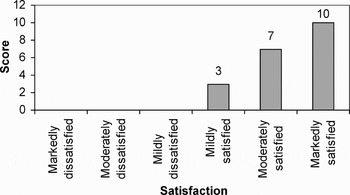
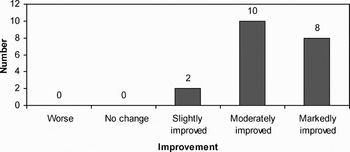
Fifty per cent of the carers were markedly satisfied with the injection outcome, 35 per cent were moderately satisfied and only 15 per cent were mildly satisfied (Figure 4). Subjectively, eight patients experienced a marked improvement in dribbling, 10 had a moderate improvement and only two had a slight improvement (Figure 5). Seventeen out of 20 carers wanted a repeat injection if the dribbling returned to its pre-injection level.
Satisfaction with outcome of botulinum toxin A injection.

Subjective improvement in dribbling following botulinun toxin A injection.

Discussion
Excessive salivation can be defined as salivary incontinence or spillage of saliva over the lower lip. Dribbling is a frequent symptom in Parkinson's disease, occurring in almost 75 per cent of all patients. It is a disabling symptom in patients with bulbar amyotrophic lateral sclerosis, affecting up to 20 per cent of patients. In the United States, 10 to 30 per cent of patients with cerebral palsy have been reported to have difficulty with dribbling due to neurological impairment.Reference Suskind and Tilton5 In our study, 70 per cent of patients had cerebral palsy, 20 per cent had Parkinson's disease, 5 per cent had suffered a cerebrovascular accident and 5 per cent had hypoxic ischaemic encephalopathy.
Dribbling is a normal phenomenon in children prior to the development of oral neuromuscular control at the age of 18 to 24 months. However, dribbling after the age of four years is uniformly considered abnormal.Reference Ellies, Laskawi, Rohrbach-Volland and Alglebe6 Therapeutic recommendations made with respect to dribbling depend very much on both the clinical status of the affected individual and the amount of dribbling. At one end of the clinical spectrum is the minimally affected but aware individual with normal intelligence who feels stigmatised in his or her attempts to integrate with society. At the other end of the spectrum is the totally unaware individual with severe neurological impairment who has profuse dribbling.
In our study, 10 out of 14 cerebral palsy cases suffered severe learning disability. Our patients with Parkinson's disease were at an advanced stage, with speech and feeding difficulties. One patient who had suffered a cerebrovascular accident, one patient with Parkinson's disease and one patient with cerebral palsy were mentally aware of their surroundings.
All of our patients benefited from botulinum toxin A injection in terms of reduction of feeding difficulty; however, it did not help much with speech. This may have been due to the thicker saliva described by most carers. Blasco, in 2002, was cautious about decreasing saliva volume and changing its viscosity in children troubled by noisy breathing, coughing and choking on secretions (requiring suctioning), fearing that such changes would worsen their respiratory status.Reference Blasco9 In our study, none of the patients developed pneumonia or worsening respiratory status. We believe that botulinum toxin A injection is safe in such conditions. Reduced dribbling also helped carers nurse the patients, as less frequent changes of bed linen and clothing were required. The cerebral palsy patients who attended school were able to follow their lessons better.
The salivary glands are controlled by the autonomic nervous system, mediated by adrenergic and cholinergic nerve endings but primarily under parasympathetic cholinergic control. The salivary glands secrete an average of 1–1.5 l of saliva per day. Saliva is secreted by the three groups of major paired salivary glands (i.e. the submandibular, sublingual and parotid glands), along with minor salivary glands located throughout the surface of the palate, tongue and oral mucosa. The submandibular gland produces 70 per cent of resting secretions. The 20 per cent from the parotid gland is as a result of external stimuli such as food. The remaining 10 per cent of saliva is secreted from the sublingual and remaining minor salivary glands. We injected both parotid and submandibular glands, in order to reduce secretion of saliva at rest and also at meals. This would not create total oral dryness, as the minor salivary glands would keep the oral cavity moist.
• Dribbling or excessive salivation can be defined as salivary incontinence or spillage of saliva over the lower lip
• Persistent dribbling is not life-threatening but may result in major hygienic and psychosocial difficulties for patients and their carers
• Intraglandular, major salivary gland injection of botulinum toxin A is an effective treatment to reduce dribbling
• Ultrasound guidance enhances the accuracy of injection, minimising the risk of complications
Bhatia et al. were the first to trial botulinum toxin A injection into the salivary glands (without ultrasound guidance), and they reported a beneficial reduction of saliva lasting six weeks to four months, with few minor side effects (such as a mild worsening of dysphagia, mild chewing difficulties and dry mouth).Reference Bhatia, Munchau and Brown10 Porta et al. were the first to report ultrasound-guided botulinum toxin A injection.Reference Porta, Gamba, Bertachi and Vaj1 They documented a 55 per cent reduction of saliva in 90 per cent of patients, with a mean duration of effect of 4.7 months and no serious side effects. Ellies et al. injected both the submandibular and the parotid glands of 13 patients suffering dribbling of varying aetiology.Reference Ellies, Laskawi, Rohrbach-Volland and Alglebe6 They reported a distinct improvement in symptoms within two weeks of toxin injection; salivary flow rates dropped sharply within one week of injection but rose again after three weeks.
Our study showed that botulinum toxin A is effective in reducing dribbling, regardless of patients' neurological diagnosis. Data analysis showed a significant reduction in dribbling, by analysing pre- and post-injection dribbling rating scores, dribbling frequency scores, dribbling severity scores, dribbling visual analogue scores and towel change scores. A few carers described daily variations in dribbling, stating that it was worse at certain times than at others, although most cases showed an overall improvement. This phenomenon has also been described in a previous study, and is unexplained.Reference Suskind and Tilton5 In my study, the reduction of dribbling started within the first two weeks post-injection and was sustained until the end of study (i.e. three months) in 85 per cent of cases. In 15 per cent of cases, the effect had disappeared by two months post-injection. This may have been due to inaccurate location of the injection; the patients struggled more than the others due to anxiety. Performance of the injection without anaesthesia was well tolerated by most patients, and the injection was completed in about five minutes. However, a few parents of cerebral palsy patients preferred that injections be performed under short duration general anaesthesia.
The main problem in our study was quantification of saliva volume, as saliva collection methods generally require the patient's cooperation. All our patients had problems with oral motor control, and most were unable to understand instructions. Therefore, the quantity of dribbling was evaluated by counting the number of towels required; this was found to be a valid and practical scoring system.
The potential adverse effects of botulinum toxin A following intraglandular salivary gland injection include: infection of the salivary glands or salivary ducts; haematoma; salivary duct calculi; transient slight weakness of the masseter muscle; transient weakness of mouth-opening; and local injury of the carotid artery or branches of the facial nerve. However, no adverse effects have previously been reported.Reference Porta, Gamba, Bertachi and Vaj1, Reference Suskind and Tilton5, Reference Ellies, Laskawi, Rohrbach-Volland and Alglebe6, Reference Jongerius, Joosten, Hoogen, Gabreels and Rotteveel7, Reference Baer, Scheuer, Buchman, Jacobson and Zeev11–Reference Pal, Calne, Calne and Tsui17 Likewise, no adverse effects were seen in our study.
Conclusion
Intraglandular major salivary gland injection of botulinum toxin A is an effective treatment to reduce dribbling. Ultrasound guidance enhances accuracy of the injection, thus minimising the risk of complications.