“Every human existence is a life in search of a narrative.”—Richard KearneyFootnote 2
In the spring of 1886, Harriet Hubbard Ayer established the Recamier Manufacturing Company at 52–54 Park Place, New York City, and began selling a face cream “for Sunburn, Pimples, etc.” and powder for “Toilet, Nursery, and after shaving.”Footnote 3 Demonstrating an entrepreneurial ambition common to the Gilded Age, Ayer used her profits to expand the business and develop new products, including the patent medicine Vita Nuova. She then established a retail shop at 27 Union Square. In 1890, Ayer expanded her business again and established a “toilet house” at 305 Fifth Avenue, where customers could purchase “every appointment of a gentlewoman's toilet.” The journalist Kate Field called Ayer's new shop “the most complete and perfect woman's shopping-place in the world.”Footnote 4
A heavy investment was required to create such perfection, or its image. In 1887, Ayer estimated that she had “$50,000 in cash capital” devoted to advertising her products, and the Printer's Ink reported in 1892 that Ayer paid $8,000 a year in rent and “advertising bills of ten times that amount.”Footnote 5 The investments paid off. According to various accounts, Ayer received a salary of $1,000 a month. She drew out of the business anywhere from $20,000 in its first two years to $200,000 in the first four years.Footnote 6 By 1890, Ayer was well on her way to becoming a visible member of greater New York City's select group of 1,265 millionaires.Footnote 7
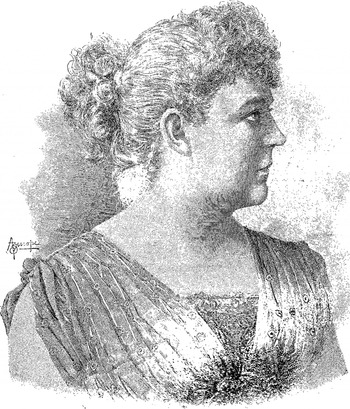
Harriet Hubbard Ayer, Frank Leslie's Popular Monthly, November 1888, 640.

Ayer's success stemmed from the marketing campaign she created for her beautifully packaged Recamier products, which she sold for high prices. She placed her name on every delicate blue pot of the Recamier face cream. In her advertisements she fashioned herself as a resilient woman who, as the sole supporter of two daughters, was forced to work when her life as a Chicago society hostess came to an abrupt, tragic end. Weaving together stories of personal tragedy, motherly responsibility, and womanly respectability, she created what I call the advertised Ayer.Footnote 8 As her company expanded, Ayer enlarged her narrative, connecting her themes of tragedy to the cultural ideal of the self-made man, gendering that ideal by advertising her own success and the successes of other accomplished women.Footnote 9
Success also stemmed from the complex network that Ayer built from financial and social capital she brought to New York from Chicago. Members of that network helped Ayer navigate New York City's fluid social and business geography.Footnote 10 She found an investor for her business and hired experts to endorse her products. She then hired the best lawyers and doctors to help her when competition for her assets quickly followed in the wake of her success. These allies helped Ayer during a series of court cases over her “person and property.” Ayer willingly went into the courtroom twice but was forced there a third time. These legal cases, which determined the trajectory of her business and career, pivoted on questions of Ayer's sanity, and they reveal the iron wall facing women who would not settle for a waged or salaried position and who demanded access to the resources available to their class. This chain of events is the cathartic moment of her narrative.
The complexity of Ayer's history—her self-fashioning, intricate intersections of the private and public, and ceaseless storytelling, but also and on the other hand, the intersections in her story of the histories of business, advertising, consumption, law, and medicine—invites a narrative approach, though one underpinned by historical analysis. In this narrative essay, which I see as an episodic treatment rather than a biographical study, I provide extensive background about Ayer to contextualize her within the Chicago elite, show her process of self-fashioning in New York City, analyze her advertisements, and examine the fights over her person and property.Footnote 11 The aims of this essay are to understand how Ayer engaged in the hard work of building a business from the ground up and to examine the benefits and losses she and her family gained from her work. To achieve this, it is important to understand Ayer's family, her social and business connections, and her careful attention to the idea of respectability.
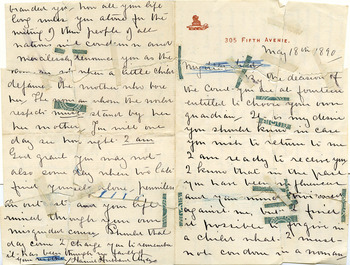
Ayer wrote constantly for public consumption, but I have been able to locate only one of her letters. This 1890 letter from Ayer to her then fourteen-year-old daughter Margaret was torn into small pieces, taped back together, and placed back in its original envelope. It is now in the Blanche Willis Howard Papers at the Bowdoin College Library.Footnote 12 (See Figure 2.) To me, this letter embodies the complexity of Harriet Hubbard Ayer's history, with its shifting private and public alliances and betrayals. For Ayer, private anguish and trauma mingled continually in what amounts in the end to another failed entrepreneurial story of the Gilded Age. Finally, the letter's state of preservation in the collection of a woman who would become one of Ayer's nemeses also provides a warning. Ayer expected that the letter would be read by individuals other than her daughter, including people she believed wanted to harm her. Everything Ayer wrote that I have been able to find—including this plea to her child—was written for public consumption.
Harriet Hubbard Ayer to Margaret Ayer, May 18, 1890, Blanche Willis Howard Papers, George J. Mitchell Dept. of Special Collections and Archives, Bowdoin College Library, Brunswick, Maine.

Chicago
Harriet Louise Hubbard Ayer was well known in Chicago society because of the prominence of her parents' families, her marriage into the Ayer family, and her social activities. Harriet's maternal grandmother, Clarissa Harlowe Rathbone of Stonington, Connecticut, was the daughter of a merchant and financier.Footnote 13 In 1808, Clarissa married Theophilus W. Smith, who read law with Aaron Burr. Eight years later they moved to Illinois, where Theophilus established a law practice and served on the Illinois Supreme Court. Smith, apparently, was a quarrelsome character, described by a colleague as “devoted to his friends and bitter toward his enemies.” This may have contributed to the 1833 impeachment hearings against him, ostensibly for “selling a clerk's office” and “swearing out vexatious writs … for the purpose of oppressing innocent men.” Smith was acquitted and held his position until he resigned in 1842.Footnote 14 After his death, Illinois governor Thomas Ford called Smith “an active, bustling, ambitious and turbulent member of the Democratic party” who “never lacked a plot to advance himself or to blow up others. He was a laborious and ingenious schemer in politics.”Footnote 15 Theophilus would have been proud to have had a granddaughter like Harriet.
In 1837, Clarissa and Theophilus's daughter Juliet Elvira Smith married Henry George Hubbard, cousin and business partner of Chicago land speculator Gurdon S. Hubbard.Footnote 16 Juliet and Henry George Hubbard had seven children, of whom four survived early childhood, including Harriet Louise, born in 1849.Footnote 17 When Henry George Hubbard died of cholera at the age of forty-three, Juliet divided her children among her sisters while she traveled in an attempt to deal with her grief. When Juliet returned to Chicago, she removed herself from her children's daily lives. Their education was left to private tutors and, for Harriet, a short time at a Catholic girls' school.Footnote 18 Thus, by her teens, Harriet had learned about the importance of acquiring property, the dynamics of entrepreneurship, the need to build and maintain social capital, and the instability of families.Footnote 19
At the age of seventeen, Harriet Louise Hubbard's business was marriage and family. She became the wife of Herbert Copeland Ayer, and soon they had two daughters, Hattie and Gertrude.Footnote 20 Herbert's paternal family roots were in Massachusetts, where his father, John Varnum Ayer, was born in 1812. The Ayers migrated to Wisconsin and then to Illinois. According to Herbert C. Ayer's New York Times obituary, his father “was in business in New Orleans, and late in the forties fell in love with a young woman … proposed, and was accepted.” While visiting Chicago, Ayer “received a letter announcing that his wife was ill. Then … a copy of a New Orleans paper arrived. It contained the announcement of her death.” Ayer remained in Chicago, became a partner in the iron-manufacturing firm of Brown, Bonnell & Company (called by the New York Times “the largest iron concern but one in the country”) and established his own iron-merchant company, John V. Ayer's Sons. He also remarried.Footnote 21 In 1864, John V. Ayer was again in New Orleans when he saw “a woman who bore such a remarkable resemblance to the first Mrs. Ayer.” The woman was, in fact, his former wife. When he approached her, he learned that “she had been persuaded by her family to consent to the deception” about her death. More stunning to Ayer was the news that the young man accompanying her was the son “of whose existence he had never even heard.” Taking “a fancy to his first born,” he brought him back to Chicago.Footnote 22
When he died in 1877, John V. Ayer left his business to his sons, but their difficulties working together left only Herbert in charge.Footnote 23 In 1879, the directors of Brown, Bonnell went to court when Herbert attempted to gain majority control of the company. More serious problems occurred in the summer of 1882 when workers at the Ayer plant in Youngstown, Ohio, went on strike. Then numerous factors led to a critical situation in early 1883. The Chicago Tribune attributed Ayer's troubles to bad management and high salaries, whereas Potter Palmer blamed overproduction. Whatever the cause or causes, John V. Ayer's Sons failed, and the Brown, Bonnell iron plants in Youngstown shut down as well.Footnote 24 The Tribune reported at the time that Herbert Ayer owned $999,000 of Brown, Bonnell's $1.5 million stock and that judgments amounting to $570,000 had been entered against the company.Footnote 25
While Herbert spent his days in Chicago and Youngstown dealing with his failing businesses, Harriet began her move from Chicago to New York. Business problems may have exacerbated problems in the marriage, but its dissolution was a long time coming. After Herbert and Harriet had married, Harriet established herself as a society hostess. According to a recollection of Caroline Kirkland, who edited a weekly society newspaper, Figaro, and then wrote for the Chicago Tribune as Madame X, Harriet Hubbard Ayer was not “in any way typical of the Chicago of her time…. In a strait-laced, conventional community she ventured to be and do what she wanted…. Mrs. Ayer loved everything that was gay and pretty, and especially everything that was French. She was the first to fill her house with bric-a-brac, to read French novels, and, worse than all, to act French plays.”Footnote 26 She was also known for entertaining stage celebrities, including Edwin Booth, Lawrence Barrett, John McCulloch, and Clara Louise Kellogg.Footnote 27 Herbert loved a social life but not to Harriet's taste; his revolved around the bawdy world of saloons.Footnote 28
Harriet's love of French culture and theatrical productions can be seen in her 1877 French-to-English translation of The Widow: A Comedy in Three Acts, a play by Henri Meilhac and Ludovic Halévy, whose fame stemmed from their 1875 libretto for Bizet's Carmen and their work with Jacques Offenbach. The Widow, one of their lesser works, tells the story of the young and beautiful Louise, Countess of Poitiers, who is left a grieving widow after four years of married happiness. Her home had once been “the centre of a gay circle of friends” but was “now the embodiment of gloom.” Friends, believing she is “wasting youth and happiness” on a man who is not worthy of such a loving memory, show her an “unpaid jeweler's bill, to hold a mirror up to some of the transactions of the loved deceased.” She calls for the jeweler, who explains that her late husband's indebtedness to him was about 300 thousand francs for jewels he had purchased over three years and which she had never seen.Footnote 29
The Widow may get at the complexity of Harriet's days in Chicago. What Caroline Kirkland remembered as a gay life was anything but lighthearted. As a young woman, Ayer had dealt with numerous grave illnesses and deaths in her extended family, but nothing could have prepared her for the death of her baby daughter Gertrude in the Great Chicago Fire of 1871. The Great Fire was a defining moment in Chicago history and may have been the defining moment of Harriet Ayer's life. It destroyed over $200 million worth of property and left 90,000 people homeless. Gertrude was one of the hundreds who died, and the fire left Harriet, Herbert, and their surviving daughter Hattie among the homeless. Her mother took Harriet and Hattie to Paris to distance them from their city's problems, and for the next few years Harriet was often traveling. She took extensive trips to New York and Paris, where she bought furniture, rugs, and bric-a-brac to fill up the new house the Ayers were building. Another trip took her to Pennsylvania and New Jersey, where she visited her sisters May and Juliette.Footnote 30 In Philadelphia she visited the 1876 Centennial Celebration where she met (and probably began an affair with) the wealthy, married Civil War general Edward Burd Grubb Jr., whose fortune also stemmed from a family iron business.Footnote 31 Later that year, Harriet was back in Chicago, where she gave birth to Margaret. By then the Ayer family was fractured beyond repair.
From Chicago to New York
During the summer of 1882, as Herbert continued to deal with his business problems, Harriet and the children again traveled. By October the couple was separated, and by December Harriet and the children were living in New York City. She enrolled Hattie in St. Mary's School, hired a nanny to look after Margaret, and began to build a new life. A few months later, Harriet took a short but significant trip to Chicago after learning that her husband had sold the family's home. It was up to her to claim any possessions that might still exist in what was essentially an abandoned house.Footnote 32
The trip made clear the Ayers' financial and personal situations. Herbert needed to pay off or escape his creditors; in either case he needed cash. According to various accounts, friends helped out, and soon after he moved to Europe.Footnote 33 One later newspaper story reported that Herbert went to Europe “to join a well-known Chicago adventuress.” Another stated that Harriet was with him in Paris until she discovered that his womanizing was a continuing problem and found she needed to move “to New York to foil schemes to use her money for payment of her husband's debts.”Footnote 34 How much cash or property Harriet had when she finally settled in New York is unclear; newspaper reports reveal that Harriet owned parcels of property in Chicago while an account of Herbert's bankruptcy states that Harriet sold her jewelry to help pay creditors. As a result, she had “a little money left in the bank in New York, but very little.”Footnote 35 Any worries she may have had about her situation were soon alleviated when she became gainfully employed.
On October 22, 1883, the Chicago Tribune reported that Mrs. Herbert C. Ayer, “formerly of Chicago … is now a sales lady in Sypher and Co.'s at No. 741 Broadway.” Mrs. Ayer, another report informed readers, had turned “her knowledge of light art to good account.”Footnote 36 Founded in 1865, Sypher was one of New York's oldest bric-a-brac stores.Footnote 37 According to O. L. Sypher, who worked in the store as an apprentice and later took over the concern, “the real move in favor of bric-a-brac dates only from 1876, that is, from the Centennial year. Then it was that our fellow-citizens warmed up to the idea of collecting ancient pieces of furniture, old china, old plate, curious relics of all sorts, as well as master-pieces from artists of present and past ages.”Footnote 38 As demand increased, Sypher sought to increase its customer base, and hiring Ayer may have been part of this planned expansion.
Having spent years acquiring bric-a-brac, Ayer was now demonstrating that she had a remarkable talent for selling it. She brought to her job not only an educated taste but also a “list of acquaintances” that “included people of wealth and the highest social position in all parts of the country.” Ayer soon left Sypher when she found that she could thrive by purchasing objects for individual clients on commission. She marketed herself as offering “assistance to those contemplating the purchase of dress goods and home furnishings, and for her trouble charged a small commission.”Footnote 39 In the advertising campaign she created for her “Artistic Furnishing and Shopping Agency,” Ayer identified herself as “formerly with Sypher and Co.,” told her customers that in using her services they would be able to avoid “shops where exorbitant prices are asked,” and promised “shopping of every description” with “promptness and efficiency.” She also advertised that she was selling lingerie, items for bridal trousseaus, and infant layettes, all “exquisitely hand-made” by “French and Swiss convent-taught seamstresses.”Footnote 40 Ayer provided references from friends and former clients, including Chicago residents Reverend and Mrs. Clinton Locke, Mr. and Mrs. Charles Farwell, and Mr. and Mrs. Reginald De Koven. Among her New York references were the Reverend and Mrs. Arthur Brooks; and the Honorable Robert Lincoln and General and Mrs. John A. Logan extended her reach to Washington, D.C.Footnote 41 Her purchasing agency was an immediate success; “my profits ran into the thousands,” she stated.Footnote 42 She soon bought a brownstone at 120 West 13th Street, and it was there she met customers, showed them furnishings and fancy goods, and arranged buying trips.Footnote 43 Moses King might have been describing her target audience in his King's Handbook of New York City when he wrote that the elite women of the city, even “the least lavish among them—those who do not buy miniatures, vignettes of the eighteenth century, art-objects of Japan—pay cheerfully for perfection, the price of which is fabulous.”Footnote 44
Whether to supplement this income or to increase notice of her business, at the same time Ayer began writing articles for the Chicago Tribune, using her initials H.H.A. The articles focused on the furnishings of notable homes, the successes of notable women, cultural activities of New Yorkers, and sometimes more serious topics such as industrial education. One can assume that some readers of the Chicago Tribune knew the story of this “lady of fashion” with “her struggles, her hopes, her disappointments, above all her remarkable force of character.”Footnote 45 Adele Douthitt Locke and Clinton Locke, the rector of Chicago's Grace Episcopal Church, were most certainly among those Chicago readers. The Lockes had assisted Ayer when she returned to Chicago to deal with the closure of her house. As a result of this trip Ayer's life took another unexpected turn.Footnote 46
When Ayer learned that the Lockes were making plans to send their daughter Fanny to study in Europe, she decided that “somehow” she “would find a way to make money. Her children were going to have advantages like other girls.”Footnote 47 Fanny Locke was returning to Stuttgart, Germany, to continue the studies that would eventually establish her as a playwright.Footnote 48 During their earlier trip to Stuttgart in the late 1870s, Fanny and her mother made the acquaintance of the American author Blanche Willis Howard, who had moved to the city to study music.Footnote 49 Howard's royalty income from her successful first novel One Summer (1875) only went so far. Consequently she established herself as the director (she hated the word chaperone) of young American visitors. Stuttgart was a wintering place for Americans on the Grand Tour, and Howard observed that parents who continued their travels in other seasons needed someone to take care of their children. Enrollment in one of the city's schools meant only instruction. Parents required someone who could negotiate with teachers and administrators and oversee all aspects of their children's lives outside the classroom. Howard's students came to her because of family connections but also because she was a woman writer whose books were praised for their moral tone; she was respectable even if she was unconventional.
Hattie Ayer accompanied Fanny Locke when she returned to Stuttgart in 1883. Three years later Hattie's younger sister, nine-year-old Margaret, followed in their footsteps. Sending a child to Europe to study for an extended period was not cheap.Footnote 50 Howard generally charged a monthly fee of between $100 and $150 for her services and billed separately for a student's room and board, clothing, lessons, and travel expenses, which varied widely.Footnote 51 The fees were high but by the time Ayer decided to send Hattie to Stuttgart she could afford them. She had successfully established herself as a buyer of luxury goods for rich clients. By the time Ayer decided to send Margaret, she could afford the fees for both daughters. Her Recamier Preparations were a success.
Marketing the Business
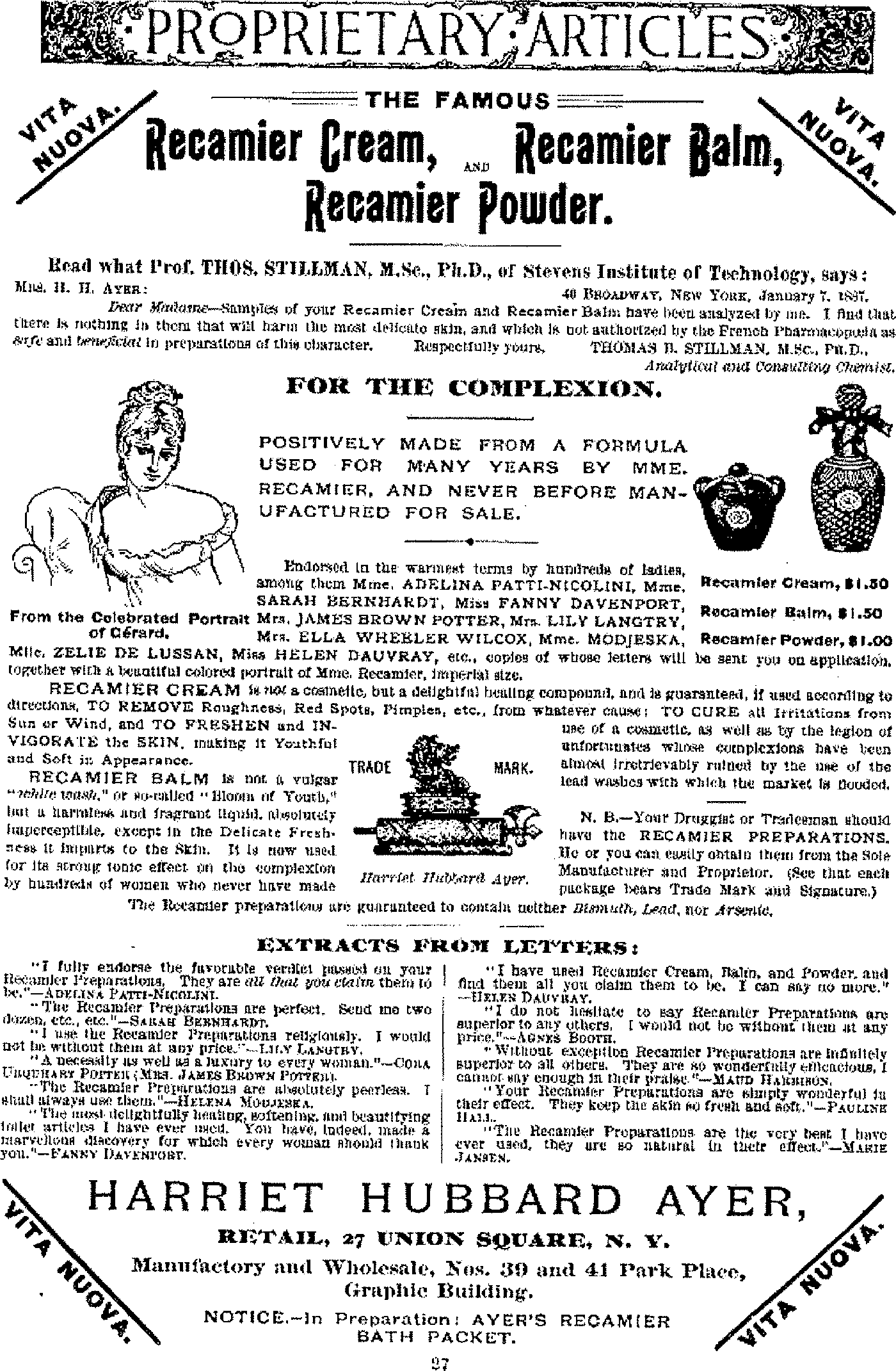
The first advertisements for Recamier Manufacturing products appeared in May 1886, but extensive advertising did not begin until April 1887 with the company's incorporation and a large infusion of cash. One of the first major pieces in this campaign was an advertisement that ran in the June 1887 Scribner's Magazine.Footnote 52 (See Figure 3.) Just a month before, Ayer developed Vita Nuova (New Life) and added it to her product line.Footnote 53 To introduce it to the public, she placed its name in the four corners of the ad, but neither the text nor an illustration described this newest product. Her cream, balm, and powder, which had been on the market for a year, take center stage at the top of the ad and are labeled “The Famous.” At the top, center, and bottom of the advertisement appeared testimonials from both experts and notable women. Notable women of the day, listed in the middle text, insisted that they endorsed the products “in the warmest terms.” In case readers did not trust the advertisement and found the extracts of the testimonials insufficient, full copies of the women's letters were supposedly available. In the middle text the women are listed as Mme, Mrs, Mlle, and Miss, whereas at the bottom their marital status is not included. Even after more than a century, some of the names remain recognizable: Adelina Patti, the opera singer; Sarah Bernhardt, the Divine Sarah; Lillie Langtry, the Jersey Lily.Footnote 54 As for the others, Americans in 1887 would have known them or felt that they should have known them. The group includes a poet (Wilcox), actresses (Davenport, Potter, Modjeska, Dauvray, Booth), and opera and popular singers (Lussan, Jansen, Hall).Footnote 55 With her choice of endorsers, Ayer asks readers to cross national boundaries in their imagination and to include women from different countries within a modern cosmopolitan culture; she reinforced this by the use of the formal titles Mme and Mlle.
Advertisement for the Famous Recamier Cream, Recamier Balm, and Recamier Powder. Scribner's Magazine, June 1887, 850. Courtesy of Making of American Collection, Cornell University Library.

The expert at the top of the ad is Professor Thomas Stillman, with master's and doctoral degrees and an affiliation at Stevens Institute of Technology. In other advertisements, Ayer used endorsements from another expert, Dr. Henry A. Mott, professor of chemistry at New York Medical College and Hospital for Women. Mott accepted numerous requests to endorse commercial products. These included Duffy's Pure Malt Whiskey, which he testified was “free from fusel oil, adulterations, or foreign impurities,” and Royal Baking Powder, which he claimed was “undoubtedly the purest and most reliable baking powder offered to the public.”Footnote 56 Unlike Stillman, Mott and “Testimonial Patti” were serial endorsers. More likely, his testimony was used because he had actually analyzed the cream.Footnote 57
Celebrity and expert testimonials were nothing new in 1887, but Ayer was unusual in using them together.Footnote 58 The experts represented safety; they reassured consumers that products were “safe and beneficial.” This theme continued at the bottom of the notable women paragraph with the statements that the “preparations are guaranteed to contain neither Bismuth, Lead, nor Arsenic” and that the “Recamier Cream is not a cosmetic, but a delightful healing compound.”Footnote 59 Ayer repeated this assertion in her “Women of Fashion” advertisement, where she asked, “Do They Abuse the Use of Cosmetics?” Ayer quoted Harper's Bazaar's claim that “nine out of every ten of the cosmetics on the market are positively harmful. White lead, bismuth, arsenic, and other powerful poisons are the usual base. They impart an artificial bloom, always followed by a darkening and coarsening of the grain of the skin.” Recamier Preparations “are not strictly cosmetics such as are referred” to in the Bazaar article, Ayer declared, because they did not contain such dangerous poisons. Having no word to substitute for cosmetics, she instead introduced “a certificate from Professor Stillman, of Stevens Institute, which is hereto annexed, that they contain nothing but that which is allowed by the French Pharmacopoeia.”Footnote 60
The women's testimonials, conveyed through letters—a decidedly feminine form of presentation—speak of both individual and collective female achievements.Footnote 61 The popular singer Patti wrote to the successful businesswoman Ayer, “I fully endorse the favorable verdict passed on your Recamier Preparations. They are all that you claim them to be.” Letters sent from one person to another were private expressions. Letters published as testimonials allowed readers into this conversation and heightened a sense of identity among women.Footnote 62 Safety, reliability, and gender identification fused together. That these letters came from celebrities also matters.Footnote 63 As one scholar has argued, during “a period of rapid urbanization when it was becoming increasingly difficult to ‘know’ people based on family history and reputation, advertisers used celebrity testimonials to make a personal appeal to consumers and invite them to join, through consumption, a community of familiar faces.”Footnote 64 In the case of Ayer and her endorsers, mobility, the process of socially or physically moving, came into play alongside urbanization, the process in which urban space is socially and physically filled in.Footnote 65
To elaborate on the point I am making, it is important to note what is absent in this Scribner's Magazine advertisement. In almost all her earlier advertisements, Ayer included a great deal of information about herself.Footnote 66 Here she offered only her name, in capital letters at the bottom, and her trademark, in the middle of the advertisement.Footnote 67 However, Ayer is actually all over this advertisement because she had already created a backstory for the reader, which she invoked through the women's testimonials and the picture of Juliette Recamier.Footnote 68 Ayer first presented this backstory for public consumption in an advertisement written as a news item headed “Successful Women.” Here Ayer positioned herself as “a courageous woman” who was “a former leader of Chicago fashion and society.” The ad mentioned but did not explain the “adversity” that transformed her from a “petted daughter” into a “brave, self-reliant breadwinner for her children.” Subsequent advertisements revealed more about how Ayer had “showed her genius” when she established her company “as the necessity arose for her to support herself and her children.”Footnote 69 “Mrs. Ayer, formerly a society woman,” stated one such ad, had “her fortune suddenly swept away, leaving her with herself and two daughters to support. Instead of being ashamed to go to work, she boldly struck out for herself.”Footnote 70
These advertisements created a particular public persona for Ayer. By the 1887 Scribner's advertisement, readers (or a certain group of consumers) knew Ayer's story well.Footnote 71 In part, Ayer was creating herself as a celebrity like the actresses whose letters she published, but Ayer was doing more than this. For consumers, Ayer's story presented ideas about women in business, as well as about divorced and separated women, that emphasized that mobility could be a path to success and power and that the movement of women across time (including through life cycle changes) and space need not be suspect or curtailed. In a larger context, her story offered the possibility that women's mobility could exist within a world that emphasized women's centrality in stabilizing social structures, specifically the family. To put it another way, although the ritual of consuming the Recamier Cream created the possibility of looking as beautiful and being as successful as great women of the stage, the ritual of consuming Harriet Hubbard Ayer created the possibility of overcoming the unnamed adversities that could befall women no matter their social or marital status. In sum, Harriet Hubbard Ayer fashioned a version of herself, and of other enterprising women, that celebrated future possibilities, minimized suspicions, and extended the definition of respectability.
Ayer seemed to embody and, in her marketing, to use the idea that anthropologists call liminality, “that quality of being between categories.”Footnote 72 With liminality, “the possibility exists of standing aside not only from one's own social position but from all social positions and of formulating a potentially unlimited series of alternative social arrangements.”Footnote 73 In her advertising campaign, Ayer was mobile; she portrayed herself going through processes that removed her from the center of normative behavior to its sidelines: wife to single mother; petted daughter to self-reliant breadwinner; Chicago matron to New York City businesswoman. Her place was ambiguous within a context where a woman's marriage led to a life-long status as wife and mother. That status, in turn, limited women's potential for financial independence. A divorced woman was expected to retreat from public view, much like a widow in mourning.Footnote 74 To do so allowed her to retain her respectability. She was certainly not meant to establish a business, and she was most certainly not meant to include in her advertisements for that business revelations about her private life. Still, this is exactly what Ayer did. Her challenge was to bring consumers along with her, to have them join the community she was building around a new cultural category of successful women.Footnote 75
Ayer did this by reassuring her readers that the movement from society to business and from motherhood to businesswoman had not diminished her status as a respectable woman.Footnote 76 She invoked her respectability by relating her current situation to her “former position in [Chicago] society,” which, she stated, “she feels extremely delicate about using” to promote her New York City business.Footnote 77 But use it she did, because without this part of the story readers would not understand that she had moved into the world of business from necessity. In a December 1887 advertisement Ayer explained that she had “two daughters … [but was] unable to do them justice on any salary that [she] could earn and determined to branch out into business (like a man).”Footnote 78 The phrase “like a man,” which she placed in parentheses, is similar to one she used in describing Mrs. James Brown Potter, who had left and eventually divorced her wealthy husband for a career on stage. Ayer wrote, “Potter's success is only another instance going to prove that American women can go out into the world and, upon their own resources, take up the struggle and succeed as well as most men.”Footnote 79 In both cases, success involved a two-step dance of self-fashioning that allowed for independence while maintaining womanly respectability. Ayer's ultimate goal (besides making money) was to promote women's success in the realm of business, not as wage or salary employees, but as owners, producers, and innovators.
There are other stories hinted at but not fully revealed in the 1887 Scribner's advertisement, including how Ayer obtained the formula for Recamier Cream. In the “Successful Women” advertisement, Ayer recounted how, as a member of Chicago's cultural elite, she had taken “sojourns in Paris” and on one of these trips had obtained the Recamier formula “from an old lady whose grandmother was a maid of honor to the Empress Josephine, and who assured Mrs. Ayer that it was the only ‘beautifier’ Mme Recamier ever used.”Footnote 80 Another advertisement stated: “Mme Recamier held her sway in French society for years, and yet history records her principal charm to have been a marvelous complexion, preserved to her death at 80 years of age.” Ayer claimed that “all our leading society women, use the same preparation that was used by Mme Recamier. It is quick and safe. Does not contain lead, bismuth, or arsenic. It is Recamier Cream … $1.50.”Footnote 81
From the perspective of advertising history, the truth of the origins story is not as important as why Ayer chose Juliette Recamier to represent the company with which she associated her own name. And why did American women respond? Historians have long noted the American fascination during this period with all things European and with French things above all.Footnote 82 The history and image of Jeanne Francoise Julie Adelaide Bernard Recamier (1777–1849) was well known in America; numerous biographies had been translated, and American publishers had brought out histories in which she appeared.Footnote 83 Stories about her often ran in newspapers and periodicals. Americans traveling abroad brought back not only printed texts, but paintings and etchings and other visuals that depicted Recamier and her world. One of the things that Americans learned about Juliette Recamier was that she was loved by men, as well as by the wives of those men. As one nineteenth-century American biographer of Recamier wrote, the “great number of her admirers were married men. That their wives did not hate this all-conquering woman is strange indeed… . French wives, we imagine, differ very little from other women, in wishing to be considered a first object of their husbands… . She, indeed, seemed to possess some talisman, by whose spell she disarmed envy and silenced detraction.”Footnote 84 Something about this aspect of Recamier may have intrigued Ayer privately, but Ayer would have chosen Recamier only if she knew that the association of her products with this glamorous figure from French history would be attractive and acceptable, and pleasing and proper, to women and to men. She would have known that American women had already embraced “Costumes a la Recamier” and a “Recamier style of hair dressing.”Footnote 85 Now she helped them have access to a cream made from “a recipe used for so many years by the beautiful Mme de Recamier,” whose complexion was “as fresh and fair at seventy as at seventeen.”Footnote 86
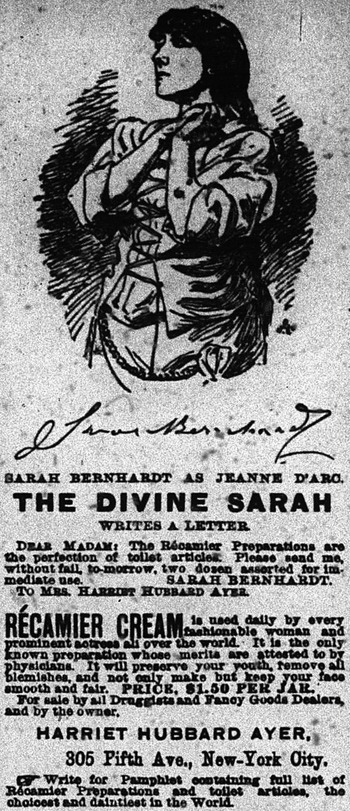
Images such as this of actress Sarah Bernhardt as Joan d'Arc continued the association of Ayer's products with France and glamor. From New York Times, Feb. 19, 1891.

In sum, Harriet Hubbard Ayer created a strong origins story that wove into the larger narrative of the advertising campaign for the Recamier products. She herself was the accomplished woman and devoted mother who, forced by the financial failure of her husband, became a successful businesswoman in the competitive culture of New York City. The advertised Ayer was self-created and optimistic. A June 1887 advertisement read: “Harriet Hubbard Ayer is … [a] woman of birth, education and breeding, she has stepped from her parlor into the whirlpool of commercial life.”Footnote 87 Moreover, in a December 1887 advertisement, the same ad where she explained her “determination to branch out into business (like a man),” she declared, “I have had a hard fight and am now victorious.”Footnote 88
The final element worth examining in the June 1887 Scribner's ad is the introduction of Vita Nuova.Footnote 89 Ayer extended the backstory constructed for her Recamier products in a new direction when she introduced Vita Nuova. In one of her earliest ads for the tonic, Ayer related that she had consulted a “celebrated physician” because she was suffering from a “terrible nervousness.” He told her the cause was “congestion of the brain, and unless you instantly do something … you will soon be beyond aid, and you will die of apoplexy or in an insane asylum.” You “do not want to end your days in an insane asylum,” he stated, and so, she explained, she took the tonic, received from him the formula and permission to manufacture it, and was soon selling it to the public. In “offering it to overworked men and women,” she stated, “I feel I am performing the most benevolent act of my career.”Footnote 90
Six months later, Ayer was claiming that every day an estimated “35,000 people in New York drink a glass” of Vita Nuova.Footnote 91 “One-half claret glassful of Vita Nuova taken after a hard day's work will impart new vigor and enable one to enjoy his dinner and evening without feeling fatigued or worn out.” The nostrum was “not intended solely for ladies, but for overworked merchants, bankers, lawyers, physicians and all other persons requiring a tonic and whose digestion is impaired in the slightest degree.”Footnote 92 The theme of the tonic ads can be summed up as follows: modern conditions had created the need for this tonic, which is not a “patent medicine” and was “made from the prescription of a well-known physician.”Footnote 93 One ad stated that “168 people fell prostrate on the street from exhaustion during one day of the past week… . All classes are subject to … terrible troubles” such as “sleeplessness, insomnia, insanity.” The answer to such troubles was Vita Nuova, a tonic that gives the “most marvelous cures.”Footnote 94 Vita Nuova “will positively cure confirmed dyspepsia, both flatulent and nervous; general debility, insomnia, nervous prostration, gastritis, hysteria in its many forms, neuralgia, sick headache, congestion, melancholia, weakness of the vital forces from overwork, either mental or physical; blood poisoning and diseases consequent upon an impoverished condition of the blood and that most common disease, malaria.”Footnote 95
Ayer also assured her readers that the contents of Vita Nuova would “cure the alcohol habit … and will take the place of whisky, brandy, etc.; for while they are injurious and lead to destruction, ‘Vita Nuova’ is beneficial, its effects are felt immediately, the exhilaration it causes is followed by no reactionary effect whatever, and if resorted to as a beverage will absolutely supplant all strong injurious drinks.”Footnote 96 Ayer promised that she would “cheerfully refund the money expended for the medicine if it proves unsatisfactory.”Footnote 97 “How can a medicine be as exhilarating as liquor and yet not intoxicating?” Ayer asked in another advertisement.Footnote 98 “To answer that here,” the ad concluded, “would be to make our formula public property,” which readers were expected to agree could not be done.Footnote 99
Financing the Business
An infusion of cash allowed Ayer to expand her business. In the fall of 1886, she opened a retail shop at 27 Union Square and rented factory space at 39–41 Park Place. The next April, the Recamier Manufacturing Company was incorporated, and the factory and wholesale business moved to 52–54 Park Place. By then she had about fifty employees.Footnote 100 Upon incorporation, Ayer put $7,000 into the company's treasury, and a Wall Street broker, James M. Seymour, loaned the company $50,000.
It is not clear how Ayer and Seymour met or when they decided to create a business relationship. However, what subsequent events show with certainty is that by letting Seymour invest in the Recamier Manufacturing Company, Ayer allowed into her network a clever and shrewd businessman whose ambitions clashed with hers and who led his new partner into grueling legal and personal trials.
Seymour and Ayer may have met in Chicago, where Seymour had set up a grain brokerage firm after moving to the city from Texas.Footnote 101 He kept an office in Chicago after he moved to New York to open Seymour, Baker, & Company on Wall Street. One newspaper article described him as a “small, slim, aristocratic-looking man” and stated that his firm was “popular and well-known.”Footnote 102 Ayer may have sought capital from him on account of the obstacles facing women in seeking bank loans.Footnote 103
Their business relationship may have developed when Seymour hired Ayer to furnish the yacht Radah, which he had purchased from Pierre Lorillard for $65,000 two years earlier.Footnote 104 At the time Ayer and Seymour were conducting their business arrangements for the Recamier Company, Seymour was suing Lorillard, claiming that he had discovered, after investing an additional $50,000 in the Radah, that it was an unseaworthy yacht. It was also very expensive to maintain; one source estimated the cost at $3,000 a month.Footnote 105 In the end, the court awarded Seymour $5,750.Footnote 106
Ayer most certainly knew about the legal dispute over the Radah, but it is not clear whether she knew about some of Seymour's questionable dealings, such as the speculative mining ventures that may have provided the funds he invested in her company. In 1879, Seymour bought the Vulture Mine, near Wickenburg, Arizona, and established the Central Arizona Mining Company. The mine's most profitable years were in the late 1860s, and the “principal ore body was worked out by 1872,” but Seymour was still a beneficiary of the late extractions of gold before the mine was shut down in 1888.Footnote 107 Also in 1879, Seymour hired mining engineer George Treadwell to find another mine to invest in. Treadwell claimed that Seymour promised him one-third interest in the mine, which he located near Phoenix. Seymour incorporated the South Pacific Mining Company and placed on his board notable individuals with reputations untarnished by mining scams. Then he heavily promoted the mine and made it a “speculative favorite of Broadway.”Footnote 108 The Chicago Tribune reported that shares of the mine were sold “at so low a figure that the poorest classes, even shop girls and elevator boys, were induced to invest in them.”Footnote 109 The price went “from $1 par to over $14” and Seymour “made millions at the expense of the unsuspecting market players and investors.”Footnote 110 At the end of the speculative run, Seymour “sold nearly all his holdings at an average price of $6 a share.” In September 1889 Treadwell sued Seymour to recover “about $400,000, alleged to be one-third of the value of the Phoenix Mine.” Treadwell claimed that Seymour covered up his breaking of their agreement by selling the mine to another company he had formed for the purpose.Footnote 111 A month after Treadwell's suit, Seymour used another trick to liquidate his holdings altogether and walked away with his cash.Footnote 112
The broker may have had similar plans for the Recamier Manufacturing Company. If so, his partner in this plan was his son, Allen Lewis Seymour, who became treasurer and trustee of the Recamier Corporation. James Seymour also secured a trustee position on the board for his clerk Albert Watson. When the 1,000 shares of capital stock were distributed, with a value of $50 each, the Seymour son and Watson each received one share. Thirty shares were given to Lutie Mason, who worked for Ayer, while Ayer, as president, held claim to 470 shares, and James Seymour, as collateral for his loan, received 498 shares but had no formal position in the company.
Lewis, as Seymour's son was known, had accompanied Harriet Hubbard Ayer on one of her numerous buying trips to Europe and became enamored of Hattie. When Harriet brought Hattie home from Stuttgart for good in the summer of 1886, her nineteen-year-old daughter announced that over the last two years she had conducted a correspondence with the twenty-two-year-old Lewis and now wanted to marry him. Tensions between mother and daughter grew in the months leading to the November 1888 wedding. Ayer sought relief by moving to a vacation home in Montclair, New Jersey, and placing herself under the medical care of Dr. John W. Pinkham.Footnote 113 After Hattie's wedding and still not feeling better, she decided to go to Europe, where she planned to meet up with her daughter Margaret in Paris and then travel to Italy. Dr. Pinkham and her New York City doctor, George F. Shrady, agreed with her plans, and she was given the name of a Paris doctor should she need additional medical care.Footnote 114 To Ayer's surprise, when she arrived in Paris with her maid, Lena Raymond, Blanche Willis Howard was there without Margaret. To retrieve her daughter, Ayer agreed to return to Stuttgart with Howard.
Illness
It is useful at this point to speculate about Ayer's illness not only because of the role it played in subsequent events concerning her business and private life, but also for what it reveals about the developing discourse over patent medicines. In 1896, Ayer gave a lecture at the Chicago Central Music Hall in which she stated that since the early 1890s “she had suffered from severe prostration, and was so weak that she could hardly move. She believed she was suffering from melancholia, and that her mind sympathized with her sick body.” She also stated that she had not suffered “profound melancholia,” and she insisted, contrary to rumor, that she did not have “a morphine habit.” Instead, Ayer stated, she had been “broken down by overwork and domestic sorrow.”Footnote 115 But one needs to go farther back.
When Ayer introduced Vita Nuova in early 1887, she placed herself at the center of its origins story.Footnote 116 Drawing on a common theme, Ayer stated that she had received “a prescription” from a “leading” New York doctor that helped her so greatly that she decided to prepare and sell the tonic herself.Footnote 117 This was the era of neurasthenia. Alcohol and narcotics were commonly used treatments for “diseases of the mind” as well as physical problems, sometimes under prescription and sometimes self-induced.Footnote 118 In her long list of illnesses that Vita Nuova would cure, Ayer included “insomnia, nervous prostration … hysteria in its many forms … melancholia, weakness of the vital forces from overwork, either mental or physical.”Footnote 119 She declared in her advertising that her tonic was as safe as her other products, and she was “willing to give it to her own children and take it herself.”Footnote 120
Ayer's decision to include Vita Nuova in her Recamier line, and thus transform the Recamier Company into the manufacturer of both cosmetics and patent medicines, might seem odd, but it may actually have been a logical business decision in an era where the right to secret, proprietary formulas allowed nostrum manufacturers incredible freedoms. To protect those freedoms and in response to a small but growing movement against patent medicines, the Proprietary Association of America was established in 1881. Questions from the public along with the regular and homeopathic medical communities about these products' contents did not trump the emerging cultural attitude (or aesthetic) that experts of all kinds could assist with the development of beautiful faces and strong bodies.
The Proprietary Association of America did not come to Ayer's defense when Vita Nuova came under attack in 1888. A new group of reformers wanted legislation to regulate drugs such as cocaine and poisons, including mercury, which was then called “corrosive sublimate.” They began publishing articles that revealed the ingredients of popular nostrums. In May 1888, the Boston Journal of Health ran an article that revealed that 19 percent of Vita Nuova was a cheap brand of port wine colored to look better, and the tonic also contained “notable quantities of cocaine.”Footnote 121 The analyses of the other Recamier preparations were equally damaging; the balm “contains a white powder—the oxide of zinc—and a corrosive sublimate.” The journal noted that the corrosive sublimate could function as a “bed bug poison.”Footnote 122
Although such attacks against Recamier fit within the movement toward greater pure food and drug regulation, Ayer saw them instead as attacks against successful women in business. The Boston Journal of Health called Ayer a “monster” in an article headed “Harriet Hubbard Ayer's Notorious Nostrums.” The writer stated that while many patent medicine manufacturers injured “their victims both in health and pocket,” a promoter who, “under the pretense of curing a victim of the opium or liquor habit,” gives them the same is a “monster.” “When we find a woman who lends herself to such a trade,” the article continued, “what must we be forced to think of her?”Footnote 123 Ayer went on the offensive. She stated that for “many years various toilet preparations, cosmetics, etc. have been freely sold, and even indorsed by the druggists and merchants in general who supply the retail demand for this trade. So far as I know, these preparations have been owned, manufactured, and controlled by men. Many of them contain mineral poisons in quantities sufficient to injure, if not destroy, delicate skin. In view of the fact that my articles, so far as I can learn, are the first publicly attacked, it suggests itself, I think, to most unprejudiced minds that there is some personal animus instigating the same.”Footnote 124
Here Ayer reintroduced the carefully cultivated image of herself as an aggrieved woman. Readers knew that she had been wounded by “adversity” and was striving on behalf of her children. Now she was a twice-wounded woman. “This is not the age of chivalry,” she continued, “and every working woman must realize how more than difficult it is to succeed in any undertaking if she has the misfortune to have views of her own, and courage enough to maintain her own self-respect, and to demand it of others.”Footnote 125 By placing the aggrieved woman at the center of her response, Ayer may have sought to minimize the origins story that had been a strategic part of earlier Vita Nuova ads. Publicizing her personal illness, even if she said she was cured, had the potential to invite more attacks on her reputation and the reputation of her company. Ayer wrote to the Chicago Inter Ocean, “Chicago people know me too well, I trust, to believe me either stupid enough or wicked enough to attempt to force upon the public any compounds of a harmful character.” They “would easily be proven injurious and certainly would forever destroy the confidence I believe I am entitled to.”Footnote 126
The attacks continued, however, with the Boston Journal of Health article widely reprinted in medical and homeopathic journals. Criticism broadened when the Cincinnati Lancet-Clinic printed an article by Dr. T. C. Minor. Where the Boston Journal of Health stated that they did not believe the men who endorsed Ayer's Vita Nuova even knew their testimonials had been included in ads, Minor attacked the reputations of women who provided Ayer with testimonials. The Recamier Cream, he noted, was endorsed by “Adelina Patti Nicolini—she of two or three husband fame—and other women of similar moral character … even that much-manned old French frigate, Sarah Bernhardt, weeps for joy when she pastes this delightful bichloride preparation on her pimpled cheek and fires off a broadside of bad French eulogy.”Footnote 127 This article was also widely reprinted, often with an introductory note that lauded Minor for his crusade against patent medicines while ignoring his misogyny.
Because Ayer already stated that she used her products, her reputation not only as a manufacturer but as a woman was at stake. She had to respond. In October and November 1888, newspapers ran advertisements that included a statement signed by Henry Mott, Thomas Stillman, and Peter T. Austen, a chemistry professor at Rutgers College and New Jersey State Scientific School. However, these experts were only willing to claim that “Vita Nuova is in no sense a wine of coca. It is compounded of an excellent brand of wine, in which are dissolved the substances that impart to it its specific properties as a remedial agent. The substances used in its preparation are all of fine grade and are obtained from well known and trustworthy manufacturers.”Footnote 128 It was a weak response.Footnote 129
Which brings one back to the question: was she ill? Evidence shows that Ayer was under the care of two doctors for melancholia and “hemorrhage of the lungs and insomnia.” Ayer advertised that she used Vita Nuova but denied she was an alcoholic or the “victim of a morphine habit.”Footnote 130 Whatever the truth of that matter, in 1889 the question became not what illness Ayer had or what drugs she took and when but who administered them and why. This question became one of the central issues of the court case that Harriet Hubbard Ayer brought against James and Lewis Seymour in May 1889.
Ayer v. Seymour et al.
Ayer worked on the premise that the public's consumption of her products, and therefore her interests and the interests of her company, were guaranteed and protected by an origins story that coupled her compelling personal history to an American fascination with European nobility. James Seymour disagreed with Ayer's assessment that the company could not survive without her and mounted challenges to her control. Ayer, surrounded by lawyers, again went on the offensive.
In Ayer v. Seymour et al., Ayer's lawyers argued that in a “conspiracy to obtain control” of the Recamier Manufacturing Company, the Seymours had “caused to be administered” to Ayer “dangerous drugs for the purpose of destroying her health and incapacitating her from managing her affairs, and that they reported that she was insane.”Footnote 131 Seymour's side argued that Ayer's “excessive use of morphine and alcoholic liquors” had led to “certain nervous disorders” and what she called a conspiracy was simply an attempt to encourage her to seek medical help from notable European physicians. The events leading up to and following the case reveal much about Ayer's shifting fortunes, and the case itself provides an example of how men of New York's elite patrolled the borders of respectability.
The case of Ayer v. Seymour was heard in the courtroom of Judge Joseph F. Daly in New York City on May 20, 1889.Footnote 132 Ayer's lawyer, Stephen Henry Olin, argued that James and Lewis Seymour began their conspiracy to take over her company in the summer of 1888 when they held a meeting of the board without notifying her. At the meeting, James Seymour was elected assistant treasurer. That November, James Seymour transferred his shares to Hattie Ayer Seymour. Ayer did not include her daughter in the complaint, but the transfer brought her into the case. Ayer's lawyers claimed that Hattie Ayer Seymour “paid no consideration for such stock, and took it with full knowledge of plaintiff's title thereto.” Then in December, when Ayer was in Europe, James Seymour broke into a closet in her house and removed business documents. According to the plaintiff, he and his son used a variety of means, including the administration of excessive drugs and forged telegrams, to keep Ayer out of the country and away from her company. As the New York Times reported, Ayer sat by her lawyers as they presented their case and throughout the day she “cast scornful looks at the Seymours.… Mrs. Seymour, her daughter, was not in court.”Footnote 133
One of the best reports ran in the Trenton Times under the headline, “Three Awful Charges: Made Against Banker James M. Seymour.” The reporter wrote that “hidden beneath a simple motion to render an injunction permanent” to restrain James Seymour “from exercising any rights to ownership in the Recamier company stock” were “startling accusations” that suddenly woke up everyone in the “small sleepy court room.” “The reading of Mrs. Ayer's collection of affidavits,” the reporter continued, “created a tremendous sensation.” Ayer's lawyers accused James and Lewis Seymour of a conspiracy to rob her of her stock, “destroy her reason, place her in an asylum for the insane and ultimately secure her entire property.” As a result, “her life had been endangered, her health permanently wrecked and her business irreparably injured.” Lawyers for the Seymours issued a “general denial. They ignored almost exclusively the accusation as to the illegal holding of the stock, but asserted that Mrs. Ayer was an irresponsible, immoral and dissipated person.”Footnote 134
Both sets of lawyers agreed to basic facts about the company's incorporation but not about the distribution of the stock. Ayer's lawyers claimed their client held 470 shares herself, and she had distributed single shares to Albert Watson and Lewis Seymour, and thirty shares to Mason. She had also provided a certificate for 498 shares to James Seymour as collateral for a loan of $50,000. Ayer claimed that Seymour's loan had been “almost or wholly repaid in or about the month of August 1888.” Seymour's lawyers claimed that Ayer had made a prior agreement with the banker to award him half the capital stock, 500 shares, “in consideration for his services in organizing the company, and as manager and director of its affairs, and of his procuring sufficient money to run the business.” Ayer did so, he claimed, because “he had previously lent her large sums of money for use in the manufacturing business,” which had “been conducted at a loss.” Seymour then “procured a loan of $50,000 from ‘one C. S. Seymour’ [the banker's wife] to the company.” After the marriage of his son Lewis to Hattie Ayer, out of “natural love and affection,” he transferred 498 of these shares to Hattie. At the same time, he claimed, he gave one share each to Watson and his son Lewis.
To bolster their argument that Seymour's transfer of stock was “in fraud of her rights,” Ayer's lawyers introduced testimony Seymour had given in October 1888 when Recamier Manufacturing Company was sued by the Giles Lithographic Company. In that case, Seymour stated that he was not a stockholder of and had no financial stake in the Recamier Company. According to one newspaper report, after Olin read Seymour's testimony from the Giles case, Seymour's counsel, Roger A. Pryor, stated, “Your honor, I never heard of that before! Er—Er—possibly it can be explained.”Footnote 135 Seymour then issued an affidavit explaining that he was not a Recamier stockholder in October 1888 because in April 1888 he gave his wife Caroline S. Seymour his Recamier stock as security for the $50,000 loan to the company. After the marriage of their son, “he induced her to deliver him the shares in order that he might make them a present to their daughter-in-law.”
Seymour's explanations of these stock transfers led Judge Daly to question his reliability. The agreement between Ayer and Seymour, Daly continued, had been made “without the presence of any other persons, so far as the affidavits show,” so resolving the question of whether the shares “were to be his property or were to be held for security only must mainly rest upon the degree of credit to be given to her testimony as opposed to his.” Ayer had credibility; Seymour did not. She had “shown satisfactorily,” Judge Daly ruled, “that of the 1,000 shares of the stock of the company she is the owner of 968, while the defendant A. Lewis Seymour owns but one share, and the defendant James M. Seymour none.”
But there was more. Ayer's lawyers argued that the Seymours had, in their conspiracy to deprive Ayer “of the shares in dispute, and to prevent her from exercising control over the company,” also caused her “to be treated medically with dangerous drugs to the peril of her health and reason, if not of her life.” They had used “fraud, artifice, falsehood, the suppression of telegraphic messages, the reports of her insanity, the abstraction of papers, etc., as heretofore and hereafter detailed.” Ayer's lawyers presented an affidavit from Ayer's cook, Amelia Queen, that James Seymour took documents from a locked bedroom closet in Ayer's 13th Street home. Ayer's lawyers claimed that these documents detailed the conditions of the $50,000 loan and contained “the cipher relating to the formulas for manufacturing.” Daly wrote in his decision that Seymour
does not deny that he went to the house as stated, and made the false representations to obtain access to the papers, as alleged, nor that he searched among the papers of the plaintiff, and took and carried away certain of them. He contents himself with swearing that he never broke open and took from any closet, bag, or trunk belonging to the plaintiff any formulas, recipes, or cipher code, nor any vouchers or receipts or records of any business transactions…. This denial is merely a negative pregnant. It is not a denial that he took away in a manner described certain papers. This extraordinary admission of gaining access to plaintiff's papers by fraud … makes it apparent that he is deterred by no scruples.
Especially through the act of stealing a partner's papers from her home, Seymour had lost his claim to respectability.
Judge Daly then moved to Ayer's allegations that she had been administered dangerous drugs. Ayer's lawyers claimed, and her doctors confirmed with affidavits, that she had been under the care of doctors George F. Shrady since 1883 and J. W. Pinkham since June 1888. The nature of her illness was not discussed by her lawyers, but James Seymour stated that “the plaintiff went to Europe at his earnest solicitation to place herself under the care of eminent physicians in Europe” to cure her of the “nervous disorders” brought on by her supposed abuse of morphine and alcohol. Ayer's lawyers argued that the Seymours conspired to have dangerous and life-threatening drugs administered to her by foreign doctors. The lawyers for the Seymours countered that they were only being attentive to a weak woman.
Affidavits from Ayer's maid, Lena Raymond, and Ayer's two American physicians were countered by “testimony of the foreign physicians” and eyewitnesses, including “Miss Howard, the lady in whose charge the plaintiff placed herself while abroad.” All the defendants' witnesses vouched for the “unremitting personal care bestowed upon plaintiff” by Howard, but Daly stated that the “pertinent subject of inquiry is whether the defendants intended to or believed they could use Miss Howard, and the means employed in plaintiff's treatment while abroad to carry out their alleged scheme to keep plaintiff out of the country for their own purposes.” Daly was alluding to the most bizarre and sensational allegations aired at the trial.
Henry T. Thomas, “a gentleman of undoubted respectability” in the printing and publishing business, had given damning testimony that he had seen Hattie and Lewis after receiving a telegram from Harriet, in which she asked him to check and see if her daughter was coming to meet her in Europe. Thomas composed a telegram informing Harriet that no one had sailed and Lewis promised to mail it. Ayer testified that she never received the telegram. Thomas testified that when he expressed his view to Lewis that “if plaintiff were ill and wanted her daughter it would seem to be the daughter's duty to go,” Lewis replied that Ayer “was not really ill physically” but was “not mentally responsible.” Lewis also stated “they were kept fully advised by Miss Howard.” In a subsequent meeting, Lewis informed Thomas that he “had taken care of” Ayer's plan to soon return by sending a cable signed “Grubb” asking “her to await this person in Paris.” Lewis told Thomas that “General Grubb was an old friend of the plaintiff, and that she would undoubtedly await his coming.” Daly wrote in his decision that the “defendant A. Lewis Seymour does not deny these statements of Mr. Thomas.”
In his decision six days after the trial, Judge Daly granted Ayer her petition for a receiver for her company, and he continued an injunction that restrained the Seymours from disposing of or voting on the stock. As soon as she heard of the decision, Ayer called a special meeting of the company's stockholders, and two new trustees were elected. Ayer also obtained an order from the New York Supreme Court requiring the “Seymour contingent” to give reasons for their retaining control of company offices on Park Place.Footnote 136 According to the Times, the Seymours had “garrisoned the place with a number of detectives and hired employees, and prepared to resist any attempt made by Mrs. Ayer to gain possession. The latter, however, did not resort to force. She bided her time, and was finally enabled to put the Seymours out with due process of law under orders from the Supreme Court.”Footnote 137 On June 5, the Times reported that the previous day Ayer “took possession of the office at 52 Park-place and all pertaining thereto. The stock in dispute was also yielded to her, including one share by Albert Walton [sic] and one by A. Lewis Seymour. On the other hand, an accounting was had, and about $6,000, found due Mr. Seymour, was paid over.”Footnote 138
Harriet Hubbard Ayer had been absent from the day-to-day workings of the Recamier Manufacturing Company for more than half a year, a costly interval.Footnote 139 On June 6, 1889, the New York Times reported “Mrs. Ayer's Effects Go Cheap.” Her home at 120 West 13th Street was emptied of its furnishings.Footnote 140 Three days later, Ayer ran a new advertisement in the Times to market a product that had already been part of the Recamier line but was never heavily promoted. Under the headlines, “Harriet Hubbard Ayer Says” and “Here is a new reason for using Soap,” the ad stated her goal as helping “me wash out a few of the financial costs of the last year. Only the Recamier Medicated Soap will do this. Fortunately it is the very best in the world.” It was signed, “Harriet Hubbard Ayer, President. Recamier Manufacturing Co.”Footnote 141
In Europe
What, then, had transpired during this mysterious trip to Europe on which Ayer's case against the Seymours hinged? On the day after the trial, Ayer gave an interview to a reporter and added to the affidavits presented in courtroom. Ayer stated that, following the advice of Dr. Shrady, she consulted Jean-Martin Charcot, a well-known Parisian physician, who agreed that she could go to Stuttgart for four days to see her daughter Margaret before continuing to Italy.Footnote 142 “After the train left,” Ayer recounted, “I discovered that my satchel, which contained Dr. Charcot's medicines, prescriptions and directions, had mysteriously disappeared. I was thus compelled … to depend upon a local physician.” In Stuttgart, at Blanche Willis Howard's urging, Ayer consulted with Dr. Julius Teuffel, director of the Ward for Internal Diseases at Ludwig's Hospital. Ayer told the reporter that Teuffel “has been an intimate friend and almost daily visitor at Miss Howard's for eleven years.”Footnote 143 This was a delicate way of saying that Howard and the married doctor were lovers.
Ayer's maid, Lena Raymond, who had accompanied her to Europe, later attested that her employer told her that she agreed to try Dr. Teuffel's insomnia treatment for a week. Dr. Teuffel visited Ayer at Howard's home, and it was Howard who actually administered the sulfonal.Footnote 144 Ayer told the reporter that she was shown telegrams signed by “Shrady” that encouraged her to take the treatment; in his affidavit, Dr. Shrady denied sending such telegrams. According to Raymond, the effect of the sulfonal “upon Mrs. Ayer was at first nauseating, then stupefying and very weakening. After the third day she became entirely unconscious and remained so for about twelve days.”Footnote 145 The Times reported that “Miss Howard administered fifteen grains of sulfonal each half hour, until at length Mrs. Ayer refused, in a lucid moment, to take more.”Footnote 146 With Lena Raymond's help, Ayer took a train back to Paris. Eleven-year-old Margaret stayed in Stuttgart with Howard.
To the reporter, Ayer stressed that she wanted publicly to discuss her younger daughter. A day earlier, the Herald had published letters from Margaret to her sister Hattie, as well as letters from Howard to Hattie and Lewis. To damage Ayer's reputation further, Seymour's lawyers gave the letters to the paper.Footnote 147 The charges in the letters, Ayer claimed, “are utterly, infamously and entirely false.” “I was not addicted to the use of alcohol. I did not drink heliotrope or tooth wash. I did not order six boxes or one box of eau blond from Paris or any other place…. I did not do one of the disgraceful or deceitful things I am charged with doing.” Ayer claimed that Margaret's letters were “forgeries or they were dictated by Miss Blanche Howard. You will notice that the language is very extraordinary for a child. The phraseology is exactly like Miss Howard's.”Footnote 148 For example, Margaret wrote to Hattie, “How I wish our mother was good. It's awful and the only thing we can do is to try and make ourselves as much unlike her as we can. I don't think she is pretty, either, for if you ever got all the paint, rouge and whitewash and dye off (but you never will) you'd see she was much different than you thought she was. I think it was very mean of her to leave Papa as soon as he lost his money.” Ayer was probably right about the dictation from Howard. Surviving Howard correspondence demonstrates that the author helped compose her students' letters home, guiding what they discussed and changing their words.Footnote 149
Margaret Ayer had a complicated relationship with Howard, who cared for the girl for a decade. Howard wrote to her sister that the “scatterbrained” Margaret had come to her “neglected, vicious and with every imaginable bad tendency.”Footnote 150 At times she was pleased with Margaret's progress and at other times exasperated, believing that Margaret had a “slippery nature.” Howard informed her niece that Margaret was being taught sewing and cooking to “learn a little order and self-control and neatness, and justice and the largeness of things.”Footnote 151 In an indirect attack on Harriet Ayer, Howard wrote that Margaret knew she was “illegitimate and that she …[had] the uncertain choice between Grubb and [the actor John] McCullough for presumptive father” and that Herbert Ayer himself had “declared this.”Footnote 152 In a direct assault, she wrote that Harriet Ayer was “without any moral sense, morally insane.” She “has an outward veneer of good nature; she has a real sense of humor, intelligence and brightness, with no depth, except for trickery and intrigue,” but her real problem was her “long use of morphine.” It had made her “cruel, selfish, ignoble” and “only death will cure her excesses or her lies.”Footnote 153
Howard was rigid in her judgments of others. She thought many of the people around her suffered “brain disease.” She worried that her nephew Harold Smith was becoming mentally ill and informed his mother that Dr. Teuffel diagnosed “a form of St. Vitus Dance, that it comes from exactly the same cause as [his brother] Howard's mental disease and [his sister] Christine's nervous prostration.”Footnote 154 Howard stated that the doctor “says this attack of Harold's is far less insidious and dangerous than Howard [Smith]'s slow advance to disease but that Harold's is nevertheless brain disease.”Footnote 155 Dr. Teuffel himself may have been mentally ill; three years after Teuffel and Howard were married, he was committed to a mental asylum, where he died in 1893. Margaret Hubbard Ayer Cobb later wrote that the “shock of Dr. T.'s death had sobered me, subduing the nervous vivacity which made some people think I had St. Vitus's dance. I was completely thrilled when a kindly old lady … called me ‘pretty.’ But Blanche Howard deflated my excitement by telling me: ‘You look all right when you are behaving properly.’”Footnote 156
When Margaret finally left Howard in August 1897, by literally walking away during a vacation in Guernsey, Howard recounted in her diary that the “coup de tete” of her leaving was “childish … grotesque yet pardonable because doubtless pathological.”Footnote 157 A year later, she stated that Margaret, “for whom I was literally slaving” was a “monstrosity” and “disgusting.” Howard concluded: “There is more of Harriet Ayer in her than any of you are aware”Footnote 158
Mason v. Ayer
In June 1889, Ayer was determined to return to business. Advertisements for the Recamier products replaced reports about Ayer's business troubles, but a month later readers learned of new difficulties. Lutie Lawton Mason, who still held thirty shares of Recamier stock, obtained an injunction restraining Ayer from selling the rest of the company's stock.Footnote 159 Upon learning this news, Ayer told the press that she had turned the concern over to her lawyers, Olin, Rives, and Montgomery, and she did not “intend to lose any sleep over the matter.” Mason was a disgruntled former employee, Ayer told the Times, and her “action is of the most diminutive order of blackmail.”Footnote 160 Ayer had spent months preparing Ayer v. Seymour with her lawyers, but this time—to her cost—she did not see the necessity for much preparation. This case, she believed, repeated what had gone before only with a different cast of characters. According to Ayer's lawyers, Mason was merely trying to make a fast buck with the story that she had played an instrumental role in the company's startup. Mason's lawyer countered that Ayer had promised Mason a salary of $5,000 a year and half of the company's worth. Mason was ready to prove her claim by disclosing information about the origins of the company and the ingredients of the Recamier products.
By mid-1889 the Recamier Manufacturing Company's origins story was well publicized and well known. It kept Ayer at the center of the narrative, and it fused her reputation with the reputation of the company. It allowed readers and consumers to envision how personal problems ranging from failure to tragedy could be overcome by the power of beauty and benevolence. Told over and over in Recamier advertisements, the tale begins with Ayer's discovery and purchase of the “old French receipt” from an elderly “French countess,” a “descendent of Mme Recamier.”Footnote 161 Lutie Lawton Mason told a different tale to the court. Mason claimed that she was working as an art teacher in Chicago when she first met Ayer.Footnote 162 They became reacquainted in New York when, in 1884, Mason visited Ayer at home. Her host complained “that her health was bad and that she was very anxious to get away from business and go to Europe.” Ayer offered to pay Mason $100 a month to oversee her business until the following fall. Then in early 1885 Ayer talked with Mason “about the enormous profits to be made in cosmetics.” When Mason concurred that such a business was a worthwhile undertaking, “Mrs. Ayer promised to find the capital, agreeing to take a half interest in any venture she might make.”
Mason testified that she “took to a chemist some French toilet cream that Mrs. Ayer had used with good results and had it analyzed.” Mason then tried to create her own cream with the help of Professor Thomas B. Stillman. Finally, she “succeeded in making a satisfactory compound, slightly differing from the original and quite differently perfumed.” In Mason's story, Ayer possessed a French cream but did not buy the formula. It was created in New York or New Jersey by a combination of Ayer, Mason, Stillman, and perhaps someone else. Mason then analyzed a powder “Mrs. Ayer liked,” and when “one of the ingredients proved to be very expensive” Mason found “something much cheaper” to use and prepared three kinds “to place on the market.” Mason also claimed to have worked on creating a lotion that was “compounded from a book on cosmetics.”
As for the origins story, Mason's affidavit claimed, “Mrs. Ayer read to Mrs. Mason with a good deal of amusement an article she had written as an advertisement for the cream, subscribing its origin to Mme Recamier. Mrs. Mason urged the impropriety of any false claims but Mrs. Ayer insisted that fiction was the best policy.” Mason recounted as well that Ayer then sent her on a selling venture around the country and then to London “to open an agency and to exhibit the preparations at the American exposition.”Footnote 163 While Mason was out of the country, Ayer received financial backing from James Seymour and incorporated the company. Mason was “angry” but “pacified” by her thirty shares until Ayer brought the suit against the Seymours. She then realized that Ayer had no intention of paying her a salary of $5,000 or transferring to her the 470 shares that would give her one-half of the shares in the company. When Ayer won that suit and in June fired Mason, her former employee turned to the courts for retribution.
The Mason case thereby revealed awkward secrets behind the Recamier Manufacturing Company. Ayer's disgruntled associate in effect confirmed charges made a year earlier by pure drug reformers. As explained in the press, Vita Nuova indeed consisted of a mixture of port wine, cocaine, and pepsin. The recipe for the cream was disclosed as rice flour, zinc oxide, glycerine, cocoa butter, lard, and mercuric chloride. Just as damning was the profit margin. “Mrs. Ayer's Romances Rudely Shattered,” a New York Herald article began. “How ruthlessly are our pet delusions shattered! Until yesterday I firmly believed the pretty little romance Mrs. Harriet Hubbard Ayer has told so often about the toilet cream out of which she has made so much money.” “Now it may interest the ladies who read the Herald to know how the famous Recamier preparations are made.” Ayer was telling the truth when she said her products did not contain arsenic, bismuth, or zinc, but the “recipes show zinc oxide in considerable quantities.” And how had Ayer grown so rich? The Herald reported that the production of a “dozen jars of the cream, including everything, cost about $1.80, and they retail for $1.50 each.”Footnote 164
Mason lost her case, but Ayer lost control over her proprietary information. The lawsuit revealed to consumers that Ayer had lied. Her experts had lied. Consumers risked being harmed. Ayer's reputation was on the line. When faced with similar circumstances in 1888, Ayer had her experts provide weak responses. This time Ayer again marshaled her testimonial forces.Footnote 165 She ran ads claiming that all news reports about the published formulas were false, and she urged “Caution: Beware of SWINDLERS and DISCHARGED EMPLOYEES. I employ no agents. The secrets of my formula are unknown outside my laboratory.”Footnote 166 She immediately began a new advertising campaign for an expanded Recamier line. Soap was already in production. Ayer also began to focus on the most secretive of all consumer items: perfume. In May 1890, Ayer began running ads that included “a complete line of the highest-grade concentrated odors, notably, the following white-flower perfumes: White Violet, White Iris, White Heliotrope, White Lilac.”Footnote 167 Her expanded line also included toothpaste, manicure items, and combs, but it was soap, the embodiment of purity, and perfume, the acceptable secret commodity, that Ayer hoped would revive her fortunes.
To repair the damage Mason's revelations did to her reputation, Ayer again depicted herself as the aggrieved subject. She reintroduced herself as the Chicago society woman who had entered business after misfortune struck. In a letter to the editor of the New York Times, Ayer stated that after her case against Seymour, she had received “twelve hundred letters and telegrams of sympathy and congratulation.” She was grateful for the public's support:
I should like every human creature who has thought kindly of me during these past weeks, and above all I should like every mother, to know how profoundly grateful I am for every gentle thought or word they have given me. In the darkest hour of my life the quick response to my position as a mother battling for her children came to me as a benediction and will remain with me always.Footnote 168
This thank-you letter sounds heartfelt, if patently manipulative. Ayer was in her best form when she composed a new advertisement, which takes the form of a letter from the author Mrs. M. E. W. Sherwood titled “On the Subject of Honest Labor.”Footnote 169 First comes the nod to France. “There is a subtle something in the French mind which the sterner Anglo-Saxon lacks. We, heavily freighted with our own respectability, are ashamed to work for a living unless we can do it with pen, pencil, or graver.” Then, with respectability on the mind, comes the identification of Ayer with France and her placement within a community of accomplished women. Why, Sherwood asked, is “that noblest of all things, ‘work,’ so honorable in men; why not in women?” Ayer, she tells readers, “has the French talent for the exactitude of the medical and chemical science” and “was, and doubtless many women are, born with” such talent. Accomplished women like this “Chicago belle” endure and thrive. Next comes the tragedy: “It took the hard schoolmistress, adversity, to teach her what is now a pleasure and a pastime, but which, at the time she took it up, was simply a breadwinner.”
Before the explanation of the “what” to any reader who might not yet know Ayer's backstory, Sherwood gives a warning: “Very many very pretty women have been killed using cosmetics…. There is something repellent to an honest mind in the very word ‘cosmetic.’” But the honest Ayer, readers are informed, “first found out that her Recamier preparations were innocent, then beneficial, and she advanced boldly to her work.” Then Ayer's constant refrain was inserted: “What it must have cost her, what publicity and wrong impressions and ignorant criticism cost a reduced gentlewoman.” Finally, the letter arrives at its purpose by introducing a list of men who “testify to the merits of her Vita Nuova”; included are the Reverend David Swing, “the genial Buffalo Bill,” and “the stroke oar of the Cornell crew.” Ayer uses her own story for the conclusion: “Any woman might be proud of these letters, and the brave woman who has tried being ‘saleswoman,’ purchasing agent, anything rather than be a burden to her friends, has risen to fortune and to a place where she can help other women, who perhaps are not as able to help themselves as she has been. It is on this side of her character that we approach Mrs. Ayer with the respect due to a discoverer.”
In what can perhaps be read as optimism following the defeat of both Seymour and Mason, in early 1890 Harriet Hubbard Ayer opened a new retail shop on the ground floor of 305 Fifth Avenue and moved into “luxurious apartments” on the top floor. Ayer's investment in this building can also be read as confidence in her ability to read consumer trends. She soon stopped selling her patent medicine and expanded her line of perfumes and soaps, while continuing to advocate the use of cosmetics. Ayer's ads for her new “toilet shop” focused more on objects and their settings than celebrities and personalities. “Gentlewomen will find this an adorable place to shop in,” Ayer wrote in one advertisement for the store. In addition to “importations made for us in special designs in sachets of every size and descriptions,” customers would find objects of “art in Antique and Modern Silver, Ivory, Tortoise Shell, Sevres, Saxe, Coalport, Chelsea, and other Porcelains, Crystal, Glass, Lacquer.”Footnote 170
Shirley Dare, a writer for the New York Herald, described a visit to the new store. Customers first encounted a page, who opened the door to the “scented interior, deliciously fresh and cool.” Once one was inside, “semblance of a shop is almost lost” because “there are no counters or wall cases, but white-and-gold Louis XVI cabinets, loaded with charming things, each in its own color…. One glittering case is filled with brushes and combs in embossed silver of rich designs … and you can order a toilet comb set with rubies and pearls, if you like, with your crest in the middle…. The scent sachets are a specialty, for the perfuming of houses and wardrobes is a business by itself nowadays.” Dare then moved from description to advocacy of Harriet Hubbard Ayer and her products. People, Dare wrote, “have a funny way of decrying the use of cosmetics, having in mind the harm done by lead powders and mercurial paints. But all applications for the skin for the purpose of beautifying are cosmetics, and if you object to them on high moral grounds you must give up using a bit of cold cream for chapped lips, or a soothing wash for a sunburned face.… There is real benefit for wrinkles and sallow complexions in these famous recipes if intelligently used.” She also stated that a “charming little pot” of Ayer's Recamier Cream, “will last two months rightly applied, and soften the face to a marvel by its protecting layer on the skin.”Footnote 171
The culture of beauty and health demanded that Dare address the cultural price women paid for using cosmetics, while public knowledge of Ayer's profits made discussion of their “true” costs a necessary counter-action. The efficiency sought by modern, urban consumers justified the prices Ayer charged. Women had long made face creams and other cosmetic items from recipes found in widely circulated books and magazines, but this tedious work did not fit with the new consumer ethos of “color and spectacle, of sensuous pleasure and dreams.”Footnote 172 It would be another two decades before women would routinely use manufactured cosmetics, some produced by a new generation of women entrepreneurs, such as Helena Rubenstein and Elizabeth Arden. Ayer paved their way by setting cosmetics in a spectacular setting and reassuring women that expending capital on this small luxury would not harm their respectability or household finances.Footnote 173
Respectability and reputation were relentless issues that drove Ayer's advertising campaigns. However, no successful ad campaign for her expanded line of products could save the company from the activities of yet another person who decided to interfere with her affairs, her former husband. Once again, Ayer's hard experiences offered a cautionary tale for late nineteenth-century women who could not contain their ambitions or conceal their private struggles.Footnote 174
Ayer v. Ayer
Herbert Ayer returned from Europe in early 1886. Later that year Harriet instituted divorce proceedings on grounds of desertion. Their divorce was finalized in February 1887.Footnote 175 In the midst of Harriet's legal troubles with the Seymours, Herbert took up residence in New Jersey and applied for a modification of the divorce decree that would give him custody of Margaret on the grounds that Harriet planned to remove Margaret from Blanche Willis Howard's care.Footnote 176 Herbert's charges were similar to those made by the Seymours: his ex-wife “was an unfit person to look after the girl.” She, as an alcoholic and morphine addict, Herbert asserted, was “not a moral woman.”Footnote 177 At this point, the couple reached a compromise. Herbert withdrew his petition, Harriet released him from all claims to alimony, and Margaret was given the right to choose her guardian when she turned fourteen. The Chicago Inter Ocean reported that “for her children's sake, and by the advice of her best friends, Mrs. Ayer has consented to a compromise which vindicates her character.”Footnote 178
Compromise did not mean reconciliation. Harriet witnessed Hattie and her father create a new bond that excluded her. Harriet then contributed to her own isolation by writing the torn letter that survives in the Bowdoin library. The May 1890 letter is addressed to Margaret, but Harriet knew that Blanche Willis Howard would read it. Harriet recalled that Margaret would soon have the right to choose her own guardian. If the girl wanted to return to New York, Harriet would welcome her back. However, she warned, “if you decide to take upon your soul the crime of repudiating your mother I have nothing to say. The condemnation and disgrace in this matter alone … will be a heavier punishment than I could wish ever to befall you.” The mother's angry warning is mixed with sadness and at least superficial understanding, alongside the emotional manipulation of a daughter by a troubled parent. “When you kissed me and embraced me day after day in Stuttgart … I could not have believed that even then you had been taught to act so hideous a lie to your mother and that the hands so often and lovingly about my neck had already written the terrible letters since published in hundreds of newspapers to the everlasting dishonor of the people who are accountable for them.”Footnote 179 The tone of regret disappears when Ayer turns to business to inform Margaret and Blanche that she would no longer be financially responsible for her daughter if she chose to stay in Stuttgart and that she had instructed her lawyers to cut Margaret from her will if she chose to remain dependent on others. With this letter, Margaret and Harriet's correspondence came to an end.
Hattie did not see her mother at all in 1889, and it is unclear how often they visited until late 1892, when Hattie reported that the family was experiencing “more troubles of the old kind.”Footnote 180 It is the “saddest most terrible thing,” Hattie stated, and she could “hardly believe it.” Doctors had informed Hattie that her mother was “insane.”Footnote 181 A year earlier, Harriet Hubbard Ayer seemed to have reached her lowest point in her long struggle with melancholia. Her struggles and misfortunes were the sort likely to exacerbate any tendency toward depression or another form of mental illness. Beyond her shop, she was also writing an adaptation of Baronne Staffe's Le Cabinet de Toilette (1891), published with her introduction in 1892 as My Lady's Dressing Room. She was overseeing the building of a mansion in Jacksonville, Florida. Amid everything else, E. Burd Grubb, Margaret's presumed father, betrayed her in a devastating way. Grubb was widowed in 1886 and Ayer, whose divorce was finalized in February 1887, may have believed they would marry. Instead, Grubb accepted an appointment as minister to Spain, where he met a twenty-six-year-old Englishwoman named Violet Sopwith. In November 1891, Sopwith and the fifty-year-old Grubb were married in a church filled with 1,200 guests. News of the event appeared in the New York papers, but Ayer might also have heard about the marriage and what led up to it from guests with whom she had done business, including Robert Todd Lincoln. Maybe her business was already feeling the effects of what would be called the Panic of 1893. Altogether, she had faced ample catalysts for a downward spiral in her health, which in turn allowed Hattie Ayer to reenter her life. When Hattie did so, she brought with her Herbert Ayer, a lawyer, and two new physicians who supplanted Ayer's longtime doctor George F. Shrady.
In early February 1893, under a “quietly issued” order from a New York judge and a certificate for commitment signed by two doctors at the behest of “her divorced husband,” Harriet Hubbard Ayer was sent to Dr. William Granger's Sanitarium in Bronxville, New York.Footnote 182 When the commitment became public news, Herbert Ayer spoke to reporters. “I have known for twelve years that she was insane,” he stated, “but to save my children I bore the knowledge secretly.”Footnote 183 He continued:
I am not moved to this step … by any personal or selfish considerations. I desire no interest in her property. I have taken this action for the purpose of protecting and guarding the name and reputation as well as to secure the peace of mind of my daughters, and that of their mother, whose failings are entirely those resultant from and attributable to her mental condition, and not from any lack of moral attributes.Footnote 184
Even if, for Herbert, the case was about madness and not money or morals, the New York Times reminded readers that Harriet Hubbard Ayer had made “a great fortune in the patent medicine business” and her “various toilet articles” were “now commanding an enormous sale on the market through a system of bold advertising conducted on a scale seldom equaled.”Footnote 185 The Times also repeated information that had leaked out during the Ayers' closed-door custody hearing about Margaret; Harriet Ayer's name “had been linked with that of a famous Republican politician [Grubb] who ran a few years ago as candidate for Governor of his State.” The New York Herald mixed madness, money, and morals in a different way: “Mrs. Ayer has practically taken no active part in the business for several years. Addiction to morphine and alcohol habits are alleged to have unsettled her mind.” She had lived “under the attendance of nurses, in luxuriously furnished apartments on the top floor of No. 305 Fifth Avenue, on the ground floor of which is the cosmetic establishment.”Footnote 186
The physicians who signed her commitment, William J. Morton and Graeme Monroe Hammond, also spoke to reporters about the case. Morton, a specialist in mental diseases, stated that he had been hired by Herbert and Hattie to treat Harriet, whom he had visited every other day for three months. “Mr. Ayer,” Morton told a reporter, “was actuated by only the kindliest motives in looking after the welfare of his divorced wife.” Morton insisted that Harriet was “undoubtedly suffering from melancholia.”Footnote 187 She was “very much depressed, with periods of mental excitement,” the physician recounted. She heard voices, cried, and moaned constantly, and her “facial expression is that of acute misery.” She said she wanted to die, “as death would be a happy release from the persecution she was subjected to.”Footnote 188 She “was doing well” at home, Morton concluded, but the “systematic care of an institution” would help her “mend more rapidly.” The case was “not hopeless by any means,” he added. “With proper treatment she will be fully restored to all her powers and full strength mentally and physically.”Footnote 189
Hammond concurred. He had known Ayer for six years, he said, and “had seen melancholia gradually coming on all that time.” Two years previous “her face became typical of melancholia.” The causes were many, he testified, and “over-attention to business was doubtless one” of them.Footnote 190
Harriet Hubbard Ayer later described what happened to her as follows: in February, when she was suffering from melancholia, she was kidnapped by a woman who announced herself as Hattie's maid and was taken to Bronxville.Footnote 191 Six weeks later, by which point Ayer said she had the body of a scarecrow, a New York Supreme Court justice held an inquiry into her sanity, but she did not understand the purpose of the proceedings or the consequences that would follow her statement, “Please take me away.” When she realized that the Bronxville institution was a “madhouse” and not a hospital, “she felt that it would be impossible to get out. However, a gentleman appeared on the scene and in French assured her he would help get her out.” He smuggled a letter to her lawyer, and eight weeks later she was released. This story of her fourteen “months of suffering” in the Bronxville Asylum was told to “an audience of her life-long friends” who had gathered at the Central Music Hall in 1896 to support her effort on behalf of “legislation for the righting of the woes of the imprisoned insane and alleged insane.” True to form, Ayer brought up all the motifs that she had woven into the public narrative of her life as “one of Chicago's best-known and most respected women.”Footnote 192
While Ayer was in the asylum, partners, employees, and family fought for control of what the courts called Ayer's “person and property.” Hattie Ayer Seymour and Ayer's sister, May Wetherill, asked the court to appoint Henry T. Cutter, the well-known drug retailer and department store operator, as “guardian of Mrs. Ayer's person and property.” Cutter may have been suggested because the family was looking to sell the company. Offering arguments against Cutter's appointment was a famous businessman, Frank J. Sprague, a managing officer of the Recamier Manufacturing Company, among his other activities. The electric motor inventor and entrepreneur may have become involved with Ayer's business when his company installed an elevator and machinery in the Recamier building.Footnote 193 Ayer's attorney, Stephen Olin, instead argued successfully for railroad attorney Alfred Bishop Mason to be put in charge of Ayer's estate. Son of a mayor of Chicago, Mason had business or personal connections to Sprague, Olin and to Harriet Ayer. Mason received permission from the court to sell $8,000 of Ayer's Chicago property to pay $5,000 worth of claims against her estate.Footnote 194
Aftermath
In August 1894, Ayer was released from Dr. Granger's sanitarium to the fanfare of newspaper headlines: “Harriet Hubbard Ayer Sane Again.”Footnote 195 True to form, this adversity did not destroy Ayer, but it did contribute to the failure of her company. On February 6, 1896, the New York Times reported that the Recamier Manufacturing Company was insolvent, and in May the corporation was dissolved.Footnote 196 A week later Ayer was corresponding with lawyers about how to sue Dr. Hammond and others for what she argued was her unlawful commitment to the insane asylum.Footnote 197
Ayer continued to receive support from members of her network of successful businessmen and professionals, but it was up to her to create a new career. She soon joined the staff of the New York World. In 1899, her many World columns were published in the 543-page Harriet Hubbard Ayer's Book: A Complete and Authentic Treatise on the Laws of Health and Beauty.Footnote 198 Now, instead of treating formulas that aided the modern effort for beautiful faces and strong bodies as proprietary, she wrote them out for readers. Again, she told stories about women and men who, because of their individual initiative and dedication to the development of their natural talents, triumphed over adversity, established themselves as leaders in their fields, and more abstractly but just as importantly, adjusted to a new cultural aesthetic that encouraged the intervention of experts in the management and manipulation of faces and bodies. The expert producer had become the expert consultant.
Harriet Hubbard Ayer's Book went out of print, but her business name lived on. When the Recamier Company was declared insolvent, the “trade-marks and good-will” were sold to employee Maria Rinn for $4,000. The next year, Ayer sued Rinn to stop her from using the Harriet Hubbard Ayer signature on the products. Ayer's lawyers successfully argued that she had sold the company but not her name. In 1920, Rinn sold the company to Anna E. Reynolds, who registered the trademarks of the crest and the word Recamier. By this time, the name and signature were also in use by another company, Harriet Hubbard Ayer, Inc., founded in 1907. This company claimed that one of Ayer's daughters gave it permission to use the name as well as “certain formulas prepared or collected by Mrs. Ayer.” Vincent B. Thomas, the company's head, registered the trademark Harriet Hubbard Ayer “in script form” in 1908. The trademark was renewed in 1928. Four years later the two companies met in court to fight over the trademarks and the name. Reynolds lost and sales of the Recamier Manufacturing Company's products “gradually dwindled away.”Footnote 199
After Vincent Thomas died in 1918, his widow, Lillian Sefton Thomas Dodge, took over Harriet Hubbard Ayer, Inc.Footnote 200 In 1938, she became the highest paid woman executive in the United States, earning $100,000 a year. In 1947, Dodge (who died in 1960) sold her company to Lever Brothers.Footnote 201 In 1954, Lever Brothers placed the European operations under control of French Unilever but sold Western Hemisphere manufacturing and distribution rights to the Boston Group, which placed it in the hands of Nestle-Lemur Company. Nestle-Lemur sold Harriet Hubbard Ayer to the Standard Metals Corporation in 1967. In 2010, it was a German firm called Ayer Cosmetics.Footnote 202
What of the others whose lives were affected by the Recamier Manufacturing Company and the career of “this remarkable woman, sensational as it was romantic”?Footnote 203 James Seymour found himself in court a few more times in the 1890s. His legal troubles included an 1894 case in which John C. Eno (the defaulting bank president whose years as a fugitive in Canada were discussed in the April 2012 issue of this journal) sought to recover $450,000 from Seymour, Baker, and Company related to the failed stock speculations that prompted Eno's embezzlement and flight. The court found in Seymours' favor.Footnote 204 Seymour then disappeared from news reports, except for 1897, when he told a reporter that he had no comment on the collapse of the Seymours' brokerage firm, which had been “caught in a bull market and failed with half-a-million-dollars in liabilities.”Footnote 205 According to Margaret Ayer, James Seymour “suddenly took all the available cash he could gather and left his wife and sons to live in California with a married daughter.”Footnote 206
Hattie Ayer Seymour began teaching piano to support her family, which included two daughters. The author of How to Think Music, she became known for her advocacy of music therapy.Footnote 207 Margaret Ayer returned from Europe in 1897 and reconciled with her mother, who helped her build a career on the stage. A 1902 Philadelphia Inquirer article, “American Girl's Great Future,” reported that Margaret's “unique rendering of eighteenth century chansonettes had been the feature of several smart musical functions in Paris” but she had “refused an offer to make her debut next season at the Opera Comique, Paris, and return[ed] to America to enter on her musical career in her own country.” The Inquirer's statement that “Mme Patti and Frau Cosima Wagner heard her sing and predict a great future for her” connects Margaret to her mother and to Blanche Willis Howard.Footnote 208 Adelina Patti provided Harriet Hubbard Ayer with some of her best advertising testimonials, while Howard had arranged an audition for Margaret before Cosima Wagner at Bayruth. The stage, however, was not Margaret's destiny. She became a journalist like her mother, taking over Ayer's column at the New York World. There she met the journalist Frank Irving Cobb, and they married in 1913. Their son, Hubbard Cobb, like his parents and grandmother, became a writer.
Blanche Willis Howard died in Munich in October 1898. After she was cremated her ashes were buried in her hometown of Bangor, Maine. Her will stipulated that her clothing, lingerie, jewels, ornaments, watch, laces, and ribbons should go to her niece Marion Stuart Smith and to “Margaret Grey,” the name Margaret Ayer used when she left Europe.Footnote 209 A report about Howard's death mentions paralysis. So too did a report about the death of Herbert Ayer three months later.Footnote 210
When Harriet Hubbard Ayer died at her home at 70 West 46th Street on November 25, 1903, the New York Times reported that pneumonia “suddenly ends a life of romance.” Ayer's funeral service, conducted by Reverend J. Hewitt Steele at Trinity Church in New York, “was a wonderful testimonial to her character,” and the “large church was filled with sincere mourners” who had come to “pay their last respects to one who had brought so much of brightness into their lives. Hers was a noble life. She was a self-sacrificing wife, a devoted mother, a loyal friend.”Footnote 211 In accordance with Ayer's wishes, her body was cremated, and she was buried in Graceland Cemetery in Chicago. She was fifty-four years old.
Well-read, in a high-stakes business, and with her own private situation of concern, Harriet Hubbard Ayer understood the cultural importance of a woman's respectability. So too did her customers, who would have been readers of novels and etiquette manuals and participants in parlor talk where women enjoyed discussions about the consequences of unacceptable behavior while hoping that the talk in the house next door was not about them. These women knew that the making and unmaking of a reputation was a public, not a private event, and women were expected to always demonstrate, not just claim, their possession of an impeccable reputation. Men's respectability was equated with integrity, reliability, and dedication to their vocation. In business, respectability was considered an asset for men. For women, it was essential.
For a woman in business, a network of allies was as essential as respectability, and the two were related. Men and women helped Ayer develop products, set up her office and manufacturing plant, create and place advertisements, and distribute her products. Her network extended from workers and assistants to lawyers and doctors. There were many people in this network beyond those discussed in this narrative, but the lack of Recamier Company business records and the loss of Ayer's private documents makes identifying them a difficult task.Footnote 212 So too does the fact that sources frequently used for business history do not seem to exist for the Recamier Company. The credit company Dun & Company was uninterested in Ayer or her company.Footnote 213 Ayer threw herself into business life, but she seems to have not been a member of any business, professional, or trade associations.Footnote 214 The powerful men who allied with Ayer seem to have not found much of lasting interest or importance in their interactions with her; Ayer fails to make an appearance in their well-documented histories. These networks of support—intertwined with social networks and to some degree informal—launched and sustained both men and women in business, but women faced special constraints on their initiatives in building these networks and then making use of them.
Ayer showed that she was willing to play the game of entrepreneurial business. Although she was clever in business, her foes were clever and shrewd and on top of that derived advantages from their gender. Historian Richard White evokes this atmosphere, in writing of the men behind the building of the Gilded Age transcontinentals. Some, White observes, “were clever enough at soliciting money and not repaying debts,” whereas the “shrewdest of them were masters at controlling and manipulating information.”Footnote 215 When Ayer took James Seymour to court in 1889, the judge determined that Ayer still owed Seymour $6,000. In not fully paying her debt until forced by the court, Ayer showed that women could be as clever in business as men. When the judge deplored Seymour's shrewdness and harshly assessed his character, he did not do damage to Ayer's respectability (or to Blanche Willis Howard's). Thus, Ayer walked away from this case with her ultimate goal, which was to demonstrate that respectable women could be clever businesswomen. Ayer made that goal clear in her 1887 advertisement, where she stated that she had branched “out into business (like a man)” because she wanted ownership, not simply wages or a salary. In the wrack of Recamier's failure were the many stories and examples of respectable, successful women that she had publicized in her advertisements. That wrack—defined as the traces of something destroyed—evokes other women's narratives of success and failure in late nineteenth-century business.
Ayer's story pivots on what historian Scott Sandage has called the Gilded Age's “quintessential American axis” of success and failure. From that perspective, the real winners may have been the lawyers and doctors who dealt with her in one capacity or other. After Ayer was legally committed to the Bronxville asylum, the doctors and lawyers who had participated in that case submitted their bills to the relevant New York judge, who refused to pay one lawyer's (probably Olin's) full bill of $1,275; $500 seemed enough. Dr. William Morton asked for $145 for his time; the judge asked for a full accounting before determining Morton's compensation. The three commissioners who listened to the one-day testimony each wanted $100; the judge reduced their fee by half. Multiply these types of excessive bills by years, maybe even a decade, and expand the network to Ayer's other physicians and lawyers, and the amount snowballs. Just how much money Ayer spent is unclear. My guess is that the actual amount is high, not because Ayer was ill, an addict, in court, or in need of legal advice, although all were true at different points in this story, sometimes all at once. The amount was high because Ayer's association with these men secured her interests; it was a little cost to them but of great benefit to her.
From this perspective, Ayer gained something crucial in making lawyers and doctors financial beneficiaries of her cause. Within the web-like networks of business and society, a single businesswoman found protection by associating herself with “mutually made” men of distinction and character.Footnote 216 The protection Ayer bought, however, was tortured and temporary. Historian Susan Yohn argues that “whatever profit” Gilded Age businesswomen “realized from their entrepreneurial ambitions was undercut by substantial pain and suffering.” Yohn underscores how “vulnerable women were to questions about their character and reputation.”Footnote 217 In the end, Ayer landed on her feet by securing a position in a field she loved, journalism, but she did so as a salaried employee of the New York World. Durable success as owners in the corporate world of the cosmetics business came to the next generation of women entrepreneurs.