From the lunch counter at Greensboro, North Carolina, to the June Fourth Movement on Tiananmen Square, students across time and space have demonstrated their might as a dynamic social group that repeatedly shapes important socio-political trajectories at crucial junctures in history. When student activism is on the rise, it threatens the hegemony of existing powers. When students become cynical towards the official ideology and the state's political manoeuvres, their lack of involvement in adult politics gives them “free rein … to adhere to absolute principles.”Footnote 1 University students are thus said to be the “repositories of the ideals of their nation,”Footnote 2 and college campuses are said to be “the central stage for the drama of democracy's ebb and flow.”Footnote 3
Over the past decade, a wave of democratization has relentlessly toppled dictators from Central Asia to the Middle East. However, university students in China – who were among the most sophisticated rebellious social groups during years of authoritarian rule, from the warlord era to the Communists – appear to be politically quiescent in the post-Deng era.Footnote 4 Indeed, no major anti-regime student movement has taken place since 1989. Where sporadic nationalist student demonstrations have occurred, their target has been the Communist regime's mortal enemy: the Western “imperialist” powers.Footnote 5 This begs the question: how does the Chinese Communist Party (CCP) keep general stability on the nation's 2,358 university campuses and maintain control over more than 22 million college students?Footnote 6
Generating and enforcing compliance lies at the core of every authoritarian regime's mandate. To further our understanding of the Chinese political system, it is necessary to look into one of its most essential control frameworks: the mechanism that engenders compliance from the country's university student population. Drawing upon intensive field research conducted in 2011, this article attempts to map out the structures and measures that the post-Deng Chinese Party-state uses to nurture political compliance and consolidate domination over university campuses.Footnote 7 The article does not seek to offer a comprehensive, all-inclusive explanation for the “deactivation” of student activism in the People's Republic of China (PRC). Nor does the author profess to argue that these structures and “tactics” per se result in political conformity or compliance. Yet, by deciphering a crucial component of China's political control apparatus, this article aims to shed new light on the internal operations of the authoritarian system that is running the PRC today, and perhaps open up interesting analytical lines of enquiry into the country's dynamic state–student relationship.
Domination and Control
Domination and control are central to the exercise of political power in modern institutional settings. Political authorities, and sovereign states in particular, rely more or less on their monopoly over the use of legal violence as either the ultimate deterrent or the last resort to establish and maintain control over their subjects.Footnote 8 Indeed, Charles Tilly describes modern states as “coercion-wielding organizations.”Footnote 9 Slavoj Žižek goes so far as to argue that today's predominant model of politics “is ultimately a politics of fear” – a sentiment aroused in reaction to the “potential victimization or harassment” imposed by the authorities.Footnote 10 In particular regard to authoritarian politics, Milan W. Svolik suggests that “violence is an ever-present and ultimate arbiter of conflicts.”Footnote 11
However, no authority, even the most absolutist, can rely solely on outright violence (or, to use the Gramscian term, “direct domination”) to secure everyday compliance from the populace. According to some, the use of direct violence takes up more resources and undermines the legitimacy of the commanding apparatus. Therefore, to instil obedience in the people they subjugate, political authorities need institutionalized means and “everyday practices”Footnote 12 that impose and maintain “an internal, articulated and detailed control.”Footnote 13 These practices are often exercised along two lines: ideological and organizational.
In his Prison Notebooks, Antonio Gramsci contends that the ruling classes in Western industrialized nations use a system of “cultural hegemony” to internalize and impose their domination over the exploited social sectors. By manipulating the “culture” – the beliefs, values, symbols, meanings and mores of a plural society – and by imposing their own cultural norms as the society's general worldview, the ruling classes effectively ensure “the ‘spontaneous’ consent given by the grateful masses.” In that case, the state coercive apparatus only needs to enforce discipline upon “those groups who do not ‘consent’ either actively or passively.”Footnote 14
Louis Althusser argues that successful reproduction of the political, economic and social orders of nations requires the reproduction of the subjugated groups' attitudes of “submission to the rules of the established order,” which should be “in the form and under the form of ideological subjection.”Footnote 15 Althusser thus differentiates between the “coercive state apparatus” and the “ideological state apparatus” (ISA), and suggests that no state power can sustain itself “without exercising its hegemony over and in” the ISA.Footnote 16 The educational institutions, as the most crucial component in the dominant ISA, ensure “subjection to the ruling ideology or the mastery of its ‘practice’,” and by doing so, these institutions reproduce the domination and control imposed by the established order.Footnote 17 Terry Eagleton also suggests that “the most efficient oppressor is the one who persuades his underlings to love, desire and identify with his power.” Ideologies (or “hegemonic discourses”) thus constitute an essential foundation for dominative power and authority.Footnote 18
Control and domination can also be established and maintained through organizational means. In Discipline & Punish, Michel Foucault argues that, for modern totalizing authorities, compliance is generated through the use of disciplinary power, which internalizes the expected norms and behaviour through the enforcement of habits, rules and orders. Such enforcement commonly involves centralized surveillance via a panoptic structure. The success of such discipline “derives from the use of simple instruments, hierarchical observation, normalising judgement and their combination.”Footnote 19 This kind of authority is exercised, as Bryan S. Turner explains, through a continual “web of institutional regulation and the micro-disciplines of control.”Footnote 20 According to Turner, “populations become progressively subordinated to rational disciplines under a process of bureaucratisation and rationalisation.”Footnote 21 Domination and control have thus come to involve “a modest, suspicious power, which functions as a calculated, but permanent economy.”Footnote 22 Žižek calls this kind of institutionalized control “systematic violence.”Footnote 23
Therefore, in modern polities, domination and control have become a complex business that combines the powers of coercion, signification and discipline. Authorities around the globe may increasingly need to deploy a full set of nuanced, normalized and internalized systems and tactics to secure their organizational and ideological grip over the subjects they rule.
Scholars who examine the history of student activism in China, from the Republican period through the Cultural Revolution and up to the Tiananmen Movement in 1989, have long emphasized the decisive influence of institutional configurations of authority in Chinese universities and the effect that these structures have on student rebellions.Footnote 24 Researchers who look into the ways that the PRC authorities of the past have controlled university students have also been interested in exploring the ways in which the regime combines ideological mobilization and disciplinary operations for maintaining their domination over student politics. For example, Ann Kent's 1975–76 study of the Shanghai Teachers' University analyses the Maoist regime's unsuccessful attempts to use educational revolution, class labelling and open-door schooling to create a new institution that equated “red” with “expert.”Footnote 25 In her 1982 book, Competitive Comrades, Susan Shirk uses Chinese high schools between 1960 and 1966 as a microcosm of the larger society to examine the CCP's political control mechanism under Maoist rule. Here, the revolutionary Party-state attempted a moral transformation of society by dispensing educational, occupational or political opportunities to those who exemplified those moral virtues preferred by the regime. Shirk terms this new control mechanism as “virtuocracy,” which differs substantially from the traditional “meritocracy” or “feodocracy.”Footnote 26 Joel Andreas' study of operations by the workers' propaganda team (gong xuan dui 工宣队) at Tsinghua University reveals that even amid the chaos of the Cultural Revolution, the Party-state strove to maintain political control over universities via a model of university governance featuring mutual supervision and institutionalized factional “checks and balances.”Footnote 27 Similarly, by surveying political courses taught in the PRC, Ruth Hayhoe finds that ideological indoctrination in the name of “moral education” (deyu 德育) has helped the Party-state to generate stability in higher education institutions and suppress political turbulence in the wake of the Tiananmen Movement, at least in the short term.Footnote 28 By evaluating survey data published by PRC researchers, Stanley Rosen examines the effect of the CCP's post-Tiananmen political re-education operations and suggests that these campaigns have not been particularly successful in instilling regime-sponsored ideologies or values in the Chinese students.Footnote 29 In a comparative study of communist regime youth policies in China and Vietnam during the 1990s, David Marr and Stanley Rosen demonstrate how the two governments have used elaborate organizational structures and the systematic provision or denial of opportunities to “induce youths to align themselves with the regime.”Footnote 30
Despite the keen insights offered by these ground-breaking works, their findings are limited, either by focusing on specific historical periods (noticeably the Cultural Revolution), or by stressing only one aspect of the Party-state's control over university students. Until now, there has been no overarching empirical study of the student control apparatus in China's universities or of the nature of this apparatus in terms of its power and domination. This article seeks to provide a preliminary answer to a series of outstanding questions. When compared to the Maoist past, what continuities or changes are there in the organizational settings and control mechanisms used in China's university campuses today? Through what means does the Party-state reach out to students and engender compliance? In a time of increasing grassroots protest, how has the Party-state attempted to marginalize the university students politically?
This article examines the continuities and changes in the organizational structure of student control in the post-Deng era. It then goes on to explore the various control measures deployed by the Party-state to keep a firm grip over students and maintain its domination over university politics. Last, it offers some reflections on the student–regime relationship in post-Deng China, and its possible imprint on the direction of China's future political development.
The Organizational Base
John Israel once opined that “[t]he Communists mastered techniques of internal social control.”Footnote 31 After its military victory in 1949, one of the most pressing priorities for the CCP was to establish and maintain effective control over university students as part of a takeover of China's urban “superstructures.” Together with a major re-organization of institutions of higher learning across China, the CCP imposed a new system of control over university campuses through which the Party-state extended its reach into every classroom. Features of this new system included the Party's political domination, the subordinated status of academic authority, the quasi-military organization of students, and a fundamentally reformed curriculum that emphasized ideological conformity, practical knowledge and the coordination of educational specialization with the nation's long-term industrial and agricultural development plans.Footnote 32 During the Cultural Revolution, universities were completely engulfed by the juggernaut of the Great Helmsman's never-ending revolutionary mass campaigns.
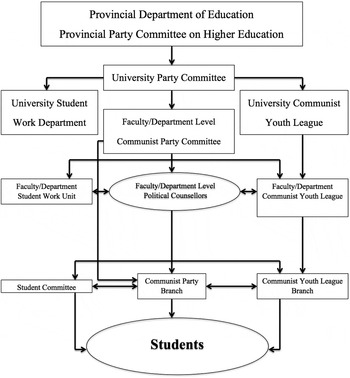
In the post-Mao era, the restored Party bureaucracy discredited mass movements and re-established institutionalized control over the universities. They imposed a three-pronged bureaucracy, comprising the Communist Party, the Communist Youth League and the student work system (xuegong xitong 学工系统).Footnote 33 These hierarchical systems facilitate both top-down supervision by the Party-state and bottom-up collaboration from loyal activists and the student body at large. Unlike the more decentralized academic authorities that exist in parallel, this triple bureaucracy is highly centralized and accountable only to the Party secretary of the university (rather than the university president). With regular Party cadres staffing the system (with the assistance of “student cadres” who are handpicked from among student activists), this internal structure extends beyond the university walls and is part of the larger control framework headed by the CCP's central or provincial committee on higher education work (gaojiao gongwei 高教工委). Figure 1 demonstrates the organizational structure of student control in a typical Chinese university.
Organizational Structure of Student Control at a Provincial University in Central China

The student control bureaucracy emphasizes the Party-state's powerful reach into the most basic levels of student communities. The most important pillar of this structure is the revived post of political counsellor (zhengzhi fudao yuan 政治辅导员) (PC). Instruction No. 24 issued by the Ministry of Education (MoE) in July 2006 mandates that a PC should be present in all college and university classrooms – a practice that was abandoned during the later Maoist years. The document also prescribes that “PCs … should have a dual identity as both a teacher and a Party-state cadre” and that “they are the primary working force for the moral and ideological education of university students.”Footnote 34 The MoE stipulates that “the ratio of PCs to students should be 1:200.”Footnote 35 In some universities, PCs are required to remain in regular residence in the student dormitories.Footnote 36 By maintaining daily contact, surveillance and control over the students, these basic-level cadre-teachers constitute the backbone of the PRC's university control apparatus.
In addition, in a legacy leftover from Maoist times, all students in China today are organized into a quasi-military structure that extends from the basic-level classrooms (班级 ban ji), to year cohort (年级 nian ji), all the way up to university level. The student Party branch (SPB), which comprises all the student Party members in a unit, is considered the most powerful self-regulating agency. Representing the authority of the Party-state, the SPB is in charge of recruiting new Party members, conducting regular political reviews of ordinary students, recommending candidates for student cadre appointments, collecting information on students' “trends of thought” (sixiang dongtai 思想动态), and making decisions on important matters related to the interests of the entire unit.Footnote 37 Combining control, surveillance and “self-management,” the post-Deng student control apparatus bears a remarkable similarity in structural terms with that of the pre-Cultural Revolution era and, indeed, remains a giant “interlocking pyramid” of Party machinery.Footnote 38
Control Measures
A solid organizational framework inherited from the past is only one side of the story. How these structures are strategically deployed by the authorities in the new era is, of course, the other issue. During the Maoist years, the mass-movement model of control ensured ideological and political congruence between students and the Party-state by mobilizing the educated youth into a host of state-sanctioned mass campaigns. With a pragmatic and materialistic cohort of Party technocrats in power, the post-Deng student control apparatus appears to be more depoliticized, bureaucratic and materialistic, and is driven by more concrete and tangible incentives rather than by ideological causes. Bureaucratic surveillance and hierarchical intervention have supplanted political indoctrination and mobilization as the main instruments of power, while regular Party-state cadre-teachers have replaced campaign activists and other extreme-left radicals as the primary scions tasked with keeping the Party-state's grip on the student body. The most important control measures used on university campuses during the post-Deng era will be explored in this section.
Ideological monitoring and control
As universal political zeal fades away in the post-Deng era, the CCP's more orthodox method of ideological indoctrination – the political education course – has flourished again in university classrooms. The Party-state blamed inadequate training in orthodox Marxist thought as one of the major causes behind the political turmoil in Tiananmen Square in 1989.Footnote 39 In March 1991, China's rising paramount leader, Jiang Zemin 江泽民, wrote to the Ministry of Education requesting that enhanced education concerning China's revolutionary history be introduced throughout the entire educational curriculum from elementary schools to universities.Footnote 40 Since then, the regime has endeavoured to rebuild a complete ideological education curriculum for higher education. Since the late 1990s, university students in the arts and social sciences have been required to complete 315 academic hours of political education courses. Students in the physical sciences and engineering disciplines have to complete 210 academic hours.Footnote 41 In 1998, the CCP's Central Organizational Department and the MoE issued a joint statement requiring that all political education courses in the 21st century be “centred around the study of Deng Xiaoping Theory and systematically teach the basic theories of Marxism as well as patriotism, collectivism and socialism.”Footnote 42 As a result, a new system called “the two classes” (liangke 两课) was introduced, which comprises compulsory Marxist education and moral training courses.Footnote 43 This special political curriculum has included required courses on the Chinese Communist Revolution and the CCP's guiding ideology du jour (for example, the “three represents” theory in the late 1990s, and the “scientific development” theory in the early 21st century).
In addition to a formal and compulsory curriculum emphasizing dogmatic ideology, political education relevant to current affairs and policies is carried out on a regular basis. According to our interviewees, these “everyday” political education events vary in format, but include regular class meetings (banhui 班会), Communist Youth League (CYL) meetings (tuanhui 团会), reading sessions (dushu hui 读书会), and SPB meetings (danghui 党会). A Party school for university students also operates on each campus and serves as an important centre for routine ideological training.Footnote 44 Special ideological campaigns are launched periodically by the Party-state – for example, “Maintaining the advanced nature of Communist Party members” and the “Celebration of the 90th anniversary of the founding of the CCP.” Such campaigns inevitably serve to convey an additional dose of political indoctrination for students.
In the event of extraordinary political situations arising outside the campus walls, urgent political study sessions are convened as a means to both pacify the students and to limit their mobility for the duration of the crisis. For example, in the spring of 2011 when overseas websites called upon Chinese youth to launch a “Jasmine revolution,” university students were immediately summoned for special study sessions to insulate them from “oppositional forces.”Footnote 45 Such political reinforcement also occasionally takes the form of patriotic ceremonies. For example, during the 2003 SARS epidemic, the CYL at Peking University held a ceremony in Tiananmen Square pledging allegiance to the Party. As one internal report described it,
On the morning of 1 July 2003, more than 100 CYL members from Peking University … came to Tiananmen Square to participate in a national flag raising ceremony. After the ceremony, students … chanted slogans such as “Keep our heart with the Communist Party” or “Reconstruct our glorious achievements.”Footnote 46
However, unlike the indoctrination of the Maoist period, these ideological education sessions have not been particularly successful in convincing today's university students to accept the government's bromide and dogma. A survey of university students conducted in 2003 found that 76 per cent of those surveyed either generally or completely disagreed with the “socialist principle of collectivism” as taught in political education classes.Footnote 47 More often than not, these sessions serve as a political ritual during which participants act “as if” they believe in the official ideologies, and demonstrate loyalty to the regime in public and among their peers. Certainly, the regime seeks to filter out or deter anyone who would dare to exercise open defiance during such mass rituals.
In her study of the personal cult of Hafez al-Assad in Syrian politics, Lisa Wedeen looks into “the role of rhetoric and symbols in producing political power in the absence of belief or emotional commitment.”Footnote 48 Wedeen argues that rituals and ideological spectacles constitute “a strategy of domination based on compliance” produced through “enforced participation in rituals of obeisance that are transparently phony both to those who orchestrate them and to those who ‘consume’ them.”Footnote 49 This form of domination is what Wedeen labels as “disciplinary-symbolic power.”Footnote 50 Similarly in the PRC, university ideological education activities serve to insist on ritualistic loyalty rather than to win true ideological adherence. This kind of “expressed” loyalty in ceremonial activities is important for a ruling regime that is gradually losing its idealist appeal to the masses. After all, as Žižek notes, “the only real obedience … is an ‘external’ one: obedience out of conviction is not real obedience because it is already ‘mediated’ through our subjectivity.”Footnote 51
The “fatiguing, depoliticizing, cynicism-producing effects”Footnote 52 of the official political discourse create a prevailing atmosphere of detachment from any form of political life on PRC university campuses. A depoliticized student populace aligns well with the Foucaultian concept of a “docile body,” and this may be helpful for disciplinary control. Nevertheless, widespread cynicism and political apathy may also threaten to alienate PRC university students from the incumbent political regime, and develop into an alternative force of silent defiance. Again, as Žižek contends, “even if we do not take things seriously, even if we keep an ironical distance, we are still doing them.”Footnote 53 There is, as always, “a politics of depoliticization.”Footnote 54
Recognizing the danger embedded in political cynicism, the authorities have explored other means of reaching out to the students in a more proactive but less-provocative manner. Compulsory counselling is one such channel. For instance, Peking University operates a so-called “consultation system” (huishang zhidu 会商制度). This system requires university political cadres to monitor the thoughts and behaviour of ten different categories of students (including students who have “radical ideas,” an unsatisfactory academic performance, “independent lifestyles,” or are mentally fragile). The cadres conduct periodic one-to-one consultation sessions with these students.Footnote 55 Also, a nationwide programme conducted by the CYL requests that university political cadres provide adequate guidance to students on “critical points in their thought development” (sixiang guanjiedian yindao 思想关节点引导), i.e. things that might lead to doubts about the legitimacy of the regime. As one political cadre explained in an interview, one of the critical points was “to convince the students to connect their patriotic love of their motherland to love of the Communist Party.”Footnote 56
Mental health monitoring (xinli weisheng jiance 心理卫生监测) has developed into a novel instrument used by the Party-state to monitor students' thoughts and detect irregularities. Predictably, the scope of mental health monitoring is defined much more widely than in most Western countries. In this context, mental illness includes not only clinical mental problems, but also abnormal, defiant or radical socio-political thoughts or behaviour.Footnote 57 At most universities, students are monitored from day one. At one of universities where I conducted fieldwork, all first-year students are required to submit to a lengthy mental health screening (usually conducted by questionnaire) during orientation. Results obtained from this screening are thoroughly studied and analysed by political officers, and the students are placed under careful scrutiny if an irregularity is identified. Follow-up political consultations might be arranged.Footnote 58 In each banji (the basic organizational level of university students), there is a special student cadre – the “commissioner of mental health” (CMH). According to an interviewee, these CMHs serve, by and large, as informants. They detect “irregular mental conditions” at an early stage and report them to the appropriate university cadres. Today, mental health monitoring and intervention have become an important control mechanism in China's universities, through which the Party-state can maintain surveillance over the students' thoughts, identify abnormalities, issue early alerts, and intervene whenever necessary.
Managing student groups
Student groups constitute a vibrant part of campus life and have served as an important mobilizing resource for student movements in the past. Flourishing student groups and activity clubs are prominent features of the university campus in post-Deng China. The management and control of these organizations has become yet another important mission for the regime. Student groups are generally categorized into three types: the CYL, the student union, and miscellaneous student clubs/societies. The student union is the officially endorsed union representing the entire student body, but the CYL (staffed by full-time Communist Party cadres with the assistance of part-time student cadres) enjoys the most prominent status among the three. The CYL is entrusted by the Communist Party to advise the student union, manage student groups/societies, and oversee all student activities held on campus. As a CYL publication says, “[t]he sole purpose of the CYL's work is to educate and guide the youth … in the direction set by the Communist Party.”Footnote 59
The CYL exercises systematic and thorough political control over all student groups. The monitoring process first begins when a student group is proposed. The CYL usually requires that the prospective group obtain the endorsement of a faculty-level Party committee (regardless of the club's nature), and that final approval can only be granted when the university-level CYL is satisfied with the endorsed proposal.Footnote 60 In most universities, student groups also have to pass an annual review conducted by the CYL; groups that are deemed politically sensitive are refused registration renewal. These administrative hoops effectively rule out the possibility of any undesirable student groups legally operating on university campuses.
The CYL enjoys a monopoly over the distribution of the campus resources (such as classrooms, meeting spaces, bulletin boards and funding) upon which student groups rely to hold their activities. Registered student groups' requests for these resources are decided on a case-by-case basis after a careful review of the contents, format and possible audience for the event. The criteria used by the CYL for this review varies according to each case and context. For example, one interviewee recalled that when the Jasmine revolution was active in 2011, the university CYL significantly tightened their review of student activities to the point that a fund-raising event for a climbing club was not permitted.Footnote 61 More customary rules are in place, too. For instance, in 2002 the provincial CYL of a central province issued a document banning any inter-university collaboration for student group activities, a measure apparently intended to prevent cross-campus mobilization from taking place.Footnote 62
“Professionals-in-waiting”
An important structural feature of the student body in post-Deng Chinese universities is the ratio between science and engineering students on the one hand, and humanities and social science students on the other. In 2010, 1,113 of the 2,358 universities and colleges in China, or 47 per cent of the total, were institutions devoted to vocational training.Footnote 63 That same year, 5,754,245 university students graduated. Of those, 4,095,814 (or 71 per cent) majored in science, engineering, agriculture, medicine or managerial science.Footnote 64 Another other significant change for university students is the dismantling of the state-controlled job-assignment mechanism; graduates in China today have to compete for jobs in a highly competitive employment market.
Given the development of practice-oriented disciplines and the pressures of a harsh job market, China's universities have increasingly bowed to the imperative of the flourishing socialist market economy, which has resulted in the complete commercialization of higher education. They are no longer “ivory towers” from where the current and future intelligentsia criticize political authorities, but instead have gradually been transformed into the major suppliers of manpower for the country's economic boom. In addition, the Party-state's 1999 decision to increase significantly the nationwide admission quota for colleges and universities has further diluted the traditional identity of university students as “elites-in-waiting” who presume to share a duty with other elites for the betterment of national politics.Footnote 65 As China's universities shift their focus to providing an education for the broader masses rather than just the elite, students suffer from intense insecurity, self-doubt and anxiety about their future lives.Footnote 66 Inevitably, these pressures lead many Chinese students to choose to detach themselves from China's critical intelligentsia and instead align themselves with a much more politically apathetic and compliant professional working class. This new identity change from presumptive elites to “professionals-in-waiting” has had a profound political impact.
Rewarding loyalty
A crucial element in the battle for political control in authoritarian regimes is the generating of compliance incentives. In the post-Deng era, where the leadership has determinedly denied legal standing to any mass movement, the Party-state embraces more pragmatic means to accomplish this important task. Supported by the Party-state's monopoly over various forms of social, political and economic resources, this is a system that decidedly focuses on the bestowing of benefits, gifts and privileges in exchange for political compliance and conformity.
With traditional control measures such as compulsory job assignments waning in the context of all-rounded marketization, the material benefits associated with CCP membership are becoming the most important incentives for political loyalty. CCP membership is dispensed to a small portion of university students through a highly selective, secretive and elitist process.Footnote 67 According to the Central Organizational Department, 11 per cent of the total university student population of China were CCP members in 2010. Footnote 68 As the dominant political authority in China, CCP membership is associated with a variety of privileges and benefits that are unavailable to ordinary students. The prospect of membership attracts those students who seek promising careers and good lifestyles after graduation. For example, most (if not all) Party and government agencies either require CCP membership, or give priority to applicants who are CCP members, when they recruit new cadres from universities.Footnote 69 CCP student members also enjoy significant advantages when they compete for employment at lucrative state-owned enterprises, according to student interviewees. Access to “occupational opportunities” serves as a strong incentive for political loyalty in a time of high unemployment and expanded university enrolment. According to a 2009 survey conducted by PRC researchers, only 12.92 per cent of student applicants for Party membership claim they actually “believe in Communism,” while the rest all cite materialistic purposes.Footnote 70
Another powerful reward for political compliance is the “direct admission to graduate school” scheme (baoyan 保研), through which those students who have been scrutinized and selected by the university authorities and endorsed by the MoE can enter graduate school directly, bypassing the extremely fierce National Admission Examinations for Graduate Schools. Although different universities may set up their own procedures for selecting this lucky group of students, most give considerable weight to the political performance of the candidates. The Party-state's most loyal collaborators – student cadres, official student union leaders, the CYL cadres and activists – are always given priority when such quotas are allocated.Footnote 71 Accordingly, students who violate the code of appropriate political conduct may be “excluded from baoyan consideration,” regardless of the violator's academic performance.
When compared to the Maoist-era when CCP cadres could allocate jobs for all graduating students, it would appear that the transition to a socialist market economy and the growth of the private sector have weakened the universities' control over students' career prospects. Nevertheless, university administrators still hold considerable power when recommending their preferred candidates to Party-state agencies or state-owned enterprises, as such employers usually solicit the opinions of the university's political cadres at the outset of their hiring process. Additionally, some employment information, such as how to gain direct entry into local Party-states as a “cadre trainee” (xuandiao sheng 选调生) or recruitment into the military officer corps, is only disseminated through the university's Communist Party hierarchy and becomes yet another carrot used by authorities to reward loyalty.
Critical and sensitive periods
While certain political control measures are daily routine, a crucial mission for all universities in post-Deng China is imposing tighter control during “critical and sensitive periods” (mingan qi 敏感期) (CSP). A CSP is usually initiated or designated by the state, and they can be established for different reasons. Some CSPs are regular (such as the week before and after the anniversary of the June Fourth Movement, and the week before the plenum session of the National People's Congress); others are sporadic yet predictable (usually before major social or political events); and some are in response to sudden or unpredictable crises (such as the SARS epidemic, or the Jasmine revolution).Footnote 72 Scholars of student political movements realize the crucial role of a “triggering event” in arousing or agitating activism, and so does the CCP.Footnote 73 The primary purpose of the extra control during CSPs is to prevent potential student activists from seizing the triggering event(s) and assigning them “symbolic political connotations” in order to springboard a movement.Footnote 74
During CSPs – be they designated or announced – the control mechanisms installed in university campuses become much more oppressive. Additional measures are implemented to secure tranquillity or to eliminate potential protest before it surfaces. CSPs feature efficient, intimate and real-time collaboration between the university administration and the state law-enforcement agencies in detecting possible student unrest and preventing large-scale gatherings from taking place.Footnote 75 As stated, many CSPs are planned for in advance. Every anniversary of the 1989 student movement, for example, is a time of high alert for university officials and student cadres all over China. Other CSPs are irregular, but no less dangerous. For example, the government informed university officials about the NATO bombing of the Chinese Embassy in Belgrade in 1998, and asked the cadres to announce a CSP as promptly as possible.Footnote 76 Interviewees also reported that governments at different levels requested CSP-enhanced controls during the Jasmine revolution, as well as during recent outbursts of nationalist demonstrations in urban centres.Footnote 77 According to one official's account:
Now we have information transmission and sharing mechanisms with the state authorities [during CSPs]. Once there is important information [about possible student action], it can be disseminated efficiently [among officials]. And if there is any sign of a potential public protest, the university will take prompt action. Usually the provincial department of education will alert the student work department of our university. Administrators in charge of student affairs (normally the vice-secretary of the Communist Party committee) will be summoned to an urgent meeting to deliberate on the situation and subsequently all the political counsellors will be notified about decisions made at that meeting.Footnote 78
An essential component of student control during CSPs is the round-the-clock surveillance and curtailing of student activities. Official student meetings are more frequently convened. The university administrators or political officials also reach out individually to targeted members of the student population. During the 2009 Uyghur riots in Xinjiang, for example, political officials at a central Chinese university were asked to call upon each student hailing from Xinjiang to make sure that s/he did not harbour any form of grievance or discontent against the state. Student cadres were also asked to pay closer attention to those students' thoughts and behaviours.Footnote 79 The official student union or the CYL will usually organize more recreational or extracurricular activities during these periods to distract students from political events, while activities organized by other student groups or clubs are either cancelled or severely restricted. According to one student leader, the university administrators specifically approached leaders of popular student clubs during the Jasmine revolution to advise them not to use their influence to mobilize their members/followers to organize or attend any public demonstrations.Footnote 80
Student informants are also widely deployed by universities during CSPs. From our interviews, it is obvious that political officials in Chinese universities routinely recruit informants among the ordinary students to monitor their classmates and report any “radical remarks.”Footnote 81 One political official in a national university described the duties of student informants:
[Student informants] are charged with reporting [unusual conditions] to … political counsellors, all the way up to the secretary of the university Communist Party committee…They garner all sorts of information, with a focus on students who have difficulties with their studies … or those who have mental irregularities. The student informants are obliged to identify and report such instances. Of course, other student cadres also carry this duty but the student informants do this round-the-clock.Footnote 82
Another university administrator emphasized that student informants are directly controlled by the university-level political cadres, rather than by the academic staff or faculties.Footnote 83 Informants are asked to report on the condition of the student body more frequently during CSPs.
During CSPs, universities tighten online controls over the campus computer network and the monitoring of online postings on campus forums is increased.Footnote 84 Political officials and CYL cadres monitor and manage public discussions floating on the university computer network on a daily basis. However, extra caution is exercised during CSPs. University administrators (sometimes a special office in charge of network management) carry out 24-hour monitoring of the online postings and chat-room contents. On occasions when officials feel that online remarks have become too radical or provocative, the informants are asked to write follow-up postings to rebut the more outrageous remarks. This tactic is referred to in the Party's official discourse as “opinion guiding” (yulun yindao 舆论引导).Footnote 85 Instigators of political rumours, radical commentaries and agitating messages are carefully identified, their comments removed or traced, and, in the more serious instances, they are investigated.Footnote 86 As a policy report suggests, “it is important that we fully deploy political counsellors, student Party members, student cadres and student activists and set up ‘detectors for information’ in every space in which students live.”Footnote 87
Universities finance and support the development of officially endorsed student websites or forums to compete with the more unruly websites run privately by students. These “official” student websites enjoy enormous advantages in terms of funding, manpower and logistical support. While other unofficial campus websites/forums might be temporarily suspended during CSPs, university administrators grant the official student websites a de facto monopoly over information flow, as well as forums for public discussion.Footnote 88 In recent years, with Web2.0 services such as social media websites, instant messaging services and Twitter/mini-blogs (weibo 微博) flourishing in China, students tend to use these 24-hour cheap and convenient forums for association and communication. Most classes, organizations and dormitories have created their own internet groups in various formats. Political cadre-teachers and student activists are also asked to monitor these internet groups closely in order to police student thinking and divert their energies in times of heightened political sensitivity.Footnote 89 All of these measures provide the university administrators and political officials with real-time, on-site and efficient means through which to gather information, identify abnormalities, shape public discourse and ultimately prevent radical student collective action from taking place on university campuses.
Conclusion
Scholars have long attempted to decode the “black-box” of authoritarian politics. However, as David Art argues in a recent article, asymmetric attention has been given to the quasi-democratic institutions and features of these regimes, at the expense of examining the control and coercion components in such systems.Footnote 90 To achieve a thorough understanding of the political process and power distribution in non-democratic systems, it is all the more important to look into the institutions, mechanisms, and methods used by authoritarian rulers to control their subjects. University students are certainly one of the most crucial links in the autocratic chain of control.
In his study on the political socialization of youth and university students in Fascist Italy and Spain, Gino Germani argues that authoritarian regimes have to face the “contradictions of participation and control.”Footnote 91 In other words, autocratic rulers need to “generate the active mobilisation of youth and their creative participation in the regime” while maintaining rigid control to prevent them from transforming into anti-systemic forces.Footnote 92 Hence, in different stages in their evolution, autocratic states often emphasize one value above another to cope with particular domestic and international situations. In Maoist China, the Party-state deployed a “participation-oriented” approach to control the student population. Using the mobilized students as a social base for Mao's Cultural Revolution against the Party bureaucracy, the revolutionary regime ensured political and ideological congruence between itself and the students.
In the post-Deng era, however, the control apparatus imposed on university students appears to be highly de-politicized, bureaucratic and pragmatic. Having learned from experiences both in China and abroad, the Party-state refrains from using outright coercion or repression to maintain its grip over the student body. On the contrary, it now turns to political rituals to solicit public affirmation of political conformity, and uses materialistic incentives to generate compliance. “Careerism” and “apoliticism” have replaced ideological devotion and zeal.Footnote 93 Subtly refined surveillance and intervention networks monitor the student body, and a vast system of censorship and control prevents students mobilizing into an organized force that might threaten the stability of the campus, city, province or nation.
Engineering stability and crafting compliance have become the top priorities for the CCP in the early 21st century. The institutionalized control mechanisms operating on university campuses have certainly contributed to the general stability of the PRC regime over the past two decades. However, the long-term sustainability of this system has been widely questioned. The de-politicization of university campuses may result in short-term tranquillity, but may also cause long-term “alienation” in an entire generation of educated youth. The kind of political cynicism and apathy that is found among today's university students in China may lead to any of several outcomes. First, cynicism and apathy may become a form of silent defiance. The students' public performances of obedience, conformity or indifference might imply more radical and provocative political discourses in private or virtual spaces. Second, when energetic university students refrain from expressing their grievances, opinions or disagreements, the accumulated negative sentiment might one day explode in a devastating manner. Third, the Party-state could face a general loss of legitimacy. The CCP's political domination has traditionally depended on its ability to penetrate the complex fabric of Chinese society. It has also depended on maintaining a semblance of ideological and organizational congruence between the regime and the people. If the social subjects start to turn their backs on the regime in a cynical move, the Party-state's governance and legitimacy might face serious challenges. How this generation of apolitical university-educated youth influences China's political future will remain a challenging question for decades to come.