Introduction
The choice of payment system for healthcare providers is an essential health policy issue. Different payment systems provide incentives for different behaviour among healthcare personnel; a fixed salary provides incentives for shirking, performance-related pay (PRP), for concentrating on those aspects of the job that are measured and misrepresenting the output. The exposure to income risk is very different between salaried workers and those solely dependent on PRP; and a risk-averse worker will – if offered the choice – most likely choose fixed salary if it is sufficiently profitable, whereas a risk-seeking will choose PRP. As such, payment systems induce self-selection of a workforce that will benefit from the inherent incentives (Gibbons, Reference Gibbons1998). The third party payer will, on the other side, prefer a payment system believed to further health policy objectives.
In the private sector, healthcare personnel often work in small-scale practices with an income based on PRP. However, in large-scale public organisations, healthcare personnel often have a fixed salary. PRP is possible to implement when it is easy to measure output and easy to make it attributable to a single worker or a team. Some parts of healthcare suit this description well, which is independent of organisational size, while others do not. Dentistry serves as an example of a healthcare sector where output can be easily measured, and where output can be attributed to the activity of one worker. This paper, empirically set in Norwegian dentistry, aims towards the study of dentists’ preferences for different pay schemes involving different levels of risk. The general research questions addressed are (i) which pay scheme would healthcare workers, offering health care with easy measurable and attributable output, prefer for themselves; and (ii) which scheme do they think would be best to further health policy objectives.
In this paper, the general term PRP is used and not the term fee-for-service that is commonly used in health economic settings. Most often, a fee set for a service in a healthcare setting is a fixed amount of money that is negotiated through government involvement. A large part of Norwegian dentistry does not operate on such a fee-for-service; therefore, it is considered more appropriate to use the term PRP.
Empirical context: the market for dental care in Norway
In Norway, the provision of dental care is characterized by a distinct split between public and private provisions. Counties are responsible for the Public Dental Service (PDS) that offers free dental services to specific groups of the population: children and adolescences under 18 years old, all mentally handicapped people and certain senior citizens. It also offers subsidised services for 18–20-year olds.
The PDS operates on fixed public budgets, and dentists who work in the PDS are county employees covered by collective agreements. Wage setting for employees covered by collective agreements take place at two levels: national and firm. At the national level, wage regulations, working hours, working conditions, pensions and medical benefits are negotiated. The firm-level negotiations determine possible local adjustments and additions to the collective agreements (Hunnes et al., Reference Hunnes, Møen and Salvanes2007). During the past 10–15 years, it has become quite common among counties to negotiate local wage agreements, enabling the PDS to offer pay schemes based on a reduction in fixed salary and an addition of PRP for dental personnel. These schemes are optional and the PRP can either be linked to team or individual output, with the share of PRP generally being low in relation to fixed salary. This is because PRP is not related to the main activity of offering free dental treatment to specific groups, but to a minor activity where treatment is given to adults who pay for services themselves. It is this income which is shared between the county and public dentists. According to the Norwegian Dentist Association, a PDS dentist earned on average €60,000 a year, ranging between €52,000 and €75,000 in 2007.
In general, Norwegian adults are required to pay for all necessary dental treatment themselves. They are mostly served by private clinics, in which the majority (71%) of general practicing dentists work (Abelsen, Reference Abelsen2008). There are no public regulations, neither concerning where a private clinic can be set up, nor which fees can be charged for dental services. The absence of private providers is the main reason why the PDS in sparsely populated areas offer dental treatment to paying adults.
Compared to dentists in the public sector, private dentists are highly exposed to market forces and carry a large amount of income risk. Most private dentists are self-employed, and a recent study showed that 38% of these private dentists work in solo practices (Grytten et al., Reference Grytten, Skau and Holst2007). Private dental care business is dominated by sole proprietorship, so what the business makes is the actual income of the individual. Grytten et al. (Reference Grytten, Skau and Holst2007) estimated that the sole proprietorship share was 65% of dental care business. The rest being organised as limited companies (31%) or companies with shared liabilities – where each participant is directly liable for their relative ownership of the company. In addition, the net profit among self-employed dentists was, according to Statistics Norway, an average of €113,000 in 2006.
Pay schemes set in a principal–agent context
A pay scheme can be seen as a contract between an agent and a principal. In the standard economic treatment of the principal–agent problem (Spremann, Reference Spremann1987; Eisenhardt, Reference Eisenhardt1989; Gibbons, Reference Gibbons1998; McGuire, Reference McGuire2000; Baker, Reference Baker2002; Falk and Kosfield, Reference Falk and Kosfield2006; McNabb and Withfield, Reference McNabb and Withfield2007) on how to make an agent act in the interest of the principal, payment systems allocate both risks and rewards for productive work (Holmstrom and Milgrom, Reference Holmstrom and Milgrom1991). Behaviour of both the agent and principal is influenced by pay scheme incentives (Grytten, Reference Grytten2005). A pay scheme can be summarised by the linear equation, y = s + bx, where the intercept, s, is the base salary and the slope, b, is the payment per output, x. Increasing b relative to s creates stronger incentives to increase output, but also imposes more risk to the agent. The extreme case, b = 0, puts no risk on the agent and offers no financial incentive for increased efforts. The other extreme, s = 0, is completely dependent on the agents output, and offers the agent no insurance at all (Gibbons, Reference Gibbons1998). The agents’ input or effort is private information and not contractible (McGuire, Reference McGuire2000). This gives the purchaser an incentive to prefer payment per output. Lazear and Shaw (Reference Lazear and Shaw2007) argue that the lower the cost of measuring output, the more likely it is that good workers will demand their output be measured; leading to a greater likelihood that pay becomes a function of output.
Although the agent stays the same, the principal – or the purchaser – differs between public and private sector dentistries. In the private sector, where self-employment and sole proprietorship is prominent among agents, the customer (patient) who seeks dental care is also considered the purchaser; similar to an ordinary market in which the consumer is the purchaser/payer, that is, there is no third party payer. In private group practices, dentists can be seen as both agents and principals, not in relation to patients but in relation to their partners (Lang and Gordon, Reference Lang and Gordon1995). In the public sector, the county authority is the purchaser, acting as principal with the aim to maximise social welfare. In negotiating proper pay schemes, the authorities will not only care about the agent’s productivity, but will also consider how the agents’ behaviour affects overall health policy objectives such as efficiency, quality and stability among dentists, in order to maintain continuity of patient care. These objectives are likely to coincide with the interests of patients paying for dental treatment themselves, but patients’ negotiating power towards the agents will be far less than that of the county authorities. There is also a reason to believe that dentists (agents) are motivated more or less by their patients for social good and self-interests (McGuire, Reference McGuire2000; Scott, Reference Scott2000).
One of the difficulties in designing pay schemes that link financial incentives to measures of performance is that the incentives may generate unanticipated or dysfunctional behaviour (Prendergast, Reference Prendergast1999). Introducing PRP in a fixed salary regime is assumed to increase production per dentist and reward the dentist with a higher income. This might improve efficiency (the ratio of oral health improvement to total input), but may also result in supplier-induced demand (SID). SID is the amount of demand created by dentists, which exists beyond what would have occurred in a market were the patient is fully informed (Evans, Reference Evans1984). If the lack of financial incentives is the reason why dentists leave fixed salary jobs, the introduction of PRP might have a positive influence on stability among dentists; but, it may, in some situations, be interpreted as an act of hostility with adverse effects to the ones intended (Fehr and Falk, Reference Fehr and Falk2002; Bénabou and Tirole, Reference Bénabou and Tirole2003). The quality of dental care matters to the patient, but quality is difficult to measure and can be seen as non-contractible input into the production of oral health, and as such unfit as a basis for payment (McGuire, Reference McGuire2000). However, the UK National Health Service introduced a PRP scheme called Quality of Outcomes Framework, in 2004; resulting in general practitoners reporting their achievements on 146 quality indicators. While the changed practice performance increased their income by about 25%, the effect on patients is less clear (Gravelle et al., Reference Gravelle, Sutton and Ma2008).
In line with Gaynor and Gertler (Reference Gaynor and Gertler1995), we assume dentist i choose to maximise utility according to the following equation:

where ui is the i’s utility, E(yi) is the expectation of i’s net income, Bi is the marginal disutility of variation in income (risk-aversion),  is the variance of i’s net income, ei is i’s effort, vi is i’s private non-monetary cost of effort.
The general description of a pay scheme, which includes the possible range from a fixed salary no-risk payment to a solely PRP-based full-risk payment, can be summarised by the linear equation:

where yi is the dentist i’s income; Si is fixed salary for individual dentist i, ⩾0; qi is fixed salary share for individual dentist i (0 ⩽ qi ⩽ 1); R is the pot set for PRP, for example, Σ Ri net revenues in practice, ⩾0; Ri is net revenue for individual dentist i, ⩾0; α is proportion of revenue generated that i keeps (0 ⩽ α ⩽ 1).
Research questions
A dentist’s perception of risk, unverifiable dentist efforts and the possibility of conflicting goals in the principal–agent relationship makes it interesting to study any discrepancies between the pay schemes dentists prefer, and which they believe will best further overall health policy objectives. First, this paper compares any discrepancy between dentists’ current and preferred pay schemes. Would salaried public dentists be willing to take on more risk in their preferred pay schemes? Would performance paid private dentists prefer pay schemes offering less risk? Second, we compare their current and preferred pay schemes with those pay schemes that dentists believe best further overall health policy objectives such as efficiency, quality and stability among dentists to maintain continuity of care. Would dentists’ preferences regarding what they think is best for themselves match with what they acknowledge might be best in terms of societal objectives? In which ways should the current pay schemes be changed in order to improve efficiency, quality and stability?
Methods
Questionnaires were mailed to a random sample of 1111 dentists in April 2005. The sample was randomly selected among members of the Norwegian Dental Association (NDA), of which 96% of all practising dentists are members. The sample included 28% of all NDA registered members, and the size was determined by Cochran’s sample size formula and budget constrains (Bartlett et al., Reference Bartlett, Kotrlik and Higgins2001). One reminder was sent with an option to fill out an electronic version of the questionnaire on the Internet. The reminder increased the respondent sample by 98 dentists, among whom 51 completed the questionnaire online. However, no distinction was made between dental specialists and dentists in general practice.
Based on knowledge concerning local wage agreements in the PDS and knowledge of the business structure and organisation of private dental care in Norway (Grytten et al., Reference Grytten, Skau and Holst2007), five different pay schemes can be categorised. The categorisation is based on two general assumptions: first, fixed salary imposes less risk to the dentist than payment per output; and second, pay schemes based on team work, compared with an individual’s work, imposes less risk to the individual dentist. This is based on the assumption that team productivity is less variable, and therefore less risky, than the productivity of individuals.
Based on equation (2), five pay schemes are described, according to the level of risks associated with how predictable dentist income will be, as follows:

The respondents were presented with descriptions of the above-mentioned pay schemes and asked to provide information about their current and preferred alternative. They were also asked to indicate which, in their opinion, among the five pay schemes would best further the three different common health policy objectives: efficiency (maximum oral health for money spent); technical quality in dental service delivery and stability among dentists to maintain continuity of care. Finally, the questionnaire asked for background information concerning the respondent’s sex, age, employment in the public or private sector, municipal residency and clinic structure, that is, number of dentists in their workplace.
The survey instrument was developed in close collaboration with senior dentists representing a wide range of skills (clinical practice, oral health planning and research), and the questionnaire was pre-tested on a small group of dentists.
For analysis purposes, the different pay schemes were assigned rank values ranging from 1 to 5 (i.e. no risk = 1, …, full risk = 5). These values, which we call risk values, were used to analyse individual rank differences between dentists’ current and preferred pay schemes, and the ones they consider best to further general dental health policy objectives of efficiency, quality and stability. The risk values are ordinal scale and the distances between the categories are not known. However, in the analyses, we treat the risk values as interval scale, assuming it to be a reasonable approximation (Allison, Reference Allison1999).
The data were analysed using frequency and contingency tables, one-sample t-test, χ 2 test, multivariate linear regression analysis and multinomial logistic regression analysis. Multivariate linear regression analysis (Allison, Reference Allison1999) was used to study the relationship between the dentists’ current pay scheme and their sex, age, residency and number of dentists in clinic. All explanatory variables were included as dummies in the analysis. Multinomial logistic regression analysis (Agresti, Reference Agresti2002; Chan, Reference Chan2005) was used to create profiles of the dentists most likely to prefer more risk in their pay schemes, and those most likely to prefer less risk. The dependent variable constructed and analysed for this purpose was risk preference. The risk preference values were categorized as no difference, if there was no difference between the dentists current and preferred pay scheme; more risk, if the risk value of the preferred pay scheme was higher than the risk value of the current; or less risk, if the risk value of the current pay scheme was higher than the risk value of the preferred. The independent variables were the same as those included in the linear regression analysis. SPSS version 15.0 was used to perform the statistical analysis.
Data
A total of 504 (45% response rate) dentists returned the questionnaire. Despite the fact that less than half of the sample responded, there was no indication of systematic non-response bias. There were no significant discrepancies, neither concerning sector of employment (private vs public) nor the place of residence, among the responding dentists compared to information on members of the NDA. Nor were there significant differences in the gender-mix between responders and non-responders.
The analysis included 478 dentists who reported their main employment to be in the public (32%, n = 155) or private sector (68%, n = 323). However, respondents were excluded if they were working in the non-clinical sector (n = 26).
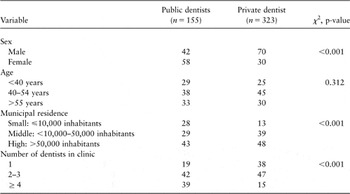
Table 1 shows respondent characteristics. Among public dentists there was a majority of women, while men outnumbered women among private dentists; there was no significant difference in age structure between public and private dentists; and the mean age was 48 years among public dentists and 49 among private ones. There was a higher share of public dentists living in municipalities with a small-sized population compared with private dentists. Working in clinics with only one dentist (solo practice) was significantly more common among private dentists than among public ones.
Respondents’ characteristics (%)

Results
The study aimed towards exploring two different issues concerning public and private dentists; the current vs their preferred pay schemes, and which pay schemes they believe would best further overall health policy objectives.
Current pay schemes
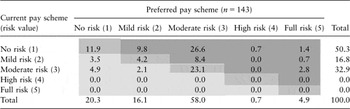
The last column in Table 2 shows that all public dentists had a current pay scheme based on a fixed salary (Si > 0 in the above equation). However, the fixed salary only was as common as a fixed salary combined with PRP, and most PRP schemes were based on the public dentist’s individual output.
Public dentists’ current and preferred pay schemes (%)

The share above the diagonal prefers more risk, while the share below prefers less risk.
Among the public dentists, a linear regression analysis was performed to study the relationship between current pay schemes and the explanatory variables of sex, age, population size of residence municipality and the number of dentists in the clinic where they worked. The analysis showed that public dentists, who were living in municipalities with a small population (⩽10,000), had significantly more risk in their current pay schemes (p < 0.001) than other public dentists; and also that female dentists had significantly less risk in their current pay schemes (p < 0.05) than their male counterparts (n = 147, R 2 = 0.172).
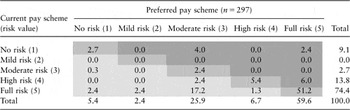
The last column of Table 3 shows that three quarters of private dentists had a full-risk pay scheme. Among the remaining individuals, a no-risk pay scheme was nearly as common as a high- risk pay scheme. A linear regression analysis, similar to the one performed on public dentist data, showed that older private dentists had significantly less risk in their current pay schemes (p < 0.05) than younger ones (n = 305, R 2 = 0.051).
Private dentists’ current and preferred pay schemes (%)

The share above the diagonal prefers more risk, while the share below prefers less risk.
Current vs preferred pay schemes
Table 2 shows that, among the public dentists, 39% preferred their current pay scheme (sum along the diagonal), 50% preferred a more risky pay scheme (sum above the diagonal), while 11% preferred a less risky one (sum below the diagonal). Public dentists had a strong preference for a moderate risk pay scheme. Among the ones whose current pay scheme was moderate risk, 69% would prefer to keep this type of pay scheme and the majority of others preferred a pay scheme with moderate risk.
The overall mean risk value increased from 1.83 in the current pay schemes to 2.79 in the preferred pay schemes among public dentists. The mean difference in risk value between individual dentist’s preferred and current pay scheme was 0.73, a number significantly different from 0 (one-sample t-test, p < 0.001). This is interpreted as a general willingness among public dentists to take on more risk in their preferred pay schemes compared to the current situation.
The majority among private dentists (62%) preferred their current pay scheme (sum along the diagonal), 26% preferred a less risky pay scheme (sum below the diagonal), while 12% preferred a more risky pay scheme (sum above the diagonal). Even if most private dentists (60%) preferred a full-risk pay scheme, as much as 26% preferred a moderate risk pay scheme (see Table 3). Compared to the current situation, where <3% had a moderate risk pay scheme, this could be interpreted as a clear preference for less risk among private dentists. Among the ones who currently had other pay schemes than full risk, there was a preference towards moderate risk.
The overall mean risk value reduced from 4.44 in the current pay schemes to 4.13 in the preferred pay schemes among private dentists. The mean difference in risk value between individual dentist’s preferred and current pay scheme was −0.32, a negative value significantly different from 0 (one-sample t-test, p < 0.001). This might support the general impression of a preference for less risk among private dentist, but it is probably more appropriate to say that private dentists fall into two groups; the majority prefer a full-risk pay scheme, whereas a minority prefer reduced risk.
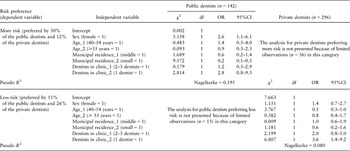
The multinomial logistic regression analysis, presented in Table 4, shows that among public dentists the probability of preferring more risk increased significantly if the dentist was a woman, and decreased significantly if the dentist lived in a low-populated municipality. Among private dentists, the probability of preferring less risk increased significantly if the dentist worked in a solo practice (see Table 4).
Multinomial logistic regression analyses of risk preference among public and private dentists on sex, age, municipal residence, and clinic structure

The reference category is ‘no difference’ (same risk in current and preferred pay schemes), which was preferred by 39% of public and 62% of private dentists.
Pay schemes and health policy objectives
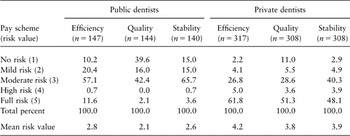
Table 5 shows that the majority of public dentists believed that a moderate risk pay scheme would be best to further efficiency and stability objectives. Concerning quality objectives, the share in favour of a moderate risk pay scheme was lower, and nearly similar to the share in favour of a no risk pay scheme. Among the private dentists, the majority believed that a full-risk pay scheme was best to further efficiency and quality objectives. Concerning stability, the share favouring a moderate risk pay scheme was lower, but not significantly different from the share favouring a full-risk pay scheme.
Pay schemes believed to best in complying with efficiency, quality, and retention objectives among public and private dentists (% and mean risk value)

Public and private dentists differed significantly in their opinion concerning which pay scheme would best further efficiency, quality and stability objectives. However, the mean risk values had the same ordering between public and private dentists; efficiency had the highest mean risk value and quality had the lowest.
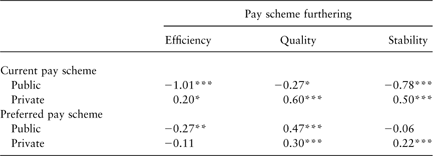
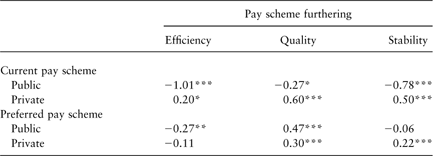
The results in Table 6 show that, among public dentists, the current pay schemes impose significantly less risk to the agent than those they believe best further efficiency, quality and stability objectives. The opposite is true among private dentists, as the current pay schemes impose significantly more risk to the agent than those they believe best further efficiency, quality and stability objectives. Among public dentists, the preferred pay schemes coincided, in general, with the ones believed to best further stability objectives; but impose less risk than believed to best further efficiency objectives and more risk than believed to best further quality objectives. Among private dentists, the preferred pay schemes coincided, in general, with the ones believed to further efficiency objectives, but impose more risk than believed to further quality and stability objectives.
Mean difference in risk value (1–5) between current and preferred pay schemes, and pay schemes considered best furthering efficiency, quality and stability objectives, among public (n = 143) and private dentists (n = 305)
One sample t-test, Ho: difference = 0, ***p-value <0.001; *p-value <0.05; **p-value <0.01.
Discussion
Dentists serve as an example of healthcare workers offering health care with easily measurable and attributable outcome. The results from this study indicate a general preference among dentists for specific pay schemes, including PRP. Public dentists would like to be exposed to more PRP, whereas private ones are happy with their current high exposure to income risk. Hence, some amount of PRP is preferred by the agents, not only by the principal. However, the amount of income risk that dentists are willing to take differed between dentists in the public and private sectors, that is, public dentists are, in general, more risk-averse than private ones.
Several experimental studies have shown that preferences are dependent on current entitlements (the endowment effect; List, Reference List2004). Prospect theory posits that individuals tend to think in terms of gains and losses rather than in terms of net assets, and therefore encode choices in terms of deviations from a reference point (usually the status quo; Kahneman and Tversky, Reference Kahneman and Tversky1979). The endowment effect might contribute to explain the difference in public and private dentists’ pay scheme preferences. Accordingly, dentists place a higher value on payments they have than payments that they do not have.
The endowment effect and degree of risk affinity could be factors to explain why public and private dentists differed significantly in their opinions, with regards to which pay scheme would best further efficiency, quality and stability objectives. Public dentists are assumed to be risk averse with preferences formed in a competition protected PDS context, whereas private dentists are assumed to be risk-seeking with preferences coloured by experienced market competition. However, the mean risk values of the pay schemes are believed to further the three different overall objectives and had similar order between public and private dentists; efficiency had the highest mean risk value and quality had the lowest. This could mean that both public and private dentists, in general, believe that a pay scheme furthering efficiency objectives should include more PRP than one believed to further increase stability and quality objectives. In other words, one pay scheme is not believed to simultaneously further all three different objectives; which is vital information to a third party payer (principal). When choosing a payment system, the principal should decide which objective they see as most important.
One in two public dentists had a current pay scheme combining fixed salary with PRP, a type of contract that was most common among public dentists who were living in municipalities with a small population. This indicates that PRP is used systematically by the PDS as a strategic measure in areas where recruiting and retaining dentists is an old and recognised challenge. The majority of public dentists believed that a moderate risk pay scheme would best further efficiency and stability objectives. Concerning quality objectives, public dentists were close to being evenly divided between moderate risk and no-risk pay schemes.
A move from fixed salary to a PRP-based pay scheme would generally have two different effects: (i) an efficiency effect and (ii) a selection effect (Garibaldi, Reference Garibaldi2006; Lazear, Reference Lazear2000). The selection effect refers to a change in the composition of the workforce; PRP is relatively more attractive to more able workers (Prendergast, Reference Prendergast1999). Workers who value intrinsic internal motivation more than extrinsic rewards will gravitate towards salaried roles (Lazear and Shaw, Reference Lazear and Shaw2007). The efficiency effect refers to the improvements in performance and productivity of workers who are already with the firm (Garibaldi, Reference Garibaldi2006). In this case, where dentists are already working in the PDS, they prefer moderate risk pay schemes in favour of fixed salary; and the majority of public dentists shared the preference for this particular pay scheme; therefore, there is reason to believe that a change in PRP will influence an efficiency effect. The strong preference for individual PRP among public dentists indicates a slack in today’s organisations, which may be reduced with appropriate payment incentives. The study results suggest that the possibility of choosing a more risky pay scheme is welcomed among public dentists, and believed to have a positive impact on both stability and efficiency. A general offer of fixed salary, combined with individual PRP to all public dentists might, however, be difficult to implement with today’s contracts, where the PRP share stems from adult treatment income. Outside low populated areas, adults are treated in private clinics and not in the PDS, so there will be no income to share between the PDS and the dentists. Hence, to meet with dentists’ preferences the PRP pot has to somehow originate from fixed PDS budgets.
The probability among private dentists of preferring a less-risky pay scheme increased significantly if the dentist worked in solo practice. This could be explained by the absence of third party regulations through fees and clinic establishments in Norwegian private sector. In theory, this means that private dentists are competing for patients in a free market; however, a key question is considered to what extent (Grytten, Reference Grytten2005). The results may indicate that solo-practicing dentists experience more competition, and hence, more risk is attached to their income than they anticipated. Gaynor and Gertler (Reference Gaynor and Gertler1995) state several reasons for organising group practices: to exploit economies of scale, to internalise referrals, to smooth work schedules, to exploit reputational economics of scale and for risk aversion caused by significant and risky investments in human capital. By merging into group practices and seeking employment rather than self-employment, less risky pay schemes can be accomplished. A capitation system could also contribute to less-risky pay schemes, but will most probably require public funding or at least public regulations of adult payments for dental services.
Payment per output links income directly to the volume of service provided and has been studied most widely in the context of SID (McGuire, Reference McGuire2000). Competition for patients can influence the dentist to induce demand for dental treatment, which in this case increases costs for patients. The presence of supplier-induced demand, in Norwegian dentistry, under the former fixed fee system, was studied by Grytten et al. (Reference Grytten, Holst and Laake1990) and Grytten (Reference Grytten1991, Reference Grytten1992). The conclusion from these studies is that demand for dental care was indeed supplier induced. The fixed fee system was replaced by a free pricing system in 1995. Grytten and Sørensen (Reference Grytten and Sørensen2000) claimed to find some evidence against the inducement hypothesis, but their results still indicated that high costs, imposed in search for cost-effective treatment, and high transaction costs of changing dentist, unable patients to put necessary pressure on dentists to offer cost-effective treatment. However, the majority of private dentists, in this study, believed that a full-risk pay scheme would best further efficiency objectives. Based on knowledge of the presence of supplier-induced demand, this result might articulate self-serving interests. The Norwegian government does not, in principle, share any risk associated with adult dental treatment, whether towards private dentists or the adult population. The results from this study indicate that third party risk sharing might meet both the minority of private dentists who preferred less risky pay schemes and vital patient benefits of quality and stability of care.
The study has certain limitations and weaknesses, with the main one of a relatively low response rate. With a response rate below 50% one should be cautious about generalising the findings. However, non-response can, but need not, induce non-response bias in survey estimates (Groves, Reference Groves2006). In this study, there is no indication of non-response bias. The uncertainty related to respondents’ understanding of the pay scheme descriptions also provides reason for caution. We do not know, with certainty, that the dentists understand what the different descriptions intend to describe, for example, if they understand that fixed salary, when combined with PRP, means a lower amount of fixed salary and not the same amount of fixed salary with additional PRP. The reliance on hypothetical choices concerning dentists’ preferred pay schemes raises obvious questions regarding the validity of the method and generalisation of the results. The use of hypothetical choices relies on two assumptions; that people often know how they would behave in actual situations of choice, and that they have no reason to disguise their true preferences.
It should be acknowledged that in general terms, people might interpret efficiency and quality as dependent variables in the sense that if quality is low, efficiency is compromised. In this study, efficiency and quality are perceived to be independent variables, and they also seem to be understood as different concepts by the respondents. A patient may, for instance, be given dental treatment of low technical quality that removes pain (i.e. improves oral health), and as such is efficient. It is also possible that an individual is given dental treatment of high technical quality with no certain health effect (i.e. changing a filling from amalgam to composite).
This paper adds, methodologically, a way of defining pay schemes including different levels of risk. Empirically, the study is set in a rather rare but interesting context, where pay schemes ranging from no risk to full risk are in current use. The data reveal information from agents asked to think as principals, and a health policy lesson learned is that the choice of payment system for health care is also a choice of health policy objectives.
Acknowledgement
I thank Professor Jan Abel Olsen, University of Tromsø, for invaluable advice, comments, support, and patience during the preparation of this paper. I also thank the Norwegian Directorate of Health for financial support.