Introduction
Reciprocity is an abiding norm in social ties. People give help, resources and affection to others willingly and with kind intent. There is a basic expectation that sooner or later, the receiver will help the giver (Gouldner Reference Gouldner1960). Ties of reciprocity are a social bedrock for individual wellbeing and societal stability. Asian societies have a strong tradition of reciprocity within families. The Asian concept of family stretches beyond household members to include non-coresident children and their spouses and offspring. Instrumental transfers of money, goods and services occur broadly in this extended family. Southeast and East Asian societies are modernising, bringing new mores and lifestyles to individuals and communities. Singapore's economic and social infrastructure is changing especially rapidly. Older Singaporeans find their social milieu vastly different from anything that they expected, yet their wishes for reciprocal family ties and their efforts to maintain them persist. This paper reports an analysis of family social exchanges by older Singaporeans in their everyday lives. We study older persons' receiving help by financial support, payment of household expenses, companionship for away-from-home activities and having a carer; and their giving help by baby-sitting, doing household chores, giving financial support, and providing advice. In line with the norm of reciprocity, we hypothesise that those who receive more help also give more help in return.
Background
Reciprocity was one of the earliest principles proposed by social scientists (Mauss Reference Mauss1925; Simmel Reference Simmel1907, Reference Simmel1922). It has been a foundation for many social and economic theories, such as social exchange (Blau Reference Blau1964; Homans Reference Homans1961), equity theory (Hatfield Reference Hatfield and McQuarie1995; Walster, Walster and Berscheid Reference Walster, Walster and Berscheid1978), contingent exchange (Deutsch Reference Deutsch1975), beneficence (Gouldner Reference Gouldner1973), and altruism (Batson Reference Batson, Gilbert, Fiske and Lindzey1998). Sociological theories emphasise the norms that operate in social ties, while economic theories emphasise rationality in people's social behaviour. Reciprocity in a relationship can occur swiftly or with long time lags, and the types of things exchanged may differ on each side and change over time. In a group, giving and receiving can occur broadly among members, not just one-to-one. Non-reciprocity also occurs in relationships, challenging goodwill and the continuation of ties.
In ageing research, receiving and giving are often separate topics. The gerontological literature has concentrated on older persons as receivers of financial help, personal care and shared residence (e.g. Allen, Foster and Berg Reference Allen, Foster and Berg2001; Soldo and Freedman Reference Soldo, Freedman, Martin and Preston1994; Spillman Reference Spillman2004; Stoller Reference Stoller1983; Stone, Cafferata and Sangl Reference Stone, Cafferata and Sangl1987). A smaller literature studies older persons as givers to family and society by means of employment, volunteering and other productive activities (e.g. Herzog et al. Reference Herzog, Kahn, Morgan, Jackson and Antonucci1989; Morgan Reference Morgan1986; Morrow-Howell, Hinterlong and Sherraden Reference Morrow-Howell, Hinterlong and Sherraden2001; Sanders Reference Sanders1988). Research has shown that giving help has positive effects on older persons' wellbeing (Kim et al. Reference Kim, Hisata, Kai and Lee2000; Krause, Herzog and Baker Reference Krause, Herzog and Baker1992; Liang, Krause and Bennett Reference Liang, Krause and Bennett2001; Lum and Lightfoot Reference Lum and Lightfoot2005; Ostir et al. Reference Ostir, Simonsick, Kasper and Guralnik2002; Wolff and Agree Reference Wolff and Agree2004).
Receiving and giving come together in the gerontological literature on intergenerational transfers. The focus is parent-child relationships, and the theme has been how elderly parents receive care and finances from their adult children (Kendig, Hashimoto and Coppard Reference Kendig, Hashimoto and Coppard1992; National Research Council 2001). But empirical studies have shown that ties between older parents and grown children are not simple, and that transfers over time or at a point-in-time are contingent on the combination of resources and needs on both sides (Couch, Daly and Wolf Reference Couch, Daly and Wolf1999; Grundy Reference Grundy2005; Henretta, Grundy and Harris Reference Henretta, Grundy and Harris2002; Künemund and Rein Reference Künemund and Rein1999; Schoeni Reference Schoeni1997; Silverstein et al. Reference Silverstein, Conroy, Wang, Giarrusso and Bengtson2002). Besides family transfers, older persons also exchange services in friend/neighbour ties (Peters and Kaiser Reference Peters, Kaiser, Sauer and Coward1985; Rosow Reference Rosow1967; Wentkowski Reference Wentkowski1981).
Surveys in Southeast and East Asia have provided ample empirical data about intergenerational transfers (Andrews and Hermalin Reference Andrews, Hermalin and Phillips2000; Knodel et al. Reference Knodel, Kim, Zimmer and Puch2005). The research emphases have been the co-residence of older parents with their adult children, and financial transfers between them, but the surveys have also tapped household services and transfers of material goods (Agree et al. Reference Agree, Biddlecom, Chang and Perez2002; Agree, Biddlecom and Valente Reference Agree, Biddlecom and Valente2005; Biddlecom, Chayovan and Ofstedal Reference Biddlecom, Chayovan, Ofstedal and Hermalin2002; Frankenberg, Beard and Saputra Reference Frankenberg, Beard and Saputra1999; Frankenberg, Lillard and Willis Reference Frankenberg, Lillard and Willis2002; Lee, Parish and Willis Reference Lee, Parish and Willis1994; Lee and Xiao Reference Lee and Xiao1998; Lillard and Willis Reference Lillard and Willis1997; Ofstedal, Knodel and Chayovan Reference Ofstedal, Knodel and Chayovan1999). Southeast and East Asian research has been assiduous in measuring both giving and receiving in relationships. Qualitative studies have probed older and middle-aged adults' attitudes about co-residence, obligations to family members, and feelings about care-giving (Akiyama, Antonucci and Campbell Reference Akiyama, Antonucci, Campbell and Sokolovsky1997; Caffrey Reference Caffrey1992; Ingersoll-Dayton and Saengtienchai Reference Ingersoll-Dayton and Saengtienchai1999; Knodel Reference Knodel1995; Mehta Reference Mehta1997a, Reference Mehta1999; Ngin and DaVanzo Reference Ngin and DaVanzo1999; Teo and Mehta Reference Teo and Mehta2001). To date, publications on older people's productive services to society by employment and volunteering, and on their exchanges in friend/neighbour ties are few for Southeast and East Asia (one exception is Kim et al. Reference Kim, Hisata, Kai and Lee2000).
Most studies of intergenerational transfers focus on specific flows going to or from a family member. Multivariate models find factors that predict the specific transfer received or given. Links between receiving and giving (reciprocity) are occasionally studied, usually as a minor topic (Frankenberg, Lillard and Willis Reference Frankenberg, Lillard and Willis2002; Grundy Reference Grundy2005; Künemund and Rein Reference Künemund and Rein1999; Lee, Parish and Willis Reference Lee, Parish and Willis1994; Lee and Xiao Reference Lee and Xiao1998; Liang, Krause and Bennett Reference Liang, Krause and Bennett2001; Lillard and Willis Reference Lillard and Willis1997). Thus, the literature by-passes a basic feature of social ties throughout life, since the motivation to reciprocate in social ties is strong, and even ill or disabled older people try to give something to family and friends in return for kindnesses and assistance received (Boerner and Reinhardt Reference Boerner and Reinhardt2003; Litwin Reference Litwin1998; Stoller Reference Stoller1985; van Tilburg and Broese van Groenou Reference Van Tilburg and Broese van Groenou2002).
In Southeast and East Asian societies, reciprocity within families is strongly normative. Older people expect to live with one of their children, have financial support from them, and receive daily assistance (Biddlecom, Chayovan and Ofstedal Reference Biddlecom, Chayovan, Ofstedal and Hermalin2002; Domingo and Asis Reference Domingo and Asis1999; Frankenberg, Beard and Saputra Reference Frankenberg, Beard and Saputra1999; Hermalin, Ofstedal and Chang Reference Hermalin, Ofstedal, Chang and Hareven1996; Knodel Reference Knodel1997; Knodel, Chayovan, and Siriboon Reference Knodel, Chayovan, Siriboon and Hareven1996; Knodel and Ofstedal Reference Knodel, Ofstedal and Hermalin2002; Lang Reference Lang1946; Phillips Reference Phillips2000; Thornton and Lin Reference Thornton and Lin1994). The reciprocity principle is especially prominent in Chinese families. The eldest son is expected to care for ageing parents' needs and wishes, with added help from his siblings (Chan Reference Chan1997; Hateley and Tan Reference Hateley and Tan2003; Lang Reference Lang1946; Tay Reference Tay2003; Thornton and Lin Reference Thornton and Lin1994). This principle of filial piety does not mean that older people cease helping others, only that their children are obligated to help them in later life.
Transfers of goods, services and affect among people are intrinsically complex. To orient data collection and analysis, experts have developed a framework to characterise family and kin transfers (Hermalin Reference Hermalin1999; National Research Council 2001; Soldo and Hill Reference Soldo, Hill, Maddox and Lawton1993). Key dimensions are the type of transfer (space, time, money/goods), the number and relationship of the participants, timing (current or over time), direction (receive or give), and quantity. Aided by this framework, most surveys study specific types of transfers to and from a chosen focal person (the survey respondent). Attitudes about relationships and transfers are seldom asked, so hypotheses about motivations for transfers are tested by statistical analyses of behaviours.Footnote 1 When evaluating reciprocity (links between receive and give), analysts have taken several approaches, such as: using one predictor variable and one dependent variable; creating a four-way variable that indicates if the person both receives and gives, just receives, just gives, or neither; and constructing more complex patterns of giving and receiving, such as latent classes.
How does our analysis fit into the framework? It is a point-in-time study of how the tradition of family reciprocity is faring in contemporary Singapore. Older Singaporeans are the main focus (as the survey respondents), and their exchanges with their extended family are studied. We ask if seniors who received help from their family endeavoured to give help back. The receiving and giving items are current instrumental behaviours in the extended family involving money, time, companion help and advice. Receiving is on the predictor side, and giving is on the dependent side. This analysis is the first to test hypotheses about intergenerational transfers in Singapore. More broadly, the paper contributes to research on intergenerational ties by concentrating on reciprocity. Links between giving and receiving are at the centre of the analysis.
Methods
The data sets
In 1995, the Singapore government conducted a survey of community-dwelling citizens and permanent residents aged 55 or more years (Ministry of Health 1996). Probability sampling identified 8,000 eligible households, and 4,750 interviews were conducted (59% response). Neither a thorough response analysis (comparison of interviewed persons with eligible ones) nor population-adjusted weights are feasible because the Ministry did not issue detailed information about the eligible but non-respondent households. In 1999, National University of Singapore researchers conducted a second survey of the 1995 respondents (Chan, Straughan and Teo Reference Chan, Straughan and Teo2001). Because the first survey was not designed to be longitudinal, re-contact was difficult. Of the original 4,750 persons, 57 per cent were located, 12 per cent had died, 16 per cent had moved to an unknown address, and 15 per cent were not located for other reasons. Of the 2,723 located people, 1,977 were interviewed (73% response).
The items in the second survey differed greatly from the first, and few longitudinal analyses are possible. To exploit the information, we decided to use the two surveys as independent datasets, each with distinctive information about contemporaneous social exchange. With this approach, we can test the reciprocity hypothesis with more indicators than either survey alone provides. We reiterate that this analysis is about contemporaneous receiving and giving. With the Singapore datasets, we cannot examine how family structure and exchanges change over time, or whether some current behaviours serve as investments for future help or repayment for past help, or how people feel about their family ties.
Dependent variables: giving help
Seven dependent variables were available to characterise the older respondents' (hereafter notated as R) giving help to family, five for 1995 and two for 1999. The 1995 dependent variables (Ys) are:
1. How often R baby-sits grandchildren living in the household (‘are you involved in look[ing] after grandchildren?’; response categories: no, at times, often).
2. How often R baby-sits grandchildren living elsewhere (‘when your children visit you or when you visit your children, do you look after grandchildren [their children]?’; no, at times, often),
3. Whether R assists in household work (‘in the household, are you involved in the following: assist in household work?’; no, yes).
4. Whether R provides financial assistance to his/her co-resident children (‘(do you) provide financial assistance to children?’; no, yes).
5. Whether R is consulted by family members for advice on important matters (‘(do) family members consult you for advice on important family matters and in decision-making?’; no, yes).
These five questions were asked to suitable subsets of seniors. Baby-sitting at home was asked only of Rs with grandchildren in that household (N=1,842), and baby-sitting elsewhere was asked of Rs with grandchildren living in another household (N=3,588). The other three items were asked to the 4,075 Rs that lived with their child(ren) and refer to activities in the household.Footnote 2 The 1999 dependent variables (Ys) were asked of all 1,977 respondents:
1. R assists with baby-sitting (from ‘do you provide assistance to baby-sit your grandchildren or others' children?’; no, yes).
2. How much does R help with household chores? (from ‘who mostly takes care of the household chores like cooking, laundry, cleaning, [and] shopping in your household?’; R does none, a little bit, some, a lot, all/most).
Predictors of giving help
How much help seniors give may be affected by their socio-demographic attributes, the availability of receivers, illness/disability, the availability of other givers, time commitments, psychosocial states, and how much help they receive. The first three factors have received much attention in the literature on intergenerational transfers, and we added the others because of their potential importance. The two surveys had different specific items for the concepts. Most items were collected in just one of the surveys (year in parentheses below), and only basic socio-demographic features and self-rated health were in both.
The collected socio-demographic attributes were gender, age, ethnic group, marital status, highest level of completed education (1995), monthly income (1999), and assets (1999). Monthly income is for R (and spouse) from earnings, pensions or retirement funds, rental property, dividends from savings, stocks or shares, income from a family business, gifts from children and other. The amount for each category was recorded in Singapore dollars and all elements summed. The assets of R (and spouse, if alive) were the value of residential or commercial buildings, land, savings/stocks/shares, own business, and other. Amounts were recorded in ranges and midpoint values of the stated ranges were summed. Government pension funds and own residence were excluded from the itemisation of assets.
The availability items concerned the potential receivers of R's help, and other possible givers of help to family besides R. The numbers of receivers and other givers affect the chances and impetus for an older person to give help. We tailored these availability predictors to suit each dependent variable. For example, we used number of other adults in the household (besides respondent) as a predictor of baby-sitting grandchildren in the household. The full set of availability predictors is described in the endnote.Footnote 3
The time commitment items are employment status, volunteer services (1999), and hours-per-week doing chores (1999; used only with baby-sitting Y). The psychosocial items are whether R has a confidant (1995), if R thinks his/her neighbours are helpful (1995), stress and worries from work, family, or daily life (1999), and how much others listen to R's worries and problems (1999). Illness and disability items are self-rated health, symptoms in past month (1995; 0–10), sensory problems (1995; 0–3), physician-diagnosed conditions (1999; 0–10), any home-based treatments (1995), any regular medical care for chronic conditions (1995), and disabilities (1995) (namely, health-related difficulties in personal care and household management tasks, often called activities of daily living (ADL) and instrumental activities of daily living (IADL), respectively). Disabilities were scored as a hierarchy (no ADL/IADL disability, IADL disability only, any ADL disability).
The help received items are: if R received any cash allowance from kin (1995) or from anyone (1999), percentage of all financial support from children (1995), how much other family members paid towards household expenses (1999), if R had a companion when going out (1999), if R had a companion for clinic visits (both years), and if R had a principal carer (1995). Local conditions in Singapore influenced the construction of some of these items. First, direct cash support from children and other kin is a common source of funds for older Singaporeans, taking the form of regular allowances or occasional gifts. The 1999 cash-allowance item excludes holiday and birthday gifts, and the 1995 item has no exclusions. Secondly, for financial support, respondents stated their total monthly income plus cash allowances, then what percentage came from his/her children. Thirdly, for household expenses, ordinal answers ranged from ‘R and spouse pay all’, to ‘other family members pay all’. Fourthly, companions are common for older persons when they go out, and they help to negotiate the hubbub of public places, read signs, and talk to English-speaking personnel (many older Singaporeans cannot read and speak only a local dialect). Typical companions are R's son/daughter, daughter-in-law or a maid. Singapore families of even modest income usually have live-in maids, and maids are increasingly hired specifically for senior care. Lastly, a principal carer is someone formally designated to handle an ill or frail older person's daily needs. Questionnaire wordings for receive-help items are in an endnote.Footnote 4
Sample characteristics
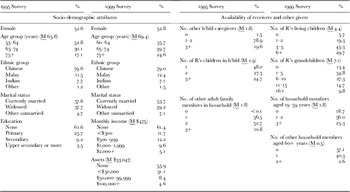
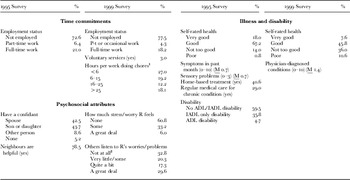
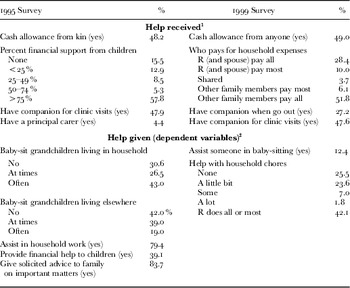
One-half of the 1995 sample was female (52.6%) and the great majority were Chinese (79.6%) (Table 1). The average age was 65.8 years. Over one-half were currently married (57.6%), and the majority had no formal education (61.6%). Most (86.2%) lived with their children; just 3.1 per cent lived alone. Potential receivers of help and potential givers besides R were almost always present in the household. Most respondents were not employed (72.6%) (Table 2). Almost all had a confidant (94.8%), and most considered their neighbours helpful (78.5%). Self-rated health was typically ‘good’ (67.2%), and the majority had no recent symptoms (63.4%; mean 0.70) or sensory problems (66.7%; mean 0.65). Home-based treatments (40.6%) were more common than regular medical care for chronic conditions (29.0%). Few seniors had any ADL disability (4.7%); one-third had an IADL disability (35.8%). For receiving help, one-half (48.2%) received cash from relatives, and the majority (57.8%) said that over 75 per cent of their income came from children (Table 3). One-half (47.9%) had a companion for clinic visits, but few (4.4%) had a designated carer. For giving help, the majority of seniors baby-sat for their co-resident grandchildren (often, 43.0%; at times, 26.5%) or for grandchildren living elsewhere (often, 19.0%; at times, 39.0%). The great majority assisted in household work (79.4%) and gave solicited advice about family matters (83.7%). One-third (39.1%) provided financial assistance to their children.
Socio-demographic characteristics and availability of help receivers and givers, Singaporeans aged 55+ (1995) and 60+ (1999)

Notes: Percentages and means are for the whole sample, except 1995 dependent variables and availability predictors (see text). Percentage distributions (sum 100.0) are shown except dichotomous items (% yes) and means (M). Monetary values in Singapore dollars. h'hld: household.
Sources: National Survey of Senior Citizens in Singapore of 1995 (N=4,750) and 1999 second survey (N=1,977).
Time commitments, illness and disability, and psychosocial attributes, Singaporeans aged 55+ years (1995) and 60+ years (1999)

Notes and Sources: As for Table 1. 1. Used only with baby-sitting dependent variable. 2. Or keep to myself.
Help received and given, Singaporeans aged 55+ years (1995) and 60+ years (1999)

Notes and Sources: As for Table 1. 1. Questionnaire wordings for receive help items are in an endnote. 2. Questionnaire wordings for give help items are in the text.
Just over one-half of the 1999 respondents were female (52.8%) and the great majority were Chinese (79.0%) (Table 1). The average age was 69.4 years. One-half of the respondents were currently married (53.7%). The majority had no monthly income (61.4%) or assets (55.9%). The majority (76.1%) lived with their children; just 6.7 per cent lived alone. Most households had available receivers and other possible givers. Most respondents were not employed (77.5%), and few (3.0%) did voluntary work (Table 2). One-third (30.3%) spent 16+ hours per week on household chores. The majority did not feel stress or worries (60.8%). One-third did not confide worries to anyone (32.8%), yet one-third said they confided a great deal (29.6%). Half rated their health ‘good’ (45.8%), and physician-diagnosed conditions were few (mean 1.4). For receiving help, half the seniors received cash regularly from others (49.0%), and the majority said someone else paid for all or most household expenses (57.9%) (Table 3). About one-half (47.6%) of the seniors had a companion for clinic visits, and one-quarter (27.2%) for away-from-home tasks. For giving help, few seniors assisted someone else during baby-sitting (12.4%), but the majority helped with household chores (74.5%).
Hypotheses
The central hypothesis is that those older people who receive more family help also give more help to their family, which reflects the power of reciprocity in social exchanges, even in later life when receiving plenty of help is normative or needed. For secondary hypotheses, we expect that women give more home-based help than men but less advice and financial help. The oldest seniors give less help of all kinds than younger seniors. The currently married give more help of all kinds. Those with higher education, income and assets give more financial resources and advice but help with fewer household tasks. A greater number of potential receivers increases opportunities and motivation to seniors to give help. A greater number of potential givers reduces their need and motivation to help. Other time commitments reduce a senior's ability to do household tasks. Being in paid employment does not increase financial support to the household. Social support enhances the motivation to give help, while stress reduces it. Illness/disability strongly reduces a senior's ability to help others. There are likely to be ethnic group differences in giving and receiving help (but no hypothesis was formulated).
Procedures
We applied two weighting procedures in the analysis. To adjust for the initial over-sampling of those aged 75 or more years, both datasets were weighted to restore the census age distribution. To adjust for 1999 non-response (selectivity relative to the 1995 sample), regression-based weights were applied to the 1999 data (conditional mean imputation; Allison Reference Allison2002).Footnote 5 The correlation matrix among the predictors in each survey year showed no multi-colinearity (no correlations exceeded 0.6). The links between receiving help (X) and giving help (Y) items were initially evaluated with bivariate regressions, and then with staged multivariate logistic regressions. The models to predict giving help were estimated with socio-demographic, availability, time commitments, psychosocial, illness/disability and received-help predictors, which were entered in that sequence. All variables were retained from their first entry to the final model; no stepwise deletion occurred for non-significant effects. Regressions were estimated by the SAS Logistic procedure (logistic regression for binary Y's, cumulative logistic for ordinal ones) (SAS Institute 1999). We report predictor effects of the full multivariate models (stated as odds ratios, OR) and pseudo R-squared of full models (R L2 in Menard Reference Menard2002).
Results
Bivariate ties between receiving and giving help
Twenty-four of the 28 (86%) bivariate ties between receive help (X) and give help (Y) were statistically significant. Among these, one-third (38%, 9 of 24) were positive, indicating that the more financial support seniors received, the more baby-sitting and household work they gave, and that the seniors who received cash support from kin were more likely to provide some financial assistance to co-resident children. But the majority of the effects (62%, 15 of 24) were negative, indicating that seniors with a companion for away-from-home activities provided less baby-sitting and chores, and were less likely to give money and advice to family. Seniors who received more financial help from family/kin were less likely to give advice.Footnote 6 In sum, the bivariate results showed that many of those who received more gave less in return. Yet if the reciprocity hypothesis is right, the underlying tie between receiving and giving should be positive. This positive relationship should appear more strongly in multivariate models, when other predictors of giving, such as illness and disability, are statistically controlled.
Multivariate analyses
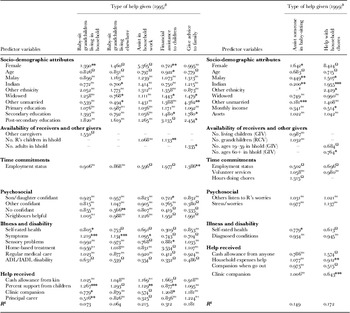
The statistically significant results from the full or multivariate models support our hypotheses with few exceptions (Table 4). Beginning with socio-demographic variations, women were much more likely than men to do baby-sitting and household chores (ORs ranged from 1.39 to 8.42), but they were less likely to give financial help to co-resident children (OR 0.72). With greater age, help of all types decreased (OR 0.68–0.92). Widowed and unmarried seniors were asked for advice more often than married ones (OR 1.48–4.36), but tended to do less baby-sitting (OR 0.18–0.77). Ethnicity had few significant effects, and they were inconsistent (that is, an ethnic group gave more of one type of help but less of another). Seniors with secondary or higher education gave more financial assistance and advice to their family (OR 1.48–2.45). Primary-schooled and non-schooled seniors were similar to each other for giving help. Income and assets had no significant effects on giving help.
Predictors of giving help, Singaporeans aged 55+ years (1995) and 60+ years (1999)Footnote 1

Notes and Sources: As for Table 1. 1. Odds ratios from full models are shown. – indicates that the variable is not applicable to model. Pseudo-R 2 is (D0 – DM)/D0, where D0 is the logistic goodness-of-fit for the intercept-only model, and DM is same for intercept+covariates model (R L2 in Menard Reference Menard2002). 2. Predictor reference group and other notes: gender (male), age groups (55–59, 60–64 … 90+ years; ordinal treated as integer), ethnic group (Chinese), marital status (currently married), education (none), availability items (integer; hhold means household, GIV means other givers, and RCV means receivers), employment status (ordinal), have confidant (spouse), neighbours helpful (no), self-rated health (ordinal treated as integer), symptoms (integer), sensory problems (integer), home-based treatment (no), medical care (no), ADL/IADL disability (ordinal treated as integer), cash support from kin (no), percent support from children (original treated as integer), clinic companion (no), principal carer (no). 3. Predictor reference group and other notes: gender (male), age (60–64 … 90+ years; ordinal treated as integer), ethnic group (Chinese), marital status (currently married), monthly income (integer), assets (integer), availability items (integer; see also note 2), employment status (ordinal), volunteer services (no), hours doing chores (ordinal response categories; used only with baby-sitters), volunteer services (no), listen to worries (ordinal), stress/worries (ordinal), self-rated health (ordinal), diagnosed conditions (integer), cash support from anyone (no), household expenses help (ordinal), companion when go out (no), clinic companion (no). 4. Other ethnicity cases (N=12) were dropped because none assisted with baby-sitting. hhld: household.
Significance levels: Ωp<0.0001, ***p<0.001, **p<0.01, *p<0.05, ns p⩾0.05.
The availability of receivers and other givers produced few significant effects, and the various measures inconsistently supported the hypotheses (the presence of other givers decreased the likelihood of providing help for one item, but increased it for another). As for the influence of time commitments, being in paid employment had strong effects, increasing financial assistance (OR 1.98) and advice (OR 1.39), and reducing home-based tasks (OR 0.50–0.70). Time spent on household chores was positively linked with baby-sitting (OR 1.32). We had hypothesised a negative link, but these tasks are easily done at the same time. Doing voluntary work had no significant effect on giving help.
The psychosocial measures produced significant effects. Seniors without a confidant were less likely to give financial help or advice to their household (OR 0.34–0.42) than those with a confidant. Seniors who felt that their neighbours were helpful provided more financial help and gave more advice to family (1.95–1.99). Stress and supportive listening from others had no significant effects on giving help. Turning to the illness and disability measures, the worse a respondent's self-rated health, the less likely they were to give any kind of help (0.31–0.80). Disability in personal care or household management tasks reduced all types of help (0.33–0.63). Seniors with more symptoms did more home-based tasks (OR 1.10–1.22), but gave less financial assistance and advice (0.70–0.74). Sensory problems had some negative effects on giving help (0.77–0.88). The other illness items (home-based treatment, regular medical care for chronic condition, number of physician-diagnosed conditions) had no significant effects.
The predictors of receiving help are the focus of the analysis, so we offer more detail. One-half (50%, 14 of 28) of the receive-help effects were statistically significant. Among these, about 43 per cent (6 of 14) were positive, congruent with the reciprocity hypothesis. The main positive results link financial support received with household services given: i.e. as the percentage of the respondent's income that came from their children increased, so did the seniors do more baby-sitting for grandchildren and more household work (OR 1.13–1.29). Furthermore, the seniors who regularly received cash support helped more with household chores (1.57). Besides these links, seniors who received cash support from kin, and those with a companion for clinic visits, were more likely to give financial help to their co-resident children (1.21–1.66). Significant negative effects (57%, 8 of 14) were contrary to the hypothesis. The main negative results link having a companion or carer with household services; those with either a companion for away-from-home activities or who had a principal carer did less baby-sitting and helped less with housework (0.32–0.78). Less marked negative effects were that as financial support from children living anywhere increased, seniors were less likely to provide money to co-resident children (0.88), and the more others paid for household expenses, the less seniors helped with household chores (0.91). Non-significant effects (14 of 28) occurred mainly for two dependent variables, give advice and assist with baby-sitting. Receiving help had no effect on giving advice or assisting someone else in baby-sitting.
The coefficients of explanation (R 2) for the full models ranged from 0.06 to 0.31. The highest was for providing financial assistance to children, and the lowest for the baby-sitting items. Across the staged models, the largest R 2 increments occurred when the illness/disability and socio-demographic predictors were entered. Illness/disability was most important, typically doubling the R 2 even though many variables had already been controlled. The increments at other stages were very small.
Discussion
Factors in older Singaporeans' giving-help to family members
The factors influencing receiving-help are the theoretical focus of this paper, but they were not the strongest empirical predictors for seniors' giving-help. We discuss first the strongest predictors, based on frequency and probability level of significant effects, and then discuss receiving-help effects.
Illness and disability greatly reduced the amount of help older persons gave to their family. The strongest impacts came from poor self-rated health, ADL/IADL disability (health-related difficulty in personal care and household management tasks), and having numerous recent symptoms. The pre-eminence of illness/disability was expected, and the explanation is straightforward: it is difficult for seniors with health and functional problems to offer services and financial resources to others.
Age and gender were next in importance. The oldest gave less help of all kinds than younger elderly people, probably because of lower energy levels and cultural norms. Older women performed more home-based services than older men, but the women gave less money to their children. Most older Singapore women in the current cohort either had no paid work or had low-wage jobs, so they have no personal financial resources. Older women and men equally provided advice. This may be because advice requires no role-based skills or financial resources.
Ranking next, socio-economic advantage (current employment and higher education) increased contributed finances and advice. Employment also signalled time commitments, and older people with a job did less housework. These results were expected, and they mirror the typical findings of previous studies (reviewed below). But higher monthly income and higher assets did not increase an older Singaporean's financial and advice help to their family. This actually makes sense for Singapore society, where income and assets are shared. Many older people received some income directly from children, and assets are often jointly held with children. Thus, an older person's income and assets are not clear signals of personal status or resources, and their amounts are not relevant for day-to-day services to family. Lastly, social support was an incentive for helping others. Older persons who declared social support from confidants or neighbours were more helpful to their own household. This suggests a nexus of goodwill that permeates their lives, moving across social zones of family, friends and neighbourhood. Singapore is a courteous society. In our own residence there, we have often experienced the general goodwill shown toward friends, co-workers and strangers.
Receiving-help ranked next in overall importance. There was only modest evidence that receiving help prompted seniors to give help in return. The most consistent positive result was that the more financial support seniors received, the more household services they gave. Thus, money and time are complements for reciprocity in contemporary Singaporean families. Secondly, the more financial support that seniors received from family, the more likely they were to give financial help to their family. Money flows are not unidirectional in Asian families, and a person often both receives and gives financial support. Cash received from a sibling may find its way into a cash gift to co-resident children. Thirdly, seniors who received companion help were more likely to give financial help to their family. This probably contributed to the wages of maid companions, or was used to thank family members for their time as companions. The negative links between receiving and giving largely involved different types of instrumental behaviours to those that were positively associated. The main finding was that seniors with a companion or carer gave fewer household services. The multivariate models had ample controls for illness/disability, so the result is probably not a result of insufficient controls for the poorer health of seniors that had companions or carers, but probably stems from the increasing employment of maids for senior care in Singapore. Maids both assist seniors and do household tasks.
Overall, comparing the multivariate and bivariate results, positive links between receiving help and giving help were only slightly more common in the multivariate (43%) than the bivariate (38%) models. The main difference between the multivariate and bivariate results was the lower significance of receive-help effects in the multivariate models (50% compared to 86% in the bivariate models). The direction of effects (positive or negative) seldom changed across the models. The fewer significant associations applied mainly to two dependent variables: give advice and assist with baby-sitting. Giving advice was common (83.7% of seniors), and it occurred regardless of receiving help. Assisting someone in baby-sitting was not common (12.4% of seniors; older people usually do it on their own), and also occurred regardless of receiving help.
Comparisons with other Asian and western studies
How do the results for Singapore compare with other research on older persons' giving and receiving in family relationships? For seniors' giving-help, previous Southeast and East Asian studies have shown that female gender, being married, co-residence with children, higher education, employment, greater economic resources, better health, lower disability, and more potential recipients usually associate with more giving (Agree et al. Reference Agree, Biddlecom, Chang and Perez2002; Biddlecom, Chayovan and Ofstedal Reference Biddlecom, Chayovan, Ofstedal and Hermalin2002; Frankenberg, Beard and Saputra Reference Frankenberg, Beard and Saputra1999; Frankenberg, Lillard and Willis Reference Frankenberg, Lillard and Willis2002; Lillard and Willis Reference Lillard and Willis1997). Predictors of seniors' receiving-help are often but not always the obverse (Biddlecom, Chayovan and Ofstedal Reference Biddlecom, Chayovan, Ofstedal and Hermalin2002; Frankenberg, Lillard and Willis Reference Frankenberg, Lillard and Willis2002; Lee, Parish and Willis Reference Lee, Parish and Willis1994; Lee and Xiao Reference Lee and Xiao1998; Lillard and Willis Reference Lillard and Willis1997; Ofstedal, Knodel and Chayovan Reference Ofstedal, Knodel and Chayovan1999).Footnote 7 Western studies generally find that, younger age, higher education, higher income and more assets, better health, and less disability associate with more giving-help by seniors, and the obverse for their receiving help (Boerner and Reinhardt Reference Boerner and Reinhardt2003; Couch, Daly and Wolf Reference Couch, Daly and Wolf1999; Grundy Reference Grundy2005; Henretta, Grundy and Harris Reference Henretta, Grundy and Harris2002; Hogan, Eggebeen and Clogg Reference Hogan, Eggebeen and Clogg1993; Künemund and Rein Reference Künemund and Rein1999; MacDonald and Koh Reference MacDonald and Koh2003; Schoeni Reference Schoeni1997; Silverstein et al. Reference Silverstein, Conroy, Wang, Giarrusso and Bengtson2002; van Tilburg and Broese van Groenou Reference Van Tilburg and Broese van Groenou2002).Footnote 8 In sum, the predictors that Singaporean seniors' give help concur with other Asian and western studies, except for the absence of income and assets effects.
What about reciprocity? Asian and western studies that consider reciprocity show positive links between seniors' receiving and giving help and support (Boerner and Reinhardt Reference Boerner and Reinhardt2003; Grundy Reference Grundy2005; Künemund and Rein Reference Künemund and Rein1999; Lee, Parish and Willis Reference Lee, Parish and Willis1994; Lee and Xiao Reference Lee and Xiao1998; Liang, Krause and Bennett Reference Liang, Krause and Bennett2001; Lillard and Willis Reference Lillard and Willis1997; Litwin Reference Litwin1998; Stoller, Reference Stoller1985; van Tilburg and Broese van Groenou Reference Van Tilburg and Broese van Groenou2002). An association between older persons' receiving money and giving time has been found in several studies (Frankenberg, Lillard and Willis Reference Frankenberg, Lillard and Willis2002; Grundy Reference Grundy2005; Lee, Parish and Willis Reference Lee, Parish and Willis1994; Lee and Xiao Reference Lee and Xiao1998; Lillard and Willis Reference Lillard and Willis1997). Our analysis demonstrates reciprocity in intergenerational ties in Singapore, especially in giving money and devoting time.
Reasons for modest reciprocity
Why are links between receiving and giving help not as strong in Singapore as implied by the norm of reciprocity? We consider both theoretical and societal explanations. From a theoretical stance, the reciprocity hypothesis hinges on instrumental behaviours, but receiving and giving also involve affective exchanges (Lin Reference Lin, Lin, Dean and Ensel1986; Mangen, Bengtson and Landry Reference Mangen, Bengtson and Landry1988). Examples of affective gestures received in everyday relationships are feeling loved or respected, being tolerated when angry or slow, patience from companions, being thanked for helping, and freedom to express fears and worries. These are often classed as social support, but can be viewed as received-help in social exchange. (From this perspective, the psychosocial items about confidants, neighbours and listening indicate affective receipt; two were positively tied to instrumental giving.) Examples of affective gestures given in everyday life are praising someone's success, listening sympathetically, smiling at someone, saying ‘thank you’, and informal conversation with family members. These ways of giving require attentiveness but little physical effort and no financial resources. Few datasets have included affective transfers (Boerner and Reinhardt Reference Boerner and Reinhardt2003; Hogan, Eggebeen and Clogg Reference Hogan, Eggebeen and Clogg1993; Silverstein et al. Reference Silverstein, Conroy, Wang, Giarrusso and Bengtson2002, Silverstein, Cong and Li Reference Silverstein, Cong and Li2006).
Even the instrumental behaviours are limited in the Singapore datasets. Other services that adults often give to their family/household members are: shopping for food and household goods, accompanying children to school or play, teaching children or helping them with hobbies, caring for chronically ill or disabled family members, helping at times of emergency, filling out forms or organising payments, sewing and mending, and doing household repairs. Several studies have included such instrumental behaviours (Grundy Reference Grundy2005; Hogan, Eggebeen and Clogg Reference Hogan, Eggebeen and Clogg1993; Künemund and Rein Reference Künemund and Rein1999; Silverstein et al. Reference Silverstein, Conroy, Wang, Giarrusso and Bengtson2002).
It should be more widely recognised that some instrumental behaviours are culture-specific. They can include important responsibilities and roles for an older person, so it is important that they are collected by surveys. In Singapore, seniors often plan annual cultural events (e.g. the Lunar New Year, Hari Raya Puasa, Deepavali), supervise maids, and house-mind when others are out (Mehta Reference Mehta1997b; Teo and Mehta Reference Teo and Mehta2001). Lastly, people's perceptions of what they are giving and receiving influence how they manage reciprocity in social ties. The Singapore surveys tapped only behaviour, not the perceptions, attitudes and wishes that underlie them, as is typical of intergenerational-transfer datasets. Taken together, these features (limited instrumental behaviours, no or few affective behaviours, no perceptions) reflect a degree of theoretical blindness, and they translate into a limited scope of analysis. How can we adequately test the reciprocity hypothesis with just a restricted set of measures of instrumental behaviour?
From a societal perspective, expectations about late life are changing in Asian countries. The latest cohorts of young adults differ greatly from their predecessors in their views. In Singapore, older people – especially the very oldest – hold the traditional expectation that their children will support and house them. Some recognise that their children have many commitments, and worry about being a burden (Verbrugge, Mehta and Wagenfeld-Heintz Reference Verbrugge, Mehta and Wagenfeld-Heintz2006). Midlife adults are caught up in a busy society with intense pressures for personal and children's success. They feel they should help their parents, but say they do not want such help in their own late life (Mehta Reference Mehta1997a, Reference Mehta1999; Mehta, Osman and Lee Reference Mehta, Osman and Lee1995). They say they have frequent conversations and special outings with their parents, but have no time for daily care or contacts. Young adults espouse family values but have adopted western individualism and goals (Teo Reference Teo2005; Thomas Reference Thomas1990). In this setting, traditional everyday exchanges across age groups are not as predictable as decades ago. Some older Singaporeans are conscious of unexpected freedom, and are pleased to live on their own with scheduled visits from their children, but others feel deeply abandoned when their children do not provide housing, give meagre funds and seldom visit.
The speed of Singapore's transformation to a modern economy has been astonishing – it has changed in just four decades from a nation of shanty towns, floods, traffic congestion and water pollution to one of high-rise housing, excellent drainage, a rapid-transit system, well-maintained highways, and high standards of sanitation. Social goals, mores and behaviour have also changed quickly, so that young and midlife adults' attitudes and plans about late life differ from today's older adults'. The oldest Singaporeans have long-held expectations of family support and little incentive to change them. Many have no formal education, no pension funds, and no skills for modern jobs. The Singapore government's policy for elder care is ‘Family First’. National programmes of income, housing and medical support for seniors have tight restrictions and low support levels (Hateley and Tan Reference Hateley and Tan2003; Mehta Reference Mehta, Phillips and Chan2002; Phua and Yap Reference Phua and Yap1998; Tay Reference Tay2003). There are few nursing homes and there is no intermediate-care housing, and non-governmental organisations provide transport, social support and counselling assistance to older people and their families, but their resources are strained. Thus, older people whose children step back from support have few other sources of help. Older Singaporeans are the ‘left-behind generation’. In this difficult situation, their greatest and often sole resource is psychological stamina (Verbrugge, Mehta and Wagenfeld-Heintz Reference Verbrugge, Mehta and Wagenfeld-Heintz2006).
Summing up, we believe that the main reason why the analysis has found only modest support for the reciprocity hypothesis is the rapid pace of social change. Family reciprocity exists in transactions that suit contemporary Singapore life. The principal exchange is seniors' time in return for financial support from their children. The second is the to-and-fro of money exchanges within the family; these are customary on special occasions and express affection, not just need. The third is financial contributions by seniors who have regular companionship when going out; the contributions help to pay maid-companion wages. Contemporary Singapore society also explains why reciprocity was not found for certain links. Maids provide senior care, household chores and baby-sitting for families of many economic strata, which has lessened the opportunities for seniors to repay care by household services.
Past, present and future
The presented cross-sectional analyses cannot prove that family reciprocity was stronger in past decades, or that it has weakened with Singapore's modernisation. Whether reciprocity between all who receive and give the items mentioned in the analysis were positive four decades ago when Singapore became a nation state, or a century ago when it was a British colony, cannot be known. Nor can we safely predict what reciprocity will look like several decades hence. What our results do show, however, is a configuration of family reciprocity that suits modern Singapore. ‘Time for money’ fits the contemporary situation in which older people have time but low socioeconomic resources, and those in midlife have material resources but severe time pressures.
Still, it is theoretically lame simply to say we know nothing about the past or future. When the pace of social change is slow, age groups can readily maintain shared expectations and behaviours about family support of older people. By contrast, rapid modernisation causes asymmetry in norms of family reciprocity across age groups. Feelings of filial piety erode, or they persist but find different behavioural expressions. As the co-residence of older parents with their children has decreased, and as young adults' emigration has increased and more women have been in formal employment for many years, affective exchanges between parents and adult children have increased to replace or supplement instrumental exchanges. Phone calls, holiday visits, special outings and gifts have become key ways by which children show that they care about their parents. Such changes occur in both urban and rural areas. These hypotheses were presaged in Matilda White Riley's work on individual ageing and social change (Dannefer et al. Reference Dannefer, Uhlenberg, Foner and Abeles2005; Riley Reference Riley1987; Riley, Foner and Waring Reference Riley, Foner, Waring and Smelser1988). Riley discussed how asynchrony occurs as different cohorts become older and encounter unexpected opportunities and restrictions, relative to their upbringing and plans. In Singapore, such asynchrony happened quickly, and was propelled by very swift modernisation.
The contemporary evidence is that intergenerational transfers are not evaporating in Southeast and East Asian societies, but are changing their behavioural shape (Akiyama, Antonucci and Campbell Reference Akiyama, Antonucci, Campbell and Sokolovsky1997; Cheng and Chan Reference Cheng and Chan2006; Hermalin Reference Hermalin and Hermalin2002; Ingersoll-Dayton and Saengtienchai Reference Ingersoll-Dayton and Saengtienchai1999; Knodel Reference Knodel1992, Reference Knodel1995; Martin Reference Martin1990; Mason Reference Mason1992; Ngin and DaVanzo Reference Ngin and DaVanzo1999; Wong and Chau Reference Wong and Chau2006). ‘Caring for’ may be shifting to ‘caring about’. Indeed, the shape of intergenerational ties may alter decade by decade as new cohorts enter midlife and older cohorts die. Asian societies offer a fine research opportunity to watch both the emergence of disparities in norms across age groups and the adjustments that maintain family wellbeing. Surveys worldwide have emphasised instrumental transfers of finances, co-residence and household tasks, but affective giving and receiving may be just as important. Reciprocity is an enduring principle in human society, making its way through social life in many seen and unseen ways. Future surveys that tap people's offers of kindness and love, as well as of resources and tasks, will provide a better map of the routes of reciprocal social exchange.
Acknowledgments
Dr Verbrugge was supported by a Distinguished Switzer Research Fellowship from the United States National Institute on Disability and Rehabilitation Research (2005–2006), as Visiting Professor at the Asia Research Institute, National University of Singapore (2004–2005), and as Senior Meyer Fellow at the Department of Sociology, National University of Singapore (2001). Dr Chan was supported by a grant from the US National Institute on Aging (R01 AG20072). The authors thank Zhengyi Wang for providing research assistance. Earlier versions of the paper were presented at a meeting of the International Network on Health Expectancy (REVES) (April 2002, Hammamet, Tunisia), at the International Federation on Ageing 6th Global Conference (October 2002, Perth, Australia), and the annual meeting of the Gerontological Society of America (November 2002, Boston, Massachusetts). This paper is given as a tribute to elderly Singaporeans that we met who are living with astonishing personal stamina in poverty and loneliness in their rapidly changing society.