Implications
Prolactin (PRL) role is critically important for the initiation of lactation in periparturient period in several species including cattle (Niswinder, Reference Niswinder1974; Forsyth et al., Reference Forsyth, Byatt and Iley1985; Johke, Reference Johke1986). Indeed in cattle, lactogenesis is the only function of PRL, clearly established by surge in secretion of PRL several hours before parturition (Johke, Reference Johke1986). Blockade of this surge with bromocryptine markedly reduced subsequent milk yield, and exogenous PRL reversed this effect of bromocryptine. The requirement of PRL differs in different species. In rats, suppression of secretion of PRL with bromocryptine suppressed secretion of milk; conversely, administration of PRL increased the secretion of milk in rats during early lactation. But in cattle and buffaloes PRL suppression did not limit the secretion of milk and supplemental PRL has no effect on milk yield (Saha and Singh, Reference Saha and Singh1998). Furthermore, bromocryptine and cold temperatures markedly reduce the secretion of PRL without suppressing the milk yield in cows (Pal, Reference Pal1996). Curiously, application of milking stimulus to the teats of cows acutely released PRL during early lactation, but as lactation progress release of PRL also declines. In addition to this, increasing daily light from 8 to 16 h/day in cattle increased several fold concentrations of PRL and also increased the milk yield from 6% to 10% (Marcek and Swanson, Reference Marcek and Swanson1984). More recent studies hypothesize that growth hormone (GH) and insulin like growth factor-I (IGF-I) could be a major player in onset of lactation in cattle in absence of PRL (Flint and Knight, Reference Flint and Knight1997).
In this study, it was hypothesized that the requirement of different hormones could be integrated by blocking the bromocryptine and measuring the hormonal levels (GH, PRL and IGF-I) for the endocrine control of milk synthesis and secretion at parturition in buffaloes, which differ from cattle in terms of milk secretion and milking temperament (Singh and Ludri, Reference Singh and Ludri1994; Singh et al., Reference Singh, Dang and Aggarwal2002). We suppressed PRL hormone, which is required for lactogenesis and determined its effect on milk production after parturition. The inhibition of PRL by bromocryptine treatment delayed lactogenesis and increased GH level indicating thereby that it has a role in milk synthesis at parturition in conjunction with GH. Further, IGF-I role as an independent hormone in milk secretion in absence of PRL (inhibition) was not found, although both GH and IGF-I acts synergistically with PRL hormone. The role of GH as a galactopoietic hormone is well established in buffaloes (Ludri et al., Reference Ludri, Upadhyay, Singh, Guneratne and Basson1989; Singh and Ludri, Reference Singh and Ludri1994), however, this study confirm that GH and PRL are required for normal milk secretion in buffaloes. Further studies are required to be carried out to explore the mode of action of GH on mammary gland in absence of plasma PRL. The information generated will be useful in manipulating PRL and GH levels to augment milk secretion in buffaloes in tropical climatic conditions.
Introduction
Bromocryptine, is an ergo line derivative dopamine agonist that is used in the treatment of many diseases. Bromocryptine also has been used to determine the role of prolactin (PRL) in milk synthesis in ruminants (Niswinder, Reference Niswinder1974; Forsyth et al., Reference Forsyth, Byatt and Iley1985; Johke, Reference Johke1986; Pal, Reference Pal1996). A single injection of bromocryptine is effective to lower the PRL level for a number of days in cattle and buffaloes, but in goat its effect is short-term and daily administration of bromocryptine is required (Hart, Reference Hart1973; Lee and Forsyth, Reference Lee and Forsyth1987; Singh and Ludri, Reference Singh and Ludri1999). Bromocryptine administration during established lactation significantly decreases the plasma PRL level without affecting the milk production and composition because of the saturation of receptors at low-PRL concentration (Saha and Singh, Reference Saha and Singh1998). PRL does not act in isolation and interact with GH and thus an interaction of both the hormone is important in milk secretion (Flint and Knight, Reference Flint and Knight1997). Endogenous bovine GH augments lactogenic properties of PRL and cortisol and substitute for PRL (Flint et al., Reference Flint, Tonner, Beathie and Panton1992). GH may mediate its action through PRL receptors due to intrinsic PRL like activity (Accorsi et al., Reference Accorsi, Pacioni, Pezzi, Forni, Flint and Seren2002), however, definite role of bovine GH in lactogenesis is yet to be established. Keeping in view of available literature and lack of information in buffaloes this experiment was carried out with the objective to determine the effect of bromocryptine on plasma GH, PRL and IGF-I hormone, blood metabolites (glucose and non-esterified fatty acid (NEFA)) and their role on milk secretion and composition, if any in Murrah buffaloes.
Material and methods
Management of animals and experimental treatment
Healthy (10) advance pregnant Murrah buffaloes in third parity having an average of age 7.5 years were selected 5 days before expected calving from the Institute herd. All the buffaloes were kept in an open loose housing system with brick floor. Buffaloes received ad lib green fodder-berseem (Trifolium alexandrium) and concentrate mixture (@ 2 kg/animal per day) as per routine management practices till parturition occurred. After parturition, concentrate mixture was offered based on milk yield of animals, whereas water was available ad lib all the time. Buffaloes were hand milked twice a day at 6.00 am and 6.00 pm and milk yield was recorded. Buffaloes were divided into two groups of 10 each. Group-I (control) animals were injected normal saline, whereas experimental (group-II) buffaloes were injected bromocryptine (2-Bromo-α-ergocryptine methanesulfonate salt; B-2134) intramuscularly, @ 100 μg/kg BW, 5 days before expected calving.
Collection and analysis of samples
Jugular blood samples were collected from individual buffaloes at 8.00 am for five consecutive days before parturition (days −5, −4, −3, −2, −1) and on day of parturition (day 0) in heparinized tubes. Post partum blood and milk samples were collected on days 1, 2, 3, 4, 5, 10 and 15. In fresh milk, fat (Milko-tester REMI), protein (Singhal and Desraj, Reference Singhal and Desraj1989), lactose (Perry and Doon, Reference Perry and Doon1950), NEFAs (Shipe et al., Reference Shipe, Senyk and Fountain1980) and citric acid (White and Davies, Reference White and Davies1963) were estimated using standard methods. Blood glucose was estimated by a Kit (M/S Span Diagnostics Ltd). Plasma GH, PRL and IGF-I was measured by double antibody radioimmunoassay procedures (Singh and Ludri, Reference Singh and Ludri2000; Singh et al., Reference Singh, Dang and Aggarwal2002). Inter-assay and intra-assay coefficient of variation for GH, PRL and IGF-I hormone was 12.3% and 8.85%, 11.30% and 9.85%, 13.54% and 9.98%, respectively. The sensitivity of GH, PRL and IGF-I assays was 20, 10 and 30 pg/tube, respectively. Statistical analysis of data were carried out using least square analysis (three-way ANOVA) with interaction (Snedecor and Cochran, Reference Snedecor and Cochran1980). The mean values of each parameter for the treatment and control group were compared for the phase-I (before parturition) and phase II (after parturition). Least square means were also compared between the groups for each parameter. Mean values were also tested using Duncan’s multiple range test for significant difference. Correlations among the various parameters of milk composition, hormones, metabolites and somatic cell counts (SCCs) were found out.
Results
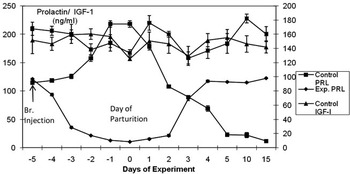
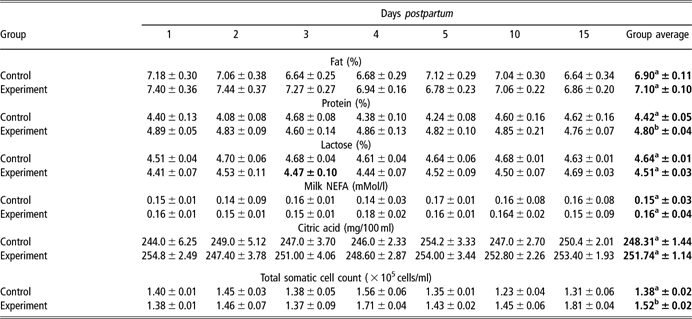
Mean GH concentration varied (P < 0.01) between the groups and was higher (P < 0.01) in experimental buffaloes in comparison to control before and after parturition. GH level was highest on day of parturition, declined on day 1, 2, 3 and 4 post partum and thereafter increased. But in control group, GH level fluctuated non-significantly before and after parturition (Figure 1). Plasma GH, PRL (P < 0.01) and IGF-I (P < 0.05) varied between days before and after parturition, however, between animal variation was non-significant. Bromocryptine suppressed the PRL level (P < 0.01) to minimum value (10.65 ± 0.29 ng/ml) on day of parturition, which increased steadily from day 3 to 15 post partum. But in control group, pre partum PRL level increased from day -3, attained peak concentration (218.48 ± 5.71 ng/ml) on day of parturition and thereafter declined (Figure 2). Plasma IGF-I was higher in treated buffaloes (P < 0.01) after parturition; however, it varied non-significantly between group before parturition (Figure 2). IGF-I levels were neither correlated to milk yield nor to plasma GH and PRL hormone. Milk and plasma NEFA, blood glucose, fat, lactose and citric acid content varied non-significantly between the groups (Tables 1 and 2), however, milk protein and SCC varied (P < 0.01). Milk yield was significantly (P < 0.01) less in experimental buffaloes (26.97%) after parturition, increased steadily and was non-significant in both the groups on day 15 postpartum. The increase in milk yield was concomitant to rise in GH and PRL level. Milk SCC was positively correlated (P < 0.01) with GH and PRL, whereas the milk yield was positively correlated (P < 0.01; r = 0.501) with lactose and negatively with fat (P < 0.05; r = −0.245). GH was negatively correlated with PRL (−0.291, P < 0.05) hormone.
Milk yield and growth hormone (GH) levels in buffaloes administered with bromocryptine (Br.) before partition.

Plasma prolactin (PRL) and insulin like growth factor-I (IGF-I) changes in Murrah buffaloes administered with bromocryptine (Br.) before parturition.

Least square mean (±s.e.) of yield and composition of milk of bromocryptine-treated Murrah buffaloes
NEFA = non-esterified fatty acid.
Values with different superscripts a, b differ (P < 0.05).
Bold values show the overall group change if any.
Least square mean (±s.e.) values of blood metabolites in Murrah buffaloes administered bromocryptine before parturition

NEFA = non-esterified fatty acid.
0 = day of parturition; * day of bromocryptine injection.
Discussion
In this study, increased periparturient GH levels and decreased milk synthesis was due to inhibition of PRL hormone by bromocyptine. However, effect of treatment on milk yield was short-term and varied between 3 and 5 days postpartum in different buffaloes. The rise in prepartum GH level was due to inhibited PRL level and suggests a role of GH in mammary glasnd development and milk secretion (Glimm et al., Reference Glimm, Baracos and Kennelly1990; Singh and Ludri, Reference Singh and Ludri1994; Flint and Knight, Reference Flint and Knight1997). This fact was evident from slow recovery of milk yield concomitant to rise in postpartum PRL and GH level in treated buffaloes. A positive correlation of GH and PRL with milk yield observed in this study indicated role of both the hormones in milk secretion. PRL does not act in isolation and interact with GH (Flint and Knight, Reference Flint and Knight1997). GH effects are mediated by IGF-I because of lack of receptors for GH on secretory epithelial cells of mammary tissue (Akers, Reference Akers1985; Bauman, Reference Bauman1992). But in this study IGF-I level did not exhibited a set pattern of change in relation to circulatory GH level and milk yield. The comparable information on this aspect is lacking. Administration of bromocryptine during established lactation did not influence milk yield and composition in buffaloes (Saha and Singh, Reference Saha and Singh1998) but treatment decreased milk yield and alter milk composition in goats (Singh and Ludri, Reference Singh and Ludri1999). The increase in protein content in experimental buffaloes was due to initial higher protein values in comparison to control. Further, no adverse effect of treatment was found on health of buffaloes and neonate calf (Schams et al., Reference Schams, Reinhardt and Karg1972; Johke, Reference Johke1986; Lee and Forsyth, Reference Lee and Forsyth1987). The non-significant changes in blood glucose and NEFA level indicated balanced feeding of buffaloes and non-mobilization of body reserves (Singh and Ludri, Reference Singh and Ludri1999). The increased SCC of milk in treated buffaloes was due to low milk yield and various factors affecting SCC (Shailja and Singh, Reference Shailja and Singh2002; Singh and Ludri, Reference Singh and Ludri2001).
Conclusion
It was showed that prepartum suppression of PRL by bromocryptine impairs the milk secretion and affects the milk composition temporarily after parturition. Both GH and PRL are crucial for milk secretion and restoring the milk yield. IGF-I level fluctuates and did not play a role in milk secretion.
Acknowledgements
The authors would like to thank the Director, National Dairy Research institute, Karnal for providing necessary facilities to conduct the experiment. We are also thankful to the National Hormone and Pituitary Development Program for the gratis of GH, Prolactin and IGF-I hormone and their antiserum used in Radioimmunoassay procedures. The cooperation of the staff in lactation physiology laboratory is duly acknowledged.