Between 1870 and 1945 some three dozen widows from the Tyne port of South Shields applied for and received naturalization as British subjects—most of them during the First World War. What distinguished these three dozen women from the nearly eight hundred local men naturalized in the same period? With only two exceptions, the women had all been born and raised in Britain, most within a few miles of the town they lived in. Between 1870 and 1948 countless British women forfeited their nationality through marriage to foreign nationals, yet only a fraction ever retrieved it.Footnote 1 In the same years thousands of foreign-born men acquired British nationality, many of them with only tenuous claims to reside anywhere in Britain.Footnote 2 The predicament of the alien widows exposes the gendered exclusions and amputations inherent in ongoing processes of state formation and nation building; the disruptive effects of total war on the transnational networks and relationships sustaining custom and culture in working class Tyneside; and the discrepancies and collusions between local and national definitions of belonging.
Scholars generally link nationality to objective bases such as “some prior unity of territory, language, or culture,” history or religion, or “shared identity and consciousness.”Footnote 3 One has interpreted the contrasting codification of nationality and citizenship in fin de siècle France and Germany as manifestations of culturally embedded understandings of national identity. Expressed through immigration and naturalization law, French territorial nationality, or jus soli, has been traced to the revolutionary construction of citizenship, solidified during the Third Republic. Germany, in contrast, recodified nationality in 1913 as a “community of descent,” jus sanguinis, to which immigrants could never gain access.Footnote 4 British nationality historically incorporated both, so that birth on British soil regardless of parentage as well as birth abroad to British parents conferred British nationality.Footnote 5 A parliamentary commission reported in 1870 that “we hold everyone born … within Her Majesty's dominions, to be a natural-born subject, no matter who his parents were”; this applied as well to “the child of every British father.”Footnote 6 The British Nationality and Status of Aliens Act in 1914 reaffirmed this, defining as a British subject “a person, or a descendant in the male line of a person, ‘born within His Majesty's dominions and allegiance.’”Footnote 7
In the same years, states simultaneously redefined national identities through the creation of internal as well as external enemies—Reichsfeinde, or enemies of the state, in Bismarck's resonant term. All such interpretations assume that states legitimately determine who is a citizen through top-down processes whose relationship with “culture” remains unclear but implicitly consensual, static, essentialized.Footnote 8 Other scholars stress how individuals purposefully shaped national cultures, implying the corresponding fluidity of national identity itself.Footnote 9 Like any hegemonic process, nation building thus appears never complete but continually contested and unstable, in need of repeated and ongoing renewal and extension, in part through ongoing redefinitions of “national identity.”Footnote 10 As we will examine in detail here, rather than a unilateral imposition, British national identity has remained subject to input and destabilization by local societies, whose commitment to state definitions of national identity may be ambivalent at best.Footnote 11
Further, purportedly universal conceptions of the nation as an organic and objective collectivity constructed by history and religion, language and custom, or such “qualifying conditions” as jus soli or jus sanguinis, cannot account for the strange predicament of the alien widows. In any of these terms, a British-born woman living in Britain should bear British nationality.Footnote 12 For explanations we must therefore consider women's anomalous relations with states and nation-building projects.
Scholars agree that such relationships have proven deeply problematic. Understanding the nation as an organic community, a family that women reproduce, has rendered “membership in the nation … highly gendered,” subject to a “complex repertoire of silencings and disabilities.”Footnote 13 Women's sexuality and reproduction accordingly became critical sites of coercion in nation-building and empire-building projects, especially in the course of the nineteenth century.Footnote 14 By its end, reasons of state submerged individual rights for women and men alike. Women's duty to give birth, populating the state and providing ready cannon fodder, corresponded to men's duty to bear arms, yet women who discharged this duty could not thereby earn citizenship.Footnote 15 Coverture implied that married women's “obligations to their husbands and families” took precedence over relations with states.Footnote 16 Endogamy, or marriage within the prescribed group, thus loomed large, constraining women's choices about marriage and sexual expression in often painful and violent ways.Footnote 17 Building the nation, we are coming to understand, thus entailed processes of marginalization, exclusion, surveillance, and silencing along multiple social axes: not only origin or race, but also gender, sexuality, and class.Footnote 18
In this scholarship the voices of nationalist elites and other hegemonic actors have been well attended to. The extent to which nationalist agendas actually reflected or succeeded in influencing popular attitudes and practices, customs or culture, remains less well explored, and open to debate.Footnote 19 In particular, the choices and penalties of marital and sexual exogamy have been little investigated, and women's voices remain virtually unheard.Footnote 20
While extant scholarship has documented policy formation and corresponding national and international campaigns for women's parity, the stories and choices of South Shields's alien widows, and the responses of their neighbors and kin as well as local and central governments, offer us a rare view, “from the bottom up,” of the local impact of ongoing redefinitions of the nation.Footnote 21 They illustrate how state-driven distinctions between insiders and outsiders intersected with and profoundly altered individual lives. These stories also reveal discrepancies between local cultural practices and the assumptions and agendas informing national policy, while showing how ordinary women mobilized to combat their dispossession.
Paradoxically, the researcher gains access to local experience through the records of the same increasingly invasive central government. The British Home Office, charged with policing the boundaries of the nation, compiled detailed information on thousands of naturalization applicants. This involved, by the twentieth century, a standardized application form, or “memorial,” containing the applicant's name, British address, occupation, age, birthplace, nationality, the nationality of the applicant's parents, and often other personal information. In addition each applicant had to furnish sworn references from native-born Britons and submit to an investigation by local police on behalf of the municipality. While application forms themselves became increasingly perfunctory, thus less informative, by the early twentieth century, police investigations had become commensurately exhaustive at the behest of the Home Office. Thus membership in the British nation became negotiated among the national state, the individual seeking British nationality, local native-born Britons, and the police representing the local government.
These records reflect how intensified nation building across Europe in the late nineteenth century crosscut long-standing cultural patterns and practices of population mobility.Footnote 22 Nation building in modern Europe involved the continuous discursive and dialectical translation of ephemeral forms of nationalism such as jingoism and xenophobia into material practices. By the end of the nineteenth century these converged in legal and institutional policies designed to control migration and define nationality. Nominally liberal access for migrants that had prevailed in post-Napoleonic Britain, for example, gradually succumbed to a growing climate of specifically anti-Semitic xenophobia associated with a “drastic loss of imperial confidence.” Denounced as the betrayal of Britain's liberal tradition, legislation in 1905 restricting migration on the basis of nationality parallelled protectionist measures aimed at Britain's industrial and maritime rivals.Footnote 23
These legal technicalities appear to have been lost on the people of South Shields, whose daily working and personal lives routinely crossed and disregarded arbitrary political boundaries. Like most industrial societies, South Shields, a maritime community, took shape only through significant migration, from elsewhere in England, from Scotland, Wales and Ireland, from Britain's overseas empire, and from the continent of Europe. Further, South Shields drew its prosperity from heavy industries embedded in and vulnerable to the vagaries of the world market: coal mining, shipbuilding and repair, iron and steel manufacturing, engineering, and merchant shipping. Such human and economic relationships sprawled across national boundaries, rendering them in many respects irrelevant. A cultural process common to ports the world over, land-based local society intersected with transnational maritime cultures detached from exclusive national affiliations.Footnote 24
Against the turn-of-the-century backdrop of rising xenophobic nationalism, and the law and policy that materialized it into practice, intermarriage in South Shields continued. Typical of maritime and heavy industrial towns throughout Europe, South Shields attracted a disproportion of adult male migrants.Footnote 25 By the late nineteenth century, hundreds of households in South Shields contained at least one foreign-born member, often the male household head.Footnote 26 Such personal contacts in turn aided migrant men in establishing formal relationships with states local and national. Migrant men derived an array of advantages from associating with and marrying local women, acquiring thereby entrée to kin, social, and church networks, bona fides with local and national states, and state-paternalistic solicitude for their British-born wives and children, not to mention the tangible benefits of what colonizing men rather indelicately called “a sleeping dictionary.” But such boundary crossing was not without costs. Unsurprisingly, perhaps, the penalties of marriage across the boundaries of state-defined nationality fell most heavily on women. British women who married foreign nationals incurred penalties in law, if not popular practice.
The first of these penalties may have passed unremarked by many women, at least initially. From 1608 until 1870 a British woman retained her nationality in spite of marriage, “a voluntary act” that could not compromise her relationship to the crown. But the Naturalisation Act of 1870 imposed coverture on British women, both to bring British law into conformity with that of the United States and other states, and on the pretext that “indelible” nationality, “neither reasonable nor convenient,” violated the liberal tenet of “freedom of action” to sever one's relationship to the state. At the same time as the male individual was thus freed to choose his nationality, the act provided that “a woman shall be deemed to be the subject of the state of which her husband is for the time being a subject.”Footnote 27 Apparently oblivious to the high rates of female exogamy in the seaports of this maritime empire, MPs assumed such women would reside abroad rather than in Britain: “there are great inconveniences in the wife being a citizen of one country and the husband of another. The domicile of the wife, the law by which her property and relations with her husband and family are regulated, is the same as that of her husband.”Footnote 28 To the objection that “at a time when the rights of women were so loudly advocated, the House should seem determined thus to curtail them,” the attorney general responded, “It was quite settled as a matter of International Law generally that the status of the wife and that of minor children follow the status of the husband and father.” While British men conferred nationality on their foreign-born wives, for women only the voluntary act of marriage thenceforth became simultaneously an involuntary act of “expatriation.”Footnote 29 MPs were reassured repeatedly that “all the real rights and privileges were protected” and that widows and divorcees “would have the same power of becoming a British subject as any other independent person.”Footnote 30 Thus from 1870 until after the Second World War, a British-born woman who married a foreign national forfeited her British nationality and acquired that of her husband, becoming an outsider in the land of her birth.Footnote 31
Yet for much of the nineteenth century this loss may have seemed of little import to the hundreds of women who courted and wed Germans, Scandinavians, and other Europeans in a cosmopolitan port such as South Shields. In the first place, British nationality conferred few rights on British women; arguably the civil and legal disabilities attached to gender effectively deprived them of legal personhood anyway, putting them “outside the boundaries of the political community.”Footnote 32 Second, British citizenship remained uncodified until after the Second World War: until then men as well as women remained subjects rather than citizens in law. Aliens, conversely, fulfilled many of the duties of citizenship, “paying taxes and rates,” sitting on local councils until 1894, and on juries until debarred from juries and the civil service in 1919.Footnote 33 Early twentieth-century legislation, while excluding aliens, entitled aliens' British-born widows and ex-wives to social benefits such as old age pensions and health insurance.Footnote 34 Thus British nationality proved of little worth to British women, while some of its prerogatives became available to technical aliens. For such women, the imagined community of the nation may simply have proven irrelevant when set beside more urgent matters.
Perhaps most important to the women themselves, the local economy relied heavily on migrant labor to man the heavy industries undergirding its prosperity: coal miners from Ireland, skilled glassblowers from France, and sailors from across the globe, but especially from the European continent and later from the Gulf of Aden. Some of these trade and migration patterns not only antedated nationality legislation but industrialization and the British state itself: Tyneside's links with the continent and the Mediterranean dated from at least the Roman occupation, and with them marriages between local women and migrant men, such as the second-century Palmyrene merchant Barates and his Catuvellaunian wife Regina.Footnote 35 Indeed, the cosmopolitanism of South Shields's working class has become a latter-day bragging point.Footnote 36 In South Shields as in most industrial centers, a predominantly male population of long-distance migrants encountered a native population with a slight surplus of women.Footnote 37 Custom and culture in South Shields appear not to have penalized exogamous women as the national state did.Footnote 38
In Victorian South Shields, a substantial proportion of the population were thus migrants or their recent descendants, including the parents of three of the nineteen women who concern us. Elizabeth Erickson had a Norwegian father and an English mother. She had married John Hanson, a German, in Christ Church, North Shields, on 13 November 1863, at a time when her marriage did not jeopardize her nationality.Footnote 39 Andrea Olefine Swan also had a Norwegian father and an English mother and, in turn, married John Bengston, a Swede, on 15 August 1893 in Holy Trinity Church, South Shields.Footnote 40 James Malanson, father of Annie Thorins, was French-Canadian: Annie married Christian Thorius, a Dane, on 21 May 1888 in St. Michael's Church, South Shields.Footnote 41 If exogamy was a conscious gamble or calculation, local women had been making it for generations. Yet in ensuing decades these individual choices fell afoul of world-historical changes that no one could foresee, least of all a working-class bride in a Victorian seaport.
Turn-of-the-century campaigns to restrict migration from overseas revealed the costs of foreign nationality. The sole legal recourse for a native-born alien was to qualify for naturalization as a British subject, effectively retrieving the status she lost at marriage. Yet with a few significant exceptions wrung from the British state by the Victorian women's movement, a married woman remained femme couverte in British law, legally obliterated, a nonperson. Marriage erased a woman's civil existence: her legal personhood resided in her husband.Footnote 42 To apply for naturalization in her own right, a woman must fall heir to legal personhood by default through her husband's death or, virtually unobtainable at the time, divorce.
Even when widowed, in recovering her British nationality a British-born woman remained handicapped relative to a foreign-born man. The process of applying for naturalization itself proved profoundly gendered, designed for and assuming a male applicant in ways that disadvantaged women at every step.Footnote 43 A man's status as head of household weighed heavily in his negotiations with the British state. Marriage to a British woman and British-born children counted in his favor, and when a man received naturalization his wife and minor children acquired British nationality along with him, even though their names did not even appear in the documents. In addition, a man's status as an economic producer formed a criterion for assessing his fitness for naturalization: witness a common bit of boilerplate supporting countless Victorian and Edwardian petitions: “a desire to continue and improve his said calling so as to obtain an honorable independence from such calling to provide for his after years and sustenance.”Footnote 44 Needless to say, honor and independence were not qualities available to women, or if they were, they bore vastly different implications. A man's stated intentions to acquire or invest in property, to enhance a business, or to participate politically by acquiring the franchise or even standing for public office, were implicitly sanctioned and encouraged by the state as they too counted in his favor. Not only were such opportunities rarely available to women, but the categories themselves tacitly excluded women.Footnote 45 Finally, men enjoyed multiple opportunities to forge prior formal and contractual relations with the British state, not only through marriage, a civil as well as a personal condition, but through acquiring board of trade certification available to various grades of mariners such as mates and masters, and through military service.Footnote 46 Between 1903 and 1914, mariners with five years’ service in British ships, and, from 1914 on, men serving in the British military became exempt from the otherwise substantial fees, as well as from producing the four referees normally required for naturalization.
Since women lacked legal personhood with which to establish such formal relations, it should not surprise us that in the nineteenth century all successful applicants for naturalization were men. Among the first women in Britain to obtain naturalization was Mary Sargant-Florence, an artist with a studio in Chelsea living in Marlow-on-Thames with her teenage children Philip, age eighteen, and Alix, age sixteen. Widowed in 1892, Mrs. Sargant-Florence sought in 1903 to recover her British nationality for the sake of “obtaining for her children the rights of British subjects.” A well-heeled and well-educated woman whose referees included an architect and a “lady of independent means,” Mrs. Sargant-Florence may not have been the first to appreciate the perils of alien nationality and the prudence of maximizing her children's rights as they approached adulthood. But she was among the first with the economic and social resources to do so. Mary Sargant-Florence paid a fee of one pound, a sum prohibitive to women of modest means, amounting as it did to a full week's wages of a skilled workman, and much more from the point of view of a working-class widow.Footnote 47 Another decade passed before any woman in South Shields took similar measures. When women from South Shields did so, they often had the same object in view and acted with greater urgency, given a dramatically altered political context.
The same world-historical economic and social processes that brought thousands of migrants to Britain paradoxically brought such distinctions sharply into relief when they eventuated in total war. For wives of foreign-born men living in the culturally diverse British seaport of South Shields, such questions first assumed urgency when the outbreak of war in 1914 rent the web of their daily lives, politicizing their exogamous marriages. War became the pretext for a new, severe Aliens Restriction Act, passed on 5 August 1914, a day after war was declared, imposing strict controls on foreign nationals generally and especially people now styled “enemy aliens” due to their German, Austrian, Turkish, or Bulgarian citizenship. The British state eventually interned virtually all such men of military age with less than thirty years’ residence, including those with British-born wives and children, deporting the old and sick unless too frail to travel, along with many German-born women and children. German-owned businesses, social clubs, and newspapers were closed. British-born wives and children and a small number of long-resident men remained, subject to restrictive surveillance.Footnote 48 Nonetheless, the Home Office had to fend off repeated and vociferous demands from the Daily Mail and other newspapers for harsher measures, expressed in the slogan “intern them all!” while the German community, including naturalized subjects and natives of German extraction, became subject to relentless right-wing calumny and periodic physical attacks. The “Lusitania riots” of May 1915 prompted wholesale internment of male enemy aliens of military age, 32,440 by autumn 1915, and deportation of 10,000 women, children, and infirm men. General Herbert Kitchener's death in June 1916 and an air raid on London in July 1917 provoked renewed violence.Footnote 49
In South Shields, German and Austrian nationals, some of them long-standing residents, became subject to government controls. With “enemy alien” men largely removed to internment camps inland, their wives and children, many of them British-born, were left to fend for themselves, often with reduced opportunities due to the women's status as enemy aliens.Footnote 50 Further, South Shields, as a strategic center of heavy industries including munitions, and a vulnerable east coast seaport, became classified as a “prohibited area” within which residence and movement were restricted. For example, British-born German national Eleanor Hunter Otto, described as “a poor woman,” proved unable to take a much-needed job in the southern suburb of Cleadon due to such restrictions: “with having to comply with the five mile rule, Mrs. Otto … has had to refuse the offer of a case to nurse.” Aliens such as Mrs. Otto required a permit each time they traveled more than five miles in a prohibited area, even to work.Footnote 51
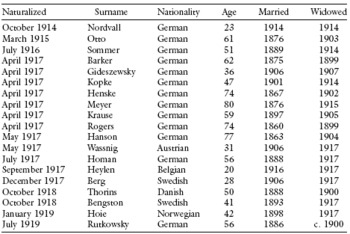
These sudden and substantial disabilities coincided with a new British Nationality and Status of Aliens Act, which received the royal assent on 7 August 1914. Affirming married women's coverture now entrenched in Empire-wide legislation, the 1914 Act, in a gesture to feminist protest, relaxed provisions whereby a British-born widow or divorcee could retrieve her British nationality. From 1914 through the Second World War, a discontinuous trickle of widowed women from the town of South Shields applied for and received naturalization as British subjects, effectively retrieving the status they had forfeited at marriage.Footnote 52 Over half of these, nineteen in all, applied between 1914 and 1919. They ranged in age from eighty-year-old Annie Meyer to young Elsie Heylen, barely twenty years old. Like Eleanor Otto's husband William, many of their husbands were long dead by 1917, yet they remained aliens in the eyes of the British state. Ten of nineteen women, more than half, had been widowed between 1898 and 1906: Christian Thorius, husband of Annie Thorins, had died in South Africa in 1900, during the couple's brief sojourn there.Footnote 53 Paul Sommer and Charles Kopke had died in 1914, and Carl Robert Homan in 1917, apparently of natural causes.Footnote 54 Otto Nordvall had died at sea in 1914 shortly after the start of the war, and Frank Louis Heylen, Sven Hoie, Joseph Hilmer Berg, and John Bengston, while serving their adopted country, had perished at sea through “enemy action.”Footnote 55 Camillo Wassnig, an Austrian, died in Carlisle while interned, and Herman Meyer, a German with an eighty-year-old wife, died in Stourbridge.Footnote 56
There is poignancy in women's recollections of marriages contracted amid the modest hopes and crab apple blossoms of Victorian South Shields. Longest married was Isabella Dockwray Storey, seventy-four years old in 1917, who had wed her German husband Thomas August Rogers on 26 May 1860 at Holy Trinity Church, South Shields, antedating the 1870 legislation that stripped her of her nationality.Footnote 57 Most recently widowed was Elsie Heylen (née Dickson), barely twenty, left with a baby son when her Belgian husband of fifteen months, Frank Louis Benoit Heylen, drowned at sea on 4 August 1917 “through his ship being torpedoed in the Bay of Biscay.”Footnote 58 For other women, the marriage itself had been fleeting: Mary Lizzie Nordvall, née Shepherd, was married a scant four months when her husband Otto, a German, “drowned on the 10th August 1914 in the Black Sea while serving on the ss. Benecia.”Footnote 59
Other marriages remained but a distant memory by 1917: Hannah Gideszewsky had married George Gideszewsky, a German, on 8 October 1906 in St. Aidan's Church on South Shields's windswept Lawe Top. George Gideszewsky died just a year later, on 8 October 1907, in West Ham, London.Footnote 60 Helen Elizabeth Howell had married Max Rutkowsky, whose German nationality the Home Office thought “doubtful,” on 8 March 1886 in Holy Trinity Church, South Shields. After eleven years of marriage, Max Rutkowsky “went to sea about the year 1897” and his wife “afterwards learned that he joined the Army in South Africa and was killed in the Boer War.”Footnote 61 Yet no matter how brief or distant in time their marriages, all these women remained classed as aliens.
Perhaps recognizing the anomaly of treating British-born women as enemy aliens, the state made the process of “readmission,” as they called it, somewhat less rigorous than the prewar process. During wartime the fee for readmission was reduced to five shillings from the substantial sum Mary Sargant-Florence had paid.Footnote 62 Yet the wartime context raised the stakes in other, gendered ways. From the state's point of view, a British-born woman who married outside of national boundaries had already transgressed.Footnote 63 Marriage to a foreigner, even one who had spent his life and lost it contributing to British prosperity, meant such a woman was not to be trusted; her loyalty to the state as well as her respectability, bound up as the latter was with sexual probity, rendered permanently suspect.Footnote 64 Scrutiny of women's character, “respectability,” and prospective loyalty to the state intensified. In addition, a woman must have “complied with the requirements of the Aliens Restriction Order,” implying that a local woman could actually damage her case if she declined to conduct herself as an outsider.Footnote 65 One might well inquire what loyalty a woman might be expected to bear a state that first acknowledged her existence by depriving her of nationality and subsequently treated her as an enemy and a potential criminal.
Unlike foreign-born mariners and soldiers admitted to British nationality based solely on their usefulness to industry and the state, “alien widows” born and raised in Britain had to produce two character witnesses to testify to their “respectability” and “loyalty” to Britain. The referees themselves were also assessed for “good character and respectability.” The chief constable of South Shields participated, whether willingly or unwillingly, in legitimating this endeavor when he reported Mary Isabella Berg, widow of Joseph Hilmer Berg, a Swede killed in September 1917 by an enemy submarine, to be “of good character and very respectable,”Footnote 66 while of Harty Rosina Wassnig, whose husband had recently died in a camp, he commented, “I do not think the applicant would do anything detrimental to the interests of the country.”Footnote 67 In 1917, batching together the eight applications of Catherine Barker, Hannah Gideszewsky, Mary Henske, Elizabeth Hanson, Margaret Kopke, Jane Krause, Annie Meyer, and Elizabeth Dockwray Rogers, the chief constable pleaded on their behalf with the Home Office, in what became his familiar and pathetic litany in the ensuing months: “The Memorialist is only a person in poor circumstances, and feels very acutely the loss of her British Nationality by reason of her marriage, and she is anxious to regain the status of British Nationality.”Footnote 68 His words suggest that the view even sympathetic male authorities took of these women, while it differed from the harsh scrutiny of the central state, remained equally paternalistic.
What did this process mean to the women who undertook it, to their neighbors and kin? Examining their cases closely suggests that local custom and culture supported definitions of strangeness and belonging, of enemy or ally significantly at variance with state-propelled ones, and reveals the resources at women's disposal in their negotiations with the state. All but five of the nineteen husbands had been German or Austrian, and their widows became the first to retrieve British nationality. Only late in the war, when the perils of alien nationality and the possibility of recovering British nationality had become clear, did a handful of women of
—British-Born Alien Widows Readmitted during the War Years

other nationalities pursue the matter.Footnote 69Table 1 reveals no discernable swell of applications after the anti-German riots that swept Britain in May 1915 after the sinking of the Lusitania, perhaps because, although terrifying and massive, riots in South Shields targeted only a dozen business premises, most of them German owned.Footnote 70 Rather, after three cases early in the war, the rest clustered in early 1917.
The first applicant from South Shields was Mary Lizzie Nordvall (née Shepherd), widowed but a few months after marriage in the first weeks of the war. In advance of the provisions in the 1914 act , which did not become effective until January 1915, Mary Lizzie Nordvall produced four referees to support her case, all of them “intimately acquainted with the applicant and her family for a number of years, through attending the Baptist Church, Imeary Street.” One was the minister himself, George Ernest Mason, who professed to have known her for fifteen years, since she was a child of eight. A local woman born in South Shields, who had married her husband in the same church only a few months before, Mary Lizzie Nordvall was typical of the women who sought and received naturalization during the war, for she mobilized local contacts and long-standing relationships to support her in negotiations with the state.Footnote 71
Lacking prior formal relations with the state, what resources did women such as Mary Lizzie Nordvall draw on in petitioning for restoration of their British nationality? Unlike foreign-born men with their direct links to the state via public sphere practices such as work, property, and military service, women applying for naturalization offered the British state as evidence the fruits of personal, kin, neighborhood, and work networks forged in the course of a lifetime. A remarkable characteristic of the forty referees was the length of time most of them had known the women. Except for those of Elsie Heylen and Mary Lizzie Nordvall, who were, after all, quite young, no referee had known his subject less than ten years, and the average length of their acquaintance was twenty-seven years. Both of Andrea Bengston's (age forty-two) referees, shipyard workers like herself, professed to have known her “since she was a girl,” twenty-six and twenty-seven years, respectively. Isabella Berg's (age twenty-eight) referees, a seagoing fireman and a laborer, had known her for eighteen and sixteen years, respectively, “since she was a child.” One of Alice Homan's (age fifty-six) referees, J. T. Stonehouse, “has known the applicant all his life. They were neighbours and brought up near each other for twenty years.”
Several women appear to have mobilized kin to vouch for them: Annie Thorins's cousin, locomotive driver Matthew Sanderson Hailes, declared that he had known her for forty-seven years, remaining “on visiting terms for her lifetime.” Thomas Pollard Storey and William Tate, referees for Isabella Rogers and Jane Krause, respectively, bore the women's respective maiden names, suggesting they may have been relatives as well. William Tate had known Jane Krause for all of her fifty-nine years. Alice Homan's daughter Charlotte was married to one William Scott, who may have been Chief Constable William Scott, explaining his solicitude for a tranche of women naturalized in spring 1917 along with the recently widowed Homan.
Andrea Bengston's employer, Readhead and Sons shipbuilders, acted as her agents, shepherding her paperwork through the bureaucratic maze with the explanation that “owing to her ignorance of such business she thought that [the application] was the certificate … and nothing further was required of her.”Footnote 72 Like Mary Lizzie Nordvall's Baptist minister, Elizabeth Sommer's physician, Doctor Blair, acted as a referee, perhaps lending enhanced bona fides to claims to respectability. That all of these forty referees were men once again reminds us of men's greater access to public life and relationships with the state. Even as alien widows reclaimed their nationality, disentangling themselves from the legacy of an alien husband, they remained compelled to rely on other men to mediate their public relationships. Nonetheless, forced to seek independent livelihoods and new social roles, several identified themselves as workers, perhaps evoking the ideology that valued men's social labor over women's domestic work. Catherine Barker, age sixty-two and widowed in 1899, worked as a “morning caller,” Andrea Olefine Bengston, forty-two and only recently widowed in the war, worked as a shipyard laborer. Hannah Gideszewsky, widowed in 1906, reported herself a laundress, while Annie Thorins, fifty and a single mother since 1900, and Margaret Kopke, forty-seven and widowed in 1914, worked as charwomen. Helen Elizabeth Rutkowsky, fifty-six, abandoned in 1897 and widowed in the Boer War, had become a housekeeper, while Harty Rosina Wassnig, thirty-one and recently widowed, worked as a barmaid.
Likewise, lacking the capacity to perform the military service that afforded alien men the opportunity to become naturalized during the war, two of the first three women naturalized cited their sons’ military service to support their cases. Eleanor Otto had two sons serving in the forces, and Elizabeth Sommer had a son in the British Expeditionary Force. Wrote Otto somewhat indignantly, “your Memorialist already has two sons serving His Majesty,” Frederick William, thirty-eight, a sergeant in the Tyne Electrical Engineers, and Charles, thirty-one, in the Royal Flying Corps.Footnote 73
Indeed, in the rare instances in which women spoke on their own behalf through the opacity of the third-person application forms, their words sound neither apologetic nor pathetic. For one thing, as the state itself recognized, women “resent what seems to be the indignity of reporting changes of residence to the Police.”Footnote 74 Eleanor Hunter Otto objected to the criminalization implied in her treatment as an enemy alien, complaining in March 1915 that “inconvenience doth arise by reason of your Memorialist having to report herself weekly to the legal authority, which in this case, is domiciled at the local Police Station, and the aversion which she has of frequenting (against her will) such a place.” Pressing her case in terms of her sons’ military service, she asserted, “the spirit of patriotism which she feels should not have been affected by reason of her marriage.”Footnote 75 Elizabeth Sommer likewise stated that she “has always resided in England and intends henceforth to do so, and she is desirous of again enjoying and exercising the freedom and liberties to which her birth entitles her.”Footnote 76 Annie Thorins, widowed since 1898, offered referees who had known her thirty-six and forty-seven years, the latter her cousin. Her petition stated her reasons bluntly, “to claim my nationality again: for no other reason.”Footnote 77 Rejecting the submergence of selfhood coverture implied, protesting the indignity of criminalization, and eschewing the chief constable's rhetoric of victimization, the alien widows of South Shields asserted individual claims to British nationality as their birthright.Footnote 78
These nineteen women's ability to marshall support from their kin, work, and social networks also suggests discontinuity between statist and local definitions of belonging, of insiders and outsiders. Yet such long-standing personal networks may not have been available to every woman who found herself an alien in her own land. The initial nineteen women naturalized during the First World War were perhaps extraordinarily well equipped to draw on local and personal networks. Of them, eleven claimed birth in South Shields and two, Margaret Kopke and Annie Thorins, in North Shields, while the rest came from elsewhere in the Northeast: Hannah Gideszewsky from Jarrow, Helen Elizabeth Rutkowsky from Darlington, Mary Isabella Berg from Middlesborough, and Elizabeth Sommer from Hetton-le-Hole, all in County Durham; and Mary Hoie from Howdon and Elsie Heylen from Willingdon near Bishop Auckland, both in Northumberland. All stood on home ground, in a sense, as Tynesiders—or Geordies, as they are called.Footnote 79 Given that personal networks, history, and contacts proved women's sole recourse, one wonders how other women might have fared who lacked such deep roots and personal networks in the locality.
Further, even such formidable personal resources as these possibly exceptional women possessed proved no match for the multiple formal routes to British nationality available to foreign-born men. After the war, women naturalized remained a tiny minority relative to foreign-born men: during the period 1925–30, eighteen persons residing in South Shields obtained naturalization, only four of them women. Between 1930 and 1940, hundreds of men received naturalization as British subjects, but only four women, two of them foreign born.Footnote 80
Despite ongoing organized agitation, British women Empire-wide continued losing their nationality at marriage until 1945, when Canada unilaterally legislated otherwise.Footnote 81 Home Secretary Chuter Ede, MP for South Shields, and Ellen Wilkinson, sole woman cabinet minister and MP for nearby Jarrow, proved critical in ensuring that Britain's 1948 Nationality Act provided that “marriage had no effect on the nationality of a British woman.”Footnote 82 Yet women remained disadvantaged in nationality law for decades after.Footnote 83 Since then, new definitions of citizenship, based on community membership and participation, however defined, have supplemented and challenged top-down juridical definitions of nationality imposed unilaterally by states composed largely of elite men.Footnote 84 Arguably, we can detect such community ties militating against or mitigating nationality policy in wartime South Shields, in spite of alien widows' technical exclusion from both citizenship and nationality.
—British Born Women Naturalized in South Shields, 1915–45

Note .—Emilia Turicci (1933, Italian) and Genja Getzove (1934, Lithuanian) have been removed from consideration because they were foreign born.
Conclusion
So, what can we learn from the case of the alien widows? First, this evidence suggests that the intensified nation building that accompanied total war exposed and widened the hitherto concealed disjunction between local custom and culture and instrumental statist definitions of nationality that purported to represent that custom and culture. Invented or imagined collectivities may correspond ill to daily practice, depending on who is doing the inventing and imagining.Footnote 85 Although defined and treated as outsiders by the British state, as enemies by the press, and as pathetic victims “in poor circumstances” by the chief constable, the alien widows of South Shields hardly proved outsiders and enemies to their neighbors and kin, nor did they depict themselves as such when we have access to their words.
Second, the longer-term impact of exogamous women's crisis of national identity remained ambiguous, but not inconclusive. Women's heightened consciousness about alien nationality appears to have proven a wartime aberration: as table 2 shows, after 1919 no woman from South Shields received naturalization until 1925, and in the two decades between 1919 and 1941, only eight women from South Shields, six of them native-born, received naturalization. Remarkably, neither the postwar fate of British-born wives and children deported from Britain with former internees, nor the right to exercise the franchise, open to women over thirty years of age in 1918 and all adult women in 1928, appears to have sustained substantial interest in British nationality once the wartime crisis passed.Footnote 86
Yet it appears that war exposed the perils of alien nationality, prompting more general concern among women and men. Although the first thirteen women to apply for readmission were “enemy aliens,” that is, German or Austrian, by the end of the war several other women also obtained readmission, including a Belgian, a Norwegian, and a Swede. Conversely, the birthplaces of women readmitted between 1926 and 1940 ranged further afield from South Shields, while their acquired nationalities included Swedish, German, Norwegian, Estonian, Egyptian, and Latvian. In addition, an Italian-born and a Lithuanian-born woman also received naturalization in these years. This suggests that a heightened sense of vulnerability was not confined to current or erstwhile “alien enemies” but became generalized among all alien women and men as well. George Edwin Anderson, born in Abo, Finland, but raised and educated in Britain since age four, pursued naturalization in 1919 explicitly because, “in case of possible marriage, he does not wish to saddle his wife with an alien nationality.”Footnote 87 Samuel William Danielson, born in Norway but resident in Britain since 1872 and married at Holy Trinity Church in South Shields in 1877, applied for naturalization in 1921 so that “his wife may regain her British nationality.”Footnote 88
So in the end, this case shows us once again how unimaginative and flawed remain the apparently objective, gender-blind categories through which scholars have conceived of and categorized the formation of citizenship and nationality in modern Europe. It reveals anew the ways policy itself has so often operated within gendered categories that privilege men, even when the categories themselves, such as property, work, or public service, appear to be gender neutral.Footnote 89 Profoundly compromised as they have been by gender, sexuality, and race, legalistic constructs such as jus soli and jus sanguinis cannot sustain assumptions that statist categories of nationality reflect custom and culture voided of social relations such as gender, class, and, arguably, race.Footnote 90 Far from a healer of social rifts, nation building has proven a mechanism of internal as well as external exclusion, reinforcing the same axes of power that have stratified societies generally. Yet like the Cockney women Ellen Ross investigated, the alien widows of wartime South Shields offset their disadvantaged access to public roles by mobilizing the personal relationships and networks forged over the life course.Footnote 91 If, as some argue, citizenship derives from membership and participation in a community, then the case of the alien widows shows the discrepancy between nationality defined by states and citizenship taking shape through local relations and daily life.
Scholarly enthusiasm for tracing the contours of hegemonic definitions of “national identity” risks assuming a consensus that these women belied. Their words and stories revealed the cruel and arbitrary excisions and amputations such boundary projects entail but at the same time the invariably incomplete and contested nature of fictions of national unity. The rupture between local and national definitions of national identity, of insiders and outsiders both external and internal, suggest there was nothing cultural, customary, or consensual about those selected for inclusion or exclusion in the “imagined community” of the British nation.Footnote 92 The alien wives and widows of wartime South Shields defined their patriotism, identity, loyalty, and rights in terms at variance from the central state, and apparently so did their neighbors and kin. We would thus do well in our investigations of human history and social change to attend not only to the hegemonic “border guards” but also to the counterhegemonic “border crossers” if we wish to understand how custom and culture operate in human affairs.Footnote 93 For it remains the border crossers from whom we yet have much to learn.