1. Introduction
It is received wisdom that quantum mechanics puts an end to ‘reductionism’—at least to the kind of reductionism we know from classical mechanics (for examples, see Maudlin Reference Maudlin and Castellani1998; Redhead Reference Redhead and Knowles1990; Mellor and Crane Reference Mellor and Crane1990). So-called quantum entanglement is responsible for nonclassical features of quantum mechanics such as holism, the failure of supervenience, and emergence (Healey Reference Healey1991; Humphreys Reference Humphreys1997; Kronz and Tiehen Reference Kronz and Tiehen2002). I will argue that this is only part of the story. Quantum mechanics provides us with a host of reductionist explanations. In particular, in solid state physics we have impressive examples of microexplanations, i.e., explanations of the behavior of compound systems in terms of the behavior of their constituents. The behavior of crystals, liquids, and metals illustrates this point. It can be explained in terms of the behavior of the molecules, ions, etc., that the systems consist of. Quantum mechanics provides the means for reductionist explanations in this sense. Thus, I will argue that the extent to which quantum mechanics tells against microexplanation has been overstated.
In what follows, I take microexplanation to be the explanation of the behavior of a compound system in terms of the behavior of its parts. The behavior of a compound system is emergent if it is impossible, in principle, to provide such a microexplanation. I will distinguish two kinds of microexplanation (or micro-‘reduction’ as it is sometimes called) and correspondingly two senses of emergence. Quantum entanglement, I will argue, provides an example for the failure of one kind of microexplanation (synchronic microexplanation), while not affecting the other. With respect to the second kind of microexplanation (diachronic microexplanation), quantum mechanics is just as reductionist as its classical counterpart.
2. Emergence and Explanation
Let me start with a short remark on emergence. I take emergence to be an ontological notion, which concerns the relation between parts and wholes. It is meant to capture the intuition that there might be some sense in which the behavior of a compound system is independent vis-à-vis the behavior of the parts.
Our guide to independence is explanation, or rather, its failure. If it is (in principle) impossible to explain the behavior of a compound in terms of the behavior of its parts, the behavior in question is said to be emergent. For the purposes of this paper, I take this progression from the impossibility of explanation to an ontological conclusion to be unproblematic. However, as we will see, even if this premise is granted, the claim that some phenomenon or behavior should be classified as emergent often relies on additional assumptions that one has to argue for.
The explanans of a microexplanation is the behavior of a compound system. So what does ‘behavior’ mean in this context? With respect to the behavior of a physical system, we can distinguish the state of the system, its constants, and the laws that pertain to it. Some quantities of a physical system are constant; others vary with time. In the case of a single classical particle, we can distinguish position and momentum as changing quantities, whereas mass remains constant. The values of the varying quantities at a particular time are called the state of the physical system at this time. However, the constants and the state of a system do not determine the complete system's behavior. Furthermore, we have laws that describe the connections between the various quantities involved, and in particular, they describe how the state of the system develops in time (the dynamics of the system).
These distinctions help to differentiate between two kinds of microexplanation: synchronic microexplanation and diachronic microexplanation. Synchronic microexplanation explains why a compound system is in a certain state at time t in terms of the states of the constituents at t. Diachronic microexplanation explains why a compound system is in a certain state at time t in terms of an earlier state of the compound system and the dynamics of the system, which is in turn tied to the dynamics of the parts. Let me turn to synchronic microexplanation first.
3. Synchronic Microexplanation
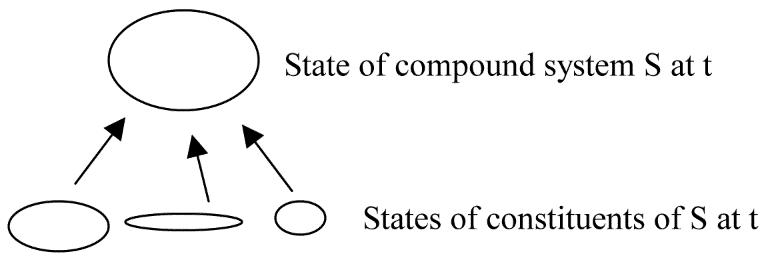
Synchronic microexplanation, as I said, is the explanation of the state of a compound system at a time t, which relies on the states the parts are in at the same time. Figure 1 will serve as an illustration. Thus, we might explain why a compound system, such as an ideal gas, has the determinate energy value E* (the macrostate) by pointing out that the constituents have the determinate energy values E 1 to
 $E^{n}$
(the states of the parts). The explanandum in this case is E* (in contrast to other possible macrostates of the system). The explanation can be reconstructed as a DN-explanation that relies on the states of the parts as well as on a law of composition. The law of composition tells us how the states of the parts contribute to the state of the compound. If we assume that interactions can be neglected, the kinetic energy values simply add up.Footnote 1
Synchronic microexplanation.

4. Quantum Entanglement
Quantum entanglement is a counterexample to synchronic microexplanation. Let me briefly discuss the example of the spin states of a compound quantum mechanical system. To make things easy, I confine myself to the spin states of a compound system consisting of two nonidentical particles. Vectors (which are normalized) in two-dimensional Hilbert space represent the spin states of the separate particles, say H 1 and H 2. For the construction of a Hilbert space for the compound system, we need a law of composition. According to this law, the possible spin states of the compound system are all those states that can be represented as (normalized) vectors in the tensor product of H 1 and H 2,
 $H_{s}=H_{1}\otimes H_{2}$
.
If we take
 $\vert \psi ^{z- \mathrm{up}\,}_{1}\rangle $
,
 $\vert \psi ^{z- \mathrm{down}\,}_{1}\rangle $
and
 $\vert \psi ^{z- \mathrm{up}\,}_{2}\rangle $
,
 $\vert \psi ^{z- \mathrm{down}\,}_{2}\rangle $
(all eigenvectors in the z-direction) as bases for H 1 and H 2, respectively, then we find the following among the possible states of the compound system:
1.
 $\vert \psi ^{z- \mathrm{up}\,}_{1}\rangle \otimes \vert \psi ^{z- \mathrm{down}\,}_{2}\rangle $
2.
$\vert \psi ^{z- \mathrm{down}\,}_{1}\rangle \otimes \vert \psi ^{z- \mathrm{up}\,}_{2}\rangle $
3.
$1/ \sqrt{2}\vert \psi ^{z- \mathrm{up}\,}_{1}\rangle \otimes \vert \psi ^{z- \mathrm{down}\,}_{2}\rangle -1/ \sqrt{2}\vert \psi ^{z- \mathrm{down}\,}_{1}\rangle \otimes \vert \psi ^{z- \mathrm{up}\,}_{2}\rangle $



What is essential for our discussion is that 3 cannot be written as a simple tensor product of vectors H 1 and H 2. It can only be written as a superposition of such tensor products. The compound is in a determinate state, but this cannot be explained in terms of the determinate states of its constituents. This is the case because there are states such as 3 that do not allow the attribution of pure states to the parts of the compound. What we see is that synchronic microexplanation systematically fails. Thus, we have an example of emergence. It is this failure of synchronic microexplanation that serves as the basis for the failure of supervenience, holism, etc., in quantum mechanics. This is a case of emergence because it is, in principle, impossible to explain the behavior of the compound (in this case: the state) in terms of the behavior (states) of the parts.
All of this is familiar. Let me just add one point before I move on. Here we have a clear-cut case of emergence, because we can see why a microexplanation is not merely hard to come by, but impossible to achieve. Quantum mechanics tells us that there are states of compound systems that do not allow for the attribution of pure states to the parts. The impossibility of attaining a synchronic microexplanation in such cases is thus implied by the formalism of quantum mechanics.
5. Diachronic Microexplanation in Classical Mechanics
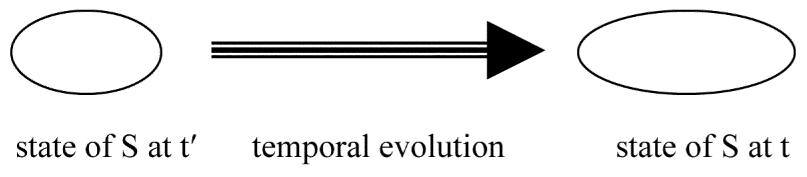
Diachronic microexplanation explains why a compound system is in a certain state at time t, in terms of an earlier state of the compound system (see Figure 2). It achieves this by specifying the temporal evolution, or dynamics, of the system, which is in turn tied to the dynamics of the parts (see Figure 3). The dynamics of the compound system is analyzed in terms of that of the parts. This is why it is appropriately considered as a form of microexplanation: The behavior of the compound (in this case, the dynamics of the system) is explained in terms of the behavior (dynamics) of the parts.
Temporal evolution of the state of a system.

Analysis of the dynamics of a compound system.

Strictly speaking, we are interested in how the state of the compound system evolves; however, I will also speak of the explanation of the dynamics of the compound in terms of the dynamics of its parts.
In the remainder of this paper I will argue that with respect to diachronic microexplanation (or the explanation of the dynamics of a compound), quantum mechanics is just as reductionist as classical mechanics. Let me start with how diachronic microexplanation works in classical mechanics.
I want to begin with the simple example of a noninteracting, two-particle system. The first step in the explanation or analysis of the dynamics of this system is the identification of its parts, i.e., the two (isolated) one-particle systems. The second step consists in the determination of the dynamics of the isolated one-particle system.
According to classical mechanics, the complete behavior of a one-particle system is specified by its path in six-dimensional phase space. The number of dimensions is due to three spatial co-ordinates plus three coordinates for the momentum (or for velocity). A point in phase space represents a state of a classical system. The Hamiltonian specifies the system's time evolution or dynamics and thus its path in phase space. These equations in turn require a classical Hamiltonian. The dynamics of an isolated particle, for instance, can be described by a classical Hamiltonian of the form
 $H=\mathbf{p}^{2}/ 2m$
, where p is the momentum and m the mass of the isolated particle.
For a noninteracting two-particle system, we first need to specify two six-dimensional phase spaces, one for each of the particles, as well as a classical Hamiltonian of the above form for each of them. That, however, is not yet a description of a two-particle system. It is a description of two separate one-particle systems.
Furthermore, what we need is something that tells us how the descriptions of the behavior of subsystems have to be combined so as to obtain the description of the behavior of the compound system. This is the job of laws of composition. According to the basic law of composition in classical mechanics, the phase space for a compound system is the direct sum of the phase spaces of the subsystems. Thus, for the two-particle system we obtain a twelve-dimensional phase space.
Such a law leaves room for further laws of composition for physical magnitudes, depending on whether these are considered to be scalars, vectors, or tensors. The Hamiltonian, for instance, is a scalar. In the absence of interactions, the law of composition attributes to the compound system the sum of the magnitudes for the subsystems. A fortiori, the Hamiltonian for the compound system is the sum of those for the isolated constituents. Thus the dynamics of the system of two noninteracting particles in classical mechanics is described by a Hamiltonian of the form:
 $H=\mathbf{p}^{2}_{1}/ 2m_{1}+\mathbf{p}^{2}_{2}/ 2m_{2}$
. Adding up the contribution of the parts (according to the laws of composition) is the third and final step to understanding the dynamics of the non-interacting two-particle system.
Let me draw attention to the following point: All the information that goes into the microexplanation of the dynamics of the noninteracting two-particle system is information about laws—laws for the dynamics of the constituents, laws of composition and, if necessary, laws of interaction. The states of the constituents play no role in the explanation of the dynamics of a compound system. Diachronic microexplanation does not require the states of the constituents to be specifiable.
A more realistic example of diachronic microexplanation in classical mechanics is the classical treatment of the ideal crystal. Standard treatments assume that the mean equilibrium positions of the ions are the sites of a regular lattice. The oscillations of the ions around this equilibrium position are considered to be small compared to the interionic spacing, so the only relevant interactions are those between nearest neighbors. Furthermore, it is supposed that the potential between nearest neighbors is harmonic (Ashcroft and Mermin Reference Ashcroft and Mermin1976, 422–427). These assumptions allow us to specify the classical Hamiltonian of the ideal crystal. Two kinds of information are needed for the construction of the Hamiltonian: the dynamics of the constituents considered as being isolated (kinetic energy terms) and their interactions while constituting the compound (potential energy). These contributions are added according to a law of composition. The procedure is thus essentially the same as in the simple example discussed before:

where

and

The Hamiltonian determines the thermal density of the crystal, which is given by

in which dΓ stands for the volume element in crystal phase space, and where

The thermal density of the crystal allows us to calculate measurable thermodynamic properties such as the specific heat c v:
 $c_{v}=(\partial / \partial T) u$
. Classically, the specific heat in a crystal is independent of its temperature.
These two examples illustrate that there is a second sense in which classical mechanics can be characterized as reductionist. Classical mechanics does not only allow for synchronic microexplanation, but it also incorporates an analytical methodology that explains the temporal evolution of compound systems (its dynamics) in terms of the temporal evolution of the parts (plus laws of composition and interaction terms). Diachronic microexplanation provides a second sense in which classical mechanics is a paradigm for reductionism.
The intuition that classical mechanics is a paradigm for reductionism depends much more on diachronic microexplanation than on synchronic microexplanation, or so it seems to me. The intuition relies on the fact that we can explain macroscopic properties (such as the specific heat) in terms of the behavior of the parts. This, as we have just seen, is a matter of diachronic, rather than of synchronic, microexplanation.
6. Diachronic Microexplanation and Emergence
The explanation of the dynamics of compound systems is at the heart of diachronic microexplanation. It comprises three steps. In the first step, the complex physical system is split up conceptually into subsystems (e.g., ions). In the second step, these subsystems are treated as if they were isolated; their dynamics in isolation are determined (the kinetic energy terms). Finally, the contributions of the subsystems, as well as the interactions (the potential energy terms), are added up so as to yield the dynamics of the compound system. This is a completely general procedure that we invoke whenever we want to determine the evolution of a compound system.
What we need for microexplanation to work is, first, information about how the parts would behave if they were isolated, second, information about how this behavior contributes to the behavior of the compound (laws of composition) and, third, information about what kinds of interactions arise if the parts are no longer isolated.
Given this preliminary characterization of diachronic microexplanation, one might ask whether it could possibly fail, i.e., whether emergence is possible at all. It is. For example, if it were impossible to specify the dynamics of the constituents considered in isolation, diachronic microexplanation would fail. Still, one might want to argue that the criteria for emergence are too strict, or conversely, that the criteria for diachronic microexplanation are too lax. As long as no further restrictions are introduced, e.g., on the kinds of interactions or forces that are admitted, an important source of what is often considered to be an example of emergence is obliterated. For instance, if we had to introduce a special force that explains the occurrence of high temperature super conduction, we should surely consider this to be a case where microexplanation fails, i.e., a case of an emergent phenomenon.
Thus, it seems to be reasonable to introduce further restrictions on diachronic microexplanations, if we want to capture our intuitions regarding emergence. Whether or not the dynamics of a compound physical system turn out to be emergent will then depend on the additional restrictions we put on the kind of information allowed for. But what are reasonable restrictions on interactions, and how is one to argue for a particular choice? This is a difficult matter, in particular since it is not clear whether intuitions about emergence are shared intuitions.
For the purposes of this paper, I do not have to solve this problem. What I want to argue is simply that if classical mechanics is taken to be paradigmatic for microexplanations of the dynamics of compound systems, then quantum mechanics is reductive in exactly the same sense (whatever the appropriate restrictions on interactions may be).
Nevertheless, there is a suggestion by C. D. Broad, which seems to me entirely plausible. It is the requirement that the laws that go into a microexplanation ought to be general rather than specific. The idea is that emergence comes with specificity. Here is one of Broad's examples: Let's suppose we want to explain the behavior of silver chloride in terms of that of its constituents. If, in order to explain or deduce the behavior of silver chloride on the basis of the behavior of silver and chlorine, we need a special law for this particular substance—a special law that is of no use in explaining other molecular combinations—then the behavior of silver chloride should count as emergent (Broad Reference Broad1925, 64–65).
If this suggestion is accepted, the notion of diachronic microexplanation can be spelled out as follows:
The state of a compound system is diachronically microexplained if it is—at least in principle—possible to deduce its temporal evolution (its dynamic) on the basis of
1. general laws concerning the temporal evolution (the dynamic) of the components considered in isolation,
2. general laws of combination, and
3. general laws of interaction.
Information about the behavior of the isolated components is in no case sufficient for determining the behavior of a complex system. We need to know exactly how the parts contribute to the dynamics of the compound. Explications of emergence often appear to neglect this fact. Paul Teller, for example, takes “the naked emergentist intuition to be that an emergent property of a whole somehow ‘transcends’ the properties of the parts” (Teller Reference Teller, Beckermann, Flohr and Kim1992, 139). However, in a strict sense, properties of wholes always transcend the properties of the parts. If one were to take Teller's intuition too literally, this would imply that every complex system's property is emergent.
Given the above characterization of diachronic microexplanation, there are (at least) two reasons why the behavior of a system might be classified as emergent: First, due to the impossibility of assigning a dynamic to the constituents of a compound system. In analogy to the case of synchronic microexplanation in quantum mechanics, such an assignment may be impossible in general. A second possible reason for emergence is that the additional restriction, e.g., Broad's suggestion that laws have to be specific, has not been met.
7. Diachronic Microexplanation in Quantum Mechanics
Let me now turn to the explanation of the dynamics of a compound quantum mechanical system. A vector in Hilbert space represents the state of a quantum mechanical system at a time t. The Schrödinger equation describes its dynamics, i.e., its time evolution. For this to work, one has to determine the quantum mechanical Hamiltonian. If we consider the case of an isolated one-particle system, the classical Hamiltonian has to be replaced by the quantum mechanical Hamiltonian
 $H=\mathbf{P}^{2}/ 2m$
, where P is the momentum operator of the particle. The behavior of the system of two noninteracting particles is determined by the same procedure as in the classical case. We invoke a quantum mechanical law of composition. It requires that we take the tensor product of the two Hilbert spaces so as to gain a new Hilbert space in which the two-particle system can be represented. (For examples, see Bohm Reference Bohm1986, 147 or Kennedy Reference Kennedy1995). The Hamiltonian for the combined system is the sum of those for the isolated subsystems.
This discussion of diachronic microexplanation in quantum mechanics suggests that not much changes when we turn from classical mechanics to quantum mechanics. That is indeed my conclusion—at least as long as we confine ourselves to diachronic microexplanation. The dynamics of compound quantum mechanical systems can be explained in terms of the dynamics of the components considered in isolation (plus laws of composition and interaction).Footnote 2
The same is true of our second example, the ideal crystal. What changes are the mathematical tools we invoke to describe the system and subsystems. However, the explanatory strategy, i.e., the analysis of the dynamics of the ideal crystal, remains the same when we turn from classical to quantum mechanics. The quantum mechanical Hamiltonian for the ideal crystal is determined by specifying the kinetic energy terms for the ions and their interactions. Operators on Hilbert space replace the variables p and q. Even though the new mathematical tools yield new empirical predictions (e.g., a temperature dependence of the specific heat), the essential point for our discussion is that the explanatory strategy remains the same.
What we see is that quantum entanglement, i.e., the failure of synchronic microexplanation, does nothing to undermine diachronic microexplanations. In quantum mechanics the same sort of completely general microreductive strategy is available and employed as in classical mechanics. Hamiltonians are built according to the same procedure as in classical mechanics: on the basis of general laws concerning the temporal evolution (the dynamics) of the components considered in isolation, general laws of composition, and general laws of interaction. The upshot is that the quantum mechanical explanation of the dynamics of compound quantum systems is just as reductionist as its classical counterpart.
Quantum mechanics, like classical mechanics, has laws of composition. These laws tell us how to estimate the contributions of the parts. Thus, quantum mechanics provides the tools we need for diachronic microexplanation to work. Furthermore, the formalism of quantum mechanics does not imply that it is impossible to assign laws of temporal evolution to the parts of compound systems (considered in isolation). This result, however, does not imply that emergence is impossible. It might turn out that an additional requirement (e.g., the generality of laws) cannot be met. It might, for instance, turn out to be necessary to postulate a special force for some particular kind of compound system. But note, in contrast to the case of synchronic microexplanation, the source of such emergence would not be quantum mechanics itself. It isn't the formalism that tells us that it is impossible to get along with general force laws. In the case of quantum entanglement, however, it is the formalism that tells us that in the case of entangled compound systems, it is impossible to attribute pure states to the constituents. Whether or not we need special force laws is implied neither by classical mechanics nor by quantum mechanics.Footnote 3
To conclude: Diachronic microexplanation is a reductive explanatory strategy that is successful in both classical and quantum mechanics, because both provide the tools for it to work. Quantum mechanics does not give us any more reason for an in-principle failure of this strategy than classical mechanics.
8. The Nonseparability of Hamiltonians
In a recent article Kronz and Tiehen (Reference Kronz and Tiehen2002) defend the claim that besides quantum entanglement (the nonseparability of quantum states) the nonseparability of Hamiltonians gives rise to emergence as well. Because their claim seemingly implies that quantum mechanical formalism generates emergence (with respect to the dynamics of the compound system), it appears to contradict the conclusions that I have reached in the last section.
Let me start my discussion by pointing out that Kronz and Tiehen's notion of emergence differs from those I have employed so far. Here is how they define ‘dynamic emergence’:
Emergent wholes have contemporaneous parts, but these parts cannot be characterized independently from their respective wholes. Emergent wholes are produced by an essential, ongoing, interaction of its parts. (Kronz and Tiehen Reference Kronz and Tiehen2002, 345)
A ‘characterization’ is defined as “an exhaustive list of the properties that are instantiated by an entity.” It is said to be independent “if the elements of the list make no essential reference to some other entity” (Kronz and Tiehen Reference Kronz and Tiehen2002, 344).
What I will argue for is the following: Kronz's and Tiehen's ‘nonseparability of Hamiltonians’ does not give rise to emergence in our sense; it is compatible with diachronic microexplanation. Furthermore, what they call ‘dynamic emergence’ can be found both in quantum mechanics and in classical mechanics.
Here is how Kronz and Tiehen define ‘nonseparability’. In the case of quantum states nonseparability amounts to entanglement. As we have seen (Section 5 above), the nonseparability of quantum states implies emergence in the sense of an in-principle failure of synchronic microexplanation. The separability of Hamiltonians, or evolution operators as defined by Kronz and Tiehen, depends on whether it is possible to write the relevant matrix as a tensor product of the submatrices for the parts of the compound. The Hamiltonian or the evolution operator is nonseparable if it can be written only as a superposition of tensor products of the Hamiltonians or evolution operators for the parts. Does the nonseparability of Hamiltonians imply emergence?
In terms of physics, a separable Hamiltonian describes time evolutions of the parts of the compounds that are independent of one another. A nonseparable Hamiltonian, on the other hand, characterizes interdependent temporal evolutions of the parts. Let me mention at this point what will be important later: If we are dealing with a compound whose parts interact, we need a nonseparable Hamiltonian to describe the compound's behavior, simply because the parts affect one another.
With this notion of nonseparable Hamiltonians, Kronz and Tiehen argue for the claim that there is a hitherto overlooked sense of emergence in quantum mechanics.
The non-separability of the state of a composite system is one degree of inextricability, but it is not the most robust form to be found in quantum mechanics. A greater degree is to be found when the Hamiltonian of the compound is nonseparable. In that case, the time evolution of the density operator that is associated with a part of a composite system cannot in general be characterized in a way that is independent of the time evolution of the whole. If the Hamiltonian is separable, then the time evolution of the density operator that is associated with a part can in general be characterized independently of the time evolution of the whole. (Kronz and Tiehen Reference Kronz and Tiehen2002, 343–344)
The nonseparability of Hamiltonians gives rise to ‘dynamic emergence’ in the sense of Kronz and Tiehen, because the parts’ temporal evolution cannot be characterized independently of the whole. As evidence for their claim, they discuss the density operator
 $\rho _{1}(t) $
of a part S 1 of a compound system S, consisting of two parts:
 $\rho _{1}(t) =\mathrm{Tr}\,^{(2) }\rho (t) $
.
The partial trace
 $\rho _{1}(t) $
is independent of the temporal evolution U 2 that pertains to the second constituent, if the temporal evolution U of the compound system can be written as tensor product:
 $U=U_{1}\otimes U_{2}$
. For this condition to be met, the Hamiltonian for the compound has to be separable. If it is nonseparable, the temporal evolution of the partial trace
 $\rho _{1}(t) $
that pertains to the first constituent will depend on the temporal evolution of the whole. (Kronz and Tiehen Reference Kronz and Tiehen2002, 344)
I am not denying that there is the difference between the separable and nonseparable Hamiltonians Kronz and Tiehen point to. However, if there is a sense of emergence that develops from nonseparable Hamiltonians, it does not affect my argument. First, the kind of reductionism I identified as being at work both in classical and quantum mechanics is diachronic microexplanation. This procedure is completely compatible with what Kronz and Tiehen call ‘dynamic emergence’. The fact that there is an essential, ongoing interaction among the parts does nothing to undermine the claim that the compound system in question can be explained on the basis of general laws (which describe how the parts would behave if they were isolated), general laws of composition, and general laws of interaction.
Second, dynamic emergence can be found both in quantum mechanics and in classical mechanics. Our planetary system as described by Newtonian mechanics provides an example of dynamic emergence in Kronz's and Tiehen's sense. The temporal evolution of the earth, for instance, cannot be explained independently of the whole system. It depends on the ongoing interactions between the different planets and the sun. Thus the behavior of the planetary system as a whole counts as an instance of dynamic emergence—but it can, to repeat myself, nevertheless be diachronically microexplained.
Let me summarize. In classical mechanics, it is always possible to consider the state of a subsystem as something intrinsic or nonholistic. There is no entanglement or nonseparability of states. This is different in quantum mechanics. However, with respect to the dynamics of compound systems, there is no analogous difference between classical and quantum mechanics. The presence of interaction terms leads to time evolutions of the parts that depend on the compound and thus implies what one may call ‘dynamic emergence’. But, this pertains to both classical as well as quantum mechanics. Therefore, ‘dynamic emergence’ neither undermines the microexplanation of the dynamics of compound systems, nor does it introduce a distinction that has quantum mechanics and classical mechanics on different sides with respect to the reduction/emergence issue.
9. Conclusion
The extent to which quantum mechanics undermines microreduction or microexplanation has been overstated. The claim that ‘reductionism is dead’ (Maudlin Reference Maudlin and Castellani1998, 54) is certainly too strong. It does pertain to synchronic microexplanation but not to diachronic microexplanation. The explanation of the dynamics of compound quantum mechanical systems invokes exactly the same kind of microreductive procedure as in the classical mechanical case. If classical mechanics is taken to be our paradigm for diachronic microexplanation (as I think it should be), then quantum mechanics is just as reductive in this respect as its classical counterpart.