Nowadays, everybody is a humanist . . . If Marxists can claim [se prétendre] to be humanists, then followers of the various religions—Christians, Hindus, and many others—can also claim to be humanists, as do the existentialists in turn.
Pierre Naville, discussion in Existentialism Is a Humanism Footnote 1When Jean-Paul Sartre declared that existentialism was a humanism in front of the tightly packed crowd at the Club Maintenant, it was a brilliant tactical move. In the year leading up to his lecture on 29 October 1945, Sartre's writings had been subject to numerous and sometimes conflicting criticisms from right and left. Derided as a decadent bourgeois philosophy or vilified as the modish immorality of the secular youth, “existentialism” had become a pawn in a chess game whose stakes were national and political. But in the talk he gave that night, Sartre regained the initiative and emerged in the political sphere as an active and determined participant.Footnote 2
It was a new direction for Sartre, whose philosophical work from the 1930s had focussed on rather technical points of phenomenology—even the social analyses of Being and Nothingness (1943) had outlined no explicit political agenda. Existentialism Is a Humanism broke new ground by bringing Sartre's thought into direct communication with broader themes and questions of postwar political discourse. Venturing into new territory, Sartre did not have the luxury of importing his own terms or re-creating the debate; he inscribed existentialism into a field with its own vocabulary, set-piece arguments, and rhetorical moves. His intervention was strategic, exploiting the hasty alliances and barely hidden antagonisms already at work in liberation politics.
Historians have been slow to consider the immediate political context, but for Sartre's audience its relevance would have been clear, because the structure of his talk directly mirrored the contemporary machinations of high politics in France. While Sartre was addressing the Club Maintenant, defending existentialism against the criticisms of “Communists” and “Catholics” by labelling it “humanist,” the three main political parties were picking over the result of the election held eight days previously.Footnote 3 Talk of a coalition had abounded and the Socialist Party (SFIO) was trying to draw together the Catholic Social Democrats (MRP) and the Communist Party (PCF) to form a government, an alliance that would be called tripartisme.Footnote 4 It was in this context that one of the bywords of the Socialists came to be particularly useful. The SFIO had decided that it could help unify the parties and discipline the most extreme wings of the MRP and the PCF by declaring itself to be “humanist.” The structure and thesis of Sartre's paper was then overdetermined. When Sartre, in his talk, stated that the contemporary moral choice was that between the MRP and the Communists, he was only making explicit the underlying framework of his text; Existentialism Is a Humanism was a political document drawing on the resources and pushing the limits of tripartisme.Footnote 5
Such an immediate and conscious appeal to a particular political moment, however, carries risks.Footnote 6 Proclaiming existentialism a humanism and thus consonant with a particular moment in French history, Sartre allowed both his immediate success and his philosophy's later decline. As politics moved on, Sartre's gesture quickly dated. By 1947, the tripartite alliance was falling apart, buffeted by the winds of an ever-harsher international climate. Because Sartre had exploited a political situation where all major parties were willing to ignore their differences to achieve a humanist consensus, the decline of tripartisme was an ill omen for existentialism; the French philosophical community began to outgrow a philosophy tailored to the fashions of 1945. Freed of the need to profess humanism, Communist phenomenologists turned to a new interpretation of Husserl to counter Sartre's subjectivist reading, and, casting off the uneasy discipline of humanism, Christian philosophers appealed to Heidegger's famous letter to Jean Beaufret for resources in the battle against Sartre's atheism. Existentialism was successful in part because Sartre was able to present it as the one true humanist philosophy, aligning it with the rising star of liberation politics. But when that star began to fade in the late 1940s and early 1950s, existentialism too lost much of its lustre. As French philosophy entered the antihumanist age, existentialism would be the first casualty.
THE RISE OF HUMANISM
The political context for the humanism debate is crucial for understanding Sartre's 1945 paper. It shows the political stakes of the turn to “humanism” as well as the indeterminacy of the word that allowed it to be successfully deployed in the creation of an alliance, either political or philosophical. Previous commentators have assumed that when Sartre claimed existentialism as a humanism, he was responding to direct assertions of the contrary. But the central question in 1945 was not whether existentialism was a humanism, but rather what type of humanism it was, and why that mattered. Catholic and Communist philosophers did not want to argue that Sartre was an antihumanist, but rather that his form of humanism was corrupt. And if they could show that his humanism was inadequate, even dangerous, then they could also apply that argument to the political stage where it really mattered. Sartre's existentialism became, in 1945, the perfect opportunity for Catholics to discredit an atheistic humanism, and for Communists to attack a bourgeois humanism that they felt to be harmful to their position within the tripartite alliance. If existentialism was not already accepted as a humanism, if the debate was not a debate within and about humanism, it would not have so exercised Communist or Catholic intellectuals.
The ultimate stakes of the debate had been set on the national stage. The election on 21 October 1945 had seen the vote relatively evenly divided between the Communist Party, the Catholic MRP, and the Socialists, and the intervening week had been filled with questions of possible alliances, rumours of the eventual form of the government.Footnote 7 In this uneasy ménage à trois, it was the Socialists who were the brokers, attempting to form a coalition government with the implacably opposed PCF and MRP.
Using “humanism” as a precipitation point for the alliance was a shrewd move by the SFIO. Sufficiently broad and positive that few of the parties would disown it, it also provided a strong rhetorical ground to criticize what the SFIO saw as the more problematic elements of Catholic and Communist agendas. Not merely helping to form an alliance, the idea of “humanism” was particularly adept at disciplining it. Drawing its power from a common opposition to Nazi barbarity, “humanism” by 1945 was deployed against resistance allies; it was the return to politics as usual in Paris.
Primarily, the term “humanist” was directed against the Communists, as its main proponents made clear. They saw “humanist socialism” as offering a middle way between American capitalism and Soviet communism. Because it was “socialism” it avoided the excessive individualism of the United States, but because it was “humanist” it avoided the subsumption of the individual into the collective that commentators identified in Russia. André Hauriou popularized the term in his 1944 book Socialisme humaniste: Vers une Théorie de la résistance. He wanted to open a “new path . . . between capitalist liberalism and total collectivism . . . between class warfare and the dictatorship of the proletariat.”Footnote 8 The term was seconded by another Socialist, Philippe Viannay, writing under his Resistance pseudonym Indomitus; though he was “socialist,” he belonged “to a family of those who state principally that man, the human person, is greater than the collectivity, taken as such.”Footnote 9 Humanism's place in Socialist Party rhetoric was assured when the grand old man of the SFIO, Léon Blum, returning in early 1945 from German captivity, adopted it—with its anti-Communist resonances intact—in his speech to the Socialist National Congress in August 1945 and his book À l'Echelle humaine of the same year.Footnote 10 When the Socialists used the term “humanism” they did so to distinguish themselves from the PCF.
MARXIST HUMANISM AND THE MAN OF TOMORROW
Willing to be part of the “humanist” alliance, the Communists were not prepared to accept the Socialists’ interpretation of the word. In a debate played out in the pages of the Catholic personnalist journal Esprit in the early months of 1945, journalists and politicians—including the socialist Catholic Jean Lacroix and Viannay (Indomitus) himself—discussed the new watchword of the SFIO. On the Communist side, Pierre Hervé, the editor of the Communist journal Action, showed a clear distrust of the term “humanist socialism,” even as he was aware of its uses:
You speak to us of humanist socialism. OK, if it is understood that Marxism is a humanism and that the Communist movement is in all respects a social and political manifestation of that great current that one calls humanism. But whenever you speak of humanist, French, liberal etc. socialism, one has the distinct impression that there is an unstated polemic. In reality, you have it in for Communism. When that humanism becomes the badge of a political bloc, we are in our rights to wonder if its promoters, weary of the Communist presence in the resistance, don't want to constitute an anti-Communist coalition.Footnote 11
While unwilling to reject “humanism” in toto, Hervé recognized all too well its anti-Communist connotations. In a book-length treatment of the same subject, Hervé proclaimed that “the new socialism calls itself humanist, to imply that the other is not.” But for Hervé the SFIO project would reveal itself to be only a “pseudo-humanism” when compared to the great humanism at work in the USSR.Footnote 12
That Hervé was prepared to ally Communism with humanism shows how seriously the PCF took national unity in the months following the liberation. Coming out of the cooperation in the National Council of the Resistance, the PCF wanted to present itself as a willing partner in the antifascist front, just as the Soviet Union was on the international level. Its slogan from August 1944 was “unite—struggle—work,” changing to the even more moderate “Renaissance! Democracy! Unity!” in 1945.Footnote 13 The change was not skin-deep, and on several occasions the party went against its own interests to support the national cause, disbanding the various liberation committees in late 1944 so as not to challenge the authority of Charles de Gaulle. The PCF's turn to patriotic respectability paid off and helped double its membership over 1945 to three-quarters of a million.Footnote 14
If the desire to play a major role in reconstruction made the Communists unwilling to emphasize differences with other parties, the real possibility of power gave party officials yet another reason to be open to humanism. A substantial alliance with the SFIO seemed possible, even to the extent of L'Humanité publishing a draft charter of a unified party on 12 June 1945.Footnote 15 The plan came to nothing, but it is important to recognize that it was not completely implausible for the two resistance allies to come together in the postwar political field, and the hope was enough to have a discernible effect on both parties’ policies. When unity with the “humanist” Socialists was realistic, it is not surprising that the PCF should toy with the term themselves. The task, then, was to reappropriate the word and rid it of its anti-Communist overtones.
Part of the strategy was to deploy the term against the third party, the Catholic MRP. In an address given by party intellectuals Roger Garaudy and Georges Cogniot to the 10th Party Congress, from 26–30 June 1945, they asserted that, with the end of the war, the “renaissance of French culture” had become a central task for the PCF. This renaissance was intimately connected to academic freedom. As Garaudy described Communist historians, “Marxism commands their actions, but not their thoughts,” because they do not want to do “partisan, but scientific history.”Footnote 16 It was a subtle attack on the Catholics. Opposing “dogmatic education,” the Communists presented themselves as defenders of academic freedom and implicitly invoked the MRP's attempt to reinstitute religious education in schools. By calling upon humanist ideas the Communist party adopted a popular and very French stance, upholding the école laïque. Footnote 17 Similarly, Hervé asserted that the true patron of humanism was Prometheus: religious humanism seemed to him “to be as contradictory as atheistic Catholicism.”Footnote 18
The party knew which elements of “humanism” it liked and which it did not, and hoped to make a bid for its own version. The debate over the term “humanism,” then, made the party more receptive to its homegrown movement. Marxist humanism had played an important role for the PCF during the Popular Front in the 1930s.Footnote 19 But this momentary recognition had come to an abrupt end in 1939 only weeks after the publication of its standard-bearing text, Henri Lefebvre's Le Matérialisme dialectique. The French translation of the official Histoire du parti communiste Bolchévik de l'U.R.S.S., reasserting a narrow materialist doctrine, and the news of the Nazi–Soviet pact shredded the PCF's reputation with Communist sympathizers. In response, many Marxists such as Georges Politzer dropped their commitment to humanism in favour of their allegiance to political Communism, while others such as Georges Guterman and Henri Lefebvre remained more faithful to their ideas and consequently were pushed to the edges of the Communist movement, rejected by the mainstream party.Footnote 20 In early 1945, then, advocates of Marxist humanism were either marginal figures in the PCF, such as Henri Lefebvre, Auguste Cornu, and Dionys Mascolo, or writing from outside, such as Luc Sommerhausen, Emile Baas, or Pierre Bigo, who were Catholics; only Roger Garaudy occupied a central position in the party.Footnote 21 But the new political situation after the liberation gave the movement a new lease of life.Footnote 22 Where before they had been politically dangerous, opposing the Stalinist orthodoxy, now Marxist humanists were a useful resource for a party trying to appropriate the word of the minute.
The need to engage in the debate over the meaning of humanism explains the Communist reaction to Sartre. In December 1944, Sartre had published a defence of existentialism in the Communist paper Action, and had, in passing, aligned his philosophy with the new fad of humanism; existentialism, Sartre asserted, was “a humanist philosophy of action, of effort, of combat, of solidarity.”Footnote 23. We have already seen how the editor, Pierre Hervé, was particularly sensitive to the valence of “humanism,” and the confrontation with Sartre offered him a perfect opportunity for debating the term in a field that was not so politically charged. It was a proxy for the broader political debate. To respond to Sartre, and reclaim humanism, Hervé chose none other than the recently rehabilitated Lefebvre.
Lefebvre's attack drew on the humanist Marxism that he had been proposing since his 1939 book, which relied heavily on Marx's 1844 manuscripts and their theory of alienation. This theoretical background was clear from the start of Lefebvre's article; he accused Sartre of ignoring the alienation that reduced Man to his product. The modern division of labour did not allow the extreme freedom for which Sartre argued. Rather, the current existing relations of production were the pre-eminent modern force for dehumanization. Sartre, from his class position as an intellectual, projected freedom of the most abstract kind; he could not get beyond the “narcissism of the pure intellectual,” and so gave no hope for a real and concrete liberation.Footnote 24 For Lefebvre, Sartre had outlined a quietist philosophy, just the sort of thing one would expect from a bourgeois, whom the division of labour required only to think and not to act. Only real practical transformation could free man.
But if Lefebvre posed his humanism as more authentic, he did not refuse Sartre the label. He merely stated, “it is impossible to accept that Sartre should present his metaphysics as the only current humanism.” For Lefebvre, Sartre's was the empty humanism of the intellectual classes who ignored the dehumanization of capitalism; true humanism was the humanism of tomorrow, the result of the revolution, not its cause.Footnote 25 It was a complaint that could just as easily have been levelled against the Socialists, who hoped to instantiate “humanist” ideals in the present, at the expense of the greater humanism after the revolution.
The conflict between Marxist and socialist “humanism” played an important role for the Communist Party. It challenged the SFIO's authority on precisely the concept with which they were attacking the PCF, and made it easier for Communists to take part in a “humanist” alliance. The PCF courted the idea of “humanism” because the term was still in play; half turned against it, it could also be aligned with a Communist political project.
MAN TURNED TOWARDS GOD: CATHOLIC HUMANISM
A very similar set of concerns animated the Catholic response to Sartre. Humanism exerted a strong attraction on the Christian left. Indeed, when Blum used humanist language at the SFIO August conference in 1945, it was felt by many to be a concession to the personnalist journal Esprit.Footnote 26Esprit had been at the heart of the Catholic turn to humanism in the 1930s, when its founder, Emmanuel Mounier, declared the need to “redo the Renaissance,” referring to the need to redirect humanism away from the secular and individualistic path that, historically, it had taken.Footnote 27 Humanism was also central to the work of the Thomist philosopher Jacques Maritain, who both before and during the war had advocated an “integral humanism.”Footnote 28
Just as “humanism” provided important resources for the Communists to attack the Catholics, especially on the question of secular education, it appealed to the Catholics for the critical edge it could provide against the Communists. Catholic critics such as Jean Daniélou could see humanist Marxism as ill-fitting with “a Communism, which is often nothing more than political Machiavellianism,” and could suspect the Communist review La Pensée of rejecting humanism.Footnote 29
But the Christians too had an ambivalent relationship with the term, for it was difficult to ignore the possible atheistic reading of “humanism,” that aspect insistently promoted by the Communists. The newly founded MRP, led by Georges Bidault, had as one of its major goals an overturning of secular education policies from the Third Republic, which had chased religion out of the classroom. For the Catholics, humanism had too often been tied to laïcisation, a debate that had begun to rumble again even before the war was over, given the support provided to Catholic schools under the Vichy regime and the expected reversal under the new government.Footnote 30 Indeed, a book entitled Humanisme by Léon Emery, published during the war, had pursued precisely this policy of secular education. A. de la Croix-Laval's review for the Catholic journal Etudes started, “what a shame that such a seductive little book should be not only an incontestable pedagogical and literary accomplishment, but also an undeniable danger to the souls of our children,” and ended, “what a shame, we can conclude, that the humanism to which so much pedagogical science and so much literary value introduces us, should be, at the end of the day, just the old secular humanism.”Footnote 31
The Catholics, then, just like the Communists, had an ambivalent relationship with the term. It was a powerful tool for opposing other parties, but also, if interpreted a certain way, had the potential to backfire on some of their most cherished political projects. It is not surprising that there were several attempts amongst Catholics to redefine “humanism,” just as there had been with the Communists. In 1945, Père Henri de Lubac published the highly successful Drame de l'humanisme athée, which discussed the dangers of a humanism detached from God, a humanism that in Comte, Marx, and Nietzsche could often turn into its opposite.Footnote 32 As he suggested in his avant-propos, “without God, man can in the end only organize himself against man. Exclusive humanism is inhumane humanism.”Footnote 33 When the book was reviewed by Gabriel Marcel in the Catholic review La Vie intellectuelle, a couple of months after Sartre's talk, he tied this concern directly to Sartrian existentialism. Closed atheistic Nietzschean humanism exhibited “a certain disposition of the soul, where ressentiment plays a central role.” This was, Marcel asserted, the type of humanism that could “be found amongst many of our contemporaries: existentialism, not in itself, but in the negative form in which it is presented by Sartre, undeniably assumes it.”Footnote 34 For the Catholics, atheistic humanism led to its own corruption; one could be truly humanistic only if one recognized Man's need for and openness to God.
Just as the Communists saw the debate with Sartre as an ideal and low-stakes forum for asserting their own definition of humanism, for the Catholics it provided an opportunity for challenging humanism's atheistic undertones. Therefore, as with Lefebvre, the goal was not to refuse Sartre the label, but rather to show that his version of humanism was limited and unattractive. In Jeanne Mercier's important 1945 critique of Sartre, she stated that for him, “fundamentally, Man is vice,” and in the end, a “Man minus humanity.”Footnote 35 Mercier continued, “how can one be surprised . . . if the need for the true God could have been replaced by others, if his very name was obscured? We have first extinguished our spirit . . . Where better than [Sartre] to survey the degeneration of a humanity without God?”Footnote 36 It was the same analysis that de Lubac had deployed against atheistic humanism, and Marcel had tied to Sartre. Sartre's existentialism provided a particularly powerful example of the failure of secular humanism, of the type being advocated by the Socialists and Communists.
Sartre's Catholic and Communist critics were not bandying around the charge of antihumanism. Rather, they were engaged in a subtler and politically more crucial debate over the meaning of “humanism,” for which Sartrian existentialism offered a suitably uncontroversial occasion. The Christians decried a humanism turned atheistic in Sartre's work; the Communists, a humanism of the bourgeois. The point was not to deny him the title, but rather to show the failings of his particular version. In both cases it was a testing ground for a larger debate being played out at the political level, a debate the result of which would have profound consequences for the causes they held closest, whether in education or in the transformation of the social system.
AGENCY TODAY: SARTRE'S HUMANISM
It is only by understanding the controversy and stakes involved in the invocation of humanism that we can begin to read Sartre's 1945 lecture. Sartre understood the cleavages in the debate and saw the fraught political and semantic situation as a perfect opportunity for furthering his own ends. Like the Socialists and the Catholics, he asserted a humanism that affirmed individual autonomy today, against what he saw as the totalizing and enveloping whole offered by the Communists. Like the Socialists and the Communists, his was a secular humanism.
Sartre's use of “humanism” to argue against conventional Marxism mirrored the arguments used by the Socialists; it was the Trojan horse in which Sartre tried to smuggle subjectivism into Marxism.Footnote 37 The Marxists asserted that only a bourgeois humanist could imagine the existence of absolute freedom in the modern capitalist world. Before the revolution, this freedom could only be abstract, unable to change anything. But Sartre turned the criticism back against them. He attacked materialism for treating “all men—including oneself—as objects—which is to say as a set of pre-determined reactions indistinguishable from the properties and phenomena that constitute, say, a table, a chair, or a stone.”Footnote 38 Sartre argued that if we believed in ironclad laws of history we would never act, because history would accomplish itself, by itself:
“Will collectivization ever be a reality?” I have no idea. All I know is that I will do everything in my power to make it happen. Beyond that, I cannot count on anything. Quietism is the attitude of people who say: “Others can do what I cannot do.” The doctrine that I am presenting to you is precisely the opposite of quietism, since it declares that reality exists only in action. It ventures even further than that, since it adds, “Man is nothing other than his own project. He exists only to the extent that he realizes himself, therefore he is nothing more than the sum of his actions, nothing else more than his life.”Footnote 39
Only by allowing individual freedom was the revolution possible. Sartre took Communist political engagement and made it dependent upon a break with vulgar Marxist theory. For Sartre, as for the Socialists, humanism meant that Communism had to relax its laws of history and accept individual human action and choice in the present.
But, of course, a direct reiteration of the socialist account would not make Sartre any friends in the Communist camp. Socialist humanism, for them, impeded the revolution, undermined the unity of the social whole, and strayed dangerously close to the individualism that they so despised in capitalism. If Sartre was willing to use the semantic possibilities of socialist humanism, he did not want to embrace it fully. Sartre went to considerable lengths to show that his version was not the one the Communists rejected. It is for this reason that Sartre was so concerned to rebuff the charge that existentialist freedom was purely individual:
The word “subjectivism” has two possible interpretations and our opponents play with both of them, at our expense. Subjectivism means, on the one hand, the freedom of the individual subject to choose what he will be, and, on the other, man's inability to transcend human subjectivity. The fundamental meaning of existentialism resides in the latter. When we say that man chooses himself, not only do we mean that each of us must choose himself, but also that in choosing himself, he is choosing for all men. In fact, in creating the man each of us wills ourselves to be, there is not a single one of our actions that does not at the same time create an image of man as we think he ought to be . . . Our responsibility is thus much greater than we might have supposed, because it concerns all of mankind.Footnote 40
Existentialist choice was not the selfish and bourgeois freedom of an isolated individual, restricted to the private sphere. Rather than an individualistic softening of the socialist ideal, the liberation promised by humanism was, for Sartre, consonant with Communism.
Sartre argued that a common human project was possible because of a shared “condition.” This “condition” was not a human essence, but the “limitations, which a priori define man's fundamental situation in the universe . . . the necessity for him to be in the world, to work in it, to live out his life in it amongst others, and, eventually, to die in it.” Even if the specifics were always different, we could nonetheless understand how people attempted to “surpass such limitations, to postpone, deny, or to come to terms with them”: good or bad faith.Footnote 41 It was this common desire to change the world in which we live, or, in failure, to submit to it, that was universal across the great variety of human existence. Despite the lack of a human essence, the mainstay of existentialism, Sartre still could appeal to the universal form of all human projects, and assert that the goal of subjective freedom was to facilitate this surpassing, both for the self and for others.
This was, Sartre insisted, the Communists’ goal too. One could choose to support freedom or not, choose to oppose slavery or not, choose good faith and the truth of existentialist freedom or bad faith and the error of its dissimulation, the PCF or the MRP:
A man who joins a Communist or revolutionary group wills certain concrete ends that imply the abstract will to freedom, yet that freedom must always be exercised in a concrete manner . . . as soon as there is commitment, I am obliged to will the freedom of others at the same time as I will my own.”Footnote 42
The desire to realize freedom concretely, to ensure the conditions for its occurrence in the world, was also the desire to will it for all, to help the workers, one might say, lose their chains.
This return to Kantianism, a universal form for morality, even if Sartre was wary about defining any specific content, has been much attacked in the secondary literature. Sartre's attempt to render social the more individualist freedom of Being and Nothingness seems to renege on his previous refusal of a priori moral principles.Footnote 43 But the weakness of Sartre's argument highlights the political necessity to reach beyond the enclosed subject and promote a universal project for human liberation. Sartre had to distance himself from the socialist humanism claimed by the SFIO that was otherwise so central to his argument against Marxist materialism. The strategic demands of Sartre's first foray into politics posed the problem of how one could socialize existentialist freedom, which would remain a focus for his ongoing thought up through his Critique of Dialectical Reason fifteen years later.
CHRISTIAN EXISTENTIALISM
With respect to the Christians, the rhetorical situation was more complicated. The complexity can be seen in a peculiarity of Sartre's 1945 paper: Christian thinkers were invoked at two separate and perhaps conflicting stages. Firstly, exemplified by Mlle Mercier, they were presented as critics of existentialism. And then later, Christian existentialism, predominantly Catholic in Sartre's eyes, was named the second major category of existentialism. The Catholics were both inside and outside the movement.
But it would be wrong to assume that Sartre was simply referring to two separate groups. In fact, Jeanne Mercier's critique, “Le Ver dans le fruit,” sketched the classic Christian existentialist critique of atheistic existentialism: it was not an attack on existentialism tout court, as Sartre had implied. Mercier suggested that Sartre's atheism was the worm in the apple; the fruit of existentialism, however, could be saved.Footnote 44 Sartre's presentation of Mercier and other Christian thinkers as outside existentialism was part of a larger project of claiming existentialism for himself. He wanted to make existentialism atheist, and to do that, his first step was to show that it was humanist.
The need to confront a Christian strand of existentialism must be understood through its history. Before the war, existentialism had been dominated by Catholics, especially René le Senne, Gabriel Marcel, and Louis Lavelle. In le Senne's second edition of the Introduction à la philosophie from 1939, his discussion of modern philosophy was divided into two sections entitled “German” and “French Existentialism,” and it was in this second grouping that he placed his own philosophy.Footnote 45 In 1939 all his French examples were Christian.
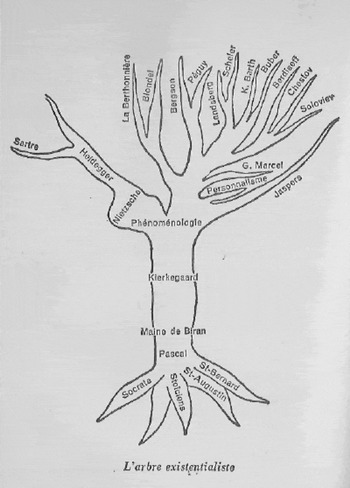
The Christian existentialists were also institutionally established in France: publishing in the series Philosophie de l'Esprit, run by Lavelle and le Senne, which counted amongst its titles most of Gabriel Marcel's oeuvre, key works by Lavelle, Jean Wahl's Etudes Kierkegaardiennes,Footnote 46 le Senne's Obstacle et valeur, and Gaston Berger's book on Husserl. After all, it was widely affirmed that the father of existentialism was the Danish Christian philosopher Søren Kierkegaard, and the Protestant Karl Jaspers was hailed alongside the “atheist” Heidegger as a major influence. When looking back to the fathers of existentialism, it was to Pascal and St Augustine that one turned, as well as to modern phenomenology. Thus when the editor of Esprit, Emmanuel Mounier, wrote an article on “existentialisms” in April 1946, he drew a family tree to show both its predominantly Christian roots, and the thick boughs of its modern religious exponents, including his own personnalism.Footnote 47 Sartre's Heideggerianism was part of a sparse and isolated branch, deformed by a Nietzschean outgrowth.
The existentialist tree. E. Mounier, Introduction aux existentialismes (Paris, 1947), 159. © Editions Denoël, 1960.

Even after the war, Christian existentialism maintained its position. In his Que sais-je book on existentialism published in 1946, the Jesuit Paul Foulquié moved through atheistic existentialism, to Christian existentialism, before concluding with the Christian “essentialist existentialism” of Lavelle.Footnote 48
Given this strong Christian tradition of existentialism it is not surprising that the most significant Christian response to Sartre was not to contest existentialism in toto, but rather to argue for the validity of a Christian approach. As Mounier put it, “historically, existentialism is more often synonymous with Christian philosophy, transcendence, and humanism, than atheism and despair.” If the two movements showed great divergence on metaphysical issues, these would be debated as “comrades in the same battle.”Footnote 49
A number of books would appear in the postwar period to show that there was space within existentialism for the Christians, or at least for religious thought. Among others were Roger Troisfontaines's Le Choix de Sartre (1946) and Existentialisme et pensée chrétienne (1948), Jean Paumen's Existentialisme spirituel (1949), and Jean Wahl's Petite Histoire de l'existentialisme (1947) and Les Philosophies de l'existence (1954), as well as the essay collection Existentialisme chrétien from 1948.
Just as Jeanne Mercier did in her 1945 critique, Christian existentialists attempted to show that the rejection of God in Sartre's system was not philosophically necessary; it was based upon Sartre's own individual choice.Footnote 50 Existentialism was supposed to confront the categories of our understanding with existence and show them to be wanting. If we could not even understand the world that was given to us, argued the Christian existentialists, how could we make dogmatic claims about the existence, or not, of God. God, in Marcel's words, was a mystery, to be approached through faith, not knowledge. Sartre's assertion of atheism ran against the very tenor of existentialism.
But the Christian existentialists were not content simply to leave a space open for a belief in God. If God could not be proved, they argued, then a powerful moral argument for his existence could be derived from our experience of the world. The Christian existentialists were particularly concerned about Sartre's “one-sided” description of existence, which led to his supposed moral nihilism. As Mercier argued,
It is true that Man carries the stigmata of the nothing, and that sin ravages his life; an overwhelming burden of misery weighs on the world, an inexpressible anxiety embraces it. But it is also true that human experience is not completely limited to this desolate landscape. M. Sartre has deliberately effaced, to the point of rendering it unrecognizable, nobility and joy . . . all the values of intelligence, of fidelity, of tenderness and of courage . . . the pure smiles of children. Optimism or pessimism? . . . One must enlarge the search to the scale of all the dimensions of existence. And it is a fact, an incontestable fact indeed, that Revelation has shone on the world, that a message of hope and of salvation has been given to us, and the hearts of men are witnesses to grace.Footnote 51
It was a point reiterated by many others. Gabriel Marcel raised the question in a lecture early in 1946 whether Sartre would have been able to write Huis Clos if the characters had been a “glorious general,” a “mother of an honest family,” and a “carmelite nun.”Footnote 52 “Hell is other people,” it seems, only when they are an infanticide, an adulterer, and a murderous postal worker. If attention was turned to the positive experiences in life, a more optimistic and moral philosophy could be built, one that would point towards God. It was this debate about and for existentialism that was most pressing in 1945, when the new atheistic existentialism had not yet succeeded in fully excluding religious belief. Sartre's 1945 talk was the most audacious attempt yet to appropriate existentialism for the atheists.
EXISTENTIALISM IS AN ATHEISM
We can now understand why the Christians should occupy such an ambivalent place in Sartre's talk. It would have been impossible to ignore Christian existentialism, but Sartre showed great hostility towards them; his presentation of Christian politics and choice of examples (the man whose failure in life led him to the priesthood, or the mad woman who thought she was talking to God) show that for him Christianity was always on the side of bad faith and resignation.Footnote 53 The acknowledgement of Christian existentialism was grudging at best; Sartre suggested that existentialism was simple to define, but
what complicates the matter is that there are two kinds of existentialists: on the one hand, the Christians, among whom I would include Karl Jaspers and Gabriel Marcel, both professed Catholics; and, on the other, the atheistic existentialists, among whom we should place Heidegger, as well as the French existentialists and myself.Footnote 54
Whereas le Senne's “French existentialists” from 1939 were all Christian, Sartre, in a declaration that was more wishful than descriptive, asserted in 1945 that they were atheists; Sartre wanted French existentialism to undergo a crisis of faith.Footnote 55
But how did Sartre hope to incite this conversion? The text gives very few philosophical reasons for atheism. True, Sartre used the example of God to explain the thesis that “essence precedes existence,” because a God who created man would already have an idea of that man before he existed. Existentialism, on the other hand, drew the philosophical consequences of the death of God. But when, later in the talk, Sartre declared that “atheistic existentialism” was more coherent, it was not with the Christian variety that he made the unfortunate comparison, but rather with an atheism that persisted in believing in stable essences.Footnote 56 Atheism in Sartre's text was always an axiom, never a conclusion.Footnote 57
While Sartre did not prove the inexistence of God, he did argue for the primacy of existential freedom that was its consequence. As he elaborated in his example of the woman hearing the voice of God, there is never any pure injunction from on high:
If I hear voices, what proof is there that they come from heaven and not from hell, or from my own subconscious, or some pathological condition? . . . I will never find any proof at all, nor any convincing sign of it. If a voice speaks to me, it is always I who must decide whether or not this is the voice of an angel; if I regard a certain course of action as good, it is I who will choose to say that it is good, rather than bad.Footnote 58
Divine commands required human consent, required us to choose them as divine. Existentialist freedom was always lurking at one degree removed.
The Christian existentialists might not have disagreed. Human freedom was just as important to them as a necessary condition of faith. If humans were not free then faith would not be meaningful: for Sartre's absurdity, the Christians substituted their own, credo quia absurdum est. God was not present in the world, obvious to all; rather, he was a “hidden God,” and false idols had to be chased away by a “purifying atheism.”Footnote 59 As Jean Beaufret suggested in a 1946 article, “isn't it legitimate . . . to see in atheism itself, however little it confesses to a malaise, a cryptogram of the act of faith?”Footnote 60 Sartre's argument that atheism and existentialism were coextensive would thus have had no purchase on the Christian existentialists; his atheistic premise could just as easily be replaced by their particular type of theology.
“Humanism,” then, was the key. It was only by using this concept that Sartre was able to argue in favour of atheistic existentialism as opposed to its theistic alternative. As we have seen, one of the dominant tropes in the Christian existentialist critique of Sartre's philosophy was that of choice. Sartre had chosen to be atheist, both in his choice of existential descriptions and in his pessimistic conclusions. By invoking humanism, Sartre suggested that it was the right choice.
At the end of his lecture, Sartre stated that for him “the only universe that exists is the human one – the universe of human subjectivity.” Man was his own legislator and it was by “seeking a goal outside of himself in the form of liberation, or of some special achievement, that man will realize himself as truly human.” The closing lines were a direct attack on the Christian theistic model:
What man needs is to rediscover himself and to comprehend that nothing can save him from himself, not even a valid proof of the existence of God. In this sense existentialism is optimistic, it is a doctrine of action, and it is only in bad faith—in confusing their own despair with ours—that Christians are able to assert that we are “without hope.”Footnote 61
Sartre denied that yearning for the divine could be humanist. The Christians submission to an almighty God was just an expression of their fear of human agency. For Sartre, this refuge was worse than the anguish they fled. True humanism, rather, accepted the dangers of human freedom, assumed the mantle of responsibility, and turned to Men, not Gods, for salvation. If the Christians turned anguish into despair, and denied their responsibility, the existentialist, Sartre suggested, saw anguish as the ground for optimism and for the adoption of a truly humanist philosophy.
When, in 1945, Sartre declared his philosophy humanist, it was not a bland and undifferentiated adoption of a fashionable term. Rather, in his intervention, Sartre played certain meanings of humanism off others. Recalling his own mockery of the humanist auto-didacte in Nausea, Sartre declared, “the word ‘humanism’ has two very different meanings.” For some, humanism was “a theory that takes man as an end and as the supreme value.” But an existentialist could “never consider man as an end, because man is constantly in the making.” Instead, existentialist humanism proclaimed that “man is always outside of himself, and it is in projecting and losing himself beyond himself that man is realized.”Footnote 62 Man was not the ultimate value, but, in the absence of the divine, value's very source: he possessed a freedom to create value that only a Communist society could let flourish.
At a time when existentialism could just as easily be religious as not, and his philosophy was decried as bourgeois and decadent, Sartre reset the table by exploiting the fissures of a local and very political postwar debate. Existentialism was both atheistic and politically Communist, because, as Sartre declared, it was a humanism.
THE END OF THE HUMANIST AGE I: HUSSERL AND THE SCIENCE OF HISTORICAL MATERIALISM
If Sartre constructed his philosophy on the sure ground of “humanism,” then, as the tectonic plates of the French political scene began to shift, that foundation would become ever more shaky. What had previously raised his profile, and provided him with the resources to make his work acceptable to Communists and wrench existentialism away from the Christians, now became a liability. The debate would no longer concern what type of humanist Sartre was, but whether humanism tout court should be supported, with Sartre now right in the firing line.
With the rising anti-Communism of the MRP and a cooling international climate, tripartisme started to fragment in early 1947, the final Communists being ejected by a Ramadier government careful to appease the Americans, with their vital Marshall Plan Aid. For the Catholics, the final split would have to wait until the failure of the troisième force government in 1951, which followed tripartisme. Without the political pressure to assert humanism, the uneasy label was often discarded and new approaches taken on board. At the limit some even started to question humanism directly. Perhaps Sartre's existentialism was a humanism, and therein lay the problem.
Communist attacks on Sartre that valorized humanism petered out by late 1947, with the PCF kicked out of the government and the burgeoning Cold War dividing East from West.Footnote 63 After this period the key political battle was not within France but rather between Capitalism and Communism on a global scale, and Andrei Zhdanov, head of the newly formed Cominform that was instituted to coordinate the Communist parties in Western Europe, made clear that intellectual life would be no exception. At first, the end of political cohabitation freed several intellectuals to make criticisms of the status quo through the humanist paradigm. The rationalist Marxist journal La Pensée began to invoke the humanist label for the first time at the end of 1947, not in an attempt to mark a belonging to the national community, but rather as a means to criticize its bourgeois form.Footnote 64 In the long term, however, the humanist tag became unconvincing to the Communists.Footnote 65 The new tactic became the assertion of objective science versus bourgeois ideology.
The new approach became institutionalized with the founding of the journal La Nouvelle critique in 1948, which fervently advocated the doctrine of the two sciences (proletariat and bourgeois) and, notoriously, Lysenko biology. In a regular section, at least in the first years of the journal, it allowed prominent intellectuals to perform auto-critique. Two of the first three were those who had been at the forefront of the humanist attack on Sartre—Roger Garaudy and Henri Lefebvre—the PCF was retreating from its previous tolerance of the humanist stance.Footnote 66 Lefebvre's auto-critique strongly attacked socialist humanism: to confer upon humanism, he asserted, “a sort of philosophical actuality—precisely in detaching it from its current conditions, from the present historical context—involves a serious danger.”Footnote 67 Garaudy was more direct in his appropriately entitled auto-critique: “Zhdanov was here.”Footnote 68
No longer having to appear humanist, Communist philosophers tried new approaches to attack Sartre. The possibility of refiguring Husserl, of rethinking his place in the contemporary philosophical world, was in large part due to the influence of a group of Communist phenomenologists that would become enormously important in the late 1950s. Unlike the “subjectivist” phenomenologists, under which label they placed Sartre, Raymond Aron, and surprisingly Georges Canguilhem, this new group would concentrate on Husserl's more “scientific writings.”Footnote 69 Althusser noted this movement in 1954, describing “the increasingly clear abandon of existentialism and the ‘return to Husserl,’ to his rationalist theses and to his theory of science.”Footnote 70 Following in the tradition of Jean Cavaillès, this movement was spearheaded by Jean-François Lyotard, Jean-Toussaint Desanti, and, most importantly, the Vietnamese philosopher writing in France, Tran Duc Thao.Footnote 71 In figuring Husserl as a philosopher of science, these phenomenologists attempted to distance him from the existentialist reading. As Lyotard put it,
We see, then, the two faces of phenomenology: a strong faith in the sciences drives its program of solidly establishing their underpinnings, and of ultimately stabilizing their whole edifice and heading off a future crisis. But to accomplish this, it must leave even science behind, and plunge into matters “innocently.” A rationalist bent leads Husserl to engage himself in the prerational [anté-rationnel]; yet an imperceptible inflection can turn this prerationality into an irrationality [anti-rationnel], and phenomenology into a stronghold of irrationalism. From Husserl to Heidegger there is certainly an inheritance, but equally treason.Footnote 72
The existentialist emphasis on freedom and escape from positive science was figured as an unjustified misreading of the Husserlian project. For the Communist phenomenologists, Husserlian phenomenology provided the ground for an understanding of the sciences, human and natural; it explained the rise of the objective—exemplified by Marxism—not a return to free subjectivity, as manifested in bourgeois (often “fascist”) ideology. Only by understanding the true meaning of phenomenology could one return to objective science, one informed by dialectical materialism. Back in the more comfortable territory of Marxist science and freed from the straitjacket of humanism, the Communists had opened up an important new direction in postwar French phenomenology, cut loose from its existentialist interpretation.Footnote 73
THE END OF THE HUMANIST AGE II: CHRISTIANS AND THE TURN TO HEIDEGGER
While the shift away from the humanist paradigm allowed the Communists to reassess their relationship with Husserl, a parallel movement by the Catholics allowed a new appreciation of Heidegger. Though scholars have paid attention to the new readings of Heidegger by the Arguments group—Blanchot, Levinas, Hyppolite, and the circle around Jean Beaufret—the antihumanist and Catholic reading of Heidegger is an important and much understudied context for the reception of the German phenomenologist into France. In the 1960 edition of the Revue internationale de philosophie dedicated to Heidegger, all the French writers were Christian, and religiously minded writers produced a significant proportion of all the Heideggerian literature in French in the 1950s and early 1960s.Footnote 74
Heidegger was not always popular amongst Catholics. In the 1940s, some proclaimed his thought the atheistic roots of Sartre's existentialism.Footnote 75 Others had a more nuanced view, for several, including Jeanne Mercier, saw promise in the German's philosophy. Mercier suggested that in Being and Time “Heidegger arrived at a philosophy of despair that he has not yet overcome,” and she anxiously awaited the expected second volume, which would go beyond this.Footnote 76 It was a common reading. The most influential book in French on Heidegger during this period was Alphonse de Waelhens's La Philosophie de Martin Heidegger (1942). De Waelhens argued that though Heidegger had intended to write an “existential” philosophy, it had ended up being merely “existentiel.” Though he had wanted to uncover the structures of Being, in the end he had merely presented an analytic of Dasein, or, in the French translation, réalité-humaine.Footnote 77 From de Waelhens's perspective, Sartre was right that existentialism was a humanism, it focused on Man and not Being, even though Heidegger had intended the opposite.
So when Beaufret invited Heidegger to respond to Sartrian existentialism in 1945, eliciting the famous Letter on Humanism, it did not have an immediate impact on the debate. Heidegger, by reasserting that his project was to understand “Being,” which an emphasis on humanism would only obscure, merely repeated his old unsubstantiated claims. Heidegger's restatement of his case did not change the fact that his existentialism had not moved beyond the human.
There was another reason why the absorption of Heidegger's ideas would be slow in France. As Anson Rabinbach has shown, Heidegger's rejection of humanism must be understood within a broader field of ideas that connected it to technological thought, nihilism, and ultimately Nazism: it was the meaning of humanism in the German context that led Heidegger to refuse it.Footnote 78 But Heidegger's understanding of the term “humanism” did not match with that of the French philosophers to whom he wrote, who explicitly opposed humanism to Nazism. Heidegger's Letter may have been addressed to Jean Beaufret, but it was a response to the situation in Germany and could not expect a smooth reception on the other side of the Rhine. For all the caveats, an ex-Nazi rejecting the term “humanist” for his philosophy in 1946 showed insensitivity to French political norms.
Only when the very political system undergirding the humanist moment broke down did Heidegger make inroads into French philosophy. Rabinbach makes much of the inexplicable Marxism in Heidegger's Letter, but the elements in the Letter that were open to a Christian interpretation played a more important role in its reception across the Rhine.Footnote 79 When domestic developments allowed an antihumanist philosophy, Heidegger's Letter found traction in the French Catholic philosophical community.
It would not take long. Though the Catholics were involved in government for much of the Fourth Republic, they had lost considerable support by the early 1950s, sliding in the polls due to the return to the political scene of the Gaullists.Footnote 80 The MRP's intellectual credentials were also weakened, as the always-fractious relationship with left-Christian journals such as Esprit and Témoignage Chrétienne became increasingly hostile. It was only then that Heidegger's Letter attracted a wider readership. The publication history of the Letter reflects this timeline. An abridged version of the Letter was published in Fontaine in November 1947. It was then published in its expanded and definitive form in 1953, a translation that was only widely available from 1957, published in the Christian existentialist Philosophie de l'esprit collection over ten years after the Letter was written. Only when political Catholicism was breaking down did some writers look for new means to attack existentialism, and Heidegger's criticism of humanism became an attractive model. In both 1947 and 1953, the Letter was translated by Catholics, Joseph Rovan and the Jesuit Roger Munier, and numerous Christians came to regard it as a turning point.Footnote 81
The development can be seen most clearly in Gabriel Marcel. In 1952 he wrote a play, the Florestan Dimension, which mocked Heidegger's philosophy mercilessly. In one scene the main character is seen questioning the possibility that an apple apples or a pear pears to the profound admiration of his audience. But when Marcel came to publish the play in book form in 1958 he regretted his mocking tone. After meeting Heidegger at Cérisy in 1955, a conference chaired by Marcel and attended by a predominantly Christian audience, Marcel suggested that he was “struck, like all those present, by a certain simplicity, even a modesty, almost a naivety which made a great impression on all of us.”Footnote 82
Heidegger's Letter was attractive to Catholics because it attempted to shed the atheistic reading that had predominated in France.Footnote 83 Heidegger had written, after all, “it is not only rash but also an error in procedure to maintain that the interpretation of the essence of man from the relation of his essence to the truth of Being is atheism.”Footnote 84 In addition, Heidegger's Letter introduced the concept of the “sacred” (das Heilige), a realm of Being that would only become apparent once metaphysical and humanistic suppositions were put aside. The analysis resonated with many Catholics, who thought Sartre's pessimistic analyses of the réalité-humaine closed off the possibility of a connection to God. For them, the Letter served to replace the second volume of Being and Time that never came, a way to challenge Sartre's humanist existentialism and move to a richer understanding of Being that would be open to religious thought.Footnote 85
From the mid-1950s, Catholic philosophers became more open in their criticisms of humanism. Abel Jeannière's 1954 article for Etudes even criticized Heidegger's early work for its humanistic resonances: “From his doctrine developed a new humanism exalting heroism before death, which must have known great success in Hitler's Germany.”Footnote 86 Rejecting “humanism, even its Christian form,” Jeannière asserted that “the true path to Salvation is that which leads to the clearing of Being.”Footnote 87 Corvez followed a similar line in a long study for the Revue Thomiste, which sketched out Heidegger's philosophy before turning to the Letter on Humanism and asking about the place of God in his ontology.Footnote 88 Corvez argued that Heidegger's ontology was not incompatible with faith, quoting Heidegger's definition of his work in the Letter on Humanism as a “waiting for God.”Footnote 89
The most influential of this new generation of Christian Heidegger scholars was Henri Birault. His 1960 article “Heidegger et la pensée de la finitude” was of crucial importance to later Heideggerians, especially Jacques Derrida, and like the others, it was the new Heidegger presented in the Letter on Humanism that captured Birault's interest.Footnote 90 To achieve an understanding of Being we had to move beyond “humanism,” “the least ‘humane’ doctrine there is, that which, by the destruction of the Sacred, must deprive our existence of its horizon and all warmth and drive us towards that nihilism, which finds its most pathetic expression in Nietzsche's cry ‘God is dead’.”Footnote 91 The most valuable tool for achieving this task, according to Birault, was Heidegger's ontological difference, the difference between Being and beings.Footnote 92 Humanism, like other ontotheologies, structured its understanding of Being by asserting the pre-eminence of one particular being, in this case, Man. The ontological difference implied, however, that no being could dominate the meaning of Being in general. Though God and Being were rigorously distinguished, according to Birault, it was only by approaching Being through an understanding of Heidegger's difference that we could be open to the Being of the divine, and thus to God.
The first major article on the “ontological difference” in French was written by le Chanoine Albert Dondeyne, professor at the University of Louvain, in 1958. Moving through the arguments against ontotheology, like the other Christian thinkers, Dondeyne was particularly careful to separate the idolatrous God of metaphysics from that of religious faith.Footnote 93 It was the very thought of the ontological difference that brought philosophy beyond the dead end of such metaphysics towards the “dimensions of the Sacred,” and it was “only this sentiment of the Sacred” which could “open the essential space (Wesensraum) for a possible encounter with God.”Footnote 94 The concern for the ontological difference became somewhat of a leitmotif for the Christian thinkers. If God was to be understood analogically with Being, then the ontological difference was the only way to avoid idolatry. It was negative theology for a new age.Footnote 95
From the mid-1950s, for many Christians in France, Heidegger became a philosopher of the sacred, a guide for thinking about the relationship between men and the divine. Heidegger's Letter on Humanism was a central document in the overcoming of Sartre's existentialism, drawn on by a generation of Catholic philosophers who rejected humanism and existentialism in the same philosophical gesture. Seeking to recover God, they rejected the pretensions of Man.
***
The turn against existentialism in the 1950s should not perhaps be overrated. Sartre continued to be influential, especially after his condemnation of the Soviet Union in 1956 and due to his principled critique of colonialism, while his political philosophy became ever more sophisticated as he revised his claims from 1945, often backtracking from the humanist label itself. But Sartre's continued appeal should not blind us to developments in academic philosophy in France. The 1950s have too often been lost in intellectual histories between the golden age of existentialism and the structuralist invasion. And yet it is the posthumanist and scientistic developments in French phenomenology during that decade that provided the necessary precondition for the reception of structuralism and post-structuralism in the 1960s.
If Naville was right to say in 1945 that everyone, including Sartre, was pretending to be humanist, then Sartre's lecture was too successful; the pretence became reality. His attempt to dictate his own reception only placed it further outside his control. Sartre had bound his philosophy to a moment that was quickly slipping into the past. While the humanist age provided the conditions for the rise of existentialism, allowing it to mould phenomenology to its subjectivist and atheistic purposes, its passing freed up Husserl and Heidegger's philosophies to be rethought in new contexts. French philosophy in the 1950s can be read as the careful sifting through the phenomenological debris of existentialism. But instead of Sartre's “death of God,” a new consensus would declare the end of Man.